
Lecture
Topics of business games
provided for in the course
1. "Minimizing the state's role vs.
an active role for the state in the economy: theory and practice of recent decades."
2. "Does capitalist
exploitation exist in the 21st century?"
3. "Reproduction and crises in the 21st century."
4. Political economy vs. economics:
their potential in the 21st century.
5. Other topics by agreement.
Recommendations for preparing for the discussions held during the business games, along with sources for preparation, are posted at
on.econ.msu.ru
Essay and paper topics
1. Interpretation of the concepts of "economic
system" and "socio-economic
system" in neoclassical theory, institutionalism, and Marxism.
2. The interpretation of the economy by neoclassical theory,
institutionalism, and classical
political economy.
3. Positivism as a method of political-economic research: potential
and limits.
4. Postmodernism as a method of political-economic research: potential and limits.
5. Dialectics as a method of political-economic research: potential
and limits.
6. The methodology of economic individualism versus the methodology based
on the study of objective relations of production: a comparative analysis.
7. A comparative analysis of the interaction between the technological and economic
strata of social life in the works of
representatives of the major schools of economic theory (a comparative analysis of 2-3 schools of the student's choosing).
8. The main technological paradigms:
their interpretation in contemporary economic literature.
9. Socio-economic mechanisms for carrying out industrialization:
a comparative analysis of theoretical
models and practices.
10. Socio-economic mechanisms
for carrying out the "knowledge revolution":
a comparative analysis of theoretical
models.
11. Trajectories and content of technological development appropriate to different types of socio-economic systems.
12. The labor theory of value: causes
and consequences of its marginalization.
13. The problem of utility in classical
political economy and neoclassical theory.
14. A comparative analysis of interpretations of property in the works of representatives
of the major schools of economic theory
(a comparative analysis of 2-3 schools of the
student's choosing).
15. The potential and problems of using the
theoretical-methodological potential of neoclassical theory (institutionalism, classical political economy) in analyzing contemporary small business (corporate ownership,
state ownership).
16. Capital: its interpretation in the works of representatives of the major schools of economic theory (a comparative analysis of 2-
3 schools of the student's choosing).
17. Wage labor: the interpretation of its nature and
its interaction with capital in the works of
representatives of the major schools of economic theory (a comparative
analysis of 2-3 schools of the student's choosing).
18. Man as an object of study in political economy and economics: a comparative analysis.
19. Historical types of socio-economic determination of values and
motivations of human behavior.
20. The relationship between the main types of socio-economic determination
of values and motivations of human behavior in the contemporary market economy.
21. A comparative analysis of countries' rankings
by the HDI and by GDP per capita, and
its political-economic interpretation.
22. Interpretations of the concept of "social capital" in contemporary economic
theory.
23. "Social capital" and a person's social
ties: economic aspects.
24. Economic efficiency and social justice: their relationship from the standpoint of the major schools
of economic theory.
25. Are there economic grounds
for the formation and reproduction of classes in contemporary society?
26. The economic foundations of the social
structure of contemporary society:
their interpretation in the works of representatives
of the major schools of economic theory
(a comparative analysis of 2-3 schools of the
student's choosing).
27. Does class struggle exist in contemporary society? If "yes," what are its socio-economic foundations? If "no," why has it become a thing of the
past?
28. The degree of social differentiation and
its effect on economic efficiency.
29. Poverty as a phenomenon and as a political-economic category. Its interpretation in the
works of representatives of the major schools
of economic theory (a comparative
analysis of 2-3 schools of the student's choosing).
30. Economic growth: the relationship between quantitative and qualitative parameters.
31. Crises: an inherent feature of a market economy?
32. The global economic crisis of 2008-
2010: who foresaw its onset, and why, and
who did not?
33. Economic crises: their historical sequence.
34. The global economic crisis that began in 2008: chance or
necessity?
35. The interrelationship between economics and politics:
its interpretation in the works of representatives
of the major schools of economic theory
(a comparative analysis of 2-3 schools of the
student's choosing).
36. Economic policy: the extent and limits of its influence on objective
economic processes.
37. The main economic actors, their
interests, and how these interests are reflected
in economic policy.
38. The interpretation of the economic nature of the state in the works of representatives
of the major schools of economic theory
(a comparative analysis of 2-3 schools of the
student's choosing).
39. To what extent are bureaucratism and corruption inherent properties of state activity in the economy?
40. The potential of the main tenets of political economy for solving problems
of corporate governance, marketing, economic policy, and so on.
Topics for group projects
• Which economic, socio-economic, and economic-political processes can (not) be adequately reflected by
political economy (economics)?
• The interpretation of the causes and nature of the global economic crisis in the works
of representatives of the major schools of economic theory.
• The main arguments of proponents of
minimizing the state's role (or of an
active role for the state) in the economy: theory and practice of recent
decades.
Requirements for essays and papers
An essay is a short (2,000-6,000 characters) text containing the author's reflections
on questions discussed in a lecture,
a seminar, a business game, and so on.
An essay need not have references
to sources or a detailed structure.
A paper is an extensive (4,000-10,000 characters)
analysis of one or more sources.
A paper must contain:
• A clear statement of the problem;
• A structure;
• Quotations and references to the source's (or sources') main points;
• A reproduction of the author's (or authors') main arguments;
• A comparative analysis of the author's (or authors') main points;
• The author's own assessment of the author's (or authors') main points;
• A bibliography.
It is possible (by agreement with the instructor) to prepare an extensive (10,000-20,000
character) original text (project) containing an original analysis of a problem with references to a fairly wide range (5-
10) of the most significant sources.
A project may receive a higher grade than a paper.
It is absolutely unacceptable to borrow
fragments (one sentence or more) from the Internet without precisely indicating the boundaries
of the material used (quotation marks) and references
to the source.
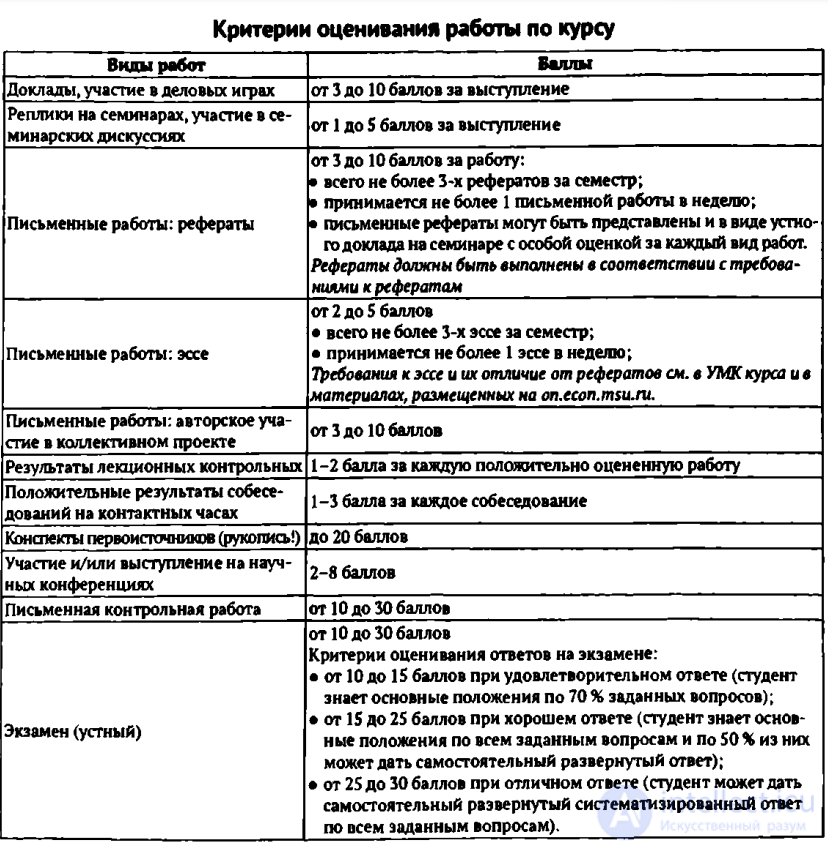
Criteria for evaluating coursework

Comments