
Lecture
Это окончание невероятной информации про .
...
social
factors studied by political economy) that influence
the actual market situation. Among these factors are incomplete information, the consumer's bounded rationality, the presence of transaction costs, and many others.
The relationship between the arrival of goods on the market and the market's
ability to sell them is expressed by the theory of supply and demand.
Demand is the quantity of a product that consumers, over a given period of time, wish to and are able to buy on the
market at a given price.
Demand is a solvent need that manifests itself in a certain quantity of goods that consumers want and are able to buy.
A distinction is made between individual and market demand. Individual demand is
the demand of a specific consumer for a given good. In other words, it is the quantity of this good that a consumer can and wants to buy. In the preceding discussion, we were speaking of individual demand, i.e., for the sake of simplifying the
situation matters were presented as though there were only
one single consumer operating in the market. But the market is never limited to a single
transaction; it involves
many of them. Therefore the question arises
of aggregate (market) demand. If
we are dealing with an observable number of buyers, the problem is solved fairly simply, and market demand is determined by summing
individual demand
characteristics.
The magnitude (volume) of market
demand depends, above all, on the price
of the good. This dependence is expressed by the
law of demand: other things being
equal, the higher the price of a good, the lower the market demand, and vice versa. Graphically, the relationship between price (P – from the English "price") and demand (Q – from the English "quantity")
is reflected by the demand curve (D – from the English "demand").
The inverse relationship between the quantity of demand for a good and its price is explained
as follows. First, when the price falls, the good becomes accessible to a larger number of consumers who will be able to buy it. Second,
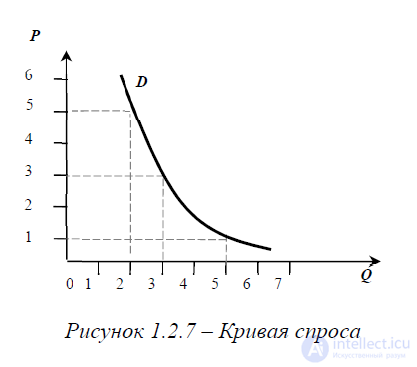
Figure 1.2.7 – The Demand Curve
at a lower price for the good, a consumer can buy a greater quantity
of that good without reducing the number of purchases of other goods.
The law of demand does not hold absolutely. There are possible cases where a change in price does not cause a corresponding change in demand:
1. An increase in the prices of necessities, as a rule, does not cause a reduction in demand for them, and in the case of Giffen goods demand will actually rise.
2. An increase in the prices of goods that determine a consumer's social status is not accompanied by a decrease in demand for them. In the case of luxury goods,
an increase in prices will actually cause an increase in demand as well.
3. Inflationary (deflationary) expectations. Under conditions of inflation, demand
for many goods does not decline. In anticipation of deflation (for example, seasonal price reductions for vegetables and fruit), some buyers will postpone their demand for
these goods.
In addition to price, the magnitude of demand is also influenced by a number of non-price determinants of demand, i.e., factors whose change affects the magnitude of market
demand while the price of the good under analysis remains unchanged. Such factors include:
1. Buyers' incomes. A change in income affects consumers' purchasing power and, consequently, the magnitude of demand.
2. A change in the price of one of a pair of substitute or complementary goods. An increase in the price of a good leads to a decrease in demand for it and simultaneously
to an increase in demand for the substitute good (for example, articles made
of natural fur and articles made of artificial fur). An increase in the price of one of a pair of complementary goods leads to a decrease in demand for both this good and
the other.
3. The total number of buyers, or the size of the market. An increase in the number of buyers in the
market leads to an increase in market demand, and vice versa.
4. Changes in tastes, habits, and fashion.
5. Consumer expectations (for example, the expectation that a large developer will enter the housing market will lead to some reduction in
market demand for apartments today).
Graphically, the effect of price on the quantity of demand is depicted as movement along the
demand curve. The effect of non-price determinants of demand is reflected as a shift
of the demand curve to the right when demand increases, and to the left when demand decreases.
Supply is understood to be the quantity of a product that a producer wishes to and is able to produce and bring to market at a given
price level for that product over a given period of time. Not only demand
but also supply depends on the price level. However, the relationship in
this case is not inverse but direct. A producer strives to produce
more of the product whose price is rising. An increase in the price of a good stimulates
supply.
Indeed, a higher price, given the costs of producing a unit of
output, allows producers to earn a larger profit. Therefore,
producers, seeking to increase profit, expand the volume of production
and supply of this good.
This relationship is reflected by the law
of supply: other things being
equal, the higher the price of a good, the
higher the supply, and vice versa. Graphically it is reflected by the supply curve (S – from the English "supply"). The
supply curve shows the quantity
of a given good that its producers would like to bring to market
at one price or another.
Besides price, the volume of supply is influenced by the following non-price determinants of supply:
1. Changes in the cost of producing a unit of output, which directly
affect the amount of profit obtained from selling a unit of output. If, for some reason (a change in tax legislation,
the introduction of benefits for a certain type of economic activity, the adoption of
new technologies, etc.), while the given price level for the product under study remains unchanged, the cost of producing it falls, then the producer will earn a greater profit from the sale of each unit of output. Therefore he
will strive to produce and sell more of it, and vice versa.
2. A change in the price of other goods, leading to a flow of production resources (a repurposing of production) from less profitable to more
profitable production. This concerns all types of economic resources. As a result of firms leaving a less profitable sphere of production for other,
more profitable ones, supply in the given sphere of activity will decrease, and supply in other, more profitable, branches of production will increase.
3. The total number of producers of the given good. The more of them there are, the greater the volume of the good, other things being equal, that will be offered for sale.
4. Producers' expectations.
The non-price determinants listed above cause a shift of the supply curve
to the right when supply increases, or to the left when supply decreases. When only the price changes, there is movement along the supply curve.
Market equilibrium is a situation in the market in which, at a given price
level, equality between the quantities of demand and supply is achieved, i.e., the quantity of goods that consumers want and are able to buy coincides with the quantity that producers want and are able to sell. Graphically, this equilibrium corresponds to the point of intersection of the demand and supply curves (point E).
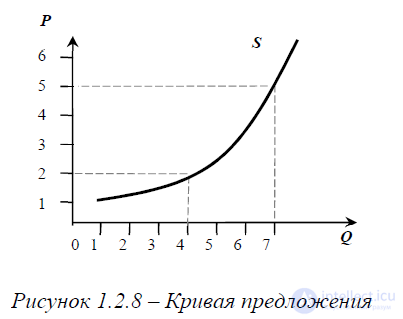
Figure 1.2.8 – The Supply Curve
Market equilibrium in any
competitive market can occur
only at some fixed moment in time. If, for some reason,
the market price (P1) is established above
the equilibrium price (Pe), then a situation of a commodity surplus, or excess supply, will arise in the market. At such a price, producers, striving to increase
profit, will bring to market a quantity of the good equal to Q2. Buyers, however, will be able to purchase
less of this good at the higher price
— Q1. In this case the excess of supply will amount to Q2 – Q1. The excess supply, owing to competition among producers, will exert downward
pressure on the price level, and it will begin to fall. As a result, the quantity
demanded will rise, while the quantity supplied will decrease, until they
become equal.
If the market price is set below the equilibrium level (P2), then a commodity
shortage will arise in the market, since demand for the good will increase while its supply will decrease. The decrease in supply is explained by the fact that at the
lower price, the producers able to offer their goods will primarily be those
whose production costs are lower. This allows them, at the prevailing market price, to cover their production costs and possibly even earn a small profit. In this situation, excess demand will exert upward pressure on the price. As the price rises, the quantity demanded will decrease and the quantity supplied will increase, which will
ultimately lead to the establishment in the market of an equilibrium price that balances supply and demand.
At the equilibrium price, the quantity of output that consumers intend and are able to buy corresponds to the quantity of output that producers
intend and are able to offer for sale. At such a price, market subjects
will have no motives to change the magnitude of demand and supply, i.e., to change their economic behavior, and consequently there will be no
tendencies toward a rise or fall in price. In practice, however, such a situation
is practically unattainable, since both demand and supply are affected by a large number of various factors. There is always a time lag in the response of
consumers and producers to changes in the market situation, along with the presence of transaction costs of exchange, a lack of information, etc.
1.2.16. The Organization (Enterprise) as an Economic Entity.
Economic management is the totality of actions and deeds of an individual or
group associated with ensuring the functioning of an enterprise or division as an independent economic unit. Economic management includes both elements of professional and labor activity of various
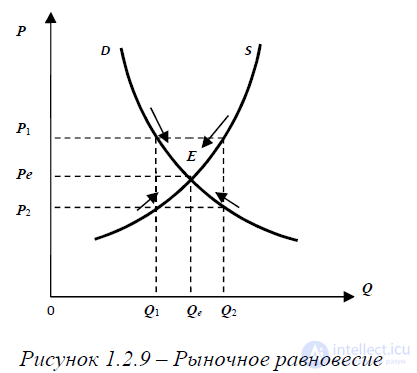
Figure 1.2.9 – Market Equilibrium
groups of workers and elements of management (participation in shareholders' meetings,
the work of the board of directors, the management of a joint-stock company, etc.).
An economic entity is a type of economic subject. The attributive characteristics
of an economic entity are:
– freedom to choose the forms and methods of carrying out its economic activity;
– independence in choosing the means of achieving its economic
goals;
– full economic responsibility for the results of its economic activity.
An economic entity is a participant in economic activity that possesses economic freedom, makes independent economic decisions, and
bears economic responsibility for the results of its activity.
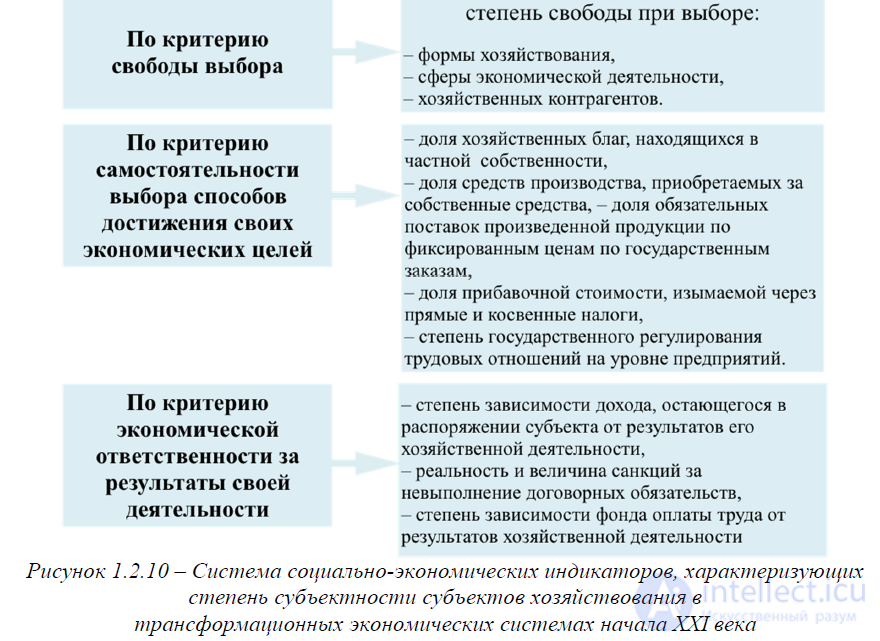
Figure 1.2.10 – A System of Socio-Economic Indicators Characterizing
the Degree of Subjectness of Economic Entities in
Transformational Economic Systems at the Start of the 21st Century
A firm is usually understood to be some organization that carries out
the production of goods and services and (or) their sale. From this point of view, a firm
is the general name for any economic production unit. And since, by its structure, a firm may consist of a single enterprise
or may include several enterprises, it is not always correct to use the terms "firm" and "enterprise" as synonyms. This is legitimate only in
the case where a firm is understood to be an independent production
unit consisting of a single enterprise. When, however, a firm is understood to be
a large corporation representing a complex of a number of enterprises whose independence, although limited, is retained, then identifying
the concepts of "firm" and "enterprise" is inadmissible. With this caveat in mind, let us consider the concept of an enterprise (firm).
An enterprise (firm) is an economic unit that owns, holds in economic possession, or manages operationally a separate body of property and possesses rights that allow it to perform
specific functions for the production and (or) sale of goods and services under its own
property liability for the purpose of earning a profit or providing socially significant services. Depending on the purpose of their operation, enterprises
(firms) are divided into commercial ones, which seek to maximize profit, and non-commercial ones, which operate to provide various kinds of socially significant services accessible to broad segments of the population regardless of their income
(education, healthcare, culture, urban passenger transport,
etc.).
The enterprise (firm), as a form of organizing production and economic activity, is the basic production-and-economic unit of the economy, since it is precisely the enterprise that engages in creating economic
goods and (or) selling them. As a production-and-economic unit, an enterprise (firm) is characterized by technical-and-production and organizational
unity.
A market economy has a great many different enterprises (firms) in operation, which requires their classification according to certain
criteria. These may be the type of activity, industry, or product produced; organizational-legal form; size; form of ownership, etc.
A set of enterprises and organizations united by some
characteristic (as a rule, extracting, producing, or supplying a homogeneous or specific type of goods, financial product, or other output, using similar
technologies) is called a branch, or sector, of the economy.
The organizational-legal form fixes the way in which property is held and used by an economic entity, and also
determines its legal status, liability, and objectives of activity.
Depending on their organizational structure, a distinction is made between legal entities and entities created without forming a legal entity (individual entrepreneurs, representative offices of foreign organizations,
etc.).
Legal entities, depending on the purpose of their activity, are divided into commercial organizations and non-commercial organizations (consumer cooperatives, public and religious organizations (associations), foundations,
institutions, associations, unions, etc.).
We, however, are more interested in commercial organizations (enterprises). Commercial organizations are distinguished by the fact that their main
goal of activity is to earn profit, which they distribute among their members. Non-commercial organizations also have
the right to engage in entrepreneurial activity, if it corresponds to the purposes set out in their charter, but this activity must not be their main one — it merely
contributes to the achievement of their main (for example, social) goal.
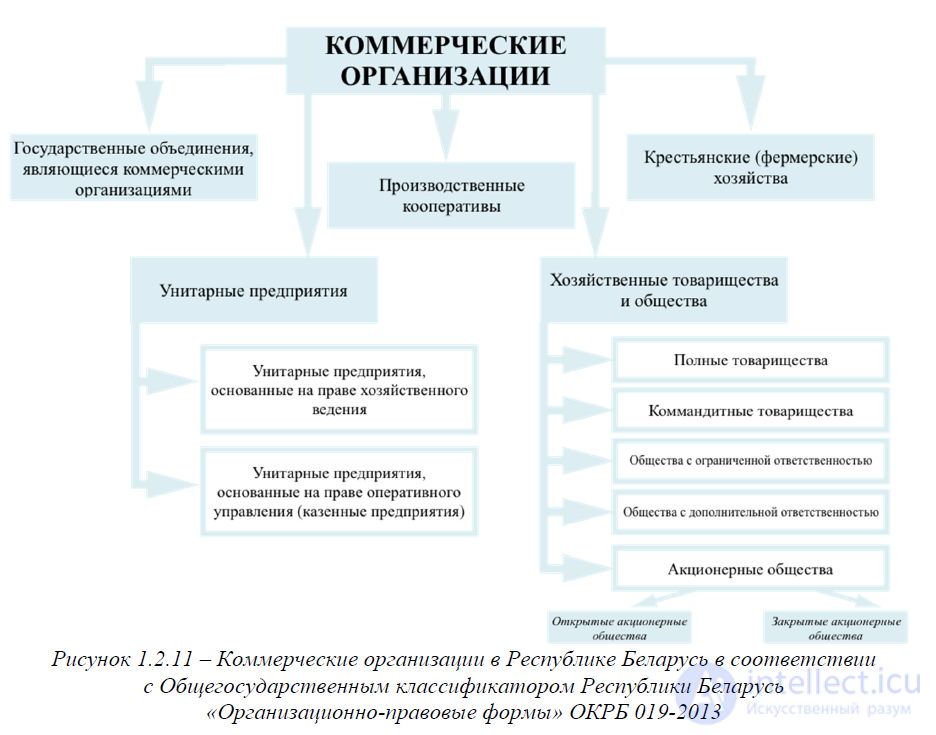
Figure 1.2.11 – Commercial Organizations in the Republic of Belarus in Accordance
with the National Classifier of the Republic of Belarus
"Organizational-Legal Forms" OKRB 019-2013
Entrepreneurs unite in the form of business
partnerships and companies. Business partnerships and companies are commercial organizations whose charter capital is divided into shares (stock) among founders (participants). A business partnership is a form of organizing
a business in which two or more separate persons agree to jointly own
an enterprise and manage it. Usually they pool their financial resources and their skill in running the business, share risks as well as profits or losses,
and bear property liability for the firm's obligations.
A business company may be established by a single person or may
consist of just one participant. A limited liability company (LLC) is an organizational-legal form of enterprise whose charter capital
is divided into shares of the sizes specified in the charter. Members of an LLC are not
liable for its obligations and bear the risk of losses associated with the company's activity only within the value of the contributions they have made. An additional-
liability company (ALC) is an organizational-legal form
of enterprise whose charter capital is divided into shares of the sizes specified in the
charter. Members of such a company jointly bear subsidiary liability for its obligations with their own property, within limits determined by
the company's charter, but not less than the amount established by law.
A special place in modern economic relations is occupied by joint-stock companies (JSCs) — enterprises whose charter capital is divided into
a certain number of shares of equal nominal value.
Members of a JSC (shareholders) are not liable for its obligations and bear the risk of
losses associated with the company's activity only within the value of the shares belonging to them. Shareholders' risk is also associated with the possible depreciation
of shares.
A share is an equity security, a stake of ownership in a company, securing for
its holder (shareholder) the right to receive a portion of the JSC's profit in the form of dividends, to participate in
the management of the JSC, and to a portion of the property remaining after its liquidation.
Joint-stock companies may be open (OJSC) or closed
(CJSC). Shares of an OJSC may be placed and traded among an unlimited
circle of persons. Shares of a CJSC are placed and traded only among the shareholders
of that company and (or) a limited circle of persons determined in accordance with the legislation on
joint-stock companies.
A production cooperative is a commercial organization whose members are obliged to make a property share contribution, to take personal
part in its labor activity, and to bear subsidiary liability for
the obligations of the production cooperative.
A unitary enterprise is a commercial organization that is not vested
with ownership rights to the property assigned to it by its owner. The property of a unitary enterprise is indivisible and cannot be distributed among contributions (shares, units), including among the enterprise's employees.
A state association (concern, production, scientific-and-production, or other association) is an association of legal entities and individual entrepreneurs, created by the state. State
associations are, as a rule, non-commercial organizations, except
in cases where, in accordance with the law, decisions are made
to recognize them as commercial organizations.
A peasant (farm) enterprise is a commercial organization
created by a single citizen or by members of a single family who have made property contributions, for the purpose of carrying out entrepreneurial activity in
the production of agricultural output, as well as its processing, storage, transportation, and sale, based on their personal labor participation and use of a plot of land.
In the process of production, the capitalist incurs costs, i.e., expends
capital on the purchase of means of production and on paying for labor power. In the process of production (combining the means of production with labor power), a new use value is created, which, through the market mechanism of purchase
and sale, is transformed into revenue that covers the costs incurred. The proceeds received by the capitalist reimburse the value of the means of production (through the mechanism of depreciation) and the value of the labor power consumed (through wages, which compensate the necessary product). The remainder is appropriated by the capitalist in the form of his profit.
The source of surplus value is not capital as a whole (as it may seem at first glance), but nothing other than the living labor of hired workers. However, from the capitalist's point of view, the entire surplus value is profit
– that is, the result of using all of the capital. And indeed this is so, if one abstracts from the analysis of inter-subject (inter-class) relations, inter-class contradictions, and turns a blind eye to the capitalist mechanisms, formed over the centuries, by which the results of the labor of some (hired workers) are appropriated by others (owners of capital or, in the modern economy,
top management).
To renew the circuit of capital, part of the revenue received
must again be used to replace the means of production and to hire
labor power. The costs of production do not include all of the advanced capital, but only that portion of it which was spent during a given
period of time on wages and means of production consumed
in the production process during that period. The essence of production costs
is that they represent the minimum boundary of the price of goods
sold. A lower price does not cover the capital owner's expenses and, accordingly, undermines the incentives to produce. In general, the capitalist advancing capital for the production of goods is interested not in the costs as such,
but in the degree of growth of capital. The rate of profit on capital answers this question.
The rate of profit is the ratio of surplus value to the entire advanced
capital, expressed as a percentage.
In its pure (ideal) form, the market presupposes non-interference by the state in the economy. However, the market, as we have already established, is merely a tool that allows the costs of interaction between people to be reduced.
Therefore, it should not be absolutized, since certain reasonable and mandatory
conditions must be observed for the market system to function successfully. For example, private property serves as the economic foundation for the emergence and development of market relations. However, someone
must establish the rules governing property relations and guarantee that these rules are observed in society. The state takes on this function.
In addition, the state is also necessary to limit monopolistic tendencies in the economy, to develop a mechanism that stimulates people's labor activity, and so on.
In a market economy, difficulties constantly arise which the market
cannot overcome on its own. Thus, the problems of cyclical fluctuations in
the economy (sharp declines in production, inflation, unemployment) cannot be
eliminated by the mechanism of market self-regulation. Sometimes this mechanism is not
only incapable of returning the economy to the necessary market equilibrium,
but is even liable to subject it to deeper shocks. Without the regulatory role of
the state, this cannot be overcome.
But even under conditions of a stable economy, there are spheres of activity
that are the exclusive prerogative of the state. Many spheres of socio-economic life do not tolerate the market mechanism of relations.
These typically include the political sphere, national defense, the extractive
industry, energy, communications, education, the protection of public order, the health security of the population, and so on. This is mainly
about the production of public goods. In these areas, the boundaries of state intervention should be determined by economic capabilities and social needs.
Situations in which the market cannot independently resolve emerging
contradictions and ensure the effective use of limited resources are called market imperfections (failures).
The main forms in which market imperfection (failure) manifests itself:
– monopolization of the economy;
– externalities;
– the need to produce public goods;
– instability of the economy;
– the need to ensure social protection of the population, and others.
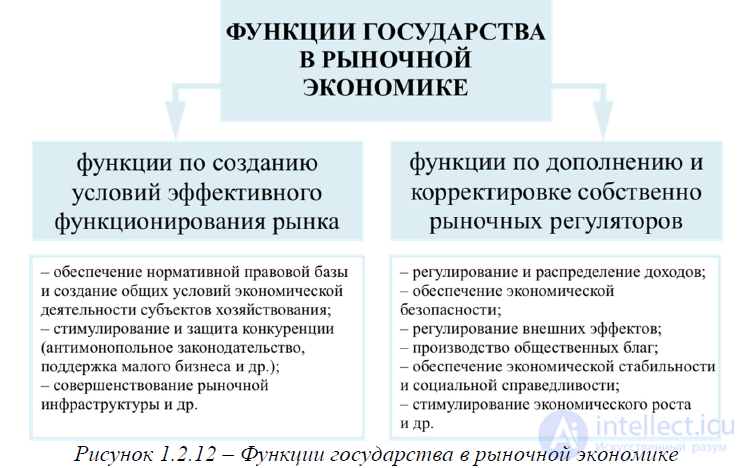
Figure 1.2.12 – Functions of the state in a market economy
The exclusive spheres of state activity also include the protection of
national economic interests in the international market, which includes measures to control the migration of capital and labor, ensure the country's balance of payments, maintain the exchange rate, and so on. One should not forget
about such an important regulatory function of the state as the proper organization of monetary circulation. Nor is the market mechanism capable of developing fundamental scientific research, owing to the risk, uncertainty, and unpredict-
ability of the timeframes and the costs required. No private owner under a market economy will invest in conducting fundamental research that does not yield a commercial effect in the short and medium
term. Nevertheless, without such research it is impossible to forecast structural
modernization or stimulate scientific and technological progress. The main burden of
expenditure in this sphere is borne by the state.
A specific function of the state is the collection of taxes from legal entities and individuals and the formation of the revenue side of the state budget. Using
the funds accumulated in this way, education, medical care, and culture are developed, defense capability is strengthened, and transfer payments are made. The latter include grants and subsidies given by the state to firms and households in order to encourage or
restrict the production of certain goods and services (the latter applies largely
to the agrarian sector of the economy). Transfers also include
state monetary payments for social needs – pensions, benefits,
scholarships, and so on.
Economic growth is the process of increasing and qualitatively improving the structure of national production, thanks to which a country is able
to produce more goods and services and improve their quality. Economic growth is generally measured in terms of the growth rate of gross domestic product (GDP).
Economic growth can be achieved by various methods: in one
case – through attracting an additional quantity of resources, and in another –
through more effective use of resources already at one's disposal. This refers to extensive and intensive types of economic gro-
wth. Extensive economic growth presupposes growth through quantitative factors. For example, an economy increases the extraction and use of
natural resources, draws in a greater quantity of labor resources, and so on.
Intensive economic growth is achieved through qualitative factors –
for example, through improving technologies, raising workers' skill levels, and so on. In practice, a combination of the two types of economic growth is most often observed.
Economic development is the expanded reproduction of the eco-
nomy, based on positive qualitative and structural changes
in the economy and the social sphere. Economic development entails improvement in such spheres of public life as education, science, culture, as well as
an increase in the level and quality of life of the population and in human capital.
The process of reproduction of social capital under the capitalist mode of production is cyclical in nature. Macroeconomic instability manifests itself in a reduction in the volume of production and a decline in its efficiency, in price fluctuations, in a decrease in labor incomes and savi-
ngs, and in a slowdown of scientific and technological progress. It has been observed that this
state of the economy occurs periodically, that is, in its development the economy, as it were, "pulses": periods of upswing are replaced by downturns, and then
an upswing begins again. Such recurring macroeconomic changes, expressed in the movement from one state of the economy to another over
a certain period of time, have come to be called cyclicity. Graphically, macroeconomic dynamics can be depicted as a wavy line, where each
wave corresponds to a complete cycle of economic development.
Cyclicity is the periodic recurrence of disturbances of equilibrium in the economic system, leading to a contraction of economic activity, a downturn, a crisis. The word "cycle" itself implies the return of the economic system to one and the same state.
The economic cycle consists of the phases of crisis, depression, recovery, and upswing.
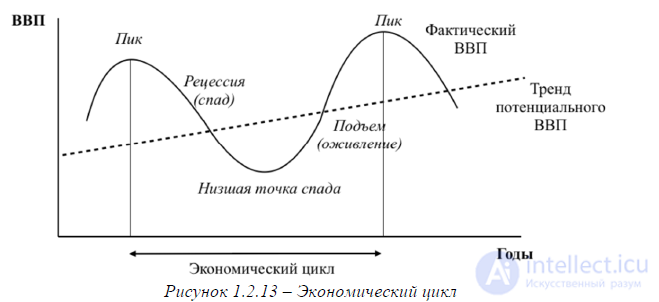
Figure 1.2.13 – The economic cycle
The basis of the cyclicity of the economy is the periodic renewal of fixed capital. The emergence and introduction of innovations under conditions of competition
forces competing producers to adopt these or other innovations, which gradually causes a mass renewal of fixed capital. Subsequently, the renewal of fixed capital spreads to other bran-
ches as well, which overall causes an increase in business activity in the economy. After
the mass renewal of the means of production is completed, there begins
a reduction in demand for the means of production and a decline in the general economic
climate. The economy enters the most destructive phase of the economic cycle – the phase of recession or downturn. The reduction in producers' demand for the means of produ-
ction is not felt all at once. The first to feel this reduction in demand
are trading organizations, which are no longer able to resell purchased goods in their previous
volumes, which causes a sales crisis. The sales
crisis is, as a rule, accompanied by a rise in the interest rate, since trading organizations that are unable to sell their goods increase their demand for
loan capital. A rise in the interest rate makes credit unavailable to the bulk of entrepreneurs. In the next turnover, industrial enterprises face the problem of selling
the goods they have produced at the previous prices and in the previous volumes. As a result,
a crisis of overproduction sets in. Some producers go bankrupt, being
unable to repay the loans they received. As a result, some banks that did not receive repayment of their credit funds also go bankrupt. All this leads to a banking crisis and the failure of banks. The banking crisis in turn entails a crisis in the securities markets. A crisis also occurs in the labor market, since the crisis of overproduction and the banking crisis entail mass
layoffs of workers. As a result, the average wage level also falls,
since supply in the labor market increases while demand decreases.
It is fairly easy to cut labor costs, and so producers
cut them first of all. All this leads both to a decline in the population's purchasing power and consumption of final goods, and to a decline in savings and investment. As a result, the economy moves into the phase of depression.
The depression phase is characterized by a slow contraction of production,
a high level of unemployment, low business activity, underutilization of resources, and the wearing out of obsolete fixed capital. Depression
can last for quite a long period of time.
A state of the economy characterized by stagnation of production and trade over a prolonged period of time is called stagnation.
The dialectic of economic development lies in the fact that the factors
of crisis become, in the depression phase, factors for emerging from it. Low prices
help to sell off the accumulated inventory of goods, expanding the volume
of demand. Step by step, the economy recovers. The enterprises remaining in the
market gradually begin to restore their volumes of production. The renewal of fixed capital begins. The expansion of production raises the level of employment, which causes an increase in consumer demand.
The recovery phase of the economy begins.
The expansion of production leads not only to an increase in the population's income and,
as a result, to an increase in the volume of demand for consumer goods, but also to growth in the volume of demand for the means of production. This causes an increase in business activi-
ty in other sectors of the economy as well. Gradually the economy moves from recovery to upswing, the highest point of which is the peak (boom, prosperity).
The criterion for the economy's transition from recovery to upswing is the attainment
of the pre-crisis level of production. The upswing stage is characterized by a high
level of employment, the expansion of production capacities, their moderniza-
tion, and the establishment of new enterprises. After some time the economy beco-
mes "overheated," and the entire cycle repeats itself from the beginning.
Both external and internal factors
(inherent in the economic system itself) can influence the cyclicity of the economy. External factors include natural disasters, wars, revolutions and political upheavals,
and population growth rates. Internal factors include the periodic renewal of fixed capital, fluctuations in consumer and investment demand, disturbances in the sphere of monetary circulation, malfunctions in the functioning of the market mechanism, changes in the country's position in the world market, a slowdown in the pace of
scientific and technological progress, and others.
Часть 1 Basic Concepts of Political Economy, Economic Laws and Categories
Часть 2 - Basic Concepts of Political Economy, Economic Laws and Categories

Comments