
Lecture
Wages In terms of its value side, capital differs from ordinary money in that the magnitude of its value does not remain constant but tends to increase continually. The owner of capital seeks to extract more from circulation than he put into it. But how is this possible? If we start from the premise of equivalent exchange by value, then only an equivalent of the value that was exchanged can be extracted from circulation. When a commodity is exchanged for money, the result is a sum of money equal to the value of the commodity. Even if the equivalence of exchange is violated, this does not bring us any closer to a solution. If, as a result of a non-equivalent exchange, someone extracts more from the exchange than he offered for it, his gain consists entirely of the other party's loss. Thus, we are not dealing with an increase in wealth, but merely with its redistribution among different people. Nevertheless, in practice we constantly encounter the fact that the formula of simple monetary circulation
M—C—M
is replaced by the formula of capitalist circulation
M—C—M' (where M' = M + ΔM, i.e., money plus increment).
Nothing changes if we turn to the sphere of production either. Yes, labor creates new value. But in exchange for one's labor objectified in commodities, one can receive only the equivalent of that labor — and nothing more. How, then, does the owner of money manage constantly to sell more dearly than he himself paid when purchasing goods, thereby extracting more money from circulation than he put into it? Such a phenomenon becomes possible if we assume that the owner of money is dealing with a specific commodity, the peculiarities of whose participation in exchange and in production allow the capitalist to enter the second act of exchange holding a greater value than was spent on the purchase in the first act.
Such a commodity was known long before the capitalist system took shape. It is labor power, or the human capacity for labor, which has acquired an independent commodity existence, alienated (in the economic, not the physical, sense) from the human being who bears it. The ability of a person to produce a product in a greater quantity than is needed to ensure his own existence has been known for a very long time and was successfully used in pre-capitalist exploitative societies. The difference between these societies and capitalism is that whereas in them the surplus product was forcibly extracted on the basis of extra-economic coercion, exploitation under capitalism is carried out on the basis of the laws of commodity production and circulation, on the basis of the exchange of equivalents. So how does the exchange of equivalents lead us to a product that contains more value than existed at the starting point? The owner of money, in acquiring labor power, pays for it exactly what it is worth — that is, exactly as much as is needed, under normal conditions, for its reproduction (for purchasing and consuming the goods necessary to restore labor power, and for replacing the worker as he ages, i.e., for supporting the life of his family). And then the aforementioned capacity of a person to produce, over a working day, more products of labor than are needed to sustain his own life and the life of his family, comes into play.
And if the hired worker possesses labor power which, in the process of being expended, allows him to work beyond the time needed for the reproduction of the worker himself — that is, beyond necessary labor time — then the problem is solved. For the worker, having worked the necessary labor time and created the necessary product (necessary to compensate for his labor power), can now continue to work during surplus labor time, during which he creates surplus product for the owner of the money (the capitalist), thereby also creating surplus value. Necessary labor time is the time needed to create a product that ensures the reproduction of the worker himself, that is, that compensates for the expenditure of his labor power and ensures the physical replacement of the worker
once his working capacity is exhausted with age
The necessary product is the product that ensures the reproduction of the worker himself, that is, that compensates for the expenditure of his labor power and ensures the physical replacement of the worker once he reaches the age at which he is no longer able to work. Surplus labor time is labor time in excess of necessary labor time. During surplus labor time, surplus product is created. Surplus product is a product produced in excess of the necessary product.
Surplus value is that part of the value of goods which the hired worker creates, under compulsion to labor, in excess of necessary labor time (that is, the value of the surplus product he creates during surplus labor time). And this occurs while fully observing the equivalence of exchange, with labor power exchanged for money exactly at its value.
Defenders of exploitation often like to point out to supporters of the labor theory of value and Marx's theory of surplus value that claims of exploitation contradict the law of conservation of energy. According to their reasoning, if we measure value by expenditures of human labor energy, then the assertion that a person can create more value than is needed to compensate for the energy he has expended (that is, to restore his capacity for labor) is absurd from the standpoint of the conservation law. Representatives of the natural and social sciences who are taken in by the appearance of scientific argumentation quite often fall for this line of reasoning.
Meanwhile, such reasoning rests on a misunderstanding (or a deliberate distortion) of precisely the physical side of the labor process. The fact is that both the worker himself, in order to restore the labor energy he has expended, and his exploiter (for his own purposes) consume not the energy expended in the process of labor, nor even the value of the product created, as measured by that energy, but rather the product obtained with its help. And although only part of the energy the worker has expended (expended only during necessary labor time) is spent on the product consumed by the worker (the necessary product), that amount may well be entirely sufficient to fully compensate for the expenditure of his labor. But is this really possible? Isn't this a direct violation of the law of conservation of energy? No, there is no violation here at all. For man does not create a product out of nothing, or solely out of his own energy (this applies even to such specific products as knowledge, although they appear to be a pure creation of human effort). The original matter of nature, which man transforms through labor, already contains energy within it.
Through his labor, man merely transforms the physical form of what is given by nature, making this matter suitable for human consumption. Let us say, for example, that a person compensates for the energy he expends in milking a cow not through that very expended energy, and not even through the embodiment of that energy in the milk obtained, but through the milk obtained, which contains more energy than the person spent on milking, since the energy in the milk is its natural property, present even before the milking process. Man does not create the milk with his energy — he draws it out, sterilizes it, packages it, transports it. Therefore, in milk ready for consumption there is not only the energy contributed by human effort, but also the energy stored up by nature. So everything is in order with respect to the law of conservation.
Capital: money capable of yielding surplus value is capital. (This is the first, most abstract and superficial definition.)
Of course, in order to ensure the exploitation of labor, the capitalist — the owner of money — needs to acquire not only hired labor power but also the means of production with which the hired worker will work. Thus the formula of simple monetary circulation, M—C—M,
turning into the formula of capitalist circulation, or the general formula of capital, M—C—M' (general because it determines the movement of all forms of capital), unfolds as follows: The general formula of capital:

where LP is labor power, MP is means of production, and P is the process of production.
The means of production and labor power, upon entering the process of capitalist production, themselves acquire a capitalist form. The value of the means of production appears as constant capital (c), since their value does not change in the process of production (although it is transferred wholly or partially to the finished product). The value of labor power appears as variable capital (v), insofar as it possesses the ability to yield a value greater than its own, to yield surplus value (m). Thus, the value of a capitalistically produced commodity breaks down into a magnitude equal to the value needed to replace the consumed and worn-out means of production, a magnitude equal to the value of the labor power expended, and the magnitude of surplus value:
C' = c + v + m.
The degree of capacity of hired labor power, functioning as variable capital, to yield surplus value to the capitalist is called the rate of surplus value (m'), or the rate of exploitation, and is measured by the ratio of the magnitude of surplus value to the magnitude of variable capital:
Rate of surplus value:
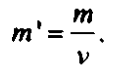
The capitalist cannot set the limits of exploitation in an entirely arbitrary manner. If he extends the working day in pursuit of an increase in the mass of surplus value, this leads to an increase in the expenditure of labor power, and therefore requires more resources for its restoration. However, this additional labor time brings the capitalist not only additional expenditures on labor power, but also additional surplus value. The question of what the limits of the working day should be within the framework of capitalist relations has no entirely rigid and strictly defined economic solution within the laws of commodity exchange.
The length of the working day has a lower limit — the working day in capitalist production cannot be shorter than the time needed to produce the necessary product that compensates for the value of the labor power expended. Otherwise the capitalist would not hire workers or organize production at all — for he engages in it not for the sake of production as such, but for the sake of increasing his advanced capital through the production of surplus value. The upper limit of the length of the working day is determined by the worker's physical capacity to restore the strength expended in the course of work. Within these limits, the length of the working day is determined by agreement between hired workers and the capitalist. The outcome of this agreement depends on the balance of power between the parties, whose interests are opposed: workers are interested in shortening the working day, while capitalists are interested in a longer working day. "Where two equal rights clash, force decides," as Karl Marx remarked on this subject.¹ ¹ Marx K. Capital // Marx K. and Engels F. Works, 2nd ed., vol. 23, p. 246.
For a long time workers were forced to agree to extremely unfavorable conditions regarding the length of the working day. This was fostered not only by the pressure of economic necessity, which compelled proletarians to sell their labor power on harsh terms, but also by the state's and private capital's use of methods of extra-economic coercion (limiting the upper bound of wages, a repressive policy toward the unemployed, the arbitrary despotism of factory overseers, and so on). During the manufacturing period of capitalism, the length of the working day was 14–16 hours per day; in the early period of the industrial revolution, 11–12 hours.
Then, as a result of the prolonged and bitter struggle of the working class (often accompanied by numerous casualties), in the mid-nineteenth century in Great Britain, and subsequently in other European countries, the length of the working day began to be regulated by legislation. This was the only way to avoid constant clashes destabilizing capitalist society, without eliminating the objective basis of the conflict but at the same time channeling it within certain bounds. In the first third of the twentieth century, after several preceding decades of struggle by an already politically organized working class, and under the pressure of the results of the October Revolution of 1917 in Russia, the eight-hour working day became the norm in the countries of developed capitalism. Thus, factory legislation appeared as the first departure from the purely market-based principle governing relations between hired labor and capital, as the first sustained intervention of society in spontaneous market processes. The necessity for such intervention arose at a relatively early stage in the development of capitalism, inasmuch as the capitalist relation gave the market transaction between capitalist and hired worker a specific character (the impossibility of strictly determining the length of the working day within the framework of the laws of the market). The resolution of these specific contradictions within the market transaction itself required a departure from purely market principles. How is the value of the labor power sold by the worker determined in the relation between capitalist and worker (and hence the ratio between necessary and surplus labor during the working day)? In the same way as the value of any commodity — by the average socially necessary labor time required for the reproduction of that commodity. And what is necessary for the reproduction of the commodity that is labor power? As already stated, it is the totality of the means of subsistence necessary to restore the working capacity of the worker himself and to support the life of his family, so as to ensure the process of the natural reproduction of labor power. And what should be included in this totality?
First, material goods necessary to maintain physical existence and working capacity in the physical sense.
Second, the costs of training the worker and educating the rising generation. Let us recall that we are speaking of the average socially necessary quantity of means of subsistence. This "average, socially necessary" level is a historical magnitude. Which of the worker's needs will be recognized by the labor market as socially necessary depends on a great many socio-historical factors.
The evolution of conceptions of the necessary level of satisfaction of the worker's needs: from the wage-fund theory to the expansion of the range of needs satisfied out of wages: There was a time when the market considered it sufficient for a worker to be more or less fed, so as not to collapse from exhaustion, to have a roof over his head in the form of a corner in a barrack or a basement, and to acquire some sort of rags to cover his body. Basic literacy, expenditure on elementary medical care, the presence of running water and sewage in one's dwelling — none of this was considered part of "socially necessary expenditure." Such a situation even gave rise to a theory (the so-called wage-fund theory), according to which the value of a worker's labor power (his wages) is determined by the minimum means of subsistence necessary for the worker. However, in the further historical development of capitalism, both under the influence of the growing organization of the working class in the struggle for its interests, and under the pressure of capital's need for more skilled labor power, the situation changed.
Workers have clearly ceased to be content with a minimum of means of subsistence, and it has in any case become impossible to provide the lengthy training of a skilled worker, and then his prolonged functioning (so as to justify the expenditure on his training), without satisfying an expanded range of needs. These are needs arising from a higher level of education, going beyond mere literacy (that is, growing general cultural needs), and from the necessity of providing medical care, a rational diet, guaranteeing support in old age, and so on.
Of course, the price of labor power may deviate from its value under the influence of conditions in the labor market, that is, fluctuations in the supply and demand for labor power. When the class of capitalists faced fragmented and unorganized hired workers, the situation in the labor market worked in favor of capital, which systematically managed to buy labor power below its value. This state of affairs changed with the growth of the organization of the working class, the formation of trade unions, then their legalization, the recognition of the right to collective bargaining, and so on. The variable capital that the capitalist applies to purchase labor power appears, on the surface of capitalist relations, as wages, that is, payment for labor. Here, in studying capitalist relations of production, we encounter the phenomenon of a converted form. The capitalist in fact does not pay for the worker's labor at all.
This assertion is incorrect both quantitatively and qualitatively. Quantitatively, the capitalist by no means reimburses the worker with the equivalent of his labor — that is, the value embodied in the commodity (even setting aside the value of the means of production, not belonging to the worker, that is transferred onto the commodity). As for the qualitative side, the capitalist buys and pays for not labor at all, as a process of purposeful activity, but labor power — the worker's capacity to work for a certain period of time, sufficient to produce both the necessary and the surplus product. From the capitalist's point of view, it would in general be absurd to pay for the process of labor regardless of its results. But equally, the capitalist does not pay for these results either — for in that case nothing would remain for his share. Therefore the capitalist buys the specific property of the worker to work beyond necessary labor time, the capacity to work more than is necessary to compensate for the labor effort expended. This property is a property of the commodity that is labor power. However, on the surface of capitalist relations, the payment which the worker receives for his labor power is tied by the capitalist precisely to the process of labor, appearing as payment for time worked (time-wage) or payment for the product created by labor (piece-wage). The rational basis of this connection is clear — the longer the hired worker works, and the more products he turns out during the time he works, the greater the labor effort he has expended, and hence the greater the magnitude of the necessary product required to compensate for it, and consequently the higher the value of his labor power. But this connection creates the appearance that the capitalist is paying the worker for all his working time or for the entire product created, whereas in fact the capitalist not only fails to pay for all the working time or the whole product, but pays not for time and not for product at all, but only for the capacity to labor, for labor power.
Converted form: When the form of a phenomenon creates a distorted, or even directly opposite, impression of its actual content, it thereby appears as a converted form.
Converted economic forms are a phenomenon characteristic of capitalist relations of production (see in more detail the section "On converted forms: features and examples" in the "Introduction"). The origins of the formation of converted forms lie in the fetishistic character of the commodity form that is the starting point of capitalism. The fetishism of commodity relations grows into the fetishism of capital. In this sphere, too, the social relations of people take on a thing-like form, and capital itself appears as a thing external to man, or as a thing-like force embodied in money, machine tools, machinery, and so forth. However, the true nature of capital consists in the fact that it is not a thing but a social relation between the capitalist and the hired worker, based on the exploitation of hired labor for the purpose of extracting surplus value.
Capital is a social relation between the capitalist and the hired worker, based on the exploitation, by the capitalist, of the labor power of a personally free hired worker whom he has acquired, for the purpose of extracting surplus value (the second, more profound and expanded definition).
Formal and real subordination of labor to capital So capital ensures its own self-expansion through the production of surplus value. The production of surplus value occurs because the process of production lasts longer than is necessary to compensate for the value of the variable capital, that is, to produce the equivalent of the value of the hired worker's means of subsistence. This means that labor time exceeds the absolute duration of necessary labor time. Absolute surplus value is the production of surplus value by extending the working day beyond necessary labor time. Absolute surplus value was historically the first form of production of surplus value. At the same time, absolute surplus value is the general form of the production of surplus value. Surplus value cannot in general be produced in any other way — if the worker is not compelled to labor beyond necessary labor time, surplus value will not come into being at all. Initially, the capitalists' desire to increase the rate of exploitation of the worker (that is, the rate of surplus value) was realized by lengthening surplus labor time. This led to a considerable extension of the working day.
Whereas the ordinary working day in England in the first third of the nineteenth century fluctuated within the range of 11–12 hours, in a number of branches of industry it could reach as much as 18 hours. Moreover, the boundaries of a day are by no means an insurmountable limit for a capitalist obsessed with the thirst for surplus labor in order to multiply his capital — cases have been recorded in which the length of a single work shift reached 36 hours! However, capital cannot base its development for long on the exhaustion of hired labor power, for its normal reproduction is nevertheless necessary for the normal functioning of capital itself. Once the natural limits on the length of the working day have been reached, the only remaining reserve for increasing the rate of exploitation becomes the reduction of necessary labor time, the time required to compensate for the value of variable capital. Thus the ratio between necessary and surplus time shifts in favor of the latter.
Relative surplus value is surplus value produced by reducing necessary labor time and changing the ratio between the magnitude of necessary and surplus labor time. Relative surplus value is at the same time also absolute surplus value, for in this case too the process of production continues beyond necessary labor time. However, the production of surplus value in this case rests not on the simple lengthening of the working day beyond necessary labor time, but on a change in the duration of necessary labor time itself. This can be achieved only by changing the conditions of production and increasing the productivity of labor.
Only then will relatively less labor time be spent on producing the means of subsistence necessary for the worker, or fewer workers — and hence a smaller expenditure of variable capital — will be needed to produce the same quantity of goods. Since, beyond a certain historical threshold, the production of relative surplus value becomes in most cases the only possible way of increasing (or even maintaining) the rate of exploitation, the application of technical innovations that allow savings on the costs of hiring labor power becomes a compelling necessity for capital. Capital becomes an ardent champion of technical progress. As noted above, the evolution of the organizational and technical basis of capitalist production, under the influence of the improvement of methods for producing surplus value, passes through several stages. Capital comes upon, and initially applies, methods of production based on individual or group manual labor that had already taken shape in pre-bourgeois modes of production.
Capital's drive toward self-expansion (just like the thirst for surplus labor in other exploitative societies) impels it to increase the number of hired workers. In general, the transformation of an independent commodity producer, applying his own labor, into a capitalist does not become final merely with the appearance of his first hired worker. It is necessary that the total mass of surplus value produced by the hired workers be sufficient to provide the commodity producer who hires them with an income enabling him to abandon the application of his own labor and concentrate entirely on performing the functions of a capitalist. Capital, and the capitalist who personifies it, now appear as the force determining and organizing simple cooperation of labor. The concentration of hired workers, based on simple cooperation of labor, is the first step of capitalist production. Already this first step creates a certain increase in labor productivity, provided by the various effects of the simple cooperation of workers (and some kinds of manual work cannot be performed at all without the concentration of workers — for example, in construction or in loading and unloading operations).
Thus, simple capitalist cooperation of labor is also the first, though still not very effective, step in the production of relative surplus value. The first independent transformative influence exerted by capital on the material mode of production (using methods of organizing production not inherited from a previous era) is the transition from simple cooperation to manufacture.
Manufacture, as already noted earlier, is a mode of organizing production based on manual tools of labor and on the division of labor among the workers employed. Manufacture may, by its origin, be organic (arising through the breaking down of a technological process into separate operations, to which corresponds an operation-based specialization of workers) or heterogeneous (arising through the combination of the independent production of separate parts into a single technological process for creating the final product, to which corresponds an item-based specialization of workers). One of the early forms of capitalist manufacture — scattered (or dispersed) manufacture — grows out of capitalist work performed at home. The latter forms in such a way that previously independent craftsmen become dependent on a merchant who buys up their goods for sale.
Quite often this buyer-up acts simultaneously as their creditor and as the supplier of raw materials (likewise on credit). Previously independent craftsmen, while formally retaining their independent status, are essentially and gradually transformed into hired workers. If work performed at home develops on the basis of rural crafts, the capitalist also saves on the fact that he does not need to pay his workers' means of subsistence in full — the peasants engaged in a craft largely provide their own food. Over time, the buyer-up, in order to increase the productivity of labor, begins to regulate the division of labor among the craftsmen — buying up raw material from some, he sells it to others for carrying out the further stages of successive processing. This is how scattered manufacture arises — in contrast to ordinary manufacture, where workers engaged in specialized labor are as a rule concentrated in a single building. The development of the specialization of labor operations in manufacture ensures growth in the productivity of labor, expands the possibilities for the production of relative surplus value, and increases the dependence of labor on capital. It is very difficult for a manufacturing worker specialized in some one operation, or in the making of semi-finished goods, to leave the manufacturer and turn once again into an independent craftsman, for he lacks the skills necessary to produce a finished product from start to finish. Nevertheless, a transition from the ranks of manufacturing workers into the ranks of independent craftsmen is possible — skills can be acquired, a craft can be learned, and acquiring a set of hand tools is not an entirely impossible task. And within manufacture itself, the position of the most skilled masters is quite independent, for they are the living bearers of skills and experience in the craft, without whom it is impossible to achieve the necessary quality in the finishing of the finished goods. The next step taken by capital in transforming the conditions of production is the transition from manual labor to machine labor.
Machine: A machine is an instrument of labor combining a motor, a transmission mechanism that converts motion into the necessary purposeful form, and the actual working tool that acts directly upon the material being worked.
Initially, machines replaced manual labor in certain branches producing consumer goods (in flour milling — even before the industrial revolution, and in spinning and weaving). Then machine production spread also to the production of the means of production — now the machines themselves came to be produced with the help of machines.
Later, machine technology penetrated agriculture, and later still (and less thoroughly) the service sector. The complete transformation of production on the basis of machine technology leads to the emergence of the factory.
Factory — an enterprise in which the process of production is based on a system of machines.
The crowning achievement in the development of the factory is the emergence of an automatic system of machines, that is, a system in which the interaction of the individual elements is determined by the technical nature of the machines making it up and does not depend on the human being, whose role is reduced to servicing, monitoring, and adjusting this system.
The factory system leads to the formation of an internal contradiction of capitalism between the planned organization of the process of production within the factory and the spontaneous market relations dominating the social economy. With the development of capitalism, a significant intensification of this contradiction is observed. The mass displacement of manual labor by machine labor allows the capitalist to reduce the relative quantity of labor power employed. To service a machine, a worker no longer needs the complex skills of a craft worker. The purposefulness of the labor process itself is now determined not by the human being but is embedded in the system of machines — the material elements of constant capital. The worker is transformed into an appendage of the machine, and his labor, in Marx's phrase, is reduced to a mere abstraction of activity, to the action of a force of nature trained in a definite way. This role of the worker as an appendage of the machine allowed capital, at an early stage of industrialization, to replace the labor of adult men on a mass scale with the labor of women and children, which reduced capital's costs for hiring labor power and for supervising it.
However, this led to considerable resistance from the working class, and, besides that, undermined the normal process of reproduction of labor power. Capital was compelled to set limits on its own greed and to resign itself to legislative restrictions on child and female labor. The transition to machine production also marked the transition from formal subordination of labor to real subordination. Formal subordination of labor to capital is that subordination of labor which is determined by the capitalist form of the process of production, that is, by capitalist relations of production, and, above all, by the character of the relations between capitalist and hired worker. Real subordination of labor to capital is that subordination of labor which, besides the character of capitalist relations of production, is also determined by the very character of the process of production itself, by the transformation of the hired worker into an appendage of the machine, by the technical subordination of the human being to the movement of the material elements of constant capital.
Real subordination of labor to capital, among other things, deprives the bulk of workers of the possibility of breaking out of the framework of the relations of labor and capital, since it renders the hired worker incapable of independently conducting the process of production beyond the bounds of his specialized function of servicing this or that process taking place within the system of machines. If a worker is trained only to fasten a particular part to a product moving along a conveyor belt with two screws, then beyond that function he is capable of nothing and is needed by no one. Yet, paradoxically, such a primitivization of functions leads to the formation of considerable mobility of labor power. It is true that the worker cannot produce anything independently, cannot make a product from start to finish. But just as it is simple to teach a person to screw in two screws, it is equally simple to teach him to place a steel sheet blank under a press punch, or to perform some analogous, elementary operation of servicing machine technology. Therefore it becomes, in general, a matter of indifference to the worker which particular primitive function assigned to him at the machine he is to perform. He can easily change his place of work... while nevertheless remaining, as an appendage of the system of machines, dependent on capital.
Machine production is characterized by a tendency toward the constant renewal of the technical basis of production. This ensures growth in the productivity of labor, and hence the possibility for capital to employ less labor for the production of a unit of output. Constant technical revolutions in the system of production become the basis for the extraction of relative surplus value and thereby turn into a compelling law governing the development of production based on capital. However, capital applies not just any innovation leading to the displacement of living labor by machine labor, but only those innovations for which the additional expenditure on constant capital is less than the resulting savings on the hiring of labor power. Otherwise, given the prevailing market price of the commodity, the extraction of surplus value would decrease. Such is the economic boundary of the capitalist application of machinery. Thus, the stages in the development of capitalism in industry — simple cooperation, manufacture, the factory — appear at the same time as progressive stages in the production of relative surplus value. Capital, as a relation of production, also determines the specifically capitalist mode of progress of the productive forces — constant revolutions in the technical basis of production, designed to increase the productivity of labor and thereby ensure progress in the production of relative surplus value. Such, under capitalism, is the mode of the reverse influence of relations of production on the development of the productive forces of society.
The emergence of production based on a system of machines (the factory) means the formation of a technical basis of production adequate to capitalism. It is precisely the system of machines that constitutes the basic technical element of the productive forces (alongside hired labor power, which constitutes their human element) adequate to the capitalist mode of production. It therefore seems quite logical to conclude that productive forces based on a system of machines cannot be adequate to a different mode of production that is to succeed capitalism.
In Marx himself, however, we find no such conclusion. The only difference between the productive forces of the future society and the productive forces of capitalism that he specifically emphasizes lies in the overcoming of man's subordination to the social division of labor. Moreover, Marx quite readily admitted a non-capitalist application of machinery (under socialism).
Why? Is this not an obvious error? Not entirely. Within the bounds of the factual material available to him, Marx could not arbitrarily construct the productive forces of the future society. The predictions he did make¹ (which will be discussed later) — predictions that are only now, in fact, being borne out — are quite sufficient. Moreover, Marx was by no means mistaken in holding that the emergence of a new mode of production would occur on the basis of productive forces that were, on the whole, still old ones, and only afterward would these forces rise to a qualitatively new stage adequate to the conditions of the new mode of production. What the technical appearance of these new productive forces would be, Marx of course could not foresee. It is worth noting, however, that the proclamation, within "Marxism-Leninism," of "socialist industrialization" as the method for creating the material-technical basis of socialism represents a gross deviation from Marxist theory. The material-technical basis of socialism is conceivable only in the form of a mature, fully developed industrial production that is already generating elements of its own negation (post-industrial tendencies). Industrialization (even accompanied by the epithet "socialist"), as the transition from production based on manual labor to machine production, represents a path for creating the material-technical basis solely of the capitalist mode of production. Industrialization (as a historical stage in the development of the capitalist mode of production) creates, at best — and even then far from fully — material preconditions for the transition to socialism (just as capitalism creates economic preconditions for it), but by no means a material-technical basis adequate to it.
1 See, for example: Marx K. Economic Manuscripts of 1857–1859 // Marx K. and Engels F. Collected Works, 2nd ed., vol. 46. Moscow: IPL, 1969, part I, pp. 280, 476; part II, pp. 35, 110, 221.
The capitalist law of population So we have established how the capitalist produces surplus value. But what is its further fate? If the entire surplus value were consumed by the capitalist, then for the continuation of the process of production he would have left in his hands only a sum of value equal in magnitude to the capital originally advanced. This would make possible the continuation of production on an unchanged scale — that is, simple reproduction. If, however, the capitalist, wishing to increase his appropriation of surplus value, wants to increase the volume of production of goods, he must convert at least part of the surplus value into elements of capital, spending it on the purchase of additional means of production and the hiring of additional labor power. On such a basis it becomes possible to resume production on a scale expanded in comparison with the preceding period — that is, expanded reproduction. Accumulation of capital: The conversion of part of surplus value into elements of constant and variable capital is called the accumulation of capital.
The process of the accumulation of capital finally establishes the capitalist nature of the process of production. Of the originally advanced capital, one cannot yet say with certainty that it is a product of capitalist production. It might have been feudal rent — the product of the exploitation of serfs — converted into capital; it might have been the result of the thrift of a successful small producer; it might have been interest mercilessly squeezed by a moneylender out of his clients... But now, with each cycle of capitalist accumulation, an ever greater share of the advanced capital consists of capitalized surplus value. Fairly soon a point is reached at which all the capital employed comes to represent a product of the capitalist exploitation of hired workers. It turns out that the hired worker himself forges the chains of his own wage slavery. The instrument of exploitation in the hands of the bourgeois class — capital — already at the initial stage of the development of capitalism becomes almost entirely capitalized surplus labor of the workers.
The worker labors in order to create, again and again, the instruments of his own exploitation for the capitalist. Here we encounter a developed form of the phenomenon of alienation: the worker's alienated labor is transformed, under capitalist relations of production, into an alien force of capital that confronts and oppresses him. Capital appropriates the worker's surplus labor, turning it into an instrument of domination over the laborer. Thus, "...The capitalist process of production, viewed in its overall connection, or as a process of reproduction, produces not only commodities, not only surplus value, it also produces and reproduces the capitalist relation itself — the capitalist on the one side, the wage worker on the other"1.
Thus, the process of capitalist reproduction means not only the constant renewal of the production of products as commodities; not only the constant renewal of the production of value and surplus value; it also means the reproduction of capitalist relations of production. In other words, the capitalist process of production and reproduction is a process of production and reproduction of the conditions of life of society and of the people who constitute it, in their social specificity as determined by capitalist relations.
1 Marx K. Capital // Marx K. and Engels F. Works, 2nd ed., vol. 23, p. 591.
The process of capital accumulation directly affects the position of workers under capitalism. Capital strives for unrestrained growth, for expansion, in order to produce more and more surplus value. This expansion requires additional workers and, consequently, leads to a growing demand for labor power. Growing demand leads to a rise in the price of labor power, that is, to an increase in wages. However, this means an increase in the bourgeoisie's expenditure on variable capital, and thus reduces the rate of surplus value.
Therefore capital seeks to limit its accumulation within bounds where the additional demand for labor power is kept below its supply, which prevents the price of labor power from rising to the point where it would lower the rate of surplus value. This regularity of capitalist accumulation determines the permanent existence of an army of the unemployed, or a reserve army of labor (the industrial reserve army). The reserve army of labor is not a constant quantity. In conditions of a high economic upswing, when capitalist production expands in anticipation of a growing market, demand for labor also grows, which leads to a shrinking of the reserve army of labor and a relative improvement in the position of employed workers.
In conditions of crisis, when capitalists curtail production, the reserve army of labor grows, and the position of workers worsens. However, both in periods of upswing and in periods of crisis, the reserve army of labor does not disappear, continuing to be a factor that ensures a surplus of labor supply over demand for it. "Hence the working population, by producing the accumulation of capital, produces, in ever growing measure, the means by which it itself is made relatively superfluous. This is a law of population peculiar to the capitalist mode of production..."
1 (Emphasis ours—L. S., L. K).
Of course, demographic processes under capitalism are determined not solely by capitalist relations of production, but also by a multitude of other factors, among which one of the foremost places is occupied by the absolute level of consumption already attained, as well as national-cultural traditions, the state of healthcare and social assistance, the presence or absence of wars, and so on. The capitalist law of population regulates only one side of population movement — it establishes the fact that, at any rate of natural population growth, capital is prepared to absorb additional labor power in its drive for unrestrained growth — however, the additional labor power supplied by natural population growth is absorbed by capital only within certain limits.
Namely, a possible increase in demand for labor power must not lead to such a rise in wages as would lower the rate of surplus value, and therefore capital does not absorb all the additional labor power, maintaining a reserve army of labor. Moreover, such relative overpopulation provides for the self-expansion of capital "a mass of human material always ready for exploitation, independent of the limits of the actual increase of population"2.
1 Marx K. Capital // Marx K. and Engels F. Works, 2nd ed., vol. 23, pp. 645-646.
2 Ibid., p. 646.
The accumulation of capital can affect the position of wage workers under capitalism in different ways. This depends on how the ratio in which the accumulated part of surplus value is divided between variable and constant capital changes, that is, on the composition of capital (more precisely, on its organic composition).
The organic composition of capital is the value composition of capital (i.e., the ratio of the value of constant capital to that of variable capital), insofar as it is determined by its technical composition. Why is it specifically the organic composition that matters? Because it determines the volume in which additional capital will draw in additional wage workers. The higher the technical equipment of production, the higher the organic composition (i.e., the relatively larger the value share of constant capital), and consequently the smaller the share of variable capital and the number of new workers required for the expansion of production. If the accumulation of capital proceeds with its organic composition unchanged, then the additional variable capital remains in the same ratio to constant capital as before.
This means that the expansion of production requires additional constant capital and additional labor in the same proportion as before. If the organic composition of capital rises, then relatively fewer new workers are required, and correspondingly the additional demand for labor power is relatively smaller, which correspondingly leads to a decline in wages. It was precisely this regularity that served Karl Marx as one of the grounds for his conclusion about a tendency toward an absolute worsening of the position of the working class under capitalism. To avoid misinterpretation, let us cite here extensive quotations from "Capital":
^ Turning to the primary sources: K. Marx on the tendency toward an absolute worsening of the position of the working class under capitalism: "The greater the social wealth, the functioning capital, the extent and energy of its growth, and, therefore, also the absolute mass of the proletariat and the productiveness of its labour, the greater is the industrial reserve army. The free labour power developed by the same causes as the expansive power of capital. The relative mass of the industrial reserve army thus increases with the potential energy of wealth. But the greater this reserve army in proportion to the active labour army, the more massive is the consolidated surplus population, whose misery is in inverse ratio to its torment of labour. The more extensive, finally, the pauperized sections of the working class and the industrial reserve army, the greater is official pauperism. This is the absolute general law of capitalist accumulation"1.
Further on, Marx formulates the same ideas even more sharply: "...As accumulation of capital proceeds, the situation of the worker, be his payment high or low, must grow worse. ...Accumulation of wealth at one pole is, therefore, at the same time accumulation of misery, agony of toil, slavery, ignorance, brutality, mental degradation, at the opposite pole, i.e., on the side of the class that produces its own product as capital"
2. * Marx K. Capital // Marx K. and Engels F. Works, 2nd ed., vol. 23, p. 659. 1 Ibid., p. 660.
As is evident today, K. Marx did not manage here to separate the genuinely universal regularities of capitalist accumulation, which determine the dependence of the position of the working class on the movement of capital accumulation, from the quantitative assessment of this dependence, conditioned by historically transient circumstances. As is clear from the text of chapter XXIII of volume I of "Capital," Marx builds this assessment on data relating to Great Britain and Ireland during the period from the 1830s to the early 1860s. This was a period of the extensive development of capitalist industrialization, a period of the displacement of small-scale craft production in industries not yet industrialized, and of manual agricultural labor by machine technology. This period was characterized by a genuine contraction of demand for labor as manual labor was replaced by large-scale machine production, and by a tendency toward the displacement of relatively skilled craft labor by simpler labor servicing machines, including the labor of women and children. The consequences of these processes for the position of the working class, as described in "Capital," were truly appalling.
All the regularities that served Marx as grounds for his conclusion about the absolute worsening of the position of the working class as capital accumulates did operate in the real history of capitalism. This was indeed a law characteristic of the transition from the artisanal manufactory-craft period to the industrial worker reduced to the role of a mere appendage of the machine. However, Marx did not fully take into account the fact that these tendencies are historically transient in character, and that they are succeeded by a number of opposing tendencies which, however, manifested themselves in full form only after his death. Marx himself, in the section on accumulation, in analyzing its regularities, did not on the whole deny the possibility of growth in the production of surplus value under conditions of rising wages for workers1. Equally, he did not in principle reject the possibility of an absolute increase in demand for labor power2 and in the level of wages during capital accumulation based on a rise in its organic composition, and, correspondingly, a relative decline in demand for labor power. It may be concluded that the dynamics of the position of the working class differ at different stages in the development of the capitalist mode of production and in different sectors of the world capitalist economy.
In the period from the last quarter of the 19th century to the last quarter of the 20th century, with the gradual completion of the extensive development of capitalist industrialization, the technical basis of capital accumulation also changed in the most developed countries. This process began to develop on the basis of the constant increase in the complexity of machine technology, which led to the growth of skilled strata of the working class and to an increase in the value of their labor power. Even the simplification of the worker's functions under flow production based on the assembly-line system had a contradictory effect on the position of the working class. On the one hand, the assembly-line worker did not require very high qualifications. On the other hand, the expansion of mass flow production also required a mass consumer, which found its expression in the ideology of "Fordism" ("my workers must be able to afford to buy my cars").
At the same time, other tendencies counteracting the worsening of the position of the working class also developed. The growth of the trade-union and political labor movement strengthened the position of the proletariat in bargaining over the terms of the sale of its labor power, which was especially evident after the October Revolution (the transition to an 8-hour working day, the gradual recognition of trade-union rights), and later in the 1950s through the early 1970s. However, the subsequent development of post-industrial tendencies led to a reduction in skilled personnel in industry and an increase in the share of low-skilled workers in the service sector. In the United States, in the last quarter of the 20th century, this resulted in a prolonged decline in real wages accompanied by a lengthening of the actual work week, while in Europe it resulted in rising unemployment. In other sectors of the world economy today, depending on the historical stage of development of a given national economy and its place in the world economy, one can observe both the regularities described by Marx in all their grimness, and the regularities characteristic of the 20th century.
Social indignation should stimulate scholarly economic analysis, not substitute for it. Marx's great and undoubted merit lies in the fact that he turned a quite definite socio-class position into a powerful instrument for exposing the real contradictions of socio-economic development. However, at times social indignation led to emotion prevailing over dispassionate scholarly research. Marx strove to proceed from observed facts, and was quite justified in his critique of the capitalism of his time. And yet he did not, in due time, subject his initial analysis to a later revision on the basis of new facts, which would have given his conclusions a more universal character and would have prevented the mistaken advancement of a claim about the absolute nature of historically transient regularities. Many of his followers (especially in the USSR) resorted to an already wholly impermissible dogmatization of Marx's original propositions, often already contrary to obvious facts, which considerably weakened both the scholarly and the ideological positions of Marxism.
NECESSARY LABOR TIME - the time needed to create a product that ensures the reproduction of the worker himself, that is, that compensates for the expenditure of his labor power, and ensures the physical replacement of the worker once his working age has passed.
NECESSARY PRODUCT - a product that ensures the reproduction of the worker himself, that is, that compensates for the expenditure of his labor power, and ensures the physical replacement of the worker once his working age has passed.
SURPLUS LABOR TIME - labor time in excess of necessary labor time. During surplus labor time, surplus product is created.
SURPLUS PRODUCT — a product produced in excess of the production of the necessary product.
SURPLUS VALUE - that part of the value of commodities which a wage worker creates by virtue of being compelled to labor in excess of necessary labor time (that is, the value of the surplus product created by him during surplus labor time).
CAPITAL: 1. Money capable of yielding surplus value (the first, most abstract and superficial definition); 2. A social relation between the capitalist and the wage worker, based on the exploitation, by the capitalist, of the labor power of a personally free wage worker acquired for the purpose of extracting surplus value (the second, deepened and elaborated definition).
TRANSFORMED FORM: when the form of a phenomenon creates a distorted, or even directly opposite, impression of its actual content, it thereby appears as a transformed form.
ABSOLUTE SURPLUS VALUE — the production of surplus value by lengthening the working day beyond the limits of necessary labor time.
RELATIVE SURPLUS VALUE — surplus value produced by shortening necessary labor time and changing the ratio between the magnitude of necessary and surplus labor time.
MACHINE: an instrument of labor combining an engine, a transmission mechanism that converts motion into the necessary purposeful form, and the actual working tool, which directly acts on the object being processed.
FACTORY — an enterprise whose process of production is based on a system of machines.
FORMAL SUBORDINATION OF LABOR TO CAPITAL — a subordination of labor determined by the capitalist form of the process of production, that is, by capitalist relations of production, and above all by the character of the relations between the capitalist and the wage worker.
REAL SUBORDINATION OF LABOR TO CAPITAL — a subordination of labor that, besides being determined by the character of capitalist relations of production, is also determined by the very character of the process of production itself, by the transformation of the wage worker into an appendage of the machine, by the technical subordination of the human being to the movement of the material elements of constant capital.
ACCUMULATION OF CAPITAL - the conversion of part of surplus value into elements of constant and variable capital.
ORGANIC COMPOSITION OF CAPITAL - the value composition of capital (i.e., the ratio of the value of constant capital to that of variable capital), insofar as it is determined by its technical composition.
продолжение следует...
Часть 1 Chapter 9. The Essence of Capitalist Production and Accumulation: Labor, Capital, and the Theory of
Часть 2 - Chapter 9. The Essence of Capitalist Production and Accumulation:

Comments