
Lecture
Catastrophe theory is a branch of mathematics that includes the bifurcation theory of differential equations (dynamical systems) and the singularity theory of smooth mappings. Catastrophe theory is a branch of modern mathematics that is a further development of stability and bifurcation theory.
The terms «catastrophe» and «catastrophe theory» were introduced by René Thom and Christopher Zeeman in the late 1960s — early 1970s («catastrophe» in this context means an abrupt qualitative change in an object under a smooth quantitative change of the parameters on which it depends). Catastrophe theory has found numerous applications in various fields of applied mathematics, physics, and other natural sciences.
To penetrate into the world of modern singularity theory, perhaps the best way is to start with concrete elementary examples.
V.I. Arnold
I seem to have been only like a boy playing on the sea-shore, and diverting myself in now and then nding a smoother pebble or a prettier shell than ordinary.
Isaac Newton
The first fundamental results in the field of dynamical systems relating to catastrophe theory belong to Henri Poincaré (the method of normal forms in the theory of differential equations) and Alexander Andronov Sr. (bifurcations of dynamical systems). The foundations of the singularity theory of smooth mappings were laid above all in the work of the American topologist Hassler Whitney in the 1940s — 1950s, which was preceded by the Morse lemma on the normal form of a function in a neighborhood of a nondegenerate critical point.
This textbook aims to introduce the reader to singularity theory (also often called «catastrophe theory»), a branch of mathematics that includes the study of singularities of smooth
mappings and singularities of dynamical systems. The first topic can be regarded as a part of the field called ‹analysis on manifolds», and the second as a part of the theory of differential equations called «bifurcation theory».
By the word «singularities» we mean various kinds of atypical, degenerate cases of behavior of the objects under study: functions, mappings, curves, wave fronts, differential
equations, and other «continuous» objects. In each specific study a definition is given of exactly what is meant by a singularity.
It will be convenient for us to use the term «function» for mappings Rn -> R and «mapping» for Rn -> Rm when m > 1.
For example, in the class of smooth functions the singularities are their critical points — points at which all first-order derivatives vanish. In the class of curves given parametrically
by a set of smooth functions, the singularities are points at which all derivatives of these functions vanish simultaneously, i.e., the «velocity» vector. For an arbitrary smooth mapping Rn -> Rm the singularities are the points at which the rank of the Jacobian matrix is less than the maximum possible value min(n,m).
Historically, bifurcation theory arose earlier; it goes back to Poincaré. Works devoted to the study of singularities of smooth mappings began to appear systematically in the second half of the 20th century, although individual results in this direction existed earlier as well (some can even be found in Newton and his contemporaries).
One cannot fail to mention the American mathematician Hassler Whitney, who made an enormous contribution to this and related fields.
In the late 1960s, René Thom took up the development of this direction. However, the ideas of Whitney and Thom gained popularity thanks to several publications by Zeeman in the 1970s, who actively promoted catastrophe theory, comparing its significance to the invention of mathematical analysis and speaking of a «revolution in mathematics». The vigorous development of catastrophe theory in the 1970s — 1990s is associated with the activity of Michael Boardman, Egbert Brieskorn, James W. Bruce, John Mather, Bernard Malgrange, René Thom, Terry Wall, Christopher Zeeman, and especially Vladimir Arnold and his students (Ilya Bogaevsky, Alexander Varchenko, Victor Vassiliev, Alexander Givental, Victor Goryunov, Sabir Gusein-Zade, Vladimir Zakalyukin, Maxim Kazarian, Vyacheslav Sedykh).
In the late 1960s — 1970s the study of singularities of smooth mappings took shape as a separate branch of mathematics, with its own ideology and apparatus. The leading role in this was played by the French
mathematician and Fields medalist René Thom, as well as several other mathematicians (mainly from France and Great Britain).
This direction was imported into Russia (then the Soviet Union) by V.I. Arnold, who created his own school of singularity theory in Moscow in the 1980s, which quickly gained recognition throughout the world, from America to Japan.
At present, singularity theory is a huge conglomerate of ideas and methods, including analysis and algebra (as well as algebraic geometry), differential equations and differential geometry and topology, and much more. To master this material one needs to read at least several fairly serious books. The present textbook sets itself the modest goal of merely bringing the reader to the point where they can begin to study the serious literature.
Here we mainly consider questions on the singularities of smooth mappings; bifurcation theory is not presented at all (although its «shadow» is present in some places in the book). Great attention
is devoted to concrete and fairly simple examples, in full accordance with both quotations in the epigraph. There are quite a number of problems, some of them supplied with solutions, but some left
for the reader to think through independently (including several rather difficult ones, marked with an asterisk). The authors have striven to prove all the statements presented, but a few central
theorems have nevertheless been left without proof. In such cases we always gave references to sources containing the necessary proofs.
In Section 13 the question of differential equations not solved with respect to the derivative is considered. This topic traditionally belongs to the standard course of differential equations taught to students, but in our opinion the presentation of the material is unsatisfactory. Almost always left offstage is the geometric construction leading to the so-called «parameter method», which is why it is unclear why this method is effective.
In general, the banishment of geometry from the modern teaching of mathematics is one of those modern ills that V.I. Arnold often spoke of.
Without geometry it is unclear why the integral curves of such equations usually have singularities — cusp points (cusps), why the discriminant curve is sometimes the locus
of these cusps and sometimes the envelope of a family of solutions, and which of these cases is typical and which is not (at one time this question became the subject of a dispute between Darboux and Catalan), and much else besides. We decided
to at least partially fill this gap, especially since this topic is a wonderful example of the application of results from the singularity theory of smooth mappings to the study of entirely
different (at first glance) objects — differential equations.
The textbook is written fairly simply (perhaps even excessively simply, at the risk of putting off a reader who loves abstract and maximally general theories) — we wanted it to be accessible to readers who possess only the basics of mathematical analysis and algebra. In some places one needs to know a bit more — elements of differential geometry, the theory of differential equations, the theory of functions of a complex variable. References are given in the bibliography by means of which these gaps can be filled.
Catastrophe theory analyzes the critical points (repellers) of a potential function, that is, points where not only the first derivative of the function is zero, but the higher-order derivatives are zero as well. The dynamics of the development of such points can be studied by expanding the potential function in Taylor series by means of small changes in the input parameters. If the points of growth combine not simply into a random pattern but form a structured region of stability, these points exist as organizing centers for special geometric structures with a low level of catastrophicity, with a high level of catastrophicity in the surrounding regions of phase space. If the potential function depends on three or fewer active variables, and five or fewer active parameters, then there exist in this case only seven generic structures of the described bifurcation geometries, to which can be assigned standard forms of Taylor series expansions, into which the repellers can be decomposed by means of a diffeomorphism (a smooth transformation whose inverse is also smooth). Today these seven fundamental types of catastrophes are known by the names René Thom gave them.
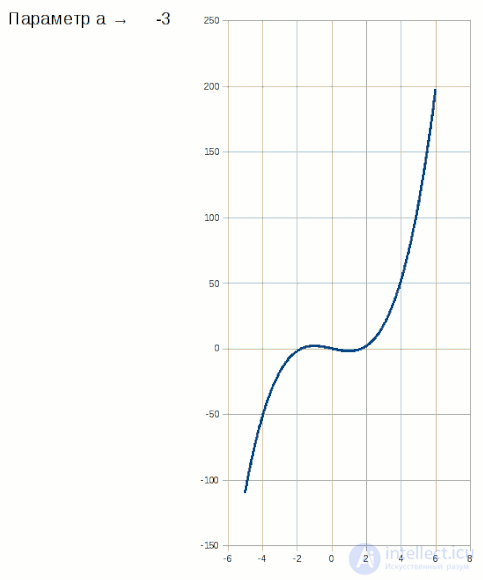
The stable and unstable parts of the extremum that disappears at a «fold»-type bifurcation:
 .
.
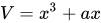
For negative values of the parameter a the potential function has two extrema — one stable (a stable equilibrium) and one unstable (an unstable equilibrium). If the parameter a changes slowly, the system can remain at the point of the stable minimum. But if a=0, the stable and unstable extrema meet and annihilate. This is a bifurcation point. When
  no stable solution exists.
If a physical system passes through a «fold»-type bifurcation point, and thus the parameter a passes through the value zero, the stability of the solution for a<0 is lost, and the system can undergo a sudden transition to a new state very different from the previous one. This bifurcation value of the parameter a is sometimes called the «fixation point».

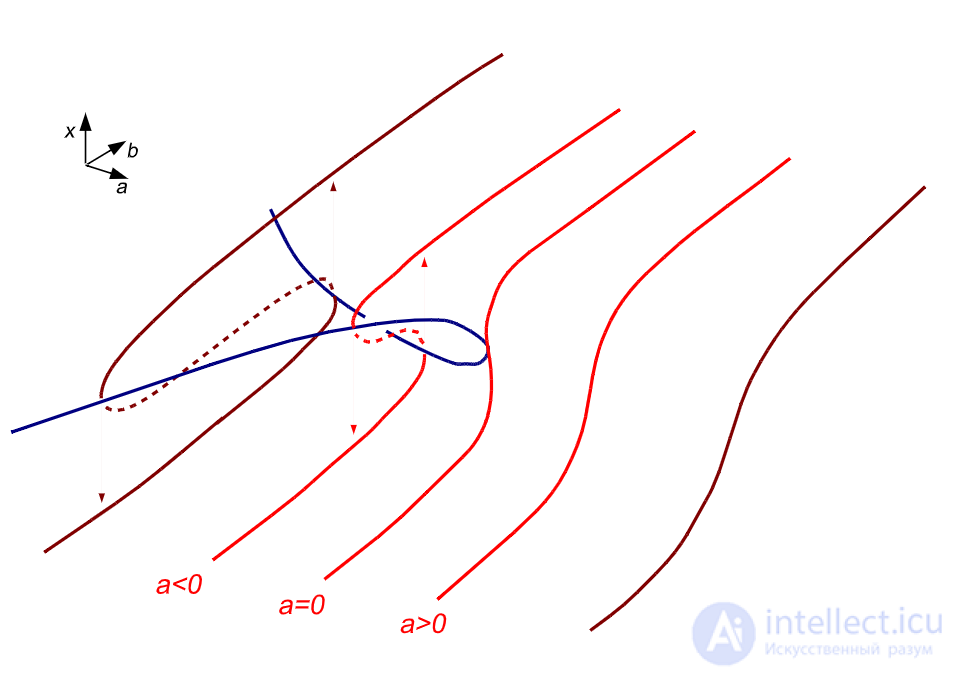
The cusp catastrophe diagram, showing the curves (brown and red) for x satisfying the equation dV⁄dx = 0 and the parameters (a,b), where the parameter b varies continuously, while for the parameter a only a few different values are shown. Outside the cusp (blue line) each point (a,b) in parameter space corresponds to only one solution x. Inside the cusp, however, there are two distinct values of x corresponding to local minima of V(x) for each point (a,b), separated by a value of x corresponding to a local maximum. |
|
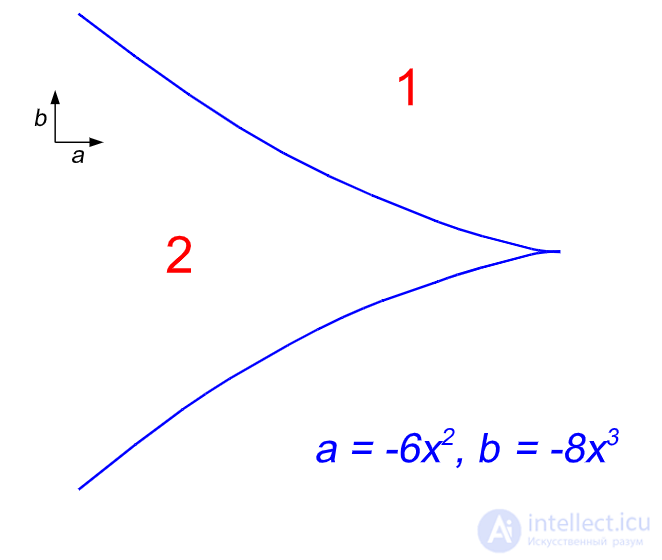
The shape of the cusp in parameter space (a,b) near the catastrophe point, showing the bifurcation separating the regions with one and two stable solutions. |
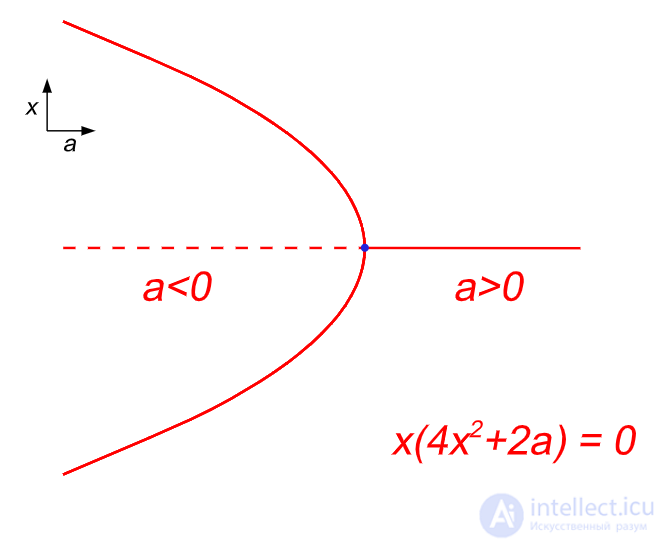
A pitchfork-type bifurcation at a = 0 on the surface b = 0 |
The «cusp» catastrophe diagram with a cusp point, showing the curves (brown, red) with respect to the variable x satisfying the expression for the parameters (a,b); the curves are shown for the continuously varying parameter b at various values of the parameter a. Outside the locus of cusp points (blue region), for each point (a,b) in phase space there exists only one extremal value of the variable x. Inside the cusp points there exist two distinct values of x, which give local minima of the function V(x) for each pair (a,b). Moreover, these values are separated by a local maximum.
A «pitchfork»-type bifurcation at a = 0 in the space b = 0. The shape of the cusp points in phase space (a,b) near the catastrophe point, showing the locus of «fold»-type bifurcations, which separates the region with two stable solutions from the region with one solution. The geometry of the cusp points is quite common when studying what happens to «fold»-type bifurcations when a new parameter b is added to the control space. By varying the parameters one can find that there is a curve (blue) of points in the space (a,b) on which stability is lost, i.e., on this curve the stable solution can suddenly «jump» to an alternative (likewise stable) value.
But in the cusp geometry the bifurcation curve folds back, creating a second branch on which this second solution in turn loses stability, and so can make a «jump» back to the original set of solutions. Upon repeatedly increasing the value of the parameter b and then decreasing it, one can observe hysteresis in the behavior of the loops, since the system follows one solution, «jumps» to another, follows it, and «jumps» back to the original one.
However, this is possible only in the region of parameter space where a < 0. If the value of the parameter a increases, the hysteresis loops become smaller and smaller, until the value of a reaches 0. At this point the loops disappear (the cusp-point catastrophe), and only one stable solution appears.
One can also consider the process of varying the parameter a while keeping the value of b fixed. In the symmetric case at b = 0, one can observe a «pitchfork»-type bifurcation: as the parameter a decreases, one stable solution suddenly splits into two stable solutions and one unstable one. During this the physical system passes into the region a < 0 through the cusp point (a = 0, b = 0) (this is an example of spontaneous symmetry breaking). Away from the cusp point there are no sudden changes in the physical system, since as one passes along the fold bifurcation curve all that happens is that a second, alternative solution becomes available.
One of the most interesting proposals for using the cusp catastrophe is that this type of catastrophe can be used to model the behavior of a dog which, in response to an external influence, may become frightened or become angry. The proposal is that under moderate influence (a > 0) the dog will exhibit a smooth change of response from fright to anger depending on how the influence was applied. But a higher level of influence corresponds to stress, corresponding to a transition into the region a < 0. In this case, if the dog was initially frightened, it will remain frightened as the level of influence on it increases, until it eventually reaches the cusp point, where a spontaneous transition to the mode of anger occurs. Upon transitioning to this mode, the dog will remain angry even if the influence on it is gradually reduced.
Another example of the applied use of the cusp catastrophe consists in modeling the behavior of an electron transitioning from one energy level to another, which is often observed in chemical and biological systems. This indicates that bifurcations of the type considered and the geometry of cusp points are the most important practical part of catastrophe theory. These are patterns that appear again and again in physics, engineering, and mathematical modeling.
The remaining simple catastrophe geometries are more specialized compared to the one just considered, and therefore appear only in certain isolated cases.
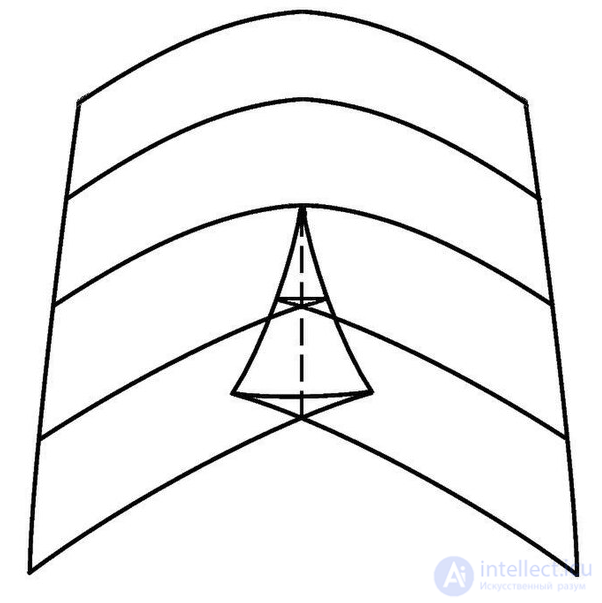
The «Swallowtail» catastrophe surface

The control space for this type of catastrophe is three-dimensional. The bifurcation cascade in phase space consists of three «fold»-type bifurcation surfaces, which meet along two cusp-point bifurcation curves, which ultimately meet at a single point representing a «swallowtail»-type bifurcation.
As the parameter values pass over the surfaces of the «fold»-type bifurcation regions, one minimum and one maximum of the potential function disappear. In the region of cusp-point bifurcations, two minima and one maximum are replaced by a single minimum; beyond them the «fold»-type bifurcations disappear. At the swallowtail point, two minima and two maxima meet at a single value of the variable x. For values a > 0 beyond the swallowtail, there exists either a single pair (minimum, maximum), or no bifurcations at all. This depends on the values of the parameters b and c. The two «fold»-type bifurcation surfaces and the two cusp-point bifurcation lines meet at a < 0, and thus disappear at the swallowtail point itself, being replaced by a single «fold»-type bifurcation surface. Salvador Dalí's last painting, titled «The Swallow's Tail», was created under the influence of this type of catastrophe.

Depending on the values of the parameters, the potential function may have three, two, or one local minimum, with all minima separated by regions of «fold»-type bifurcations. At the point with the poetic name «butterfly», three distinct spaces (three-dimensional planes) of such «fold»-type bifurcations meet, together with two cusp-point bifurcation surfaces and a «swallowtail»-type bifurcation curve. All these bifurcations vanish at a single point and transform into a simple cusp-point structure once the value of the parameter a becomes positive.
Umbilic catastrophes are examples of second-order catastrophes. They can, for instance, be observed in optics when light is reflected from three-dimensional surfaces. Such catastrophes themselves are closely connected with the geometry of nearly spherical surfaces. René Thom proposed regarding the hyperbolic umbilic catastrophe as the breaking of a wave, and the elliptic umbilic catastrophe as a process of creating structures resembling hair-like coverings.



V.I. Arnold proposed the «ADE classification» of catastrophes, which uses deep connections with the theory of Lie groups.
 .
. .
.

In singularity theory there are objects corresponding to most of the other simple Lie groups.
The creation and development of this part of mathematical analysis was connected with the broad possibilities of the visual analysis of certain complex phenomena, especially those encountered in the description of the most diverse natural phenomena, in which discontinuous functions are also considered, for which the apparatus of mathematical analysis is not suited (rainbows, caustics, loss of stability of structures, oscillation and failure in structural mechanics, behavior in ethology, astrophysics, bifurcational instability of an atomic lattice, spontaneous order in biochemical reactions, population dynamics, hydrodynamic instability and the onset of turbulence, chaotic dynamics of a strange attractor).
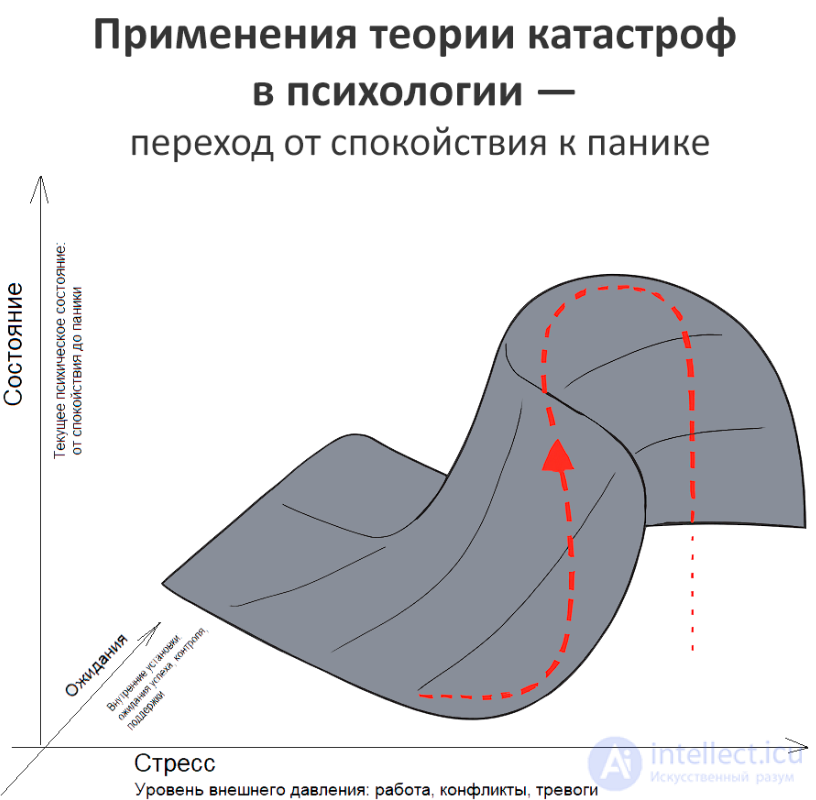
Physics: modeling phase transitions, for example, the transition of water into ice or steam.
Structural mechanics: stability analysis of structures, predicting the failure points of beams, shells, and bridges.
Fluid dynamics: description of turbulence and sudden changes in fluid flow.
Mechanical engineering: predicting failures in complex mechanisms, especially under loads close to critical.
Embryology: explaining morphogenesis — how complex organs form from homogeneous tissue.
Medicine: modeling sudden transitions in a patient's condition, for example, during an epileptic seizure or a heart attack.
Ecology: predicting bifurcation points in ecosystems, where a small change can lead to the extinction of species.
Geology: modeling earthquakes, volcanic eruptions, landslides — as catastrophic transitions in the Earth's crust.
Psychology: describing sudden changes in human behavior, for example, the transition from calm to panic.
Social crises: predicting revolutions, economic collapses, mass protests — as bifurcation points in society.
Financial markets: modeling stock market crashes, bubbles, and sudden price jumps.
Risk management: identifying critical points in business processes, where a small change can lead to failure of the entire system.

Comments