
Lecture
4.2. Critical points of corank 1
Let us begin with the «least degenerate» critical points —
points of corank 1. In this case the 2-jet function } in the representation (4.6) depends on only one variable з/, which we shall further
denote simply by у, and formula (4.6), taking into account representation (1.5) from
problem 1.2, immediately gives the following result.
If the multiplicity of the function /(у) at the point 0 is finite (denote it by ри),
then there exist smooth coordinates in which the germ Е has the form
ЕР(т1,... Хи} = 17 +... + @и—122 | 1 а =-. (4.7)
A critical point of corank 1 with normal form (4.7) is called
a singularity of type А». Note that if the number р + 1 is odd, then
the sign = in formula (4.7) can be replaced by a plus. But if р + 1 is even,
then this sign is an invariant.
42
4.3. Critical points of corank 2
In the case of corank 2, representation (4.6) contains a function {of
two variables. Consequently, our problem reduces to bringing to normal form the germ of a 2-jet function of two
variables, which we shall further, for simplicity, denote by т, у.
So, let /(т,у): Е? + В be a function 2-jet at the point 0:
(2, у) = аох* + алх?у + азту? + азу” + 9(т, у), (4.8)
where р(т,у) is a function that is 3-jet at 0.
Let us begin with the case ф(т, у) = 0, i.e. when }(х,у) is a homogeneous polynomial of the third degree:
Р(т, у) = ао2* + аля? у + азту? + азуз. (4.9)
This problem is solved by means of linear algebra. Suppose
that /(т,у) = 0. Then, without loss of generality, we shall henceforth assume
that @0 = 0 (see the following problem).
PROBLEM 4.3. Prove that by means of a suitable linear
change у =} Ах + у, the polynomial }{(т, у) = а1т?у + а2ту? = 0 is brought
to the form (4.9) with coefficient ао = 0.
A homogeneous polynomial is uniquely determined, up to multiplication by,
a nonzero constant factor, by its zero-level set: /(т,у) = 0, consisting of a finite number of lines,
passing through the origin. In particular, the zero-level set of polynomial (4.9) may consist of one, two, or three
lines passing through 0. These lines can be found as
follows. By virtue of the condition а0 5% 0, the line у = 0 cannot
be contained in the set {(т, у) = 0. Therefore, dividing }(т, у) by 3
and denoting # = т/у, we obtain the polynomial
Р(® — ао -+ а? + а + аз, =. (4.10)
у
REMARK 4.1. For the reader familiar with the basics of projective
geometry, we note that the transition from the pair of variables т, to the variable # is a projectivization of the plane. Namely, т: у are homogeneous coordinates, and # is a non-homogeneous coordinate on the projective line obtained by projectivizing the plane of variables (ту). All
possible lines in the plane passing through 0 are obtained
43
when # runs over all real values and со. Here the value
+ = со corresponds to the line у = 0. In the case 040 5 0, the line у =0
is certainly not contained in the zero-level set, and it suffices
to consider only finite values of $.
Thus, the lines composing the zero-level set of the homogeneous polynomial (4.9) correspond to real roots of the cubic polynomial (4.10). Four cases must be distinguished,
listed in the table. Here roots &; and +; with { > 7 are considered distinct, repetition of a root corresponds to its multiplicity.
case | roots of the polynomial Р(Ё | example of the polynomial {(т, у)
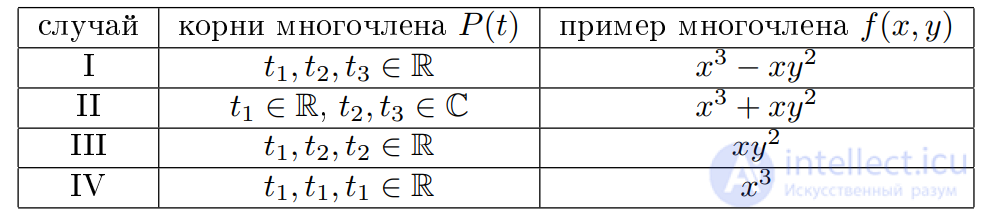
PROBLEM 4.4. Prove that any two polynomials of form (4.9),
belonging to the same row of the table, are carried into one another by a suitable nondegenerate linear transformation of the plane (т,у).
In case 1 (three distinct real roots) the statement follows immediately from a well-known property of projective transformations. Namely,
if Ат, В1, Сти 45, Вь, С> are two triples of points of projective space such that the points in each triple are pairwise distinct
and lie on one line, then there exists a projective transformation carrying the first triple into the second. In other words, if
Ат, Ву, Сти Ао, В2, Со are two triples of lines of a linear space,
such that the lines in each triple are pairwise distinct and lie in one plane, then there exists a nondegenerate linear transformation carrying the first triple into the second. (This statement holds both for real and for complex spaces.)
Applying the indicated property in case Г where А, В:,С1 and
Ао, В’,С> are the triples of lines composing the sets (ту) = Ои
Р(т, у) = 0, we obtain the required result (the reader is invited to restore the missing details independently). Note that
in case П this reasoning also leads to the same conclusion,
but the sought linear transformation is now, in general, complex (whereas we require a real one). Therefore we shall give
a «real» proof.
44
SOLUTION OF PROBLEM 4.4. First perform a linear transformation carrying the line т/у = Н, corresponding to the real
root Н of the polynomial Р(Ё), into the line 1 = 0. Then, obviously, in both
formulas (4.9) and (4.10) we will have аз = Оиа2 = 0, i.e.
Р(Н = ЦаоЁ + а1Ё + а2), (т, у) = т(аот? + алту + аэу°).
Next we use a linear transformation лу +} Ах + у with a suitable
coefficient А, bringing the quadratic form а01? +а1ту-+а22
to diagonal form. After this we obtain
(а, у) = г (аа? + 6?) = аа? + Бгу?,
and, choosing a suitable scale on the axes т and у, we bring
the function {(т, у) to the form 13 + ху? or 13 — ту?, depending on the sign
of the number аб. These are exactly cases Ги П from the table.
In case ПТ we perform a linear transformation carrying the lines 5 /у = Н and х/у =Б into х =0 and у = 0. Then, obviously, we will have
ао = аз = 0, i.e.
Р(® = Най+ а2), Г(х,у) = ху(ат + а2у).
Since the line а1т + а2у = 0 coincides with either т = 0 or with у = 0,
we have either а1 = 0, or а2 = 0. After choosing a scale on the axis т
or у, we obtain { = т?у or } = 147. These forms differ only
in the naming of the variables.
Case [У is considered similarly. |
COROLLARY 4.1. Any polynomial of form (4.9) is brought to one
of four normal forms
3 ху’, зу, 2 (4.11)
by means of a suitable nondegenerate linear transformation.
To determine which normal form a given polynomial /(т7,у)
reduces to, one must determine to which of cases
Т [У the roots of the corresponding polynomial Р(® belong.
Now let us turn to functions of form (4.8), assuming that the cubic
part has been brought to one of three normal forms: 4:3 +172, гу? (we shall not consider case т3). To bring the germ of the function
Г to normal form, one must use smooth nonlinear changes of the variables х, у. But before we proceed to this, let us give one
useful auxiliary argument.
45
Let {(х, у) : В? -+ В be a smooth function having 0 as its nondegenerate critical point, }(0) = 0. By the Morse lemma, the germ }
at the point 0 is brought to the form а11? + @2?, where о; = 1. Let us give a very
simple proof of this statement, using the fact
that the function depends only on two variables.
PROOF OF THE MORSE LEMMA FOR TWO VARIABLES.
By means of a linear transformation we bring the quadratic
part of the function {(т,у) to canonical form @11? + @2у2, @; = +1.
Then, by means of the Hadamard lemma, we represent the «tail» (terms of order higher than 2) in the following form:
(т, у) = (аа? + а2у?) +
+ =Зал (т, у) + г?уа2(т, у) + ху?аз(т, у) + уЗаа (т, у),
where all а;(т,у) are smooth functions. Note that each of the four
terms of the «tail» contains either the factor 52, or 2. Hence,
the entire «tail» belongs to the ideal (in the ring of smooth functions) generated by the monomials 12 and у. This allows us to write:
(с, у) = =2 (1 + гал (т, у) + уа2(2,у)) + у? (а + таз(т, у) + уаа(т,у)).
From this it is easy to see which change brings {(т, у) to the form о1х2 +922.
For example, in the case @1 = а2 = +1 this change is
=> \/1 + та1 (т, у) + уа2(х, у),
ук и\/1 -- таз(х, у) =Е уал (т, 3).
The proof is complete. |
Similar arguments will also be used by us for degenerate critical points of corank 2. The «principal part» of the function
Г(х, у) will now be the 3-form 53 -Е ту? or 52, and the «tail» has the form
ф(х, у) — ‘ал Г у) +23 уа2 (т, у) Е х?у?аз(т, у) ИЕ туаа (т, у) +‘ аз(х, 9),
where all а;(5,у) are smooth functions. Compared with the Morse lemma,
the new difficulty consists in the fact that now not all terms in the «tail»
belong to the ideal generated by the monomials from the principal part. This
difficulty is what we must now overcome.
PROBLEM 4.5. Prove that if {(т,у) = 23 + ту? + ф(т, у) or
Г(т, у) = ту? + 9(т, у), then by means of a suitable change
тн: т + уи(у), (0) =0, (4.12)
46
one can bring the germ ф to the form ф(т,у) = тф1(т, у) with a smooth function 1, without
changing the cubic part of {.
SOLUTION. Consider the function
Р(х, у) = 3 + =зу? + ф(х,у), ЕЕ 1. (4.13)
The case /(т,у) = ту? + ф(т,у) is investigated in a completely analogous manner.
Making in (4.13) the change (4.12) and then substituting 1 = 0, we obtain:
1(0, у) = 3 (м3 + ви + у(олий + арм? + ази? +
+ али + а5)) = У (и? + ви + уА(у,и)),
where the functions а; = а(уи, у), the notation А(у, и) being obvious. The required
condition will be satisfied if we choose the function и = и(у) so
that (0) = Оби и?" + 5и + уА(у, и) = 0. This gives us an implicit equation for the unknown
и. Computing the derivative of the
expression on the left-hand side of the identity with respect to the variable и at
у = и = 0, we obtain the number = 5 0. By the implicit function theorem, in
a sufficiently small neighborhood of the point 0 the sought function и = и(у) exists. By virtue of the condition (0) = 0 and the Hadamard lemma, we have the representation (у) = у%(у) with a smooth function %(у), hence the change,
(4.12) does not change the cubic part of the function {. |
After the change (4.12) and transformation of the «tail» we have
Их, у) = 13 + ету? + ера (т,у) =
= 13 + =ту? + 2‘ал (т, у) + хЗуа(т, у) + х’у?аз(т, у) + хуЗал(т,у) =
= #3 (1 + гал (х, у) + уа2(т,у)) + ху? (Е + хаз(х, у) + уал(т,у)).
The reader is invited to determine independently which changes need
to be used to bring the germ {to the form 13 + ЕТУ”.
It remains for us to consider the case
т, у) = ту’ + три, у), (4.14)
where го1(х,у) is a function that is 3-jet at the point 0. Unlike (4.13), the cubic part of germ (4.14) contains only one monomial 21/2, and this
is clearly not enough for the existence of an ideal containing the entire «tail».
Hence, the «principal part» must be supplemented by at least one more monomial of degree higher than three.
47
Let us additionally assume that function (4.14) has finite multiplicity at the point 0 with respect to х. Denote this multiplicity by р,
3 < и < <. Hence, the Taylor series of the function 2$р1(т,у) in the totality of variables contains the monomial х"\", but does not contain monomials 2! with
1 < р. We shall now consider the principal part of function (4.14) to be the binomial ту? + 2" 11. This is already better than before, but the ideal generated by the monomials 2/? and "+1 still does not contain the monomials зу, 3 << и,
which may be present in the «tail». Let us show that by means of a
suitable change of variables all such monomials can be killed.
PROBLEM 4.6. Show that for any п > 3 there exist numbers
А1...., Ап, such that the polynomial change,
уни + Лот +. Ах”, (4.15)
carries germ (4.14) into a germ of the same form, not containing the monomials 23,..., 271.
Solution. Denote by а the coefficient of the monomial х3Зу in the original function { of form (4.14). Making the change у ++ у + Лот?, we obtain
the function {(т,у) = ту? + хфо(т, 9) with a new «tail», in which the coefficient of the monomial х3у equals 25 + а (the coefficients of all
other monomials in the «tail» also change in some way, but we need not track them). Setting Л’ = -а/2, we kill the monomial 23.
Denote by В the coefficient of the monomial х“у of the function {(х, у) = гу? + тфэ(т, у) obtained at the
previous step. Making the change
ук уи+ Азт3, we obtain the function (т, у) = ту? + тфз(т, у), having a new «tail», but the same 4-jet as the previous one. Hence,
the monomial 23 is still absent, and the coefficient of the monomial “у
has the form 2Аз + В. Setting Аз = —В/2, we kill the monomial т“у.
Continuing this process, we successively kill all the monomials
23у,..., ту. The change obtained as a result has the form (4.15). |
Let us apply to the function } of form (4.14) the change (4.15) constructed above with the number п = р. As a result we obtain
и Г(з, у) =? +» `Р(т,у) + =Ф(т,у),
+=4
where Р;(т,у) are forms of degree #, not containing the monomials 1", у", ху, and
тФ(т, у) is a smooth function of multiplicity // with respect to 1 at 0, whose Taylor series
does not contain the monomial х#у. Since each form Р; (т, у) is divisible by
1/2, we have Р;(т, у) = ху?Опх, у), where Ох, у) are forms of degree # — 3,
48
1=4,..., и. The reader is left to verify (using the Hadamard
lemma) that the function %Ф(т,у) is representable in the form
тФ(т, у) = "Ка + а(т,у)) + ху?Цт, у),
where the number а = Оиа(т, у), т, у) are smooth functions vanishing at
the point 0. As a result we obtain the representation
и
1(х,у) = ту? (: +» О, у) + Цт, у) +2" (а + а(т,у)).
1=4
The reader is invited to determine independently which changes need
to be used to bring the germ {(т,у) to the form ху? + ж" 1.
Thus, we have obtained the following results:
THEOREM 4.1.
® The germ of a function of form (4.8) whose cubic part has
three distinct complex or real roots, is brought to the form ту? - 13 (the sign Е corresponds to complex
or real roots).
® The germ of a function of form (4.8) whose cubic part has
two distinct roots, satisfying some additional condition, is brought to the form ту? + же 1 with integer и > 3.
The condition mentioned was formulated explicitly above; the codimension of the set of points that do not satisfy it is
equal to infinity. Both normal forms from Theorem 4.1 can be combined together, giving the following definition. A critical point of corank 2 with normal form
2 2 2 1 Е(11,..., Жи, т, у) = @11 +: + ап о + ту" + жит, (4.16)
where а; = +1, д > 2, is called a singularity of type В „+2.
PROBLEM 4.7. Compute the codimensions of the singularities Аз and
Вр-+2.
PROBLEM 4.8 (*). Investigate in a similar way the omitted
case [У — the germ of a function of form (4.8) whose cubic part
has one root of multiplicity 3.

Comments