
Lecture
Let us present one fundamental result of singularity theory, using the notion of the multiplicity of a function in one variable.
THEOREM 2.1 (division theorem). Let F(x; y) :  be a smooth function of m+ 1 variables.
If  is the multiplicity of the function F with respect to x at the point 0, then in a neighborhood of 0 the function F(x; y) can be represented in the form
 , (2.3)
where ai(y) and φ(x; y) are smooth functions, ai(0)=0 and φ(x; y)  0
0
REMARK 2.2. Theorem 2.1 has a local character.
Of course, it holds not only at the origin but at an arbitrary point (the general case is obtained by shifting the origin of coordinates).
This theorem also holds for analytic functions:
in its statement, the word «smooth» must be everywhere replaced by the word «analytic».
It was first proved by Weierstrass for analytic functions of complex variables ( holomorphic functions of complex variables). A holomorphic function or a single-valued complex analytic function (from the Greek ὅλος — «whole» and μορφή — «form»), sometimes called a regular function — is a function of a complex variable, defined on an open subset of the complex plane  and complex-differentiable at every point.
Unlike the real case, this condition means that the function is infinitely differentiable and can be represented by a Taylor series converging to it.
Holomorphic functions are also sometimes called analytic, although the second notion is considerably broader, since an analytic function can be multivalued, and can also be considered for real numbers.
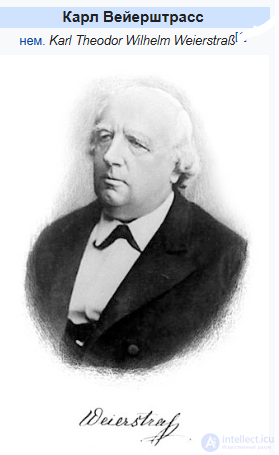
Its analytic version is often called the «Weierstrass preparation theorem».
The smooth version (given above) is sometimes called the «Malgrange division theorem» or the «Mather division theorem».
We shall give the proof of Theorem 2.1 for analytic functions (see Section 12).
The proof in the smooth case is obtained from the analytic one by means of a technique similar to the lemmas of Section 5.3. It can be found, for example, in the books |9, 15].
The essence of the division theorem (Weierstrass division theorem, Malgrange–Mather division theorem) is that it describes how a smooth function is structured near a singular critical point of finite multiplicity in one variable.
Put simply:
We have a function f(x,y1,…,yn), depending on one «special» variable x and n more parameters y.
At the point 0 it has a critical point with respect to x, where the derivatives with respect to x up to order μ inclusive vanish, while the derivative of order μ+1 is nonzero.
That is, x=0 is a root of multiplicity μ+1 (with respect to the variable x) for the function at fixed y=0.
Then the theorem asserts:
near zero f can be represented as the product of a nondegenerate factor φ(x,y) (which does not vanish) and a polynomial in x of degree μ+1, whose coefficients ai(y) depend on the parameters y and vanish at y=0.
Formally:
Intuition:
This is an analogue of the Weierstrass theorem for polynomials: if a polynomial has a root of multiplicity μ+1, then it can be factored in the form «a nondegenerate part × (a polynomial with the given root)».
In the case of smooth (or holomorphic) functions, the theorem says that locally, around a singular point, everything reduces to such a «polynomial form» in the distinguished variable.
Why it is needed:
The division theorem is a foundation of the theory of singularities of functions (Thom, Malgrange, Mather).
It allows one to reduce the analysis of the behavior of a function near a singular point to the analysis of a polynomial, which greatly simplifies the classification of critical points and their invariants.

Comments