
Lecture
In conclusion, let us discuss an important property of nondegenerate critical points — their stability with respect to small perturbations of the function.
Namely, under a sufficiently small perturbation of the function (small together with all its derivatives), a nondegenerate critical point does not disappear but merely shifts slightly, and no new critical points appear in its neighborhood. Degenerate critical points, by contrast, can disappear or split into several nondegenerate ones under an arbitrarily small perturbation of the function. Let us consider a few examples in the simplest situation, that of a function of one variable F(x), having a critical point x = 0. As the perturbing term we will use a monomial εxn of one degree or another — a function unbounded on the whole real line. Therefore, in order for the perturbation to be genuinely small, we must restrict ourselves to a bounded subset of the line. We will consider the perturbation on the interval I : |x| < 1.
EXAMPLE 1.1. The function F(x) = x3 has a degenerate critical point at 0. The perturbed function x3 + εx on the interval I in question either has no critical points at all, or has two nondegenerate critical points (for −3 < ε < 0). If instead we consider the perturbation x3 + εx2, then for |ε| < 3/2 the perturbed function will have two nondegenerate critical points on the interval I.
EXAMPLE 1.2. The function F(x) = x4 has a degenerate critical point at 0 (a minimum). The perturbed function x4 +εx2 also has a single critical point at 0 (a minimum) if ε > 0, but for ε < 0 it has three critical points, and 0 is now a point not of a minimum but of a (local) maximum, see fig. 1.2.
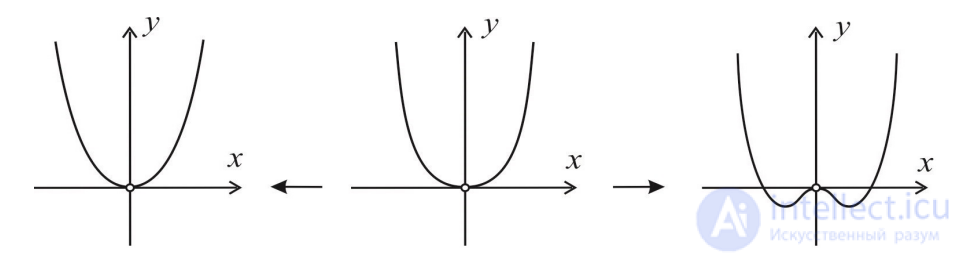
Fig. 1.2 The function F(x) = x4 (center) and its perturbations x4 + εx2 for ε> 0 (left) and for ε < 0 (right)
EXAMPLE 1.3. The function F(x) = x2 has a nondegenerate critical point at 0. One can show that if the perturbing term is sufficiently small (together with all its derivatives), the perturbation results only in a slight shift of the critical point.
For example, passing to the function x2 + εx , the critical point shifts from x = 0 to x = −ε/2. If instead we take x2 + εx2 with small ε (it suffices that |ε| < 1), the critical point does not move at all.
Finally, if we take the perturbation x2 + εx with small ε (it suffices that |ε| < 2/3), then within an ε-neighborhood of the point х = 0 it will still remain the unique critical point of the perturbed function.
PROBLEM 1.6.
1. Study the perturbation of the critical points from examples 1.1 and 1.3 by means of a term that is arbitrarily small on the entire real line. For instance, take the term  .
.
2. Devise a function of one variable whose critical point, under an arbitrarily small perturbation, splits into n nondegenerate critical points.
3. Study the critical points of the functions
F(x, y) = ax2 + 2bxy + cy2
for various choices of the coefficients a, b, c, and the perturbations of these critical points.
The reason why nondegenerate critical points are stable is fairly clear. For the sake of illustration, let us give the corresponding argument for a function of two variables F(x, y).
In this simplest case, the critical points are defined as the intersections of two curves given by the equations Fx(x, y) = 0 and Fy(x, y) = 0.
The additional condition H  0 means that these curves intersect at a nonzero angle (or, as one often says, transversally). In general, the notion of transversality applies not only to the intersection of curves — it is much broader and is one of the fundamental notions of singularity theory. But when it comes to the intersection of two curves in the plane or on any two-dimensional surface, it can be understood simply as a synonym for the phrase «intersection at a nonzero angle».
Under a small perturbation of the function F (small together with all its derivatives), the curves Fx = 0 and Fy = 0 shift and deform slightly, and their point of intersection may likewise shift slightly from its original position (fig. 1.3, left).
But it does not disappear, and no new points of intersection arise. Note that if the curves intersect non-transversally, this statement fails (fig. 1.3, right).
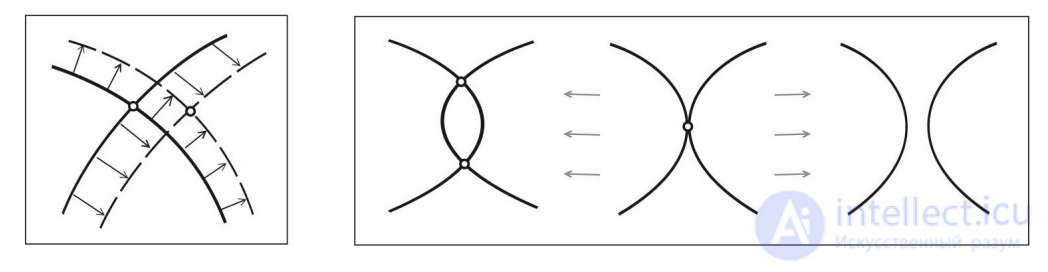
Fig. 1.3 Left: a transversal intersection of curves is stable. Right: a non-transversal intersection is unstable — under a small perturbation it may split into two (left) or disappear entirely (right)
PROBLEM 1.7. Carry out an analogous argument for the stability of nondegenerate critical points in the case of functions of an arbitrary number of variables.

Comments