
Lecture
To prove the main results of this section we shall need smooth functions with special properties (see the following three problems).
PROBLEM 5.1. Construct a smooth function φ : R → R, satisfying the conditions φ(x) = 0 for all x ≤ 0, φ(x) = 1 for all x ≥ 1,
and strictly monotone on the interval 0 < x < 1 (the graph of such a function
is shown in Fig. 5.1, center).
SOLUTION. First we define the auxiliary function
f(x) = e⁻¹⁄ₓ , x>0, (5.3) f(x) = 0, x≤0,
its graph is shown in Fig. 5.1 (left). Checking that this function is smooth is left to the reader. It is easy to check
that the function φ(x) = f(x) / (f(x) + f(1−x))
satisfies all the required conditions. |
PROBLEM 5.2. For any given number 0 < ε < 1,
construct a smooth function ψ : R → R, satisfying the conditions
ψ(x) = 1 for all |x| ≤ ε, ψ(x) = 0 for all |x| ≥ 1, and strictly monotone on the intervals −1 < x < −ε and ε < x < 1 (the graph of such a function
is shown in Fig. 5.1, right).
52
SOLUTION. Define the function ψ by the formula
ψ(x) = φ((1−|x|)/(1−ε))
where φ is the function from the preceding Problem 5.1. □
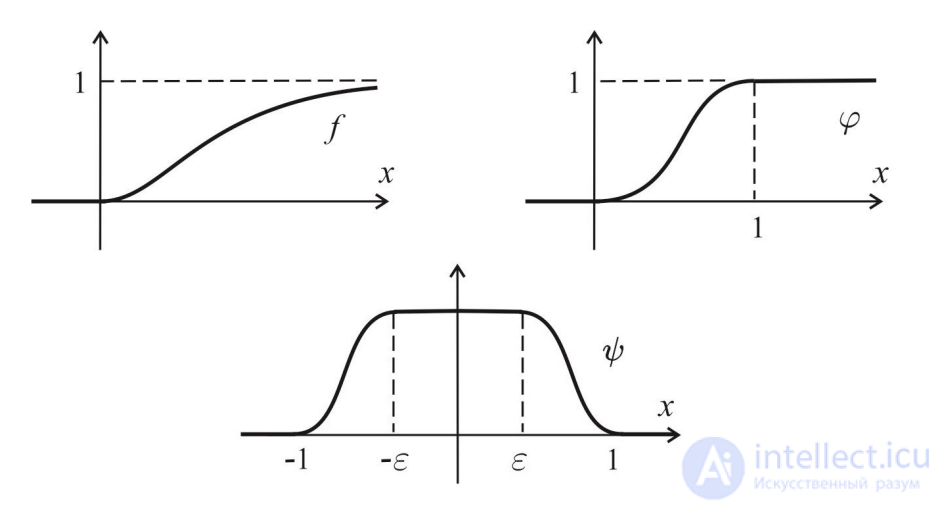
Fig. 5.1 Smooth functions with special properties
PROBLEM 5.3. For any given number 0 < ε < 1,
construct a smooth nonnegative function Φ : Rⁿ → R, satisfying the conditions Φ(x) = 1 for all |x| ≤ ε, Φ(x) = 0 for all
|x| ≥ 1, and strictly positive for all ε < |x| < 1. Here
|x| denotes the Euclidean norm.
SOLUTION. The function Φ with the required properties can be obtained
from the function ψ constructed in Problem 5.2 by the formula Φ(x) = ψ(|x|).
The trivial verification of all the properties is left to the reader. □
Using the functions constructed above, one can prove a number of nonobvious and useful statements. For example, one can construct the so-called partition of unity, a notion playing an important role in analysis,
topology, and the geometry of manifolds (with its help, for example, one proves Stokes' formula, as well as Whitney's theorem on the smooth embedding
of a compact manifold in Euclidean space). These questions
are treated in many textbooks, for example [18, 32, 22]. We shall give
here one less well-known, but rather striking, example.
53
THEOREM 5.1. Any closed subset A ⊂ Rⁿ is the zero-level set of some smooth function.
This statement (sometimes also called Whitney's theorem) is rather surprising: even on the line (p = 1) a closed set
can be arranged in a highly nontrivial way — for example, the Cantor set. It is by no means obvious that such a «pathological» set can be given as the zero level of a smooth function.
PROOF. Denote by Γ the (common) boundary of the sets
A and B = Rⁿ \ A. Since the set B is open, it can be covered
by a sequence of open balls Bₙ, each of which is contained in B (and the union of all the balls gives the whole set B). For example, consider the balls Bₙ centered at points qₙ ∈ B ∩ Qⁿ, i.e. centers with
all possible rational coordinates in the set B. For
each ball Bₙ define the quantity
ρₙ = dist(qₙ, Γ) = inf |s − qₙ|
the distance from the point qₙ to Γ. Note that ρₙ is either a positive number or infinity. Define the radius rₙ of the ball Bₙ
by rₙ = ρₙ, if ρₙ < ∞, and by rₙ = 1, if ρₙ = ∞
(instead of one, any positive number can be taken).
The family of balls Bₙ ⊂ B constructed in this way is countable (so it can be written as a sequence, and the manner of numbering plays no role) and covers the whole set B. That any
point x ∈ B ∩ Qⁿ is contained in at least one of the balls is obvious
(by construction, x is the center of some ball Bₙ). For points
in B \ Qⁿ one must give a very simple argument, using the
openness of the set B and the fact that the set Qⁿ is everywhere dense in Rⁿ.
Let us construct a sequence of smooth functions Ψₙ : Rⁿ → R, strictly positive in the open ball Bₙ and equal to zero outside it. Clearly,
for this it suffices to set
where the function Φ is taken from Problem 5.3. Next, define the number
(2)
cₙ = max sup , n ≠ |α| m∈Rⁿ α
where here closedness (and openness) is understood in the sense of the standard Euclidean metric in Rⁿ.
54
where

Since the function Ψₙ and all its partial derivatives are smooth and identically zero for |x| > rₙ, the «inner» supremum for
each fixed multi-index α is finite. The number of multi-indices α satisfying |α| ≤ n for any n is also finite. Consequently, all the quantities defined above are finite. On
the other hand, cₙ ≥ sup |Ψₙ(x)| ≥ 1, since the set of multi-indices contains
the multi-index α = 0.
Consider the function f, given as the series
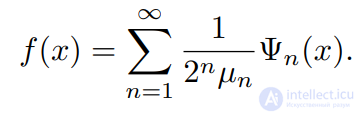 ) (5.4)
The inequality 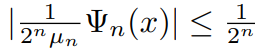 shows that the series (5.4) converges absolutely and uniformly over the whole space Rⁿ. By the theorem known from the
calculus course, the function f(x) is defined and continuous on all of Rⁿ.
Thus formula (5.4) defines a continuous nonnegative function f, strictly positive at every point x ∈ B (for every
point x ∈ B there is at least one ball Bₙ containing this
point and, consequently, at least one function Ψₙ for which Ψₙ(x) > 0) and identically equal to zero on the set A = Rⁿ \ B.
It remains to prove that the function f is not merely continuous but
also smooth. For this it suffices to show that the series obtained
by term-by-term differentiation of series (5.4) also converges uniformly. It is easy to check that for any α = (α1,...,αp) ∈ Zₓⁿ, one has

proving the uniform convergence of the required series. To obtain this estimate we discarded the first |α| − 1 terms of the series, in order to
achieve the condition n > |α|, but discarding a finite number of terms of the series does not affect its convergence. □

Comments