
Lecture
A tax is a compulsory, individually non-reciprocal payment levied on organisations and natural persons in the form of the alienation of funds belonging to them by right of ownership, for the purpose of financially supporting the activities of the state and municipal entities .
Taxes should be distinguished from fees (duties). These are also compulsory, but their levying is directly linked to the performance of certain actions by state officials in relation to the payers (that is, they resemble payment for specific state services).
The levying of taxes is governed by tax legislation (see tax law) .
The totality of established taxes, together with the principles, forms and methods of their establishment, modification, abolition, collection and control, constitutes the tax system of a state .
In response to the proposal of Aemilius Rocca, prefect of Egypt, to raise the amount of tax, the Roman emperor Tiberius replied: "It is the task of a good shepherd to shear his sheep, not to flay them" .
S. Yu. Witte: "Taxes are compulsory levies (contributions) on the income and property of subjects, collected by virtue of the sovereign rights of the state for the realisation of the higher aims of the state community".
Ya. Targulov, a Russian Soviet economist: "A tax is such a form of revenue of the state or of some other socially coercive units in which these revenues, received from the property of citizens, constitute a one-sided sacrifice on their part, without their receiving any equivalent, arise from the nature of the state as an organ of power, and serve to satisfy public needs".
K. Eheberg, a German economist: "The payer's relationship to the state presents the tax not as a special recompense for the benefits of belonging to the state, but as a duty of the citizen, his sacrifice, made by him for the maintenance and development of the whole".
F. B. Milhausen, a Russian financier: "Levies and taxes in the strict sense of the word are those sacrifices which subjects give to the state".
Jean Simonde de Sismondi (1819): "A tax is the price paid by a citizen for the enjoyments he receives from public order, the fairness of justice, and the safeguarding of personal liberty and the right of property. Taxes cover the annual expenditures of the state, and every taxpayer thus participates in the common expenditures made for his sake and for the sake of his fellow citizens".
Bo Svensson: "A tax is the price we all pay for the opportunity to use public resources for certain common purposes, for example defence, and to influence the distribution of income and property among citizens".
N. I. Turgenev (1818): "Taxes are essentially the means of attaining the goal of society or the state, that is, the goal that people set for themselves when uniting into a society or when forming states. On this is also founded the government's right to demand levies from the people. Having united into a society and entrusted the supreme power to the government, people entrusted to it along with this the right to demand taxes".
A. A. Isaev (1887): "Taxes are compulsory monetary payments by private households, serving to cover the general expenditures of the state and of self-governing units".
I. I. Yanzhul (1898): "One-sided economic sacrifices of citizens or subjects, which the state or other social groups, by virtue of being representatives of society, levy by legal means and in a lawful manner from their private property in order to satisfy necessary public needs and the costs these entail".
A. A. Sokolov (1928): "By a tax is to be understood a compulsory levy, collected by the state authority from individual economic persons or households to cover the expenditures it makes or to achieve some tasks of economic policy, without providing the payers with any special equivalent in return".
Murray Rothbard (1982): "All other persons and groups in society (except for individual criminals such as thieves and bank robbers) obtain their income by means of voluntary contracts: either by selling goods and services to consumers, or through an act of gift (that is, membership in a club or association, bequeathing an inheritance, receiving an inheritance). Only the state obtains its revenue by means of violence, threatening dire penalties if the revenue is not forthcoming. Such violence is known as taxation, although in less advanced times it was called tribute. Taxation is simply pure theft, and theft on a staggering scale that no criminal could match. It is the compulsory seizure of the property of the inhabitants or subjects of the state" .
Taxes simultaneously perform four main functions : fiscal, distributive, regulatory and monitoring.
The beard tax (Beard Tax, Russia, 1698) – Peter I introduced a tax on wearing a beard in order to bring men into line with European fashion.
The window tax (Window Tax, England, 1696–1851) – Payment depended on the number of windows in a house. Small windows were often bricked up in order to pay less.
The door and gateway tax (Door and Gateway Tax, medieval Europe) – House owners paid a tax for each door or gateway.
The hat tax (Hat Tax, Great Britain, 1784) – Hat owners had to buy a special stamp for the hat.
The smiling tax (Smiling Tax, myth or folklore, 19th century) – Mentioned in anecdotes as a jocular tax on the public expression of joy.
The tax on lamps and candles (Candle Tax, France, 18th century) – People paid according to the number of candles or oil lamps in the house.
Sun Tax (Spain, 2015) – A tax on people who installed solar panels and used their own electricity.
Google tax / digital tax (Digital Services Tax, EU, since 2019) – For large IT companies that earn revenue from digital services.
Sugar Tax (United Kingdom and others) – An additional rate on sweetened beverages to combat obesity.
Hobby Tax (USA, some states) – If a hobby generates a profit, it is taxed as "additional income".
Fat Tax (Denmark, 2011–2012) – A tax on products with a high fat content.
Smartphone and gadget tax (E-Waste Tax, South Korea, EU) – For the disposal or partial financing of electronics recycling.
Plastic Bag Tax (many countries) – Encouraging people to give up plastic bags.
Coffee Tax (Finland) – Coffee imports, and even particular varieties, are heavily taxed.
Pink Tax – The additional cost of goods for women: cosmetics, hygiene products, clothing.
Wealth Tax – An additional tax for wealthy individuals, practiced in some European countries.
Alcohol tax / "sin taxes" (Sin Tax) – On tobacco, alcohol and gambling, in order to reduce consumption.
E-commerce Tax – Online purchases are additionally taxed in some countries.
Bag Tax – As already mentioned, on plastic bags. Sometimes differentiated by the size or type of bag.
Coffee Gender Tax (rare examples) – Some marketing studies have found products where coffee for women is more expensive.
Environmental taxes (Carbon Tax, Plastic Tax) – On CO₂ emissions, single-use packaging and plastic.
Loneliness Tax – Found in discussions and pilot projects in some cities to encourage social activity (more of a concept).
Rain tax / storm sewer tax (Stormwater Fee, Rain Tax) In some regions (for example, Crimea, the USA, Germany) property owners pay for the use of the storm sewer system. The purpose: financing rainwater drainage systems, preventing flooding and the pollution of rivers/seas. It is often calculated on the basis of the roof area and the area of the plot that collects rainwater.
Negative income tax, In economics, a negative income tax (abbreviated NIT) is a progressive income tax system in which people earning below a certain amount receive an additional payment from the government instead of paying taxes to the government.
Property taxes A property tax (or real estate tax) is a tax levied on the value of property, which the owner of the property is obliged to pay to the state in whose territory the property is located. Several jurisdictions may tax the same property. There are three main types of property: land, improvements to land (immovable man-made property, such as buildings) and movable property. Real estate is the combination of land and the improvements on it.
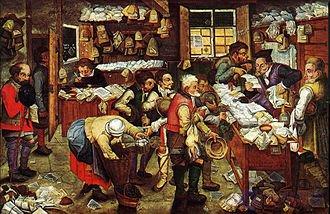
Pieter Brueghel the Younger, "The Payment of the Tax", 1640
All taxes are divided into several types:
Taxes are divided into direct ones, that is, those taxes levied on economic agents for income from factors of production , and indirect ones, that is, taxes on goods and services that are embedded in the very price of consumer goods . Direct taxes include such taxes as the personal income tax, the profits tax and the like . Indirect taxes include value added tax, excise duties and others ].
It is also customary to distinguish between lump-sum and income taxes. The former are set by the state regardless of the level of an economic agent's income . Thus,
 .
.
The latter are understood as taxes constituting some particular percentage of income (Y) . This relationship is shown either by the marginal tax rate (t), which explains how much the tax increases when income rises by one monetary unit, or by the average tax rate (q): simply the ratio of the amount of tax levied to the amount of income That is,

or
 , where:


Income taxes are themselves divided into three types:
The first known system of taxation existed in Ancient Egypt around 3000–2800 BC, during the First Dynasty of Egypt's Old Kingdom . The earliest and most widespread forms of taxation were the corvée and the tithe . The corvée was forced labor provided to the state by peasants too poor to pay other kinds of taxes ( labor in the Ancient Egyptian language is a synonym for taxes). Records from that time indicate that the pharaoh made a biennial tour of the kingdom, collecting the tithe from the people. Other records are granary receipts on limestone flakes and papyrus. Early taxation is also described in the Bible . The Book of Genesis (chapter 47, verse 24 – New International Version ) says: "But when the crop comes in, give a fifth of it to Pharaoh . The other four-fifths you may keep as seed for the fields and as food for yourselves and your households and your children." Samgahitr is the name of a tax collector mentioned in Vedic texts. In Hattusa , the capital of the Hittite Empire , grain was collected as a tax from the surrounding lands and stored in silos, displaying the king's wealth.
In the Persian Empire, a regulated and sustainable system of taxation was introduced by Darius I the Great in 500 BC; the Persian system of taxation was adapted to each satrapy (a territory administered by a satrap or provincial governor). At various times there were between 20 and 30 satrapies in the empire, and each of them was taxed according to its estimated productivity. It was the satrap's duty to collect the amount due and send it to the treasury after deducting his own expenses (the expenses, and the right to decide how and from exactly whom to collect money in the province, offered the greatest opportunities for making rich pickings). The amounts required from the various provinces gave a vivid picture of their economic potential. For example, Babylon was assessed the highest tax and a striking variety of goods: 1,000 silver talents and a four-month supply of food for the army. India , a province famed for its gold, was to supply gold dust equivalent in value to the enormous amount of 4,680 silver talents. Egypt was known for the abundance of its harvests; it was to become the granary of the Persian Empire (and later of the Roman Empire ) and had to provide 120,000 measures of grain in addition to 700 talents of silver. This tax was levied exclusively on the satrapies depending on their lands, productive capacity and level of tribute.
The Rosetta Stone , a tax concession issued by Ptolemy V in 196 BC and written in three languages, "led to the most famous decipherment in history — the deciphering of hieroglyphs." [
In the Roman Republic, taxes were levied on individuals at a rate of between 1% and 3% of the assessed value of their total property. However, since collecting taxes was extremely difficult, the government held auctions annually. The tax collectors who won the auction (called publicani ) paid the tax revenues to the government in advance, and then kept for themselves the taxes collected from individuals. The publicani paid taxes in coin, but collected them using other media of exchange , thereby relieving the government of the need to carry out currency conversion itself. Payment of taxes essentially acted as a loan to the government, on which it paid interest. Although this scheme was a profitable enterprise both for the government and for the publicani , it was later replaced by a system of direct taxation by the Emperor Augustus ; after which each province was required to pay a 1% property tax and a flat rate on each adult. This led to regular censuses of the population and shifted the tax system toward taxing individuals' incomes rather than property.
Islamic rulers introduced the zakat (a tax on Muslims) and the jizya ( a poll tax on conquered non-Muslims). In India this practice originated in the 11th century.
Numerous records of the collection of government taxes in Europe, dating from at least the 17th century, are available today. However, the level of taxation is difficult to compare with the size and flow of the economy, since data on output are not so readily available. Government expenditure and revenue in France in the 17th century grew from about 24.30 million livres in 1600–1610 to about 126.86 million livres in 1650–1659, and to about 117.99 million livres in 1700–1710, when the public debt reached 1.6 billion livres . In 1780–1789 it reached 421.50 million livres . [ 48 ] Taxation as a percentage of the output of final goods could reach 15–20% during the 17th century in places such as France , the Netherlands and Scandinavia . In the war years of the 18th and early 19th centuries, tax rates in Europe rose sharply, as war became more costly and governments more centralized and skilled at collecting taxes. The greatest increase was observed in England: Peter Mathias and Patrick O'Brien found that the tax burden increased by 85% over this period. Another study confirmed this figure, showing that tax revenues per capita grew almost sixfold over the 18th century, but steady economic growth meant that the real burden on each individual over this period, prior to the Industrial Revolution, only doubled. Effective tax rates in Britain were higher than in France in the years preceding the French Revolution , twice as high relative to income per capita, but they fell mainly on international trade. In France taxes were lower, but the burden fell chiefly on landowners, individuals and domestic trade, which is what provoked far greater discontent.
Taxation as a percentage of GDP in 2016 was 45.9% in Denmark , 45.3% in France, 33.2% in the United Kingdom , 26% in the United States , and among all OECD members averaged 34.3%.
In monetary systems prior to the introduction of fiat money, one of the most important forms of taxation was seigniorage — a tax on the creation of money.
Other obsolete forms of taxation include:
In some principalities, taxes were levied on windows, doors and cupboards in order to reduce the consumption of imported glass and fittings. Cupboards, sideboards and wardrobes were used to evade the taxes on doors and cupboards. In some cases, taxes are also used to implement public policy, for example the congestion charge for entering the city center (to reduce road traffic and encourage public transport) in London. In tsarist Russia, taxes were levied on beards. Today, one of the most complex systems of taxation in the world exists in Germany. Three quarters of the world's literature on taxation refers to the German system. ] The German system has 118 laws, 185 forms and 96,000 regulations, and 3.7 billion euros are spent on collecting income tax In the United States, the IRS has roughly 1,177 forms and instructions 28.4111 megabytes of the Internal Revenue Code , which as of February 1, 2010 contained 3.8 million words, numerous tax provisions in the Code of Federal Regulations and additional material in the Internal Revenue Bulletin . Today the governments of more developed economies (i.e. Europe and North America) tend to rely more on direct taxes, while developing economies (i.e. a number of African countries) rely more on indirect taxes.
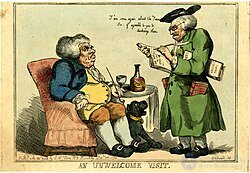
An English caricature of 1794 depicting the arrival of the tax collector at the taxpayer's home
The existence of a stable system of taxes is a sign of a certain stage of state development. Such systems did not appear all at once. Initially, states provided for the maintenance of their armies and state apparatus largely out of funds obtained in the form of war booty, indemnities and tribute from conquered peoples[13]. In the Roman Empire the system of taxes was already quite developed and had a diverse base. The Romans carried out rather complex operations of counting the population (capitatio) for poll taxes, and of assessing property (jugatio) — for property and income taxes.
In medieval Europe the main sources of income for feudal rulers were their lands (domains) and regalia. These were private-economic revenues, which in essence are closer to commercial activity.
The tax system proper began to develop in Europe mainly from the end of the 15th and the beginning of the 16th centuries as a consequence of the replacement of the former subsistence economy by a monetary one, along with the development of foreign and domestic trade. Another impetus to the development of taxes was the need to maintain standing armies and the concentration of military power in the hands of the head of state. Reliance of the authorities on a regular army made it possible to demand the payment of taxes more decisively, taxes that went not only to maintaining the army but also to the rulers' other needs.
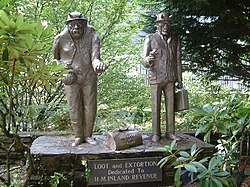
"Robbery and Extortion" — a sculpture dedicated to the British department of state revenue of the kingdom
Historically, the first regular payments were duties, that is, fees for state services: judicial, border, road, bridge, port and so on. The taxation of a ruler's own subjects was initially perceived quite negatively; it resembled tribute from conquered peoples. Gradually, indirect commodity levies were introduced — on bread, meat, salt, sugar, tobacco, spirits, and also on luxury items.
Gradually, various forms of the poll tax became widespread. It was simple to calculate, but the inability of large families to pay it gradually became apparent. It began to be replaced by various forms of proportional or progressive taxation of income, and income taxes began to be introduced ].
A country's level of taxation is often measured as the total share of taxes in gross domestic product (GDP).
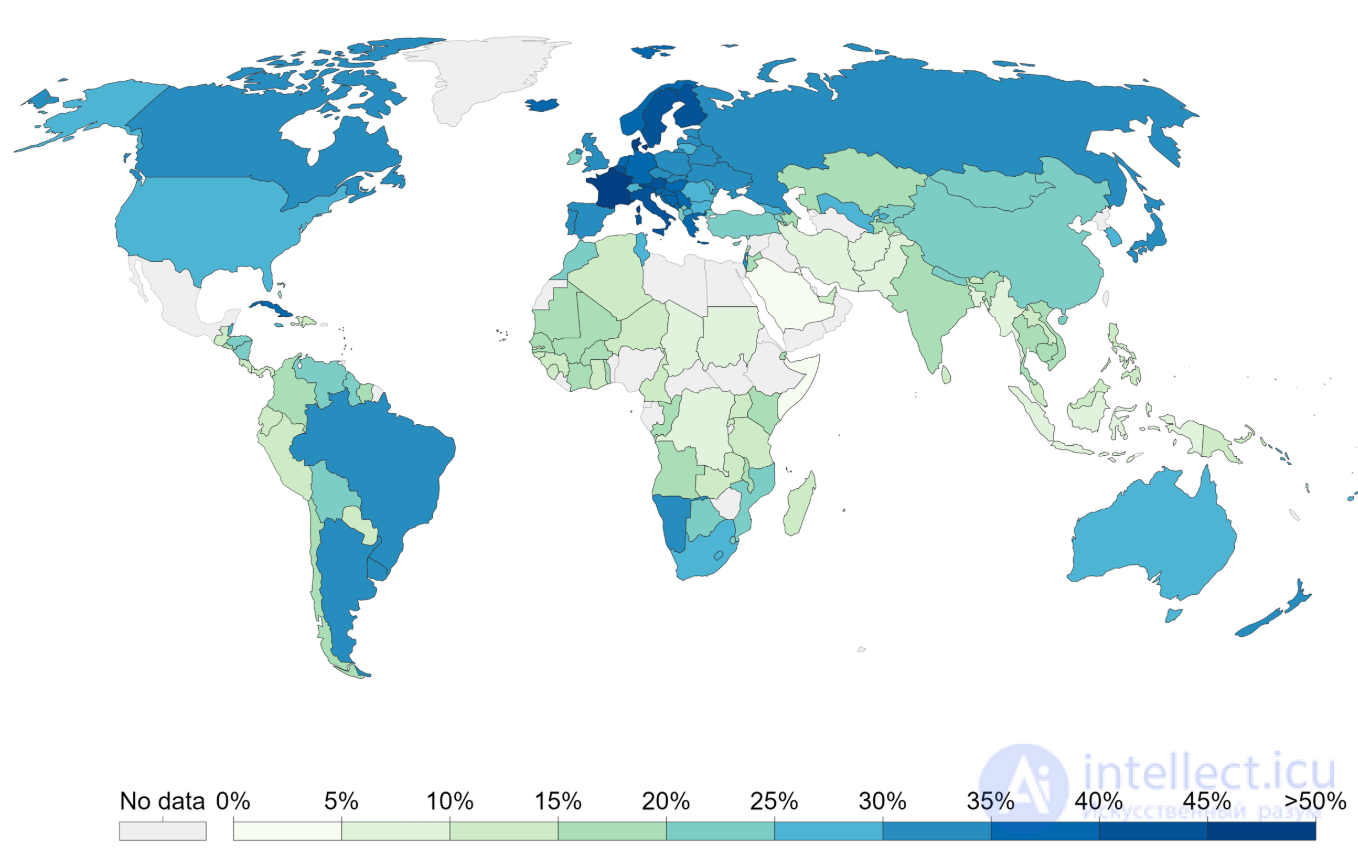
Total revenue from direct and indirect taxes, presented as a share of GDP in 2017
The Organisation for Economic Co-operation and Development (OECD) publishes data on the level of taxation in various countries:
| Country | Total tax | Taxes on income, profits, capital gains, etc. | Social contributions and pensions | Property taxes (as a % of cadastral value) | Taxes on goods and services | Other taxes |
|---|---|---|---|---|---|---|
 Canada Canada |
33,3 | 16,6 | 4,8 | 3,3 | 7,9 | 0,7 |
 Mexico Mexico |
18,0 | 5,0 | 2,8 | 0,3 | 9,5 | 0,4 |
 USA USA |
28,3 | 13,9 | 6,6 | 3,1 | 4,7 | 0,0 |
 Australia Australia |
30,8 | 18,2 | 0,0 | 2,7 | 8,2 | 1,5 |
 Japan Japan |
28,3 | 10,3 | 10,3 | 2,5 | 5,1 | 0,1 |
 South Korea South Korea |
26,5 | 8,4 | 5,5 | 3,4 | 8,3 | 0,9 |
 New Zealand New Zealand |
35,7 | 22,5 | 0,0 | 1,9 | 11,3 | 0,0 |
 Austria Austria |
42,3 | 12,7 | 14,2 | 0,6 | 11,7 | 3,1 |
 Belgium Belgium |
43,9 | 16,5 | 13,6 | 2,3 | 11,0 | 0,1 |
 Czech Republic Czech Republic |
37,4 | 9,4 | 16,2 | 0,4 | 11,1 | 0,3 |
 Denmark Denmark |
48,7 | 29,0 | 1,0 | 1,9 | 16,3 | 0,1 |
 Finland Finland |
43,0 | 16,9 | 11,9 | 1,1 | 12,9 | 0,2 |
 France France |
43,5 | 10,4 | 16,1 | 3,5 | 10,7 | 2,8 |
 Germany Germany |
36,2 | 11,3 | 13,2 | 0,9 | 10,6 | 0,2 |
 Greece Greece |
32,0 | 7,5 | 11,7 | 1,4 | 11,4 | 0,0 |
 Hungary Hungary |
39,5 | 10,0 | 12,9 | 0,8 | 14,9 | 0,9 |
 Iceland Iceland |
40,9 | 18,5 | 3,1 | 2,5 | 16,5 | 0,3 |
 Ireland Ireland |
30,8 | 12,1 | 4,7 | 2,5 | 11,1 | 0,4 |
 Italy Italy |
43,5 | 14,7 | 13,0 | 2,1 | 11,0 | 2,7 |
 Luxembourg Luxembourg |
36,5 | 12,9 | 10,2 | 3,6 | 9,9 | 0,0 |
 Netherlands Netherlands |
37,5 | 10,9 | 13,6 | 1,2 | 11,2 | 0,6 |
 Norway Norway |
43,6 | 21,0 | 9,1 | 1,1 | 12,4 | 0,0 |
 Poland Poland |
34,9 | 8,0 | 12,0 | 1,2 | 13,3 | 0,4 |
 Portugal Portugal |
36,4 | 9,4 | 11,7 | 1,4 | 13,7 | 0,2 |
 Slovakia Slovakia |
29,4 | 5,8 | 11,7 | 0,4 | 11,3 | 0,2 |
 Spain Spain |
37,2 | 12,4 | 12,1 | 3,0 | 9,5 | 0,2 |
 Sweden Sweden |
48,3 | 18,7 | 12,6 | 1,2 | 12,9 | 2,9 |
 Switzerland Switzerland |
28,9 | 13,2 | 6,7 | 2,4 | 6,5 | 0,1 |
 Turkey Turkey |
23,7 | 5,6 | 5,1 | 0,9 | 11,3 | 0,9 |
 United Kingdom United Kingdom |
36,1 | 14,3 | 6,6 | 4,5 | 10,5 | 0,2 |
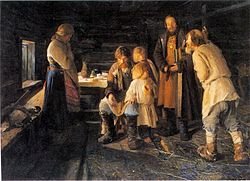
"Taxes", a painting by N. V. Orlov (1895)
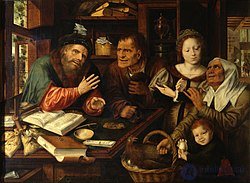
Jan Massys, The Tax Collector
The actual tax burden on the economy is understood as the share of compulsory payments actually paid to the state in the country's GDP. The tax burden varies considerably across countries. Underdeveloped countries (which lack a powerful social security system) are characterized by a low tax burden, developed ones by a relatively high tax burden (which in Sweden reached 60% of GDP in some years). The exception is certain developed countries of Southeast Asia, where the tax burden is relatively low. In Russia the tax burden in 2013 amounted to 33.3% which corresponds to the average level for the OECD (higher than in the USA, but lower than in Germany, ).
The difference between the nominal and the actual burden characterizes the degree of tax evasion. The higher the nominal burden, the greater the evasion. When the nominal burden exceeds a certain level, evasion becomes widespread and the actual burden declines. Some economists believe that the nominal tax burden should be somewhat below the "inflection point", proceeding from the concept of the Laffer curve, which depicts the relationship between tax revenues and tax rates and implies the existence of an optimal level of taxation, since higher values force taxpayers to violate tax legislation .
The tax burden on an enterprise should be understood as the ratio of the sum of taxes and deductions for which the enterprise is the real payer to the enterprise's profit. The real payer of a tax is the entity that is:
The "tax burden" indicator is used in Russia to analyze the level of taxes paid by an economic entity, with the aim of monitoring the level of payments and identifying entities potentially evading taxation.
According to the Letter of the Federal Tax Service of the Russian Federation of July 31, 2007 No. 06-1-04/505 "On the conformity of economic entities with the publicly available criteria for taxpayers' independent risk assessment used by the tax authorities in the process of selecting objects for on-site tax audits", the tax authorities pay closer attention to taxpayers whose financial reporting indicators differ substantially from the statistical averages.
Up-to-date data on the burden are set out in the Concept for the Planning of On-Site Tax Audits (order of state bodies).
The "tax burden" is calculated as the ratio of the amount of taxes paid according to the tax authorities' reporting data to the turnover (revenue) of organizations according to the data of the Federal State Statistics Service (Rosstat). The threshold value of the indicator is set annually by sector of the national economy.
The indicators "return on assets" and "profitability of product sales" are also subjected to analysis.
The state may impose taxes for various reasons: from redistributing the population's income to eliminating external economic effects. The impact of taxes can be examined at both the micro- and the macroeconomic level.
A reduction in taxes stimulates the growth of both aggregate demand and aggregate supply .
The less tax that has to be paid, the more disposable income households have for consumption. Thus, aggregate consumption grows, and consequently so does aggregate demand For this reason, governments reduce taxes when they pursue an expansionary economic policy, that is, when the state's aim is to pull the country out of the trough of the business cycle. Correspondingly, a contractionary economic policy implies raising taxes, with the aim of eliminating "overheating of the economy"
Firms perceive an increase in taxes as an additional cost, which leads them to reduce the supply of their goods . In general, a reduction in firms' supply leads to a reduction in aggregate supply . Thus, the size of the tax is inversely proportional to the amount of aggregate supply. The relationship between the introduction of taxes and the state of aggregate supply was described in detail in his works by the economic adviser to US President Ronald Reagan, Arthur Laffer, who became the founder of the theory of "supply-side economics" .
The tax burden affects the amount of financial leverage of business systems themselves in two ways: directly and indirectly :
The position that taxation is theft , and therefore immoral , is found in a number of political philosophies. Its popularization marks a significant departure from conservatism and classical liberalism, and as a result is considered radical by many . This position is often shared by anarcho-capitalists , Objectivists , most minarchists , right-libertarians and voluntaryists , as well as by left-anarchists , libertarian socialists and some anarcho-communists .
Proponents of this position regard taxation as a violation of the non-aggression principle . According to this view, the government violates property rights by applying compulsory collection of taxes, regardless of their amount. Some opponents of taxation, such as Michael Huemer , argue that legitimate property rights should be based on what he calls "natural property rights", rather than on those defined by the law of the state.
Defenders of taxation argue that the concepts of both legitimate private property rights and theft are defined by the state's legal system, and consequently taxation by the state does not constitute a violation of property rights unless the tax itself is unlawful. Some defenders of taxation, such as the socialist Matt Bruenig , argue that the phrase "taxation is theft" is a logical fallacy , since it is based on the assumption of a particular theory of property rights.
In the 17th century John Locke, inthe "Second Treatise of Government", took the position that governmental power arises from the consent of the governed , and not through the divine right of kings . The libertarian activist L. K. Samuels, in his work "The Rulers' Paradox", argues that since citizens are the holders of all rights, government bodies obtain their power to govern society through the election of state officials. In this context, Samuels argues that citizens can grant only those rights that they themselves possess. The rulers' paradox comes into effect when government bodies exercise rights that citizens do not possess or could not possess. In Samuels's words: "If ordinary citizens could kill, steal, imprison, torture, kidnap and tap telephone conversations without any charges, that power could be transferred to the government for its democratic arsenal of political weapons." [ 11 ] Taxation can be regarded as theft, since, according to Locke's doctrine of natural rights, governmental power must derive its rights from the citizens.
Lysander Spooner , a 19th-century lawyer and political philosopher who argued before the US Supreme Court, wrote the essay "No Treason: The Constitution of No Authority" . In it he argued that a supposed social contract cannot serve as a justification for government actions such as taxation, since the government will apply force against anyone unwilling to enter into such a contract.
No open, avowed or responsible association or body of men can tell him this, because there is no such association or body of men in existence. If anyone claims that such an association exists, let him prove, if he can, who compose it. Let him produce, if he can, any open, written or other authentic contract, signed or agreed to by those men who formed the association, declared themselves such to the world, appointed it their agent and assumed individual or collective responsibility for its acts done on their behalf. Until all this is proved, no one can say that in any legal sense such an association exists; or that he is their agent; or that he ever gave them an oath; or ever swore allegiance to them.
The 19th-century French economist Frédéric Bastiat called taxes legal plunder . Bastiat believed that the only legitimate function of the state is the protection of the individual's life, liberty and property.
Now, legal plunder can be carried out in an infinite multitude of ways. Hence there arises an infinite multitude of plans of organization: tariffs, protection, benefits, bounties, encouragements, progressive taxation, free public education, the right to work, the right to profit, the right to wages, the right to relief, the right to the tools of labor, credit bounties, etc., etc. And it is all these plans taken as a whole, with what they have in common — legal plunder — that bear the name of socialism. [ 15 ]
Murray Rothbard, inhis work "The Ethics of Liberty" (1982), argued that taxation is theft, and that resistance to taxation is therefore legitimate: "Just as no one is morally bound to answer a robber truthfully when he asks if there are any valuables in the house, so no one can be morally bound to answer truthfully similar questions asked by the state, for example when filling out a tax return."
Andrew Napolitano attempts to substantiate the position that "taxation is theft" in his book "It Is Dangerous to Be Right When the Government Is Wrong", where he poses a series of rhetorical questions, such as "Is it theft if one person stole a car?" and "What if a gang of ten people held a vote (allowing the victim to vote as well) on whether to steal the car before stealing it?", demonstrating, in his view, the similarity between theft and taxation
types of taxes:
продолжение следует...
Часть 1 Tax: types and essence

Comments