A dual-circuit economy is a concept for organizing an economic system in which economic activity is structured as two interconnected but functionally distinct circuits (levels, spheres), each of which performs its own tasks and is governed by its own regulatory mechanisms. The term is used in economic theory, political economy, institutional analysis, and in applied models of the development of states and large economic systems.
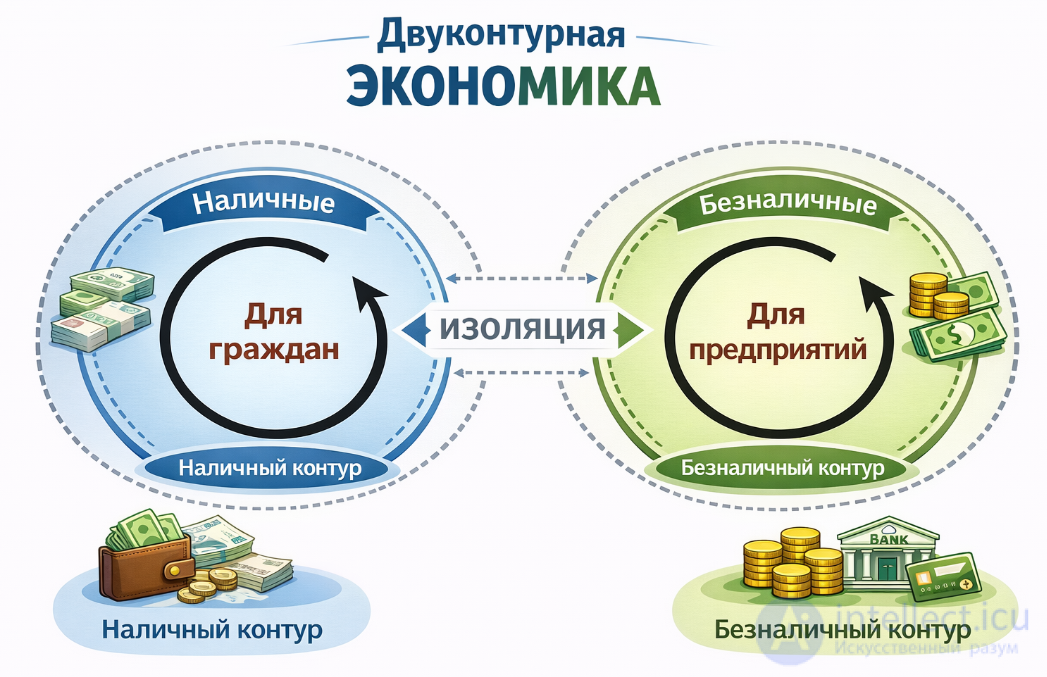
A dual-circuit economy (or monetary and financial system) is a model in which two circuits of money exist in parallel: one for settlements between enterprises (non-cash, "accounting" money) and another for payments to the population (cash), which in the USSR created a rigid separation of and control over financial flows, preventing the "cashing out" of funds and embezzlement; today, however, modern variants are being discussed for the development of investment (for example, national digital currencies) that create reserve investment circuits complementing the emission circuit.
In the Soviet context (a historical example)
- Separation of money: There were non-cash rubles for settlements between state enterprises and cash rubles for wages, travel allowances and personal expenses.
- Control: Non-cash money could not be freely converted into cash, which limited the theft of raw materials and products, since the bulk of funds was "locked" in non-cash form.
- Purpose: Centralized allocation of resources and the maintenance of control over monetary flows under a planned economy. Thanks to this isolation of some monetary flows from others, the state could issue non-cash rubles without this fuelling inflation in cash rubles, and this money went towards infrastructure development. In addition, corruption was significantly reduced among the decision-makers (DMs) involved in these allocations.
- Problems: it can work only in a planned economy
Contemporary proposals (for example, in Russia)
A dual-circuit economy is a model in which:
- the first circuit is oriented towards basic reproduction, stability and public needs;
- the second circuit is directed towards innovation, growth, capital accumulation, market efficiency and external competition.
Both circuits exist simultaneously and interact with each other, but are regulated by different instruments and logics.
- Investment circuit: The creation of a reserve investment circuit by means of non-emission securities (for example, digital financial assets) backed by goods.
- Linkage of the circuits: This new circuit is intended to link the financial and real sectors of the economy, complementing the existing system of money issuance without creating surrogates.
- Purpose: The generation of long-term and cheap investment resources for economic development, without restoring old systems.
- The introduction of national digital currencies is possible
Historical background
The idea of dividing an economic system into circuits arose as a response to the contradiction between:
- the need for social stability;
- the need for economic dynamism and development.
Sources of the idea:
- Marxist political economy (the distinction between base and superstructure, between reproduction and accumulation);
- Keynesianism (the delimitation of the state and market sectors);
- institutional economics;
- the experience of planned and mixed economies of the 20th century;
- contemporary development models of China and other states with an active role of the state.
The structure of a dual-circuit economy
1. The first circuit (basic, social, reproductive)
Characteristic features:
- orientation towards sustaining the life of society;
- relative stability;
- priority of public interests.
Includes:
- infrastructure (energy, transport);
- education and healthcare;
- basic production;
- social protection;
- the state sector and regulated industries.
Regulation:
- state planning;
- budget financing;
- administered pricing;
- long-term strategies.
2. The second circuit (market-based, innovative, competitive)
Characteristic features:
- orientation towards growth, profit and efficiency;
- high volatility;
- competition and entrepreneurship.
Includes:
- private business;
- innovative industries;
- export-oriented production;
- financial markets;
- start-ups and venture projects.
Regulation:
- market mechanisms;
- competition;
- investment incentives;
- a flexible institutional environment.
Interaction of the circuits
The key feature of a dual-circuit economy is the inseparable link between the circuits:
- the first circuit provides a stable foundation for the second;
- the second circuit generates resources and innovations for the first;
- crises in the second circuit can be offset by the resilience of the first;
- excessive pressure from the first circuit can reduce the efficiency of the second.
Maintaining a balance between the circuits is a strategic task of economic policy.
Advantages of the model
- resilience to crises;
- the combination of social justice and economic growth;
- flexibility amid technological and geopolitical change;
- the possibility of long-term planning without suppressing initiative.
Risks and limitations
- the danger of excessive state control;
- institutional conflicts between the circuits;
- corruption-related distortions;
- gaps in income and access to resources;
- the complexity of management and coordination.
Contemporary interpretations
In the 21st century the concept of a dual-circuit economy is applied in the context of:
- sustainable development;
- digital transformation;
- national economic security;
- "dual circulation" (domestic and external markets);
- the combination of the AI economy and traditional industries.
Significance in theory and practice
The dual-circuit economy is regarded as:
- a theoretical model for analysing complex economic systems;
- an instrument of state policy;
- a method of balancing stability and development.
It is especially relevant for countries with transitional, mixed or strategically managed economies.
See also
- Mixed economy
- Institutional economics
- State regulation
- Economic sustainability
- Systems analysis of the economy


Comments