
Lecture
The informal economy is a sector of the economy, a field of human activity aimed at obtaining benefit, in which the principal regulation takes place by means of dominant informal norms; it may be defined as all economic activity that, for various reasons (non-monetary turnover, high taxes, statutory prohibitions, etc.), is not captured by official statistics and is not included in GDP .
The term itself is an example of a «negative» definition, that is, a definition by exclusion ; there is no consensus among economists as to what should be counted as the informal economy .
Whether some economically motivated activity can be counted as an element of the informal economy is determined, above all, by the law . Social norms and morality are not decisive here: for example, theft and robbery are elements of the informal economy, whereas confiscation is not.
The informal economy in the broad sense is identical to the non-observed economy; it includes as subsets the irregular, «grey» and shadow economies, as well as many others.
The informal economy may be defined as the set of relations inherent in the economy as a whole or — within the economic-sociological approach — as a particular strategy (logic) of economic agents , a way of earning a living by meeting people's demand irrespective of the legality of the actions undertaken, and, on the other hand, as an opportunity for economic actors to pursue their goals under conditions more acceptable to them than those that exist within the framework of the law.
Besides this broad sense, the «informal economy» is defined as the «grey» economy: activity aimed at obtaining benefit where the incomes and the ways of obtaining them remain outside the management of state institutions, while similar types of activity are regulated by them . The «grey» economy is concealed activity that could be disclosed, but which those who carry it out find it more advantageous to keep out of the sight of supervisory authorities. This narrower definition includes the legal types of activity of the shadow economy (excluding its criminal types, see black market) and does not include the social economy (including the household, communal and moral economies), which is difficult to account for even when no attempt is made to conceal it.
In the regulatory documents of Rosstat of the Russian Federation, informal economic activity is defined more narrowly — in effect, as the household or communal economy: as activity carried out mainly on a lawful basis by individual producers or unincorporated[10] enterprises producing goods partly or wholly for their own consumption[11].
Attempts by the state to regulate people's activity arose no later than in Sumer. To this day none of these attempts at regulation has been carried out fully and completely, since in any society there are people who seek to evade regulation.
When formal regulation had not yet appeared, activity within the framework of informal norms already existed, and its first name in economic theory was the «traditional economy». A new name appeared because under new conditions the content of the activity changed, and also because the old name was used in theories that did not explain the existence and growth of such an economy under conditions of a developed economy.
In the 1960s one of the modernisation theories (developmentalism)[12] predicted that the traditional sector of the economy in developing countries would disappear as a result of economic progress, when outdated traditional forms of labour organisation would be displaced by more progressive and more efficient new forms. This did not happen; moreover, such activity even expanded, and economists began a more detailed study of this sector. It was found that it was not only failing to contract, but was even absorbing and mastering new technologies, being more competitive in certain kinds of activity.
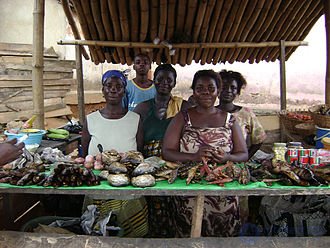
A market in Ghana
The term «informal economy» was introduced with respect to such activity by the English anthropologist Keith Hart[en] when he was carrying out research commissioned by the International Labour Organization in 1971 in Ghana and in 1972 in Kenya, which showed that a significant proportion of city dwellers engaged in small and medium-sized business had virtually no connection with the official state economy[13]. He showed that informal activity follows market logic, although there are a number of substantial differences between it and activity within the formal economy.
An enormous influence on subsequent research into the informal economy was exerted by the book The Other Path by the Peruvian economist Hernando de Soto, Archived copy of 22 May 2009 at the Wayback Machine. De Soto showed how the actions of his country's government forced the population to ignore laws that prevented people from simply living and meeting their needs. The government's actions to monitor compliance with such laws forced people to engage in unproductive activity: a politicised struggle with the state, which led to the legalisation of many unlawful types of activity and property rights, and this did not change the overall picture, since both new illegals and new illegal types of activity appeared.
Criticising the government's actions, de Soto showed that the economic system of Peru (and of many other developing countries) can be characterised not as a market economy but as mercantilism. This book largely shifted responsibility for the existence of the informal economy from the backwardness of the local population to the backwardness of state and social institutions in society. Considerable influence on the development of the concept of the informal economy was also exerted by Ronald Coase with his «Theory of Property Rights»[14] and by Becker with his book «Crime and Punishment: An Economic Approach»[15].
The term informal economy used to be associated with developing countries, where about half the population may work outside the taxation system, but, as became clear, all economic systems contain it to one degree or another. In the late 1970s a number of articles appeared in the United States which highlighted for researchers the problem of the informal economy in developed countries as well, in particular in the USA (Gutmann, 1977; Feige[en], 1979) and the USSR (1977, Grossman[16]; Katsenelinboigen[17]). Such an economy came to be called the shadow, underground or illegal economy, emphasising not its informal character but its concealment from supervisory authorities, since in developed countries there is a more settled system of state and social institutions, and the state has greater capacity to regulate citizens' economic activity.
The origin of the informal economy is inseparably linked with traditionalism[18]. Since the 1970s the growth of the informal economy has been observed in the majority not only of developing but also of developed countries[19] This trend is primarily connected with the state's aspiration to broaden and deepen legal control over various areas of people's activity. However, it may also be stimulated by the state's slowness in regulating the economy under conditions of a rapidly changing market situation, or by the monopolisation by transnational corporations of entire markets for goods and services.
The extralegal economy is the spontaneous and creative response of the people to the state's incapacity to satisfy the basic needs of the impoverished masses[20](Hernando de Soto)
Individuals seek acceptable forms of adaptation on the basis of previously formed experience; the moral and ethical basis and specific skills of running a household may be passed from generation to generation regardless of current legislation, and therefore the adoption of laws without the implementation of measures that genuinely influence people's behaviour is practically useless. People, while admitting ignorance of the laws, characterise them, or the monitoring of their enforcement, negatively in order to justify such activity in their own minds[21].
The homeless
Poverty is simultaneously a consequence and a cause of the existence of the informal economy[22], since poor citizens are interested in obtaining at least some income, and the legality of the way of obtaining it takes second place[23] to the need to survive[24]; getting by this way requires resourcefulness. People from certain social groups may have practically no chance of legal employment. In some cases the homeless themselves seek to end up in prison[25]. For the poorer strata of the population, the loss of time associated with being taken into custody is not as frightening as fines; for the rich, correspondingly, losses of time are more frightening than fines.
Needs are boundless, whereas the state's power of coercion is limited, as are its resources; this makes it impossible to establish the rule of law in cases where laws clearly disadvantageous to society are in force in a state, and people commit offences even under threat of the death penalty[26]. It follows from the models of the economics of crime and punishment that the greater the profit an offence can bring, the more resources will have to be spent on deterring it, or the more severe the laws that will have to be enacted. Corruption of legislative bodies leads to the adoption of laws without balancing the interests of the individual, society and the state.
The trust of economic agents in one another, as an important element of informal ties, is extremely important for the existence of the informal economy[27]. According to Rousseau's social contract theory, the state should act as a guarantor agent and provide citizens with public goods; however, when its functions and powers are privatised by shadow structures, it loses these functions, which leads to a loss of trust in the state and in the law as guarantors of compliance with the rules[28].
The design of the state and of the laws on which it is based is imperfect. The interpretation of law is a never-ending process, not least because laws are written in natural language with all[29] its multiplicity of meanings. The imperfection of laws is due, among other things, to the fact that the customs of business practice in society may be unclear or unknown to state bodies, just as the mechanism for participating in the adoption of laws may be unclear to broad strata of society.
In some cases a law is adopted not in order to entrench a certain course of action or to solve an existing problem of society, but in order for particular people or groups to obtain material or political advantage[30][31].
To this day no unambiguous and generally accepted terminology and classification of the various forms of non-observed activity has been developed. This is connected primarily with the many-sided nature of the phenomenon of the informal economy, with the fact that this phenomenon is studied by representatives of different disciplines (anthropology, law, psychology, sociology, criminology, various branches of economics, etc.) from different countries with differing laws. The very nature of this activity is such that it is difficult to obtain complete and verifiable data on it. Precisely defining the types of activity that make up the informal economy is also impossible because its composition can change almost instantaneously as a result of changes in the law.
| [32] | The rights of another economic agent | |
| Legality | Violated | Not violated |
| The law is broken | Illegal criminal «black» economy | Informal «grey» economy |
| The law is observed | Extralegal «pink» economy | Legal «white» economy |
The extralegal «pink» economy includes, for example, financial pyramid schemes.
| Legality of the form of activity | Compliance with fiscal rules | ||
| Communal and household economies | + | + | Official economy |
| Informal economy | + | - | Shadow economy |
| Illegal economy | - | - | Fictitious economy |
| (less) →connection→with→the→official→economy→ (more) | |||
The fictitious economy is unlawful activity by agents employed in the official economy that is connected with the concealed redistribution of legal incomes. Such activity may be carried out by people in managerial positions, and for this reason this variety of concealed economic activity is also called «white-collar»; it is heavily dependent on the official economy. It encompasses a wide range of activities, including corruption, tax evasion, fraudulent bankruptcies and industrial espionage, and often inflicts greater damage on the state, corporations and society than other types of concealed activity.
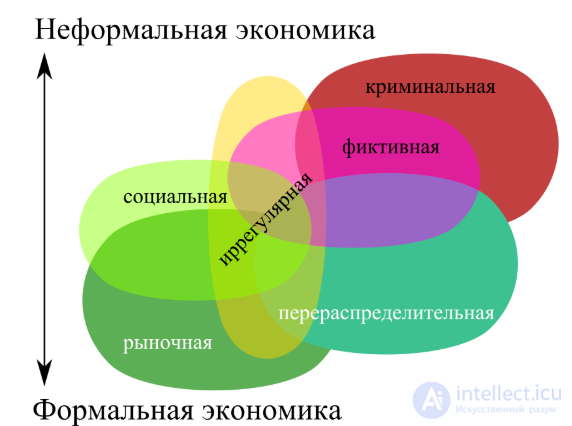
One version of the interpenetration of different types of economies
In the figure above, the formal economy is made up of two sectors: the market economy of free enterprise and the redistributive economy of state regulation. The irregular economy is work «on the side»; the social economy is the sector of economic activity that does not use money as a medium of exchange, in which «social capital»[33] — obligations accepted by individuals — is used instead.
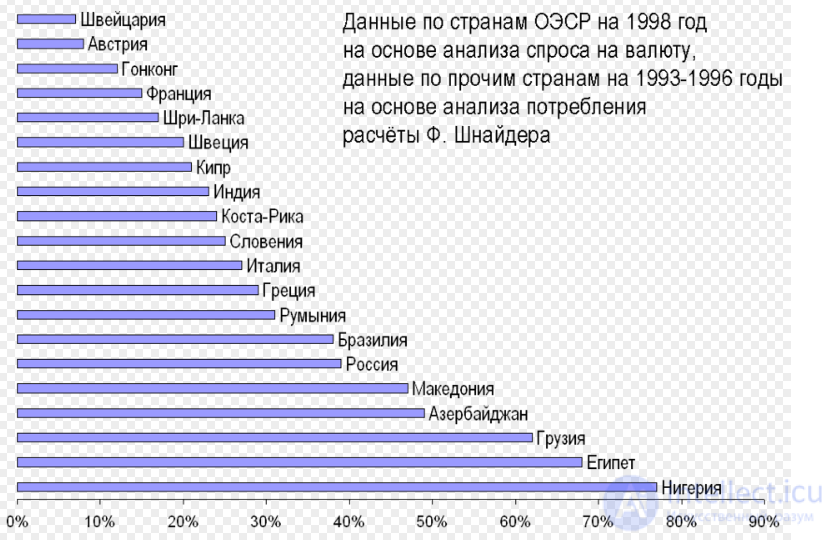
The informal economy as a percentage of GDP.
In the economies of excessively bureaucratised and corrupt developing countries, the informal economy substitutes for the official economy, allowing people to survive and to work[20]. At the same time, in most developing countries drug production with subsequent export (and other destructive activity) accounts for a comparatively small share of the total volume of the informal economy, although there are exceptions to this rule: according to CIA data, 80–90 % of the heroin consumed in Europe is made from raw material produced in Afghanistan[34]. At the same time it is beyond doubt that part of the income from this goes to finance military operations which are interpreted on the one hand as terrorism and on the other as a struggle for freedom.
Extremely instructive in this case is the example of the decolonisation of Africa, which ultimately led to an expansion of the informal economy sector, especially in West Africa. The very fact of decolonisation is assessed differently by experts depending on their political views, but its consequences, associated with the abrupt severing of economic ties and the dismantling of functioning social institutions in the absence of national managerial cadres, often proved fatal. Social institutions that vanished in an instant inflicted serious damage on the economies of African countries. The economy of Southern Africa as a whole had still not reached, by the beginning of the new millennium, the level preceding decolonisation in the 1960s[35].
In developing countries the largest share of the informal economy is concentrated in such industries as construction, clothing manufacture and retail trade[36].
During the transition to a different economic system at the time of the collapse of the USSR, informal relations enabled many enterprises to continue functioning; the informal sector was reoriented from supplying the population with scarce goods (mainly redistributive activity) to selling cheaper, more widely available and often lower-quality goods, while the old informal sector practically dissolved into trading activity. State control in transition economies is far more substantial than in developing countries, and the main component of the informal economy consists of transactions concealed from the state by registered firms.
If the level of the tax burden is calculated as a weighted average for the «white» and «shadow» sectors of the economy, then a reduction in tax rates may lead to an increase in the average tax burden through a contraction of the «shadow» sector and an increase in tax collection[37]. In 2004–2005 in Russia the share of the shadow sector fell by approximately 6.2 % owing to the introduction of the simplified taxation system[38].
Developed countries are states with a developed market economy, long-standing traditions of market institutions and a stable political system, with relatively high levels of household income and industrialisation. Recently the share of the shadow economy in developed countries has been increasing, which is attributed to greater control on the part of the state.
In the 1960s, against the background of the dismantling of the colonial system, the process of globalisation of the economies of developed countries continued; the shortage of unskilled labour in many of them was resolved through migration from Third World countries. This process contributed substantially to the growth of the informal economy in developed countries, since less well-off migrants are more readily drawn into the informal economy.
The share of the informal economy in the service sector is large, which is connected both with the fact that the main capital of those employed in the informal sector is human capital[39] and with the ease of avoiding taxation when dealing directly with the customer.
The high level of household income in developed countries makes it possible to satisfy the demand for such illegal luxury items as high-priced drugs (for example, Colombian or Peruvian cocaine), but this expenditure accounts for a small part of spending on household services, construction and repairs. As of 1997 the turnover of the drug market accounted for 8 % of world trade[40].
As direct methods of estimation, it is possible to use data from sociological surveys, for example on employment in the informal sector. There is also a large number of analytical methods for estimating the scale of the concealed economy[41]. The discrepancy method makes it possible to establish the probable existence and approximate size of the informal sector by using different methods of calculating one and the same indicator — for example, GNP measured separately by income and by expenditure.
Usually the informal economy in its full extent is not directly observable; its size is estimated indirectly by the following methods:
Within the monetary method of estimation based on the demand for cash, the following propositions are assumed:
The contestability of this method is obvious, since
Nevertheless this method is used (analysis of the volume of monetary transactions, the Gutmann and Feige methods), and it is even being developed further through the application of correlation and regression models that take into account incomes, taxes, interest rates and the functioning of the informal sector itself.
Indirect methods generally yield an overstated estimate, while direct methods, on the contrary, yield an understated one[42], presumably because under direct analysis individuals tend to conceal their participation in the informal economy by whatever means are available to them, whereas under indirect analysis the estimate is affected by a multitude of factors that cannot be corrected for.
Although estimates of the shadow economy accurate to fractions of a percentage point are encountered, even combining different approaches to estimating the share of the informal economy clearly does not make it possible to achieve such precise results: for example, estimates of the share of the informal economy in the USA in 1977–1978 varied from 4.4 %[43] – 10 %[44] to a third[45] of the entire volume of the economy. This is connected with the use of indirect methods of studying the informal economy, direct collection of information on which is in most cases ineffective.
Difficulties in collecting information for the analysis of the informal economy may be connected, for example, with the difficulty of reliably dividing certain economic phenomena into formal and informal ones. Thus, in the 1990s, under the conditions of a transition economy in Russia, barter was extremely widespread as a type of relationship, and barter often masked what in criminal law is termed commercial bribery: formally one consignment of goods was exchanged for another consignment of goods, while in reality the party that was more interested in the transaction taking place was at the same time paying the other party.
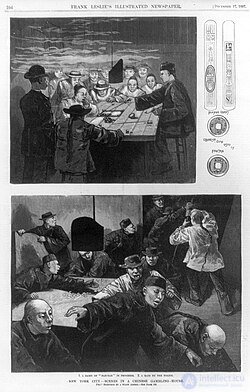
A Chinese gambling house, New York, 1887.
Among illegal but profitable types of activity are such as
Among the types of activity that are frequently prohibited are such as
the demand for which pushes people into breaking the law.
The higher the profitability of an industry and the more heavily it is regulated, the larger, other things being equal, will be the share of the informal economy within it. Recently cryptocurrencies, for example Bitcoin, have become widespread.
Sometimes prohibitive measures produce the opposite effect. A frequently cited example is the rise in prices and in the volume of trade in «ebony» (black slaves) at a time when slavery in the USA was permitted while the importation of slaves from Africa was prohibited; another example cited is the situation with the prohibition of drugs, the significant growth in consumption of which occurred precisely after they were banned. The economic mechanism here is fairly similar: initially the ban creates a shortage; because of the shortage prices rise to a level that compensates for the increased risk; the possibility of obtaining extremely high profits stimulates supply, and the increased size of supply in turn stimulates demand.
Because of the inelasticity of demand for drugs[48] and alcohol on the part of consumers accustomed to them, prohibitive measures often prove of little effect, since consumers are prepared to compensate producers and distributors for their risks. Some researchers of the «economics of drugs» within the framework of the economics of crime and punishment argue that the tightening of prohibitive measures is justified; others, that this sphere must be fully legalised; a third group, that medical legalisation with the retention of control can decriminalise this sphere without negative consequences[49].
| Approximate share of presence for 2003–2004 | |
|---|---|
| World average | 35 % |
| China | 91 % |
| Ukraine | 91 % |
| Russia | 87 % |
| Eastern Europe | 61 % |
| European Union | 36 % |
| Canada | 35 % |
| USA | 21 % |
In some cases prohibitive measures are difficult to introduce because of technical constraints. Acquiring legal versions of proprietary software, and of films and music protected from distribution by copyright, entails paying substantial sums to sound- and film-recording companies; but since these goods can (once copied) be consumed by a practically unlimited number of consumers without any reduction in the utility that each of them receives, and since it is extremely difficult, in the case of mass sales, to restrict other people's access to them, this brings the goods in question close to being public goods. Copyright rules must strike a balance between providing authors with an incentive to create works and the positive economic effect of the free use of these goods.
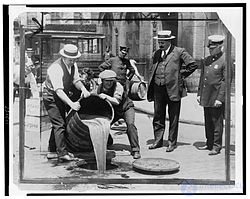
Police pouring alcohol into the sewer.
The scale of the informal economy in the spirits and vodka sector can be gauged from the following data: in 1996 the capacity of all Russian vodka distilleries amounted to 230 million decalitres, and their official capacity utilisation was 30 %, while at the same time, over the course of 1996, 214 million decalitres of vodka and spirits products were sold in Russia[50]. Thus about two thirds of the vodka sold had been produced illegally.
During the «semi-dry» law in the USSR, sales of eau de cologne rose by half, sales of glue by more than 30 %, and of window-cleaning fluid by 15 %[51]. At the same time, in connection with the restrictions introduced, consumption of alcoholic beverages in terms of ethanol fell by approximately 40 %[52]. Home production was strongly felt on the scale of the entire economy — sugar consumption rose by 20 % because of home distilling. The cost of obtaining alcoholic beverages legally consisted of the comparatively low price of the alcohol and greatly increased transaction costs.
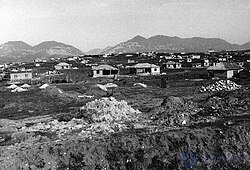
An illegal settlement north of Tirana
Under conditions of severe restrictions on acquiring land as property, unauthorised seizure of it may develop. Illegal seizure of land may be carried out both by individuals and on a mass scale. Particular attention is paid to the speed of erecting temporary structures and fencing. People who have despaired of obtaining land by lawful means prepare supplies and building materials in advance, so as to manage to found a settlement before representatives of the authorities can prevent them. Large settlements even have something resembling a court — this is usually administered by a leader chosen by the people, who may also represent the settlement before the authorities in order to have it legalised[20].
The Sicilian mafia engaged in racketeering and extortion-based protection of businesses for centuries, effectively duplicating the system of state authority. The very existence of the mafia was largely grounded in the weakness of state power on the island of Sicily, historically separate from Italy, and in a centuries-old tradition. During Mussolini's dictatorship the mafia was virtually suppressed under the conditions of a strengthened dictatorial state.
However, in the period after the fall of Mussolini's regime, in the post-war years, the mafia once again came to play a dominant role on the island owing to the weakening of the central government's role. Ultimately, after the stabilisation of Italy's economy in the 1960s and the strengthening of the state's role, an original method of combating the mafia was implemented with the participation of the Jesuit religious order:
In this way, conditions were created in which people who ensured the genuine enforcement of laws came into positions of power, generating economic incentives for people not to support racketeering, so that the mafiosi could no longer carry out this activity on the former scale.
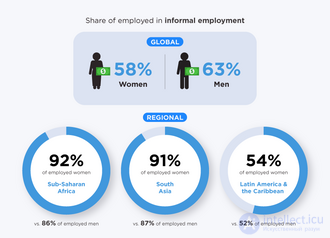
Share of those employed in the informal sector of the economy by gender
According to development and transition theories, workers in the informal sector generally earn less, have unstable incomes and lack access to basic protections and services. [ 45 ] [ 46 ] The informal economy is also much larger than most people imagine, and women play an enormous role in it. The working poor, especially women, are concentrated in the informal economy, and most low-income households rely on this sector for their livelihood. [ 5 ] However, informal enterprises may also lack growth potential, trapping employees in low-skilled work indefinitely. On the other hand, the informal sector can allow a significant share of the population to escape extreme poverty and earn an income sufficient for survival. [ 47 ] Moreover, in developed countries some people working in the formal sector may prefer to perform part of their work outside the formal economy precisely because it gives them greater advantages. This is called «moonlighting». They receive social protection, a pension, child benefits and the like thanks to their official job, while at the same time enjoying tax and other advantages by working in parallel.
From the point of view of governments, the informal sector can create a vicious circle. Unable to collect taxes from the informal sector, a government may have difficulty financing public services , which in turn makes this sector more attractive. Conversely, some governments regard informality as an advantage, allowing surplus labour to be absorbed and unemployment problems to be mitigated. [ 47 ] Recognising that the informal economy can produce a significant quantity of goods and services, create needed jobs and contribute to imports and exports is of decisive importance for governments. [ 5 ]
Since work in the informal sector is neither monitored nor registered by the state, its workers are not entitled to social security and face unique difficulties in joining trade unions or forming them . [ 48 ] Workers in the informal economy work overtime more often than workers in the formal economy, who are protected by labour legislation and regulations. A landmark study conducted by the World Health Organization and the International Labour Organization found that exposure to long working hours caused approximately 745,000 deaths from ischaemic heart disease and stroke in 2016. [ 49 ] A systematic review and meta-analysis of health service utilisation and treatment outcomes among informal economy workers compared with formal economy workers showed that these workers use health services less often and suffer from depression more often, underscoring their substantially poorer health. [ 50 ]
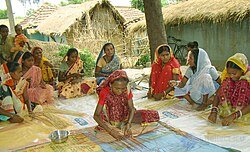
A group of Indian women make bamboo products for sale in the town of Dumka, Jharkhand state.
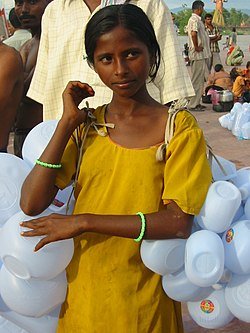
A girl sells plastic containers for carrying water from the Ganges, Haridwar , India.
In developing countries the greater part of the female non-agricultural labour force is employed in the informal sector. [ 51 ] Women's representation in the informal sector is driven by a multitude of factors. One such factor is that employment in the informal sector is the most accessible source of employment for women. [ 52 ] A 2011 study of poverty in Bangladesh found that cultural norms, religious seclusion and illiteracy among women in many developing countries, along with greater commitment to family responsibilities, prevent women from entering the formal sector. [ 53 ]
The main occupations in the informal sector include home-based workers (such as dependent subcontractors, independent own-account producers and unpaid workers in family enterprises) and street vendors , both of which belong to the informal sector. [ 52 ] Women as a rule make up the largest share of the informal sector, often ending up in its most precarious and corrupt segments. [ 45 ] In India women working in the informal sector often work as waste pickers , domestic workers , porters, traders, beauticians, construction workers and seamstresses.
According to a 2002 study commissioned by the ILO, the link between employment in the informal economy and poverty is stronger for women than for men. [ 6 ] While men tend to be over-represented in the upper segment of the informal sector, women predominate in the lower segment. [ 6 ] [ 45 ] Men are more often engaged in large-scale operations and trade in non-perishable goods, whereas among women there are few employers who hire others. [ 6 ] Instead, women more often take part in small-scale operations and trade in food products. [ 6 ] Women are under-represented in high-paying positions in the informal economy and over-represented in low-income positions. [ 6 ] As a result, the gender wage gap is higher in the informal sector than in the formal one. [ 6 ] Labour markets , household decisions and the state all contribute to this gender inequality . [ 45 ]
Workers in the informal economy have no significant influence on public policy. [ 28 ] Not only is the political power of informal sector workers limited, but the very existence of the informal economy creates problems for other politically influential actors. For example, trade unions have difficulty organising informal economy workers, and often unionised formal sector workers show no direct interest in improving the position of informal sector workers out of fear of losing status. Nevertheless, the informal economy negatively affects union membership and investment. Workers who could be formally employed and join a union for protection may prefer instead to start their own business. Although such a hostile attitude is not always present, the nature of informal employment — low and irregular income that is insufficient to pay union dues, rapidly changing decentralised workplaces, and informal sector workers' self-perception as self-employed — creates barriers to union organising in the informal economy. [ 54 ] As a result, trade unions tend to oppose the informal sector, emphasising the costs and disadvantages of this system. Producers in the formal sector may also feel threatened by the informal economy. The flexibility of production, the low labour and production costs, and the bureaucratic freedom of the informal economy may be seen as substantial competition for formal sector producers, prompting them to contest and object to this sector. Finally, the nature of the informal economy is to a large extent anti-regulatory and free of standard taxes, which reduces the material and political power of state agents. Whatever the significance of these concerns, the informal sector can redistribute political power and energy. [ 28 ]
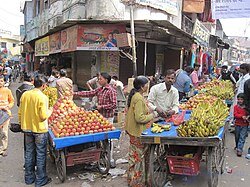
Informal traders in the state of Uttar Pradesh
The link between the informal sector and poverty is certainly not simple, and no clear causal relationship exists. However, an inverse relationship is observed between the growth of the informal sector and the slowing of economic growth . [ 45 ] Average incomes in the informal economy are substantially lower, and the poor population predominates in the informal sector. [ 55 ] In addition, informal economy workers are less likely to benefit from unemployment benefits and social protection programmes. [ 5 ] For example, a study in Europe shows that respondents having difficulty paying their utility bills worked in the informal sector more often in the past year than those without such difficulties (10% versus 3% of respondents). [ 56 ]
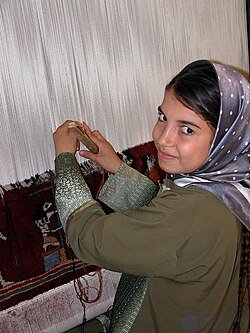
A girl weaving a carpet in Egypt
Children work in the informal economy in many parts of the world. They often work as waste pickers (collecting recyclables from streets and dumps), day labourers, cleaners, builders, vendors, take part in seasonal work, and work as domestic workers and in small workshops; and they often work in dangerous and exploitative conditions. [ 57 ] [ 58 ] In some parts of Latin America and Asia children often work as domestic servants . Such children are highly vulnerable to exploitation: they are often not allowed breaks or are forced to work long hours; many suffer from a lack of access to education, which can contribute to social exclusion and a lack of future opportunities. UNICEF considers domestic work one of the lowest-paid forms of work and reports that most children working as domestic servants live in the employer's house and are under round-the-clock control. [ 59 ] Some estimates indicate that among girls domestic work is the most widespread form of employment. [ 60 ]
In periods of economic crisis many families face unemployment and job loss, which compels adolescents to supplement their parents' income by selling goods or services in order to contribute to the family economy. In essence, young people are forced to sacrifice their social activity with other young people and instead prioritise participation in the informal economy, thereby forming a working class of adolescents who must take on an adult role in the family. Although this is associated with the negative stigma of deviant behaviour, for most people, mainly for people of colour, the informal economy is not an ideal choice but a necessity for survival. Participation in the informal economy becomes the norm because of the shortage of resources in low-income and marginalised communities, and no matter how hard they work, it does not help them advance up the economic ladder. When a parent is unemployed or their work is not in demand, they are forced to seek other ways to provide for themselves and, most importantly, for their children. Nevertheless, because of all the constraints and the shortage of jobs, children end up cooperating with their parents and also working for the good of their family's economy. Because of the need to help provide for the family, children miss out on their childhood, because instead of taking part in the activities other children their age engage in, they are forced to take on adult roles, put the family first and contribute to its well-being.
Adolescents' participation in the informal economy is a contested issue because of the existing restrictions and laws binding young people to labour. One of the main dilemmas arising from involving children in this kind of work is that privileged adults condemn children's participation as forced labour. Because of the young age of the participants, the adults are considered «bad» parents since, first, they cannot provide for their children, second, they deprive the child of a «normal» childhood, and third, child labour is condemned. Furthermore, some people believe that children should not work because children do not know the risks and pressures associated with work and responsibility, but in reality in most families children are not forced to work; rather, they themselves choose to help provide the family's income. Young people are compelled to work by circumstances, that is, because of their situation they have little choice. Young people are capable of recognising their family's financial constraints, and many consider it their moral duty to contribute to the family income. Thus they end up working without asking for money or wages, because children understand that their parents cannot on their own provide the household with sufficient income, so their contribution is necessary, and their participation becomes a decisive factor in their family's economic survival. [ 61 ]
Emir Estrada and Pierrette Hondagneu-Sotelo went into the predominantly Latino communities of Los Angeles, California, to observe the everyday activities of street vendors. They analyse why adults take part in the informal economy. Although this is associated with a negative stigma of deviance, for most people the informal economy is not an ideal choice but merely a necessary measure for survival. Observing Latinos' constant struggle to survive and earn money for food, they saw how children's participation either benefits the family or even harms it. On the basis of field notes obtained in the course of their participation, Estrada argues: «Children are not simply „baggage“ that adult immigrants bring with them. In the case of street vendors, we see that they also contribute to family processes». [ 62 ] The results of Estrada's research show that children work to help increase the family income, but, most importantly, they play a vital role in overcoming language barriers. Children become more than just workers; they gain an understanding of how to run a business and trade.
The division of the economy into formal and informal sectors has a long history. Arthur Lewis, in his seminal work «Economic Development with Unlimited Supplies of Labour» , published in the 1950s, presented a famous development paradigm for the newly independent countries of the 1950s and 1960s. The model assumed that the unorganised sector with its labour surplus would gradually disappear as the surplus labour was absorbed by the organised sector. Lewis's model is based on the experience of capitalist countries, in which the share of agriculture and of the unorganised sector showed an impressive decline, but it was not borne out in many developing countries, including India. On the other hand, the probabilistic migration models developed by Harris and Todaro in the 1970s treated the phenomenon of the informal sector as a transitional stage through which migrants move into urban centres before shifting to work in the formal sector. It is therefore not surprising that policy towards the informal sector remains inconspicuous. Curiously, the informal sector finds no permanent place in Marxist theory, since they foresee the destruction of the pre-capitalist structure as a result of the aggressive growth of capitalism. In their view, in the course of development «the little fish are devoured by the big fish». Therefore neither in Marxist theory nor in classical economic theory does the unorganised sector occupy a permanent place in the economic literature. [ 63 ]
The informal sector expands as the economy is liberalised. [ 45 ] This expansionary trend began in the 1960s, when many developing countries did not create enough formal jobs in their economic development plans, which led to the formation of an informal sector that was not confined to marginal work alone and in fact contained profitable opportunities. [ 6 ] In the 1980s this sector grew in parallel with the formal industrial sectors . In the 1990s the growth of global communications and competition led to a restructuring of production and distribution, often with greater reliance on the informal sector. [ 6 ]
It is believed that over the past decade the informal economy has provided more than half of the newly created jobs in Latin America. In Africa it accounts for about eighty per cent. [ 6 ] There are many explanations of why the informal sector has expanded in developing countries over the past several decades. It is possible that the development taking place has failed to support the growing labour force in the formal sector. The expansion may also be explained by the increase in subcontracting linked to globalisation and economic liberalisation . Finally, employers may turn to the informal sector in order to reduce costs and cope with intensified competition.
Such fierce competition among industrialised countries arose after the EU's expansion into the markets of the new member states: Greece, Spain and Portugal, and especially after the creation of the European Single Market (1993, the Maastricht Treaty ). Mainly for French and German corporations this led to a systematic growth of their informal sector under liberalised tax legislation, which enhanced their mutual competitiveness and their fight against small local competitors. The continuous systematic growth of the German informal sector was halted only after the creation of the EURO and the holding of the 2004 Summer Olympic Games [ 38 ] , which were the first and (so far) only ones within the Single Market. Since then the German informal sector has stabilised at the level reached of 350 billion euros, which points to an extremely high level of tax evasion for a country with 90% wage employment.
According to data from the Swedish International Development Cooperation Agency (SIDA), the key drivers of the informal economy's growth in the 21st century are: [ 4 ]
Historically, development theories have maintained that as an economy matures and develops, economic activity will shift from the informal sphere to the formal one. In fact, much of the discourse on economic development centres on the idea that formalisation indicates the degree of development of a country's economy; more on this can be read on the page devoted to fiscal capacity . [ 64 ] However, evidence suggests that the transition from informal to formal sectors is not universally applicable. Although the characteristics of a formalised economy – full employment and an extensive social security system – have served as effective methods of organising labour and welfare for some countries, such a structure is not necessarily inevitable or ideal. Indeed, development appears to be uneven across places, regions and countries, as well as depending on the kind of work being carried out. [ 4 ] [ 64 ] For example, at one end of the spectrum of kinds of work practised in the informal economy are small enterprises and manufacturing; at the other are «street vendors, shoeshiners, scrap metal collectors and domestic servants». [ 4 ] Regardless of how the informal economy develops, its continued growth cannot be regarded as a temporary phenomenon. [ 4 ]
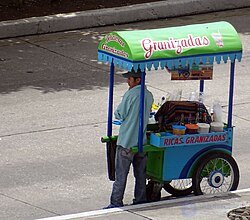
An informal beverage vendor in Guatemala
Since the informal sector has historically been stigmatised, from a policy standpoint it has been viewed as a factor undermining the national economy and impeding development. [ 65 ] The rationales for such criticism include regarding the informal economy as fraudulent activity leading to a loss of tax revenue, the weakening of trade unions, the creation of unfair competition, the loss of regulatory control by the government, reduced compliance with health and safety standards, and a reduction in the availability of workers' benefits and rights. These characterisations have led many countries to pursue containment policies through strict rules and punitive procedures. [ 65 ]
In a 2004 report, the Department for Infrastructure and Economic Cooperation at SIDA set out three perspectives on the role of government and policy with regard to the informal economy. [ 4 ]
Since the informal economy possesses considerable potential for job creation and income generation, as well as the capacity to meet the needs of low-income consumers by providing cheaper and more affordable goods and services, many stakeholders adhere to the third perspective and support government intervention and compromises. [ 4 ] [ 66 ] Underlying the third perspective is a considerable expectation that governments will revise policies that have favoured the formal sphere at the expense of the informal sector. [ 4 ]
Theories about how to adapt to the informal economy advocate public policies that, while recognising the value and importance of the informal sector, regulate and restrict it where necessary, but on the whole are aimed at improving working conditions and raising efficiency and productivity. [ 4 ]
The problem with policy measures is that there are many different kinds of informal work; a solution must take diverse circumstances into account. [ 45 ] One possible strategy could be to provide better protection and benefits for participants in the informal sector. However, such programmes may lead to a rupture between the labour market and protection, which would not in fact improve the conditions of informal employment. [ 45 ] In a 2014 report devoted to monitoring street vending, WIEGO proposed that urban planners and local economic development strategists study the carrying capacity of the areas regularly used by informal sector workers and provide the urban infrastructure needed to support the informal economy, including water supply and toilets, street lighting and a regular electricity supply, as well as adequate shelters and storage facilities. [ 66 ] That study also called for basic rights and protections for informal sector workers, such as proper licensing and permit practices. [ 66 ]
Ongoing policy debates consider the value of state tax relief for household services such as cleaning, childcare and home maintenance, with the aim of reducing the influence of the shadow economy. At present Sweden [ 67 ] and France [ 68 ] operate schemes offering 50 per cent tax relief on home cleaning services. In the United Kingdom the possibility of introducing a similar scheme has also been discussed, potentially delivering significant savings for middle-class families and a greater incentive for women to return to work after having children. [ 69 ] The European Union has used policy measures to combat the shadow economy. Although a final solution has not yet been found, the Council of the EU has led a dialogue on a platform that would tackle undeclared work. [ 70 ]
The World Bank's 2019 World Development Report « The Changing Nature of Work » [ 71 ] discusses the question of extending social assistance and insurance schemes to informal sector workers, given that in 2018 8 out of 10 people in developing countries still received no social assistance and 6 out of 10 worked informally.
The International Labour Organization has noted that in most developing countries of the Asia-Pacific region [ 72 ] the informal sector constitutes a significant and vitally important share of the labour force. This sector accounts for about 60 per cent of the labour force. The informal economy [ 73 ] includes the economic activity of workers (legally and in practice) that is not regulated or is insufficiently regulated by formal labour contracts or agreements. Informal employment means that the payment of wages may not be guaranteed, and dismissal may be carried out without prior notice or compensation from employers. As a rule, unsatisfactory working and safety conditions are observed, as well as an absence of social benefits, including sick pay, pensions and health insurance [ 74 ] . The informal economy absorbs the greater part of the constantly growing labour force in urban centres. In 2015 the urban population of Asian countries [ 75 ] began to grow, while the service sector also continued to expand. These developments contributed to a significant expansion of the informal urban economy across virtually all of Asia [ 74 ] .
In India the informal sector has accounted for more than 80 per cent of the country's non-agricultural industry over the past 20 years. The shortage of employment means that for most Indian citizens only one option remains – to find work in the informal sector, which continues to grow because of the system of contracting and the outsourcing of production. [ 76 ] An article in First Post (June 2018) states that approximately 1.3 billion people, or more than 68 per cent of those employed in the Asia-Pacific region, earn their living in the informal economy. It is widespread in rural areas (about 85 per cent) and almost 48 per cent in cities. 2 billion people of the world's population (61 per cent) work in the informal sector. [ 77 ] According to an article published in Eco-Business in June 2018, the informal sector has become an important component of the economic environment of the region's cities. Consequently, the importance of the contribution made by informal sector workers deserves recognition. [ 78 ] For a more detailed overview devoted to informal employment in the countries of South Asia, see the section «The informal economy of South
продолжение следует...
Часть 1 The informal (non-observed) economy, consisting of the irregular, grey and shadow economies
Часть 2 Iconography - The informal (non-observed) economy, consisting of the irregular,

Comments