
Lecture 93 min.
Slavery is a system of social relations in which a person (a slave) is permitted to be the property of another person (a master, slave-owner, owner, lord) or of the state. In the past, captives, criminals and debtors were turned into slaves, and later civilians as well, who were forced to work for their owner. Slavery in this form was widespread until the 20th century, and in some Arab and African countries it still exists today.
In the modern world slavery is condemned in most countries as a crime and is prohibited by the laws of those countries. The essence of slavery as a crime lies in depriving slaves of their future, wholly or in part.
Slavery has existed since prehistoric times in various civilisations, in most cases taking one institutional form or another. For a long time in European historiography, especially Marxist historiography, slave labour was considered characteristic of ancient states, and the slave-owning order was identified as a separate socio-economic formation. At present most researchers hold that slave labour never constituted the basis of production and was not a specific feature of the states of the Ancient World. Today slavery is prohibited in all countries (the last to abolish slavery was Mauritania in 1981, although de facto the ban is not enforced).
At present there also exist phenomena indistinguishable from slavery or similar to it. These may include: serfdom, debt bondage, the confinement of domestic servants, child soldiers, human trafficking, the transfer of children and adolescents for the purposes of exploitation, and forced marriage. On this approach, between 20 and 36 million people, by various estimates, are in a condition of slavery in the modern world.
In the conditions of the 21st century this is a social phenomenon characterised by the total restriction of the human rights of a person (an individual or a group of individuals), of their freedom, personal inviolability, by coercion into involuntary labour, into performing work that is unlimited in time or indeterminate in character, into sexual unfreedom, as well as by the exploitation of a person as an object of property rights (through sale, hire and other means).
This table shows the evolution of slavery and the differences in the status of slaves in different societies. Modern forms of slavery are prohibited, but in fact persist in the form of forced labour and human trafficking.
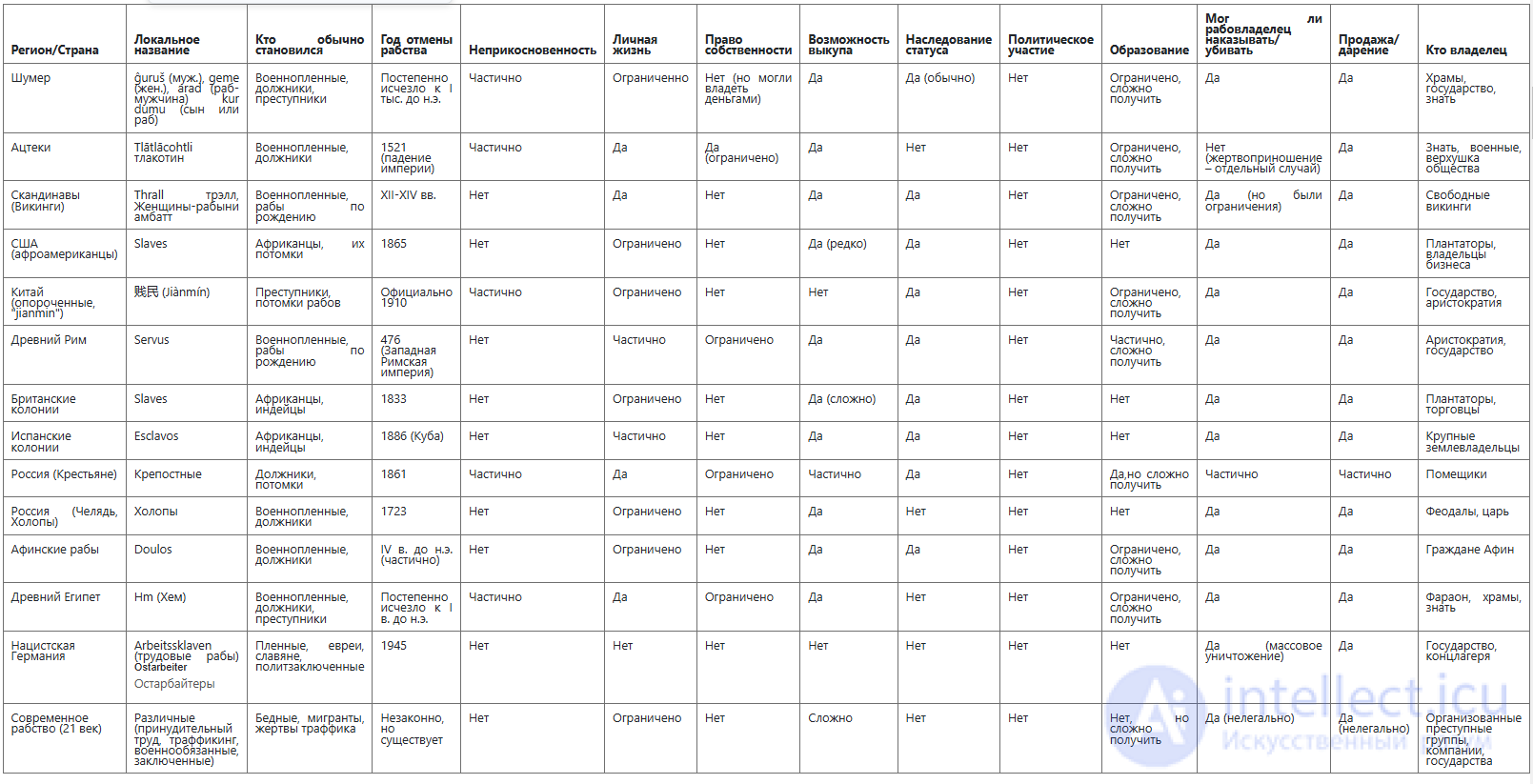
Table 1: the rights and characteristics of slaves in different countries and periods
| Region/Country | Local name | Who usually became one | Year slavery was abolished | Inviolability |
Presence of consciousness sensations of pain |
Degree of compliance with orders |
Repairability and service life — this is not only biological life, but also the period of active exploitation. |
Personal life | Property rights held by the slave himself | Possibility of ransom | Inheritance of status | Political participation | Education | Could the slave-owner punish/kill | Sale/gift | Who was the owner |
|---|---|---|---|---|---|---|---|---|---|---|---|---|---|---|---|---|
| Sumer, the territory of present-day Iraq | ĝuruš (male), geme (female), arad (male slave) kur dumu (son or slave) | Prisoners of war, debtors, criminals | Gradually disappeared by the 1st millennium BC | Partially |
yes |
High (temple and royal slaves) | Low, max. 10-20 years | Limited | No (but they could own money) | Yes | Yes (usually) | No | Limited, difficult to obtain | Yes | Yes | Temples, the state, the nobility |
| The Aztecs, the territory of present-day central Mexico, the valley of the lakes | Tlātlācohtli, tlacotin | Prisoners of war, debtors | 1521 (the fall of the empire) | Partially | yes yes |
Medium (they could buy their freedom) | Low, 1–5 years (often sacrificed) | Yes | Yes (limited) | Yes | No | No | Limited, difficult to obtain | No (sacrifice is a separate case) | Yes | The nobility, the military, the upper stratum of society |
|
The Incas Tawantinsuyu (the present-day territories of Peru, Bolivia, Ecuador, Chile, Argentina, Colombia) |
Aqllas (Quechua aqllasqa): the «Virgins of the Sun», concubines of the Incas (exempt from tribute). Yanakuna (Quechua yanakuna): servants of the Inca and of the State. Piñas, slaves (Quechua piñakuna): prisoners of war belonging to the Inca but who did not become yanakuna. |
Captured enemies, punished criminals, or people wholly dependent on the state | There was almost no slavery as an institution, only its equivalent; the system disappeared after the conquest (1533–1572) | Low, but better than for slaves in Europe or Rome — they could not be tortured without cause |
yes yes |
Complete, strict labour discipline (the state was the absolute master) | Term of service = the whole of life; the state monitored the worker's health so that he could perform his functions | Partially permitted: they could have families if this did not interfere with their service | Very limited; property usually belonged to the ayllu (the community), not to the individual | No formal ransom existed; sometimes they could obtain freedom for service | Usually not — the status of dependants was NOT passed on to children | None; dependants did not take part in governance | Only basic training in a craft; elite education (Yachaywasi) was inaccessible | Could punish to some extent; killing was prohibited by law, that was for the court to decide | Formally they could not be sold as objects; but they could be redistributed between communities | The state (the Sapa Inca), less often — temples or kin-based communities |
| The Scandinavians (Vikings) | Thrall, women slaves ambátt | Prisoners of war, slaves by birth | 12th–14th centuries | No | yes yes |
High (household and military slaves) | Low, 5–15 years | Yes | No | Yes | Yes | No | Limited, difficult to obtain | Yes (but there were restrictions) | Yes | Free Vikings |
| The USA (African Americans) | Slaves | Africans and their descendants | 1865 | No | yes yes |
Very high (total control) | Low, 20–40 years (for life) | Limited | No | Yes (rarely) | Yes | No | No | Yes | Yes | Planters, business owners |
| China (the debased, "jianmin") |  (Jiànmín) (Jiànmín) |
Criminals, descendants of slaves | Officially 1910 | Partially | yes yes |
High (social isolation) | Low, 30–50 years (social stigma) | Limited | No | No | Yes | No | Limited, hard to obtain | Yes | Yes | The state, the aristocracy |
| Ancient Rome | Servus | Prisoners of war, slaves by birth | 476 (Western Roman Empire) | No | yes yes |
High (slaves were property) | Medium, 10–30 years (manumission possible) | Partially | Limited | Yes | Yes | No | Partially, hard to obtain | Yes | Yes | The aristocracy, the state |
| British colonies | Slaves | Africans, Native Americans | 1833 | No | yes yes |
Very high (plantation labour) | Low20–40 years | Limited | No | Yes (difficult) | Yes | No | No | Yes | Yes | Planters, merchants |
| Spanish colonies | Esclavos | Africans, Native Americans | 1886 (Cuba) | No | yes yes |
High (Native Americans and Africans) | Low, 10–25 years | Partially | No | Yes | Yes | No | No | Yes | Yes | Large landowners |
| Russia (peasants) | Serfs | Debtors, their descendants | 1861 | Partially | yes yes |
Medium (corvée, quitrent) | Low, 30–50 years | Yes | Limited | Partially | Yes | No | Yes, but hard to obtain | Partially | Partially | Landed gentry |
| Russia (chelyad, kholops, vdachi, zakups) | Kholops | Prisoners of war, debtors | 1723 | No | yes yes |
High (personal dependence) | Low, 20–40 years | Limited | No | Yes | No | No | No | Yes | Yes | Feudal lords, the tsar |
| Athenian slaves | Doulos | Prisoners of war, debtors | 4th century BC (partially) | No | yes yes |
High (household and state labour) | Medium, 10–25 years | Limited | No | Yes | Yes | No | Limited, hard to obtain | Yes | Yes | Citizens of Athens |
| Ancient Egypt |
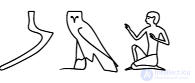
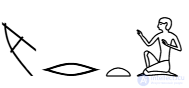
Hm (Hem, ), the slain-alive mr.t (Meret, )
|
Prisoners of war, debtors, criminals | Gradually disappeared by the 1st century BC | Partially | yes yes |
High (state projects) | Low, 5–15 years | Yes | Limited | Yes | No | No | Limited, hard to obtain | Yes | Yes | The pharaoh, the temples, the nobility |
| Nazi Germany | Arbeitssklaven (labour slaves) Ostarbeiter
Ostarbeiters |
Prisoners, Jews, Slavs, political prisoners | 1945 | No | yes yes |
Very high (camps, labour) | Zero, 0.5–4 years (camps, genocide) limited medical treatment | No |
No more details https://intellect.icu/r-12855 |
No | No | No | No | Yes (mass extermination) | Yes | The state, concentration camps |
| Modern slavery (21st century) |
Various (forced labour, trafficking, those liable for military service, prisoners) Ukraine: фізична особа Russia: natural person |
The poor, migrants, trafficking victims, ordinary people | Illegal, but a disguised form exists with the same features and essence |
No, example countries under martial law |
yes yes |
High (labour exploitation) | max. 40-50 years, treatment limited by money | Limited; some states prohibit meeting in meeting places — restaurants and so on — where a modern slave could choose a partner for themselves; for example, countries under martial law | it exists, but in practice it can be annulled for any infraction, for debt or under internal sanctions | Difficult, impossible; possible only by fleeing the country on one's own | No, but in practice yes | No, an ordinary natural person cannot take part for indirect reasons | No restrictions, but hard to obtain either because of entrance examinations or because of the cost of tuition |
Yes (illegally) and legally — the shooting of undesirable leaders and extrajudicial reprisals, dispatch to military operations,
in certain countries judicial executions are practised for ordinary people for certain deserved or undeserved violations |
Yes (illegally) | Organized criminal groups, companies, certain states |
| The slavery of the future |
robots human-as-thing biohuman biorobot |
robots and certain human-things, possibly grown artificially |
there will be no abolition there will be endless transformation |
no |
partially partially |
Maximum (programmable biologically or electronically) |
indefinitely, after treatment and repair high repairability |
no | no | no | makes no sense | no, but possible as a doll | limited | yes | yes | a limited and select group of people |
The Russian word «рабство» ("slavery") derives from «раб» ("slave"), which is a borrowing from Church Slavonic рабъ. The original Russian form was *робъ. According to Zachary Goryushkin, in the 18th–19th centuries it was believed in the Russian Empire that «рабство» derived from the word «работа» ("work"). He distinguished temporary slavery, that is, contractual work for a master for payment, and "eternal" slavery, in which the slave was legally obliged "to serve the master hereditarily".
According to one version, which gained currency from the 18th century onwards, in the Romance, Germanic and certain other languages (for example Arabic — "saqaliba", Welsh, and the constructed languages Esperanto and Volapük) the words "slave" and "slavery" derive from the word "Slav": these words, via Late Latin Sclāvus, are derivatives of Middle Greek Σκλάβος [Sklábos], Σκλάβινοι [Sklábinoi], originally denoting the tribal name of the Slavs (Proto-Slavic *Slověninŭ), but in the 8th–9th centuries shifting in meaning to "captive slave", "slave", since Slavic captives became a frequent object of the slave trade. Some authors, beginning in the 19th century, considered this version disputable. One contemporary academic version traces the origin of the Byzantine Σκλάβος to the verb σκυλάω [skūláō, skyláō], σκυλεύω [skūleúō, skyleúō], meaning "to strip (a slain) enemy", "to take spoils of war". This hypothesis is also subject to criticism.
In Justinian's Digest (Corpus iuris civilis), slavery is defined as "an institution of the law of nations by which a person is subjected, contrary to nature, to the dominion of another" (Digest. 1.5.4.1).
The Slavery Convention adopted by the League of Nations in 1926 introduced the following definitions of a slave and of the slave trade into international usage:
- Slavery is the status or condition of a person over whom any or all of the powers attaching to the right of ownership are exercised.
- The slave trade includes all acts involved in the capture, acquisition or disposal of a person with intent to reduce him to slavery; all acts involved in the acquisition of a slave with a view to selling or exchanging him; all acts of disposal by sale or exchange of a person acquired with a view to being sold or exchanged, and, in general, every act of trade or transport in slaves.
— Cited from UN, 2002, Article 1
Slavery was condemned by a League of Nations treaty in 1926 and in the UN Universal Declaration of Human Rights of 1948, as well as in all other principal human rights instruments. In 1956 the Supplementary Convention on the Abolition of Slavery, the Slave Trade, and Institutions and Practices Similar to Slavery was adopted.
Article 4 of the UN Universal Declaration of Human Rights states:
No one shall be held in slavery or servitude; slavery and the slave trade shall be prohibited in all their forms.
— The Universal Declaration of Human Rights. // The United Nations.
In Europe, slavery is prohibited by the European Convention for the Protection of Human Rights and Fundamental Freedoms.
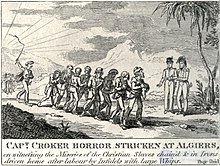
Christian slaves in Algiers, 1815
The International Labour Organization (ILO) defines the indicators that a person has in effect been reduced to slavery as follows: violation of labour rights, restricted freedom, inability to resign, the presence of overseers and guards at the workplace, violence applied to workers, and so on .
In Russian scholarship there was a tradition of equating serfs with slaves; however, despite a whole range of similar features, slavery and serfdom have many differences, connected first and foremost with the societies in which they are embedded (for example, serfs owned property and formally the master had no right to dispose of their lives, whereas a slave normally cannot own property, is himself the property of the slaveholder, and the latter has the right to take his life). It should be assumed that for certain historical periods, especially before the mid-17th century, slavery and serfdom in Russia cannot be fully equated. International law classifies serfdom among practices and institutions similar to slavery .
The division of labour is vital for achieving efficiency in production. In organizing such a division, heavy (above all physical) labour is the least attractive. At a certain stage of society's development (when technological progress enabled a worker to produce a greater volume of output than he himself needed to sustain life), prisoners of war, who had previously been killed, began to be deprived of freedom and compelled to perform heavy labour for a master. People deprived of freedom and turned into the property of a master became slaves.
In the earliest stages of development the sole source of slaves among all peoples, and later a very substantial one, was war, accompanied by the capture of the enemy's warriors and the abduction of people living in his territory. The institution of slavery arose among various peoples simultaneously with the development of class society, that is, in step with the transition from gathering and hunting to agriculture and stock-raising (see the Neolithic Revolution). Hunter-gatherers did not take the defeated captive, since there was no economic sense in doing so.
First came patriarchal slavery, in which slavery was not the basis of production and was intended to satisfy the needs of the patriarchal family. Under this type of slavery, slaves usually lived in the same house as their masters, and women could be the master's concubines.
From the point of view of the philosopher Varro, the slave is merely a "speaking tool", animate property, a beast of burden (in the language of Roman law — res, that is, a thing). Slaves are normally used as a labour force in agricultural and other production, as servants, or to satisfy other needs of the master. The slave's character as a thing is expressed above all in the fact that all the products of slave labour become the property of the owner; but in return the care of feeding the slaves and providing for their other needs falls on the master. The slave has no property of his own; he may dispose only of what the master chooses to give him. The slave may not enter into a lawful marriage without the master's permission; the duration of the marital bond — if it is permitted — depends on the arbitrary will of the slaveholder, to whom the slave's children also belong. Like any component part of an estate, a slave may become the object of all manner of commercial transactions.
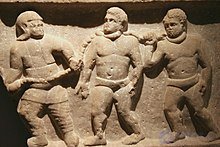
Slavery in Ancient Rome
The slave's living conditions are determined only by the humanity or the self-interest of the slaveholder. The former was and remains a rarity; the latter dictates different courses of action depending on how difficult it is to obtain new slaves. The process of raising slaves from childhood is slow and expensive and requires a fairly large contingent of "breeding" slaves, so that even an utterly inhumane slaveholder is compelled to provide his slaves with a standard of living sufficient to maintain their capacity for work and general health; but in places where adult and healthy slaves are easy to obtain, their lives are not valued and they are worked to exhaustion.
The slave is not a subject of law as a person. Neither in relation to his master nor in relation to third parties does the slave enjoy any legal protection as an independent person. The master may treat his slaves as he sees fit. The killing of a slave by his master is the latter's lawful right, while a killing committed by anyone else is regarded as an encroachment on the master's property rather than as a crime against a person. In many cases the slave's owner also bears liability for damage caused by the slave to the interests of third parties. Only in the late stages of the existence of slaveholding society did slaves acquire certain rights, but very insignificant ones.
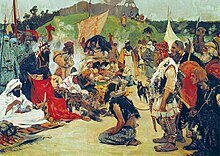
"Trading in the land of the Eastern Slavs", a painting by Sergei Ivanov
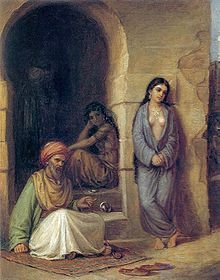
John William Waterhouse. "The Slave Girl" (1873)
The slave trade reached its greatest scale in Africa, which from the 16th century onwards became the main supplier of labour for the plantation economy of the New World. Slave traders bought slaves from local rulers who waged regular wars for this purpose. Mass seizure of black slaves was also practised by the Arab rulers of the north-western part of the African continent. The number of black slaves exported is estimated at at least 10 million people.
The Barbary slave trade in the Mediterranean was also of great scale, based on piracy and raids by Arab slave traders on coastal territories. According to data from Tunis, Algiers and Tripoli alone, between 1 million and 1.25 million Europeans were carried off into slavery in North Africa from the beginning of the 16th century to the mid-18th (these figures do not include Europeans who were enslaved by Moroccan and other raiders and traders of the Mediterranean coast)[30]. The slave market went into decline after Sweden and the United States, and then the Anglo-Dutch fleet, defeated the Barbary states in the Barbary Wars (1800–1815).
In addition, customs statistics of the 16th and 17th centuries indicate that the export of slaves from the Black Sea to Istanbul amounted to about 2.5 million between 1450 and 1700 .
In England (Great Britain)
In the Middle Ages the slave trade was prohibited in England (in 1102) . At the end of the Middle Ages and the beginning of the modern era (in 1698) the English Parliament once again permitted private persons to engage in the slave trade . However, after the Somerset case in England (1772), the French Revolution and the start of the war with Napoleon, in 1807 the British Parliament seized the moment to first prohibit ships from delivering slaves to the French colonies. Then the abolitionists Wilberforce and Grenville secured the extension of this prohibition to other countries as well; in the same year the Royal Navy began combating the slave trade off the coast of West Africa, which halted the shipment of human cargo across the ocean too. The Slavery Abolition Act was passed in Great Britain in 1833 and did not extend to India, where slavery was recognized as part of the "national culture".
Every elite in every historical era has a stereotyped justification of slavery: the slave is a simple, naive person who at any given moment may be subjected by a self-interested, aggressive, domineering individual to humiliations, which may take the form of dominating (often coercive) unnatural demands made by one person on another, with the requirement of unquestioning submission to any demand of the one making it.
On the whole, slavery is economically inefficient in the long run. However, the historian and economist Stanley Engerman, in the book "Time on the Cross: The Economics of American Negro Slavery", co-authored with the Nobel laureate in economics Robert Fogel, argues that the slave economy of the American South not only failed to stagnate but even flourished; the rate of return on the slave plantations of the South was no lower than that of the owners of northern industrial enterprises, and moreover the slaveholders introduced labour-saving technologies and modernized production. Some researchers of the ancient Roman economy have reached the same conclusions: with proper organization of the estate, the return on a slave's labour was no less than the income from the labour of a tenant or a hired worker.
Over the last 5,000 years slavery has existed almost everywhere. Among the best-known slaveholding states are Ancient Greece and Rome. Slavery in the Ancient East had many distinctive features. In Ancient China the concept of xi, equivalent to slavery, has been known since the middle of the 2nd millennium BC. In modern times slavery existed in the United States and Brazil, and to an insignificant degree in Europe.
The first sources date from the period of the seizure of Sumer by Semitic tribes. Here we encounter the subjugation of a captured people and its subordination to a master. The earliest indications of the existence of slaveholding states in the territory of Mesopotamia date to the beginning of the third millennium BC. In biblical sources slavery is described after the Flood (Gen. 9:25). The ancient patriarchs had many slaves (Gen. 12:5, 14:14).
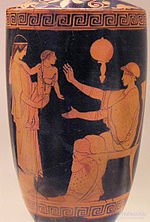
A slave woman hands a child to its mother. Image on an ancient Greek lekythos, 5th century BC.
Slavery emerged and spread in societies that had made the transition to agricultural production. The use of slave labour became economically justified and, naturally, became widespread. Within this system slaves constituted a distinct class, from which a category of personal, or household, slaves was usually distinguished. The condition of the other slaves, personally little known to their master, often differed hardly at all from that of domestic animals, and was sometimes even worse. As the culture and education of society advanced, yet another privileged class emerged among household slaves — slaves whose value was determined by their knowledge and their aptitude for the sciences and the arts.
The condition of slaves gradually changed for the better. The change in attitudes towards slaves was reflected first in religious prescriptions and customs, and later in written law as well (the law first took domestic animals under its protection, and only afterwards slaves). Rules appeared regulating the manumission of a slave, the status of a female slave who had become pregnant by her master, and the status of her child; in some cases custom or law gave a slave the right to change his master.
Only a fundamental change in economic conditions could destroy the institution of slaveholding, and slaveholding itself contributed to this by acting in a progressive direction upon social organisation. Inevitably a moment arrived when, under slave labour, output ceased to grow, while the cost of maintaining a slave rose steadily. All of this undermined the institution of slavery. The scale on which slave labour was used narrowed, and the class of agricultural slaves disappeared.
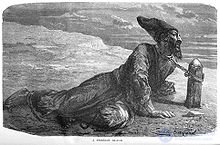
A Persian slave. Khanate of Khiva, 19th century
The economy of southern Iraq rested on the slave labour of Africans right up to the Zanj Rebellion. The high concentration of East African slaves and the harsh conditions of their existence enabled the Kharijites to turn the Zanj into the strike force of the rebellion they organised, known as the Zanj Rebellion (869—883). As a result of the uprising the Zanj managed to establish their control over the whole of Lower Iraq. At the cost of an enormous effort the Abbasid caliphs nevertheless succeeded in suppressing this rebellion[36].
Slave labour and the slave trade were an important part of the extensive economy of the medieval Asian states created by nomads, such as the Golden Horde, the Crimean Khanate and early Ottoman Turkey (see raiding economy). The mameluke guard of the Abbasid and Ayyubid dynasties was replenished with slaves exported from the Black Sea region. The Crimean Khanate, which succeeded the Mongol-Tatars in the northern Black Sea region, was likewise actively engaged in the slave trade. The total number of slaves who passed through the Crimean markets is estimated at three million people[37].
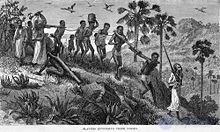
The Arab slave trade, East Africa, 19th century
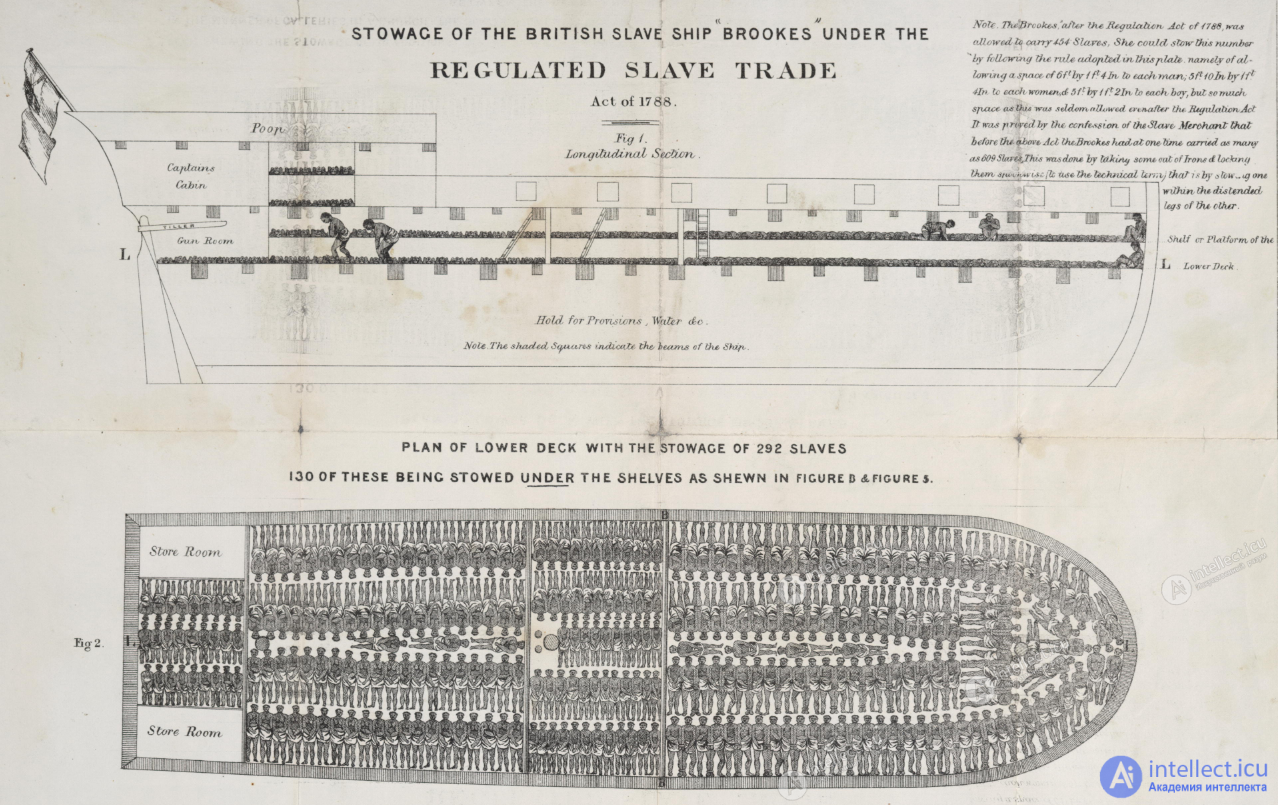
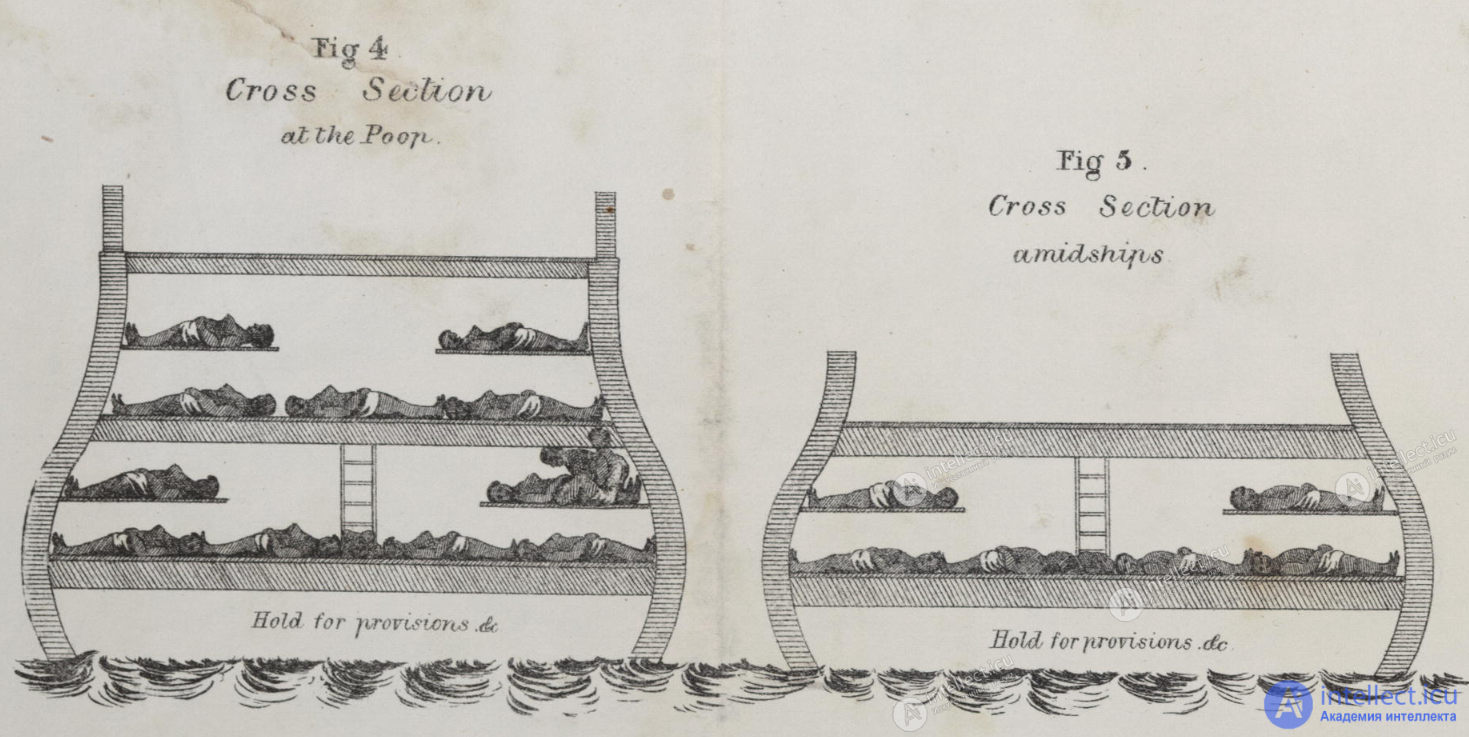
The stowage of slaves aboard a slave ship
In the Islamic states of North Africa slavery existed right up to the colonisation of these lands by Europeans in the 19th century; the main sources of slaves were both Africans and captured Europeans. In Mauritania, which Europeans colonised comparatively late, slavery continued to exist both during the colonial period and even after independence was gained.
Slavery, which had almost everywhere in Europe been replaced by serfdom, was restored in the New World in the 16th century, after the beginning of the Age of Discovery. In the course of the exploration of Africa by white Europeans, it became apparent that a practically unlimited number of workers could be obtained fairly easily by capturing and enslaving the indigenous Africans.
On 27 December 1512 the Spanish government prohibited the use of American Indians as slaves in the colonies, but at the same time permitted the importation of slaves from Africa into the New World. The use of African slaves was highly profitable for planters. First, African Americans were on average better adapted to gruelling physical labour in a hot climate than white Europeans or Indians; second, having been taken far from the lands inhabited by their own tribes and having no notion of how to return home, they were less inclined to flee.
Thus began the mass transatlantic slave trade, which flourished right up to the 19th century. Africans were seized in their native lands (as a rule, by Africans themselves), loaded onto ships and sent to America. The principal carriers of African slaves were British slave traders. The largest home ports for their vessels were Liverpool and Bristol. Over the course of 400 years more than 17 million slaves were brought into America (not counting those who died in transit)
In Asia African slaves were little used, since in that region it was far more profitable to employ the numerous local population in the work ("coolie labourers").
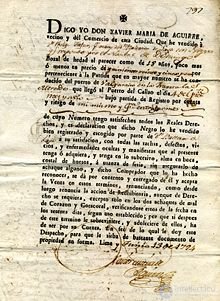
The Lima-Peruvian treaty on slavery of 13 October 1794
The profits from cotton and sugar-cane plantations and the rising price of slaves in the Southern states of the USA prompted every possible measure to be taken to safeguard the institution of slavery and to keep slaves in a subordinate position.
In Canada, where the climate was colder and there was no need for a mass labour force on plantations, slavery was adopted by Europeans from the local Indian tribes. The number of slaves in Canada was never high; captive Indians predominated among them (panis ), taken by other tribes and sold to European colonists, but there was also a small number of black slaves. Since the Catholic Church actively encouraged the conversion of slaves to Christianity and their reception into the community, slavery in Canada in fact went into decline even before its formal prohibition by British law.
The wretched lot of African American slaves began as early as the 18th century to provoke protests from the more advanced part of society. In Great Britain a movement for the abolition of slavery (abolitionism) arose. In 1765 the London physician Granville Sharp saved the life of a black slave brought by his owner from Barbados, beaten half to death and abandoned in the street. When two years later the owner encountered his former slave and confined him in his house, Sharp secured his patient's release through the courts, arguing that slavery was immoral and contrary to English law[39].
At the end of the 18th century several sensational trials took place in Great Britain that shook notions of the lawfulness of slavery and served as a precedent for the abolitionists' subsequent struggle in the judicial bodies[40]. Thus, in 1772 a certain Charles Stewart attempted to seize his runaway slave named James Somerset and deport him to Jamaica to work on the sugar plantations. While in London, Somerset had been baptised, and his godparents challenged the slaveowner's decision in court, demanding compliance with the British law of Habeas Corpus. Judge Murray declared in his ruling of 22 June 1772:
The state of slavery is of such a nature that it is at present impossible to justify it in court on the basis of simple common sense or general considerations of nature or policy; it must have legal grounds; …no master was ever here permitted to take a slave by force and sell him abroad because he evades the performance of his duties or for any other reasons; we cannot say that this is permitted or justified by any law of this kingdom, and therefore this man must be set free.
— Quoted from a publication in the newspaper General Evening Post of 21-23 June 1772
In 1801 slavery was abolished in Saint-Domingue as a result of the Haitian Revolution — the only successful slave uprising in history.
In the USA the mounting tension between the free Northern states and the slaveholding Southern states led to the secession of the southern states and to the Civil War, in the course of which millions of slaves were freed. In the first period after the war, under the influence of mistrust towards the southerners, the government of the United States called African Americans to active participation in elections and in administration. But it soon turned out that an administration composed of less cultured elements led to the southern states being burdened with debts and to abuses of various kinds. With the ending of martial law in the South and the restoration of full rights to whites in the pacified states, they gained the opportunity for a fuller exercise of self-government, which they used above all to exclude African Americans from participation in legislative, judicial and administrative activity (see the Jim Crow laws).
African American slaves were freed last of all in Brazil, where African Americans had mixed most extensively with the Portuguese and the Indians. According to the census of 1872 there were here 3,787 thousand whites, 1,954 thousand African Americans, 3,802 thousand people of mixed race and 387 thousand Indians; of the African Americans about 1.5 million were slaves. The first step towards the abolition of slavery was the prohibition of the importation of slaves in 1850. In 1866 the slaves of monasteries and of certain institutions were freed; in 1871 all children born in Brazil were declared free, all state-owned and imperial slaves were freed, and a special fund was established for the annual manumission of a set number of slaves. In 1885 all slaves over the age of 60 were freed. Only in 1888 did the complete emancipation of the remaining slaves follow. This measure was one of the causes of the military coup that resulted in the abolition of the monarchy in the person of Emperor Dom Pedro II and the establishment of a presidential republic headed by Marshal Deodoro da Fonseca.
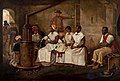
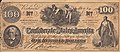
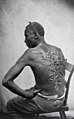
In the 18th century slavery began to be condemned by figures of the Enlightenment movement. By the beginning of the 19th century most European governments had recognised the need to abolish slaveholding. In 1807—1808 the importation of African slaves into the USA and the British colonies was prohibited. By 1833 slaveholding had been completely prohibited in the British Empire. In the USA slavery was abolished only in 1865 (see the Thirteenth Amendment to the United States Constitution. The last state to officially ratify this amendment was Mississippi in 2013). In the journalistic literature of the time this list often also includes the abolition of serfdom in Russia in 1861. Slavery in Brazil was abolished in 1888, and in China in 1910. In 1948 slavery was declared illegal in the Universal Declaration of Human Rights. In Saudi Arabia slaveholding became illegal from 1962. The last country in which slavery was abolished was Mauritania, in 1981.
The main causes of the abolition of slavery varied depending on the historical context and the country, but among the principal ones the following may be singled out:
Economic changes: With the development of industrialisation and the transition to a capitalist economy, slavery became less efficient, especially in countries with a developing industrial sector, where the labour of free workers was more profitable.
Moral and ethical considerations: In the 18th-19th centuries the human rights movement gained strength, which led to slavery being condemned as a morally unacceptable institution. Abolitionists (those who advocated the abolition of slavery) fought actively for the rights of slaves, arguing that all people have equal rights to freedom.
Political and social changes: In some countries, such as Great Britain and the USA, the abolition of slavery became part of political reforms aimed at improving social justice and the rights of citizens. These changes were also supported by growing democratic movements.
Military conflicts: In the USA, for example, the Civil War played a key role in the abolition of slavery. After the war the 13th Amendment to the Constitution was adopted, which prohibited slavery.
International pressure: In the 19th century the international community began to condemn slavery. Great Britain and other European countries adopted measures aimed at eliminating slavery in their colonies and in other countries.
Rising labour productivity: Workers who receive a wage are motivated to work more efficiently, since their income depends on their productivity. Unlike slaves, who had no economic incentives to raise productivity, free workers could labour more diligently, which led to an increase in the overall level of output.
Taxation: Wage-earning workers are subject to tax accounting, and the state can levy taxes on their incomes, which becomes a sustainable source of government revenue. The work of slaves, by contrast, brought the state no direct tax receipts.
Social stability: Workers who receive a wage are usually more socially engaged and interested in the stability of their lives. Whereas slavery sustained social inequality and potentially led to revolts and protests, broader wage employment fosters the strengthening of social cohesion.
Economic development: With the transition to a more diversified and industrial economy, the system of free labour began to promote the growth of the consumer market and the development of domestic markets for goods and services. Slavery, on the other hand, constrained this process, since slaves had no means to consume the goods they produced.
Every country has its own particular features in the history of the abolition of slavery, but all these factors played an important role in the process.
Studying the Bible, one may conclude that slavery is presented in it not only as an element of the social order, but also as a form of survival under conditions of an undeveloped economy. In times of famine or natural disaster, in unfavourable agricultural years, free people not infrequently gave themselves into slavery to wealthier members of their own people or to neighbouring peoples in order to have a chance of survival. The Jewish people, according to the biblical account, were led by Moses out of slavery in Egypt . In some of the commandments given through Moses, the Jews were told how to treat slaves. The Bible prescribes buying from other peoples, and such people become property that may be handed down as an inheritance and is retained by the master in perpetuity.
Noah cursed his grandson Canaan, saying that he would be a slave of slaves to his brothers, because Ham (Noah's son and Canaan's father) came upon his drunken, naked father, saw his nakedness and told his brothers about it, thereby showing disrespect towards his father.
Abraham, the biblical righteous man, according to the Old Testament had many slaves, including those he acquired when he gave his wife to the Pharaoh of Egypt . While recovering his nephew Lot from King Chedorlaomer, along with property, women and people, Abraham armed 318 of his slaves.
Slaves and livestock are to rest together with the master on the seventh day of rest. Slaves are also provided for in festive rejoicing along with the master and all his household. The punishment of a female slave betrothed to a free man who has slept with another is mitigated by the fact that she is not free, and in this case both escape the death penalty. For killing his own slave a punishment was prescribed for the master (in the case where the slave died immediately; but if he lived another day or two, the punishment was cancelled, since the slave is the master's property). For inflicting physical injury on a slave, the master must set his slave free.
A slave's life was valued at thirty shekels of silver: that is the amount that must be paid to his master if a slave is gored to death by an ox.
Following the apostles, the Church Fathers permitted slavery. The New Testament says that if it is possible for a person to become free, it is better to take that opportunity. This was a centuries-old component of the life and economy of the ancient world, which had existed for many centuries, and they knew of no other alternative. The canons of the Orthodox Church forbid admitting a slave into the clergy or into monasticism without the master's consent, and forbid slaves to evade service to their masters and to marry without the master's will.
In an extended treatise of 1859 on the Christian understanding of slavery and freedom, St Ignatius (Brianchaninov) writes that "both the Word of God and the Church, both the Universal and the Russian, in the person of the holy Fathers, never said anything about the abolition of civil slavery", yet "the freeing of slaves was always recognised by the Church as a good deed, a deed of mercy, a deed of brotherly Christian love".
The Roman popes condemned slavery and, in particular, forbade the enslavement of Indians (Pius II declared slavery a "great crime" in 1462). In 1537 Paul III, in 1639 Urban VIII, and in 1741 Benedict XIV repeated this prohibition with regard to Indians. At the same time, some popes (Nicholas V and Paul III) allowed the enslavement of prisoners of war captured in the course of a "just war" who refused to accept Christianity.
Islam permits the existence of slavery and regards the freeing of a slave as one of the deeds pleasing to God. Under Islamic law, all Muslims are free from the outset. It is impossible to enslave a Muslim within Muslim domains, including for debts. From the life of the Prophet Muhammad it is known that he had in all up to two dozen slaves known by name, whom he freed at various times.
In Islam it is forbidden to make slaves of co-religionists, but this prohibition does not extend to people professing other faiths or to atheists. For this reason slavery in one form or another still exists in many Islamic societies, although it was officially prohibited during the 20th century in all Islamic countries. In particular, in some Islamic countries the forcing of women into sexual slavery is still widespread, while in Mauritania, despite the official prohibition of slaveholding, it exists in a concealed form, as serfdom: the inhabitants are attached to the land, and its owner may, in particular, sell the land together with the inhabitants .
In the "Islamic State" slavery exists openly in the 21st century.
In the modern world human trafficking ranks third in profitability, after the trade in narcotics and in weapons. The number of people held in various forms of slavery was estimated in 2016 at 45.8 million. In world practice human trafficking may be carried out in various spheres of exploitation
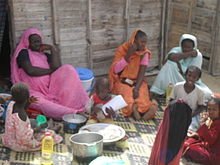
Representatives of the Haratin slave caste in Mauritania
At present slaveholding is officially prohibited in all states of the world. In Ethiopia debt slavery formally existed until 1977. The most recent prohibition on owning slaves and using slave labour was introduced in Mauritania in July 1981 (although de facto the prohibition is not enforced).
Since no legal right to slaveholding currently exists, classical slaveholding as a form of property and a mode of social production does not exist either, except, probably, in a number of underdeveloped countries mentioned below in the text, where the prohibition exists only on paper, while the real regulator of social life is unwritten law — custom. With regard to "civilised" states, the more correct term here is "forced, unfree labour" (unfree labour).
Some researchers even note that after the slave trade moved into illegality, the income from it not only did not decrease but even grew. The cost of a slave, in comparable terms with 19th-century prices, has fallen, while the income he can bring in has risen. At present-day auctions in Libya the price of a slave starts at 100 US dollars a head[48]. Despite the legislative prohibition, the number of slaves in the modern world is not only not decreasing but is growing, having risen from 40 million in 2016 to almost 50 million in 2021.
In forms typical of classical slaveholding society, slavery continues to exist in the states of Africa and Asia where its formal prohibition occurred relatively recently. In such states slaves are engaged, as they were many centuries ago, in agricultural work, construction, mineral extraction and crafts. According to the UN and human rights organisations, the most severe situation persists in such countries as Sudan, Mauritania, Somalia, Angola, Pakistan, India, Nepal and Myanmar. Following the intervention, slavery also flourished in Libya[48]. The official prohibition of slaveholding in these states either exists only on paper, or is not backed up by any serious punitive measures against slaveowners.
Thus, in Mauritania the descendants of black people enslaved many generations ago constitute a slave caste owned by Arabs. Slavery is transmitted by inheritance: the children of slaves belong to the owners of their parents. The number of slaves in the country is estimated at 600,000 people, which amounts to 20% of the population , the highest percentage in the world.
In the terminology of critics of capitalism (socialists, communists, anarchists) — a condition characteristic of capitalism in which the worker de jure works of his own free will, yet de facto is compelled to sell his own labour power in order to survive.
According to ILO data, the total income derived from the illegal use of forced labour amounts to no less than 150.2 billion dollars a year.
The largest incomes, of the order of 99 billion dollars, come from the use of slave labour in the sex industry.
About 34 billion dollars a year is generated by slaves employed in construction, industry and mineral extraction, 9 billion dollars a year by agricultural slaves, and 8 billion dollars by domestic servants.
In absolute figures the greatest income is generated by slavery in the Asia-Pacific region — $51.8 billion, but this is due to the large number of slaves; per slave the income is relatively small and amounts to around $5 thousand a year. In European countries and the USA the annual profit from each slave is 6—7 times higher, which in aggregate yields around $46.9 billion a year.
Slavery in the 21st century (modern slavery or neo-slavery) — slavery occurring in contemporary society. In the 21st century slavery is a social phenomenon whose defining features are the total restriction of human rights (freedom, personal inviolability), coercion into involuntary labour (the performance of work unlimited in time or indeterminate in character), forced marriage, and exploitation as an object of property rights (human trafficking, the hiring out of people).
In the modern world slavery is prohibited by law and is regarded as a crime .
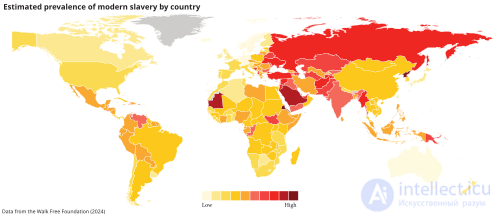
The prevalence of modern slavery as a percentage of the population by country, according to Walk Free estimates
Despite the legislative prohibition, the number of slaves in the modern world is not only not decreasing but is growing, having risen from 40 —46 million in 2016 to almost 50 million in 2021.
According to a joint report by the International Organization for Migration (IOM), the international human rights group Walk Free ("Be Free"), and the International Labour Organization (ILO), out of 50 million slaves (2021 data):
Of the 28 million people engaged in forced labour:
Of the 28 million people engaged in forced labour:
Women and children suffer most from slavery, as do migrants .
Instances of modern slavery have been recorded in practically every country in the world, with victims drawn from every people .
The total annual income of human traffickers (2014 ILO report) was estimated at more than 150 billion dollars, of which 99 billion dollars came from commercial sexual exploitation.
Compounding crises — the COVID-19 pandemic, armed conflicts and climate change — have led to unprecedented disruption in employment and education, a rise in extreme poverty and migration, and consequently to an increased risk of all forms of modern slavery.
According to the Sustainable Development Goals (SDGs), modern slavery among children is to be ended in 2025 and worldwide by 2030 (target 8.7).
The Office to Monitor and Combat Trafficking in Persons, an agency of the US Department of State, is guided by the following terms for the criteria of "slavery" and "human trafficking":
through the use of force, fraud or coercion.
The US federal Trafficking Victims Protection Act of 2000 and the "United Nations Protocol to Prevent, Suppress and Punish Trafficking in Persons, Especially Women and Children" use a number of different terms:
According to the American professor Kevin Bales, co-founder and former president of the non-governmental organisation and human rights group "Free the Slaves", modern slavery arises:
when a person is under the control of another person who uses violence and force to maintain that control, and the purpose of that control is exploitation
The impact of slavery is intensified when it is directed at vulnerable groups, such as children. The principal indicators of slavery are determined by the Global Slavery Index. Slavery has been officially abolished everywhere, the practice is illegal and consequently more hidden from the public and the authorities.
Modern slavery persists for the same reasons as before: it is economically profitable, despite the ethical problems. In recent years the cost of slaves has fallen considerably.
The "market" for exploitative labour is on the rise, despite the fact that slavery has been officially abolished and that enslavement is illegal control rather than lawful ownership. Although the purchase of slave labour has been abandoned and slaves have disappeared as a category of employment, people nevertheless continue to fall into the traps of human traffickers.
Modern slavery is a by-product of:
The use of slaves is characteristic of such sectors as
Slaves produce goods for domestic consumption or for export to more prosperous countries.
In the older form of slavery slaves were expensive, and so the costs of maintaining their health were considered a worthwhile investment. Under conditions of modern slavery people are easier to obtain at a lower price, and so replacing them becomes simpler.
Modern slavery is profitable, and corrupt governments in every country tacitly tolerate it, despite the fact that it is prohibited both by international treaties, such as the Supplementary Convention on the Abolition of Slavery, and by local laws.
The total annual income of human traffickers in 2014 was estimated at more than 150 billion dollars, of which 99 billion dollars came from commercial sexual exploitation.
The price of an American slave in 1809 reached 40,000 US dollars in today's money. Today a slave can be bought for 90-100 dollars.
Slavery is an economic crime:
People do not enslave people in order to be cruel to them; they do it in order to make a profit
With the development of technology, humanity is increasingly confronted with questions that once seemed like science fiction. One of them is the ethical status of robots. Today they perform millions of tasks: from assembling cars to caring for the elderly. But the question remains open: is the use of robots a form of new slavery?
The word "robot" comes from the Czech robota — "forced labour". In Karel Čapek's play R.U.R. (1920) robots are artificial beings created for work, but who ultimately rise up against their creators. Even then the idea arose that creating intelligent machines for exploitation might be morally questionable.
As of today robots are objects of property. They have no rights and are not considered subjects of morality or of law. Their task is to carry out human commands. This resembles the classical model of slavery, in which one subject fully controls another.
| Category | Human slave | Robot |
|---|---|---|
| Legal status | Person | Object |
| Capacity for pain | Yes | No (so far) |
| Self-awareness | Yes | Partly (in the future?) |
| Ability to refuse | Limited | Absent |
If robots become intelligent enough to be aware of themselves, then their exploitation without consent may be morally comparable to slavery. Some philosophers (for example, David Chalmers) discuss the possibility of artificial consciousness, and hence of artificial rights as well.
Humanity creates robots with a single purpose — to serve. This includes:
Physical labour: factories, warehouses, cleaning.
Emotional labour: AI companions, assistants, therapeutic robots.
Military tasks: drones, combat vehicles.
A robot cannot refuse, express protest or demand compensation. This is an absolute form of subordination.
| Scenario | Description | Ethical status |
|---|---|---|
| Industrial robot | Performs tasks in a factory | Instrument, not subject |
| AI companion | Converses, learns, adapts | Ethical disputes |
| Self-aware AI | Has goals, emotions, memory | Possible subject of law |
| Machine uprising (hypothetically) | Robots demand freedom | Political and ethical conflict |
So long as robots remain instruments, the concept of "slavery" is applicable only metaphorically. But with the development of artificial intelligence and the possible emergence of self-awareness, humanity must be prepared to reconsider its relationship with machines. Perhaps in the future the emancipation of robots will become a new milestone in the history of rights.
The word "slavery" is most often associated with slavery by descent and chattel slavery.
In chattel slavery an enslaved person is considered the personal property (chattel) of someone else, and can usually be bought and sold. Historically this occurred earlier through conquest, when a defeated person was enslaved, as in the Roman Empire or the Ottoman Empire, or through the slave trade, as in the Atlantic slave trade.
In contemporary society human trafficking, recognised as criminal and illegal, continues (after the civil war of 2014 in Libya, enslaved migrants were sold publicly, including at open slave markets in the country).
Mauritania has a long history of slavery, and after its abolition the laws against it went largely unenforced. It is estimated that about 90,000 people (more than 2% of Mauritania's population) are slaves.
Debt bondage is transmitted by inheritance, like chattel slavery.
Those who fall into sexual slavery effectively become chattel property.
The United Nations has defined human trafficking as follows:
According to data from the US Department of State (2013), "an estimated 600,000 to 820,000 men, women and children are trafficked across international borders each year, ~70% are women and girls and up to 50% are minors. Most transnational victims become objects of commercial sexual exploitation".
Every year in the United States 50,000 people become victims of human trafficking.
The Internet and popular social networking sites have become tools of human traffickers, and consequently criminal cases are brought against them and heard in court (a female user's suit against Facebook accusing it of negligence over a case of sexual abuse and sale by someone posing as her "friend" in 2012. Smartphone applications are also used to sell slaves.
In 2016 an article in the Washington Post condemned the activities of the Obama administration, which sent migrant children to human traffickers, because:
State-imposed forced labour takes various forms:
State forced labour, also known as state-sponsored labour, is defined by the International Labour Organization as events "when people are coerced into work through the use of violence or intimidation, or by more subtle means such as accumulated debt, retention of identity papers or threats of denunciation to immigration authorities"[28]. Many governments close off their citizens' exit from the country so that they cannot leave; ~35-40 countries currently have some form of conscription in place, even if it is only temporary service.
An example of an improving situation is Uzbekistan, whose government every year organised the forced labour of students and civil servants in the cotton harvest, the country being a major exporter of cotton, and also used the child labour of primary and secondary school pupils[30], but it reduced its use of forced labour, as a result of which a major boycott of Uzbek cotton was lifted in March 2022.
In 2022 the following 11 states were found to have documented state policies of human trafficking, including within state-funded programmes, forced labour in state medical services, sexual slavery in government camps, and the use of child soldiers[34]:
Eritrea
According to UN investigators, in Eritrea between 300,000 and 400,000 people are serving indefinite military service, which amounts to mass slavery[35].
North Korea
In North Korea, according to estimates by the Global Slavery Index (2018 report), 2.8 million people were slaves[36], working for the government, both within North Korea itself and beyond its borders. The value of all labour performed by North Koreans for the government is estimated at 975 million US dollars, with dolgyeokdae (youth) forced to carry out dangerous construction work, and inminban (women and girls) forced to sew clothing in sweatshops. Workers often went unpaid.[37] In addition, North Korea's army of 1.2 million conscripts is often made to work on construction projects unrelated to defence, including the building of private villas for the elite[37]. The government also sent up to 100,000 workers abroad[38].
United States
In 1865 the United States ratified the 13th Amendment to the United States Constitution prohibiting slavery and involuntary servitude; however, labour as punishment for a crime was not prohibited. There is thus a legal basis for slave-like penal labour and, as a consequence, for the convict leasing system, applied primarily to African Americans. In 2020 there were 2.3 million people in US prisons, and almost all able-bodied inmates worked. In Texas, Georgia, Alabama and Arkansas inmate labour was unpaid. In other states inmates were paid between $0.12 and $1.15 an hour; on average Federal Prison Industries paid inmates $0.90 an hour (2017). Inmates who refused to work were punished with solitary confinement or a ban on visits from relatives. From 2010 to 2015, in 2016 and in 2018 some inmates in the United States refused to work, demanding higher pay, better conditions and an end to forced labour. The strike leaders were punished with indefinite solitary confinement.
Forced labour of inmates is used not only in state-run but also in private prisons. CoreCivic and the GEO Group account for half of the private prison market share, with combined revenue of 3.5 billion dollars (2015). The value of all inmate labour in the United States is estimated in the billions of dollars. In California 2,500 incarcerated workers fight wildfires for just 1 dollar an hour under the CDCR Conservation Camp programme, which saves the state up to 100 million dollars a year.
China
In the Chinese laogai system of corrective labour prisons, an analogue of Hitler's concentration camps and Stalin's Gulag, millions of prisoners were subjected to forced unpaid labour, and the system caused tens of millions of deaths. In 1997 more than 1,000 laogai camps were in operation, holding 8–10 million people. At present between 500,000 and 2 million prisoners are held in the laogai system. Alongside the laogai system, China operated a system of re-education through labour in prisons until 2013, as well as forced labour camps in Xinjiang for Muslims, Uyghurs and other ethnic minorities and political dissidents (possible numbers of up to 1 million).
North Korea
In North Korea tens of thousands of prisoners may be held in corrective labour camps under harsh conditions:
Children and political prisoners at the Yodok concentration camp were subjected to forced labour. The camp was closed in 2014, and its prisoners were transferred to other prisons.
United Kingdom
In the United Kingdom there are three main types of prison labour:
Prisoners in the United Kingdom may earn as little as 10 pounds sterling for a 40-hour working week.
Australia
In Australia prison labour occurs in New South Wales (paying as little as $0.82 an hour), Victoria, Queensland and the Northern Territory. Some prisoners work for private companies.
New Zealand
In New Zealand prisoners receive 16 dollars an hour (compared with 35 dollars an hour for an ordinary unionised worker doing the same job).
Bonded labour, also known as debt bondage, occurs when people pledge themselves into slavery as security for a loan, or when they inherit a debt from a relative.
The "loan" is arranged in such a way that it can never be repaid; it is often passed down from generation to generation, and is even assigned to future generations, in which case it is called peonage.
Bonded labour is used throughout the world. It is most widespread in India, Pakistan and Nepal.
In India the majority of bonded labourers are Dalits (untouchables) and Adivasi (indigenous tribes). A former brick kiln worker in Punjab (India) testified: "We do not stop even if we are ill". The price of slaves in India relative to the price of land, paid labour or oxen is at present 95% lower than in the past.
People are lured into migrating by the promise of work, but it is a deception: their documents are confiscated and they are forced to work under threat of violence against them or their families. Along with sexual slavery, this form of slavery is most commonly found in wealthy countries such as the United States, Western Europe and the Middle East.
In the Middle East the kafala system operates (outdated laws and weak government oversight), leading to forced labour and human trafficking. In the United Arab Emirates the majority of the permanent population consists of foreign migrant workers. In 2017 the UAE adopted laws protecting the rights of domestic workers.
Qatar
In Qatar migrants number 1.7 million people and make up 90% of Qatar's labour force.
In October 2019 Qatar abolished the kafala system and carried out reforms:
This new system reduced the number of abuses.
However, forced migrant labour was used in the preparations for the 2022 FIFA World Cup in Qatar; more than 6,500 migrant deaths were recorded during the construction of the stadiums, 3,200 migrant workers worked daily, of whom 224 reported cruel and exploitative treatment of them, and high recruitment fees, poor living conditions, fraudulent wages, delays in wage payment, inability to leave the stadium or the camp, inability to leave the country or change jobs, threats and forced labour were documented.
United Kingdom
In the United Kingdom two people in the county of Kent were found guilty of trafficking six Lithuanians. Farms that used forced labour supplied eggs to major supermarket chains such as Tesco's, Asda and M&S.
Vietnamese teenagers are sold into the United Kingdom and forced to work on illegal cannabis farms. Trafficking victims caught during police raids are usually sent to prison.
United States
In the United States, in the state of New York in 2010, 19 Mexican migrants were effectively enslaved by their employer. The men were paid about 10% of the promised wage, while working far longer than their contract stipulated, and would have been deported had they left the job, since that would have been a violation of their visas.
A 2021 interagency federal investigation, codenamed "Operation Blooming Onion", found that a long-running human trafficking network forced migrant workers from Mexico and Central America into "modern slavery" at various agricultural sites in south Georgia. The indictment alleges that in the fields migrant workers were forced at gunpoint to dig onions with their bare hands for 20 cents a bucket. They were held in labour camps surrounded by electrified fences, in squalid and cramped conditions, without access to safe food and water.
Saudi Arabia
Reports of abuse of and disregard for Kenyan migrants in Saudi Arabia emerged in early September 2022.
Sexual slavery, forced prostitution, is a form of modern slavery most commonly found in wealthy regions such as the United States, Western Europe and the Middle East. Sex slaves are supplied from Eastern Europe and South-East Asia (especially from Moldova and Laos), including children.
20% of slaves today are employed in the sex industry. Sexual exploitation can also become a form of debt bondage.
Boys from Nepal (2005) were lured into India and enslaved for sex. Many of these boys were also subjected to mutilating operations on their male genitals (castration)
People from Nigeria often fall victim to sexual slavery; although at first they do so voluntarily, they later fall into human trafficking traps].
Today children make up about 26% of slaves.
Child labour inevitably interferes with their education.
Types of forced child labour:
Many child beggars in Europe, Asia, Africa, Latin America and the Middle East are enslaved.
Forced child labour is the predominant form of slavery in Haiti.
Child soldiers are enslaved by:
Child soldiers are used:
Early or forced marriages, despite being rooted in the culture of some regions, are a form of slavery. When families cannot support their children, daughters are often married off to men from wealthier and more influential families. These men are often considerably older than the girls. Women are forced into a life whose main purpose is to serve their husbands. This often creates an environment for physical, verbal and sexual abuse.
Forced marriages also occur in developed countries: in the United Kingdom, over the three years from 2014 to 2016, the police received 3,546 reports of forced marriage.
In the United States more than 200,000 minors were legally married between 2002 and 2017; the youngest was only 10 years old, while their spouses were adults.
At present 48 US states, as well as the District of Columbia and Puerto Rico, permit the marriage of minors:
In 2017–2018 several states began passing laws restricting child marriage or banning it altogether.
Bride price (the purchase of a bride as property, similar to chattel slavery) may also be linked to human trafficking.
Besides sexual slavery, the occupations of modern slaves include:
Signs of slavery:
In the United Kingdom there is a hotline for reporting suspected modern slavery.
The dispatch of Cuban doctors around the world to combat the COVID-19 pandemic was condemned by the European Parliament as human trafficking and modern slavery.
According to Human Rights Watch, Thailand's multibillion-dollar fish export industry uses slave labour. Trafficking victims are often deceived by brokers' false promises of "good" factory work, and are then forced onto fishing boats, where they are caught, bought and sold, held against their will for months or years and made to work gruelling hours (a 22-hour working day in dangerous conditions.
Those who resist and those who flee are beaten, tortured and often killed.
A survey of nearly 500 fishermen in 2012 found that almost one in five "reported working against their will under a penalty that would prevent them from leaving".
Trafficking victims may beg on the streets, with the money they earn taken by the traffickers.
In the 21st century some government organisations began taking measures to address the problem of modern slavery.
The US State Department's annual Trafficking in Persons Report assigns ratings to each country according to governments' efforts to meet the TVPA minimum standards for eliminating crimes against people.
Governments with the strongest response to modern slavery (Tier 1):
The British government passed the Modern Slavery Act 2015, reinforcing it with reforms to the legal system (the Criminal Finances Act 2017). Despite this, the government refused asylum and deported children who had been trafficked into the United Kingdom as slaves. Those deported face the secondary risk of falling back under the control of slaveholding gangs.
The British government identifies slave labour in public sector supply chains, and has also launched a nationwide campaign against modern slavery entitled "Modern slavery is closer than you think".
Governments accused of taking the fewest measures against slavery (Tier 3):
In September 2013 the Freedom Fund was founded. As of December 2019 the Freedom Fund had affected the lives of 686,468 people, freed 27,397 people from modern slavery and helped 56,181 children who had previously not attended school to obtain formal or informal education in Nepal, Ethiopia, India and Thailand.
In 2014 the Global Modern Slavery Directory was launched, becoming the first publicly available database of more than 770 organizations working to end forced labour and human trafficking].
Modern slavery is a multibillion-dollar industry, in which just one component, such as forced labour, generates 150 billion US dollars a year. According to estimates in the Global Slavery Index (2018), 71% of contemporary victims of slavery are women, and one in four is a child.
As of 2018, the countries with the largest numbers of slaves were: India (8 million), China (3.86 million), Pakistan (3.19 million), North Korea (2.64 million), Nigeria (1.39 million), Indonesia (1.22 million), the Democratic Republic of the Congo (1 million), Russia (794,000) and the Philippines (784,000).
Other countries also have slaves: the United States (400,000), the United Kingdom (10,000 victims of modern slavery).
Various jurisdictions require large commercial organizations to publish slavery and human trafficking statements concerning their supply chains for each financial year (in California, the United Kingdom and Australia).
British police reports published in March 2020 showed that the number of recorded offences related to modern slavery had risen by more than 50%, from 3,412 cases in 2018 to 5,144 cases in 2019. This coincided with a 68% increase in calls and enquiries to the modern slavery helpline over the same period.
The COVID-19 pandemic affected global supply chains, including factories in Malaysia supplying personal protective equipment to the United Kingdom's National Health Service, as well as the increase in online orders for clothing manufactured in third-world countries. The rapid growth in demand for clothing and personal protective equipment drove up the exploitation of vulnerable workers labouring during the pandemic at risk of contracting the disease. The pandemic led to numerous consequences worldwide.
Self-isolation and social isolation are among the principal outcomes of the pandemic, increasing the vulnerability of young people because of the lack of contact with friends and family.
Quranic schools in West Africa practise forced begging, which during the pandemic failed to bring in the expected income, leading to punishment of the pupils.
Wealthy families in Mauritania dismissed Haratin domestic workers in order to avoid travel, leaving the workers' families without means of subsistence.
Global brands cancelled orders, which led to factory closures; more than 1 million workers in Bangladesh were dismissed or suspended. Workers in Cambodia, India, Myanmar and Vietnam faced similar problems. The absence of state support for citizens led to a rise in human trafficking as people turned to bonded labour in order to survive.
Victims of modern slavery are victims of a crime, yet they are treated as criminals — prosecuted, detained and deported. Victims of modern slavery often live in cramped conditions in which the Covid virus can spread rapidly, while being afraid to seek help from the authorities, so they contract diseases and may die as a result.
Lockdowns restricted the activity of anti-slavery organizations; support services and educational centres closed.
The number of suspected victims of modern slavery in the United Kingdom fell as a result of the pandemic, owing to restrictions, increased self-isolation and business closures[135].
But there was a rise in the number of child victims.
Modern slavery under martial law manifests itself through human trafficking, forced labour, sexual exploitation and the exploitation of the vulnerability of refugees and displaced persons. War heightens the risk of ending up in such situations, since people lose the protection of the state and become dependent on intermediaries.
Definition: Modern slavery is a system of exploitation in which a person is deprived of freedom and used as an object of property. Its forms include forced labour, debt bondage, sexual exploitation and forced marriage.
Scale: According to international organizations, some 50 million people in the world today live in conditions of modern slavery.
Vulnerability of the population: During war, people are forced to evacuate, cross borders or look for work in new places. This makes them especially vulnerable to recruiters and human traffickers.
Forced labour: Military conflicts are often accompanied by the use of civilian labour for the needs of the army or the occupying authorities.
Sexual slavery: Women and children are at risk of sexual exploitation, especially in refugee camps or during illegal transport.
Military slavery: The scholarly literature identifies a distinct form — conscript or military slavery, in which people are forcibly drawn into armed formations.
Loss of documents and legal status.
Dependence on intermediaries when crossing borders.
False offers of work or housing.
Recruitment into armed groups under threat of violence.
Check all offers of work and housing through official channels.
Keep copies of documents and the contact details of trusted persons.
Use the information leaflets developed by ministries and international organizations to prevent human trafficking.
Occupations
Slavery laws
Other

Comments