
Lecture
Economic system — the totality of all economic processes taking place in the world, a state, a country (region) or a society on the basis of the property relations and economic mechanism that have developed within it.
In every economic system, production requires specific economic resources, while the results of economic activity are distributed, exchanged and consumed.
According to C. R. McConnell and S. L. Brue, there are five fundamental questions (English: five fundamental economic questions) that define every economic system :
The concept of the economic system (its content, elements and structure) depends on the school of economics. In the neoclassical paradigm, the description of the economic system is developed through microeconomic and macroeconomic concepts. The subject matter of the neoclassicals is defined as the study of the behaviour of people maximising their utility in an environment of limited resources and unlimited wants. The main elements are: firms, households, the state .
Institutionalists place the main emphasis in their study of economic systems on institutions: institutionalist research is characterised by an effort to distinguish between institutions and organisations. An institution is regarded as any established rule or norm of economic behaviour . The new institutionalists emphasise a systems approach and pay attention to the specific features of economic systems, studying: the mode of coordination, the system of property rights, transaction costs and the system of contracts .
Marxism focuses its attention on a systems methodology based on the dialectical systems approach. The dialectical approach in Marxism, first, uses as its foundation the principle of studying contradictions, the dialectical unity of opposites, as the basis for the functioning of economic systems; second, it identifies not only quantitative but also qualitative leaps in the development of economic systems; third, it emphasises the historical limits of economic systems. Marxist logic inherits Hegelian logic, which stressed that the concrete whole, the system, is «not the result, but the result together with its becoming». One of the indispensable conditions for studying economic systems in the development of the Marxist approach is the study of the history of economic systems or, as is customary in Marxism, the study of the mode of production .
Economic systems are also studied from the standpoint of other theoretical schools directly connected with economic theory. From the standpoint of scholars of modern post-industrial society, the post-industrial economy (the neo-economy, the «information society» or the «knowledge society») emerges as a distinct technological order that substantially transforms economic and social systems as a whole. Within the paradigm of «development economics» a special group of «third world» countries is singled out, in which a number of important regularities are found: an institutional structure, particular features of macroeconomic dynamics, a distinctive model. Development economics thus examines a class of special economic systems. Unlike the dominant concepts of neoclassical economics and new institutionalism, the historical school emphasises the historically evolved differences between national economic systems .
The principal factor of an economic system is its economic institutions. Their emergence, development and change directly affect the type of economic system. Thus, the appearance of the institution of private property in the economy and its development foster the development of the capitalist economic system. As a rule, the greatest role in the change of an economic system is played by changes in the institution of property and changes in the institution of economic regulation (the economic mechanism). Changes in other institutions may also play an important role and underlie various classifications.
Economic systems are studied from the standpoint of technological orders. In terms of structure these are: pre-industrial, industrial and post-industrial economic systems . An important parameter for post-industrial systems is the extent of the development of creative activity and its role in the economy. To measure it, measurable parameters of the level of education are usually employed, for example, the share of persons with higher education, the structure of professional employment, and so on. A most important characteristic is the assessment of the extent to which environmental problems are solved within the economic system. Demographic parameters make it possible to answer questions related to an economic system's approach to post-industrial society, and the following bear directly on these parameters: life expectancy, infant mortality, morbidity, and other indicators of the nation's health. The weight of post-industrial technologies is usually calculated from the share of those employed in the production of various sectors in the total volume of GDP .
These parameters are especially relevant for countries with economies in transition. A characterisation is given of the mechanisms of state economic planning, the development of commodity-money relations, the extent of the development of subsistence farming, and the extent of the development of the shadow economy. The characterisation of market development includes: the extent of the development of market institutions, the extent of market self-organisation (competition), market saturation (the absence of shortages), and market structure. Measures of the development of regulation include: antimonopoly regulation; the extent of the development of state regulation (selective regulation, countercyclical regulation, programming); the extent of the development of regulation by public associations A more detailed study of the role of the state in the economy is carried out in public choice theory, which examines the process of government decision-making, the system of the social contract (constitutional economics) and so forth.
In analysing economic systems, a characterisation is given of the ratio of the shares of state, cooperative and private enterprises Nevertheless, such a characterisation is formal; for a deeper characterisation of an economic system, qualitative and quantitative characteristics are used to describe the essence of the forms and methods of control over property and its appropriation. For example, for countries with economies in transition such a characterisation can be given by answering the following questions:
Over time an economic system may become more democratic, as a greater volume of powers over the management and appropriation of property passes to enterprises and private individuals.
An important characteristic of property relations is the forms of ownership, i.e. what share is accounted for by enterprises: wholly in state ownership; joint-stock enterprises whose controlling stake is held by the state; cooperatives and collective enterprises; joint-stock enterprises whose controlling stake is held by the employees; joint-stock enterprises where the controlling stake belongs to private individuals and private corporations; private individual enterprises using hired labour; those based on the owners' own labour; enterprises belonging to foreigners; property of public organisations; various types of joint ventures .
The level and dynamics of real incomes. The «price» of the real income received (the length of the working week, the family's fund of working time, the intensity of labour). The quality of consumption (market saturation, time expenditure in the sphere of consumption). The share of free time and the ways it is used. The quality and content of labour. The development of the social and cultural sphere and the accessibility of its services. The development of the scientific and educational sphere and its accessibility .
GDP and its structure, the regional distribution of GDP, the share of services, the share of military expenditure, the development of socio-cultural sectors. Indicators of growth/decline. Indicators of the balanced development of the economic system. Inflation over time and across space. The integration of the economic system into the world economy (the degree of openness of the economic system) .
The market is a complex economic system of social relations in the sphere of economic reproduction. It is governed by several principles that determine its essence and distinguish it from other economic systems. These principles are based on the freedom of the individual, on his entrepreneurial talents and on the state's fair treatment of them.
There are not many such principles, yet their importance for the very concept of a market economy is extremely great. Moreover, these foundations — namely, individual freedom and fair competition — are very closely linked to the concept of the rule-of-law state. Guarantees of freedom and fair competition can only be given under conditions of civil society and the rule of law. But the very substance of the rights acquired by a person under the rule of law is the right to freedom of consumption: every citizen is entitled to arrange his life as he sees fit, within the limits of his financial means. A person needs his property rights to be inviolable, and in defending these rights the principal role is played by the person himself, while the state assumes the role of protecting a citizen's property from unlawful encroachments by other citizens. Such a balance of forces keeps a person within the bounds of the law, since ideally the state is on his side. A law that comes to be respected, whatever it may be, becomes just at least for the person who respects it. But in protecting citizens' rights the state must not cross the line into either totalitarianism or chaos. In the first case citizens' initiative will be held back or will manifest itself in distorted forms, and in the second the state and its laws may be swept away by violence. However, the «distance» between totalitarianism and chaos is quite large, and in any case the state must play «its own» role. That role consists in the effective regulation of the economy. Regulation should be understood as a very broad range of measures, and the more effectively it is used, the greater the trust in the state.
Distinctive features of a market economy:
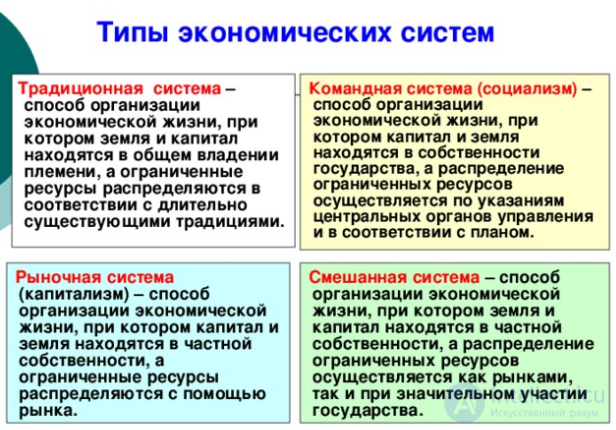
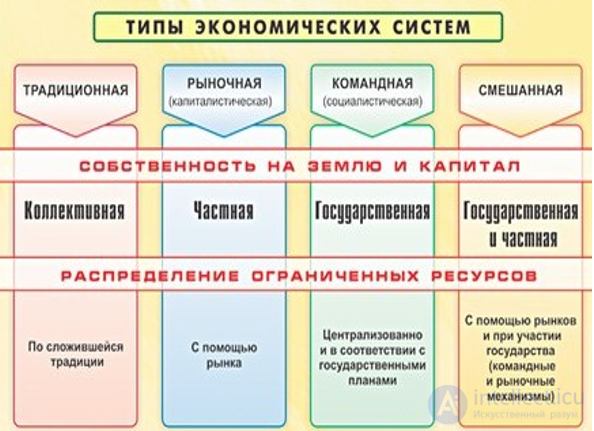
The traditional economic system is the most ancient economic system, characteristic of primitive society and of situations of resource scarcity. Today the traditional economic system exists in the agricultural zones of South America, Asia and Africa and in other regions of the Earth. This type of economic system is based on backward technology, the widespread use of manual labour, and a multi-structured economy. Subsistence farming is characteristic of the traditional economy.
A multi-structured economy means the existence within a given economic system of various forms of economic organisation. In a number of countries subsistence-communal forms are preserved, based on communal management of the economy and on in-kind forms of distributing the product created. Small-scale commodity production is of enormous importance. It is based on private ownership of productive resources and on the personal labour of their owner. In countries with a traditional system, small-scale commodity production is represented by numerous peasant and artisan households, which dominate the economy.
Given the relatively weak development of national entrepreneurship, foreign capital often plays an enormous role in the economies of the countries under consideration.
The traditional economic system is characterised by low-productivity farming, hunting and gathering — there are no regular food surpluses, and therefore trade is not of a permanent character.
The life of society is dominated by centuries-hallowed traditions and customs, religious cultural values, and caste and estate divisions, which hold back socio-economic progress.
The solution of key economic tasks has specific features within the various economic structures. One feature characteristic of the traditional system is the active role of the state. Redistributing a significant part of the national income through the budget, the state channels funds into the development of infrastructure and the provision of social support to the poorest strata of the population. The traditional economy is based on traditions passed down from generation to generation. These traditions determine which goods and services are produced, for whom and in what way. The range of goods, the production technology and distribution are based on the country's customs. The economic roles of members of society are determined by heredity and caste membership. This type of economy survives today in a number of so-called underdeveloped countries, into which technical progress penetrates with great difficulty, since it tends to undermine the customs and traditions established in these systems.
Advantages of the traditional economy:
Disadvantages of the traditional economy:
Distinctive features:
Traditional economic system: Burkina Faso, Burundi, Bangladesh, Afghanistan, Benin. These are the world's least developed countries. The economy is oriented towards agriculture. In most of these countries the population is fragmented into national (ethnic) groups. GNP per capita does not exceed 400 dollars. The economies of these countries consist mainly of agriculture and, less often, mining. Everything that is produced and extracted is insufficient to feed and provide for the populations of these countries. In contrast to these states are countries with higher incomes that are nonetheless also oriented towards agriculture — Côte d'Ivoire, Pakistan.
The planned economy (the administrative-command system) formerly prevailed in the USSR, the countries of Eastern Europe and a number of Asian states.
The characteristic features of the ACS are public (state) ownership of virtually all economic resources, the monopolisation and bureaucratisation of the economy in specific forms, and centralised economic planning as the basis of the economic mechanism.
The economic mechanism of the ACS has a number of distinctive features. It presupposes, first, the direct management of all enterprises from a single centre — the highest echelons of state power — which nullifies the autonomy of economic agents. Second, the state fully controls the production and distribution of output, as a result of which free market ties between individual economic units are excluded. Third, the state apparatus directs economic activity chiefly by administrative and directive (command) methods, which undermines material interest in the results of one's labour.
The complete nationalisation of the economy gives rise to a monopolisation of production and marketing unprecedented in its scale. The giant monopolies established in every branch of the national economy and supported by ministries and departments, in the absence of competition, take no care to introduce new equipment and technology. The shortage economy engendered by monopoly is characterised by the absence of normal material and human reserves in case the balance of the economy is disturbed.
In countries with an ACS the solution of general economic tasks had its own specific features. In accordance with the prevailing ideological precepts, the task of determining the volume and structure of output was considered too serious and important to be entrusted to the direct producers themselves — industrial enterprises, state farms and collective farms.
The centralised distribution of material goods and of labour and financial resources was carried out without the participation of the direct producers and consumers, in accordance with goals and criteria selected in advance as social ones goals and criteria, on the basis of centralised planning. In accordance with the prevailing ideological precepts, a significant share of resources was directed towards the development of the military-industrial complex.
The distribution of the output created among the participants in production was rigidly regulated by central bodies by means of a universally applied tariff system, as well as centrally approved norms for allocations to the wage fund. This led to the predominance of a levelling approach to remuneration.
Main features:
Main features of the economic mechanism:
This type of economic system is characteristic of: Cuba, Vietnam, North Korea. A centralised economy with an overwhelming share of the state sector is more heavily dependent on agriculture and foreign trade.
The command economy is a form of economic organisation in which material resources are in state ownership and are allocated by the government. The government requires individuals and enterprises to act in accordance with centralised economic planning.
The command economy is characterised by a high degree of centralisation of the functions of economic management and by the use of directive methods of administration.
The market economy is an economic system based on the principles of entrepreneurship, a diversity of forms of ownership of the means of production, free market pricing, and contractual relations between economic agents, with minimal economic intervention by the state in economic activity and state regulation of the economy. According to C. R. McConnell and S. L. Brue, a market economy is an economy in which only the decisions of consumers themselves, of resource suppliers and of private firms determine the pattern of resource allocation.The market system is the markets for products and resources and the links operating between them — a mechanism that allows the prices formed in these markets to allocate scarce economic resources, to provide information about the decisions taken by consumers, firms and resource suppliers, and to coordinate these decisions . In the opinion of a number of economists, the «market» — by which is usually understood a system based on freedom of contract, pricing according to the law of supply and demand and a counter-flow of the money supply (that is, a commodity-money market system) — represents no more than one of the historically conditioned and historically transient forms of commodity exchange and commodity distribution.
The market economy is based on the principles of:
Main features:
It possesses the following properties:
A mixed economy is an economic system in which both the state and the private sector play an important role in the production, distribution, exchange and consumption of all resources and material goods in the country. It is multi-structured: the regulatory role of the market is supplemented by a mechanism of state regulation, while private property coexists with public-state property. The mixed economy arose in the interwar period and to this day represents the most effective form of economic organisation. Five main tasks addressed by the mixed economy can be identified:
Distinctive features:
This type of economic system is characteristic of Russia, China, Sweden, France, Japan and the United Kingdom.

Comments