
Lecture
A gift economy, or gifting economy (English: Gift economy), gift-onomics, gratuitous economic system — a system of social organization in which valuable goods and services are regularly transferred without any specific agreements about immediate or future reward (that is, there is no exchange, no requirement of "a service for a service") . Ideally, regular gifts (acts of giving) create a continuous circulation and redistribution of values within society.
The organization of a gift economy differs substantially from barter and market economies. Instead of a fixed exchange of goods or services for money or other goods (services), in a gift economy exchange takes place through the personal determination of the value of the good received .
Gift economies were widespread before the emergence of the market economy, but gradually disappeared as society became more complex. Some elements of such an economy have survived to the present day, but nowadays no society functions as a gift economy. Elements of a gift society are today most often encountered in the form of religious gifts and in the information technology community
The tradition of scientific research is an example of a gift culture. A scholar publishes the results of their research, thereby giving other researchers the opportunity to use those publications in their own work. The more other authors cite a scholar's work, the greater their prestige and authority in the eyes of the community, which increases the likelihood of obtaining research grants. In addition, all scholars draw on a growing base of knowledge.
The free software community has its roots in hacker culture and can also serve as an example of a gift culture. Programmers make source code available to the community so that anyone can modify and improve it. Individual programmers can thereby gain reputation, while the entire community benefits from the improvement of the software.
Anarchists also apply the principles of gift-giving in their culture. Products are often donated and distributed freely.
A gift culture can coexist with planned, market and barter economies.
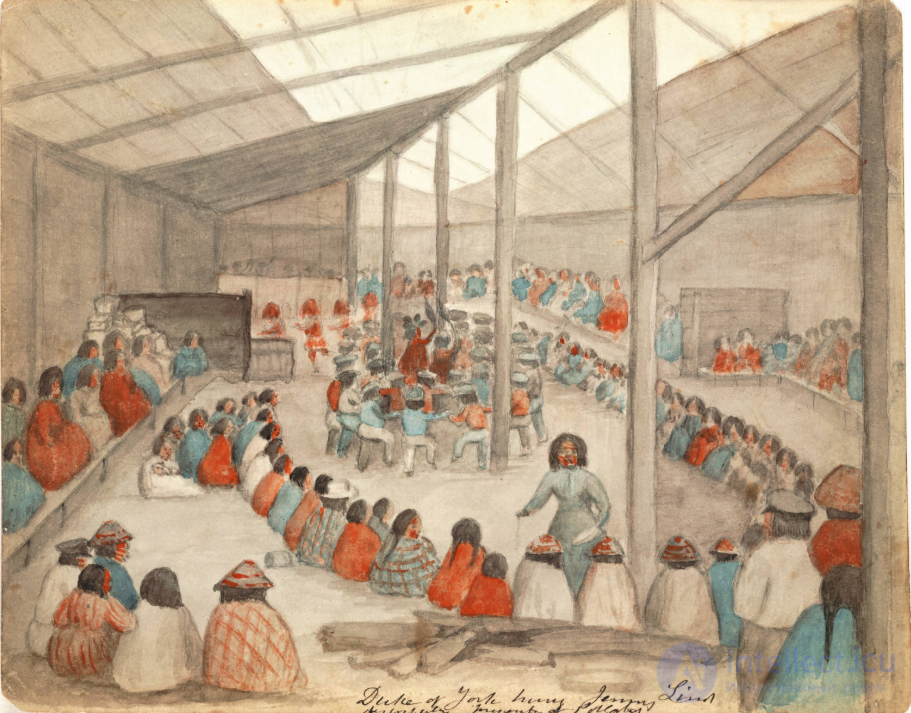
James G. Swan depicts the Clallam Indians at Port Townsend during a potlatch ceremony. Watercolour.
Contrary to popular belief, there is no evidence that society relied primarily on barter before it began using money for trade . In fact, non-monetary societies operated largely on the principles of a gift and debt economy . At the same time, barter relations arose, as a rule, between strangers or potential enemies .
Lewis Hyde traces the origin of the gift economy to the exchange of food, citing as an example the way the inhabitants of the Trobriand Islands called a gift in the Kula Ring "food we cannot eat", even though this gift was not food but an ornament made specially to be passed on as a gift . The Potlatch festival likewise originated as a "great feeding" . Hyde argues that in many societies this gave rise to the notion of a gift as something that must "perish".
The anthropologist Marshall Sahlins writes that the economic system of the Stone Age was by its nature an economy of gift and abundance rather than of scarcity, despite modern readers' notions of its objective poverty .
With the emergence of city-states the existence of money became a necessity, and the gift economy was replaced by an economy based on commodity-money relations[10].
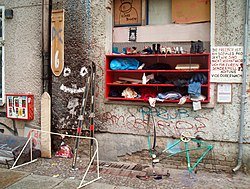
A Freebox in Berlin, Germany, 2005, serving as a centre for distributing free gifts.
Most often a gift economy requires that the exchange of gifts be more than merely a reciprocal exchange between two people. For example, a Kashmiri tale tells of two Brahmin women who tried to fulfil their obligation to give alms simply by passing the alms back and forth to each other. After death they turned into two poisoned wells from which no one could drink, reflecting the barrenness of this pitiful semblance of charity[11]. The phenomenon of widening the circle of giving can also be observed in societies where hunters give animals to priests so that part of them may be offered to a deity (which is expected in return to grant a bountiful hunt). The hunters do not sacrifice themselves to the deity[11].
Many societies have strict prohibitions on the conversion of gifts into trade or commodity capital. The anthropologist James Wendy writes that among the Uduk people of north-eastern Africa there is a persistent custom according to which any gift that crosses inter-clan boundaries must be consumed rather than kept[12]. For example, an animal given as a gift must be eaten and is not used for breeding offspring. However, as in the example of the Trobriand armband and necklace, this "perishing" need not consist of consumption as such; instead, the gift may be passed on further. In other societies it is customary to provide a return gift, either directly in exchange or to a third party. It is reprehensible to keep a gift and give nothing to another. Hyde observes: "In folk tales, the person who tries to hold on to a gift usually dies"[13].
In many societies there are strict prohibitions on turning gifts into commodities or capital . The anthropologist Wendy James writes that among the Uduk people of north-eastern Africa there is a strict custom according to which any gift that crosses subclan boundaries must be consumed rather than invested. [ 35 ] : 4 For example, an animal given as a gift must be eaten rather than raised. However, as in the example of the Trobriand armbands and necklaces, this "perishing" may consist not in consumption as such, but in passing the gift on to another person. In other societies it is a matter of giving another gift, either directly in return or to another person. Keeping a gift and refusing to exchange another is considered reprehensible. "In folk tales," observes Lewis Hyde , "the person who tries to keep a gift usually dies". [ 35 ] : 5
Daniel Everett , a linguist who studied the small Pirahã hunter-gatherer tribe in Brazil, [ 36 ] reported that although they are aware of ways of preserving food by drying, salting and so on, they use them only for goods traded outside the tribe. Within the group, when someone has a successful hunt, they immediately share the abundance, inviting others to a feast. When asked about this practice, one hunter laughed and replied: "I store meat in my brother's belly". [ 37 ] [ 38 ]
Carol Stack's book All Our Kin describes both the positive and the negative sides of a network of obligations and gratitude that effectively constitutes a gift economy. In her account of a poor Chicago neighbourhood, The Flats , there is a passing mention of the story of two sisters, each of whom received a small inheritance. One sister hoarded her inheritance and for a time prospered materially, but became estranged from the community. Her marriage broke down, and she returned to the community largely by giving gifts. The other sister lived up to the community's expectations, but after six weeks she had nothing material left from the inheritance except a coat and a pair of shoes. [ 35 ] : 75–76
Marcel Mauss carefully distinguished the "gift economy" (reciprocity) in market societies from the "total prestations" rendered in non-market societies. A prestation is a service rendered out of obligation, for example "community work". [ 22 ] These "prestations" bring together various spheres encompassing political, religious, legal, moral and economic definitions, so that exchange can be regarded as embedded in non-economic social institutions. These prestations are often competitive in nature, as in the case of the potlatch , the Kula exchange and the Moka exchange. [ 39 ]
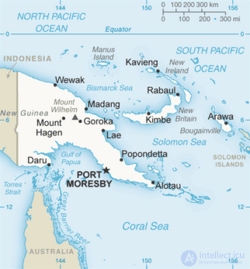
Mount Hagen , Papua New Guinea
The Moka is a highly ritualized system of exchange in the Mount Hagen area of Papua New Guinea , which has become emblematic of the anthropological concepts of the "gift economy" and the " big man " political system. The Moka consists of reciprocal gifts that raise the giver's social status if the gift is larger than the one the giver received. Moka refers specifically to the increment in the size of the gift. [ 40 ] The gifts consist of a limited range of goods, mainly pigs and rare pearl shells from the coast. To return a moka of the same value as the one received is merely to repay a debt, strict reciprocity. Moka is the surplus. For some this represents interest on an investment. However, a person is not obliged to give moka, only to repay the debt. Moka is added to a gift in order to enhance one's prestige and place the recipient in debt. It is precisely this constant renewal of debt relations that sustains their existence; a fully repaid debt puts an end to further interaction. By giving more than one receives, a person builds a reputation as a "big man", whereas merely repaying a debt or failing to repay it in full shifts one's reputation towards the other end of the scale, towards that of a "rubbish man". [ 41 ] Thus the exchange of gifts has a political effect; it confers prestige or status on one party and a sense of obligation on the other. A political system can be built out of such status relations. Sahlins characterizes the difference between status and rank by emphasizing that a "big man" is not a role but a status shared by many. A "big man" is not a "prince over men " but a "prince among men". The "big man" system rests on the ability to persuade rather than to command. [ 42 ]

Three noble Tongkonan houses in a Torajan village
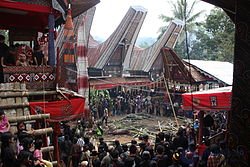
Slaughtering pigs at a funeral
The Toraja are an ethnic group , the indigenous population of the mountainous region of South Sulawesi , Indonesia. [ 43 ] The Toraja are known for their elaborate funeral rites, burial sites carved into rocky cliffs, and massive traditional houses with peaked roofs known as tongkonan , which belong to noble families. Membership in a tongkonan is inherited by all descendants of its founders. Thus, any person may be a member of several tongkonan if they contribute to their ritual events. Membership in a tongkonan brings benefits, such as the right to rent part of its rice fields. [ 44 ]
Torajan funeral rites are important social events, usually attended by hundreds of people and lasting several days. Funerals resemble "big man" contests, in which all the descendants of the tongkonan compete by donating sacrificial livestock. Participants have invested livestock in other people over many years and use these extensive networks to make the largest gift. The winner of the contest becomes the new owner of the tongkonan and its rice lands. They display all the horns of the livestock obtained through their victorious sacrifice on a pole in front of the tongkonan. [ 44 ]
Torajan funerals differ from the "big man" system in that the winner of the "gift" exchange gains control over the tongkonan's property. This creates a clear social hierarchy between the noble owners of the tongkonan and its land and the commoners, who are forced to rent their fields from it. Because the owners of the tongkonan receive rents, they compete better in the exchange of funeral gifts, and their social status is more stable than in the "big man" system. [ 44 ]
The anthropologist David Graeber has argued that the great world religious traditions of charity and gift-giving arose almost simultaneously in the Axial Age (800–200 BC), when coinage was invented and market economies were established on a continental scale. Graeber argues that these traditions of charity arose as a reaction to the nexus formed by coinage, slavery, military violence and the market (the "military-coinage" complex). The new world religions, including Hinduism , Judaism , Buddhism , Confucianism , Christianity and Islam , sought to preserve a "human economy" in which money served to strengthen social relations rather than to buy things (including people). [ 45 ]
Charity and alms are religiously sanctioned voluntary gifts that are given without expectation of anything in return. However, research shows that such gifts are not necessarily altruistic. [ 46 ]
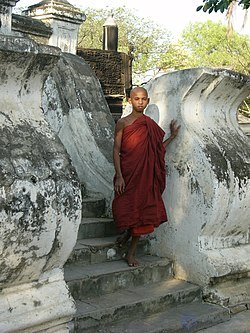
A young Burmese monk
Thai Theravada Buddhism emphasizes the importance of giving alms ( making merit ) without the intention of a return (the pure gift), which, according to doctrine, is best achieved through gifts to monks and temples. The emphasis is on selfless giving, which "makes merit" (and a better life in the future) for the giver, rather than on relieving the burden of the poor or of the recipient of the gift. However, Bowie's research shows that this ideal form of giving is confined to the wealthy, who have the resources to donate to temples and to sponsor the ordination of monks. [ 47 ] The monks come from these same families, so this doctrine of giving has a class element. Poorer peasants pay far less attention to making merit through gifts to monks and temples. They equally approve of giving to beggars. Poverty and hunger are widespread among these poor groups, and by approving giving to beggars they are in effect demanding that the rich attend to their needs in hard times. Bowie regards this as an example of a moral economy (see below), in which the poor use gossip and reputation to resist exploitation by the elite and to pressure it into relieving their suffering in "this world". [ 48 ]
Dāna is a form of religious charity practised in Hindu India. The gift is believed to embody the sins of the giver ("the poison of the gift"), of whose evil the giver is relieved by passing it on to the recipient. The merit of the gift depends on finding a worthy recipient, for example a Brahmin priest. Priests must be able to digest the sin through ritual actions and pass the gift on, with increase, to someone more worthy. It is crucial that this be a true gift, without reciprocity, otherwise the evil will return. The gift is not intended to create any relationship between the giver and the recipient, and there must be no return gift. Thus dāna violates the so-called universal "norm of reciprocity". [ 10 ]
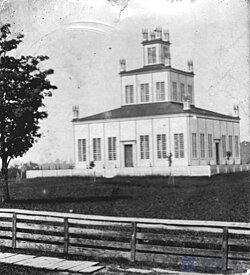
Sharon Temple
The Children of Peace (1812–1889) were a utopian Quaker sect. Today they are known above all for the Sharon Temple , a national historic site and an architectural symbol of their vision of a society founded on the values of peace, equality and social justice. They built this richly ornamented temple in order to raise money for the poor, and they erected the province of Ontario's first shelter for the homeless. They played a leading role in organizing the province's first cooperative, the Farmers' Storehouse , and opened the province's first credit union. The group soon discovered that the charity they were trying to distribute from the temple's funds endangered the poor. Accepting charitable aid was regarded as a sign of indebtedness, and a debtor could be imprisoned without trial ; this was "the poison of the gift". They therefore converted their charitable fund into a credit union that made small loans, like modern microcredit organizations. This is an example of singularization , since money in the temple ceremony was transformed into charity and then moved into an alternative sphere of exchange in the form of a loan. The interest on the loan was then singularized and turned back into charity. [ 49 ]
Non-commodified spheres of exchange exist in relation to the market economy. They are created through processes of singularization , in which particular objects are for various reasons decommodified and enter an alternative sphere of exchange . This can be set in opposition to the market and its supposed greed. It can also be used by corporations as a means of creating a sense of obligation and loyalty among customers. Modern marketing techniques often aim to introduce features of gift exchange into commodity exchange, thereby blurring the supposedly sharp distinction between gifts and commodities. [ 50 ]

A poster promoting blood donation, the Second World War.
The market economy tends to "reduce everything — including people, their labour and their reproductive capacity — to the status of commodities". [ 51 ] "The rapid transfer of organ transplant technologies to third world countries has given rise to a trade in organs: sick bodies are sent to the Global South for transplants, while healthy organs from the Global South are transported to the wealthier countries of the Global North, creating a kind of 'Kula ring' of bodies and body parts". [ 52 ] However, all commodities can also be singularized, or decommodified, and turned into gifts. In North America the sale of organs is illegal, and citizens are enjoined to give the "gift of life" and donate their organs within an organ gift economy. [ 53 ] Yet this gift economy constitutes "a medical sphere replete with powerful forms of mystified commercialization". [ 54 ] This multi-million-dollar medical industry requires clients to pay high fees for a donated organ, which creates a stark class division between those who donate (often in the Global South) and will never benefit from donated organs, and those who can pay the fees and thereby obtain a donated organ. [ 53 ]
Unlike bodily organs, blood and sperm have been successfully and legally commodified in the United States. Thus blood and sperm can be commodities, but once used they become the "gift of life". Although both can be donated or sold, are perceived as the "gift of life", yet are stored in "banks" and can be collected only in accordance with strict government regulations, recipients clearly prefer altruistically donated sperm and blood. The samples of blood and sperm with the highest market value are those that have been donated altruistically. Recipients regard sperm as a repository of the potential characteristics of their future child in its DNA, and value altruism above greed. [ 55 ] Similarly, donated blood is the archetype of a pure gift relationship, since the donor is motivated solely by the desire to help others. [ 56 ] [ 57 ]
Engineers, scientists and software developers have created free software projects such as the Linux kernel and the GNU operating system. These are typical examples of the dominant position of the gift economy in the technology sector and of its active role in spreading the use of permissive free software licences and copyleft licences, which allow software and knowledge to be freely reused. Other examples include file sharing , open access , unlicensed software and so on.
Many retail organizations have "gift" programmes designed to foster customer loyalty to their stores. Bird-David and Darr call these hybrid "mass gifts", which are neither gift nor commodity. They are called mass gifts because they are handed out in large quantities "free with purchase" in conditions of mass consumption. As an example they cite two bars of soap, one of which is given free with a purchase: which one is the commodity and which the gift? The mass gift simultaneously confirms the clear distinction between gift and commodity and at the same time confuses it. As with gifts, mass gifts are used to create social relationships. Some customers accept these relationships and gifts, while others reject them and interpret the "gift" as a 50% discount. [ 58 ]
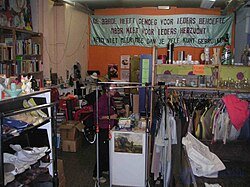
Inside the Utrecht Giveaway shop. The banner reads: "There is enough on Earth to satisfy everyone's need, but not enough to satisfy everyone's greed".
" Free goods shops ", "free shops" or "open access shops" are shops where all the goods are free. They resemble charity shops , mostly stocked with second-hand items — except that everything is available free of charge. Whether it is a book , a piece of furniture , clothing or a household item, everything is given away free, although some operate a "one in, one out" policy (swap shops). A free shop is a form of constructive direct action that offers an alternative to monetary realities, allowing people to exchange goods and services outside the money economy. The 1960s anarchist countercultural group the Diggers [ 59 ] opened free shops that gave away their stock, provided free food, distributed free drugs, handed out money, organized free music concerts and performed works of political art. [ 60 ] The Diggers took their name from the original English Diggers led by Gerrard Winstanley [ 61 ] and sought to create a mini-society free of money and capitalism . [ 62 ]
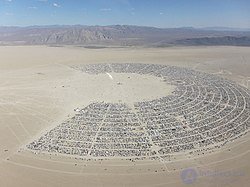
Black Rock City, the temporary settlement created in the Nevada desert for the Burning Man festival, 2010.
Burning Man is an annual week-long event devoted to art and community-building, held in the Black Rock Desert in northern Nevada , in the United States. The event is described as an experiment in community, radical self-expression and radical self-reliance. The event prohibits commerce (with the exception of ice, coffee and tickets to the event itself) [ 63 ] and encourages gifting [ 64 ] . Gifting is one of the event's 10 principles [ 65 ] , as participants in Burning Man (both the desert festival and the year-round global community) are encouraged to rely on a gift economy. The practice of gifting at Burning Man is also documented in the 2002 documentary film Gifting It: A Burning Embrace of Gift Economy [ 66 ] , as well as in the Making Contact radio programme "How We Survive: The Currency of Giving [encore]" [ 64 ] .
According to the Associated Press, "gift-giving has long been part of marijuana culture" and accompanied legalization in US states in the 2010s. [ 67 ] Voters in the District of Columbia legalized the cultivation of cannabis for personal recreational use by approving Initiative 71 in November 2014, but the federal " Cromnibus " appropriations bills of 2015 prevented the District from creating a system allowing its commercial sale. Possession, cultivation and use of the drug by adults in the District are legal, as is gifting it, but sale and exchange are prohibited, which is in effect an attempt to create a gift economy. [ 68 ] In the end, however, this led to the creation of a commercial market tied to the sale of other items. [ 69 ] Before the legalization of cannabis possession in Vermont in January 2018, in the absence of an appropriate legal framework for sales, a similar market was expected to emerge there. [ 70 ] For a time, residents of Portland, Oregon, could legally obtain cannabis only as a gift, which was marked at the Burnside Burn rally. [ 71 ] For a time a similar situation arose after the legalization of cannabis possession in California, Maine and Massachusetts. [ 67 ] [ 72 ] [ 73 ]
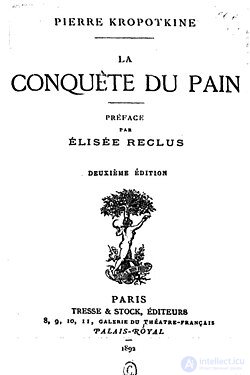
Peter Kropotkin's The Conquest of Bread is an influential work setting out the economic conception of anarcho-communism.
Many anarchists, especially anarcho-primitivists and anarcho-communists , believe that variants of the gift economy may be the key to breaking the vicious circle of poverty . They therefore often seek to reorganize the whole of society into a gift economy. Anarcho-communists advocate a gift economy as an ideal, without money, markets or planning. This view goes back at least to Peter Kropotkin , who saw in the hunter-gatherer tribes he visited a paradigm of " mutual aid ". [ 74 ] Instead of a market, anarcho-communists , such as those who lived in certain Spanish villages in the 1930s, support a gift economy without currency, in which goods and services are produced by workers and distributed in communal stores where everyone (including the workers who produced them) essentially has the right to consume whatever they want or need, as payment for the goods and services they have produced. [ 75 ]
As an intellectual abstraction, mutual aid was developed and advanced by mutual aid or labour insurance systems, and consequently by trade unions as well, and it was also employed in cooperatives and other civil society movements. As a rule, mutual aid groups are open to join and participate in, and all activity is voluntary. They are often structured as non-hierarchical, non-bureaucratic non-profit organisations, where members control all resources and have no external financial or professional support. They are run and organised by their members. They are egalitarian in character and are designed to support participatory democracy, equality of members' status and power, and shared leadership and cooperative decision-making. Members' external social status is considered irrelevant within the group: status in the group is determined by participation. [ 76 ]
The English historian E. P. Thompson wrote about the moral economy of the poor in the context of the widespread food riots in the English countryside in the late eighteenth century. Thompson argued that these riots were generally peaceful acts that demonstrated a common political culture rooted in feudal rights to "set the price" on essential goods in the market. These peasants held that a traditional "fair price" mattered more to the community than a "free" market price, and they punished large farmers who sold their surpluses at higher prices outside the village while some members of the village still needed the produce. The moral economy is thus an attempt to preserve an alternative sphere of exchange from the encroachment of the market. [ 77 ] [ 78 ] The notion of peasants with a non-capitalist cultural mentality using the market for their own ends is linked to subsistence agriculture and the need to insure one's livelihood in hard times. However, James C. Scott points out that those who provide this insurance against destitution in bad years are wealthy patrons who exact a political price for their assistance; that assistance is provided in order to recruit followers. The concept of the moral economy has been used to explain why peasants in a number of colonial contexts, such as the Vietnam War, rose in revolt.
Some may confuse common property regimes with gift exchange systems. The commons are the cultural and natural resources available to all members of a society, including natural materials such as air, water and habitable land. These resources are held in common rather than owned privately. [ 80 ] The commons may include everything from natural resources and common land to software. [ 81 ] The commons include public and private property in which people hold certain traditional rights. When common property is converted into private property, this process is called "enclosure" or "privatisation". A person entitled to common land jointly with another or others is called a commoner. [ 82 ]
There are a number of important aspects that can be used to describe true commons. First, the commons cannot be turned into a commodity – if that happens, they cease to be commons. Second, unlike private property, the commons are inclusive rather than exclusive – their nature is to distribute ownership as widely as possible rather than as narrowly as possible. Third, assets held in the commons must be preserved regardless of the return on capital. Just as we receive them as a common right, so we are obliged to pass them on to future generations at least in the same condition in which we received them. If we can increase their value, so much the better, but at a minimum we must not degrade them, and we certainly have no right to destroy them. [ 83 ]
Free content, or free information, is any kind of functional work, work of art or other creative content that meets the definition of a free cultural work. [ 84 ] A free cultural work is a work that carries no significant legal restrictions on people's freedom:
Although different definitions are used, free content is legally similar, if not identical, to open content. An analogy is the use of the competing terms "free software" and "open source", which describe ideological rather than legal differences. Free content includes all works in the public domain, as well as those copyrighted works whose licences respect and uphold the freedoms mentioned above. Because copyright law in most countries by default grants rights holders monopolistic control over their creations, copyrighted content must be explicitly declared free, usually by referencing or including licence statements within the work.
Although a work in the public domain because its copyright has expired is considered free, it may become non-free again if copyright law changes.
Information is especially well suited to a gift economy, since information is a non-rival good and can be given away at virtually no cost (zero marginal cost). In fact, there is often an advantage in using the same software or data formats as others, so even from a self-interested point of view it may be beneficial to share one's information.
Pacific island societies before the nineteenth century were essentially gift economies. To this day such practices are still present in some parts of the Pacific region — for example, on some remote Cook Islands[14]. In Tokelau, despite the gradual arrival of the market economy, a form of gift economy still persists in the practice of inati — the strictly egalitarian distribution of all food resources on each atoll[15]. On the island of Anuta a gift economy called "Aropa" still exists[16].
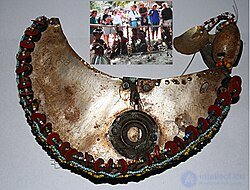
A photograph of a necklace taking part in the reciprocal ceremonial Kula exchange.
In Papua New Guinea the Kula ring still exists to this day, as do other exchange systems such as the Moka exchange.
A significant portion of the Pacific islander diaspora living in New Zealand, Australia and the USA still maintain relationships characteristic of a gift economy. Even though they find themselves drawn into the market economies of these countries, some of them strive to preserve the foundations of a gift economy, such as reciprocal monetary gifts or remittances back home[17].
The North American Indians who lived in the Pacific Northwest (primarily the Kwakiutl) practised the potlatch ritual, in which chiefs give away large quantities of goods to their subjects in order to strengthen group ties. By sacrificing accumulated wealth, a leader gained honour among the people and also issued a challenge to his rival, which could be answered only with a new potlatch more lavish than the first[18].
The Tarahumara people of north-western Mexico have a custom called kórima. The custom holds that it is everyone's duty to share their wealth with others[19].
In the 1930s Spanish anarcho-communists living among villagers tried to minimise monetary relations by maintaining a gift economy. Goods and services were produced by workers and distributed in communal shops, in which everyone (including the workers producing them) had the full right to receive what they wanted or needed as payment for the goods and services they had produced[20].
"Burning Man" is an annual eight-day art event held in the Black Rock Desert in northern Nevada, USA. The organisers themselves define the event as an experiment in creating a community of radical self-expression while relying entirely on itself (radical self-expression, and radical self-reliance). Commerce at the event is outlawed (except for the sale of ice, coffee, and tickets to the event itself)[21], and gifting is encouraged in every way[22]. Gifting is one of the festival's ten key principles[23]. Participants in the event are encouraged to be guided by the principles of the gift economy both during the festival and at other times. The practice of gifting at Burning Man is described in the 2002 documentary film "Gifting It: A Burning Embrace of Gift Economy"[24].
Since information can be distributed at virtually no financial cost while increasing in value, it is ideally suited to a gift economy.
Traditional scientific research can be regarded as part of an information gift economy. Scientists carry out research work and publish its results through journals and conferences (although access to the journals themselves may be expensive), and other scientists may freely cite such sources. In this way all scholars with access to these journals benefit from the growing body of knowledge. The authors themselves derive no direct benefit from publishing their own work, but they enhance their reputation in the scholarly world. Failing to cite the work of the original authors (thereby depriving them of due credit) is considered improper conduct[27].
Using file-sharing networks, any user can search and find on any other user's computer the resources that person has made freely available, and download them for free. And since the number of users of such file-sharing programs runs into the hundreds of thousands, and sometimes even millions, a user will most likely find the file they need.
In his ethnographic work "Consumer Gift Systems", Markus Giesler characterises music downloading as a system of social solidarity based on free transfer[28].
The well-known hacker and programmer Eric Raymond notes in his book "Homesteading the Noosphere" that developers of free and open source software have created a "gift culture" whose participants compete for prestige by investing their personal time, energy and creativity[29]. However, prestige is not the only incentive for gifting code. A sociological study among members of the Fedora community conducted at the University of North Texas in 2010-11 showed that the main reason they gave for their participation was "the pleasure of learning and collaborating with interesting and clever people". Motivation by personal gain and career advancement was encountered far less often. A typical response among those surveyed was something like: "basically, I help out so that I can use it myself" and "programmers' hands just itch"[30].
Members of the Linux community often call their activity a gift economy[31]. Debian — the best-known distribution of the GNU/Linux operating system — offers more than 35,000 free open source software packages for download[32].
The free online encyclopedia Wikipedia contains millions of articles, and almost none of its many authors and editors receives material reward directly[33][34].
The Pay what you want payment system is also based on the principles of the gift economy. In the absence of a fixed price, the recipient has the opportunity to determine for themselves the value of the good received and to reward the giver according to their means[35].
There are various social theories that characterise the gift economy. Some consider gifting a form of reciprocal altruism. Others state that social status is acquired in exchange for gifts. It is also held that in this way egalitarian relations within the group are deliberately maintained. For example, among some hunter-gatherers the sharing of food obtained is a guarantee for any individual against failure in their daily foraging. This custom may reflect concern for the well-being of others and may serve as an informal form of insurance, or it may bring social status and other advantages.
In his well-known book The Gift: Creativity and the Artist in the Modern World, Lewis Hyde shows that the traditional gift economy is based on "the obligation to give, the obligation to receive, and also the obligation to reciprocate", which carries "at once economic, legal, moral, aesthetic, religious and mythological meaning"[36]. He describes the spirit of the gift economy (and its difference from the market economy) as follows[37]:
Set against the "Indian giver" is the "white man keeper"... Everything received is meant to be given away rather than kept. And if something is kept, then something of equal value must go out... The gift may be returned to its original giver, but this is not required... Most important of all: the gift must keep moving.
Hyde also argues that there is a difference between a "true" gift given in gratitude and a "false" gift made solely out of obligation. In Hyde's view, a "true" (disinterested) gift creates a bond that goes beyond any commodity transaction, but "we cannot become truly bonded to someone who gives us false gifts"[38].
According to Hyde, when an economy based mainly on the principle of gifting turns into a commodity economy, "the social structure of the community invariably breaks down"[13]. Just as there is a prohibition on turning gifts into capital, there are prohibitions on treating gift exchange as barter. Among the Trobriand Islanders, for example, turning the Kula ring into barter is considered a disgrace[39]. Hyde writes that in principle any commercial good can become a gift, but when gifts become commodities, the gift "…either ceases to be a gift or loses its bounds… Transactions of the heart lie outside the framework of the law, and when such transactions descend into legally sanctioned relations, the circle of gifting narrows"[40].
The sociologist Marcel Mauss argues that a gift always entails an obligation and is never "free". According to Mauss, however attractive a gift economy may seem, people do not always want to be entangled in a web of obligations. "A gift that has not yet been repaid demeans the person who accepts it"[41], as is borne out by the experience that young people go through when they try to start an independent life and decide to stop accepting money or gifts from their parents[42]. As Hyde writes: "There are moments when one wants to be an outsider and a stranger"[43]. One would like to be able to go to the shop around the corner, buy a tin of soup, and have the shopkeeper not meddle in our affairs, nor we in theirs. It is more pleasant to travel by plane without worrying about what sort of relationship we have with the pilot. Gifts create a "felt bond", while commodity exchange does not[44].
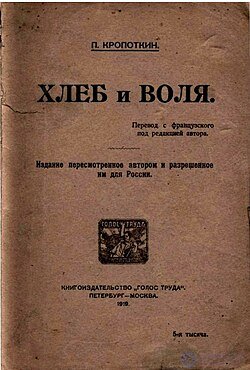
Kropotkin's book The Conquest of Bread describes an economic system based on mutual aid and voluntary cooperation.
The French writer Georges Bataille used Mauss's argument in his book The Accursed Share (La Part maudite)[45] in order to construct a theory of the economy. In his view, the structure of gifting is the initial premise of any possible economy. Particularly interested in the potlatch tradition described by Mauss, Bataille argues that its antagonistic character obliges the recipient of a gift to confirm subordination, and that the structure of gifts can lead to a practice that defines different roles for the parties taking part in it, thus establishing in the act of giving a Hegelian dipole of master and follower.
Anarchists, in particular anarcho-primitivists and anarcho-communists, believe that the gift economy in its variations can become the key to escaping the vicious circle of poverty. They therefore wish to extend the gift economy to the whole of society. Anarcho-communists champion the ideal of a gift economy free of money, markets and central planning. This view is attributed at least to Peter Kropotkin, who saw in hunter-gatherer tribes a paradigm of "mutual aid"[46].
Kropotkin argued that mutual benefit is a stronger incentive than mutual strife, that it leads to higher individual productivity and that, ultimately, it is more efficient for the collective in the long run. At the heart of the gift economy is an emphasis on the idea of increasing individual human capabilities and their means of production, which then (in theory) enhance society's capacity to reciprocate an individual's gifts.
The economist Duran Bell argues that exchange in a gift economy differs from simple commodity exchange in that it is used primarily to build social relationships. Gifts between individuals or between groups help to build relationships, which enables people to work together. The generosity of a gift raises a person's prestige and social standing. Differences in social rank are determined not by access to goods but by "the ability to give to others; the desire to accumulate is regarded as a sign of weakness"[47].
продолжение следует...
Часть 1 Gift economy

Comments