
Lecture
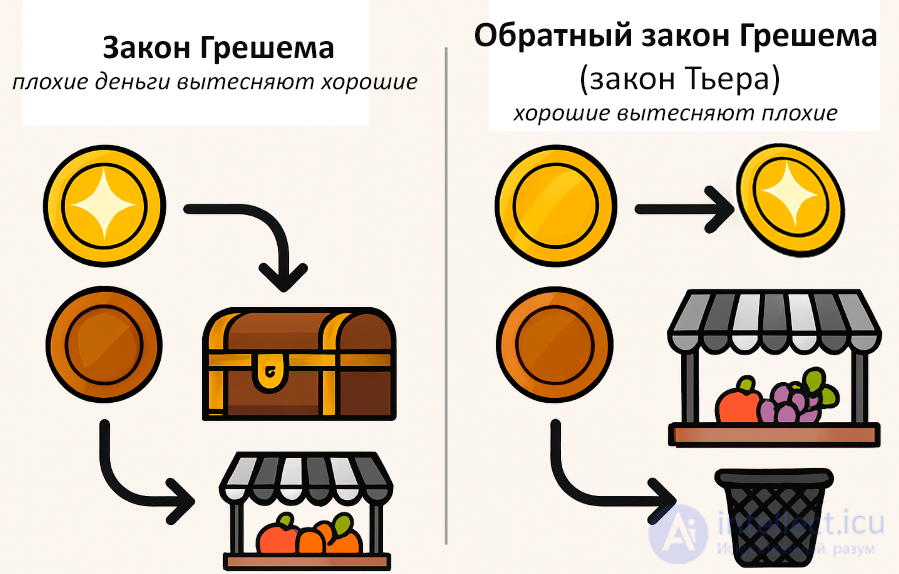
Copernicus–Gresham's law (also Gresham's law) is an economic law stating: "Bad money drives good money out of circulation."
The law was postulated in 1526 in the treatise Monetae cudendae ratio (On the Minting of Coin) by the Polish astronomer, economist and mathematician Nicolaus Copernicus (1473-1543) and was definitively formulated in 1560 by the English financier Thomas Gresham (1519-1579).
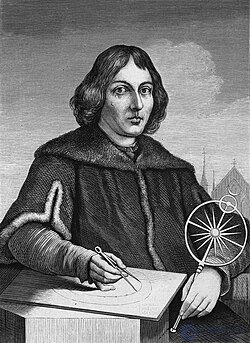
Portrait of Nicolaus Copernicus (1473—1543)
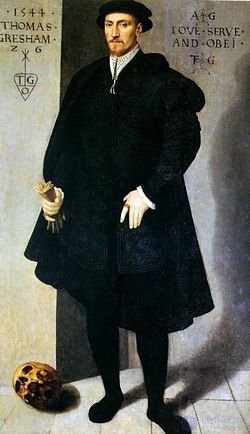
Portrait of Thomas Gresham, 1544
The authorities of many states engaged in the debasement of coinage. This consisted in reducing their gold or silver content while retaining the previous nominal value. By "debasing" money, the state often sought to resolve emerging financial difficulties. The consequences of such actions were rising prices and the effective withdrawal of "full-weight money" from circulation, its conversion into a form of hoarded treasure with a value higher than its face value. The fact that "full-weight money" disappeared from everyday use and was replaced by "underweight" money was noted by one of the early mercantilists and financial adviser to the English Queen Elizabeth I, Thomas Gresham. The idea he expressed, that "bad money drives good money out of circulation," entered history under the name of Gresham's law .
Although the law is named after Gresham, the phenomenon it describes was noted almost two thousand years before his birth. Thus, as early as the 5th century BC, in the comedy "The Frogs," Aristophanes noted the phenomenon of "good" money being driven out by "bad":
It often seems the city treats its citizens and sons,
Both the worthy and the worthless, in exactly the same way
As it treats the ancient coinage and the currency of today.
Those genuine coins of ours, in no way counterfeit,
The finest of the finest, famed in every land
Among the Hellenes and even in far barbarian realms,
With sturdy, proper minting, of true and golden assay,
We do not use at all. Copper coins are what we spend,
Badly struck, in haste, rubbish and debasement, worthless .
These ideas are also expressed in the works of the 12th–13th century Islamic scholar Ibn Taymiyyah, the 14th century French philosopher Nicole Oresme, and also Nicolaus Copernicus.
Gresham's law distinguishes the existence of "good" and "bad" money. "Good" money refers to money in which the value of the material from which it is made is higher than the material of "bad" money of equal nominal value.
During the period when silver and gold coins were in wide use, this law was highly pertinent. Thus, when the content of precious metals in coins was reduced while the previous nominal value was retained, previously issued coins quickly went out of use. This was explained by the fact that people preferred to save "good" money, paying with "bad" money.
At the same time, Gresham's law holds only where there is a legally established equality or fixed ratio between the values of "bad" and "good" money. Under free-market conditions, two independent monetary units are formed, exchanged at a particular rate (for example, the assignat ruble and the silver ruble). This limitation was noted by Ludwig von Mises in 1912 in his work "The Theory of Money and Credit." Later this conclusion was confirmed by other economists as well — Murray Rothbard ("What Has Government Done to Our Money?", 1962), and Friedrich von Hayek in the book "Denationalisation of Money" (1975) formulates it as follows: "Gresham's law applies only to different kinds of money between which a fixed rate of exchange is enforced by law. If the law makes two kinds of money perfect substitutes for the payment of debts and forces creditors to accept a coin of a lower content of gold in the place of one with a higher content, debtors will, of course, pay only in the former and find a more profitable use for the latter. In contrast to the case of legally fixed exchange rates, with variable exchange rates the money of inferior quality would be valued lower and people would try to get rid of it as quickly as possible, especially if there is a threat of a further fall in its value."
The 1999 Nobel laureate in economics Robert Mundell supplemented Gresham's law, which in his interpretation should read: "Bad money drives out good if they exchange for the same price" (Bad money drives out good if they exchange for the same price) .
As soon as the paper money being issued ceased to be freely exchangeable for the corresponding quantity of gold coins, the latter instantly disappeared from circulation.
The discovery of rich gold deposits in California and the resulting gold rush in the mid-19th century led to a rise in the value of silver relative to gold in the USA. As a result, the silver coins in circulation were withdrawn from circulation, melted down, and exchanged for a larger quantity of gold coins, which were then exchanged again for silver ones. The quantity of silver coins fell sharply, and the state was forced to begin minting silver coins with a lower silver content.
In 1922 in the USSR, in addition to sovznaki, the chervonets, backed by gold, was introduced. But the purchasing power of these parallel currencies was not equalized; two different prices were indicated for goods. This ensured a stable external exchange rate for the chervonets and did not lead to its being drained from circulation.
In 1965 US President Lyndon Johnson abolished the silver standard, which caused the rapid withdrawal from circulation of previously minted silver coins (including the 1964 Kennedy 50-cent piece). At the same time, unlike the 10- and 25-cent coins, which began to be minted from a copper-nickel alloy, the 50-cent piece remained 40% silver. For this reason people also hoarded these coins, withdrawing them from wide circulation. In 1971 the 50-cent coins also began to be minted from a copper-nickel alloy. By that time vending machines had come into use which did not accept 50-cent coins, and people had grown unaccustomed to using them.
The experience of dollarization in countries with weak economies and currencies (such as Israel in the 1980s, the countries of Eastern Europe and the countries immediately after the collapse of the Soviet bloc , or Ecuador through the late 20th and early 21st centuries) can be regarded as the operation of Gresham's law in its reverse form (Guidotti and Rodríguez, 1992), since on the whole the dollar in such situations was not legal tender, and in some cases its use was illegal.
Adam Fergusson (in the book " When Money Dies ") and Costantino Bresciani-Turroni (in the book "Le vicende del marco tedesco" , published in 1931) noted that during the great inflation in the Weimar Republic in 1923, when the official money became so depreciated that practically no one was willing to take it, people simply stopped accepting the currency in exchange for goods. This was especially serious because farmers began to hoard food. Accordingly, any currency backed by some value became the medium of exchange in circulation. In 2009 hyperinflation in Zimbabwe began to display similar characteristics.
These examples show that in the absence of effective legal tender laws, Gresham's law works in reverse. If people are given a choice of which money to accept, they will accept the money that in their view has the greatest long-term value, and will not accept that which in their view has low long-term value. If, however, there is no choice and they are obliged to accept all money, good and bad, they will as a rule keep the money perceived as more valuable for themselves and pass the bad money on to others.
In short, in the absence of legal tender laws a seller will accept nothing but money of a certain value (good money), but the existence of legal tender laws will compel the buyer to offer only the money with the lowest commodity value (bad money), since the creditor must accept such money at face value.
Nobel laureate Robert Mundell believes that Gresham's law could be formulated more precisely, taking the reverse situation into account, if it read: "Bad money drives out good if they exchange at the same price ».
The reverse Gresham's law, according to which good money drives out bad money whenever bad money becomes almost worthless, was named "Thiers' law" by the economist Peter Bernholz in honour of the French politician and historian Adolphe Thiers . "Thiers' law will only come into operation later [under inflation], when the rise of the new flexible exchange rate and of the rate of inflation reduces the real demand for the inflationary money."
The principles of Gresham's law can sometimes be applied in various fields of study. Gresham's law can be applied generally to any situation in which the true value of something differs substantially from the value people are compelled to accept, owing to factors such as a lack of information or a government regulation.
Former US Vice President Spiro Agnew used Gresham's law to describe the American media , stating that "bad news drives out good news," although his argument was closer to an argument about a race to the bottom for the sake of higher ratings than about the overvaluation or undervaluation of certain kinds of news.
Gregory Bateson postulated an analogue of Gresham's law operating in cultural evolution, according to which "the oversimplified ideas will always displace the sophisticated and the vulgar and hateful will always displace the beautiful. And yet the beautiful persists."
In the used-car market, "lemon" cars (analogous to bad currency) drive out good cars. [ 30 ] The problem lies in the asymmetry of information. Sellers have a strong financial incentive to pass off all used cars as good ones, especially "lemons." This makes it difficult to buy a good car at a fair price, since the buyer risks overpaying for a "lemon." As a result, buyers pay only the fair price for a "lemon," so at least they reduce the risk of overpaying. High-quality cars tend to be driven out of the market, because there is no reliable way to establish whether they are really worth more. Certified pre-owned car programmes are an attempt to mitigate this problem by providing a warranty and other quality guarantees. "The Market for Lemons" is a work that examines this problem in greater detail.
Cory Doctorow wrote that an effect similar to Gresham's law is observed in the trade in carbon offsets . The presumed information asymmetry is that it is difficult for people to determine how effective the credits they purchase are, yet they can easily determine the price. As a result, cheap but ineffective credits can drive out expensive but valuable carbon credits. [ 31 ] As an example, the proposal by the organisation The Nature Conservancy to acquire cheap but "meaningless" carbon credits by purchasing cheap land that was unlikely to be logged in any case, instead of expensive and valuable land at risk of being logged, was cited.
A corollary of this is Hughes's law, which in moral philosophy states: "The evil deeds of bad men engender in better men deeds which under better circumstances would also be called evil."

Comments