- Theory of social action
- Theory of the social system: structure, functions, changes.
He introduced the modern sociological language. He developed his work against the background of empirical sociology. He wanted to understand the processes taking place in society. He wrote in a very complex language.
He completes structural functionalism, giving it its finished form.
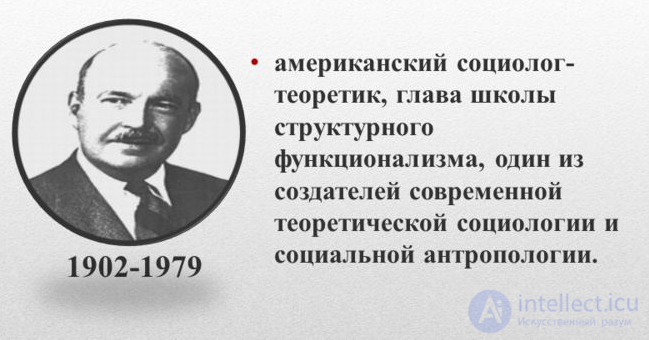
T. Parsons (1902-1979). A man of broad erudition. He was interested in biology, physiology, economics and organisation theory.
Contribution: he was the founder of the structural-functional school of sociology. He taught at Harvard and did research training in Germany.
Main works:
- “The Structure of Social Action” (1937)
- “Social Statics” (1950s)
- “The System of Social Societies” (970s)
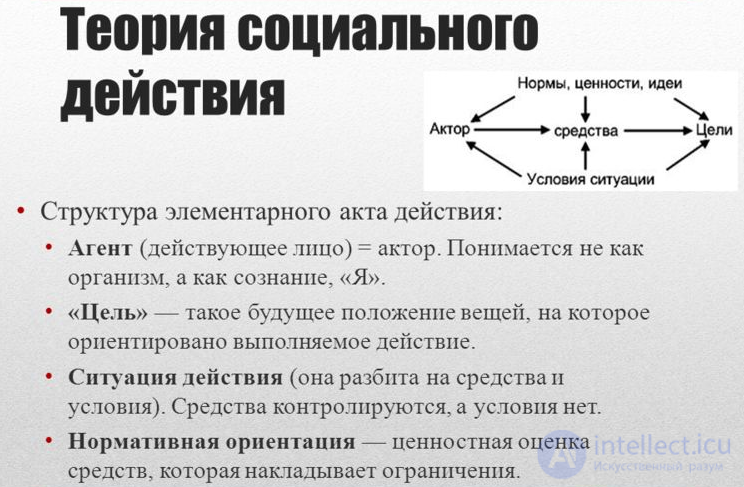
- Parsons believed that the primary cell underlying social reality is the social action of the actor (the acting person).
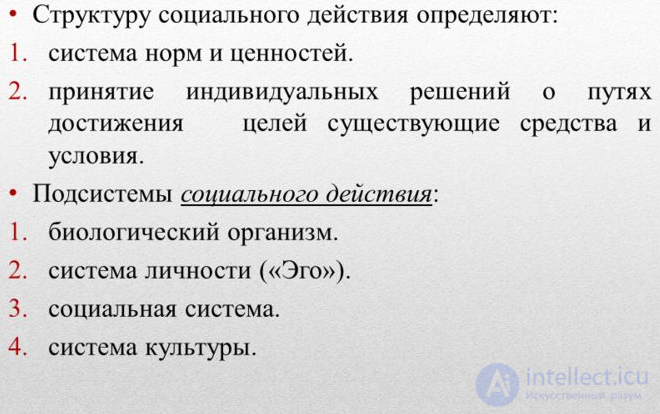
Social action is distinguished by 4 features:
- Human action is symbolic in character, i.e. it has meaning, which is expressed in the form of language and other signs. The meaning of human action – it purposefully strives towards a definite result. Meaning is driven by values and needs. The basis – values (a similarity to Weber)
- It is directed by social norms and is normative in character (a similarity to Durkheim): social action – the action of a person belonging to a particular social system; it is determined by its norms and values. The individual is compelled to act as society requires, for the sake of survival. The individual is weak and incapable of surviving in isolation, so he is forced to adapt to society (conformism, adjustment, adaptation) – the fundamental property of the individual.
- Human action is characterised by voluntarism, i.e. a person always makes a choice, exercises his will. A person makes a conscious, rational choice between various goals and ways of achieving them. However, the basis for the choice is not rationalism as such (Weber), but the existence of a norm in society. A social norm – is a generally binding rule of behaviour, or a standard action in given situations. Therefore the norm brings order to human action, makes it predictable, makes other people – recognisable; thanks to the norm, one expects similar behaviour from another person.
- The presence of a situational environment. Conditions and factors that influence human behaviour. Conditions – objective circumstances not alterable by the person. Factors – alterable circumstances, which the person may use as means for achieving a goal. Human action has several levels of situational environment:
The external environment: the lowest level – the material world, the physico-chemical environment; the highest – the spiritual, transcendental world (god, love, humanism).
At the bottom – energy; at the top – information. The more information there is, the more control there is over human behaviour.
The next level: the biological system – the organic world surrounding the person.
The next: the personality system, which has a genetic nature and a biological and cultural shell.
The next level: the social environment (system) – these are the persons, groups, classes and communities that affect the person directly or indirectly.
Further: the cultural system – spiritual energy.
All the elements of the situational environment influence human action. They are all interconnected with one another; each successive level of the social system draws energy from the previous level. Each successive system controls the one before it. The higher the level of the social system, the more it controls the lower one. The cultural system and the higher spiritual reality possess the greatest controlling effect. Accordingly, the less informed a society is, the less control there is over social processes, and the more spontaneous processes dominate in society.
Each system performs a particular function:
- Biological – adaptation to the environment
- Personality system – goal-setting
- Social system – integration (unification)
- Cultural system – the function of maintaining and reproducing the pattern
1, 3, 4 – are the environment for the social system. ! for the others – control.
2. Parsons applied a systems approach. Parsons’ theory of social systems goes back to the general theory of systems developed in cybernetics by Wiener and Von Bertalanffy.
It is based on the concept of a closed and an open system.
A closed type of management is directed at carrying out a rigidly defined task and is based on strict control over the execution of the programme; deviations from the programme are suppressed; there is no connection with the external environment (an iron curtain). Social action in a closed system is determined by the framework of the set tasks and goals. It is closed because the task was rigid (for example, the building of communism).
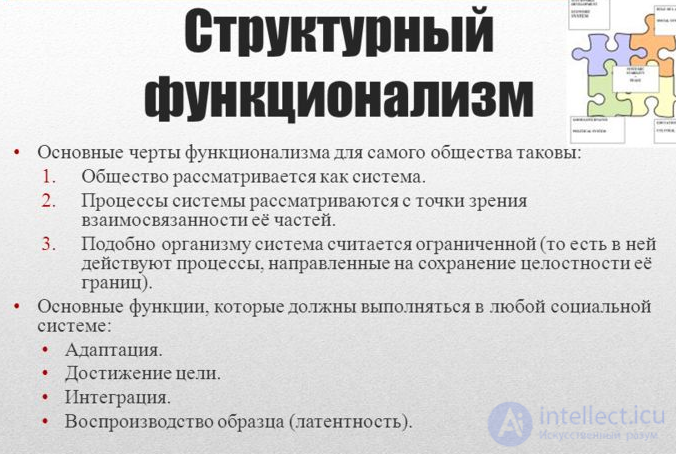
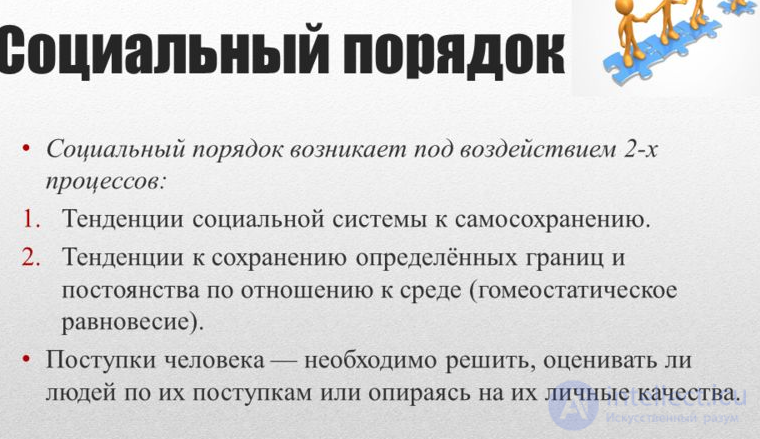
In an open system, deviations are not suppressed but are accumulated, processed, and turned into proposals for changing the system. There is a connection with the external environment. It is characterised by conditions of stability, order and development, owing to 4 basic functions:
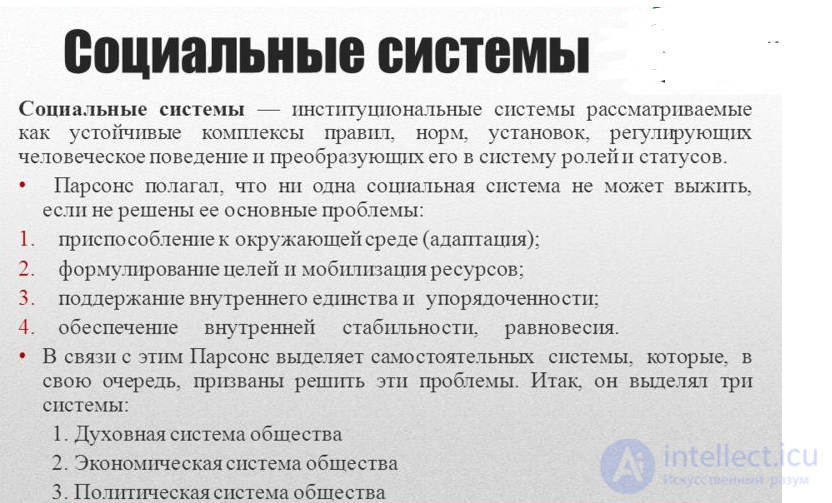
- The function of adaptation: every system must ensure the acquisition of resources and their distribution within the system; it must be able to adapt to internal and external changes within society. This function is performed by the country's economy.
- The function of goal attainment: the system's ability to define the goals of society's development and to mobilise resources (above all, human ones) to achieve those goals, and to determine the order in which they are achieved. This function is performed by the political sphere of society.
- The function of integration: every system must maintain its own unity, social order, the internal coordination of its parts, and must suppress the possibility of deviation. Integration as a means of achieving solidarity (performed by the social sphere). It forms the core of society. It includes the social institutions that integrate and control the members of society: basic values, (legal) norms, social roles, and collective organisations, which direct the social activity of individuals in the interests of social systems and contribute to its integration.
- The function of pattern maintenance (latency): the maintenance of customs, traditions, rituals and values. Every system must instil in its members such value-based motivation of behaviour as corresponds to the goals of the system. The system creates, preserves and refines the motivation of individuals and their patterns of behaviour, directed towards strengthening integration, achieving the collective goal, and adapting to the environment. This function is performed by the spiritual sphere of society through institutions: education, upbringing, the family, profession, since it contributes to its development, for changes in society begin with changes in values (in Marx – with the mode of production).
social systems and changes
The system of functioning of social systems: agile
Society and the individual in Parsons: at the centre of the social system lies the social action of the individual, and all the social institutions in society are directed at regulating and controlling the individual's social action.
How does sociality arise? The mechanism of social action finds its manifestation in interaction with basic social processes that shape society and the individual.
The principles by which the interaction between society and the individual takes place:
- The principle of internalisation. It means the process, incorporated into the system, of the individual's orientation towards the cultural values, social and role expectations.
- The principle of socialisation. It means the social form of the individual's perception of the social information necessary for the process of adaptation to society. Unlike Durkheim, Parsons believed that the individual does not passively perceive and absorb social norms and requirements, but actively selects the information he needs. The essence of socialisation consists in preparing competent bearers of social roles (daughter, pupil, citizen, future parent). Functions: it ensures the principle of role expectations, ensures the reproduction of society and its stability, ensures the dynamism of society's development, and the inheritance and adoption of existing social institutions (the family)
- The principle of institutionalisation. It means that the system of institutions in society is inherited by new generations and adopted by means of internalisation and socialisation.
Parsons’ theory of development:
Parsons developed an alternative to K. Marx's theory of development.
- The essence: Marx – the basis of society's development is the mode of production (the material basis of development). Parsons – the basis of society's development is the process of differentiation, the striving for order, and efforts at adaptability.
- The driving force: Marx – conflict between classes, between the productive forces and the relations of production. Parsons – changes in the structure of the functions of systems and their adaptation to the environment.
- Ways and mechanisms of development: Marx – revolution, the change of formations. Parsons – evolution, innovation and adaptation.
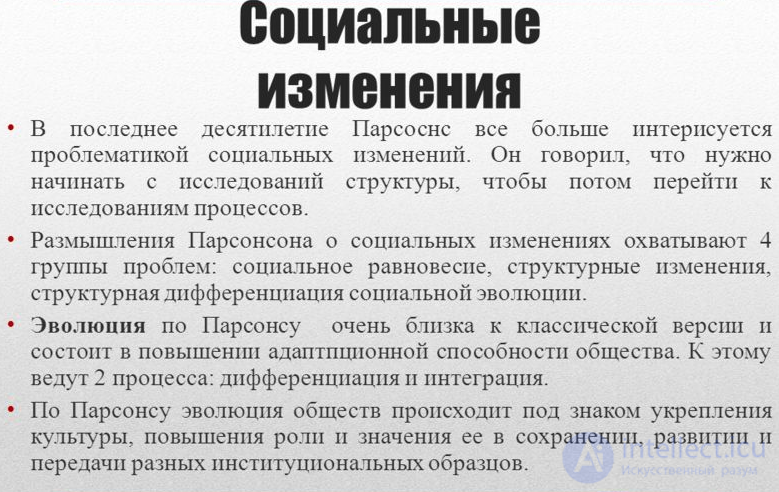
What underlies the changes in society? – the idea of differentiation; the content of social evolution changes in the direction of the system's growing complexity and increasing adaptability, through the age-related differentiation of the role functions performed by a person within the system, i.e. society becomes more complex owing to the increasing complexity and differentiation of a person's role functions.
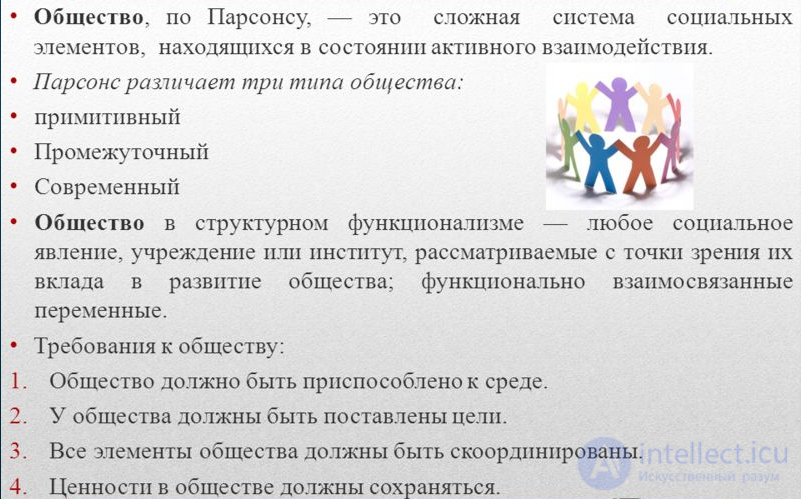
Parsons identified 3 stages in the development of society:
- Primitive society: a person performed various role functions in one and the same person. There is no differentiation, no division of labour.
- Intermediate society: partial division of labour is present (men and women); social stratification appears, simple differentiation, culture develops.
- Modern society: identifies 3 revolutions:
- The industrial revolution, which led to the differentiation of the economic and political systems
- The democratic revolution, connected with the change and increasing complexity of the political system
- The educational revolution, which separates from civil society the subsystem of the reproduction of the structure and the maintenance of the cultural pattern.
In modern society there occurs a separation of the legal system from religion; an administrative democracy is formed, a market economy, a democratic electoral system, and a complex differentiation of social roles.
Simple and complex societies. Their developmental tendency.
Society develops from collectivism towards individualism. There are 2 ways by which society resolves the vital questions of its members:
- how individuals receive their reward
- Should the members of society seek ways of realising their own interests themselves, or should this be done by the social groups to which they belong.
In simple societies a person's needs are satisfied with the help of collectives. In a highly industrial society the individual himself seeks ways of satisfying his needs.
|
|
Simple society
|
Industrial society
|
|
Status
|
Ascribed (determined by the type of family into which the individual is born)
|
Achieved (attained through personal effort – diligence, work)
|
|
Communication
|
Diffuse
(people communicate to satisfy a wide range of needs)
|
Specific (people enter into relationships to satisfy particular needs: you for me, I for you)
|
|
Attitude towards others
|
Particularism. Different attitudes towards different people: loyal – towards relatives, acquaintances; wary – towards strangers; deferential - towards those of rank.
|
Universalism. People treat others according to the principle: everyone is equal before the law (regardless of family ties, a police officer can arrest a relative).
|
|
Attitude towards accumulation
|
Affectivity. The striving to satisfy one's desires as quickly as possible (a treasure, a miracle, a magic pike) without effort or labour.
|
Restraint. More restrained regarding the timing of reward; they set aside funds for large purchases.
|
|
The individual and society (the group)
|
Collective orientation. People place the interests of the social group to which they belong above their own interests
|
Self-orientation. Above all, people pursue their own goals, not the interests of their group.
|
According to Parsons: the driving forces and mechanisms of social change:
Changes in society begin with changes in spiritual values.
The basic foundations of society – values. Change the values – and society changes.
Evolution is connected with innovation, a breakthrough in the cultural sphere, in the system of values, and only then in other spheres, providing society with a new level of adaptation to the environment. Values play a special role in such spheres of social action as professional roles and the family.
Conditions for the existence of social systems:
- Compatibility with other systems.
- The presence of support from other systems
- The system's ability to satisfy the basic needs of those who support the system through their participation in it.
- The system's ability to mobilise the maximum activity of its members towards the implementation of a development strategy
- The exercise of control over potentially deviant behaviour.
- Strict control over destructive conflicts.
- A unified cultural orientation: the presence of a common language and principles of communication.


Comments