
Lecture 13 min.
He combined Parsons’ high theory with empirical sociology and created middle-range theories (the theory of deviance, the theory of social structure, the theory of anomie, of bureaucracy, of science, of behaviour):
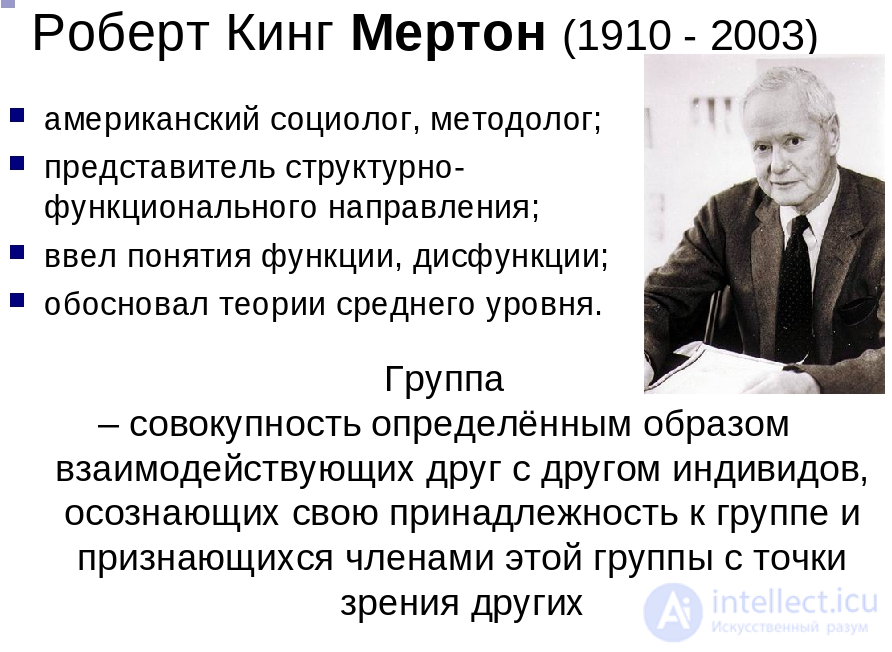
Works:
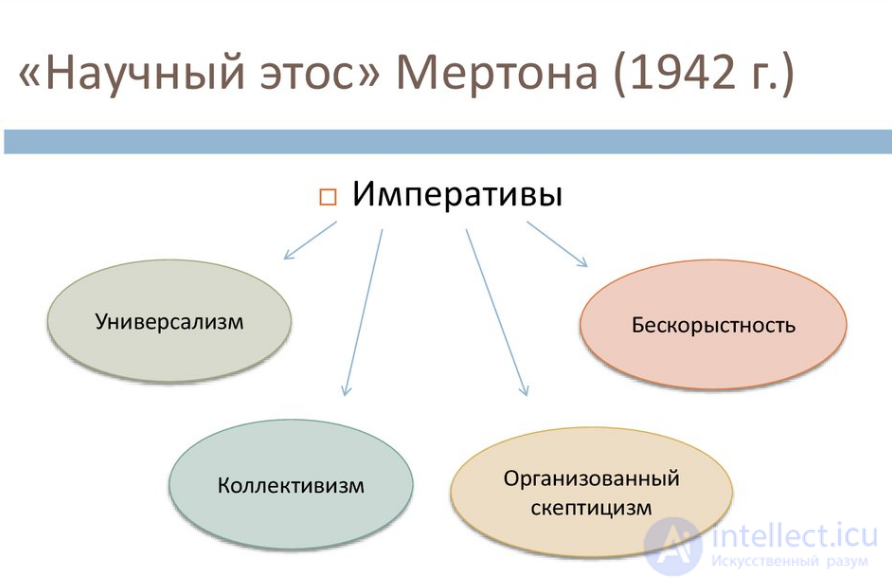
the scientific ethos
1. Structural functionalism – a method of studying society, proceeding from the following principles:
Conclusions: Functional analysis examines social structures from the point of view of their functional consequences for the fulfilment of 4 functions of development: adaptation, integration, goal attainment, and the reproduction of the value pattern – which contribute to the wholeness, stability and evolutionary development of society (the main propositions were worked out by Parsons).
Merton developed and deepened the theory of structural-functional analysis worked out by Parsons, and developed a structural-dysfunctional model of social change.
Novelty: he introduced into functionalism the idea of change on the basis of dysfunction, i.e. the deviation of a system from the accepted normative model. Society changes owing to dysfunctions.
This deviation leads to a change in the system, which manifests itself:
Thus, for Merton, changes occur not in the value-related, but in the normative aspects
Merton critically analysed 3 interconnected postulates of Parsons:
|
Parsons |
Merton |
|
1. The postulate of functional unity, meaning that any part of society, any of its social institutions, is directed towards the functional unity of society. A change in one of the institutions will lead to changes in all the others. |
1. In any complex, highly differentiated society there may be social institutions that do not unite but divide society. For example, religious pluralism, political pluralism. In a complex, highly differentiated society some institutions may be autonomous: changes in 1 institution may have no effect, or little effect, on other institutions. Postulate: “The degree of functional unity”. |
|
2. The postulate of universal functionalism: all social institutions are useful, they perform a positive function of strengthening social order and stability in society. |
2. Any part of society, any social institution, can be functional (useful), but also dysfunctional and non-functional. He introduces the postulate: “The balance of functional manifestations and consequences”.
|
|
3. The postulate of necessity, of indispensability: every social institution, like an organ in a living organism, is necessary and irreplaceable. Each is unique, important for society. |
3. An analogous function can be fulfilled by other institutions. A substitution of institutions is possible (a communicative ideology performed the function of religion), hence the postulate of functional alternatives is possible. |
Conclusion: Merton formulated the basic theorem of functional analysis. It states: “Just as one and the same phenomenon can have numerous functions, so one and the same function can be performed in different ways by different phenomena”.
2. A manifest function – is a consequence that is caused intentionally and recognised as such. This means that the goals and aspirations of individuals are adequate to their actions (they wanted something, and they did it), and the consequences coincided with the expectations of the participants in the action. They know or assume these consequences.
A latent function – hidden, invisible. It is a consequence that was not intended by the acting person, and he does not know that he caused it. This is an unplanned effect! These are consequences that its participants do not even suspect.
Dysfunction – is just as regular an occurrence as function (Parsons: “Dysfunction – is an exception and must be neutralised by a system of strict control”). These are changes in human activity (or in social institutions) that threaten the unity of society. These are observable consequences that reduce adaptation and regulation within the system.
From this he formulated the sociologist's task: to analyse those aspects of social life that constitute a challenge to the existing order of things, i.e. the main attention should be devoted to analysing the latent functions and dysfunctions in society.
Non-functional consequences – are such objective consequences of human actions or social institutions as are simply indifferent to the given system.
3. The concept of “anomie” in sociology was developed by Durkheim. Compared with Durkheim, Merton interprets “anomie” as a conflict of norms within a culture, when people are unable to submit to the value-normative system of society.
For Durkheim, anomie was social in character (the loss of social bearings).
When contradictions arise between the norms-goals dominant in the culture (of a market) or an industrial modernist society and the existing sanctioned norms, institutions and means of achieving them, then deviance arises.
The basic norms-goals of a market society: the striving for wealth, property, power and success.
Sanctioned means: entrepreneurship, business, banking, intellectual work, highly professional work, stock-exchange transactions, barter. For most of the population these means are unavailable and deprive them of any possibility of realising the goals they have set by legal means. From this may arise apathy, crime, disillusionment with life, and the following types of social (adaptive) behaviour:
|
types |
goals |
means |
|
1. Conformity: the social goals of society and the ways of achieving them are sanctioned and fully accepted by citizens (individuals) |
+ |
+ |
|
2. Innovation: the social goals are accepted, but not the ways of achieving them (racketeering, forgery of one kind or another, corruption, drug and arms trafficking, fraud). |
+ (accepts the goals) |
- (uses illegal means) |
|
3. Ritualism: the social goals are not internalised, but the ways of achieving them are unshakeable and sacred (bureaucratism, machinations, acquisitiveness, falsifications) |
- |
+ |
|
4. Retreatism: rejection of both goals and any means of achieving them (both conformist and innovative ones). These are anarchists, drug addicts, the homeless, vagrants, virtual reality, retreating into a “quiet lane”, taking up rural labour. The person lives his own life, withdraws from society. |
- |
- |
|
5. Rebel: rejection of both the goals and the means proclaimed in society, with their simultaneous replacement by new goals and means, of political terrorists, freedom fighters, revolutionaries, radicals. |
+ |
+ |
The imperative of universalism
The independence of the results of scientific activity from the personal characteristics of the scientist;
Equal rights to a scientific career for people of any nationality and any social standing;
The international and democratic character of science.
The imperative of communalism
Requires the scientist to transfer the fruits of his labours to common use without delay;
Scientific discoveries form the common property of the community; “property rights” in science effectively do not exist;
The scientist derives benefit only in the form of recognition and respect as the author of the discovery.
The imperative of disinterestedness
The scientist must conduct his activity as though he had no interests other than the pursuit of truth;
It warns against actions performed by scientists for the sake of eclipsing rivals or obtaining personal gain.
Organised scepticism
It requires a detailed, objective analysis of any subject, since no contribution to knowledge can be accepted without thorough, comprehensive verification;
The scientist is obliged to subject both his own and others' discoveries to doubt and to publicly criticise any work upon discovering it to be erroneous.
Since the early 1970s, Merton's conception has begun to come under criticism – opponents analysed the basic norms of scientific activity singled out by Merton and, using clear examples, showed their discrepancy with real practice in science. Mertonian norms are terms of an ideology that does not translate into recommendations for specific behaviour
The applicability of Merton's scheme today
Merton's image of science, copied from the German universities of the second half of the 19th century, reflects the situation of “little science”, which is relatively close to only one of the modern forms of scientific activity –
professional academic science.
Merton's ethos of science – is an ideal model of scientific activity in the era of classical science. Changes in the character of scientific activity in connection with the transition to “big science” have affected not only the forms of organisation of research, but also the mentality of scientists. The place of the lone scientist has been taken by a collective, whose labour activity is organised depending on external funding.
Under the new conditions of the functioning of science, the observance of some norms has become impossible. The enormous scale of “closed” research undermined the effectiveness of the norm of “communalism”. For scientists engaged in research that
was undertaken specifically for the use of its results, there could be no question of “disinterestedness”.
As the well-known researcher in the sociology of science, Doctor of Sociological Sciences E. Z. Mirskaya, puts it, “the overwhelming majority of today's scientists not only do not know the classic formulations of the ethos of science, but have probably never even heard the name of Merton. However, this does not diminish his contribution to understanding and optimising the functioning of science”.
Robert Merton's main contribution – is “a clear explication of the fundamental values of science and the corresponding ideal principles of scientific activity, as well as an unshakeable confidence in their effectiveness. This confidence
has gradually become part of the collective consciousness of the scientific community and to this day constitutes an important part of the mentality of people sincerely devoted to science”. According to Robert Merton's theory of social anomie, antisocial behaviour increases noticeably when society exalts above all else symbols of success that are, as it were, common to the population as a whole, while the social structure of that society restricts or entirely eliminates access to legitimate means of attaining those symbols for a substantial part of that same population.
 -
- -
-
Comments