
Lecture
Main tenets and his contribution to sociology:
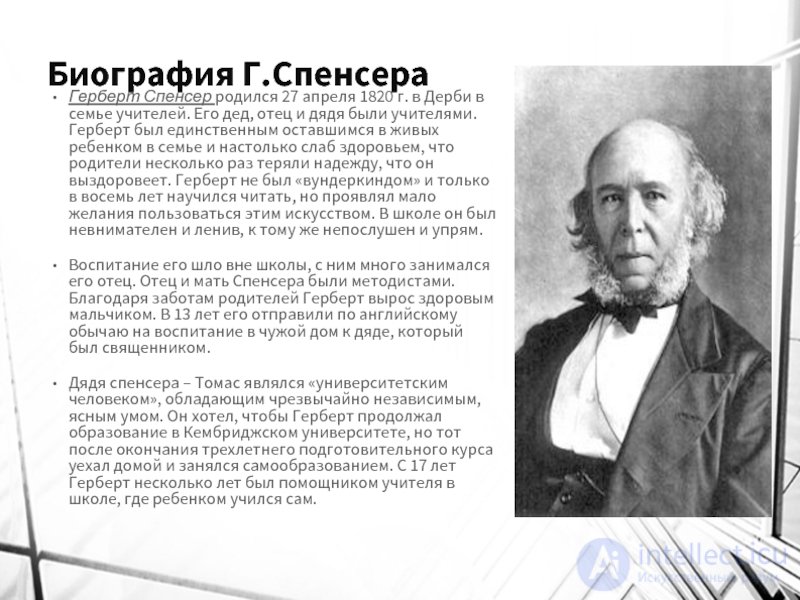
Main works: “First Principles” (1862), “The Principles of Sociology” (1876–1896), “Social Statics” (1850), “The Study of Sociology” (1873).
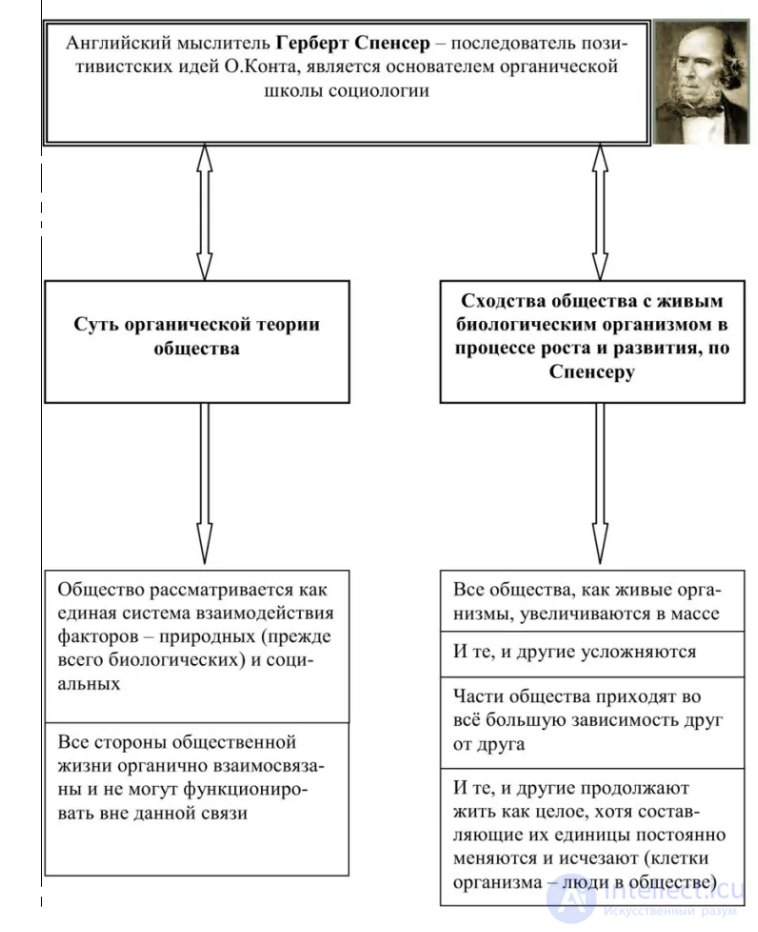
The organic theory of society:
Spencer is counted among the founders of social Darwinism.
Common features and differences with a bio-organism.
Spencer compared society with an organism, but did not equate it with one
Common features:
In a complex organism all parts are strictly specialised in performing their functions, are not subject to interchange, but are interconnected (interconnection – the basic category of the structural-functional paradigm). This means that all parts of society are equal in significance and there is no main element of society. It is enough for a single organ to malfunction – and the work of all parts, of the whole organism, is disrupted. This is the essence of the principle of functional analysis, as distinct from deterministic analysis, which presupposes singling out a leading factor of development.
Differences:
According to Spencer:
Society – a collection of individuals; the primary social cell – the individual (for Comte – the family)
“On the whole, living together turned out to be more advantageous than living separately. People agree to live together because it is advantageous for them”.
Man: the quality of society depends on the quality of the individuals that make it up, therefore, to improve society one must improve man. However, man is difficult to change. Physical, mental, psychological and moral qualities change very slowly, and society likewise evolves slowly. The less developed a person’s abilities, the more he depends on external conditions, and vice versa: a changed social nature of man also exerts an influence on society itself and on nature.
The relationship between man and society: (for Comte – society – is primary). For Spencer – society serves the interests of man. He was the first to introduce the individual principle into sociology.
Laws of social evolution.
Social evolution – is part of general evolution. In nature he considers 3 levels of evolution: the inorganic sphere (the physical world), the organic (the animal world), the superorganic world (society). In all 3 spheres 5 laws of evolution operate:
The main difference from Comte’s theory of evolution: Comte considers the evolution of human knowledge of nature and society as the basis of progress. Spencer studied the evolution of society under the action of universal evolutionary laws.
Social order in society – is the result of natural universal evolution.
Cohesion in society depends on social integration
Factors and mechanisms of social evolution:
The mechanism of evolution:
Social functions and institutions.
Compared with Comte, Spencer took a step forward in developing the structural-functional paradigm (SFP). He developed the concept of “social function”. He held that function is more important than the social institution
“People change, cells are renewed, but the function must ensure the vital activity of the organism as a whole”.
“A function appears in society out of necessity, and not arbitrarily or at will”
“Certain conditions, not intentions, are the cause of the emergence of certain social institutions and their corresponding social functions”.
“Social institutions are neither good nor bad, they are the product of a certain social environment and certain social conditions”
Functions for sustaining the social organism:
The family according to H. Spencer: he was opposed to socialism, since socialism does not create the conditions for the development of individuality. Under socialism the principles of family life are extended to the whole of society, and the family harms society.
If unity of will and thought is extended to society, as in the family, this can lead to despotism, totalitarianism. If the family principles for the distribution of benefits (towards children, the elderly, the disabled) are extended to the whole of society, this will lead to a decline in labour productivity, and will contradict the laws of evolution: the more enterprising survive.
Typology of society:
What is the basis of the typology? The greatest role in shaping the type of society is played by the influence of the environment and the relation of a given society to the society surrounding it. It is on this factor that the type of internal regulation of society depends. For Spencer this type is the most important, essential, distinguishing one society from another.
Regulation: the closed type and the open type.
Spencer divides society into the militant and the industrial, but there are 4 more types.
“Societies can be distributed, first of all, by their degree of complexity, as simple, compound, doubly compound and trebly compound”.
A simple society is characterised by the incoherence of social realities (relations between savages, which in essence do not differ from those of animals).
Compound societies – are those in which there is a hierarchical system of governance, a differentiated social structure of division of labour.
A doubly compound society: here in the political sphere one can observe more developed and stable governments. The separation of law from religion and tradition. The economic division of labour deepens, which is manifested in the growth of the spheres of science, the arts, etc.
A trebly compound society: according to Spencer – these are the most developed modern countries of the world, as well as future societies, in which the functions of the state are reduced to “protecting the members of society from the possibility of harming one another, and here account is taken not only of direct harm, but also of remote harm: every violation – is inequality”.
Within this classification Spencer divided society into the militant and the industrial. As the structural complexity of society increases, its militant character gives way to the industrial.
Comparison of militant and industrial society:
|
CRITERION |
MILITANT SOCIETY |
INDUSTRIAL SOCIETY |
|
Endless war, conflicts, conquests, rather than creation.
A closed type of rule, according to a rigidly set programme, centralised governance, direct regulation of people’s behaviour. The interests of society above all; the individual is subordinate to society.
Natural economies predominate, the household mode of production, the state regulates production and distribution. Reward not according to quantity and quality, but – according to status.
The class of townsmen, warriors and slaves. The social structure is rigid, migration between classes is almost absent.
The soldier – a conservative, uninitiative type. Executive.
Survival and the conquest of territory. |
Industrial competition, the main attention is paid to labour, abilities, diligence, the individual wins out, his intellectual abilities, and consequently society as a whole.
An open type of rule, adapted to a changeable environment, people are united not by coercion but on the basis of knowledge, accommodation, voluntarily. Society for the sake of man.
Industrial division of labour and specialisation of labour operate, an internal market, free exchange, deals between employer and worker, free enterprise and private property. Reward for quality (professionalism, qualification) and quantity.
A flexible social structure, more complex, consisting of the class of industrialists, workers, peasants and bankers. There is a high degree of social mobility.
The poet – independent, self-reliant, capable of innovation and creativity.
The highest happiness – creativity, freedom, individuality. The personality. |
Conclusion: unlike Comte, who was a proponent of a strong authoritarian state, Spencer was an opponent of the strengthening of the state and its interference in the economy and enterprise. Equilibrium in society will be achieved through free exchange and interaction between workers and employers, on the basis of the market; interference by the state disrupts the equilibrium and can harm the freedom of the individual.

Comments