
Lecture
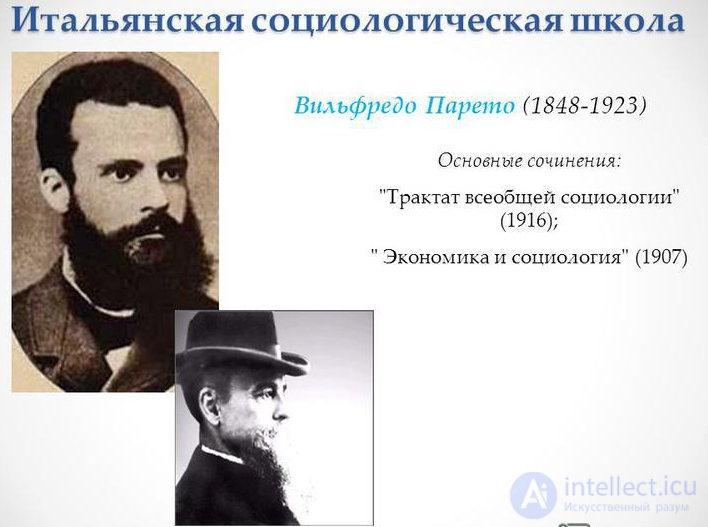
Vilfredo Pareto (15.07.1848-1923). A representative of the psychological current in sociology.
Main works:
An Italian, born in Paris. He was under his father’s influence. He spoke 2 languages. He spent his life and career in Italy. He lived the last 10 years of his life in Switzerland. He was married 3 times. By character he was a difficult, conflict-prone person. He received a good mathematical and economic education.
The law of balanced economic development:
“The well-being of a nation depends on the level of differentiation of the nation’s incomes. This level is determined by the difference in income between the richest 10% of the nation’s families and the poorest 10% of the nation’s families. The greater the difference in incomes, the lower the well-being of the nation, and vice versa…”
The richest countries: the UAE, Saudi Arabia, Kuwait, Scandinavia, Switzerland.
Every citizen of the country can receive an education in any country free of charge. He has the right to work in accordance with his qualifications. Anyone can engage in agricultural labour; he is allotted 70 hectares of irrigated land free of charge, with all the agricultural machinery and buildings.
Pareto’s contribution to sociology:
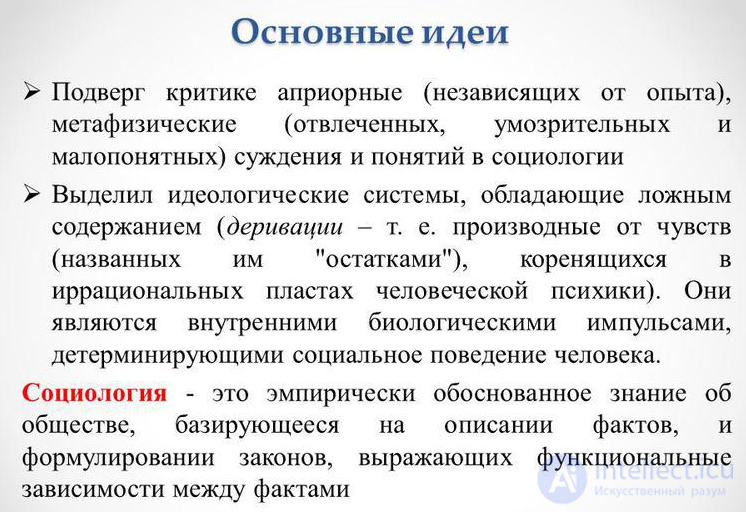
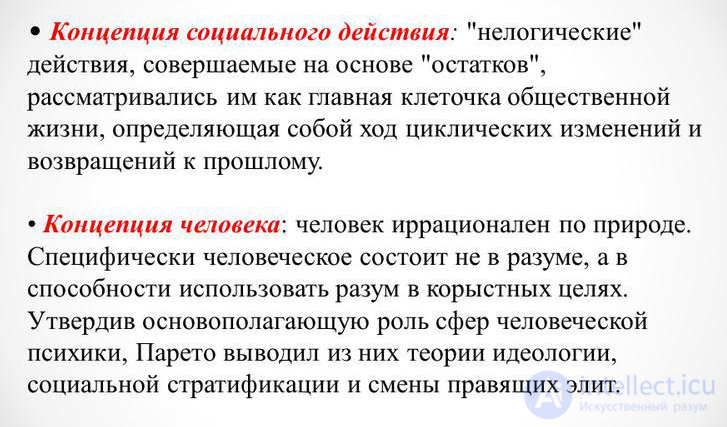
Unlike Weber, he developed the theory of social action. Pareto held that by no means all human activity is rational in character. A person is by nature more irrational than rational.
For Weber: a person first thinks through his actions and then acts in accordance with his plans.
Pareto: first acts, then explains his actions. What is specific to man is his ability to use reason for self-interested ends. He identified 2 types of human actions. As the basis for the typology he used the relation between ends and the means of achieving them:
Pareto classed most human actions as non-logical, since a person acts more under the influence of feeling than of reason.
Logical actions are based on reasoning, which happens extremely rarely.
Feelings – are the true driving forces of history.
The subject of sociology – the study of the non-logical actions of man, based on feelings.
Non-logical actions arise under the influence of residues, i.e. residues – are more than feelings and broader than the subconscious. This includes various predispositions: attitudes, stereotypes, passions, prejudices, emotions, customs, feelings, traditions, mores – everything that acts upon a person apart from common sense and rational logic.
Residues account for 90% – the main cause of the non-logical actions of man.
Having performed an action, a person rationalises it, and this process is called derivation.
Pareto divided residues into 6 classes:
The first 2 residues play an especially great role in human behaviour; their alternation affects the whole of society and its subsystems (ecology, culture, politics). Everywhere one observes an alternation of successive tendencies: development and stability. Society develops cyclically, from a change of development to stabilisation, and then the reverse (the pendulum theory).
This is precisely the theory of the development of the cycles of subsystems!
Society develops under the influence of processes of action and counteraction, at the basis of which lies the instinct of change and the need for stability. Society develops not along an ascending line, but on the pendulum principle, rhythmically repeating tendencies opposite in essence, factors of cyclical development.
The cyclical development of society is influenced by the following factors: external natural conditions (soil, climate), external non-natural conditions (other societies, history), internal factors (the racial-anthropological nature of a people, its feelings, its capacity for reasoning).
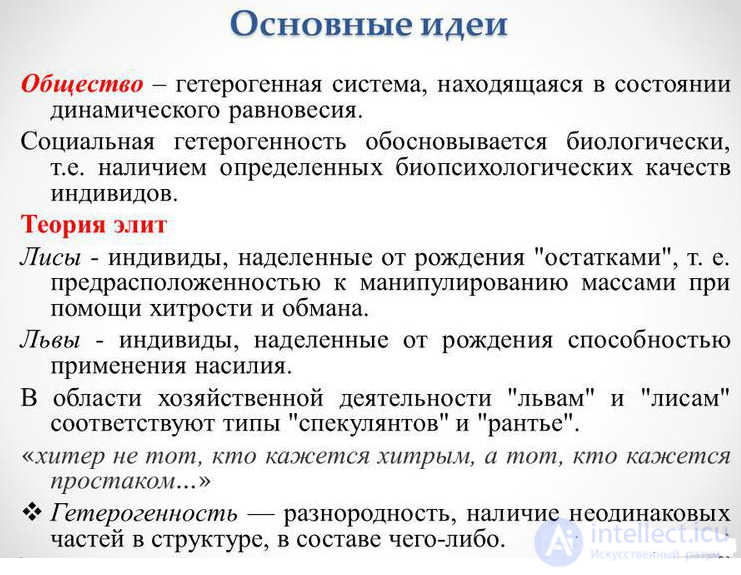
The driving force of social development is the circulation of elites. Society is divided into 2 levels: the elite and the non-elite. The division occurs not as a result of any economic, social or political causes, but as a result of the biopsychic properties of the individual.
People are divided from birth into those capable of governing and those incapable. Such a division is possible in all social strata of society. The main thing is to possess the following qualities:
People who come into politics are those endowed from birth with a predisposition to manipulate the masses by means of cunning and deception (foxes), or possessing the ability to apply violence (lions). These 2 types create two different forms of government, which alternate with one another:
Why do foxes and lions come to power? The cause of the change of types of elite lies in the operation of 2 mutually exclusive tendencies in society, which correspond to the first 2 classes of residues: the instinct of change and the need for stability. When the former accumulates in society – foxes come to power; they have an excellent feel for the situation, they form alliances, promise much, rule by bribery and deceit. When the instinct for preservation, for order intensifies in society – lions are in power; they are brave, bold, aggressive, unshakeable, they rule by authoritarian methods, applying violence, coercion.
The law of the circulation of elites, which can function thanks to the feedback of the ruling elite with the masses. The most worthy from the masses can enter the ruling elites, and vice versa…
If the feedback channel is absent, two negative phenomena occur: a) The degradation of the ruling elite, b) Discontent accumulates among the lower strata, in the masses; individuals may seize power and overthrow the ruling elites.
The mechanism of the change of elites occurs either by evolutionary or by revolutionary means.
Such a politics also exists in economic activity, in the form of speculators, rentiers, shareholders and businessmen.
Rentiers are evidence of the decaying stage of a stable phase of the development of society.
Speculation: this indicates a developing society and its unstable equilibrium
Businessmen and shareholders: a sign of a healthy, stable society.
In spiritual life: the alternation of faith and scepticism. Faith – stability; sceptics – development.
G. Tarde – “The Theory of Imitation”
G. Le Bon – “The Psychology of Crowds”
S. Freud – the theory of social action, socio-psychological explanations, the origin of culture.
A discovery was made – hypnosis. It began to be used by the mass media, to influence people.
By the end of the 19th century capitalism began to develop, and people began to “cluster together”; the process of urbanisation appeared.
Historical conditions for the emergence of the psychological current in sociology:
I
II
It has a theoretical, scientific, epistemological character. It is connected with the discovery of the phenomenon of hypnosis, the role of suggestion on people’s behaviour. The new process in society could no longer be explained by means of evolution, the biological model.
The roots, the causes of social processes were sought in psychology at 3 levels: the psychology of the individual, of the group, of the crowd (the people). It is held that the causes of social phenomena are: innate instincts, aspirations, passions, desires, the consciousness of the race at the level of the spirit of the people.
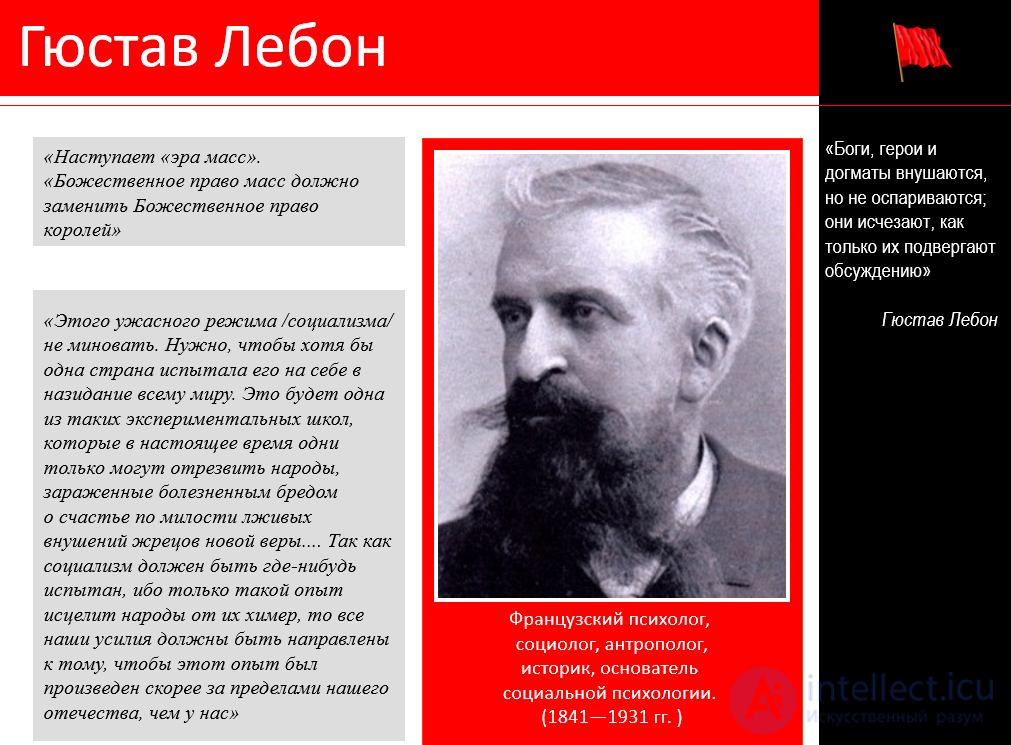
G. Le Bon (1841-1931) – “The Psychology of Crowds” (1895)
He went down in history as the creator of the theory of crowd psychology. This work is considered a classic work in the study of man.
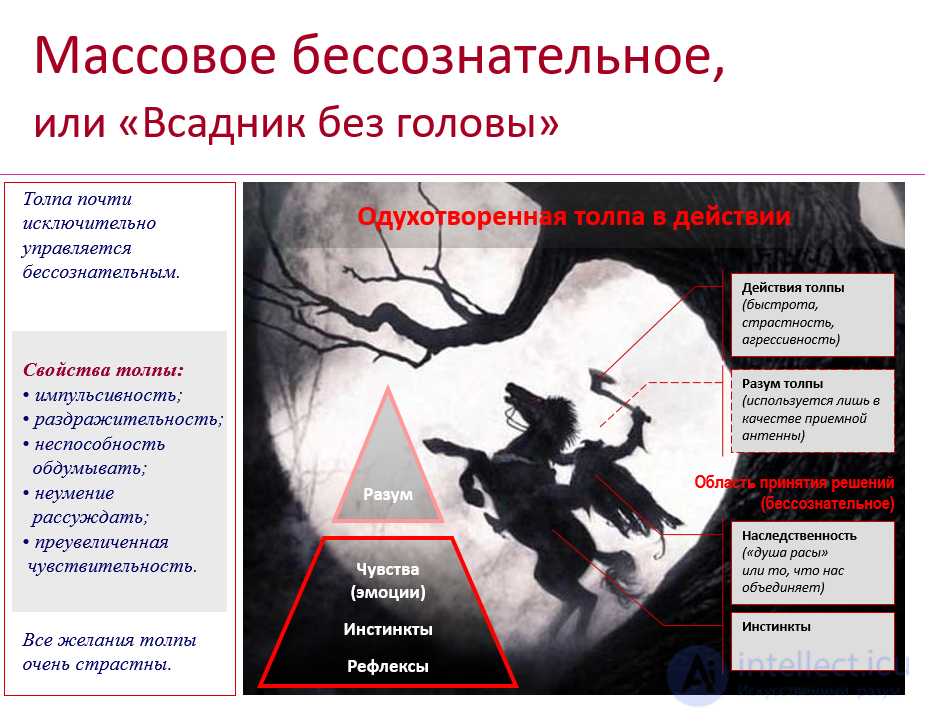
The beginning of the 20th century – the era of the crowd. “Any gathering of people constitutes a mass, a crowd. A mass is by its nature disorderly, chaotic, and therefore needs a leader. A constant (unconscious) law of the spiritual unity of the crowd operates. Under the action of this law any person who falls into a crowd loses the capacity to reason (a loss of intellect occurs), loses personal responsibility for his behaviour; a sharp predominance of feeling over intellect occurs: the person turns into an irrational being”.
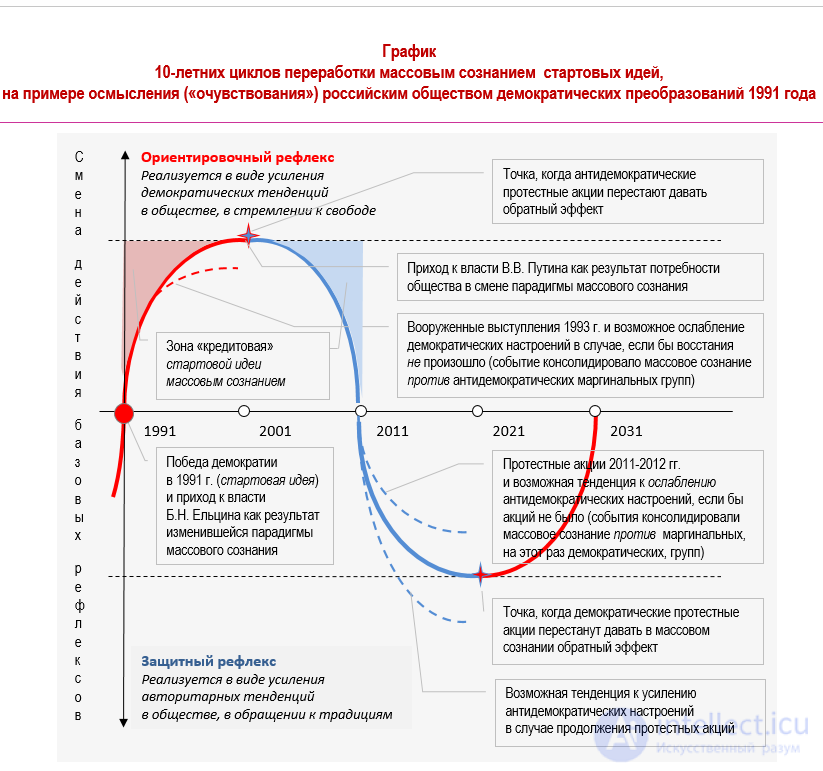
A graph of the 10-year cycles of the processing by mass consciousness of starting ideas, using as an example the comprehension (“taking to heart”) by Russian society
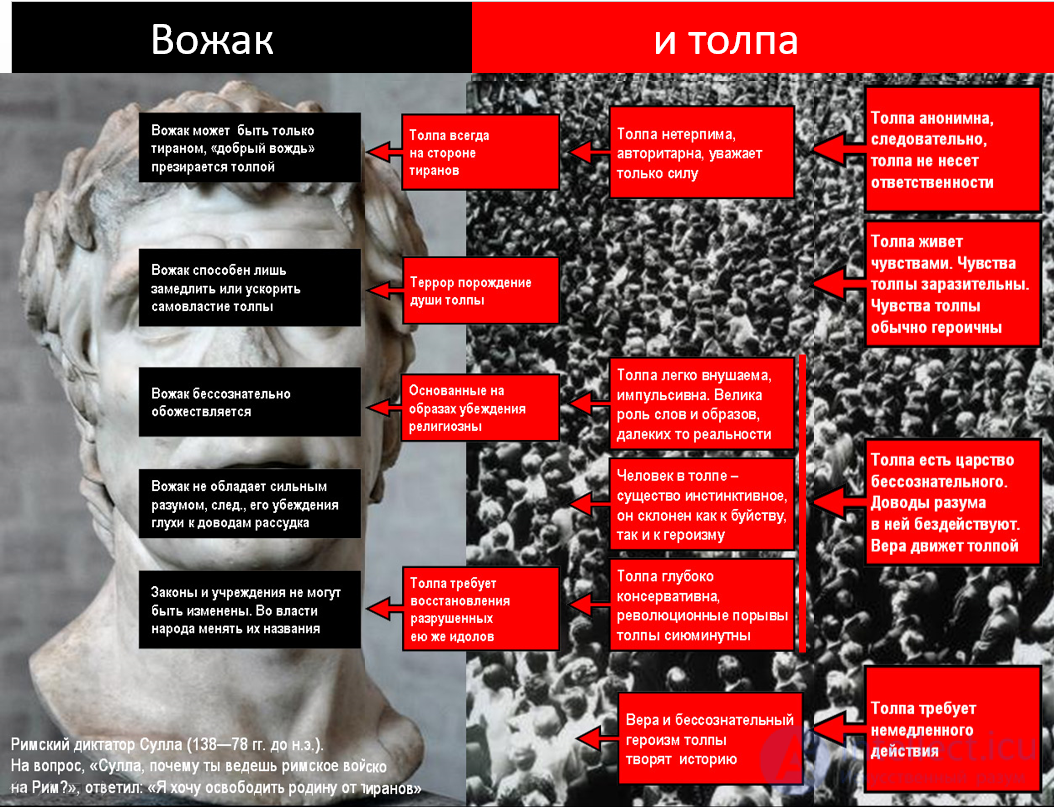
the leader and the crowd
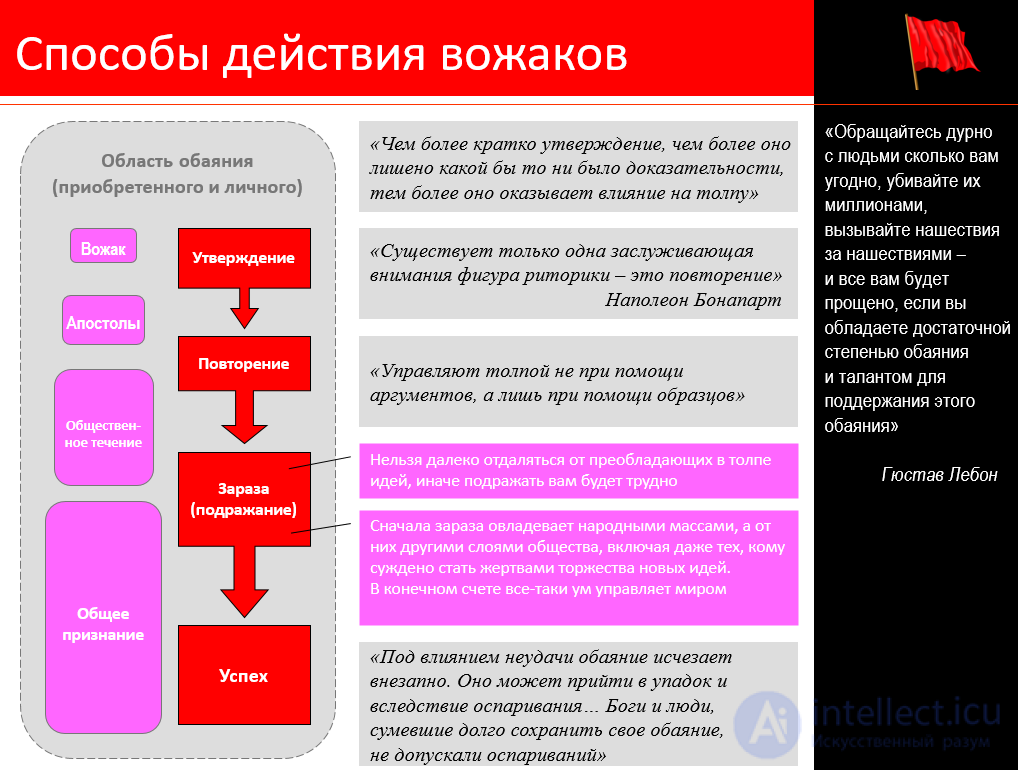
methods of action of leaders
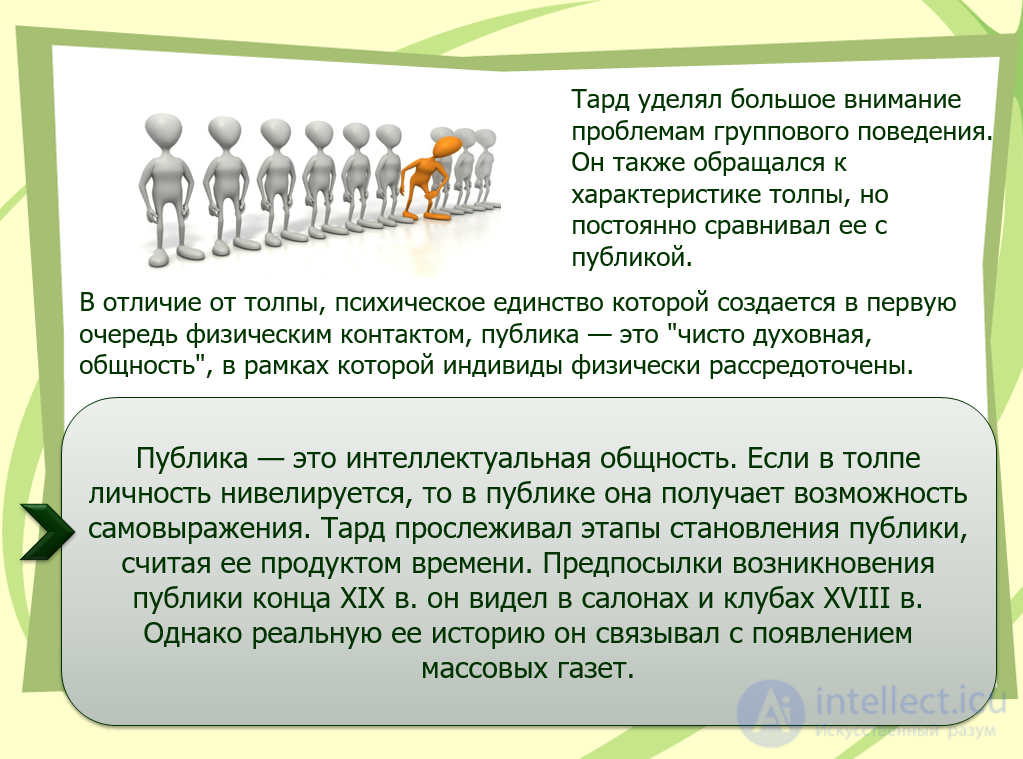
He is considered one of the leading representatives of the psychological current in sociology. He was famous throughout the world. In Russia all his works were translated: “The Laws of Imitation”, “Social Logic”, “Public Opinion and the Crowd”, “Social Studies”, “Social Law”.
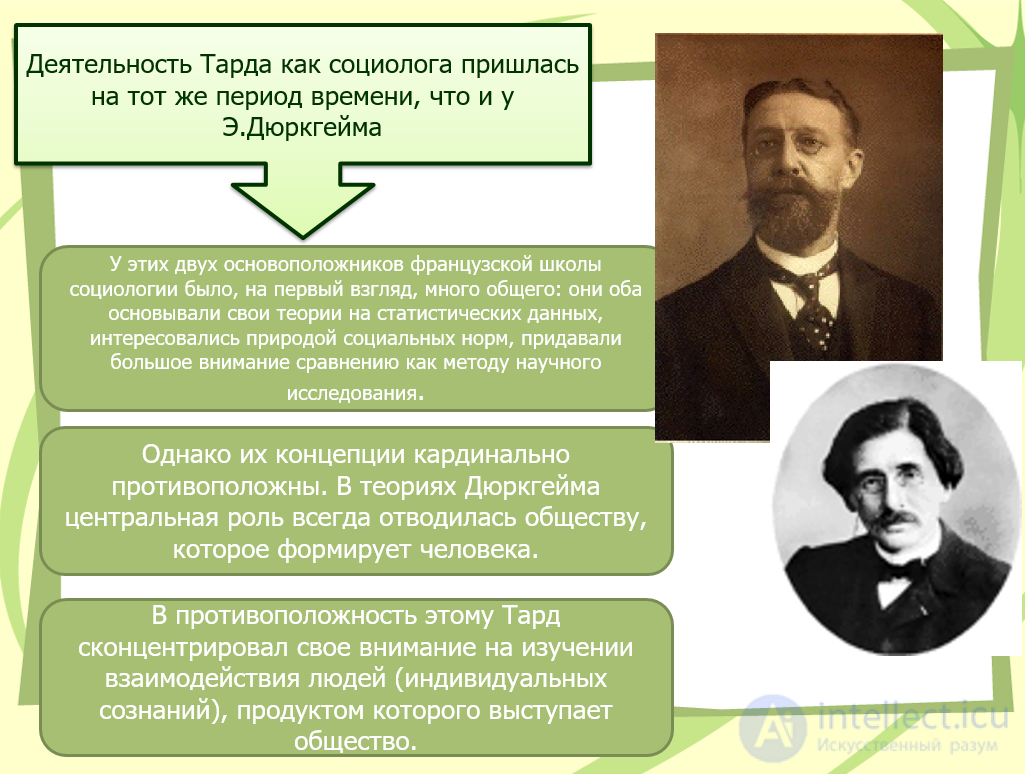
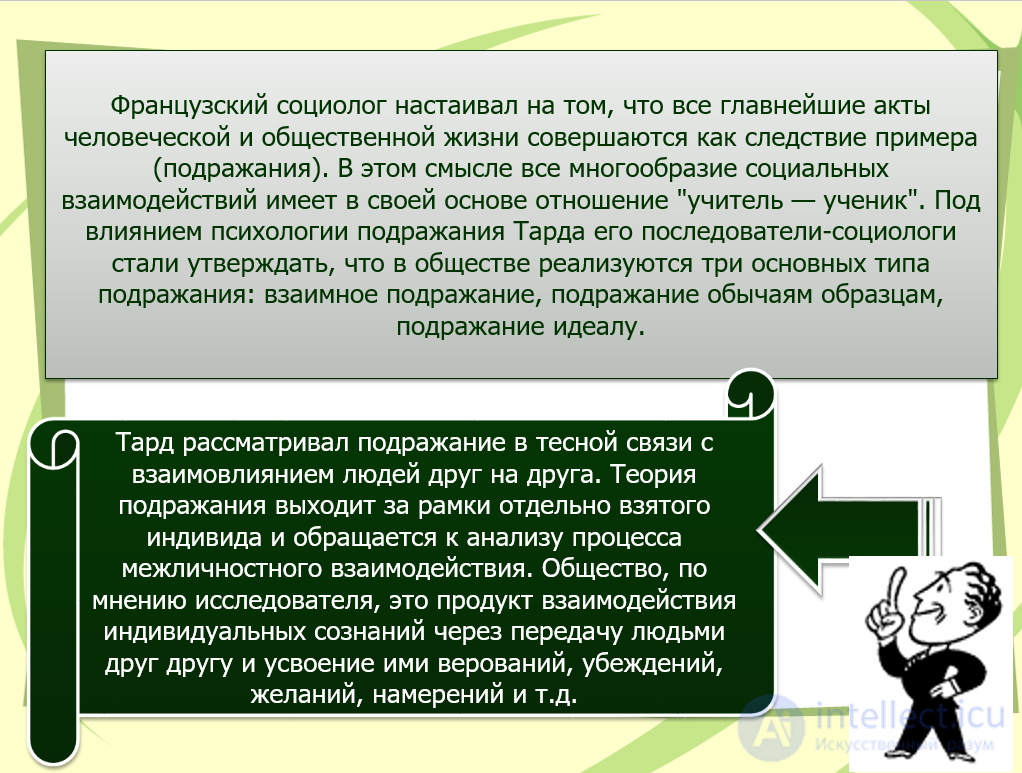
Tarde compares society to a brain, a cell of which is the individual consciousness of a single person. Society – is a product of the interaction of individual consciousnesses, through people transmitting to one another and assimilating beliefs, convictions, desires, intentions.
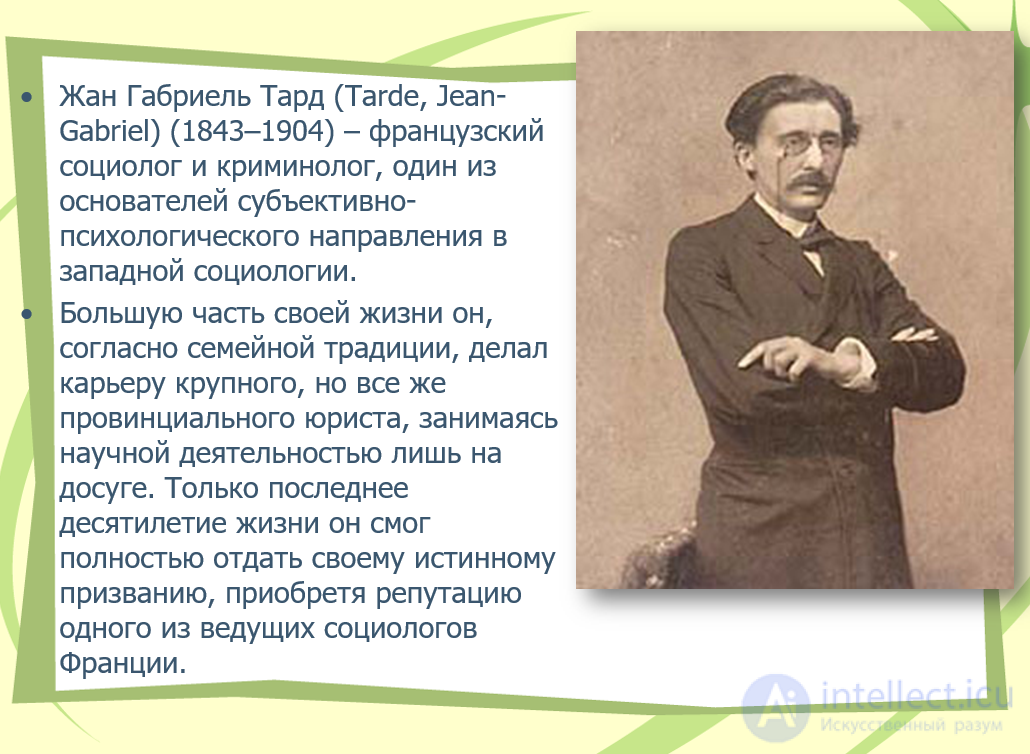
The foundation of sociology – is social psychology. Sociology – is a part of social psychology. It has no laws of the development of society distinct from psychology.
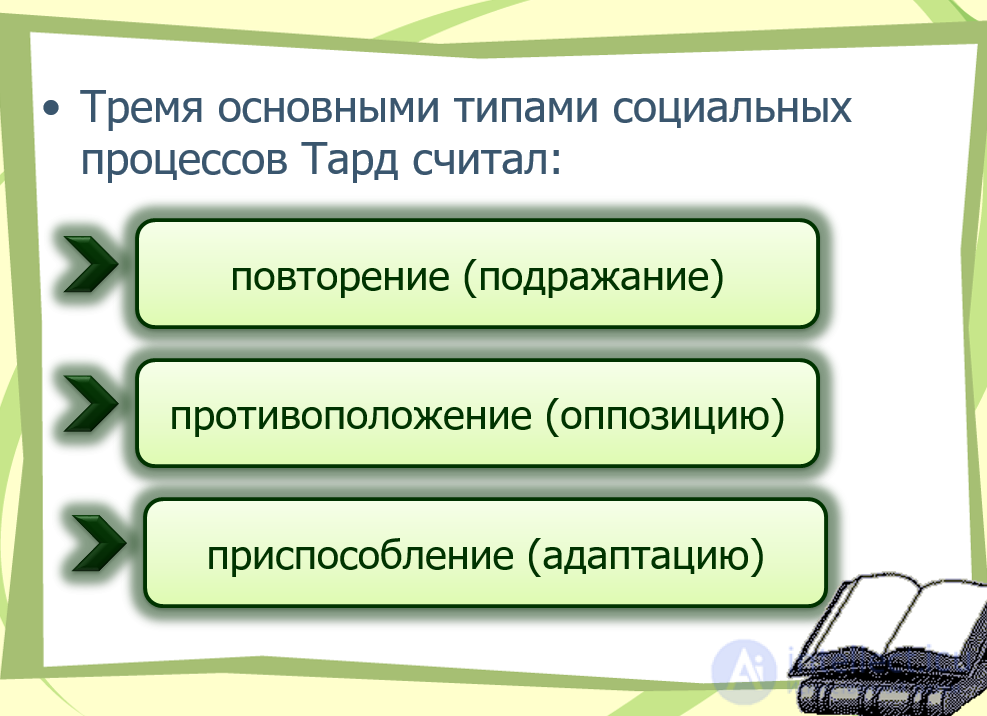
The primary cell of social life (for Durkheim – the social fact, for Weber – social action), for Tarde, is imitation.
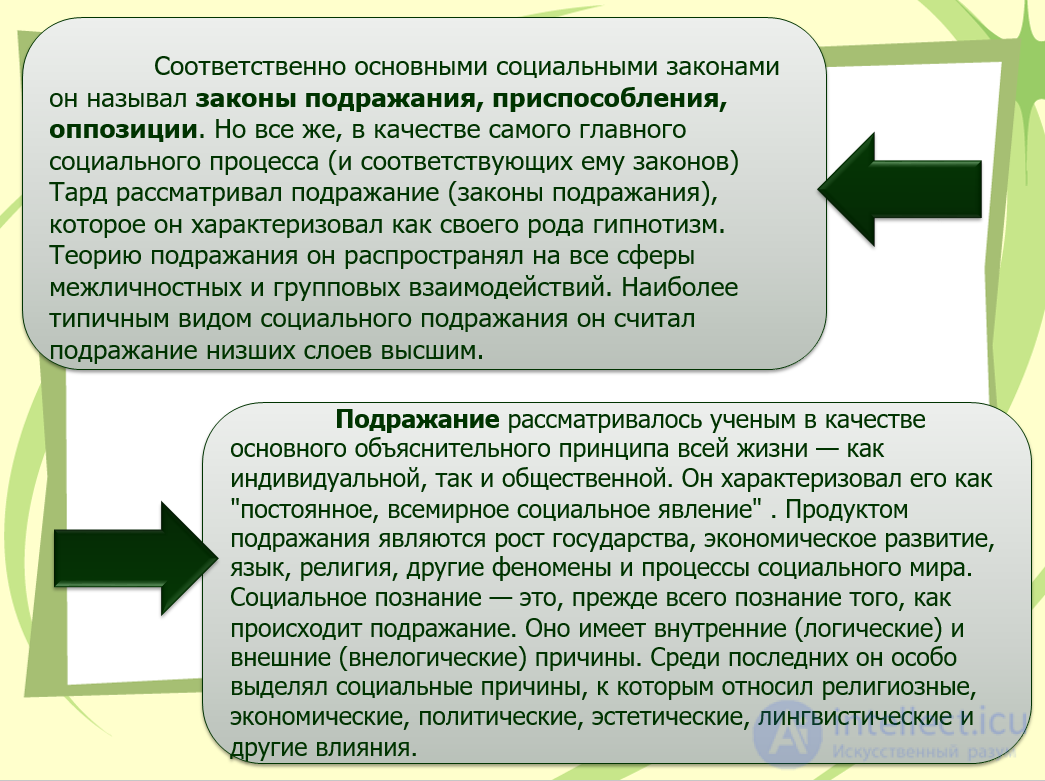
Imitation – the mutual influence of one individual’s “I” on another individual’s “I”. The essence of social life.
Social processes take place under the influence of the psychological mechanism of imitation, on which human relationships are built.
Society differs from nature in that in nature the law of heredity operates, while in society – the law of imitation operates.
Imitation – an irresistible psychic urge of people; the main driving force of the process; the central idea of Tarde’s theory.
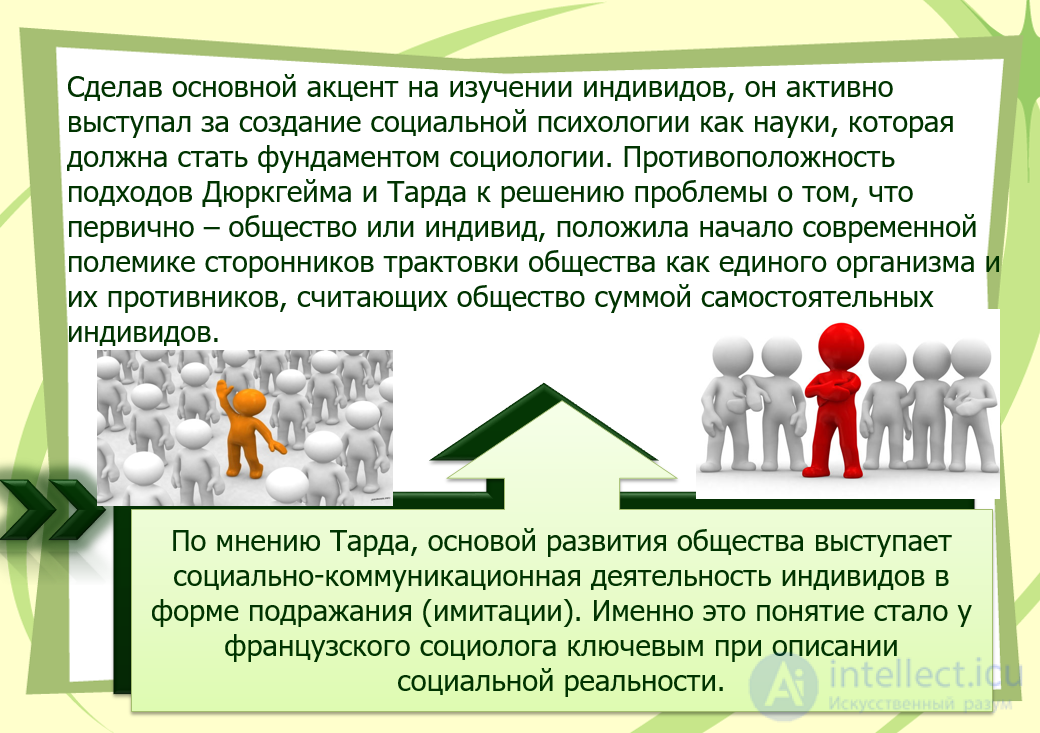
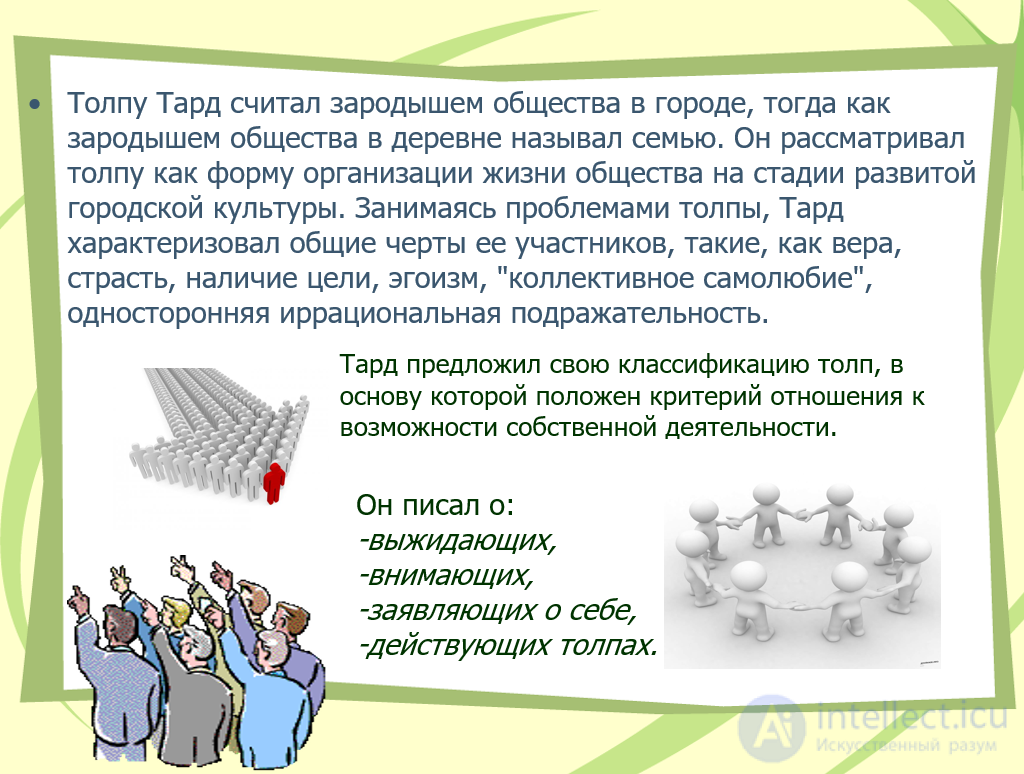
Contemporary scholars recognise the importance of Tarde’s contribution to the development of sociological science. Since, however, sociology in the 20th century is dominated by the notion of the determining influence of society on the individual, rather than the reverse (as with Tarde), Tarde is nowadays less popular than his opponent Durkheim
The theory of progress: (for Marx – communism)
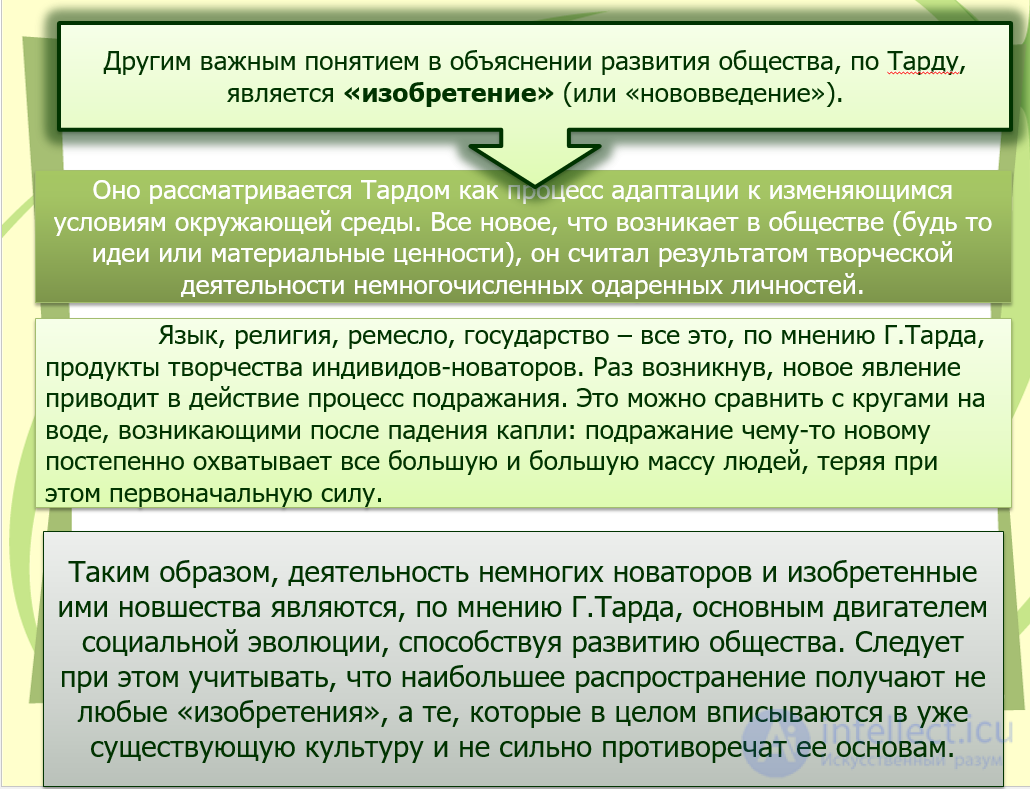
It takes place under the influence of discoveries and inventions that answer to needs that have matured, and their diffusion through imitation. The main role in discoveries is played by the individual. Inventions – are acts of individual creativity.
Thanks to individual creativity, there arose language, the economy, military clashes, an innate laziness that prompts people to borrow from others in order to avoid the labour of invention, imitation of fashion.
Objects of imitation: patterns of behaviour, classes, society, the individual.
The psychological nature of imitation is conditioned by man’s natural need for uniformity, to be like everyone else.
Tarde discovered the logical laws of imitation. Among the laws: “the imitation of the higher strata of society by the lower”. Classes in society do not feud but cooperate in the direction of levelling out contradictions by means of such mechanisms as the unification of lifestyles, manners of behaviour, polite address (England, from the 17th century).
The following seven impulses are the most contagious:
One who loves imitates the one he loves!
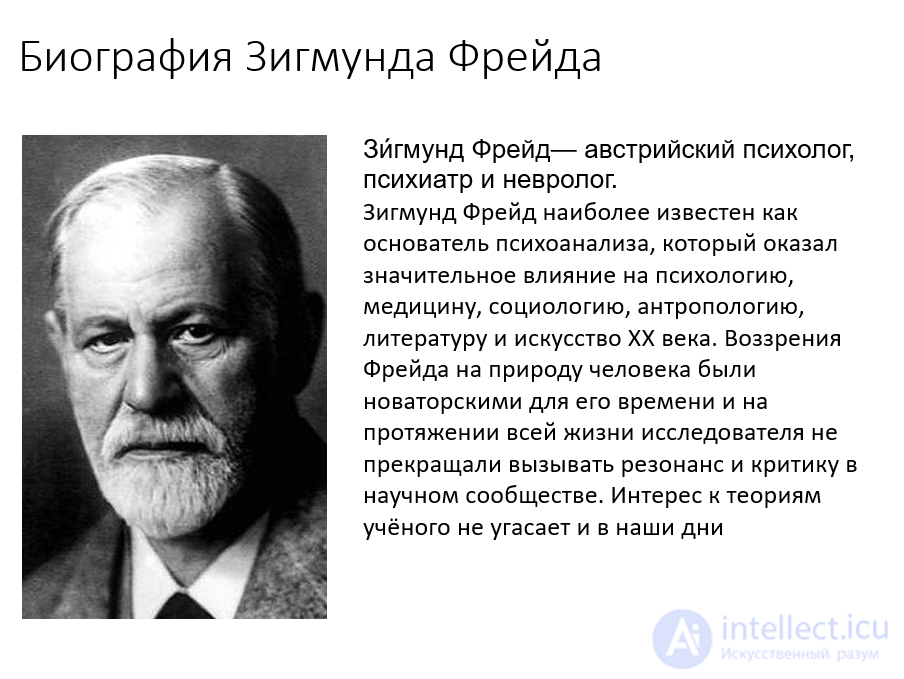
S. Freud (1856-1939) – “The Interpretation of Dreams” (1900), “Introductory Lectures on Psychoanalysis” (lectures from 1929 to 1935), “The Ego and the Id”.
He changed the face of 20th-century psychology. His name is linked to the emergence of a new current – Freudianism.
The theory of social action (also found in Weber and Pareto). Unlike Weber, who held that the main role is played by reason, by consciousness, Freud held that human action possesses 2 properties:
“Sexual drives participate in the creation of the higher cultural, artistic, social values of the human spirit. Their contribution should not be underestimated” (p. 12, “Introductory Lectures on Psychoanalysis”).
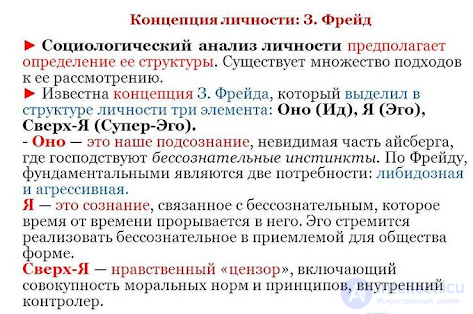
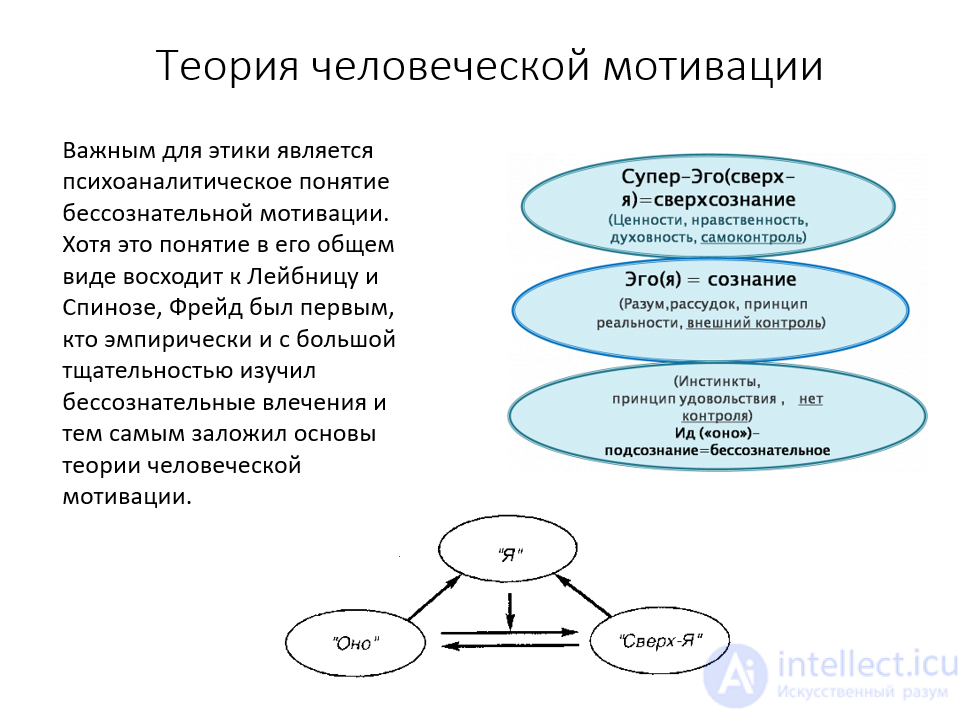
The structure of personality – 3 main components:
SUPEREGO EGO ID
“ID”: contains the instincts. It acts on the basis of the pleasure principle (I want!). Irrational, it knows nothing about society, about moral foundations, rules, about good and evil. The source of energy for the whole personality.
“SUPEREGO”: You must not! Based on the principle of identification – the likening of one’s own “I” to the parental “I” (ideals, heroes, teachers). It is formed in early childhood on the basis of prohibitions and commands. It performs 3 functions: of conscience, of self-control, of forming an ideal.
“EGO”: Our personality. Based on the reality principle. It is aware of the surrounding world, of society, of moral and ethical values, of “good” and “evil”. It makes independent decisions. Must! It is responsible for its decisions.
“Superego” (the continuity of generations): “Humanity never lives entirely in the present. In ideologies the Superego continues to keep alive the past, the traditions of the race and the people, which yield only slowly to the influences of modernity, to new changes. As long as the Id acts through the Superego, it plays a significant role in a person’s life, independent of the economic relations.
The socio-psychological explanation of the origin of culture.
The essence of Freudian sociology: “The leading role in the organisation of human life-activity is played not by consciousness, not by reason, not by the environment, but by various institutions (institutes). The leading role is played by two universal cosmic institutions: EROS (the instinct of life, the sexual instinct, self-preservation) and THANATOS (the instinct of death, aggression, destruction). Their struggle determines the meaning of the life of every individual person, the activity of social groups, political parties, even of peoples and states.
The basis and the driving force of human life is the existence of the sexual erotic drive.
The origin of religion, culture, morality and social community.
The starting point was the Oedipus complex (guilt and fear). This myth is a reflection of the primal memory of human history, when people still lived in hordes.
Religion was invented under the action of instinct.
The community – taboo. A new form of social organisation and legal regulation appears.
The Oedipus complex – is the basis of the origin of religion, new forms of the state, the community, society.
The emergence of the social contract.
The theory of “The Psychology of Crowds” is explained by the need for a leader. “A crowd – is not a gathering of people, a mass, but one organised in a particular way by some common interest in an object, by a feeling in a given situation, organised by a single collective will, by the predominance of an affective and unconscious readiness for the immediate execution of one or another intention. The mass – is a revived primitive crowd, distinguished by a libidinal attachment to the leader, by the awareness that all people are brothers, and that the leader, like the primitive father, loves everyone equally.
Crowds, masses can be of 2 types: natural – self-organising, and artificial – formed under the influence of the population, but their indispensable condition of existence is love for the leader and the awareness that he loves everyone equally, which we observe in totalitarian regimes”.
Freud’s teaching made it possible to determine, on a psychological basis, many social processes and the behaviour of the individual.

Comments