
Lecture
No sociology in the world has made as enormous a contribution as American sociology (today the United States has more sociologists than the rest of the world put together).
American sociology has developed empirical sociology to a high degree, in terms of the methods of sociological research. Sociology was an instrument for solving the practical questions of social life in business, politics, economics, labour, communication, migration, urban life, and so on.
A high theoretical level of development in sociology: in the development of structural-functional analysis, the conflict paradigm, and interactionist theories.
Sociologists in America found a favourable environment: they were welcomed in politics and in the sphere of enterprise and business.
The end of the 19th–beginning of the 20th century is the beginning of the development of American sociology. This span of time left its mark on the distinctive character of the development of sociology.

American society did not have a multi-tiered hierarchical structure comparable in “depth” to the European one.
The American was accustomed to operating in categories of individualism, to acting alone and shouldering the burden of responsibility for his own actions. That is why in the USA “class” theories never found a sufficient number of supporters.
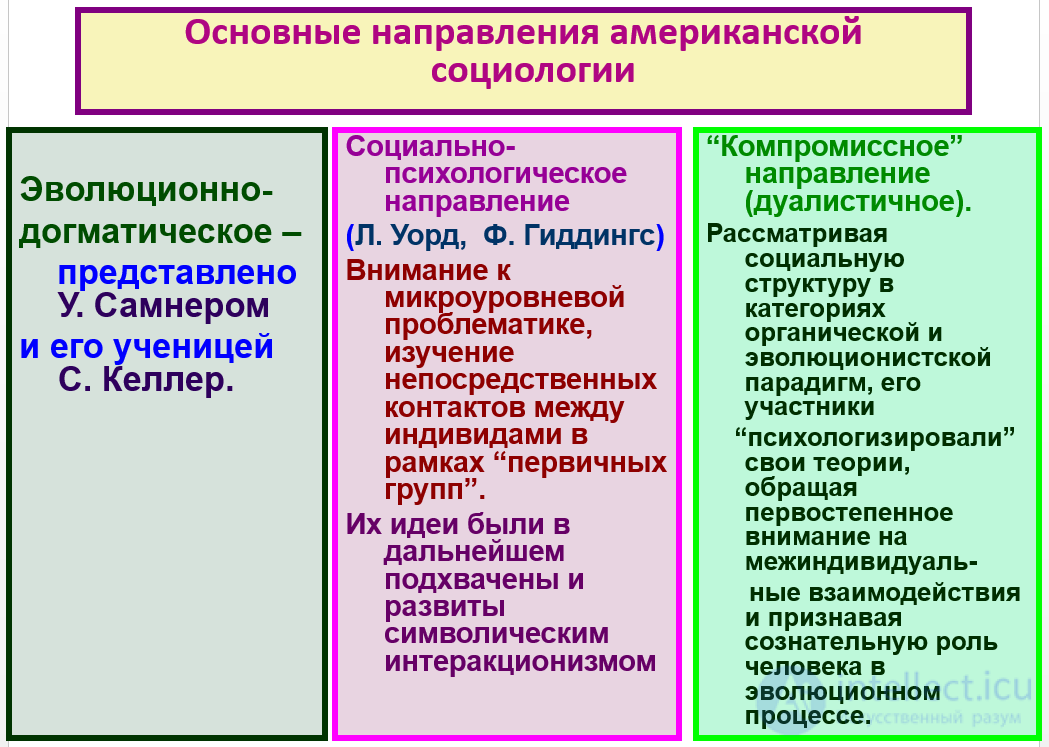
In world sociology during this period the psychological current began to develop vigorously, while in the USA Spencer’s doctrine of the evolutionary-organicist development of society enjoyed great popularity. They were especially drawn to social Darwinism.
In America, evolutionism and psychologism merged into a new current – psychological evolutionism! Its essence was that society develops evolutionarily, but, unlike an organism, the influence of human activity (the human factor) is introduced. In society natural selection is carried out on the basis of competition for life, innate instinct, consciousness of the race, and so on, i.e. one or another psychological factor is present.
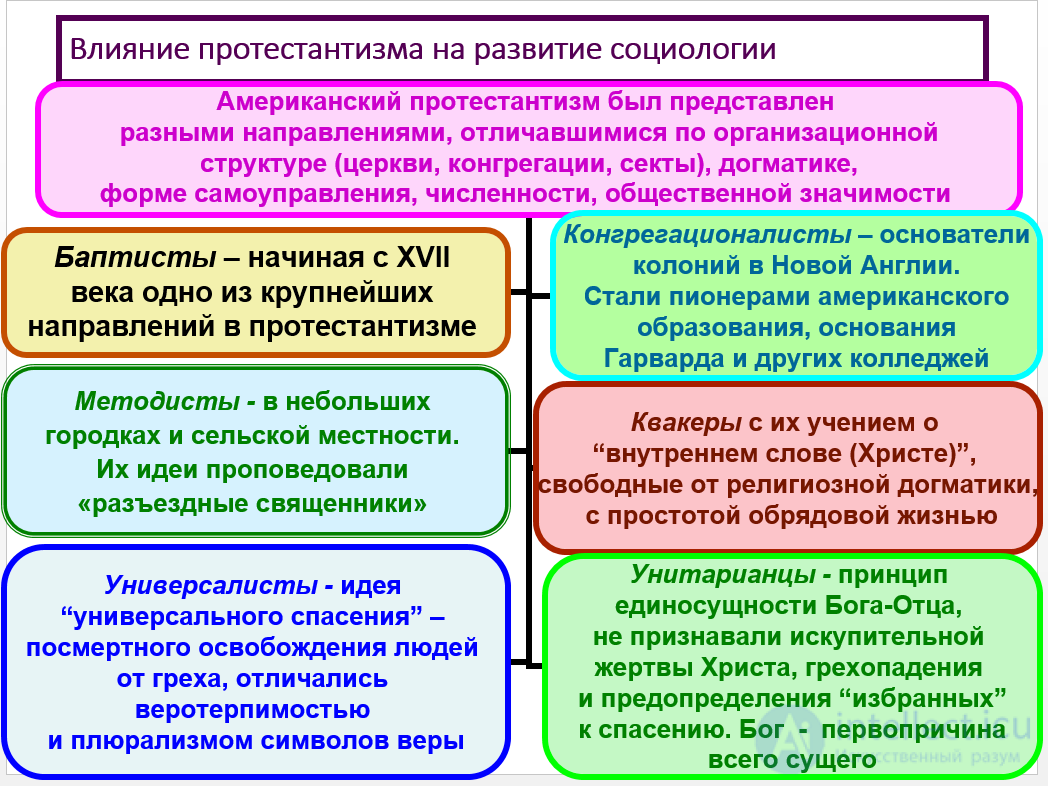
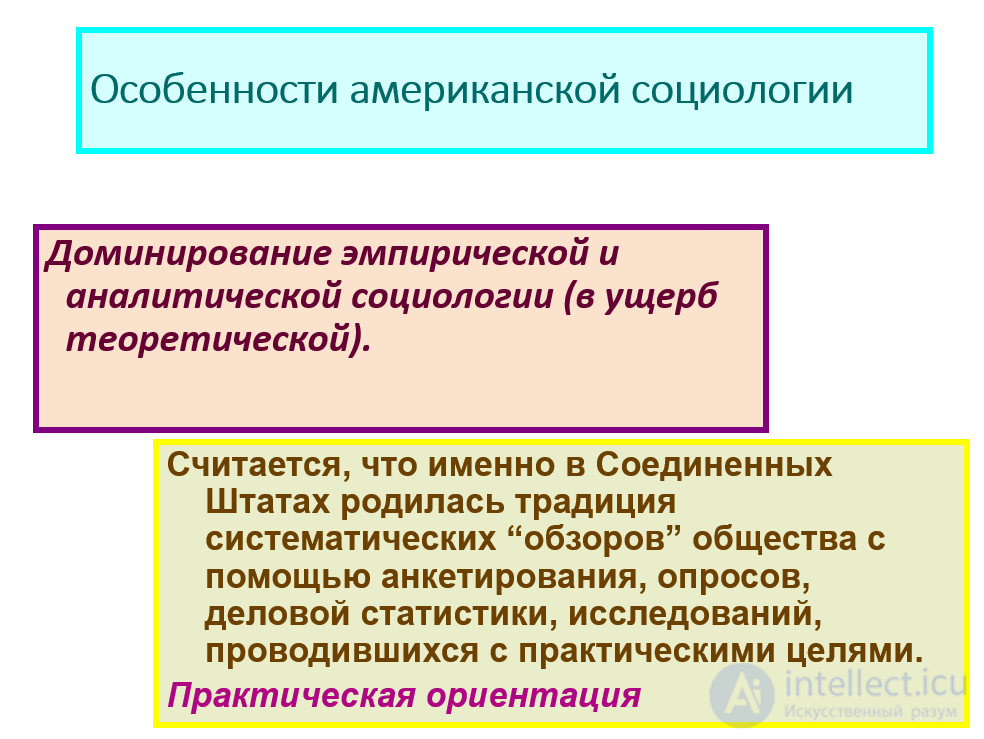
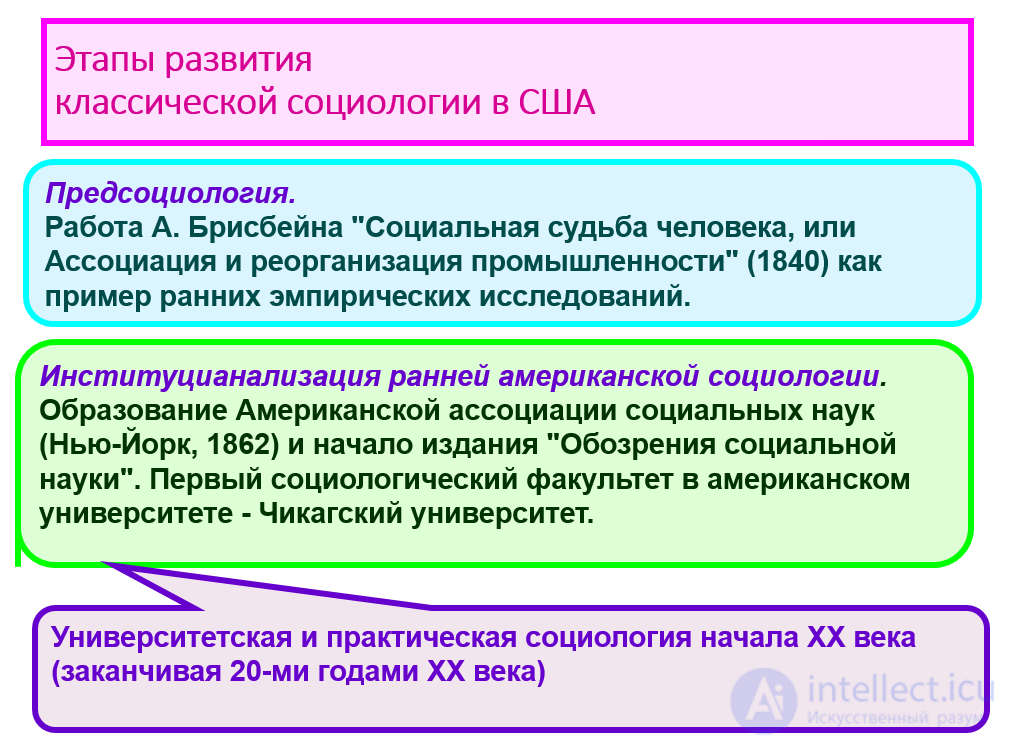
The creation of empirical sociology is the main achievement of the 2nd stage.
The reasons for its emergence: in the early 1920s America was going through a period of rapid urbanisation. This was accompanied by intensive emigration, and in the conditions of such a city many problems arose that needed to be regulated.
Empirical sociology set itself the task of studying specific problems by means of special sociological methods.
Empirical sociology – a complex of sociological studies oriented towards the collection and analysis of specific facts of social life by means of the special methods of concrete sociological research:
Empirical sociology arose within the framework of the Chicago school of sociology
The Chicago school of sociology, its significance:
From psychology: tests, scales, sociometry, psychodiagnostics. From economics: modelling, experiment, econometric methods.
American sociologists were also practitioners, i.e. academic sociology moved out into practical life.
Small served on the Chicago Civic Federation, Thomas worked on the Chicago Vice Commission. Park – in the Chicago Urban League.
In the 1930s the Gallup Institute began its activity, conducting nationwide polls within short periods of time.
These methods remain relevant to this day and are used by all of contemporary sociology.
Thus, a new function of sociology appeared – the organisational-technological function, which established a link between theory and practice and between sociology and the practice of management.
The theme of the city received the name urban social ecology. It became the main theme of the Chicago school in the 1920s.
The urbanised city is a fundamentally new city, based not on the control of public opinion but on the control of every individual’s inner self-discipline. The urbanised city was the embodiment of the new industrial civilisation and of the development of the new America through the development of the urbanised city.
In the 1920s an industrial civilisation was established in the USA (in the USSR – in the late 1950s; this was determined by the ratio of urban to rural population, i.e. the predominance of the urban population over the rural). In 1920 Chicago had a population of 2 million 700 thousand. In 1930 – 3 million 400 thousand.
The principal sociologists who worked on this problem.
R. Park (1864-1944). He studied at many universities in the USA and Europe, and developed the theoretical foundations and research programme for the study of the social ecology of the city. The research toolkit was developed by his associate Burgess, and it has retained its force to this day. The most valuable thing in his work is his doctrine of the “natural areas” of the city, which formed naturally, as a result of the differentiation of the city’s population by needs, by spiritual values and cultural traditions. Areas distinguished by a specific mode of social adaptation.
He identified 7 natural areas:
Park studied the problem of social control in the city.
The task of sociology: to identify such mechanisms of social regulation as could, under city conditions, solve 2 interrelated but opposite tasks:
Cultural differentiation is linked to a certain disorganisation in society. “Disorganisation is necessary, but within certain limits: when it promotes the development of creative abilities, the search for better living conditions, and the fuller satisfaction of human needs. However, the excessive spread of disorganisation threatens the fundamental values of society and can lead to a threat to the existence of society as such”.
CONCLUSION: the problems of natural areas of the city, social control and disorganisation are applicable to virtually any city, including in our own time.
Industrial sociology.
Founder – Taylor (1856-1915). An American engineer and researcher, he created the foundations of industrial sociology, especially in the field of management.
As a result of the measures taken, labour productivity at the enterprise increases by a factor of 2 to 5.
But SOL is the rational organisation of the workplace based on the standardisation of work operations, i.e. the creation of an ideal type of labour behaviour, scheduled by the minute. This is so as to precisely register the labour contribution of each individual worker, and to take it into account and evaluate him by his contribution.
The secret of economic labour incentives: not arbitrarily raising or lowering pay, but taking into account the specific labour contribution of each specific worker; or differentiated pay depending on each specific worker. Taylor initiated professional selection of personnel. It is not economically advantageous to hire random people: newcomers did not begin work immediately, but went through a school of professional training and retraining, and began work under the supervision of a mentor.
The sociology of small groups.
One of the topical themes in the 1930s-40s. It was the leading and central theme, since under conditions of the country’s urbanisation it becomes an important problem for society.
In sociology, psychological reductionism was replaced by communicative reductionism (an attempt to seek the key to all social phenomena in the psychological processes of the individual, the group or society).
Communicative reductionism – an attempt to explain an individual’s behaviour as the result of the influence on him of…
Small-group theory is studied from the point of view of communication and mutual influence.
3 main directions of small-group research took shape:
Moreno (1892-1974). Founder of the sociometric direction in sociology. Born in Bucharest. Graduated from the University of Vienna in philosophy and medicine. Was strongly influenced by the views of Freud, Simmel and Cooley.
From 1925 he worked in the USA.
1940 – founded the Institute of Sociometry and Psychodrama.
Sociometry (“socias” – society, “socius” – companion, “metreo” – I measure) – is a branch of sociological knowledge studying the emotional interpersonal relations in small groups on the basis of sociometric methods: the sociomatrix, the sociogram, the sociometric test.
This made it possible to identify:
The object of sociometric theory is small, already established, groups that have experience of communication.
The subject – the study of the emotional interpersonal relations of people in a group on the principle of sympathy, dislike, indifference.
The main hypothesis in sociometric research is the study which assumes that all tensions and conflicts in the group and in society as a whole are caused by a mismatch between micro- and macro-structures, i.e. this means that the system of sympathies (micro) and antipathies in the group does not coincide with the system of officially assigned relations (macro).
In the macro-structure this is the formal collective; the individual often finds himself in a collective of psychologically incompatible people.
The task of sociometry – to arrange things so that people, both at work, and in the family, and in their living quarters, work and live surrounded by people who are sympathetic to them and who sympathise with them.
Reshuffling workers with regard to their sympathies or antipathies removes quarrels and leads to a rise in labour productivity.
“-”: The main shortcoming – the absolutisation of emotional-psychological relations, whereas the spectrum of relations in a group is much wider and includes activity-based relations (economic, political).
E. Mayo (1880-1942). His method of studying relations in small groups was built on the basis of a social experiment.
Social experiment – a way of obtaining information about a social object as a result of the influence on it of controlled and regulating factors.
I.e. observation of the object under artificially created and controlled conditions.
Mayo’s Hawthorne experiment (near Chicago there was a company called “Western Electric”) – conducted for almost 12 years. As a result, the doctrine of human relations was formulated. The essence of the doctrine – based on 2 discoveries:
Kurt Lewin (1890-1947). He used the laboratory method of studying small groups.
German by origin, he moved to the USA at the age of 33.
Central idea: the laws of social behaviour should be sought in the domain of psychological and social forces.
Under laboratory conditions groups with given characteristics were created. And then various artificial conditions were created that influenced people’s behaviour: the influence on the effectiveness of people’s group activity, competition or cooperation; the causes of internal conflicts; the dynamics of power and subordination; leadership styles; ways of reaching group decisions (star, circle, wheel).
Significance: original methods were developed for studying group dynamics that are still used today.
Representatives:
W. Sumner – “We – group, they – group”, the concept of ethnocentrism. L. Ward – psychological evolutionism. A. Small – interests. F. Giddings – consciousness of kind. E. Ross – instincts. They are all founding fathers of American sociology.
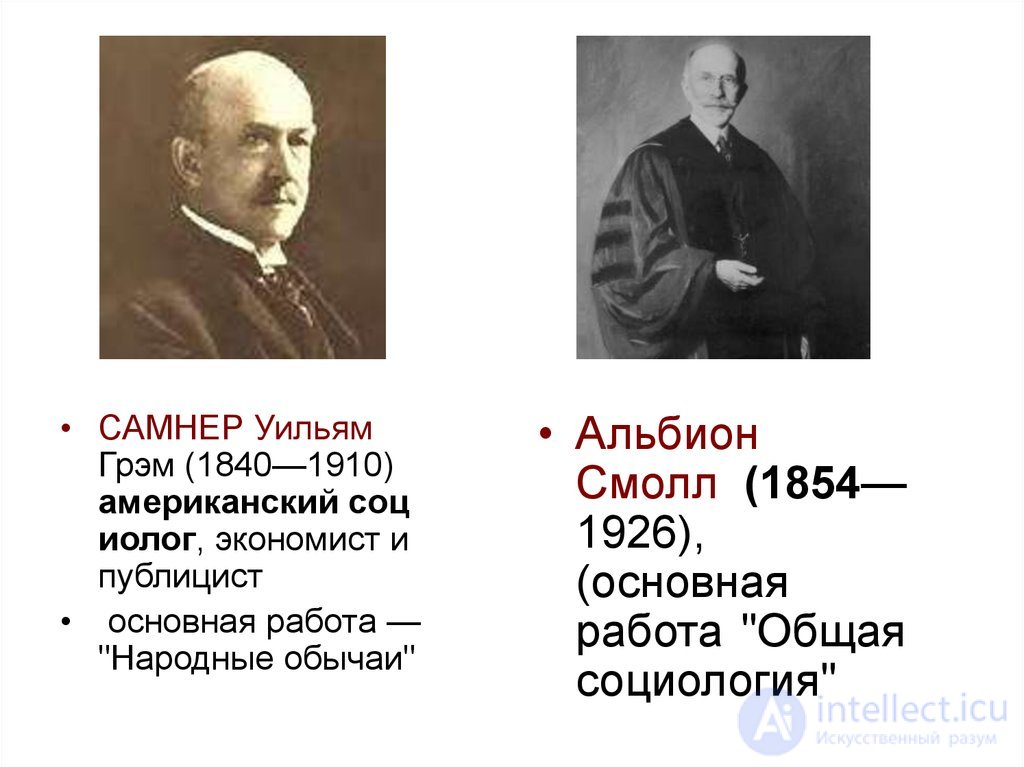
W. Sumner (1840-1910). Born, lived and died in America. Professor of Political and Social Science at Yale University. A representative of orthodox social Darwinism. Considered the laws of evolution universal, extending to society as well.
In society the laws of natural selection and the struggle for existence play a decisive role. He was a supporter of the spontaneous development of society.
Man should not interfere in the social process. Social inequalities are normal and necessary conditions for the coexistence of society.
He spoke out against state regulation of socio-economic relations, since it hindered free competition.
Sumner went down in the history of American sociology not as an adherent of social Darwinism, but for the fact that he wrote the book “Folkways”, in which he developed a concept of the norms of social behaviour, based on ethnic stereotypes and customs. He developed the concepts of “We – group”, “They – group” and the category of “ethnocentrism”.
He studied a large body of ethnographic material using many peoples as examples and concluded that the primary factor in the development of society is rights and customs.
Society consists of competing groups. Competition for survival in the social space between groups and individuals is a feature of the social organism.
Ethnocentrism – the universal human trait of perceiving and evaluating all phenomena of the surrounding world through the prism of the cultural values of the ethnic group to which one belongs.
According to ethnocentrism, society is “We – group” and “They – group”.
“We – group” perceives relations within the group on the basis of agreement, solidarity, cohesion. The basis for cohesion is high respect for the norms, values and traditions that have been worked out. One’s own group is the centre of everything, and all others are measured and evaluated from the standpoint of “We – group”.
“They – group” – refers to an alien group, based on hostility, mutual contempt and ethnocentrism.
Sumner formulated the laws of the confrontation between the WE and THEY groups:

L. Ward (1841-1913). Born, lived and died in America. First president of the American Sociological Association.
Founder of psychological evolutionism. He believed that the development of society is based on psychological laws. Social evolution occurs under the action of psychic forces.
Social life differs from natural processes in 2 fundamental respects:
The driving force of movement in society consists of instincts, desires. Interests, beliefs: hunger, thirst, sexual needs – primary desires (in Sumner – habits). On their basis intellect and moral and aesthetic needs are formed. It is precisely these that ensure the development of society through the purposeful activity of the individual. The law of social development – the struggle for organisation!
The principal bearer of the collective reason of society is the state. Ward was under the influence of Comte. The state must intervene broadly in social life, regulating the economy and social relations in order to overcome the negative consequences of free competition.
Reforms in society will be successful on condition of compulsory universal education.
A. Small (1854-1926). He lived, worked and died in Chicago. He made a great contribution to the institutionalisation and professionalisation of sociology. He was the founder and head of the world’s first department of sociology, at the University of Chicago (1892).
Founder of the American Sociological Association, and of the journal “American Journal of Sociology” (1895). Founder of the Chicago school of sociology.
He personally conducted many sociological studies. He actively participated in empirical sociological research. In his views he was under the influence of social Darwinism and psychologism (Ward).
The subject of sociology – interests, as necessary elements of human action.
Social life – the result of the interaction of people’s interests. He classified all interests into 6 groups:
They serve as the basis for the formation of social groups, as well as institutions, so as to give practical advice on improving social relations, on harmonising social structures.
His main contribution to sociological theory – a version of the nature of social conflict, as a conflict of interests.
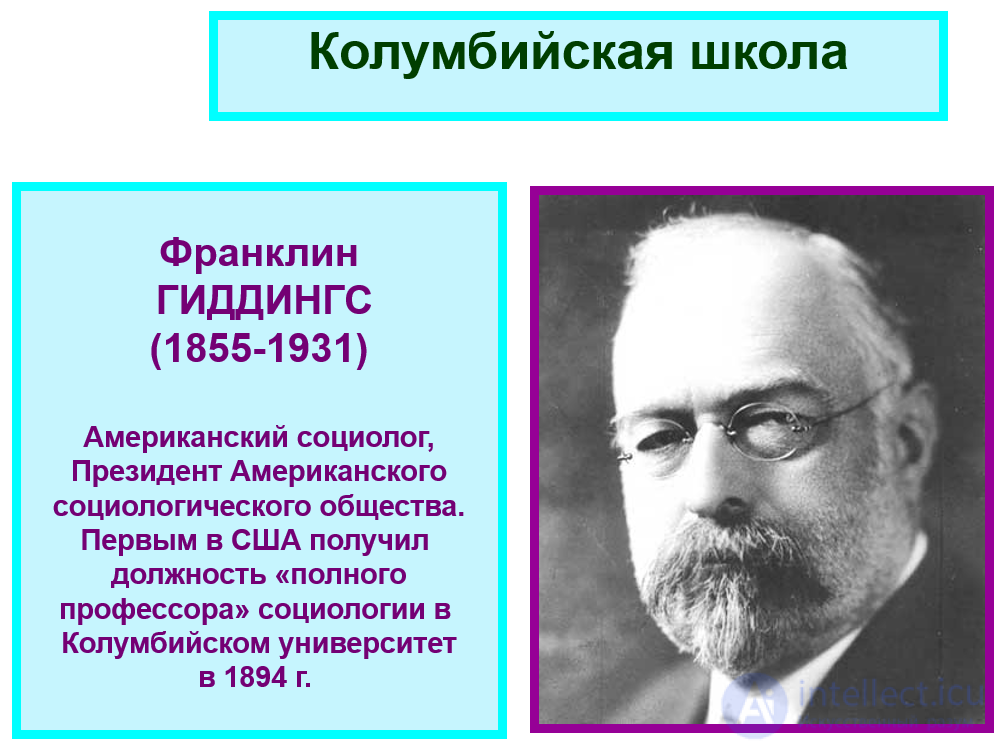
F. Giddings (1855-1931). One of the first presidents of the American Sociological Association (1908). First professor of sociology at Columbia University (1894).
He entered sociological theory with the concept of consciousness of kind, i.e. a collective consciousness ensuring mutual understanding and communication among people. He believed that consciousness of kind is the first particle of social life. It is the basis for the union of people into classes. Depending on the degree to which collective consciousness is expressed, he identified 3 classes:
He classed these as primary classes. Classes of the secondary order included: political, economic, industrial classes (workers, peasants, bankers).
For example, vital classes are classes that differ in degree of longevity. Longevity is a product of heredity and the development of consciousness of kind. The vitality of classes is determined by the ratio of birth rate to death rate. For example, the class of high vitality has a high birth rate and low death rate, and coincides with the agricultural population. The class of medium vitality: low birth rate and low death rate, coinciding with the trading and professional strata of urban society. Classes of low vitality: low birth rate and high death rate, coinciding with the poor working-class urban strata.
Classes of persons – classes of personalities. Determined by a combination of social heredity and social circumstances. These include: the class of geniuses and the talented, the class of the normally gifted, the class of the deformed. Unfortunately, the class of gifted people is practically unstudied, and there is no accurate statistics of any kind, with the exception of the class of the deformed – society has statistics on cripples, the blind, the deaf, the mute, drunkards, idiots, epileptics, suicides, and the insane.
The main doctrine is connected with the analysis of social classes. He distinguished them by the degree to which consciousness of kind and adaptation to social life are expressed. These qualities are acquired as a result of upbringing, heredity, population density and social differentiation.
He distinguished the following social classes:
Edward Ross (1866-1951). He was strongly influenced by Small and Ward. He went down in the history of American sociology as the creator of the psychological concept of social order and control (Comte was the first to speak of social order).
“Man instinctively feels the need for a better order than the one he can achieve”
What does sociology study? – its subject – the study of social processes as the result of the interaction of social groups and individuals.
Social order – the absence of hostile social clashes, where the claims of social groups are satisfied in accordance with established rules. Order is established at the cost of a certain sacrifice by the individual or social group in the name of the public interest. This is the law of society’s existence. Man feels a need for security, and therefore he feels a constant need for stability and a better order.
The reverse side of this need is a feeling of threat to one’s own wellbeing, of insecurity, requiring social control.
Social control – is the deliberate influence of society on human behaviour with the aim of stabilising and reproducing the dominant system. The levers of social control are fear of punishment, self-interest, and the public good. Ross developed a chain of social control, consisting of the following links:
The essence of the chain: attitudes orient towards values, which serve to justify norms. Norms ground sanctions.
Types of control mechanisms:
Typology of obedience:
The task of sociology consists in this, that by changing the content and direction of psychic processes, i.e. the individual’s internal attitudes, it should promote individual order, and establish harmonious internal and external relations of social groups and institutions.

Comments