
Lecture
Formal sociology in Germany set itself the task of working out the basic forms, concepts and categories of sociology as a science, i.e. it wanted to create a categorial apparatus, a special language. As its methodological basis it no longer used biology or physics, but the philosophical theory of knowledge and the theoretical doctrines of Kant, Hegel and Marx. German sociology, proceeding from the premise that the socio-humanitarian sciences are sciences of the spirit, of the free activity of man, pursued its own goals; sociology must study man’s inner world, his consciousness, his experiences, and consequently the methods of study are not natural-scientific (subject). W. Dilthey discovered the method for studying man’s inner world. The method of empathetic co-experiencing (in order to understand another, one must put oneself in his place).
Windelband – the Baden school (neo-Kantianism). The concept of form: the isolation, from the whole totality of social phenomena, of a special kind of fact that can be united into pure formal concepts, separate from the content in which these forms live. Example: morphology – the composition of a word; it has pure forms (prefix, root, suffix, ending); these are forms of language that have no content, yet nonetheless have general laws of spelling, applicable already to specific content.
In sociology, the isolation of pure social forms constitutes an obligatory stage in its formation as a science. The basic categories of sociology were formulated, making it possible to identify the laws, principles and features of a social phenomenon.
Key categories:
F. Tönnies: community, society, unions, associations, corporations, group, social relations
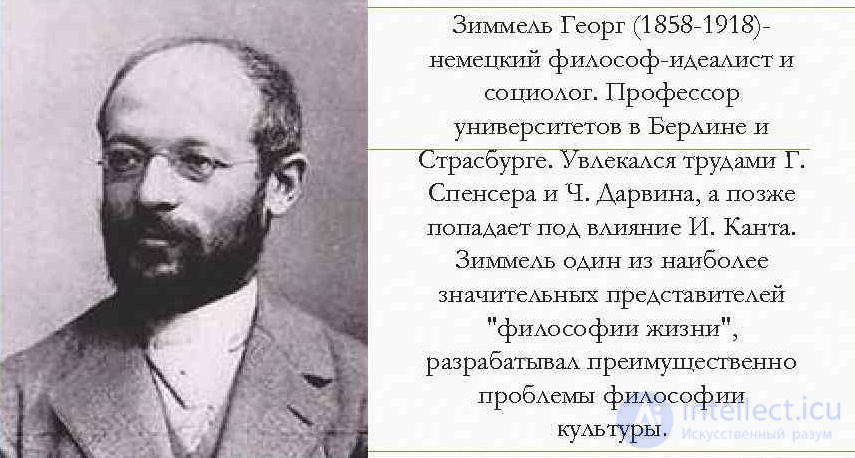
G. Simmel: social differentiation, social processes, types, patterns of behaviour, small group.
M. Weber: ideal types, social action, power, economics, capitalism, religion.
The 1st professional sociologist in Germany, a lecturer in sociology, was the founder of the German Sociological Society.
His main contribution to world sociology is connected with the development of pure theoretical forms (community, communality and society). The subject of sociology is the study of the interaction of people. General sociology studies conflicts and mutual negative actions among people.
He lived at a time when, in Germany, the agrarian communal order was giving way to an industrial capitalist society. It was important to understand the essence of these changes.
“COMMUNITY AND SOCIETY”
|
criteria |
Community (gemeinschaft) |
Society (gesellschaft) |
|
Type of settlement |
Peasant community |
Industrial urban society |
|
Individual motivation for life, meaning |
Informal kinship relations. Selfless, free provision of help and support to one another, warmth of spirit, emotional attachment, trust |
Formal relations, striving for personal gain, payment for goods and services, tense, almost hostile relations |
|
Social control |
Based on public opinion, strict social control, observance of traditions and laws |
Formal law, equality |
|
Character and division of labour |
Division of labour only within the family, agricultural labour |
Professional division of labour, labour separated from the family. Industrial in character. Labour for society – a fiction, everyone works for themselves |
|
Culture |
Based on religious values |
Secular in character, based on science |
|
Type of personality |
Irrational, selfless, collectivist, communal |
Rational, calculating citizen |
|
Main social institutions |
Family, neighbours, community, friendship, fellowship |
Large corporations and associations, industrial associations, parties, trade unions, government |
|
Social mobility |
Minimal |
Very high, both horizontally and vertically |
|
People’s will to interact |
Based on mutual understanding and agreement. In the family, the unity of will is determined by instinct, habit, the memory of shared joys. Neighbourliness and friendship are based on spiritual community. and mutual understanding and agreement. -munity member with emotional attachment, an industrial capitalist society was replacing -tion peo |
Fictitious unity; people are disunited, relations are built on exchange, the market. |
“Sociology of Differentiation”, “The Philosophy of Money”, “The Conflict of Modern Culture”.
He studied the work of Comte and Schopenhauer (as did Tönnies). He studied the problems of urbanisation, the sociology of sex, the sociology of fashion, of differentiation, of science, of sociability, of conversation.
Form – the interaction of elements, thanks to which they form a unity.
Content – that which is present in individuals in the form of drives, interests, goals, psychic states… That out of which an effect on other people is formed, and that which facilitates the perception of these interactions.
In the totality of the interaction of form and the content that fills it, society is realised.
“If there is a science whose subject is society and nothing else, its sole purpose can only be the study of these interactions, forms, types of association” (Simmel. “The Problem of Sociology”. Western sociology, 19th-20th centuries, texts, p. 420).
“‘Society’ itself is properly such an existence with another, for another, against another, in which material or individual contents and interests, through drive or purpose, acquire or retain form” (“Sociability”, vol. 2. Contemplation of Life, p. 489).
Main categories: the category of life (life – a process of creative becoming, in which the rational and irrational forces of man are engaged – his reason, feelings, intuition). The social group (he derived the laws of the small group: “the size of a group is closely dependent on the level of development of its individual members; the size of the group is directly proportional to the degree of freedom of its members: the smaller the group, the less personal freedom each person has”). Money and intellect (in parallel with the growth of freedom and individualisation, intellect develops, and at the same time this contributes to the development of the monetary system; the characteristic features of capitalist society – are money and intellect; the money economy is the embodiment of intellectual potential).

Comments