
Lecture
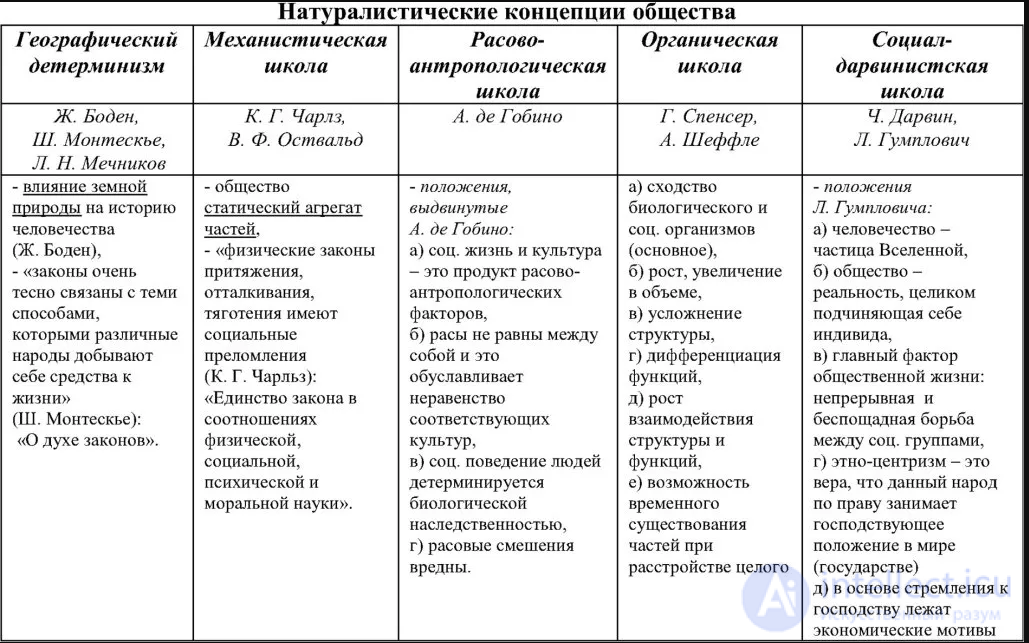
These schools were widespread in sociology in the middle of the 19th century. All of them belonged to the single-factor schools of development (+ the mechanistic schools).
Central question: what factor forms the mainspring of society’s development?
The search for the main factor determining the development of society and man relates to the determining factor that is the root cause of development.
The naturalistic schools tried to find the causes of development in nature itself or in human nature.
1. The bio-organic current originates with H. Spencer.
Its essence can be expressed in the following propositions:
René Worms (1869-1926), A. Schaeffle (1831-1903).
Worms was the first to lay the foundations for the institutionalisation of sociology. He organises the first institute of sociology. He was the first to organise and hold a sociological congress. Main work: “Organism and Society”. Thesis: “Society is a single organism and must be studied by the laws of biology”.
Schaeffle – Minister of Trade of Austria. Work: “The Structure and Life of Social Bodies”. He likened society to an organism; the basis of society’s existence was the laws of evolution, i.e. the struggle for existence.
“The social body, or society, differs from an organic body by its mentality, its capacity for thought, the presence of spiritual-psychological ties between individuals, a collective consciousness, and social memory. The main factor contributing to the emergence of society is spiritual and moral values”.
The significance and shortcomings of organicism in sociology:
“+”: 1. Organicism was a step forward in the attempt to study society as an integral, interconnected organism, compared with the theory of the social contract. This proposition is a contribution to the structural-functional paradigm.
2. The methods of natural science were used in the study of society, which contributed to the discovery of the laws of social development, as well as to the process of integrating natural-scientific and social knowledge.
“–“: 1. Drawing a complete biological analogy between society and an organism did not make it possible to fully reveal the specificity of sociology, the full complexity of society as a social organism.
2. Social evolution was presented as proceeding exclusively along a linear path through defined stages, from simple to complex, like a biological organism.
3. The diversity of the historical forms of social development was underestimated.
4. Conservative organicism absolutised the primacy of society over the individual. Liberal organicism absolutised the primacy of the individual over society.
2. Social Darwinism. It was topical, and was widely disseminated in the USA at the end of the 19th and beginning of the 20th centuries. In Russia – in the 1990s.
The key concepts of the theory are made up of the basic principles of the evolutionary process: natural selection, the struggle for existence, survival of the fittest.
These 3 laws were used to study society, and the methodological basis was Darwin’s theory and the theory of the leading role of conflict in the life of society (Hobbes, Gumplowicz).
Social Darwinism viewed social life as an arena of continuous and universal struggle between individuals, groups and classes, on the principle of “the war of all against all” (Hobbes).
Representatives: L. Gumplowicz (1838-1909), W. Bagehot (1826-1877), W. Sumner (1840-1910), A. Small (1854-1926), G. Ratzenhofer (1824-1904).
Significance and shortcomings:
“+”: 1. A shift in scholarly attention from the global problems of human society to the problems of social groups and inter-group relations.
2. Awareness of the role of competition in the development of society and the individual. Competition as the main factor in the development of society.
3. The essence of conflict was rethought in a new way
“-“: 1. The use of biological reductionism
2. Exaggeration of the role of conflict in the life of society
3. Social Darwinism often served to justify amoralism and lawlessness, the right of the strong in economics and in political life.
3. This school took shape in the middle of the 19th century. Its main propositions:
Gobineau (1816-1882), Lapouge. They arrived at this theory from anthropology.
According to this theory:
The Aryans and their descendants – are the main source of intellect and creative development of the race. Dolichocephalics (long-heads) have a ratio of head width to its length of less than 75%. Externally, such people are blue-eyed blonds. They are characterised by exceptional energy, rebelliousness, love of freedom, creative abilities; they are born leaders, geniuses. They make up approximately 1.5% of Europe, at the time of the study (mid-19th century) – descendants of royal dynasties, clergy, the aristocracy and the urban bourgeoisie of the 3rd and 4th generation. Special conditions of existence must be created for them: social institutions that would secure their dominance and the purity of the races – the institution of marriage, the preservation of caste and estate distinctions, the institution of education, the absence of physical labour (predominance of mental labour), diet, and special comfortable living conditions.
Brachycephalics (round-heads) have a peaceable character, are hardworking, diligent, and lack initiative and creativity. Born servants to the dolichocephalics. Brunettes with brown eyes. All their strength is directed towards the struggle for existence.
Meaning: the theory is aimed at justifying the privileges of the ruling class. At the same time, the coefficient of the elite, i.e. the creative potential of society, constitutes the spiritual gene pool of a people and creates a new structure of society.
Zavalsky studied the state of the elite in Russia before and after the revolution, as well as during perestroika. Before the revolution – 8%, after – 2%, before perestroika – 0.8%.
Kaznacheyev: by the end of the 1980s the population of Russia had lost 60-80% of its intellect. Causes: alcoholism, emigration, regression, famine, war. “The absence and loss of the gene pool causes a loss of selfhood, i.e. we have lost the ability to develop independently, trying instead to copy American, Chinese, Swedish and other models of social development”
Vulnerability of the theory:
The emergence of this school contributed to the emergence and development of eugenics. Eugenics – the science of improving the human race. It can be positive: concerned with developing methods for improving the human race, the selection of the most favourable marriage combinations. Negative: on the basis of an analysis of the hereditary pathology of a lineage, excluding undesirable marriages.
4. Representatives: Ch. Montesquieu (1689-1755) – “The Spirit of the Laws” (the influence of the geographical environment on man and society), M. Le Play (1806-1882), F. Ratzel (1844-1904).
Idea: the main factor of social development – the geographical environment. Its components (climate, soil, flora, fauna) influence occupation, religious beliefs, the development of scientific thought, the political system, the development and character of social institutions, people’s character, the birth rate, the state of health, etc.
Montesquieu: was the spiritual father of the French Revolution. “Man is the measure of all things”. He studied jurisprudence independently. 1748 – “The Spirit of the Laws”: “Climate influences people’s character. In a cold climate people are sturdier, more straightforward, less suspicious, because the blood flows to the heart more quickly. A hot climate relaxes a person; the main trait – laziness (a natural quality). Climate influences the organisation of labour: in hot countries – labour is undeveloped, but wise states pursue a policy and instil a religion that promote the effective organisation of labour. In China a policy of encouraging labour is pursued. As a result China has developed such a trait as diligence (though there is also cunning), and its religion – Confucianism – encouraged the joy of life. In India – Buddhism, which caused enormous harm to society, since it did not stimulate diligence and effort; its essence – nirvana (detachment from worldly cares). Climate influences the type of family: polygamous and monogamous (5:1).
In a hot climate there exists a slave-like dependence of women on men, because physically such women mature very early. But this does not match the development of their childlike minds. The Eastern woman does not manage to attain the optimal ratio of beauty and intellect that could contribute to her independence from man and power over him, which is characteristic, for example, of the European woman. Because of early physical maturity it is customary to marry early, since women age quickly and blossom early; polygamy is permitted in order to produce offspring.
The influence of climate on drunkenness: the strength of a drink increases with the degree of latitude. In the south all religions prohibit drunkenness, because it is harmful to health to drink. In northern countries drinking – is a natural necessity (for warmth)”.
Significance:
5. This current encompasses concepts of society that arose under the influence of the successes of the development of the physical sciences at the turn of the century. This current sought analogies in society for various physical processes, and strove to describe social processes taking into account the latest discoveries of physics, chemistry and mathematics.
A particular impetus to the development of mechanism was given by the emergence of thermodynamics.
Representatives: H. Carey (1793-1879), W. Ostwald (1853-1932).
Carey reduced society to a mechanical aggregate and established the laws of social processes by analogy with the processes of the inorganic world (mechanics).
Ostwald, taking into account the new achievements of the physical sciences, turned to “energetic” reductionism. Arguing that energy, not matter, is the most general “substance of the world”, to whose transformations everything, including social phenomena, can be reduced. Ignoring the qualitative distinctiveness of the social, Ostwald created a physio-sociological conception of the socio-cultural process as the transformation of free energy into bound energy. This process corresponds to the “energetic imperative”, which contains within it the formula: “Do not waste energy, use it”.
Nevertheless, the representatives of mechanism, being proponents of collective and statistical methods, made a valuable contribution to the theory and methodology of social change, and their influence can be felt in contemporary trends in the use of sociology and cybernetics.
The single-factor schools appeared in the second half of the 19th century. Inspired by the outstanding achievements of the natural sciences, social scientists tried to find the single main factor determining social development. At this time sociological concepts appeared that explored analogies between the social world and the physical factor, the biological (organicism), the geographical, the ethnographic, and the evolutionary.

Comments