Karl Marx and his contribution to sociology: the conflict paradigm and the materialist theory of progress

Lecture


  1. The materialist understanding of history and social progress
  2. The conflict paradigm. Classes and class struggle
  3. The socialisation of society and of the individual. The individual as object and subject of social relations
  4. National-ethnic processes in society.

Literature:

  1. Preface to A Contribution to the Critique of Political Economy. Marx and Engels, vol. 13, pp. 16-17
  2. The Communist Manifesto
  3. Theses on Feuerbach

Karl Marx and his contribution to sociology: the conflict paradigm and the materialist theory of progress

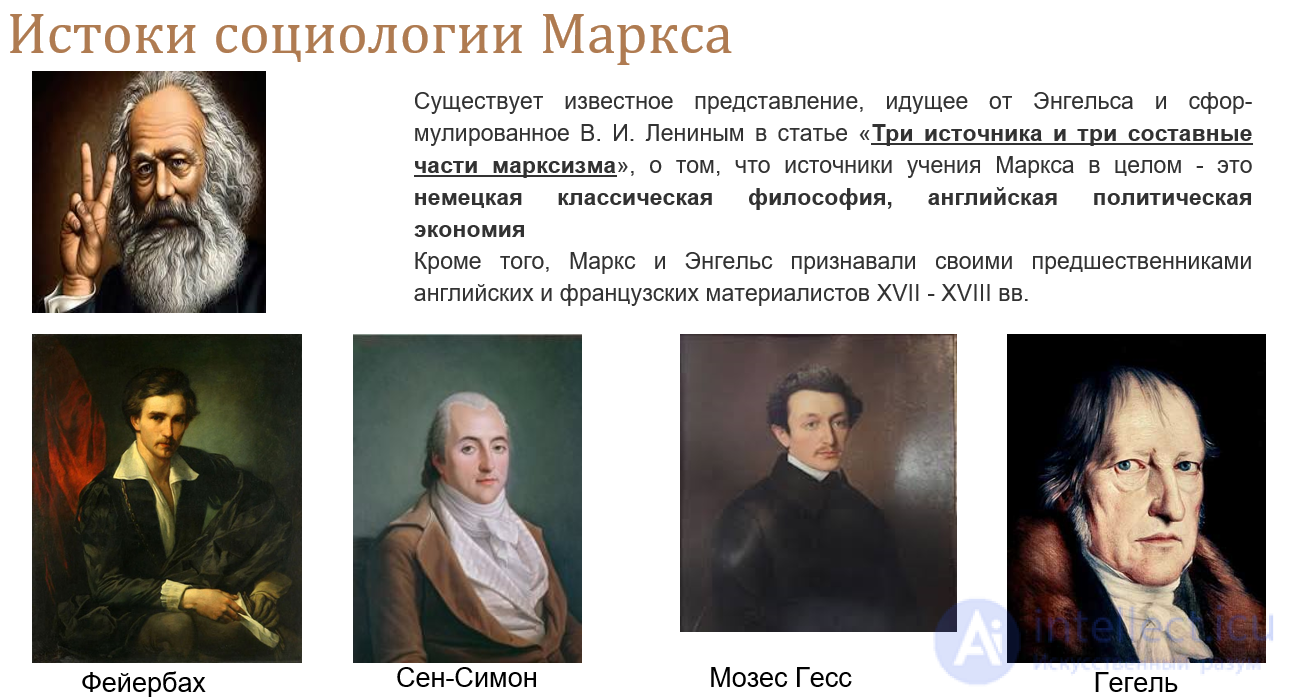
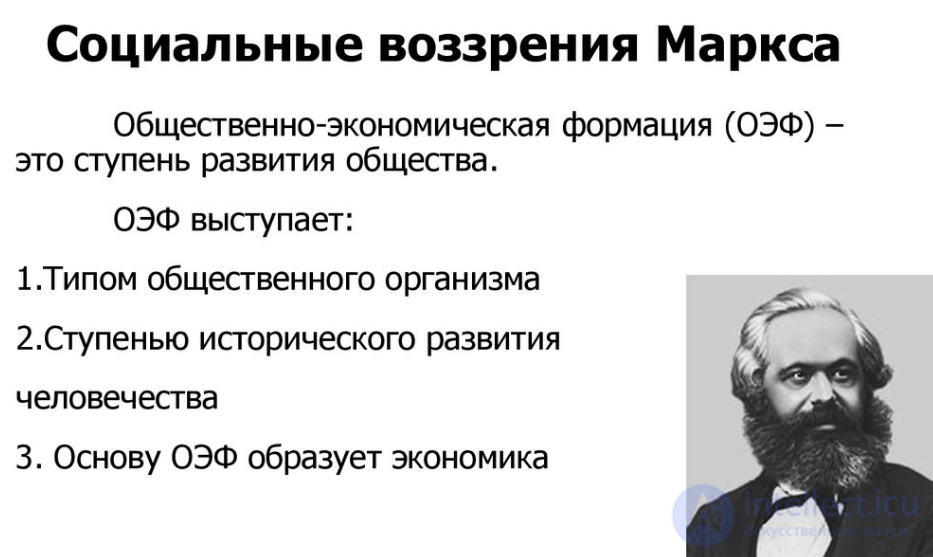
K. Marx (1818-1883) was born in Germany into the family of a lawyer from Trier. By nationality – a Jew. The family adopted the Protestant faith. He spent most of his life in England. He considered himself a marginal figure. His character was extraordinary, outstanding. A genius. A one-woman man, a freedom-loving person. He received a legal education.

F. Engels, his friend. Many joint works. A like-minded thinker, a collaborator.

Before Marx there existed 2 versions of the understanding of true progress: the idealist understanding (A. Comte) and the naturalistic (H. Spencer).

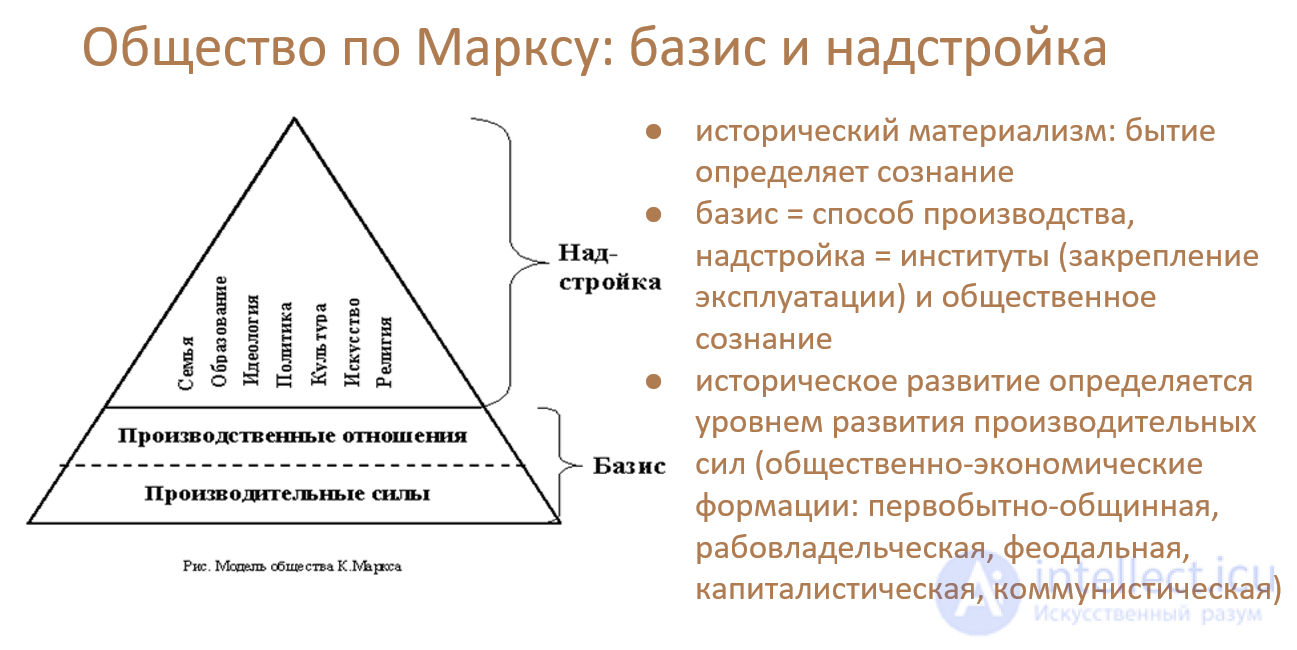
Marx developed the materialist understanding of history and progress. This formula is set out in the preface to A Contribution to the Critique of Political Economy: “The development of society is determined by the mode of production of material goods. The economy – is the base of society. Society consists of 2 parts: the base and the superstructure. The base of society is made up by the economy, the main element of which is ownership of the means of production. It is the owners who determine the superstructures (politics, the social sphere, classes, ideology), i.e. politics, sociology and the spiritual sphere.

An important part of the base is the mode of production.

Karl Marx and his contribution to sociology: the conflict paradigm and the materialist theory of progress

The most conservative element – relations of production; the dynamic one – productive forces.

Productive forces are constantly developing, improving, and at a certain stage of their development they come into conflict, into contradiction with relations of production.

A mismatch arises between the new level of development of the productive forces and the old relations of production. This conflict is resolved by revolutionary means. The old relations of production are destroyed, and new relations of production are established that correspond to the new productive forces.

A new owner appears, he dictates a different policy, new classes, a new ideology, a new religion – a different social mode of production appears.

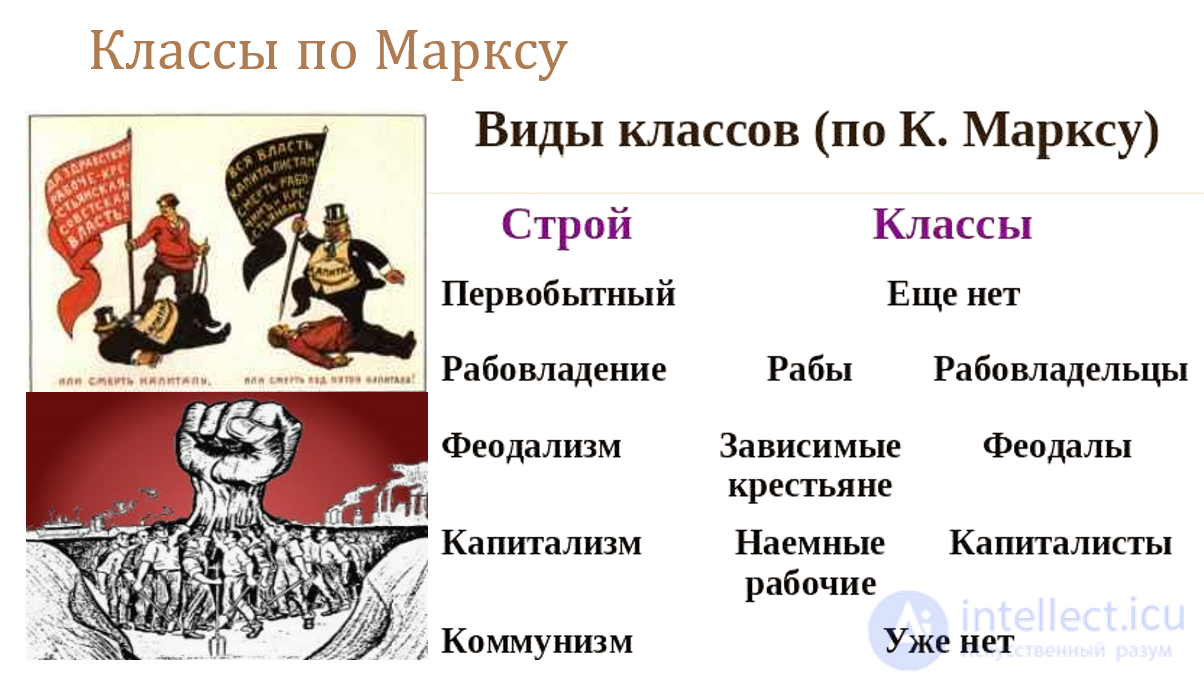
Marx identified 5 types of social formations:

  1. Primitive-communal
  2. Slaveholding
  3. Feudal
  4. Capitalist
  5. Communist

The history of humanity begins with the communist formation. All preceding formations – are prehistory. In communist society new laws will operate:

  1. The law of the increase of free time: “The more free time in society, the richer society is and the more developed the person is”
  2. The law of the growth of spiritual needs: “Material needs have limits of satiation. There is no limit to the improvement of spiritual needs”

A comparative analysis of the views of Comte and Marx on the theory of social progress.

In common:
  1. A linear approach to the development of society. Progress develops from the simple to the complex.
  2. A progressive approach to the history of humanity. Humanity does not regress, but progresses. For Comte – a scientific society (the ideal of progress); for Marx – a communist society.
  3. A practical approach to the development of society. A striving for the practical improvement of society; Comte attempts this by means of a religion of goodness, Marx – by revolution.

Karl Marx and his contribution to sociology: the conflict paradigm and the materialist theory of progress

Differences:

  1. Comte: social development takes place on the basis of the continuity of generations, gradually, without sharp leaps, evolutionarily. Marx: a revolutionary leap, a complete break with the past. “The tradition of all the dead generations weighs like a nightmare on the minds of the living”.
  2. Comte: social progress is peaceful in character; the task of social development – the achievement of consensus. Marx: the source – conflict, contradiction in the mode of production.
  3. Comte: the driving force of the development of society – reason. Marx: class struggle, revolutions. Comte discovered the law of the 3 stages. Marx: the basic law of social progress – the contradiction between the productive forces and the relations of production.
  4. Comte: the mechanism of social development – intellectual reforms in the shaping of the spiritual sphere. Marx: social revolution.

Karl Marx and his contribution to sociology: the conflict paradigm and the materialist theory of progress

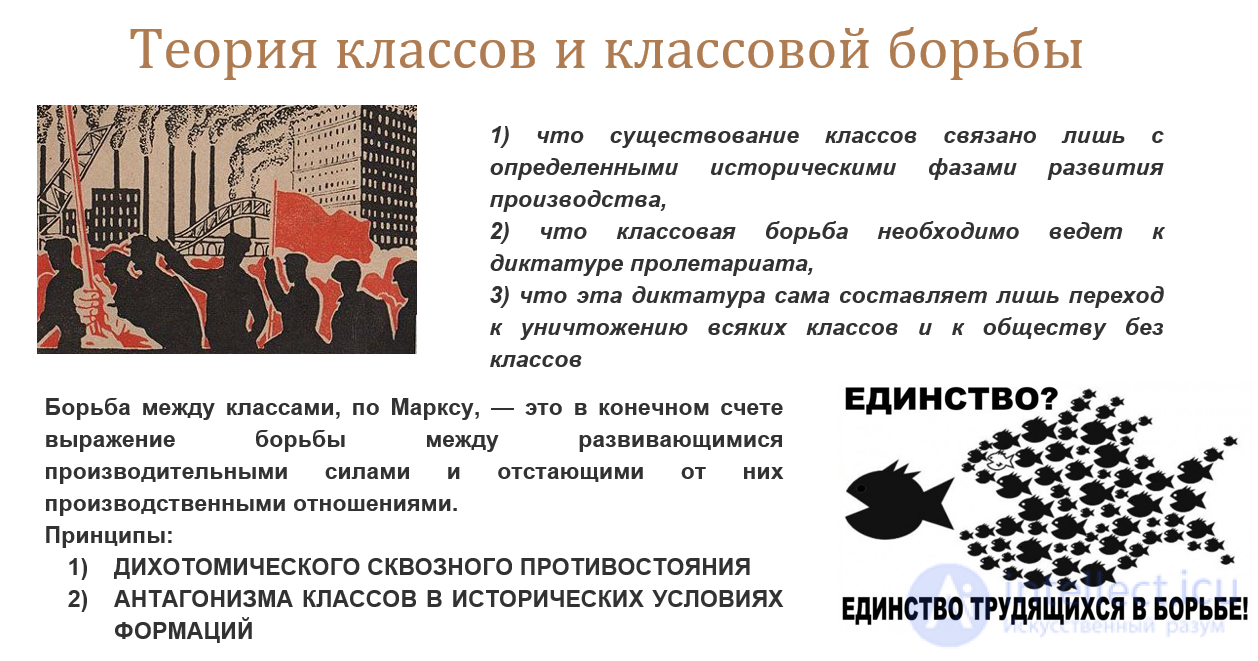
The conflict paradigm:

  1. The basis of conflict in society – class struggle. For Comte class relations can be regulated by means of science. The basis for dividing society into classes is the relation to power and administration. The patriciate governs, the proletariat – executes. For Marx the basis of division is the relation to ownership of the means of production. Whatever the type of ownership, such are the classes (feudal lords and peasants, the proletariat and the bourgeoisie)
  2. Marx showed that the existence of classes has a historical form and is linked to the historical phases of the development of production. That is, there was a time when there were no classes (primitive-communal society) and there will be a time when there will be no classes (communist society) (“Critique of the Gotha Programme”).
  3. The relations between classes are antagonistic, i.e. irreconcilable. They can be resolved only through the destruction of one of the sides (for Marx – the bourgeoisie). Marx discovered the law of surplus value: the capitalist appropriates the unpaid labour of the worker, exploiting him
  4. The dictatorship of the proletariat. The class struggle between the proletariat and the bourgeoisie can be resolved only by a social revolution, which culminates in the establishment of the dictatorship of the proletariat. The task – to destroy the bourgeoisie as a class and to abolish classes altogether, the building of a classless society.
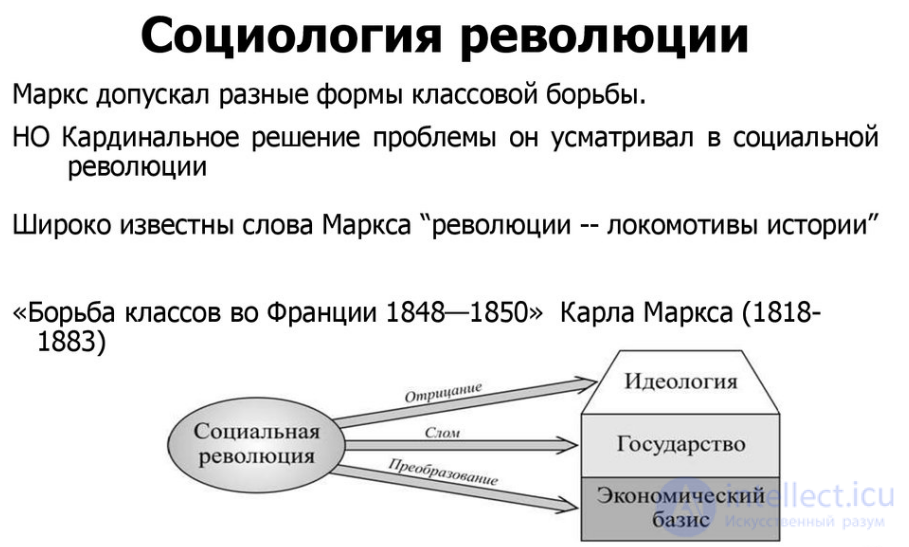
  5. On social revolution. Marx – the first revolutionary in sociology. He gave the concept of “social revolution” - this is not simply a transition from a less progressive formation to a more progressive one. It is not only a qualitative transformation of society (a new mode of production, economy, politics, classes), but a rapid, sharp, conflictual shift in social relations, based on violence.

Karl Marx and his contribution to sociology: the conflict paradigm and the materialist theory of progress

“Revolutions – are the locomotives of history”, “society is pregnant with revolution”.

Marx discovered the world-historical mission of the proletariat, fulfilling 2 tasks: gravedigger of capitalism and creator of a classless communist society.

The sociology of the individual. The individual and society.

One of the central problems of sociology – the relationship between community and the individual.

Unlike Comte and Durkheim, who considered the person for the sake of society, and unlike Spencer, who considered society for the sake of the person, Marx considered the relation of society and the individual as mutually dependent, mutually complementary; the individual can be a subject of society if he acts in line with the objects of social laws. Through their participation these subjects can speed up or slow down this process, change its forms or methods, but cannot cancel the historical process.

Marx regarded the individual as a subject of social development, but on one condition: if the individual is aware of the laws of social development and acts in accordance with these laws.

People – the authors of the historical drama – must not passively wait for the course of history, but actively participate in its development. History – is nothing other than the activity of man pursuing his own goal. A person can influence historical development through his activity (labour, political, social, cultural). But the space for the free social action of the individual is small, and therefore the possibility of influencing the historical process is insignificant; consequently, the individual cannot play a determining role in historical development.

As subjects of social development Marx considers the whole of humanity, the state, the nation, classes, the family, the individual.

Karl Marx and his contribution to sociology: the conflict paradigm and the materialist theory of progress

Society develops through the action of all these subjects, but the strength of their influence is not equal. In different epochs one or another subject could come to the fore as the driving force.

Class struggle – the main driving force. Marx regarded the individual as an object of society. “The individual – is a drop of water reflecting the essence of society, and the surrounding environment exerting an influence on the formation of the individual and his behaviour. The individual – is the ensemble of all social relations. The development of the individual is conditioned by past and future generations”.

National-ethnic processes in society as understood by Marx.

The nation – is the highest social form of ethnic development. Every people passes through the following evolution in its development: clan, tribe, community, ethnos (narodnost), nation.

An ethnos (narodnost) includes the following features: language, culture, a common territory, mentality, psychological makeup.

The nation absorbs all these 4 features and adds a community of economic life. Such a community appears only under capitalism, and consequently the nation – is a product of capitalism.

Under capitalism there appears something that did not exist under feudalism – an internal market, formed on the basis of commodity-money relations (CMR) and the division of labour.

Under feudalism natural economy predominated; the division of labour and CMR were absent.

Capitalism cemented the nation by means of CMR, the internal market, where everything depends on everything else.

Thanks to the internal market a literary language is formed.

There occurs a correlation of the social and the national: the social is more important.
Karl Marx and his contribution to sociology: the conflict paradigm and the materialist theory of progress

Marx’s dialectic

•matter and motion are a mental abstraction
•motion is the mode of existence of matter – the highest form of motion is thought
•the character of motion is dialectical
•the interconnection of objects and phenomena is universal — every object and phenomenon has a mutual connection with every one of all the others
•matter is inseparable from thought
•freedom as such is the knowledge of necessity;
•freedom as such is the thinking of necessity;
•freedom as such is the reflection of necessity by thought;
•freedom of will is the capacity to apply knowledge;
•the freedom of the individual person is his capacity to apply his knowledge
•the opposite of freedom — submission to violence
sociology of revolution
Karl Marx and his contribution to sociology: the conflict paradigm and the materialist theory of progress

The idea of the “withering away” of the state

An important place in the Marxist
sociology of revolution is occupied by the idea of the
“withering away” of the state
According to Marx, a necessary stage on
the path to stateless
self-government is the establishment of
the political power of the working class in
the form of the dictatorship of the proletariat
Marx’s achievements
Thanks to the achievements of K. Marx
society was for the first time presented as a
product of historical development, as a
dynamically developing system, at the
basis of which lies social
conflict as a form of expression of
social inequality, both in the
economic and in the political
spheres

Comments

To leave a comment

If you have any suggestion, idea, thanks or comment, feel free to write. We really value feedback and are glad to hear your opinion.
To reply

Lectures and tutorial on "History of Sociology"

Terms: History of Sociology