
Lecture
Main works: “The Protestant Ethic and the Spirit of Capitalism” (1904-1905), “On the Categories of Interpretive Sociology” (1913), “Sociology of Religion” (1914), “Economy and Society” (1920) – not translated.
Born into a family of industrialists. His mother was a Protestant. He lived with his family until the age of 29. He studied at the universities of Berlin and Heidelberg. He took up scholarship from 1907.
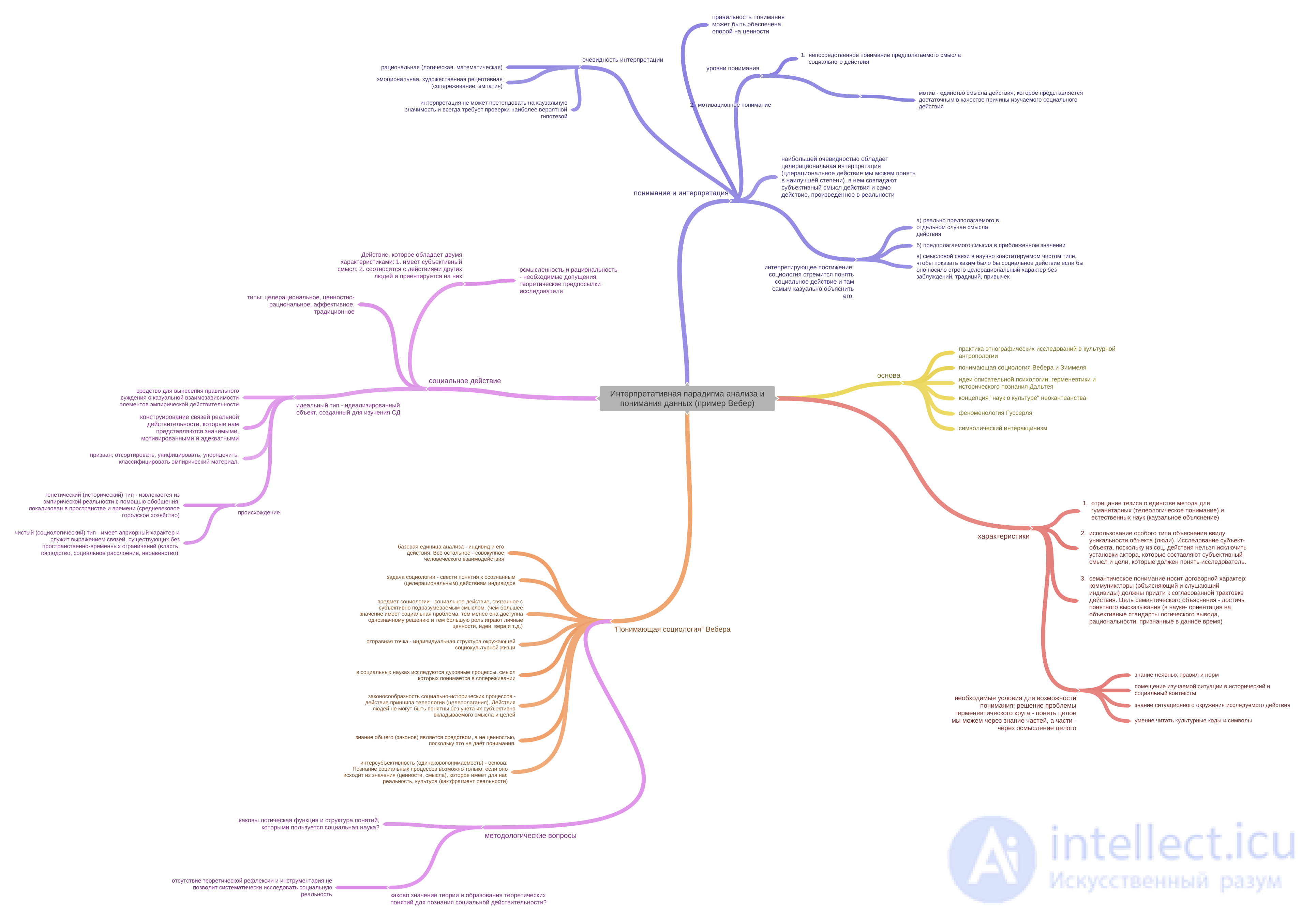
Founder of a new paradigm in sociology: interpretive sociology (understanding sociology)
He held that social reality is created by the human being himself. Each person has his own motives, interests. The sociologist must understand what drives people, why a person performs social actions. To understand the person from within, through motivation.
He developed methodological principles. Weber posed the question: “How does the science of human behaviour differ from other sciences?” - “by its distinctive methods and objects of study.
We cannot understand the behaviour of a cell, but we can understand the behaviour of a person. A person is distinguished by consciousness, meaningful behaviour. A person knows what he wants, and therefore the sociologist must understand the motives of a person’s behaviour, the meaning of his actions. Having understood the nature and meaning of human actions, one can also understand society, which consists of people”.
Hence M. Weber’s interpretive sociology. Its essence: to study society through the human being. This is the fundamental difference from structural functionalism, where society is studied through social institutions.
Weber held that society itself, the state, class are not subjects of action, since they do not possess consciousness. The real subjects of action are individuals endowed with consciousness.
Classes, politics, economics, institutions organise the concrete actions of the person
Therefore the subject of study of sociology must be the study of the person’s social action.
The category “social action” has 2 features:
Non-social actions: if the action is oriented towards natural phenomena; if the action is oriented towards material objects (animate or inanimate); the action is oriented towards the individual’s inner world; the action is performed out of imitation.
Typology of social action: 4 types of social action. The classification is based on the degree of rationality displayed
An action is considered social if it is conscious, reasoned, rational. Only types 1 and 2 can be classed as social, while 3 and 4 cannot be classed as fully social, since they contain the element of awareness only to a minimal degree.
The category of rationality. Rationality – conscious, purposeful, well-founded, the counterweight to the irrational, which is based on feelings, instincts, emotions.
Using the criterion of rationality, Weber formulates ideal types as a methodological device for studying social reality.
Ideal types are not an aim of cognition but a means of cognition, which make it possible to:
Weber developed ideal types in several areas: in people’s behaviour and their social actions (irrational action), in politics – the liberal type of power and rational bureaucracy, in economics – the capitalist mode of production based on a rational economy (rational capitalism), in religion – Protestantism.
Weber’s model of capitalism:
…It was a response to the question of Germany’s path of development in the late 19th and early 20th centuries. At that time Germany was one of the most backward countries in Europe (4-5 times behind England and America). It was dominated by an agrarian Junker economy.
Weber advocated the industrial capitalist development of Germany. He sought to answer the central question of the age: What is modern capitalist society? What above all determines the essence of capitalism?
According to Comte: the essence of capitalism was determined by the scientific organisation of labour
Spencer: competition
Marx: the pursuit of profit
Weber: notes that the striving for profit has existed at all times, among all peoples. A certain category of people has always engaged in trade, plunder, speculation. But this economic man, the adventurer, did not create the civilised industrial capitalism that arose in the West. The capitalism of Western Europe is rational capitalism. Irrational capitalism, which existed among all peoples at all times, had as its goal the acquisition of capital, while the means of enrichment were luck, chance, the Russian miracle, cunning, adventure, deceit. It corresponds (irrational capitalism does) to an economic man of the trading type, distinguished by amorality, dishonesty, unscrupulousness, impudence. Such irrational capitalism has always existed wherever it was possible to make money by reselling finished goods. In Western Europe – industrial capitalism. The means of accumulating capital – industrial labour. The goal – the use of money for further development. It corresponds to an economic man of the second type, characterised by diligence, the ability to soberly assess the situation, activity, initiative, industriousness, a sense of duty fulfilled within the bounds of one’s calling. The rational capitalism of Western Europe was formed thanks to the economic man of the second type. The predecessor of such a man – spiritual capitalism (the Protestant religion, the Protestant work ethic).
Every person has his own calling, which he must fulfil as diligently as possible. Entrepreneurial activity is also pleasing to God. The more he labours in the sphere of his calling, the more pleasing he is to God. Man’s salvation from his sins lies in his diligent labour. Labour – the mediator between man and God.
Sociology of power:
Power – is the ability to influence the behaviour of other directions, their efforts towards achieving the aims of a society, an organisation or an individual.
In his work “Economy and Society” Weber studied all types of economy, from the slaveholding to the modern industrial economy, and concluded that all types of economic activity rest on 3 types of domination, which constitute 3 types of social action:
The ideal type – is the 3rd type of power; for Weber – the liberal type.
The ideal type of bureaucracy:
For bureaucracy not to degenerate but to work effectively, it must meet the following criteria…
10 features (“commandments”) of rational bureaucracy:
Sociology of religion.
“The Protestant Ethic and the Spirit of Capitalism”, “The Economic Ethics of the World Religions”.
Weber studied religion from the point of view of its influence on the motivation of people’s behaviour, especially in the sphere of economic activity. (for Comte religion is needed to ensure social order; for Durkheim – it performs the function of mechanical solidarity).
Religion can act as an active, independent force, influencing the motivation of people’s behaviour and the meaning of their activity. And by virtue of this it is capable of influencing the change of social processes, i.e. religion can act as a factor of social development in its own right.
Unlike Durkheim, Weber studied not the elementary, primitive-communal forms of religion, but the most highly developed forms of religiosity.
Weber studied Hinduism, Buddhism, Taoism, Confucianism, Protestantism, Christianity.
He examined the relationship between religion and economics. Weber concluded: the degree of rationalisation of economic activity is inversely proportional to the strength of the personal element in decisions.
The more rational elements present in a religion, the more rationalised human behaviour becomes, the more rationalised the economy becomes.
Religion gives meaning to economic activity, shapes the attitude to labour, to wealth, the character of the motivation for labour (example: in Confucianism the degree of rationalisation is high, the goal – a prosperous earthly life, magical elements are not very pronounced, belief in an afterlife is absent).
The most rational religions – Protestantism, Confucianism. In Protestantism labour and diligence – are the basis of salvation and worldly well-being.
This-worldly asceticism – the Protestant ethic. It presupposes renunciation of all of life’s pleasures; the rational fulfilment of one’s own duties and self-restraint, regarded as a sacred duty.

Comments