
Lecture
Outline:
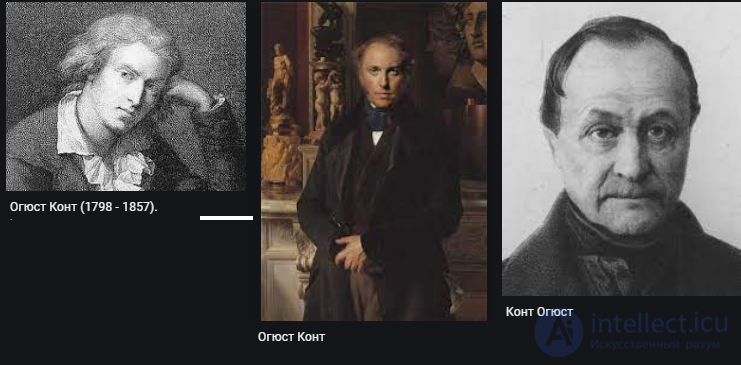
1. Auguste Comte (19.01.1798–05.09.1857) – the founder of sociology. He laid the foundations of the positive science of society. He determined the place of sociology in the system of sciences, its object and subject. He formulated the scientific method of sociology. He gave a characterisation of the social structure of society – social statics, and its social institutions. He formulated the basic law of the development of society (the law of progress): the law of the 3 stages. He characterised the stages of social development (social dynamics). He determined the nature of man, his threefold essence. He formulated the main features of industrial society.
2. Sociology, social order, social progress, consensus, social statics, social dynamics, social institution, the positive method, the law of the 3 stages, scientific-industrial society.
3. Comte gave a pyramid of scientific knowledge (a classification of the sciences).
 At the base: mathematics
astronomy
physics
chemistry
biology
At the top: sociology
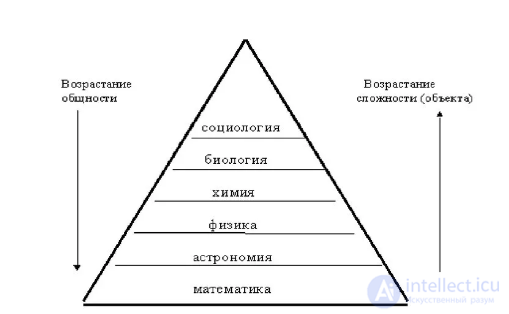
Sociology absorbs all the scientific methods used in the preceding natural sciences.
4. Methods:
The main one – the method of observation. It can be direct or indirect.
The second – comparative: historical or theoretical.
The method of comparing different types of society, social phenomena, doctrines.
Further – experiment: direct (artificially created conditions) and indirect (revolutions, deviations).
The positive method (5 meanings):
5. In Comte, object and subject merged.
Object: sociology – is a new natural-scientific discipline about society. It studies society in its integrity and interconnectedness. It studies the laws of its stable development and functioning.
6. Human nature consists of the heart, reason and activity, i.e. man is feeling, reason and activity at the same time. Which one determines the essence? According to Comte – activity.
The motive force of human action is feeling (for Weber – motivation).
Human nature remains unchanged. Man cannot create himself. The task is to ensure that people are guided by disinterested feelings.
Egoistic feelings: sexual, martial, maternal, alimentary, industrial (labour), pride, vanity.
Altruistic: attachment, veneration, kindness.
Reason – the organ of control and management of human behaviour. It is built on the understanding of human behaviour. It moves from fetishism to the positive.
7. Social statics – is a characterisation of the social structure of society and its social institutions in a state of rest.
Society – a collection of families, united not on an instinctive basis, but on the basis of the division of labour.
The supreme social law – social order, public agreement, consensus.
The supreme goal of social statics – the discovery of the laws of social order.
The economic basis – the division of labour, the basis of social solidarity, since everyone feels their dependence on others.
The political basis – the state, which ensures centralised governance on the basis of strict discipline and order.
The social basis – a hierarchy based on the division of society into rulers and executors, into patricians and the patriciate.
The social organisation of society – social institutions:
8. Social dynamics (the theory of progress) – the doctrine of social progress.
Social progress – is the progressive, evolutionary, linear development of society.
A necessary condition for progress – the continuity of generations. “The dead govern the living”.
The driving force of social progress – reason. In its development, reason passes through 3 stages:
Reason determines and directs the movement of history, but a number of other factors also influence social progress: race, climate, politics.
“The success of an individual’s activity depends on the degree of penetration into the meaning of history, on grasping the tasks and ideas of history”.
9. Main features (according to Comte):

Comments