
Lecture
The laws of the development of society and its causes must be sought within society itself.
There were many followers, and consequently a school arose.
The period of institutionalisation!
Works:
Main categories:
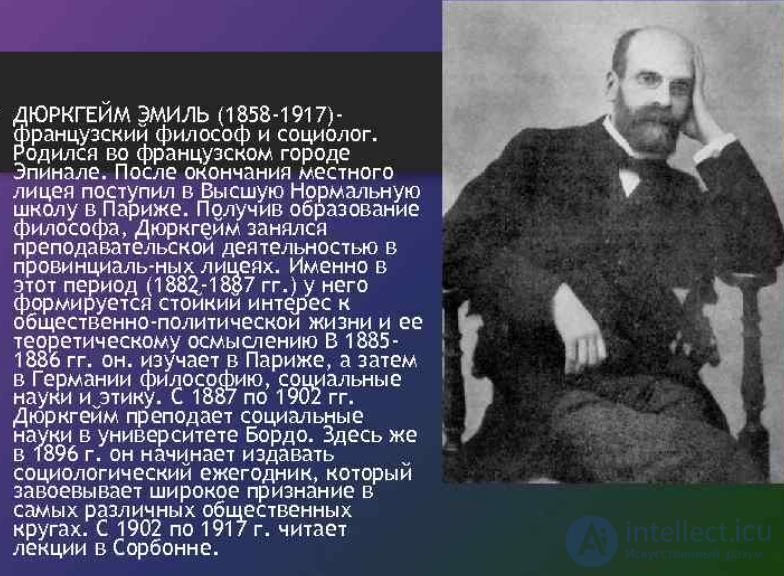
Main task: to show the role of the division of labour in society
Conclusion: the division of labour in society performs the moral function of uniting society and contributes to its solidarity.
Methodology: sociological reductionism – reveals the causes of a causal relationship, proceeding from the nature of society. Method: study the social by means of the social. Subject: the social fact. Object: social reality. Society possesses laws that flow from its nature.
“The division of labour – is for uniting, for creating the integrity of society, its solidarity”, (it was Comte who first regarded the division of labour as the basis for the life of society, while at the same time perceiving the danger of its disintegration).
2 methods of proof:
1. Explain the complex by means of the simplest, i.e. “use elementary forms as a model for studying developed forms”.
He used the example of the family. On the basis of the sexual division of labour the family arose (economic, political and military activity – this is the occupation of men; the woman – is the keeper of the hearth, the continuer of the line). Man and woman, by their qualities, stand at opposite poles that attract each other. Man – is manly, strong, rational, intelligent. Woman – is weak, feminine, irrational, with a developed spatial imagination.
The opposition of the sexes – is the basis for the creation of the family. Man and woman passionately seek one another, striving to create something whole, which is called the family. The family – is something more than the sum of 2 people in love, which can be designated as an integrity.
“When people live together and constantly maintain relations with one another, they sense the whole that they form through their union, become attached to that whole, care about its preservation, and take it into account in their behaviour. The “I” of each member of the family is subordinated to the common “we”. So it is in society too: the division of labour – is a new, more perfect factor of uniting society, of creating its integrity”.
2. The method of distinguishing 2 types of solidarity. Alongside 2 types of social organisation of society, Durkheim distinguished 2 types of solidarity:
COLLECTIVE CONSCIOUSNESS.
“This is the totality of beliefs and sentiments common on average to the members of one and the same society; it forms a definite system that has a life of its own; it can be called the collective consciousness”.
Specific features of the collective consciousness as a reality:
1. It is not concentrated in any single organ, but is dispersed throughout the whole space of society.
2. The collective consciousness is objectively independent of the particular conditions of people’s lives (geographical environment (north, south), social organisation (town, village), occupation (professions)): these conditions change. They pass, but the collective consciousness remains.
3. The collective consciousness does not depend on, and does not change with, each generation; on the contrary, it serves as the source of the connection between successive generations.
The collective consciousness – is the psychological type of a society, its mentality. It has its own way of developing, its own properties, its own conditions of existence.
The social fact can be of two kinds:
Subject: material and immaterial social facts. The immaterial facts chiefly interested the scholar, since they made it sociologically possible to interpret proper, acceptable behaviour and deviant behaviour.
Progress: source – the division of labour, criterion – the degree of solidarity in society.
The concept and typology of society:
Society – is the object of social cognition.
Durkheim was the first to focus attention on a quality of society – its integrity.
Society – is not a simple sum of individuals (Spencer), but a system formed by their associations and representing a reality endowed with its own special properties, the most important of which is integrity.
The relationship between society and the individual: society, as social reality, is primary, while the individual, as individual reality, is secondary. The consciousness and behaviour of the individual are determined by society. Society is analogous to the family. Society – is a special reality that first arises as a result of the interaction of people, but then, having arisen, begins to live according to its own laws.
The structure of society: consists of 2 elements:
Typology of society:
1st criterion – the type of society and its structure
1. This type of society is based on the resemblance of individuals. Structure: clan-based, special social ties, low population density.
2. This type of society is based on the division of labour. Structure: regulated by the internal market and urbanisation, high social interdependence, social mobility and high population density.
2nd criterion – types of law.
1. Repressive law, i.e. conditional law. Essence – punishment.
2. Civil law. Essence – restoring justice.
3rd criterion – collective consciousness
1. C.c. absorbs the individual, has a large volume.
2. C.c. has a small volume, leaves room for individual initiative.
4th criterion – the supreme value
1. Society itself
2. The individual
5th criterion – regulation of behaviour in society
1. Belief and collective feeling, religion, traditions
2. Division of functions, mutual exchange, mutual complementarity
In complex society, collective or mechanical solidarity does not disappear entirely, but acquires secondary characteristics.
The subject of social analysis: for Durkheim – this is the study of social facts. Social facts – are elements of social reality (social institutions, spiritual-social facts, the collective consciousness of norms, judgements). A social fact – is a way of thinking, acting and feeling, external to the individual and endowed with coercive power, i.e. a social fact possesses 2 characteristics:
The method of sociology.
Durkheim’s achievement consists in the fact that he was the first to develop a sociological method of research.
The essence of the method: to explain the social by means of the social. This means that the causes of a given phenomenon of society should be sought outside society (single-factor schools).
Requirements of the social method:
1. The analysis of a social phenomenon must be carried out on a scientific basis, just as is done in physics, biology and chemistry, i.e. positively.
Analysis reveals causes, and here it is most important to seek social causes, i.e. within society. The selection of facts (as against arbitrariness and chaos).
2. It studies the consequences of this social phenomenon.
3. It identifies the functions of the social phenomenon, i.e. what social need it affects
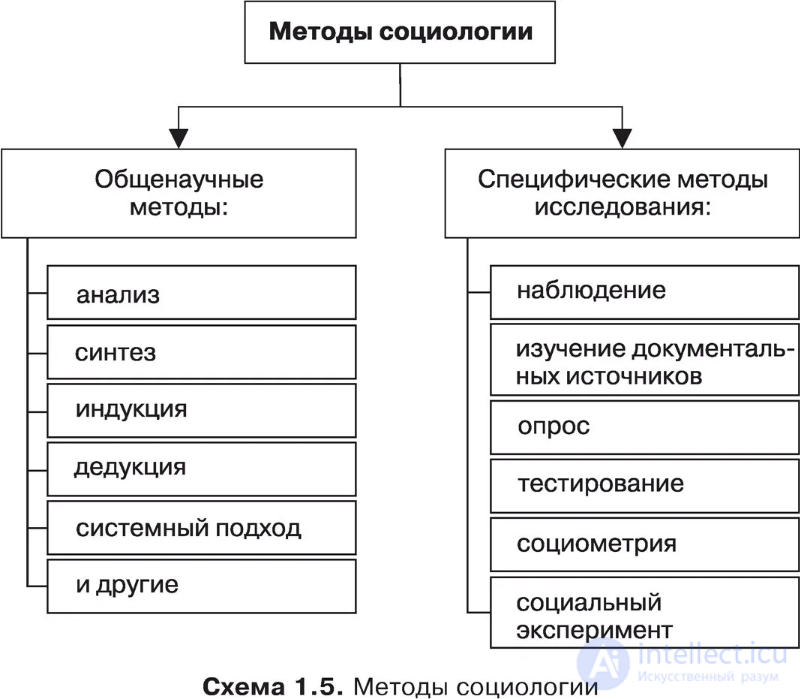
2 methods of social analysis:
Durkheim was the first to establish specifically sociological methods of research:
Durkheim was the first to introduce mathematical methods into sociology:
Qualities of an honest sociologist:
“Suicide”.
He was the first to analyse the social nature of suicide. He set himself the task of identifying whether there are factors within society itself that influence suicide.
Social factors:
He gave a typology of suicides:
The basis for the classification – is the degree of connection or solidarity of the individual with society. The varying strength of the influence of social norms on the individual.
1st: arises when the ties of the individual with society are broken, and the individual is left alone with himself. Purpose and meaning of life are lost.
2nd: occurs where the individual is entirely absorbed by society or the group. And the individual gives his life for the group.
3rd: anomie (“nomos” - law) – the absence of law. It is conditioned by a state of society in which, as a result of changes in society, social norms cease to operate while new ones have not yet formed. A loss of social bearings occurs.
4th: arises under growing social pressure and the hopelessness of one’s existence.
The Elementary Forms of Religious Life:
Why does man need religion? Durkheim studied the aborigines of Australia, the essence and functional significance of religion
Conclusion: the most valuable thing in religion – is the presence of a social mechanism of solidarity that unites people.
The main function of solidarity – the consolidation of society, unification, solidarity.

Comments