
Lecture
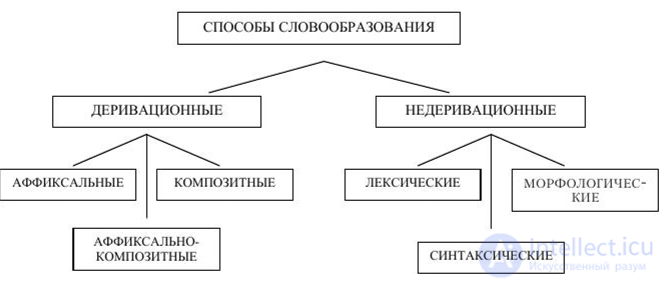
In modern English, words can be formed in various ways, including the following:
From the root of a word: new words can be formed by changing the root of an existing word. For example, the word "happy" (feeling pleasure) can be changed into the word "unhappy" (feeling sad), by adding the prefix "un-".
Prefixes and suffixes: in English there are many prefixes and suffixes that can be used to form new words. For example, adding the prefix "pre-" to the word "history" gives the new word "prehistory" (the period before recorded history).
Compounding and word composition: in English, words can be combined together to form a new word. For example, the words "book" and "shelf" can be combined to form the word "bookshelf" (a piece of furniture for storing books).
Shortenings: English may use shortenings to form new words. For example, the shortening "info" may be used instead of the word "information".advertisement – ad (an advertisement)
alligator – gator (an alligator)
examination – exam (an examination)
Acronyms: words can be formed by combining the first letters of several words. For example, the word "NASA" (a space agency) is formed from the first letters of National Aeronautics and Space Administration.
New words related to technology and culture: in modern English there are many new words connected with rapidly developing technology and culture. For example, the word "selfie" (a self-portrait photograph) was coined in connection with the popularity of self-portrait photographs taken with mobile phones.
Conversion – this is the shift of a word from one part of speech to another. For example, brave – the brave (brave, adj. – a brave person, n.). More often it is not only nouns but also verbs that undergo conversion.
Back-formation – this is a way of forming a new word by removing a derivational suffix. donation → to donate, gambler → to gamble
These are only some of the ways words are formed in the English language.
Perhaps no method of word-formation in various languages, including English, has been studied as often and as thoroughly as affixation. And this is natural: in affixal word-formation the semantic changes undergone by the underlying base are explicitly expressed and are linked to the addition of formal markers - affixes - to it. The formation of new naming units is necessarily connected with certain, above all semantic, transformations of the source units, and accordingly every derivative has a word-formation meaning. As E.S. Kubryakova points out, the derivational affix in a derivative "is not an obligatory component of its form, but where it is present, the distinctive features of the derived word appear with particular clarity and obviousness" (7,144).
Despite the large number of studies, it cannot be said that all the problems of affixal word-formation, in English as well as in other languages, have been resolved. This applies above all to the fundamental questions of affixation: the problem of the derivational status of the affixal morpheme and the problem of the semantics of the derivational affix. Describing the affixal subsystem of any language requires, as its first task, establishing the inventory and boundaries of affixation and the semantic load carried by a given affix, which determines its place within that subsystem. Undoubtedly, in describing the affixal subsystem of particular languages a good many other problems arise, determined by the structure of the given language (cf., for example, the relevance of the problem of infixes or linking elements (Fugenelementen) for Russian and German and its practical absence in English, etc.).
The dominant problem for affixation is the problem of the derivational status of affixal morphemes. Its importance for English is linked to and explained by the considerable number of borrowed words in English, the establishment of whose morphemic and word-formation composition is fraught with considerable difficulty. It is no coincidence that various sources give lists of affixal morphemes of modern English that do not agree in the number and type of affixes included. Thus, in the suffixation system different authors count from 42 to 162 affixes. O.Jespersen, for example, identifies 130 suffixal morphemes in English, while H.Marchand identifies 82, P.M.Karashchuk 64, and R.G.Zyatkovskaya 91. Even in the most comprehensive studies of prefixation, carried out by K.V.Piottukh and M.M.Polyuzhin, there is disagreement regarding the composition of the prefixal subsystem of modern English. K.V.Piottukh counts 42 prefixes, while M.M.Polyuzhin counts 48.
The reason for such discrepancies is, first, an undifferentiated treatment, in terms of synchrony and diachrony, of morphemes of the type -k, -le (the words lark 'a joke', stalk 'a stem, a gait', yolk 'the yellow part of an egg'; angle 'a geometric angle', knuckle 'a finger joint', nettle 'a stinging plant') and others, and morphemes of the type -y, -ness and others (the words branchy 'branching', kindness 'the quality of being kind', etc.), observed in a number of studies. In such cases the boundary is blurred between living affixes of the type -y, -ness, which function in the present period, and dead affixes of the type -k, -le, which functioned in English at other time periods but are not now felt to be living and can be identified within a word only through special diachronic analysis.
Second, the absence of clearly outlined boundaries of the affixal subsystem is connected with differing interpretations of the morphemic status of units of the type under- (the derivatives underfeed 'to feed too little', underestimate 'to rate too low', etc.), -man (the derivatives workman 'a manual laborer', seaman 'a sailor', etc.). This problem, known as the problem of semi-affixes, is relevant for many Germanic languages. Depending on whether we regard these morphemes as root morphemes or assign them affixal status (see in more detail below), the boundaries of the affixal subsystem will differ considerably.
The achievements of word-formation theory in recent years make it possible to define the notion of the derivational affix more clearly and precisely, and to single out, from the multitude of prepositive and postpositive morphemes, those which, by their function, semantics and structural properties, are genuinely derivational affixes. The distinction between synchrony and diachrony, between the morphemic and derivational types of word analysis, and the determination of the conditions of word-formation derivedness (discussed earlier) provided the theoretical basis on which it became possible to establish the derivational status of the affixal morpheme. Studies of the functioning of individual word-formation subsystems, comparison of the functional properties of morphemes of different types, and the establishment of their specific features have led to a clarification of the status of intermediate-type units and to their assignment to one or another area of word-formation means. Moreover, the parameters for describing word-formation morphemes have now been defined, and the range of information making up the so-called profile of the affixal model has been outlined.
The first stage in describing affixation is the identification of synchronically relevant prepositive and postpositive morphemes. At the second stage, the class of morphemes to which a given unit belongs is determined, and from the general list of synchronically relevant prefixal or suffixal morphemes those that are derivational are singled out. At the final stage, information is obtained on the semantics, structural properties and functioning of the derivational affixes identified, their combinability, their place within the overall system of affixation, etc., and finally, information on the derivatives resulting from the attachment of the affix to the underlying bases.
At each of these stages its own difficulties arise. Thus, at the first stage - the stage of singling out synchronically relevant prepositive and postpositive morphemes - the researcher is confronted with the fact that, alongside sound sequences of the type -lt (exult 'to rejoice', exalt 'to elevate', consult 'to seek advice', halt 'to hesitate', etc.) or -ch (French 'relating to France', Scotch 'relating to Scotland', etc.) and others like them, which are not relevant at the synchronic level and are not singled out as morphemes, there is a considerable number of units whose degree and character of segmentability differ. Among them one can readily find defectively segmentable morphemes, i.e. those which, according to the definition given by E.S.Kubryakova, occur in a unique or almost unique environment. These are morphemes of the type cran-, rasp-, bil- and others in the names of berries: cranberry 'a tart red berry', raspberry 'a soft red berry'. In many words one finds conditionally segmentable morphemes, which occur in more than one linguistic environment but do not have a clear meaning. Such, for example, are morphemes of the type de- in the words detect 'to discover', deceive 'to mislead', re- in the words receive 'to get', reject 'to refuse', remit 'to forgive', which might seem formally analogous to the morphemes de- and re- in the words deform 'to disfigure, to deform', rewrite 'to write again', but which, unlike the latter, cannot be defined semantically.
In all, lexical units that are unconditionally segmentable and meet the criteria of word-formation derivedness make up, according to data from K.V.Piottukh and A.V.Perevoy, a little more than half of all the words treated by English lexicographic sources as suffixal or prefixal derivatives. Accordingly, most series of words with identical prepositive or postpositive elements turn out to be mixed: they include non-segmentable, conditionally segmentable, defectively segmentable and unconditionally segmentable, i.e. derived, words. Such, for example, are the series of words ending in -a1, -ous, -ant/-ent, -ar, -ate, -oid, etc., among which there is a considerable number of non-segmentable, defectively segmentable and conditionally segmentable formations alongside a certain number of derivatives. To these two opposite groups belong the words pious 'devout, religious', previous 'preceding', ominous 'sinister, threatening' and, opposed to them, envious 'feeling envy', dangerous 'perilous, hazardous', infectious 'contagious', etc.
Some series with initial morphemes dis-, mis- and others are mixed, in which the words discern 'to perceive', discomfit 'to upset (plans)', mistake 'an error', misgive 'to arouse distrust' are non-segmentable or conditionally and defectively segmentable, while the words disbelieve 'to not believe', disestablish 'to abolish', disenable 'to render incapable', misdeal 'to act wrongly', misapply 'to use incorrectly' and many others are derived.
It should be noted that mixedness of a series is characteristic mainly of borrowed words. An analysis of the data of A.V. Perevoy, among them groups of adjectives and nouns in which there are no non-segmentable formations or very few, leads to the conclusion that they include native morphemes of the type -ed, -fast, -fold, -ful, -less, -like or assimilated borrowed affixal morphemes of the type -able, over- etc.
Thus, it becomes evident that both the composition of affixal morphemes as such and the length of the corresponding series of affixal derivatives depend on how strictly we follow the conditions of word-formation derivedness in defining them.
Sometimes knowledge of Latin and Greek stems makes it possible to derive rules for building a whole series of words (of the type cardiac 'relating to the heart', filial 'relating to a son or daughter', rural 'relating to the countryside').Having been borrowed from the source language - Greek, Latin, French - ready-made, these words are perceived as non-derived only in the borrowing language, since in' this language there are no units that could be regarded as their underlying bases. But in the source language these are derived words, formed according to the rules of that language and displaying both a semantic and a formal connection with certain of its units. (Cf.: Gk kardia 'heart' - kardiakos, L.filius 'son, daughter' - filialis, rus, ruris 'village, ploughland, field' - ruralis.) Since of these correlative pairs only one - the derived - lexeme is borrowed, in the borrowing language it loses its derived character and becomes non-derived for speakers of that language. However, thanks to their genetic derivedness, the semantic segmentability of the borrowed derivatives is preserved, which drives the search in English for corresponding units denoting the entities to which these borrowings refer. This ultimately led, in modern English, to the creation of a highly specific and widely ramified system of suppletive correlates of the type nose 'the organ of smell' - nasal 'relating to the nose', ear 'the organ of hearing' - aural 'relating to the ear', eye 'the organ of sight' - ocular 'relating to the eye', hand 'the end part of the arm' - manual 'relating to the hand' city 'a large town' - urban 'relating to a city', sheep 'a wool-bearing animal' - ovine 'relating to sheep' and many others, which significantly distinguish the vocabulary of modern English as a whole from the lexical systems of other languages in which word-formation is carried out according to fixed models.
In modern English there are also numerous cases where both members of a pair were borrowed, i.e. both the derivative and its underlying base (for example, dynasty 'a ruling family' – dynastic 'relating to a dynasty', economy 'a system of production and trade' – economic 'relating to the economy', cyclone 'a system of rotating winds' - cyclonic 'relating to a cyclone' effect 'a result, consequence' – effective 'producing a desired result' matrinomy 'marriage, matrimony' – matrimonial 'relating to marriage' and many others). The large number of borrowings of this kind led to English assimilating the corresponding word-formation models and to the creation, within the word-formation system of modern English, of a special subsystem, named by H.Marchand word-formation on a Neo-Latin basis. A serious problem of word-formation analysis in English is therefore establishing whether both members of the pair - the base and the derivative - were borrowed, or whether the derivative was formed already in English according to a word-formation model that took shape under the influence of numerous borrowings. Significant for diachronic analysis, this question, however, loses its relevance when describing synchronic relations between words, when far more important are the problems of word-formation analysis of those borrowings which are formally non-derived, and of establishing the derivational status of the affixal morphemes forming part of them.
With the delimitation of the class of morphemes relevant at the derivational level, the problem of the inventory of the affixal subsystem does not receive a final solution. It is necessary to determine the status of intermediate-type morphemes which, within the language system, correlate with independent words - the so-called, following M.D. Stepanova, semi-affixes.
The classification of postpositive or prepositive morphemes as root or affixal is carried out according to various criteria - on the basis of either a purely structural or a purely functional feature.
In the first case a morpheme is considered a root morpheme if it correlates with a unit occurring in free use, i.e. a separate word. If, however, no such correlation with an independent word is observed for a unit standing in preposition or postposition to another, then it is regarded as affixal. Such, for example, is the view of H.Marchand and A.I. Smirnitsky, who regard the morpheme man- and others analogous to it as a root morpheme, and formations with it as compound words.
According to the second point of view, proposed by E.S. Kubryakova, the status of a morpheme is determined by the type of its functional load: if a morpheme functions like a full-fledged affix, then it should be regarded as affixal. Relying exclusively on the structural features of a unit – its boundness – within the language system seems justified only in a purely formal respect. In terms of content, however, the presence or absence of a free correlate for a whole series of word-formation morphemes has no substantial effect on the role they play in building their constructions.
Among the features of semi-affixes that bring them close to full-fledged affixes are the following: the denotation of broad word-formation categories, considerable productivity, the ability to compete with genuine affixes or to share their sphere of action with them. The closeness of affixes and semi-affixes is also manifested in the fact that they frequently 1) act as absolute or partial synonyms (English hypersensitive and oversensitive 'extremely sensitive'); 2) display antonymic relations (English underestimate 'to rate too low' - overestimate 'to rate too high'); 3) show similarity in expressing certain areas of meaning (cf. locative meanings, meanings characterizing the course of an action, intensifying meanings, etc.); 4) prove interchangeable in translation from one language into another (cf. English out-, rendered by the Russian prefixes пере- and е-); 5) build word-formation series of the same length (this significantly distinguishes formations with semi-affixes from compound words); 6) build word-formation series whose members are distinguished by strict regularity and repeatability of semantic relations between the components of the derived unit. Compound words with a repeating first or second component do not possess these features. Cf. ice-breaker 'a ship that breaks ice', iceberg 'a large floating mass of ice', ice-cream 'a frozen dessert', icebox 'a cooler for keeping food cold' (4)
An important role in determining the status of a derivational morpheme is played by its semantics, and in this respect semi-affixes also come close to affixes.
Much has been written about the semantics of the affix. In the linguistic literature there are heated debates as to whether an affix has meaning at all, and if so, what type of meaning this is. The most varied, often opposing points of view are expressed, which, however, can be reduced to several main directions:
1) the affix does not have independent meaning by itself; it merely forms the external side of the word;
2) the affix performs mainly only a transpositional function, transferring the base from one lexico-grammatical class to another, and is lexically "empty";
3) the affix may be characterized by the presence of various kinds of meanings: some affixes express a broad and varied range of lexical meanings, while others express purely grammatical meanings (the latter H.Marchand assigns to the class of categorial markers).
The dominant view, however, was the conception according to which the affix acts as the main bearer of word-formation meaning, and its meaning is accordingly the word-formation meaning. The existence of so many contradictory opinions concerning the semantics of the affix is explained by the fact that researchers' attention was drawn to different word-formation processes. Consideration of the role of the affix in the structure of the onomasiological structure of the derived word leads to the conclusion that word-formation formants can perform various semantic roles: they can act as categorizers, thereby performing a purely transpositional function and possessing, in that case, a general categorial meaning. Such formants introduce into the semantic structure of derived words a meaning corresponding to the most general notional categories of individual parts of speech (for example, the suffixes -ion, -ment in English, -ние in Russian, etc.). Word-formation affixes can also be classifiers, i.e. markers of particular semantic subclasses within general categories. In that case they possess a particular categorial meaning (e.g., -er as an indicator of the agent category, -an, -ian, -ese, etc., indicating that a person belongs to what is denoted by the underlying base).
Word-formation formants can also play the role of modifiers. Such are usually evaluative-expressive suffixes, as well as locative, temporal and other prefixes. In addition, word-formation formants can perform the function of relators, i.e. indicators of the connection between two categories. Such, for example, are the suffixes of relative adjectives, indicating the connection of a feature with a particular object. Thus, derivational affixes can combine heterogeneous meanings and serve to convey meanings of different types. It is important, however, not to reduce the word-formation meaning of a derivative to the meaning carried by the affix. The meaning of the affix is only part of the word-formation meaning of the derived word and corresponds to the role that the affix performs in the onomasiological structure of the derived word.
The onomasiological role of the affix may, in our view, be the key to solving yet another difficult problem of affixation - the problem of polysemy/homonymy of affixes.
How difficult it is to determine the identity of affixal morphemes and to establish the limits of the semantic variability, or "spread", of the meanings of a polysemantic affix, beyond which the homonymy of derivational means begins, can be judged from the existence of the most contradictory points of view regarding the polysemy/homonymy of the suffixes -er,-y,-less etc. in English, –к(а), -чик, -ник, -гель etc. in Russian, and so on.
Sharing E.S. Kubryakova's conception that the affix in the onomasiological structure of a derived word can perform the role of a marker of the onomasiological base, as well as the role of a marker of the onomasiological feature, and even the role of a marker of the onomasiological link, we consider it logical and legitimate to link the homonymy of word-formation means, given their material identity, with a difference in the semantic roles they perform. Materially identical affixes are, in our view, homonymous if they play different roles in the onomasiological structure of derivatives. It follows from this that affixes performing one and the same onomasiological task in the structure of derivatives of one and the same part of speech (the suffixes -er in English, -чик, -ник, -тель etc. in Russian) or even in the structure of derivatives of different parts of speech (for example, the prefix dis-(disorganize 'to disorganize', dissimilar 'not alike'), -еньк -(синенький, доченька) etc. in Russian), do not split into homonyms.
According to the established criterion of affix homonymy, suffixes of the type -y, -less in English, -арь, -ач, -яга etc. in Russian, are not homonyms. The theory in which the homonymy of an affix (a derivational formant) is determined by its correspondence to different derivational steps, i.e. by its combinability with underlying stems belonging to different parts of speech, does not, in our view, have sufficient semantic grounds. The onomasiological task of the suffix (for example, -y (starry 'starlike, full of stars', yellowy 'somewhat yellow', runny 'running, flowing'), -less (painless 'without pain', relentless 'without mercy', bitterless 'not bitter') in English is one and the same; it does not depend on which part of speech the source words belong to as the underlying units for the derivatives.
Homonymous, it would seem, are only the suffixes of the type -(y)/-ie (the derivatives girlie 'a young girl (affectionate)', auntie 'an aunt (affectionate)') and –y2 (the derivatives starry 'starlike, full of stars', girly 'girlish') in English. In the onomasiological structure of the first series of derivatives (with a diminutive-affectionate meaning) they perform the role of the onomasiological feature, while in the derivatives of the second series they perform the role of the onomasiological base.
A consequence of the homonymy of these suffixes is the homonymy of the derivatives of the type girlie 'a young girl (affectionate)' and girly 'girlish', whereas the identity of affixal morphemes of the type -y, -less, -al, -ous, -ic and others, not destroyed by their involvement in creating several word-formation meanings and cemented by the identity of the many underlying bases they combine with and even, often, by the identity of the motivating meaning of these bases, entails the identity of affixal derivatives of the type floury 'made of flour, covered or dusted with flour, flour-like', firry 'made of fir, overgrown with firs', gluey 'sticky: resembling glue, covered or smeared with glue', delightful 'feeling delight, causing delight' and many others. The semantic structure of these derivatives is characterized not by a single word-formation meaning but by several; their polysemy is due to the repeated involvement of the underlying bases in word-formation processes and is therefore often regular and predictable, since the particular word-formation meanings inherent in one and the same structural type are themselves regular and predictable.
Polysemy and homonymy of word-formation means are clear evidence that the law of asymmetry reigns in the sphere of derivational morphology as well. As observation shows, many affixal morphemes, suffixes in particular, are able in English to act as markers of several word-formation meanings (WFMs), while, conversely, no single WFM turns out to be tied to only one means of expression. This reveals the following regularity: the more central, more "core" or more universal a given meaning is within the system of WFMs, the more formal means of expression are associated with it.
The phenomenon of morphological asymmetry in the word-formation system — one affix pointing to a whole range of meanings, and, conversely, a WFM being expressed by an entire set of affixes — is the main reason for the difficulties, still unresolved, that arise in attempts to model word-formation processes and that determine the present-day irresolvability of many problems of word-formation synthesis. Even having compiled an index of the WFMs that can be expressed by a given word-formation means, or, conversely, having enumerated all the WFMs that a given affix can indicate, we are nonetheless still far from formulating the rules and regularities according to which a particular generating base combines specifically with a particular affixal morpheme. Accordingly, the main difficulty of word-formation synthesis lies not in enumerating the semantic transformations that a given generating base may undergo: knowing its semantics and the natural logic of things, one can predict which meanings may be "added" in the course of word-formation operations, especially since the number of onomasiological categories of a given language, and accordingly the number of general onomasiological tasks performed in the course of word-formation operations, is of course limited, and, as a comparison of word-formation systems across different languages shows, the semantic transformations themselves are for the most part fairly universal.
It is far harder to predict and formulate the rules for choosing, from the available set of word-formation means, those whose combination with generating bases will give the required result — derived words marked by particular affixes and carrying particular WFMs.
An interesting solution in this respect is the one proposed by R. Beard, who seeks to demonstrate the need for two levels in the description of word-formation - a semantic level, or the level of lexical derivation, in the author's terms, and a structural level, or the level of affixation. At the first, semantic, level, what must be formulated are the rules and regularities of the possible semantic transformations of the source units, i.e. the onomasiological tasks performed by the word-formation system. In other words, at the semantic level the semantic paradigm of the word-formation operations taking place in the language must be revealed. At the second, structural level — the level of affixation —, specific affixal morphemes are attached to generating bases, and accordingly, at this level what must be formulated are the rules and regularities governing the combinability of specific affixes and generating bases. These rules and regularities are based on the semantic paradigm of the level above, but also depend on the specific characteristics of the generating bases and affixes and are meant to take into account all of their — phonological, morphonological, etymological, lexico-semantic, etc. — properties. These are essentially rules of the contextual use of word-formation means, far more numerous than the rules of the semantic level and, unlike the latter, which are universal in nature, specific and individual to particular languages.
The asymmetry of affixes and word-formation patterns also prompts one to wonder what the point of so many word-formation means is, if all of them are aimed at expressing one and the same word-formation meaning.
The mystery behind the many variants of linguistic form in word-formation lies, as research shows, first, in a certain selectivity in the combination of affixes and classes of generating bases, and, what is very interesting and important, in the more or less strict association of the meaning modifications of a given WFM with a specific type of derivative marked by a particular affix.
Researchers of the word-formation system have long noted the connection between semantic and word-formation categories, the relevance and importance for word-formation of a semantic taxonomy of nouns into names of concrete and non-concrete entities, and, among concrete nouns, of names of things, plants, animals, people, etc. This connection shows itself in the fact that lexical units of a given semantics are characterized by a given word-formation activity, i.e. by the ability to enter into interaction with particular word-formation means. Thus, words belonging to the names of persons, names of animals, etc., serve as generating bases for derivatives with the suffix -ish (for example, camelish 'stubborn as a camel', boyish 'boy-like', coltish 'colt-like', priggish 'pedantic', and many others), while they do not do so for derivatives with the suffix -ed. The generating bases of the latter are names of items of clothing, footwear, etc. (derivatives liveried 'dressed in livery', mitred 'wearing a mitre', bloused 'in a blouse', trousered 'dressed in trousers, wearing trousers', etc.).
The absence of exhaustive semantic classifications does not, unfortunately, at present allow one to obtain a more or less complete description of the word-formation potentials of lexical units of various semantics, or of the possibilities of their combining with particular affixes, despite the importance and necessity of such a description for the theory of word-formation. Establishing the semantic classes characterized by the total absence of word-formation potential, as well as determining the semantic classes actively involved in word-formation processes and forming the basis of the word-formation system, identifying the properties that determine the generative capacity of words and its magnitude, establishing the laws of selectivity between semantic classes of units and particular word-formation means or even groups of word-formation means - all this is a pressing task of the theory of derivation.
Accomplishing this task, however, is made considerably more difficult by the fact that it is still not known what principles determine the choice of word-forming units within a given semantic class (for example, of plants, of persons, etc.), or what degree of generality or, conversely, of detail the semantic classification of generating bases should have in order to capture their combinability with affixes. The division of the vocabulary into lexico-semantic groups is sometimes not general enough for the purposes of word-formation or, conversely, is not detailed enough. This happens because the lexico-semantic characterization of generating bases, as one of the most important factors determining their combinability with particular word-formation means and, in general, the participation of a lexical unit in word-formation processes, is not absolute but relative. Its relativity shows itself in the fact that within a lexico-semantic group of units recorded as interacting with particular word-formation means, not all members are drawn into the word-formation process. Alongside units that combine with a given affix or even with groups of affixes (cf., for example, the names of persons man 'man', woman 'woman', etc., which serve as the basis for the word-formation paradigms of the derivatives manly — mannish — manlike — manless — manful; womanly — womanish — womanlike, etc.), within the LSG there is also found a whole series of units with negative word-formation potential. In that same group of names of persons, the words female 'woman, female person', male 'man, male person', squire 'squire, landowner', thief 'thief', etc., quite characteristic of this group, do not take part in the word-formation processes mentioned above. This may be due to the influence of phonetic, morphological, etymological, and other factors.
The experiments carried out, in particular the results of the informant survey, show that the absence of derivatives of a given type from certain members of an LSG is not the result of a chance or incomplete recording of derivatives in dictionaries. It is merely a reflection of a certain specific interrelation between word-formation and semantic categories. It appears that the word-formation system imposes its own word-formation-relevant grid of semantic relations between units, which does not always and does not fully coincide with the lexico-semantic grid established on a different parameter, although a certain correlation between them is observed. A given feature, often secondary and possibly even occasional in the semantics of a given word, one that does not determine the lexico-semantic classification of that word, may become the leading one when the word is drawn into word-formation processes, and may bring about the possibility of the corresponding derivative appearing. Especially important in such cases is a functional commonality uniting many words, or the establishment of such commonality in a given context. A vivid example of derivatives whose formation became possible owing to the establishment of a functional commonality between their generating bases and the generating bases of already existing derivatives are the derivatives earful 'as much as a car can hold', stockingful 'as much as a stocking can hold; a full stocking', forkful 'as much as fits on a fork; a full fork', etc., which appeared by analogy with spoonful 'as much as a spoon can hold; a full spoon', boxful 'as much as a box can hold; a full box', etc., even though a car is most often a means of transport, stockings are an item of clothing, and a fork is a utensil for eating, rather than an ordinary vessel or receptacle for holding something.
For the semantic modelling of word-formation phenomena it is accordingly necessary, it seems, to take into account not only the dominant, leading semantic features of lexical units, but also their potential semes, actualized in particular situations and determining the word-formation activity of the word.
Obtaining an exhaustive list of the rules, or regularities, governing the combinability of generating bases and affixes is also made more difficult by the fact that the same units can enter into interaction with several affixes, which, as noted above, leads to the creation of particular word-formation paradigms of derivatives, often with a single WFM. Yet it is precisely in such paradigmatic groupings that the reason for the existence of many word-formation means for expressing one WFM is most clearly revealed; it is in them that one can find the key to morphological asymmetry in the sphere of derivation, for the derivatives in such paradigms most plainly and unambiguously demonstrate the more or less strict association of particular modifications of given WFMs with a specific affixal type of derivative. At the level of the meaning modifications of general WFMs, asymmetry does not take on the scale it has at the higher level. The modifications of a WFM in one type of derivative, marked by a given affix, do not, as a rule, coincide with the modifications of that same WFM in another structural type of derivative. In other words, a different linguistic form is associated with a different meaning. In the system of derived adjectives this is reflected in the fact that particular points on the scales of quantification and/or qualification are fixed for particular types of affixal derivatives. Cf., for example, the excessive, high degree of the presence of a property in derivatives with -y and the small, insufficient degree of it in derivatives with -ish (the derivatives coppery — containing copper, copperish — somewhat coppery, gravelly — abounding in gravel, gravelish — somewhat gravelly), or the positive evaluation in resemblance found in derivatives with -ly and the negative evaluation in derivatives with -ish (the derivatives maidenly - resembling or suitable to a maiden: Gentle, Modest; maidenish — resembling a girl: Old-maidish).
At the same time, the boundaries between points on the scale, especially on the scale of quantification, are blurred and indistinct, and it is precisely this that makes it possible for one and the same type of derivative to express neighbouring quantitative meanings. Thus, an insufficient amount of something is merely a transitional stage towards its total absence, and owing to this closeness the coexistence of these two meanings is possible not only within one type of derivative - derivatives with the suffix -less - but even within one and the same derivative. Airless, for example, can mean both the total absence of air (airless planet 'a planet with no air') and an insufficient amount of fresh air (airless room 'a stuffy room').
Thus, the whole range of word-formation meanings and their possible modifications is the ground on which the diffuseness and indeterminacy of the semantics of the derived word arise and develop and, accordingly, the "readiness" of the derivative to serve the most varied communicative situations. However, lexical units, in seeking to strengthen their linguistic status as individual units carrying particular information, are subject to a tendency both towards the fixing within them of particular general meanings and particular meaning modifications, and towards the development of new meanings, i.e. a tendency towards lexicalization and idiomatization, which act as forces counteracting the law of morphological asymmetry.
The choice, from a fairly broad palette of meanings associated with a given derivational process, of only certain meanings to be fixed for the derived words, together with all manner of semantic modifications that obscure the original motivation and the development of new meanings (idiomatization and lexicalization), ultimately create the semantic uniqueness of derivatives. Thanks to this uniqueness they acquire the status of individual lexical units whose semantics does not fit within the framework of word-formation patterns. The lexicalization and idiomatization of derived words therefore require moving on to a qualitatively new and deeper stage of analysis of the semantic aspect of word-formation. Scholars try to find the key to them in the causes of lexicalization and idiomatization. Some see their origin in the nominative tasks of derived words, in their denotational reference, and in the semantic changes that lexical units undergo in the course of their functioning. Others link the explanation of the semantic differences between derivatives formed according to one and the same pattern, and the non-derivability of the semantics of derivatives, to the action of extralinguistic factors. Still others look for the foundations of lexicalization and idiomatization in the agreement, established between speaker and listener in the process of their communication, and in the pragmatic context of use of the derived words, which form a special semantic category of linguistic expressions called contextual. The main point, however, as their researchers stress, is that lexicalization and idiomatization are necessary for derived units to attain the status of lexical units and to acquire the stability that distinguishes elements of the vocabulary from free word-combinations, which are reinterpreted anew every time they are used.
Once the inventory of affixation and the semantic properties of affixes have been established, their further systematization becomes possible, carried out in the form of classifications that take into account this or that characteristic of affixal morphemes. The most general division of affixes is their classification by position within the word into prepositive (prefixes) and postpositive (suffixes). Prefixes and suffixes form a great variety of subgroups depending on which of the whole range of properties inherent in them is chosen as the classification parameter. One such parameter may be, for example, their origin, on the basis of which native prefixes and suffixes are distinguished (e.g. the prefixes a-, be-, un-, fore- mis- mid-; the suffixes
-dom, -ed, -er, -ful, -hood, -ness, etc.) from borrowed ones (e.g. the prefixes de-, en-, ex-, non-, anti-; the suffixes –able, -acy, -al, -an, -ee, -esque, -ic, -ize, -ous, etc.).
The criterion for grouping prefixes and suffixes into particular subgroups may be the morphonological and other changes that accompany the attachment of an affix to a generating base, or the absence of such changes. On this basis -ous, -ic, -ity, and certain other borrowed suffixes are opposed to native suffixes, as well as to prefixes, which cause neither a change of stress in the generating base nor any alternations (cf. 'good/ 'goodness, 'father/fatherhood, 'water/'watery, doctor/bedoctor, alcoholist/antialcoholist; sin'cere/sinc'erity, 'avarice/avaricious history/historic, etc.).
An important classification parameter is the part-of-speech membership of the derivational bases to which affixes are attached. On the basis of this ability of a prefix or suffix to combine with units of particular lexico-grammatical classes, called internal valency, the following are distinguished within the affixation system of Modern English:
When attached to generating stems of a given class, prefixes and suffixes may perform a transposing and/or modifying function, thereby playing a significant role in determining the part-of-speech membership of derivatives. According to the lexico-grammatical class to which the derivatives formed with the help of affixes belong, the affixes themselves (suffixes in the first place, since their role in determining the part-of-speech characteristics of derivatives is more obvious than that of prefixes) are subdivided into:
There also exists a classification of affixes based on their productivity and activity. However, since affixes that combine with generating bases of different parts of speech display differing activity in doing so and form series of unequal length (cf., e.g., the suffix -er in combination with verbal and nominal generating bases, the suffix -less in combination with nominal, verbal, and adjectival bases, and so on), it seems expedient to take, as the unit of classification on the principle indicated above, not affixes taken in isolation, but the models to which they belong, especially since the latter reflect a whole complex of information about the affix (its internal valency and the type of derivatives formed by the affix). According to D.A. Vesnik and S.S. Khidekel (1), the centre of the system of affixal word-formation of Modern English is formed by such active and productive prefixal and suffixal models as:
From the list of affixal models given above it becomes evident that suffixation and prefixation are represented differently across the different lexico-grammatical classes. Thus, adjectives and nouns – are, in the main, the domain of suffixation, while the verb is characterized by prefixation.
Another significant parameter in the classification of affixes may be their semantic load, owing to which they are grouped into semantic groups such as:
affixes with the meaning of resemblance (-al, -ial, -ed, -esque, -ful, -ic, -ical, -ish, -like, -ly, -ous, -some, -y, crypto-, neo-, etc.),
affixes with the meaning of negation (a-, dis-, in-, non-, un-, -less),
diminutive affixes (-ette, -ie/-y, -ikin, -let, -ling),
+affixes with the meaning of a person (-an, -ian, -arian, -ant, -ard, -by, -ee, -een, -eer, -er, -ess, -ette, -ician, -ie, -ing, -ist, -ister, -kin, -ing, -ster, -ton),
affixes with the meaning of number-(bi-, demi-, di-, mono-, multi-, pan-, poly-, semi-, tri-, twi-, uni-)
and many others (more complete information on the semantic groups of affixes in Modern English can be found in the work of H. Marchand).
The system of affixation functions in close interaction with other means of word-formation in Modern English: conversion, compounding, and minor means of word-formation, to the successive examination of which the following sections are devoted.
In the speech of present-day English speakers, examples of the type Let me say in the beginning that even if I wanted to avoid Texas I could not, for I am wived in Texas and mother-in-lawed and uncled and aunted and cousined within an inch of my life (J.Steinbeck. Travels with Charley)
'Let me say from the outset that even if I had wanted to avoid Texas, I could not have done so, for in Texas I found myself supplied with a wife and a mother-in-law. In Texas I have uncles, aunts, and cousins at every turn', in which the words wife, mother-in-law, uncle, aunt, cousin appear in a function untypical of them, that of verbs, and with somewhat modified meanings. In a similar way, cases are not infrequent of the conversion of verbs, as in No sooner was he settled anywhere than he would light unexpectedly upon a new find (A.Christie. Selected Stories /”no sooner had he settled anywhere than he unexpectedly found something new”.
This phenomenon is so" active in Modern English that words of practically every part of speech are drawn into it, though with unequal frequency: nouns, verbs, adjectives (But he retained my hand, and I could not free it 'he could not get his hand free), adverbs (They were nearing Chicago 'they were approaching Chicago').
Despite the high productivity and activity of this linguistic phenomenon, its essence, however, is not entirely clear, and there exist at least two opposing explanations. Foreign linguists (A. Kennedy, R. Waddell, K. Pollock, and others) tend to regard this phenomenon as the use of one and the same word in the functions of different parts of speech, or a functional shift from one part of speech to another. Another point of view, which took shape on the basis of the work of Soviet scholars, above all A.I. Smirnitsky and V.N. Yartseva, consists in treating this phenomenon as an act of word-formation, in the course of which words of a common root are formed, homonymous with their generating bases and differing from the latter in their paradigms. At the root of these two opposing conceptions lie different understandings of the word and of its ability to belong simultaneously to different parts of speech. In other words, adherents of the functional-shift conception regard units such as wife 'a wife', to wife 'to marry', knife 'a knife', to knife 'to cut with a knife', to run 'to run', run 'a run' and many others as forms of one and the same word, differing in their syntactic functions, and take the fundamental position according to which a word may belong simultaneously to different lexico-grammatical classes. This position, based on syntactic criteria, which are decisive in defining the word in languages with a poorly developed morphology, such as English, is also widespread in dictionaries (cf., e.g., the dictionary entries for roof, drawl, dredge, flirt, hurl, stammer in Concise Oxford Dictionary).
Criticizing this concept, A.I. Smirnitsky firmly stresses that it does not correspond to the facts of the English language, since a noun and a verb that are homonymous in one of their forms are, on the whole, represented by completely different systems of forms, characterizing them as different words. Since, in A.I. Smirnitsky's view, a word (at least an inflected word) – is a system of coexisting, mutually conditioning and functionally united forms, it is not legitimate to speak of the identity of nouns and verbs of the type love 'love' and love 'to love' in Modern English, for they differ both in their systems of forms, i.e. in paradigm (the noun has a substantival system of word-changing suffixes – -( ), -'s, -s, -s', while the verb has a verbal one ( -( ),-s, -ed, -ing,...), and functionally. These are different words, formed by a change of paradigm.
Being consistent, one must admit, writes A.I. Smirnitsky, following the identity of homonymous verbs and nouns, also the identity of words of the type exaggerate 'to overstate' and exaggeration 'overstatement', move 'to move' and movement 'motion' and similar pairs, since semantically they correlate with each other in the same way as love 'to love' and love 'love', while the formal differences can be interpreted as differences of forms of one and the same word. Thus, treating correlated verbs and nouns (the most frequent correlations in Modern English) as forms of one and the same word leads to a failure to distinguish parts of speech in English as definite grammatical classes of words, and thereby ignores the deep-seated differences embedded in the grammatical system of the language.
Once we recognize correlative units as different words, then, owing to their semantic and formal correlation, there are grounds to regard the relations between them as relations of derivational motivation, and the process itself of forming such correlative words – as word-formation.
However, in treating correlated pairs of words of the type love v and love n as base and derivative, quite a few difficulties and problems arise. The main ones are concentrated in resolving the following questions:
When analyzing word-formation relations in correlative pairs of the type love v and love n, it is not hard to notice that the word-formation process here, unlike affixation, is carried out without the aid of any morphological markers specially intended to formally indicate the changes that have occurred in the course of the word-formation act. It is therefore no accident that in one of the first attempts to describe this method of word-formation it was interpreted as "non-affixal word-formation". Such an interpretation, while emphasizing the difference of this method of word-formation from affixation, is nevertheless not constructive, since it fails to reveal the essence of the word-formation processes taking place. More informative, though also clearly unsatisfactory, is the concept of "root word-formation". Oriented toward describing the results of word-formation processes, it notes an important characteristic of theirs, namely: words formed in the course of the type of derivation described are, in their morphemic structure, root words, i.e. consisting of a single root. But, by absolutizing this fact, this concept comes into conflict with the actual state of affairs in Modern English and unjustifiably narrows the scope of correlative words of the type described, among which there are words containing, besides the root, both suffixes and prefixes (e.g., difference 'difference' → difference 'to differentiate', discomfort 'discomfort' → discomfort 'to cause discomfort, to inconvenience', counterattack 'counterattack' → counterattack 'to counterattack' and others), as well as words consisting of two roots (e.g., blacklist 'blacklist' → blacklist 'to blacklist', nightwatch 'night watch' → nightwatch 'to keep night watch' and others).
The interpretation that has become most widespread, especially in foreign English studies, holds that the formation of correlative homonymous units is carried out by means of a zero morpheme, and the method of word-production itself is called zero-derivation, or, even more often, conversion. Being an echo of the concept of functional transposition, the term "conversion" is not entirely successful for describing this word-formation process, for in reality no transformation or change (i.e. conversion in the proper sense •of this word) takes place in English. What occurs is merely the use of some lexical units as base forms for producing others by means of, in the opinion of E. Kruisinga, H.
продолжение следует...
Часть 1 Ways of Forming Words in Modern English: Affixation, Compounding and Minor Types
Часть 2 Compounding - Ways of Forming Words in Modern English: Affixation,
Часть 3 Conclusions why is it needed and how to use it?

Comments