
Lecture
For the process of communication to take place, and for it to proceed successfully, mere knowledge of words, of the rules of their formation, and correspondingly of the rules for recognizing their meaning, is clearly not enough. Knowledge is also required of the rules for using words, i.e. the rules of their combination in the flow of speech. Accordingly, the most important aspect of lexical units, and above all of the word as the central unit of the lexicon, determining the construction, in the course of communication, of correct utterances – both grammatically and semantically – is the ability of words to combine with one another, i.e. combinability. Combinability is the joint occurrence of words in speech, in the course of which certain logico-semantic and morphosyntactic connections are established between the words forming a given syntagmatic sequence.
The concept of combinability in the theory of language is closely connected with the concepts of environment and distribution, context, and valency. Owing to the closeness of their scope, dictated by their correlation with the same linguistic objects - combinations of words with one another, these concepts are often used as synonymous. However, such equivalent use of them is not always justified, since each of them bears the imprint of the conceptions within which it was formed – structuralism (distribution, environment), contextology (context), valency theory (valency) – and also differs in the angle from which the object under study is viewed. Thus, considering the combinability of words from the standpoint of language or of speech gives rise to the opposition valency/combinability, whereas the contrast between the static aspect of combinability, its resultative side, and the processual, dynamic side, underlies the opposition context (environment) – combinability.
Valency of a word, in this case, appears as the ability, the potential of the word to enter into connections with other words, and knowledge of this ability is fixed in the empirical experience of every speaker.
Combinability, in turn, is nothing other than realized potential, finding expression in concrete word-combinations. The analysis of these word-combinations, aimed at describing the possible and/or realized connections of their constituents, makes it possible to identify the context of the unit chosen as the point of reference, i.e. the minimum number of preceding and/or following units necessary for recognizing its meaning.
Word-combinations, in turn, as units arising from the joining of words, are unities consisting of at least two notional words connected with one another according to the laws or rules of the given language. These unities occupy a distinctive position in relation to such linguistic units as the word and the sentence. Owing to their ability to function as a nominative means, i.e. a means of designating objects, phenomena, features, etc., the word-combination is brought closer to the word. Like the word, the word-combination performs a communicative function only as part of a sentence, and forms an independent sentence only upon acquiring predicativity. At the same time, the word-combination differs from the word precisely in its two-member character and, correspondingly, in the obligatory segmentation of the expression of a single, albeit complex, meaning. Unlike the word, the word-combination, with the exception of phraseological word-combinations, is not a reproduced, ready-made unit, but is built, generated according to the rules existing in the language, in the process of communication, and this brings it closer to the sentence. Nevertheless, the absence in the word-combination of predicativity, and the absence of the syntactic categories of modality, tense, and person, which are obligatory for the sentence, makes it possible to draw a clear line between the word-combination and the sentence.
The formation of word-combinations is governed by numerous regularities, the description of which in linguistic theory ought to constitute a system of rules for the syntagmatic interaction of words and the combination of their meanings. Creating such a system of rules, however, turns out to be an extremely difficult task, since at its basis lies a subtle interplay of syntactic, semantic, and other connections, dictated by the multiple aspects of the units being combined. At present, only the most general dependencies have been identified, finding reflection in various aspects of combinability, various types of valency, various factors restricting combinability, or restrictions on combinability, etc., which condition the operation of the principle of selectivity – the global principle of word combinability – and its concrete manifestations in the word-combinations of a given language. It has become axiomatic in present-day linguistics to recognize at least two types of restrictions on the combinability of words: 1) restrictions determined referentially-logically (ultimately by the denotatum and its possible features) and lying outside language, in the sphere of the real world and its connections, and 2) restrictions arising as a result of the historical development of the language, as a result of the traditions of the linguistic use of units. Knowledge of the first type of restrictions, essentially extralinguistic in nature, follows from knowledge of the surrounding reality. Basing themselves on this knowledge, speakers readily create word-combinations of the type green grass 'green grass', green leaves 'green leaves', green dress 'a green dress', green bench 'a green bench'; write a letter 'to write a letter', write a book 'to write a book', write an article 'to write an article', write a note 'to write a note'; spend quickly 'to spend quickly', spend foolishly 'to spend foolishly', spend wisely 'to spend wisely', spend lavishly 'to spend lavishly' etc.
Obviously, the word green in English will readily combine with all names of objects that possess the property of green colour, the word write – with designations of what can be written, and the word spend - with all names of the ways of performing this action. Combinations of the type colourless green ideas 'colourless green ideas', sleep furiously 'to sleep furiously', making up N. Chomsky's famous example "Colourless green ideas sleep furiously", are perceived by speakers as semantically incorrect, not corresponding to the real state of affairs in the world around us, or else are interpreted as describing phenomena of some other, possible world, in which ideas possess simultaneously the property of colour and colourlessness, and sleep, as a state of rest, is characterized by active activity. It is no accident that in fairy tales and various kinds of fantastic works such word-combinations, demonstrating deviations from the natural logic of things and events, are not only admissible but widespread. Animals in fairy tales talk, turn into people, into various objects, and objects acquire properties not inherent to them in the real world.
Extralinguistic restrictions underlie both the individual combinability of lexical units, examples of which were given above, and combinability at the level of word classes. It is thus quite natural that nouns combine with verbs and adjectives, i.e. with classical predicates naming properties, dynamic (verbs) or static (adjectives), inherent in the bearers of these properties denoted by the nouns. The freedom with which adverbs, naming the quality of a feature, enter into interaction with adjectives and verbs, and, conversely, the prohibition on combining adverbs with nouns, likewise follow from the natural logic of the real world. Thus, the onomasiological nature of a word, determined by the character of what is denoted, is one of the leading factors permitting or, conversely, forbidding this or that word-combination. Moreover, owing to the universality of this factor, the acquisition of restrictions of the first type on the combinability of lexical units in a foreign language presents no difficulties whatsoever, while possible deviations in the construction of word-combinations (incidentally, both in a foreign and in one's native language) are the result either of ignorance of the "piece" of reality being described, or of the specific way of perceiving it, often necessary for creating a poetic image.
Alongside extralinguistic restrictions, normative restrictions also operate in language, determining the possibility/impossibility of the combinability of words and finding reflection in the distinctive character of the grammatical constructions and individual word-combinations of a language. In other words, normative restrictions, being restrictions of a purely linguistic order, exert their influence likewise at two levels: the level of word classes and the level of individual units. The operation of this type of restriction at the level of word classes explains, for example, the impossibility of using verbs in the infinitive form after the verb suggest 'to suggest, to advise' and the obligatory use of the -ing form (He suggested my following him 'He suggested that I follow him') or else of a subordinate clause (He suggested that I should follow him). Infinitive and gerundial constructions of the type hear smb. do smth. 'to hear someone do something', see smb. doing smth. 'to see someone doing something', which took shape in the course of the development of the English language, likewise belong to the list of those features that make up the distinctive character of the grammatical structure of this language. As a result of normative restrictions, combinations of the Russian type Мне кажется, хочется, видится, слышится (literally 'it seems to me', 'it is wanted', 'it is seen', 'it is heard' - impersonal verb forms with an implied experiencer, impossible to render this way in English) and many others are impossible in English.
Examples of normative restrictions on the combinability of individual words are even more numerous. Easily identified in the course of a comparative analysis of word-combinations in different languages, they are especially evident in word-combinations with predicate vocabulary. For example, English thick 'thick', thin 'thin' do not combine as freely as their Russian equivalents (cf. толстая/тонкая книга, толстые/тонкие пальцы, толстый/тонкий мальчик, толстый/тонкий мужчина - a thick/thin book, thick/thin fingers, a fat/thin boy, a fat/thin man, etc.) with names of persons; in such combinations the adjectives fat, stout are customary (fat man, stout woman etc.). The Russian word-combinations сесть в самолет, в машину, в такси, в трамвай, meaning 'to take a seat in a plane, a car, etc. in order to travel' - correspond in English not to combinations with the verb sit, the direct correlate of the Russian сесть, but to combinations with the verb take: take an airplane, a car, a taxi, a tram etc. Other high-frequency English verbs, for example do, make, catch, get etc., likewise differ in their combinability from their Russian equivalents. Cf.: do the house 'to tidy up the house', do the dishes (the windows, the floors) 'to wash the dishes, the windows, the floors', do medicine (history, science) 'to study medicine (history, the exact sciences)', do Hamlet (Lear) 'to stage or play Hamlet (Lear)', make well (poorly) 'to earn well (badly)', make a garden (a park, flowerbeds) 'to lay out a garden (a park, flowerbeds)', make port (harbour, home, land, one's destination) 'to reach port (harbour, home, land, one's destination)', make a lawyer (a good teacher, a bad farmer, a good waiter, an excellent husband) 'to be a good lawyer (a good teacher, a bad farmer, a good waiter, an excellent husband)'; catch the bus (the 5.15 plane, the last tram, the train) 'to catch the bus (the 5.15 plane, the last tram, the train)', catch a disease (the flu, the measles) 'to catch a disease (the flu, the measles)'; get good results (advantage, fame, wealth) 'to achieve good results (advantage, fame, wealth)', get the thief (the runaway, a squirrel) 'to catch the thief (the runaway, a squirrel)', get a good teacher (a place, another job) 'to find a good teacher (a place, another job)' and many others. Arising as a result of the specific nature of the reference field of a given word, these restrictions present the greatest difficulty in the process of mastering a foreign language.
Under the influence of extralinguistic and linguistic restrictions, a word's ability to enter into interaction with words of certain lexico-grammatical classes is formed, i.e. the grammatical valency of the word (the terms morphosyntactic valency, syntactic valency are also used). It is determined by the lexical unit's belonging to a particular grammatical class of words (part of speech) and by its ability to perform certain syntactic functions. This does not mean, however, that all words of one and the same part of speech are characterized by the same grammatical valency. Far from all verbs, for example, possess the ability to enter into combinations with a noun as a direct object, although this model of verbal word-combinations (V + N) is the most frequent, and it is precisely in this model that the overwhelming majority of verbs realize their meanings. Such, for example, are the English verbs ache 'to ache' (my head (ear, stomach, tooth) aches 'I have a headache (earache, stomach-ache, toothache)', ache for smb./smth. 'to yearn for someone/something'; agree 'to agree; to come to terms; to concur' (agree readily, willingly, reluctantly 'to agree readily, willingly, reluctantly', agree to do smth. 'to agree to do smth! etc.); aim 'to aim; to strive; to set as one's goal' (aim to do smth./aim at doing smth. 'to strive to do smth.', aim at smth., smb. 'to aim at smth., smb.'; matter 'to matter' (more often in negative and interrogative sentences) and many others. Even verbs close in meaning, tell 'to tell' and say 'to say', coincide in grammatical combinability only partially: the verb tell enters into a far greater number of models of possible word-combinations than the verb say (cf., e.g., the possibility of using the verb tell in the constructions tell smb. smth., tell smb. to do smth., tell smb. that... and the impossibility of an analogous use of the verb say).
It becomes important, in determining the grammatical valency of a word, to distinguish its various meanings, for polysemous words in one meaning may possess the ability to combine with those grammatical classes of words with which, in their other meanings, they do not combine. Grammatical valency, thus, plays the role of an indicator of this or that meaning of polysemous words and contributes to the unambiguous resolution of the indeterminacy that is a logical consequence of the asymmetry of the word. For example, grow in the meaning 'to grow, to increase;
to intensify', like other intransitive verbs, requires and admits no direct object; in the meaning 'to grow, to cultivate', on the contrary, a direct object is obligatory, while in the meaning 'to become, to turn (into)' this verb combines with adjectives. Cf. vegetables, berries, finger-nails, fame, influence, taxes, prices grow 'vegetables, berries, nails, fame, influence, taxes, prices grow, increase'; grow corn, cucumbers, cabbage, tomatoes, roses 'to sow, to grow wheat, cucumbers, cabbage, tomatoes, roses'; grow light, broad, strong, easy, thin, fat 'to become light, broad, strong, thin, fat' etc.
The determining role in distinguishing the various meanings of a polysemous word belongs, however, to the lexical valency of the word, i.e. the word's ability to enter into combination with individual lexical units of one or another lexico-grammatical class. Thus, the adjective deep, in its different meanings 'deep' and 'serious, thorough, fundamental', combines with nouns, but within one and the same grammatical construction A + N the choice of contextual partners is made differently. For deep in its first meaning, these are nouns denoting phenomena possessing certain physical properties, in particular depth (e.g., river 'river', ocean 'ocean', recess 'a recess', wound 'a wound', snow 'snow' etc.). The nouns that deep selects in its other meaning form a group of names of phenomena of an abstract order: thought 'thought', intellect 'intellect', study 'a study', argument 'an argument' etc.
The description of lexical valency finds reflection in lexico-semantic models of word combinability, in which the possible partners of a word are recorded in the form of lexico-semantic groupings (semantic classes, ideographic groups, etc.), i.e. unions of lexemes according to a single semantic feature. Thus, the models treat + NDis (designations of diseases) and treat + + NAbsrr. (names of intellectual phenomena) fix the different lexical valency of the verb treat in such of its meanings as 'to treat (medically)' (treat pneumonia, scarlet fever, a sprained ankle 'to treat pneumonia, scarlet fever, a sprained ankle') and 'to discuss, to consider' (treat this important problem, the question of semantic change 'to discuss this important problem, the question of semantic change' etc.).
This form of describing the lexical valency of words is highly convenient and preferable in those cases where a word possesses the ability to enter into combination with a sufficiently wide range of lexical units. Often, however, the semantic selectivity of a word, as fixed in lexico-semantic models, is far broader than its actual combinatory possibilities, since the given word cannot combine with all, or even with most, of the units belonging to the indicated lexico-semantic class. The adjective hazel 'light brown, hazel', out of all names of body parts, selects only one, namely eyes 'eyes', buxom 'plump, healthy-looking, sturdy, pleasant, comely' combines, out of all names of persons, with designations of female persons, dapper 'smartly dressed, dandyish' - with designations of male persons, etc. Describing lexical valency of this type requires a certain degree of specification, which is achieved by an enumeration, a list of all the individual lexemes with which a given word combines. This form of description is especially widely used for words possessing a unique or very narrow combinability (see the examples given above), as well as for words whose contextual partners do not lend themselves to grouping on the basis of a common semantic feature (e.g., sharp intelligence 'a sharp mind', sharp answer 'a witty answer', sharp eyes 'a keen glance', sharp lad 'a quick-witted fellow'). Naturally, for revealing the combinatory possibilities of the words of a foreign language, describing lexical valency in the form of a list is most convenient, since in this way the specificity of the syntagmatic connections of words in each language becomes evident. The peculiarities of the grammatical and lexical environment of the individual words of a given language form precisely that property of it which is sometimes called the idiomaticity of a language, meaning by this precisely the distinctiveness of the network of relations between words in the speech chain, demonstrated by practically all the examples of English word-combinations given above in comparison with their Russian equivalents, and which becomes fixed in the language in the form of norms of combinability. Their violation testifies to insufficient command of the language or of its literary standard, or else, if deviations from the norm are made by speakers deliberately, pursues certain goals: creating a comic effect, emotional impact, etc.
It is important, however, to emphasize that, despite all the specificity of the semantic connections of words in speech for a particular language, at the basis of the selection of combining units lie unified rules of semantic agreement, subject to one of the following three conditions, formulated by V.G. Gak. These are: 1) the presence of a common seme in both members of the word-combination (e.g., fly 'to fly, i.e. to move through the air' and bird 'a bird, i.e. a creature that moves through the air', whose combination is suggested by the characteristics of the object and the property denoted); 2) the absence, in one of the members of the word-combination, of semes contradicting the semes of the other member (e.g., stand erectly, obediently, sullenly, at ease 'to stand upright, obediently, sullenly, at attention' etc.); 3) the suppression, in one of the members of the word-combination, of semes contradicting the semes of the other member, or the transfer of missing semes (e.g., in the word-combination time flies 'time flies' the verb fly loses the seme 'to move through the air', since "time" is not a creature possessing the ability to move, but represents an abstract concept, and acquires the seme 'to pass quickly'). The main parameters according to which the members of a word-combination are brought into agreement are the conceptual-logical basis of the word's meaning (its object-conceptual core), and its expressive and stylistic colouring, i.e. the various aspects of the content of the word which together make up its meaning.
In other theoretical studies, on the basis of these components, various aspects of word combinability are distinguished – conceptual combinability, conditioned by the relations and connections of extralinguistic reality, and semantic combinability, conditioned by the lexical meanings of words, and the necessity of taking into account the expressive-stylistic components of a word's meaning is invariably emphasized.
The conditions and parameters of semantic agreement, which constitute the core of the entire mechanism of word combinability, are most closely connected with the scope of combinability. According to E. Coseriu, three types of lexematic dependencies can be distinguished, differing from one another in the scope of combinability: affinity, selection, and implication. In the first case, the combinability of a word, under the influence of its semantics, is restricted to the names of some one class of objects (e.g., smile 'to smile' serves only to characterize people). In the case of selection, the combinability of a word is broader and is determined by the presence of a common seme (archiseme) in the meanings of words of different classes (e.g., smell 'to smell, to have a smell' readily combines with the names of various classes of objects united by the presence of this property (cf. flowers, grasses, soap, meat, onion, shoes smell 'flowers, grasses, soap, meat, onion, shoes give off a smell')). In the case of lexematic implication, the combinability of a word is restricted to only one lexical unit, in whose meaning the corresponding semantic component is present (e.g., addle 'rotten, spoiled' combines only with the word egg 'an egg').
The scope of combinability, correlating with the concepts of freedom and productivity of combinability, may also be used as a fundamental criterion in the typology of word-combinations. The most important classification of word-combinations is the distinction between free and phraseological word-combinations. Free, or productive, word-combinations are created by speakers in the process of speech as a result of the combination of words conditioned by the norms of the language and by the type of information being conveyed. Their meaning, although not a simple sum of the meanings of the components, but rather the result of their complex interaction, is nevertheless motivated by the semantics of the words combined and is therefore readily recognized by listeners. Yet another distinctive feature of free word-combinations is the possibility of substitution of their components. For example, in the speech chain I saw a small... 'I saw a small-sized...' the second member of the attributive word-combination could be the words window 'a window', table 'a table', cup 'a cup', house 'a house', book 'a book', boy 'a boy' etc. Similarly, in this attributive word-combination the adjective can also be replaced: I saw a new (interesting, French, blue, etc.) book 'I saw a new (interesting, French, blue, etc.) book'.
The class of free word-combinations is opposed by the class of phraseological word-combinations. These are non-productive word-combinations functioning as ready-made units, i.e. brought by the speaker into the flow of speech as stable combinations of words already known to him beforehand. These are word-combinations of the type beat about the bush 'to avoid coming to the point', blue blood 'aristocratic origin', big heart 'a generous, noble-hearted person', in the short run 'in the near future' and many others. Phraseological word-combinations are characterized by semantic unity and cohesion, and although they are not homogeneous in the degree of cohesion of their constituent elements, the meaning of many of them cannot be derived from the semantics of the components, as the examples given above show. With regard to phraseological word-combinations, it is hardly legitimate to speak of the action of factors conditioning the collocability of words, especially extralinguistic ones, since there is practically no possibility of choosing components in them, and the freedom of substitution for many of them is reduced to zero. Accordingly, the predictability of the next component of a phraseological word-combination is equal to one hundred percent.
Being ready-made nominative units functioning on equal terms with the word, phraseological word-combinations form a constituent part of the vocabulary of the language and are accordingly subject to consideration in lexicology, unlike free word-combinations, which constitute the subject-matter of syntax. Of course, a large number of transitional-type word-combinations are found between phraseological and free word-combinations, whose "free" or "phraseological" nature is not revealed with a sufficient degree of clarity or definiteness. Therefore, distinguishing between these two cardinal types of word-combinations is fraught with great difficulties and represents a complex problem. Its solution, as well as the solution of many other problems connected with the description of phraseological units, is among the tasks of phraseology - a special science that is a branch of lexicology.
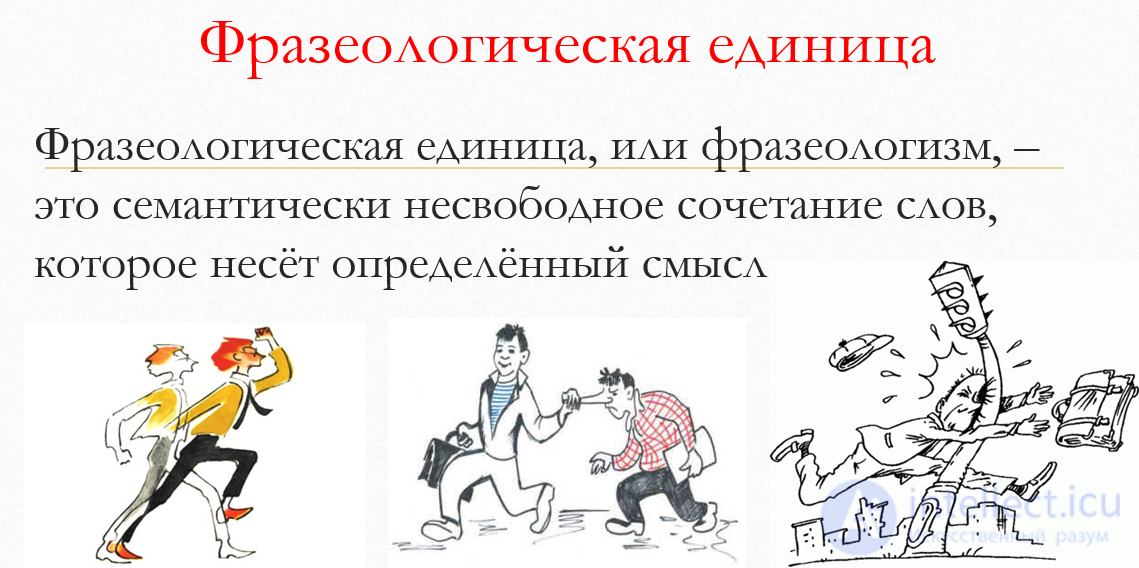
A phraseological unit or phraseologism is a stable, semantically connected combination of words, integral in its meaning, distinguished by imagery, expressiveness, stylistic and emotional colouring, fully or partially rethought.
The formation of phraseology as an independent linguistic discipline is closely connected with the definition of phraseological units as the object of its study. Scholars have long noted such features of phraseological units as euphony, a certain rhythmic organization accompanied by alliteration - the repetition of identical (or similar) sounds or sound combinations - usually at the beginning of the words making up phraseological combinations (e.g. with might and main 'with all one's strength; with full determination', safe and sound 'unharmed and in good condition', thick as thieves 'bound by close friendship, close friends', bright as a button 'neat, spruce' and others). Many of them are built with the help of stylistic devices, contain contrast, comparison, metaphor, and are figurative, stylistically marked expressions (e.g. fair as a lily 'beautiful as a lily', bright as a new pin 'neat, spruce', like patience on a monument 'like a figure of grief', a big fish in a little pond 'a local bigwig', great cry and little wool 'much ado about nothing', ships that pass in the night 'fleeting encounters' etc.). Thanks to these properties, phraseological units are used as vivid, expressive linguistic means for stylistic purposes. But, despite all their significance, the characteristics indicated above nevertheless do not become diagnostic for phraseological units, allowing them to be distinguished from free word-combinations on the one hand and from compound words on the other. What serve as such diagnostic features are the idiomaticity of phraseological units, stability, and equivalence to a word.
Features of a phraseologism:
Idiomaticity is a semantic characteristic of phraseological units, and it consists in the non-derivability of the meaning of the whole linguistic formation from the sum of the meanings of the parts making it up. Phraseological units, despite their structural separateness and the correspondence of their structural building models to the grammatical models of free word-combinations and sentences, differ from the latter in semantic integrity, in the peculiarity of the meaning of the whole as compared with the meanings of the constituent parts, which arises as a result of their complete or partial rethinking. In other words, phraseological units are idiomatic. Such are, for example, carry the guns 'to be well prepared, sufficiently qualified', be off one's nut 'to go crazy, lose one's mind', at sea 'utterly puzzled, at a loss', a cool beggar 'an impudent, insolent person; a cool-headed, level-headed person' and many others. The connection between the meaning of phraseological units and the literal meaning of their components has, for various reasons, been broken; phraseological units have acquired the property of non-motivation and that special type of meaning which scholars propose to call phraseological meaning. The individual lexical meanings of the components of phraseologisms are weakened, they recede into the background, as it were, and are subordinated to the general meaning of the phraseological unit, which becomes a unit with a close semantic connection of its components, ultimately conditioning the semantic integrity of the whole phraseologism. A consequence of the "loss" of the lexical meanings of the components of a phraseological unit may be its homonymy with a free word-combination, in which the same words, entering into interaction, retain their lexical meanings. Cf.: let the cat out of the bag or let the cat out 'to blab, to give away a secret' and let the cat out 'to let the cat out', a bird in the bush 'a deceptive dream, a chimera' and birds in the bush 'birds in the bushes', a fighting cock 'a quarrelsome person, a brawler (of people)' and a fighting cock 'a gamecock' and others.
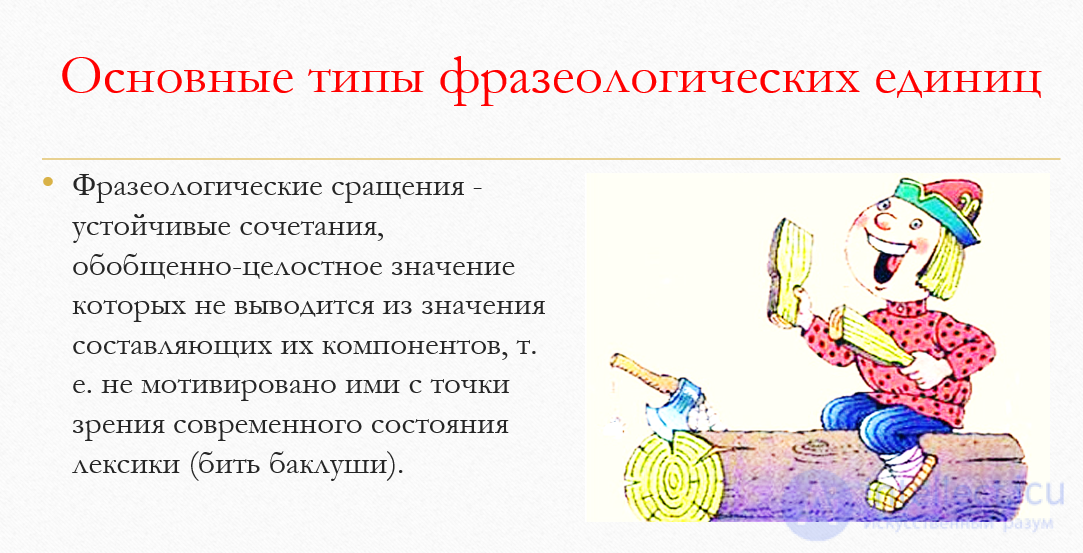
The degree of idiomaticity and, accordingly, the semantic cohesion of phraseological units can vary. On this basis, types of phraseological meaning are distinguished: a) fully integrated, b) partially integrated, c) partially rethought meaning, and d) partially integrated, partially rethought meaning. A.V. Kunin, who proposed this classification of phraseological meanings, defines them as follows. Fully integrated meaning is a type of meaning of phraseological units with constant, fully rethought components. It is characteristic of phraseologisms of the type on ice ' coll. a sure thing; postponed, shelved', kick the bucket 'coll. to die, to kick off', pigs in clover 'upstarts; people who rightfully occupy a high social position'. Many phraseological intensifiers possess fully integrated meaning: as hell 'infernally, devilishly, damnably; terribly', as the devil 'terribly, extremely', like mad 'desperately, furiously'.
Partially integrated meaning characterizes units in which the variable components are used in their literal meanings, while the constant, pivotal components are always rethought (e.g. close (shut) one's eyes to smth. 'to turn a blind eye to something', set smth. on foot 'to set something in motion', cross the Rubicon 'to cross the Rubicon, to pass some important milestone' etc.).
The distinguishing feature of partially rethought meaning - the third type of phraseological meaning - is its mixed character: some pivotal words are used in a figurative meaning, while others are used literally. For example, as dead as a door-nail 'lifeless; irrevocably ruined', as sober as a judge 'completely sober', die by inches 'to die a slow death', dormant (sleeping) partner 'a partner who does not take an active part in the affairs of the firm' and others.
In phraseologisms with the fourth type of phraseological meaning - partially integrated, partially rethought meaning - the literal meaning of one pivotal component is combined with the rethought meaning of other pivotal words and with the presence of a variable component, as is observed in phraseologisms of the type fit smb. like a glove 'to be just right, to fit perfectly', talk through one's hat 'to talk about what one does not know, to talk nonsense'.
Undoubtedly, it is extremely difficult to separate one type of phraseological meaning from the others. What is important, however, is that regardless of the degree of semantic connection of the components of phraseological units and the type of phraseological meaning, the obligatory features of a phraseologism become rethinking - complete or partial - and the idiomaticity that follows from it.
Earlier the correspondence of the building models of phraseologisms to the grammatical models of free word-combinations was noted. The grammatical peculiarities of phraseologisms, their paradigmatic defectiveness, their structural-grammatical heterogeneity in comparison with free word-combinations are so insignificant that they can be disregarded. Nevertheless, although resembling the combination of words in free word-combinations and sentences, the combination of words in phraseologisms is not such in its essence, since it is not, as A.I. Smirnitsky notes, produced in the process of speech. What is placed at grammar's disposal is not separate parts of a phraseological unit, but the whole unit as a ready-made whole. Possible grammatical changes are connected with the functioning of the whole phraseological unit, which turns out to be a stable combination reproduced by speakers in the process of communication. The combination of words making up a phraseological unit is fixed by linguistic usage, by tradition, and does not allow, or allows only to a very limited degree, variability of its composition. The stability of a phraseological unit is multi-faceted. It presupposes stability of use, i.e. the use of the phraseological unit not by this or that author, but by the entire linguistic community. Arising as individual formations, phraseological units become public property. A phraseological unit is also stable in its lexical composition and its meaning. The words - components of phraseological units - are either completely unreplaceable (e.g. a blue print 'an outline, a project', like a red rag to a bull 'irritating, infuriating, like a red rag to a bull'), or vary to an insignificant degree, with the substitute words always limited to a narrow circle (e.g. as cunning (sly) as a fox 'cunning as a fox', give smb. the kick (mitten, push, sack) 'to dismiss, to fire', give smb. the fidgets (the jumps) 'to get on someone's nerves, to irritate someone'). The stability of phraseological units is also manifested in the stability of the morphological forms of the components. Nouns, for example, in many phraseologisms are used only in the singular (chase the wild goose 'to chase after the unattainable', put one's finger on smth. 'to find out, to determine, to hit the nail on the head') or only in the plural (in high places 'in high places', small potatoes 'trifles, minor matters', the high seas 'the open sea, the sea beyond territorial waters'), or in the possessive case (a gentleman's agreement 'a gentleman's agreement', a coon's (dog's) age 'a long time, an eternity', butcher's bill 'a list of those killed in a war'). The stability of the word order of phraseological units, changes to which are possible only within the limits of normative structural changes, e.g. voice changes of many verbal phraseologisms, allows one to speak of their syntactic stability. All aspects of stability are closely interconnected and together form the coefficient of minimal stability of phraseological units, not characteristic of a word or of free word-combinations. The former possess a considerably higher degree of stability than the latter.
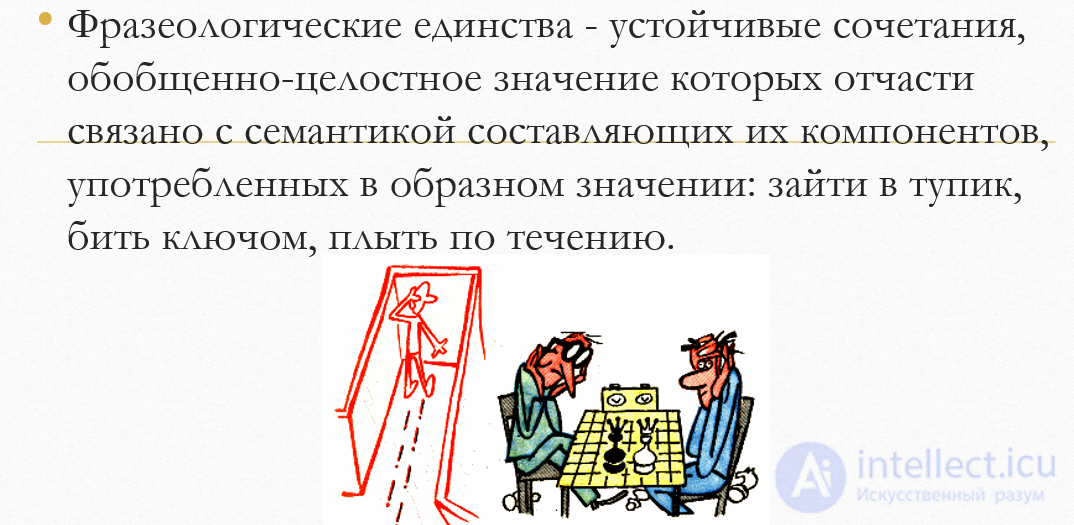
Despite this high degree, the stability of phraseological units is nevertheless not absolute. Moreover, for different phraseological units the threshold and degree of stability may not coincide. On this basis, a distinction is made between phraseological units with an upper threshold of stability (allowing no changes whatsoever - tit for tat'tit for tat', spick and span 'dapper, brand new), with a lower threshold of stability (allowing the greatest variability - shed (throw, turn) light (a light) on (upon) 'to shed light on something'), and with a medium threshold of stability (allowing only minimal changes (the Procrustes' bed - the Procrustean bed 'a procrustean bed', white caps (horses) 'whitecaps (white crests of breakers)' ). Unfortunately, no objective criteria have been found for establishing the threshold and degree of stability of phraseological units, which considerably complicates both their internal classification and their separation from free word-combinations, especially that group which is characterized by narrow collocability and, as a result, a tendency toward stability of reproduction.
Idiomaticity and stability bring a phraseological unit closer to a word. Since, as A.I. Smirnitsky writes, a phraseological unit is incorporated into speech precisely as a whole unit and functions in speech as one whole word, it turns out to be a certain "equivalent of a word". The equivalence of a phraseological unit to a word (its assimilation to a word) consists in the fact that a phraseological unit possesses two characteristic features of a typical word: semantic integrity and existence as a ready-made unit in the language, its reproducibility in speech. The assimilation of a phraseological unit to a word also proceeds along the line of a commonality of syntactic functions, as a result of which, in certain contexts, it is possible to replace a phraseological word-combination with a word (e.g. the eye of day ' poet. the daytime luminary, the sun' - the sun, turn a blind eye on smth. 'to turn a blind eye to something' - ignore, lock, stock and barrel 'completely, entirely' - completely etc.). The similarity between a phraseological unit and a word is also manifested in the fact that phraseological units, like words, can have synonyms (e.g. be in Queer Street 'to be in great financial difficulties', be in low waters 'to be in a difficult financial position', be on the rocks 'to be in a difficult financial position', be on one's beam ends 'to be left without means', be as poor as a church mouse (rat) 'to be as poor as a church mouse', be hard up 'to be (badly) in need of money', be on one's uppers ' coll. to be in need, to be penniless, to hit rock bottom' etc.), antonyms (e.g. in the long run 'in the long run' - in the short run 'in the near future'; keep the run of smth. 'to keep abreast of something; to follow something' - lose the run of smth. 'to no longer be abreast of something; to stop following something'; a hard heart 'a heart of stone, hard-heartedness, callousness' - a kind heart 'a kind heart, soft-heartedness, responsiveness' and others). Phraseological units, just like words, but to a considerably lesser degree, possess polysemy and homonymy. For example, without rhyme or reason means:
1) senselessly, without any sense whatsoever, and 2) out of the blue, for no reason at all; rough and ready has the meanings:
1) done anyhow, carelessly, hastily, in a slapdash manner (rough and ready device),
2) rough but energetic (rough and ready people),
3) persistent, decisive, rough (of style, manner, etc.) (rough and ready methods).
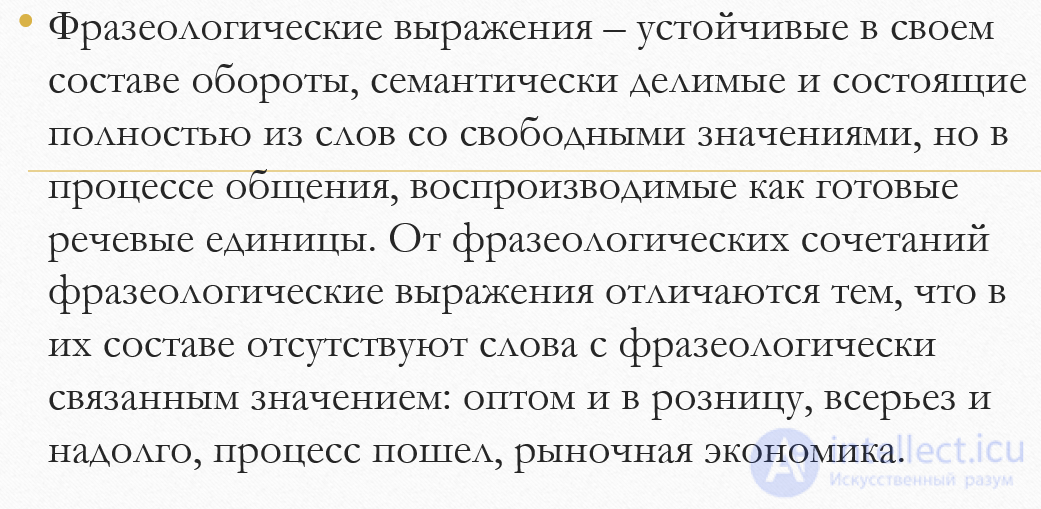
Despite the considerable similarity, which allows one to speak of the equivalence of a phraseological unit to a word, or more precisely, of the correlation of a phraseological unit with a word, phraseological units and words are qualitatively different formations. The main line of their distinction lies in the separateness of form of the phraseological unit and in the integrity of form of the word. However semantically integral, functionally unified a phraseological word-combination may be, it is nevertheless a combination of words and thus close to free word-combinations. Words, however, cannot consist of words. Being often complex formations, uniting several roots or stems in their structure, they represent formally integral unities, created according to certain models. The modelling of phraseological units, however - if it is fundamentally possible at all, which gives rise to heated discussions - is of a completely different kind than the modelling of words.
+Thus, it becomes evident that phraseological units are units of an intermediate type. Like any transitional units, they are difficult to delimit from free word-combinations on the one hand and from compound words on the other, and the difficulties of their delimitation are aggravated by the circumstance that the characteristics proper to different types of phraseological units (idiomaticity, stability, equivalence to a word) are inherent in them to varying degrees. The incongruence of these properties, manifested in the fact that idiomatic word-combinations are not always stable but allow variability of their components, stable word-combinations are not always rethought but are motivated by the meanings of their constituents, while equivalence to a word, especially in the functional respect, is not always observed, creates the possibility for different, sometimes contradictory definitions of the boundaries of phraseology and for different classifications built on several principles simultaneously, which will be discussed below. The incongruence of these properties also leads to the fact that the sets of word-combinations denoted by the terms "idioms" (idioms), "stable word-combinations" (set phrases, set expressions), "word-equivalents" (word-equivalents) merely intersect with one another, but there is no complete identity between them, just as there is no identity between the sets denoted by the most general terms "phraseologisms", "phraseological units" (phraseological units) in different theories.
The most important characteristic of phraseological units, as noted above, thanks to which they become part of the vocabulary of a language, is their reproducibility. The property of reproducibility, however, is possessed both by word-combinations of the above-mentioned type and by many sentence-structured expressions, which include proverbs, sayings, catchphrases, literary quotations, phrasal clichés, etc. It is precisely these that become the subject of lively discussions and diametrically opposed decisions, depending on which the scope of phraseology changes. Some authors, for example V.V. Vinogradov, V.L. Arkhangelsky, A.V. Kunin, V.N. Teliya and others, include sentences reproduced in speech within the composition of phraseology; others, for example A.I. Smirnitsky, who by no means denies the possibility of sentences entering the system of language and assigns them a corresponding place in his classification (see below), nevertheless deny them the status of phraseological units and exclude them from the bounds of phraseology. Still others, for example N.N. Amosova, assign to phraseology only those sentences which possess an integral meaning and constitute a constant context, and, when entering into the composition of a variable sentence, do not turn it into a complex one, i.e. they function as units of nomination rather than of communication. These are units of the type as the crow flies 'by the shortest way, in a straight line, directly', as bad luck would have it 'unfortunately, as ill luck would have it'. Proverbs and sayings, however, which carry communicative meaning, do not, in N.N. Amosova's opinion, belong to phraseology. Still others, while including sayings within the composition of phraseology, exclude proverbs from it on the grounds that the latter are the equivalent of a whole story, a description of events, etc. For a detailed review and argumentation of different conceptions regarding the scope of phraseology, see (5,194 - 211).
Thus, there is no unified opinion in linguistics about the scope and boundaries of phraseology. Guided by the needs of foreign-language learners, we must say that knowledge of stable expressions of various types, including sayings, proverbs, catchphrases, etc., which lend a language its distinctive national colour, is necessary for achieving a high degree of command of the language, although the practical expediency of studying them cannot serve as a more or less weighty argument in the construction of theoretical conceptions.
Unity of opinion is likewise absent in the classification of phraseological units, meant to encompass the whole diverse range of non-free combinations. Of the classifications of phraseological units currently available, the most widely known are the classification of V.V. Vinogradov, developed by him with reference to Russian-language material, the classification of A.I. Smirnitsky, and the later classifications of N.N. Amosova and A.V. Kunin, carried out on English-language material.
According to V.V. Vinogradov, within the whole set of phraseological units it is easiest and most natural to single out a class of units that are absolutely indivisible, unanalysable, whose meaning is completely independent of their lexical composition, of the meanings of their components, and is just as conventional and arbitrary as the meaning of an unmotivated word-sign. Phraseological units of this kind may be called phraseological fusions. Sometimes they are called idioms. They are unmotivated and non-derived and represent semantic units homogeneous with the word, devoid of inner form. These are Russian у черта на куличках (u chorta na kulichkah - in the middle of nowhere), сидеть на бобах (sidet' na bobakh - to be left with nothing), бить баклуши (bit' baklushi - to twiddle one's thumbs), точить лясы (tochit' lyasy - to chit-chat), с боку припёку (s boku pripyoku - a fifth wheel) and others. In English, the class of phraseological fusions may include on the bend 'dishonestly', all my eye (and Betty Martin) 'nonsense, sheer rubbish', be in the red 'to be in debt, to have a deficit' and others.
If, within a close-knit phraseological group, at least weak features of the semantic separateness of the components have been preserved, if the meaning of the whole is connected with an understanding of the inner figurative core of the phrase, then such groups form phraseological unities. In Russian these are phraseological units of the type держать камень за пазухой (derzhat' kamen' za pazukhoy - to bear a grudge), плясать под чужую дудку (plyasat' pod chuzhuyu dudku - to dance to someone else's tune), из пальца высосать (iz pal'tsa vysosat' - to make up out of thin air), намылить голову (namylit' golovu - to give someone a dressing-down) etc.; in English these include add oil to the fire 'to add fuel to the fire', tear the mask from smb. 'to tear the mask off someone, to expose someone', rub smb. up the right way 'to please, to placate someone' and others. Phraseological unities differ from phraseological fusions in the semantic complexity of their structure, in the potential derivability of their overall meaning from the semantic connection of the components. Being, like phraseological fusions, stable, close-knit phraseological groups with an integral, unified meaning, they are distinguished from the latter by the fact that in them this integral meaning is motivated and represents a product arising from the fusion of the meanings of the lexical components.
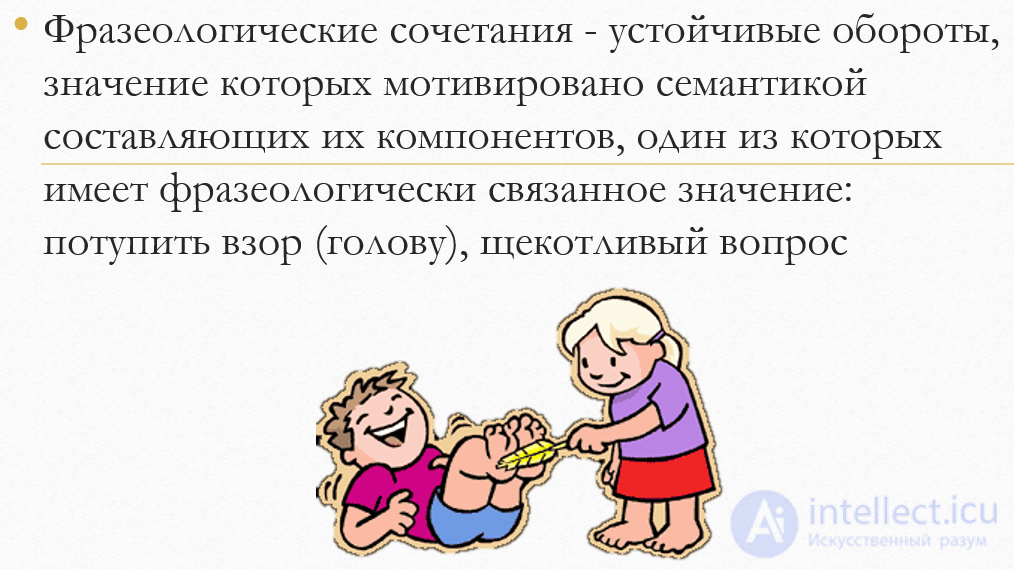
The third class of stable phraseological groups is formed by phraseological groups produced through the realization of non-free, bound meanings of words. These are phraseological combinations. They are analytical in their meaning, allow synonymic substitution and replacement, and identification. Their difference from phraseological unities consists in the fact that in a phraseological combination the meanings of the combining words are, to a certain extent, on an equal footing, and usually only the meaning of one of the words is perceived as non-free, bound. In Russian these are phraseologisms of the type: щекотливый вопрос (shchekotlivy vopros - a delicate question), щекотливое положение (shchekotlivoye polozheniye - a delicate position), потупить глаза (potupit' glaza - to lower one's eyes), потупить голову (potupit' golovu - to hang one's head), беспробудный сон (besprobudny son - a deep, unbroken sleep) and others; in English, phraseological combinations include the expressions come to power 'to come to power', make it a rule 'to make it a rule', second to none 'unsurpassed by anyone', take one's seat 'to take one's seat' and many others.
From the foregoing it is evident that V.V. Vinogradov's classification is essentially semantic in nature, since it is carried out by taking into account the motivation of phraseological units. Its main drawback is connected with the main principle of the classification, namely: the vagueness, the blurredness of the boundaries between phraseological fusions and phraseological unities, on the one hand, and phraseological unities and phraseological combinations, on the other. The determination of the degree of motivation of phraseological units turns out to be purely subjective, lacking clear criteria and accordingly allowing different solutions. Moreover, the principle by which one or another expression is assigned to the category of phraseological units is not entirely clear either. Stability and reproducibility coexist with variability, with the admission of synonymic replacements, with the combinability of words in a bound meaning with whole groups of concepts and their verbal designations (cf. V.V. Vinogradov's example - страх, тоска, досада, злость, зло, ужас, зависть, смех, раздумье, охота (strakh, toska, dosada, zlost', zlo, uzhas, zavist', smekh, razdum'ye, okhota - fear, longing, annoyance, anger, malice, horror, envy, laughter, deep thought, a sudden urge) and so on берёт (beryot - seizes/takes hold) ). The boundary between free word-combinations and phraseological combinations thus turns out to be undelineated. Thus, V.V. Vinogradov's classification, which proposes a certain systematization of phraseological units, runs into those contradictions which are generated by the intermediate character of this type of lexical units. Nevertheless, this classification, like V.V. Vinogradov's other works in the field of phraseology, has had an enormous influence on the study of phraseological units, including in the English language.
An important role in the development of phraseology as a science was played by the works of A.I. Smirnitsky and the classification of phraseological units he proposed. According to A.I. Smirnitsky, the distinctive feature of a phraseological unit is its equivalence to a word, that is, the presence of two characteristic features of a typical word: semantic integrity and existence as a ready-made unit in the language, i.e. its reproducibility in speech. However, in all their diversity, phraseological units form only a part of the word-combinations that are reproduced rather than created in the process of speech. The set of reproduced combinations is much wider and broader, and alongside phraseological units equivalent to a word it includes numerous combinations that are not equivalent to a word. It also includes: a) traditional word-combinations, b) idioms proper, c) sentences that belong to the system of the language. Traditional word-combinations such as rough sketch 'a hastily made, preliminary sketch', nice distinction 'a fine, subtle distinction', take an examination 'to sit an examination' are habitual and ordinary in the language, reproduced in speech many times over, just like phraseological units. However, for all their repeatability, they are not equivalents of words: they lack the semantic integrity (idiomaticity) inherent in phraseological units. One might say these are free word-combinations with a very narrow collocability of one of their components, but free word-combinations of a special kind, which, owing to the narrowness of their collocability, are regularly reproduced in speech.
Idioms proper are idiomatic word-combinations based on a transfer of meaning, characterized by vivid stylistic colouring and emotional intensity. In them, speakers are aware of the meanings of the words that make them up and of the unusual, distinctive nature of their use. For example, take the bull by the horns 'to face a difficulty boldly and directly', fish in troubled waters 'to take advantage of a confused or troubled situation', as dead as a door-nail 'showing no sign of life', etc. The specific stylistic character of idioms proper distinguishes them from phraseological units that have lost the figurativeness underlying them.
In people's everyday life there is a great many situations that recur again and again and, accordingly, do not require the creation of new, original utterances to denote them. The recurrence of life situations lies at the root of the recurrence, as ready-made stretches of speech, of sentences such as How are you 'a common greeting enquiring how someone is doing'. What's the time? 'a common enquiry about the current time', Thank you very much! 'an expression of strong gratitude', I beg you pardon! 'a polite apology or request to repeat' and the like, which become reproducible units and enter the system of the language. Their authorship is unknown and insignificant, and in this they differ fundamentally from quoted sentences, which are likewise repeated but have not attained the status of language units. Sentences that belong to the system of the language, unlike phraseological units, are made up of semantically clearly distinguishable parts; they are not equivalent to a word, although they are used as whole, ready-made units.
According to A.I. Smirnitsky, phraseological units are opposed to traditional word-combinations, idioms proper, and sentences belonging to the system of the language above all in that, as noted earlier, they are likened to a single whole word, although all of their components turn out to be grammatically arranged (separately formed). For example, take the chair 'to preside, act as chairman', fall in love 'to become enamoured', take care 'to look after, be careful', etc.
In present-day English, A.I. Smirnitsky considers it possible to distinguish two structural-semantic types of phraseological units: one-top units and two-top (many-top) units. One-top units are phraseological units that have one semantically full-fledged component. The most typical among them are verb-adverb phraseological units such as give up 'to abandon, renounce', pull up 'to come to a stop (of a vehicle)', bring up 'to rear, educate' etc. The first component of these idiomatic word-combinations is their semantic and grammatical centre. One-top phraseological units also include units such as be
продолжение следует...
Часть 1 Collocability of Lexical Units: Conditions and Rules. Phraseological Units and Their Classification
Часть 2 Origin and equivalence of phraseological units - Collocability of Lexical

Comments