
Lecture
It has already been said earlier that linguistic forms are capable of being associated with a whole series of things signified and, accordingly, of expressing several meanings. This capacity is an inexhaustible source of semantic ambiguity in the vocabulary, the number of examples of which in English, as in other languages, is unlimited.
Called forth by the need for names for such a complex and constantly changing system as the reality surrounding us, semantic ambiguity in the vocabulary ensures, on the one hand, the economy and surveyability of the language code, and, on the other hand, its flexibility and its capacity to serve all the communicative needs involved in denoting the diversity of the world as known by man. Moreover, thanks to the semantic ambiguity of lexical units, language becomes a tool, an instrument of cognition, since the denotation by one sound complex of several phenomena, properties, etc. at once is often based on relations and connections established by speakers between these phenomena. It is therefore no accident that the semantic ambiguity of lexical units, in its various manifestations, especially such as polysemy and homonymy, is, in all likelihood, a semantic universal, deeply rooted in the fundamental structure of language.
"No language, – academician V.V. Vinogradov wrote, – would be able to express every concrete idea by an independent word or root element. The concreteness of experience is boundless, while the resources of even the richest language are strictly limited. Language is forced to distribute a countless multitude of meanings among one or another rubric of basic concepts, using other concrete or semi-concrete ideas as mediating functional links" (2,18).
The main types of semantic ambiguity are polysemy and homonymy. Polysemy, or the multiple meaning of a word, – is the presence in a word of several interconnected meanings characterized by the commonality of one or more semantic components. Homonymy differs from polysemy in the absence of any interconnection between the meanings associated with one and the same linguistic form. This fundamental difference is determined by differences in the processes by which these types of semantic ambiguity come into being, and in this connection it seems necessary to examine the procedural aspect of polysemy and, somewhat further on, of homonymy.
In its procedural aspect, polysemy is the result of semantic changes, when one meaning arises on the basis of another according to certain models of semantic derivation and is connected with the latter by relations of derivedness. The causes and paths of semantic derivation are manifold.
Among the causes that lead to the repeated use of an already existing name with an established meaning, the main ones, apparently, are causes of an extralinguistic order. Various historical, social, economic, technological and other changes in the life of people give rise to a need for new names. The response to this need is the use of nominative means already available in the language in new meanings, as happened, for example, with the nouns collar, cage, concertina, ship and others in present-day English, which, alongside their already existing meanings (collar 'the part of a garment that fits round the neck', cage 'a structure of bars or wires for confining an animal', concertina 'a musical instrument', ship 'a large seagoing vessel'), have recently come to be used also in such new meanings as: collar 'a floatation device used to keep spacecraft afloat and upright on water after splash-down', cage 'a sheer or lacy outer dress worn over a slip or a dress', concertina 'brand of woman's gird expanding and contracting like a concertina', ship 'spacecraft'. (Cf. Rus. стрела 'the boom of a crane', спутник 'a spacecraft launched into orbit by means of rocket devices', нагрузка 'a duty, an assignment', перегиб 'a departure from the correct line, a harmful excess' and many others, used for the purposes of secondary nomination and which acquired new meanings in the Soviet period.)
Social factors play a very important role in the semantic change of a word, above all the use of words by particular social groups. Each social milieu is characterized by the distinctiveness of its own designations, as a result of which a word acquires different content in the speech of different social, cultural and professional groups and accordingly becomes polysemous. Such are the polysemous words ring 'a circle; a ring used in abseiling (mountaineering); the rim of a basket (basketball); a circus arena; a ring, a platform (for wrestling); an annual ring of wood; naut. a ring-bolt, etc.'; pipe 'a tube; a smoking pipe; a shepherd's pipe, a reed, bagpipes; geol. an elongated ore body; naut. a boatswain's pipe', etc.; doctor 'a doctor, physician; a doctor (academic degree); a learned theologian', etc. in present-day English.
Besides the factors indicated above that condition the development of the polysemy of words, psychological causes of semantic change also deserve attention. These are, above all, the existence of various kinds of prohibitions, or taboos, dictated by feelings of fear and religious beliefs (out of superstition, people avoid calling the devil, evil spirits, God, etc. by their own names), by feelings of delicacy when it comes to unpleasant subjects, such as illness, death, etc., by the desire to observe propriety when speaking of phenomena relating to the sexual sphere of life, to certain parts and functions of the human body, as well as by various kinds of change in the emotional evaluation of objects and phenomena. Because of these causes, speakers begin to use euphemisms, i.e. substitute words, which over time acquire these meanings as their permanent semantic characteristics.
Such are the sources of the new meanings of polysemous English nouns of the type hostess, used not only to denote the mistress of a house, the hostess of a hotel, etc., but also to name a paid female companion in a dance hall or night club; head, whose set of meanings has been enriched by one more - the meaning 'a drug addict'; model, mystery, which in recent years have acquired the meaning 'a woman of loose morals, and many others.
Besides extralinguistic causes conditioning the emergence of new meanings and thereby the development of the polysemy of words, intralinguistic causes are also at work. These traditionally include constant co-occurrence and the resulting ellipsis of the word-combination, whereby one remaining element of the word-combination acquires the meaning of the whole combination (e.g., the Kremlin 'the Soviet government' as a result of the contraction of the word-combination the Kremlin government; daily 'a daily newspaper; a daily charwoman', etc.). The differentiation of synonyms can also lead to the polysemy of a word, as illustrated by the English nouns bird 'a bird' and fowl 'a bird, game; domestic fowl, especially a hen'. Polysemy may also arise as a result of semantic analogy, when, in a group of words united by a single conceptual core, under the influence of the fact that one of the words in the group acquires some new meaning, all the other members of the group develop analogous meanings. Thus, the words get, grasp, synonymous with the English catch 'to seize, to grasp', after the latter acquired the meaning 'to grasp the sense of, to understand', by analogy also acquired the meaning 'to take in mentally, to understand, to realize'.
It must be noted, however, that the action of intralinguistic causes is not as evident as the influence of the extralinguistic factors conditioning the emergence of polysemy, and has consequently been studied far less.
In the same way as the causes of semantic change can be, as was shown above, extremely varied, the semantic changes themselves can also differ in their nature, for different regularities may underlie them. In other words, the use of the name of one object to denote some other object is not carried out chaotically. At the basis of the secondary use of names, usually described as a transfer of meanings, although it would undoubtedly be more correct to speak of a transfer of names and the development of secondary meanings in them, lie the laws of associative connections. They determine the types of semantic change a word undergoes in the course of its historical development, the types of relations between meanings in diachrony, and, as a final result, the types of the meanings themselves in the semantic structure of a polysemous word.
Associative connections, being a reflection of our concepts and ideas about the interaction of the facts and phenomena of the objective world, are complex and manifold. The most stable of them, which have entered the social experience of the language community and predetermine the emergence of the secondary use of words, are based on a real or imagined connection and commonality of the objects of the surrounding world established by our consciousness. Depending on what forms the basis of the associative connections - a connection, the contiguity of phenomena, or a commonality of certain of their features and the resulting similarity - metonymic and metaphoric transfers of meaning are distinguished, and, as their varieties, synecdoche and functional transfer.
Metonymy is that type of semantic change ”in which the transfer of the name of one object or phenomenon to another object or phenomenon is carried out on the basis of real (and sometimes imagined) connections between the corresponding "objects or phenomena. Connection (contiguity) in time or space, cause-and-effect relations, etc. can give rise to regular, stable associations, which makes it possible to establish certain models of metonymic transfer. The following regular types of metonymic transfer may be cited as examples:
1. Animal – meat of the animal: for example, fowl - 1) a domestic bird, esp. a hen, 2) poultry meat, esp. chicken meat; goose - 1) a goose, a female goose, 2) goose meat; turkey - 1) zool. a turkey (Meleagris gallopavo), 2) cul. turkey meat, etc. (cf. Rus. gus, indyushka, krolik, kuritsa, leshch, sudak, utka etc.).
2. Tree – the wood of that tree: for example, pine - 1) bot. pine (Pinus), 2) pine wood; oak - 1) bot. oak (Quercus gen.), 2) oak wood; maple – 1) bot. maple (Acer gen.), 2) maple wood, etc. (cf. Rus. bereza, yel, kedr, osina, sosna etc.).
3. Material – a product made of this material: for example, bronze –1) bronze, 2) an article made of bronze; clay – 1) clay, alumina, 2) a clay pipe; silver – 1) silver, 2) silverware, etc. (cf. Rus. bronza, gips, zoloto, steklo, serebro etc.).
4. Container – contents: for example, school - 1) a school, schoolchildren; an educational institution, 2) collect. the pupils of a school; hall -1) a building of a college or university intended for meetings or classes; 2) the students living or studying in this building; house – 1) a house, a building, 2) a family, a line; a house, a dynasty, 3) a theatre, a cinema, 4) the public, the audience, etc. (cf. Rus. auditoriya, zal, klass, zavod etc.).
5. Property – the subject possessing the property: for example, authority – 1) authority, weight, influence, 2) an authority, a leading specialist; beauty – 1) beauty, the beautiful; 2) a beauty; talent - 1) talent, a gift, giftedness; 2) a talented person, a talent, etc. (cf. Rus. geniy, bezdarnost, avtoritet, nichtozhestvo etc.).
6. Action – the subject of the action: for example, support – 1) support, help, 2) a support, a mainstay; 3) a breadwinner; supply – 1) a temporary substitution for a post, 2) a temporary substitute; safeguard – 1) protection;
a precautionary measure, 2) a guard, an escort; 3) a protective device, a guard (of a machine), etc. (cf. Rus. dezhurstvo, zamena, obvineniye, smena, pogonya etc.). Many other types of metonymic transfer are also connected with the names of actions, such as:
action - the object of the action, action – the result of the action, action - the means of the action, action - the place of the action, etc. Unfortunately, English studies lack a more or less exhaustive description of the types of metonymic transfer occurring in the semantics of polysemous words of the English language, together with their characterization in terms of degree of productivity and regularity, as has been done for the lexical system of the Russian language by Yu.D. Apresyan (1, 193 – 215). It is known, however, that every sixth meaning of the frequency-ranked nouns among the first thousand most frequent words is the result of metonymic transfer.
Metonymic transfers are characteristic not only of nouns, but also of words of other parts of speech: adjectives and verbs (e.g. green – 1) green, of green colour; 2) unripe, not ripe, green; ancient – 1) old, decrepit; 2) venerable, white-haired with age; wise (with years); blind – 1) blind, sightless; 2) intended for the blind; shoot – 1) to shoot, to fire; 2) to hit, to strike, to wound or kill; sit – 1) to sit; 2) to be in session, to hold a session; 3) to be absorbed in doing smth., to pore over smth., etc.).
A variety of metonymy, often treated as a separate type of semantic change, is synecdoche. Representing a transfer of a name from the part to the whole (e.g., cat – 1) a domestic cat (Felis domesticus); 2) an animal of the cat family (Felis or Panthera); head – 1) a head; 2) a person; 3) a head of cattle; 4) a herd; a flock (of birds), etc.) or from the whole to the part (e.g., doctor – 1) arch. a teacher, mentor, a learned man; 2) doctor (academic degree); 3) doctor, physician; burner – 1) a person or device for burning smth.; 2) a burner, a jet; 3) a kiln, etc.), synecdoche stands out as a separate type of transfer because it is based on logical connections. In synecdoche there occurs a change in the range of referents denoted by the word: the name of a narrower set is used to denote a wider set of objects, of which the narrower set is merely a constituent part, and conversely: the designation of a wider set becomes the designation of its individual subsets. In the linguistic literature this process is also described as widening and narrowing of meaning.
As a consequence of the universality of the laws of human thinking '– and of the use, as a rule, of objectively existing connections between objects and phenomena called by one and the same name as the basis for metonymy and synecdoche, one might expect the emergence, in correlative words in different languages, of uniform types of transferred meanings. As a comparison of polysemous words in different languages shows, such a coincidence does indeed occur (cf. the models of metonymic transfer given earlier), but it is not absolute. Alongside analogous types of meaning (cf., e.g., Engl. hope, love, loss and their Russian equivalents nadezhda, lyubov, poterya, denoting both the action and, as a result of metonymic transfer, the object at which this action is directed, and many others), numerous metonymic gaps are observed in the semantics of correlative polysemous words in different languages. Thus, Engl. citation, on the basis of the meaning 'citing, quotation', acquires the meaning of the object of the action 'a quotation', whereas in Russian it is matched by two different words – tsitatsiya, tsitata. Engl. writing means both the process 'the act of writing' and its result - 'a letter, a note, an inscription, a piece of writing', etc. Rus. pismo has a different system of meanings: 1) a written text sent to communicate something to somebody; 2) the ability to write, etc. Without increasing the number of examples either of analogous metonymic transfers or of their absence in the semantics of correlative words in different languages, which would be simple enough to do, one should draw a conclusion about the specificity of this phenomenon in each language. It is important, however, to stress that the distinctiveness of metonymy lies not in its bases or in its procedural aspect (these are universal). What may be distinctive is the choice of the starting point or name for the metonymic transfer, determined in part by the peculiarities of the system of nominative signs of each language. What may turn out to be distinctive is the choice of the type of connection (spatial, temporal, causal, etc.) as the basis of the transfer. Finally, the productivity of one or another model of metonymic transfer differs from language to language. All these factors, taken together, ultimately determine the distinctiveness of the linguistic picture of the world in that part of it which is represented by meanings that have arisen as a result of metonymic transfer.
Another extremely productive type of semantic change leading to the formation of secondary, derived meanings is metaphor. Metaphor is the transfer of the name of one object or phenomenon to another object or phenomenon on the basis of their resemblance, and the likening of one object to another may take place owing to a commonality of the most varied features: shape, colour, external appearance, position in space, the sensation or impression evoked, evaluation, etc. In cases where the name of an object or phenomenon is transferred to another object or phenomenon owing to their functional commonality, functional transfer is singled out as a variety of metaphor. Various groups of vocabulary may serve as sources for metaphoric transfer. The metaphoric relations between the meanings of words, one of which is primary, original, and the other secondary, derived, are also varied. All this makes it difficult to arrive at more or less stable models of metaphoric transfer. At the same time, certain regularities in the working of metaphor common to many languages can be noted. Among them is the frequent use of the names of animals to denote people to whom the properties of animals are ascribed (e.g., ass – 1) zool. a domestic donkey (Equus asinus); 2) a fool, an ignoramus; cow - 1) zool. a cow (Cavicornia); 2) coll. a clumsy, stupid, annoying person; wolf – 1) zool. a wolf (Canis lupus); 2) a cruel, merciless or greedy person; a wolf, a predator, etc.; cf. Russian осел, корова, волк, собака, обезьяна (donkey, cow, wolf, dog, monkey), etc.), and the use of the names of body parts to denote various parts of objects (e.g., head – 1) a head; 2) the upper part of smth., the crown (of a tree); 3) the head (of a flower), a head (of cabbage), an ear, a panicle (of cereals); 4) the head (of a pin, a screw, etc.), the head (of a nail), the poll (of an axe); arm – 1) an arm (from the shoulder to the wrist); 2) an arm, an armrest (of a chair); 3) tech. the arm (of a lever); a bracket, a console; a handle, a grip; a spoke (of a wheel); the boom (of a crane); the shank (of an anchor); a leg (of a pair of compasses); a vane (of a semaphore), etc.; cf. Russian головка, ножка, нос, зуб (little head, little leg, nose, tooth), etc.).
In the sphere of adjectival vocabulary, the most regular pattern is the transfer of names of various physical properties (temperature, size, taste, light, etc.) to denote intellectual characteristics, the evaluation of emotional states and other rational properties (e.g., warm – 1) warm; heated, warmed; 2) hot; cordial; 3) hot, passionate, ardent; dry – 1) dry; 2) dry, reserved; cold; unemotional; sharp – 1) sharp, keen, pointed; 2) clever, quick-witted; witty; perceptive; 3) skilful, adroit; cunning, etc.; cf. Russian теплый, холодный, сухой (warm, cold, dry), etc.). Among adjectives, the so-called synaesthetic transfers are of considerable interest, in which the names of one type of sense-perceived property are used to denote another type of sense-perceived property, the transfer, as J.M. Williams argues, following the pattern:

As a result of these semantic changes, which, according to observations by scholars, are of a universal nature, present-day English has come to allow collocations such as sharp wine 'a sour (tart) wine', sharp smell 'a sharp, pungent smell', sharp voice 'a sharp, harsh voice', dull colours 'dim, faded colours', soft music 'quiet (gentle) music', soft light 'soft, diffused light', soft tints 'soft (delicate) tints', sour smell 'a sour smell', etc. The adjectives deep 'having great depth', low 'of small height', thin 'not thick' combine in their semantics the meanings of size and sound properties. The semantics of the Russian correlates of the examples given shows that similar semantic processes also occur in Russian.
Among verbs, metaphoric transfers of the names of physical actions to denote intellectual activity are quite frequent (cf., e.g., to smash a tea-cup 'to break a cup' – to smash a theory 'to demolish a theory', to tie a horse to a tree 'to tether a horse to a tree' – to be tied by the rules 'to be bound by the rules', to bear a heavy load 'to carry a heavy load' – to bear responsibility 'to be answerable, accountable', etc.).
The models of metaphorical transfer given above do not, however, exhaust the whole wealth of metaphorical transfers underlying the derived meanings of polysemantic words. Metaphor, in the words of V.N. Teliya, is ubiquitous. It plays the role of a prism that makes it possible to view the newly cognized through the already cognized, as fixed in the meaning of a linguistic unit. Based on the similarity of things, metaphor is most closely bound up with man's cognitive activity, for it presupposes the comparison of at least two objects and the establishment of some feature or features common to them, which function in the course of semantic change as the basis for the transfer of a name. In the choice of the properties that serve as the basis for a metaphorical transfer, an important role is played by the anthropocentricity and anthropometricity of metaphor. These two parameters, according to which natural phenomena, abstract notions, etc. are conceived of as living beings or persons (anthropocentricity), while man himself serves as the standard, the point of reference, the measure of all things (anthropometricity), combined with the mode of fictitiousness, which consists in the assumption that X is, as it were, Y, ensure the extraordinary productivity of metaphor, and, together with it, a properly human - anthropocentric - interpretation of the conceptual model of the world. Thanks to the properties mentioned above, metaphor becomes the most important means of creating the linguistic picture of the world, in which are stored, accordingly, not only the names of the realia of the visible, sensorily perceived world and of the invisible, psychic world, but also the associations connected with them.
This linguistic picture of the world, captured in the meanings that arise as a result of metaphorical transfer, is marked, across different languages, by a considerable degree of individuality, much greater than the individuality of metonymic meanings. Despite numerous analogies, apparently dictated by the universal laws of associative thinking (see the examples given earlier), in the semantics of correlative words even more numerous divergences of metaphorical meanings are observed (cf., e.g., the word mouth 'a mouth' and its metaphorical meanings: 'an opening, an outlet; mining the mouth of a working; an entrance (to a harbour, a cave); the mouth (of a river); the neck (of a bottle); mil. the muzzle (of a gun); the mouth (of a cartridge case); a shop window;
tech. the jaws, the mouth; an outlet nozzle; a bell-mouth', etc., whose Russian equivalents are not connected with the word mouth; or the word leg in such of its meanings as: 'a leg (of a table); a support, a stand; an upright; a stage, a leg (of a journey); sport, a lap, a round; a ruler (a T-square"”; tech. a door jamb; a bend, an elbow; an angle bracket; electr. a phase; a leg (of a three-phase circuit)' and many others). Of interest in this respect is an example from L. Bloomfield, which demonstrates both the commonality and the distinctiveness of metaphorical transfer in Modern English as compared with other languages. "Very many linguistic forms are used for more than one typical situation, - the American scholar wrote. – In English, we speak of the head of an army, of a procession, of a household, or of a river and a head of cabbage, of the mouth of a bottle, cannon, or river, of the eye of a needle and of hooks and eyes on a dress; of the teeth of a saw; of the tongue of a shoe or of a wagon; of the neck of a bottle and a neck of the woods; of the arms, legs and back of a chair; of the foot of a mountain; of hearts of celery. A man may be a fox, an ass, or a dirty dog; a woman a peach, lemon, cat or goose; people are sharp and keen or dull, or else bright or foggy; as to their wits, warm or cold in temperament; crooked or straight in conduct; a person may be up in the air, at sea, off the handle, off his base, or even beside himself, without actually moving from the spot" (12, 37). At the root of this distinctiveness lies an element of subjectivity, organically inherent in metaphor and conditioned by the wide range of properties of the entities being compared, by the possibility of choosing any of them as common ones, and also by the mode of fictitiousness, which allows the likening of entities that are logically not comparable and ontologically dissimilar.
In concluding the description of the types and nature of semantic change, it must be said that metonymic and metaphoric transfer, as ways of creating secondary meanings, differ from metonymy and metaphor as special devices of figurative speech – tropes used for stylistic purposes. Their main difference is that, arising originally in an utterance, metaphoric and metonymic transfer of the first type, as a result of frequent use, become facts of the language and must be learned by people studying that language, whereas the devices of figurative speech - metaphoric and metonymic transfer – remain facts of speech, creating a special expressiveness and imagery and affecting the aesthetic perception of the listener or reader.
Another important point in the description of semantic change is the role it plays in preserving the unity of the word and ensuring the semantic stability of substantial layers of the vocabulary. Very often a change in the objects and phenomena of the world around us, as well as a change in our conceptions and knowledge of the world, does not entail the replacement of old names, whose semantics undergoes considerable change. On the contrary, already existing names are transferred to the new range of objects or phenomena that has arisen in the course of development, especially if their purpose and functional orientation have remained the same. Thus, the word bread 'bread' nowadays denotes a product considerably different from the one this word denoted centuries ago, in the same way that the kinds of weapon denoted by the word weapon in Modern English are quite different from those of the medieval period, although their intended use has remained unchanged. Our conception of the structure of the atom has also changed, since it is no longer thought of as indivisible, as its etymology suggests, and the semantic content of the word atom has changed accordingly. The retention of a name occurs not only in cases where the internal structure or shape of objects, or the manner in which they perform an action, etc., changes. A name is also retained when the range of denotata it designates changes - widens or narrows in the course of historical development - or when the emotional-evaluative attitude towards what is designated changes. For example, the word cook was used before the sixteenth century to denote only male cooks, whereas nowadays its field of reference includes women as well; uncle 'an uncle' is used today to denote not only the mother's brother (its original meaning), but also the father's brother, the aunt's husband, thereby considerably widening the set of people it denotes. A widening of meaning has also occurred in the semantics of the words bird, junk, album, assignment, companion, butcher, picture, and many others. The field of reference of the word girl has also changed: in the Middle English period it denoted a young person of either sex, whereas in Modern English it refers only to persons of the female sex. The meaning of the word hound has also undergone narrowing: instead of the general set of dogs, it has come to denote only the set of hunting dogs. Similar processes of narrowing of meaning have occurred in the semantics of the words token 'a sign, a symbol', meat 'meat', undertaker 'the owner of a funeral parlour; an entrepreneur', deer 'a deer', coast 'a sea coast, a shoreline', stool 'a stool', and others.
The semantics of the word knave also underwent change: instead of the obsolete meaning 'a boy, a servant; a person of low birth', it developed the pejorative, derogatory meaning 'a scoundrel, a rogue, a rascal' owing to a change in its connotative content; the adjectives sly 'cunning, artful, sly', cunning 'cunning, sly, crafty', crafty 'cunning, crafty, sly' likewise lost the positive connotations of their original meaning 'skilful, adept' (see similar processes in the semantics of the words lust 'lust, desire', lewd 'lewd, dissolute', immoral 'immoral, unethical', vice 'vice, evil', hussy 'an impudent, loose girl', harlot 'a prostitute, a harlot', villain 'a villain, a scoundrel', boor 'a rude, uncouth, ill-mannered person', churl 'a boor, a churl' and many others). The words knight 'a knight, a warrior', bard 'a bard, a poet', enthusiasm 'enthusiasm', angel 'an angel', nice 'fine, pleasant' and others, on the contrary, improved their originally neutral or negatively connoted meanings (see also marshal 'a marshal, a master of ceremonies', minister 'a minister', squire 'a squire, a landowner', chamberlain 'a chamberlain', Tory 'a Tory, a conservative', Whig 'a Whig, a liberal', Methodist 'relig. a Methodist', pretty 'nice, charming', fond 'tender, loving' and others).
The list of examples of the widening and narrowing of meanings, and of their deterioration and amelioration, could easily be continued. The main point, however, is that, owing to the transfer of names, the constant semantic changes brought about by extralinguistic and linguistic causes do not, as might be expected, bring about a radical change in the lexical stock of the language, but merely obscure or completely destroy the original motivation of words (cf., e.g., the loss of motivation in the verb book 'to reserve in advance (a hotel room, a ticket, etc.)', since nowadays an advance reservation is by no means always connected with registering the customer's name in a book, as was suggested by the verb's primary meaning 'to enter in a book; to register (orders)', or the noun disease 'an illness', which arose through prefixation – dis + ease – and formerly meant any event, illness included, that caused a state of unease or discomfort).
+Thus, semantic changes perform a twofold function. On the one hand, they act as a factor ensuring the continuity and stability of the lexical stock of a language. On the other hand, they are an effective means of creating secondary meanings and ultimately lead to the emergence of polysemy in lexical units. It should be stressed once again that, despite their universal nature and the technique by which they are carried out, the paths of semantic change are specific to each language, which is also confirmed by examples of the different semantic development of genetically identical words, such as Ger. Tier 'an animal, a beast' and Eng. deer 'zool. a deer (Cervidae); hunt. red deer; a reddish-brown colour', Ger. Hund 'a dog (Canis L); a hound; mining a mine tub' and Eng. hound 'a hunting dog, especially a hound; abus. a dog, a cur; slang an enthusiast (for something), a reporter; slang the last rider in a group (cycling)' and others.
The various processes by which secondary meanings arise, and accordingly the differing nature of these meanings, are reflected in a general typology of meanings that might be called procedural, since it is built taking into account the nature of the meanings that make up the semantic structure of a polysemantic word. In this typology the most important place belongs to the opposition of primary and secondary meanings, which can also be qualified, from the point of view of nominative processes, as direct and derived, respectively. The clarification of the nature of the semantic changes that led to the appearance of derived meanings is carried out by distinguishing their metaphorical, metonymic, etc. subtypes.
In the process of a language's functioning and development, the relations between the various meanings of a polysemantic word described above, as they have taken shape and are viewed from a historical perspective, do not, however, remain unchanged. New meanings appear, some meanings disappear over time, the direction of derivation changes, and meanings that are currently perceived as figurative may, from a historical point of view, turn out to be direct, primary ones, and, conversely, meanings that arose as figurative, derived ones may in the modern language be perceived as direct, primary meanings, especially in cases where the direct meanings have been lost. Thus, in Modern English there no longer exist the original meanings of such words as bribe 'a bribe, graft' (originally 'something stolen'), client 'a client (of a lawyer, a notary, commercial and industrial enterprises, etc.); a regular customer, a purchaser (originally 'a person under the protection of another, a vassal'), sprawl 'to stretch out, to sprawl; to sit sprawling; to spread out in all directions; to extend; to spread' (originally 'to lie tossing restlessly') and many others. Their originally figurative meanings are perceived as direct ones, on the basis of which, in turn, figurative meanings have arisen. Thus, it is evident that speakers' present-day perception of the relations and connections within the system of meanings of a polysemantic word is not identical to their historical connections. At the same time, as D.N. Shmelev notes, the redistribution of meanings within a word, the change in their correlation, on the contrary, once again confirms the fact that the totality of a word's meanings is always characterized by a certain organization, that meanings form a definite structure.
The variability of the relations between the meanings of a polysemantic word makes it necessary to distinguish between the diachronic, historical, and the synchronic, present-day perspectives of their analysis, and accordingly the synchronic typology of meanings does not coincide with the diachronic typology described earlier. In place of the main opposition of meanings in the diachronic typology – primary and secondary meanings – there comes the opposition of the central, main meaning and the minor, particular meanings, which reflects the unequal standing of these meanings within the semantic structure of a polysemantic word, as well as their differing dependence on context. The central, main meanings are not determined by context; they are contextually free; the minor, particular meanings require certain syntagmatic conditions for their realization, i.e. they are contextually conditioned. For example, the word ladder, outside of any context, is perceived by speakers of English as meaning 'a ladder (a portable one); a gangway'. In combination with the adjective social, it means 'a sequence of posts or ranks within a social hierarchy from the lowest to the highest'; in the collocation stocking ladder its meaning is 'a run (in a stocking)'. The noun flower, in its central meaning 'a flower, a flowering plant', requires no context for its understanding; such of its other meanings as 'the flower, the pride (of something); flowering; the flourishing, the prime; an ornament, a decoration; print. a floral ornament; a vignette' only become clear in context: the flower of the nation's army 'the flower of the army', burst into flower 'to burst into bloom', the flower of life 'the prime of life', flowers of speech 'flowery turns of phrase', etc.
Since, for a polysemantic word, the context proves to be quite specific and individual for one or another of its meanings, it comes to perform the function of a differentiator of meanings and, as such, is used for the purpose of distinguishing them, becoming a universal methodological device and finding wide application in the analysis and lexicographic description of the polysemantic word.
Context is often limited to the framework of a collocation or, more broadly, to a set of lexical units with which a given word, in a given meaning, enters into interaction, and which, properly speaking, make up the lexical context of the word, necessary for the realization of this or that meaning of it. For example, for the verb look in the meaning 'to look, to glance', the list of words with which this verb interacts in this meaning (man, fellow-passenger, map, flower, wall, illustration, etc.) differs from the group of words in combination with which this verb realizes another of its meanings, 'to regard, to form some opinion of someone or something, to perceive', words such as offer, motive, fact, problem, etc. Similarly, this verb requires a different lexical environment (cf.: look for my brother, for smb.'s hat, for a job, for gold, for rare plants, etc., on the one hand, and look for the arrival of the ship, for the news, for a letter from you, for his friend, etc., on the other) for the realization of its meanings 'to search for, to look for someone, something' and 'to wait, to await something, someone, with impatience'.
Sometimes, to reveal the meaning of a polysemantic word, a list of the lexical units preceding or following the given word and forming its immediate environment is not even required. It is enough to indicate their general categorial features, their membership of this or that part of speech, in order to establish in which of its numerous meanings the given word is being used. For the same verb look, describing words such as happy, ugly, promising, young, old, thin, charming, pretty, etc., with which it combines in the meaning 'to look (like)', in terms of their lexico-grammatical characteristics, in other words their classification as adjectives, is a quite reliable clue for recognizing this meaning. The possible verbal environment of a word, considered at the level of parts of speech, constitutes the grammatical context of the word. It should be remembered that the lexical and grammatical types of context are related as the concrete and the generalized, representing nothing other than a representation, in the form of concrete lexical units (lexical context) or in the form of classes (grammatical context), of everything that directly surrounds a word in the process of its functioning in speech, precedes the word, or follows it in speech.
Context, however, is not always the immediate verbal environment, the minimal stretch of speech that determines each individual meaning of a word. In modern linguistics the notion of context has expanded considerably. The collocation forming the closest environment of a word, and even a complete sentence, may be insufficient for determining the meaning of a word, which becomes clear only in the context of an entire paragraph or a supra-phrasal unity that reveals the whole situation being described, or even in the context of an entire work. Such a broader context is called thematic and is of particular importance in stylistic analysis when determining the semantics of words in literary works of various types and, as a special case, when deciphering the title of an entire work (e.g., Running for Governor by Mark Twain, The White Silence by Jack London, Giants by Jack Ansell and many others).
The verbal environment, in its narrow and/or broad sense, forms, in the totality of its varieties - lexical, grammatical, and thematic context - the linguistic context. At the same time, it has become axiomatic in modern linguistics that linguistic units cannot be understood deeply and fully enough unless one takes into account the conditions and particulars of their use in speech, which are connected with various historical, cultural, social, situational, etc. factors. For a polysemantic word this means that the correct recognition of its meaning in linguistic context also requires taking into account extralinguistic factors: the situation in which the communication takes place, the temporal parameters of the word's use, the purpose of the utterance, the associations that have taken shape under the influence of the traditions and culture of the given speech community, and, finally, the particulars of the life of that speech community, etc. Thus, for example, in order to correctly understand the meaning of the utterance I don't want to be an albatross to you (J.Warren. The Nobel Prize), meaning literally 'I do not want to be an albatross for you' and to be deciphered as 'I do not want to be a burden to you', one needs to relate this utterance to Coleridge's poem about the sailor who killed an albatross - a bird considered sacred by sailors - and who, as a punishment, wore the dead bird around his neck, i.e. a cultural context is needed. The meaning of O. Henry's utterance "East is East, and West is San Francisco" (literally: 'East is East, and the West is San Francisco') in the story A Municipal Report requires, for its adequate understanding, knowledge of the poem 1by Kipling, "The Ballad of East and West', which begins with the lines East is East and West is West, and never the twain shall meet, and knowledge of the corresponding realia, or the corresponding idiomatic context, is necessary for determining the meaning of O. Henry's utterance "That will be ... a feat in story-telling somewhat older than the great wall of China" in his story A Service of Love. Historical context, which presupposes taking into account the temporal attachment of an utterance to the system of meanings corresponding to that period, makes it possible to decipher the word nicely in Shakespeare's utterance "Can sick men play so nicely with their names?" as meaning 'cunningly, skilfully'. In different situations the word nice in the expression What a nice wife you are! can mean exactly the opposite: approval, or else irony, a poor evaluation, i.e. the semantics of the word varies under the influence of situational context.
+Thus, the primary role of context, in its various types, in ascertaining meanings becomes evident. An awareness of this role, however, should not lead to the methodologically very important conclusion that a word has no meaning of its own at all, no meaning outside context, that its semantics follows entirely and completely from the context - a conclusion that is fairly widespread and essentially incorrect (see the controversy on this point in (6). Without denying or diminishing the role of context, one must nevertheless acknowledge the indisputable fact that words have more or less constant meanings. This is proved both by the fact that the referential range of a word, i.e. the range of objects or phenomena it denotes, is sufficiently definite and stable (a condition necessary for communication, without which communication would be altogether impossible), and by a series of experiments aimed at studying the role of context, which revealed the existence of a semantic nucleus of the word, whose modification under the influence of context is possible only within certain limits. Meaning is realized, is revealed in context; the syntagmatic connections of a word most fully disclose its semantics, which is fixed to the word by virtue of its nominative functions. The differentiation of the lexical meanings of a word, however, is considerably complicated by their diffuseness, indeterminacy and the fluidity of their boundaries, which determines both the possibility of an erroneous interpretation of this or that meaning and the difficulty of differentiating the meanings themselves, of determining the status of a meaning as a separate lexico-semantic variant of the word.
The diffuseness and indeterminacy characteristic of meanings, and conditioned by a whole range of causes:. the nature of the thing denoted (cf., e.g., an object and a feature), the types and strength of the associations underlying them, also stem from the obligatory interconnectedness of the meanings of a polysemantic word, including at the synchronic level, which forms, alongside the paradigmatic and syntagmatic relations of a word, yet another type of relation – intra-word relations, which have received the name of epidigmatic relations and are classified as the third dimension in vocabulary. These intra-word relations have no formal expression and are of a complex character, hidden from direct observation. Even in linguistic dictionaries, intended to give an exhaustive description of the semantic structure of a word, and thereby to reveal both the content side of the language sign and the semantic connection of its different meanings, the latter is most often not recorded in the definitions of the lexico-semantic variants of words. As F.A. Litvin notes, in the dictionaries of English known to us the task of establishing the closeness of the different meanings of a word in their descriptions is not only not formulated but is not even envisaged – probably because the commonality of the different variants of a word is taken as given, is felt intuitively by speakers, the more so since most of these dictionaries are intended for those who know English as a native language. Moreover, this commonality is to a considerable extent perceived as given precisely because of the common form of expression: lexicographic practice” usually proceeds from the normality of polysemy and the need to prove homonymy, rather than the other way round. The explication of the connections between meanings therefore requires a complex procedure, the application of a particular methodology and analytical techniques, the reconstruction of the process of nomination in the course of which this or that meaning arose, the involvement of extralinguistic factors, etc.
Nevertheless, the very fact of the existence of connections between the meanings of a polysemantic word, or its lexico-semantic variants (LSVs), is beyond doubt. Epidigmatic relations, which in our view have solid psycholinguistic grounds, are felt intuitively not only by native speakers of a language but also by those studying it as a foreign language. Apparently, the psychological reality of intra-word connections, an unconscious command of the mechanism of their formation, allows everyone who knows a given language to grasp them fairly easily, as if reconstructing the original process by which the meanings were formed, even in cases where no such interconnected meanings exist in the system of their native language. Moreover, both the connection itself and its direction are grasped.
In recent times, however, thanks to the advances made by componential analysis of lexical meaning in penetrating the depths of its structure, attempts have been made in lexicological research to study the semic mechanism of intra-word connections of meanings synchronically. Such a complex entity as a meaning (an LSV) within the structure of a polysemantic word, having a complex organization and consisting- of small, further indivisible, elementary units of sense - semes, or semantic components, reveals a certain commonality of its components with the components of another meaning (LSV), owing to which a connection is established between them.
Applying the previously given model of the structure of lexical meaning, it is possible to determine the place of these components, common to interconnected lexical meanings (one of which is perceived as the source meaning and the other – as the derived one), and the type of their interaction. Thus, by distinguishing in the source meaning the intension, the strong implicational, the weak implicational and the negative implicational (see pp. 61 - 62), and analogous portions in the derived meaning, the following variants of semic interaction in the semantic structure of a polysemantic word can be found:
– inclusion, or that type of connection between lexical meanings in which the derived meaning fully includes the source meaning, being broader than it in scope (cf. woman – 1) a woman; 2) a maidservant; 3) dial. a wife), or, conversely, the source meaning fully includes the derived meanings (cf. able – 1) capable, skilful; 2) able, talented; 3) able-bodied, physically strong, etc.);
– intersection, or that type of connection between lexical meanings in which there is a partial coincidence between them, with the most varied kinds of variation possible here: a coincidence of the semes of the intensions, a coincidence of the semes of the implicationals, a coincidence of the semes of the intension of one meaning with the semes of the strong implicational of the source meaning and the semes of the intension of the derived meaning, etc. (cf. barren - 1) barren, infertile; 2) barren, incapable of bearing offspring; 3) poor (in something); devoid (of something), united by the single semantic feature "not productive" etc.). Scholars still have to clarify the role of each of the indicated types of semic interaction in the semantic structure of polysemantic words of different lexico-grammatical and lexico-semantic classes, as well as to establish the possibility and the conditions for the presence, in a polysemantic word, of a common semantic invariant, or semantic nucleus, i.e. a single set of semantic components linking all the meanings of the polysemantic word.
The intra-word connections of the meanings of a polysemantic word, taken in their entirety, make up .the model, the framework of its semantic structure, and may also be described from the point of view of the direction, pattern and ordered sequence of the connections and their content characteristics, which determine the varieties of intra-word connections.
A polysemantic word is not simply a sum of meanings somehow interconnected. It represents a definite structure of lexico-semantic variants, hierarchically organized on the basis of the direct nominative meaning and linked by a relation of semantic derivation. This structure is by no means always characterized by a one-dimensional arrangement of meanings, successively connected with one another and forming a single chain, as is the case, for example, in the semantics of the word bluster, whose meanings 'to rage, to roar (of a storm); to bluster, to rant, to threaten; to boast' form a single line. Graphically, this type of arrangement of meanings and their connections can be represented by means of the following graph:

Chain connection is also characteristic of the polysemantic words hectic 'usual, constantly recurring' (hectic fevers are characteristic of tuberculosis);''consumptive, tubercular' (a hectic patient); 'flushed, with an unhealthy colour in the cheeks' (the hectic colour brightened in the boy's face); 'feverish, hot; excited, restless' (hectic travel through thirty countries), bleak 'unprotected from the wind, exposed' (bleak hillside); 'cold, harsh' (bleak weather, bleak wind); 'dreary, sad, gloomy' (bleak prospects) and others. Chain polysemy in its pure form, however, is extremely rare. Far more widespread is radial connection of the meanings of a polysemantic word, in which all its derived meanings are directly connected with the direct nominative meaning and are motivated by it. Such is the character of the relations between the meanings of the adjective honest, whose direct meaning 'truthful, honourable' (poor but honest) is directly connected with such of its meanings as: 'truthful, straightforward, sincere, frank' (honest confession); 'real, genuine, unadulterated' (honest wool); 'chaste, virtuous' (an honest wife). Their graphic representation is as follows:
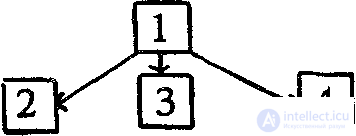
The meanings in the semantic structure of the noun cradle are arranged in an analogous way: with its first meaning 'a cradle, a cot' all its other meanings are directly connected: 'origins, beginnings; a receiver rest (of a telephone); tech. a frame, a support; mining a trough for washing gold-bearing sand; naut. a launching cradle; med. a splint, a support; mil. a gun cradle'.
Finally, the most usual type of arrangement of connections in the structure of a polysemantic word is radial-chain polysemy, which takes on the most varied configurations depending on which meanings are in direct connection. Thus, for the noun hammer, whose meanings 'a hammer, a small hammer (a part of a mechanism); anat. the malleus (of the ear); sport, a hammer; an auctioneer's hammer; mil. a hammer, a firing pin; an uppercut to the chin (boxing)' are directly connected with its direct nominative meaning 'a hammer', while the meanings 'hammer-throwing' and 'coll. a hefty fellow, a boxer' are connected with the corresponding terminological meanings, this configuration has the following form:
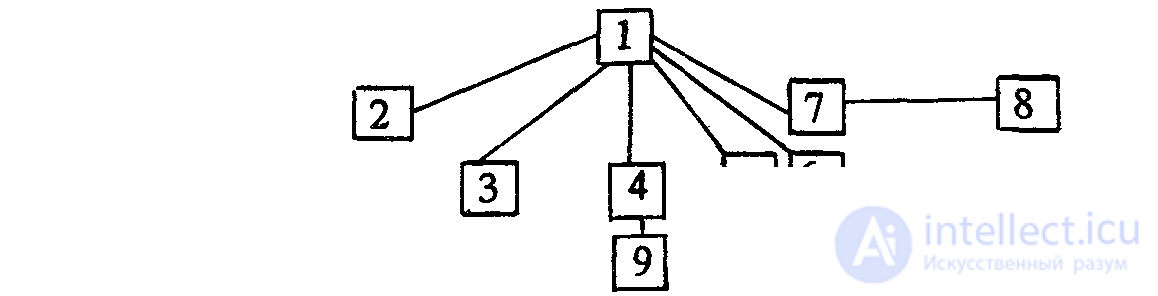
The graphs given above, reflecting the three topological types of polysemy (chain, radial and radial-chain), clearly demonstrate one more important property of the connection between meanings: the directness and indirectness of relations in the semantics of a polysemantic word. Direct connections are established between meanings, one of which acts as the source meaning while the other is derived from it. Indirect connections arise between derived meanings.
As a result of the indirectness of connections, some meanings in the semantic structure of a polysemantic word are situated at a fairly great distance from one another. Moreover, when, in the course of historical development, a word loses the source meaning that linked them, the connection between the meanings may be lost completely, which leads to the disintegration of polysemy and the emergence of homonyms (see in more detail the section "Homonymy").
From the point of view of their content characteristics, intra-word connections are a reflection of those processes of semantic change that underlie the secondary meanings of a word. Because the character of a connection is determined by the type of semantic process, the content connections of meanings are traditionally described in the same terms as the types of semantic processes: metonymic (including synecdoche), metaphoric (including synaesthesia and functional transfer), narrowing and widening of meaning, etc. To a certain extent, the use of this scheme, developed specifically for the typology of semantic changes, is possible in synchronic descriptions of the semantic structure of a word, but it must necessarily be synchronically oriented, i.e. based on the synchronically established relations of the meanings of a polysemantic unit, which is not always clearly carried out. Moreover, not all types of connections fit under the traditional classification. All this has served as a stimulus for the development of a new model for describing content connections of meanings, proposed by M.V. Nikitin. "Content connections, - the author writes, – are the same as conceptual connections, i.e. connections of concepts and representations ... The objective basis of conceptual connections is formed by 1) connections between entities of the objective world, 2) commonalities between entities of the objective world according to their existing features. Correspondingly, two basic types of conceptual connections are distinguished, as are the content connections between word-meanings: 1) implicational and 2) classificational"
продолжение следует...
Часть 1 Polysemy: Semantic Ambiguity, Its Types and Semantic Change
Часть 2 - Polysemy: Semantic Ambiguity, Its Types and Semantic Change

Comments