
Lecture
In the lexical system of a language, alongside polysemy, there exists another type of semantic ambiguity, related to and bordering on polysemy, but nevertheless distinct from it. This is homonymy - a phenomenon in which one and the same linguistic form has several meanings which, unlike in polysemy, share no common semantic features, no common elements of meaning, and are accordingly in no way connected with one another. Such are the nouns rent1 'money paid for the use of property; house rent; income from property' and rent2 'a hole, a tear; a slit, a gap; a break in the clouds', shiver1 'a trembling, a shudder and shiver2 'a splinter, a fragment'; nurse1 'a children's nurse, a nanny; a wet nurse; a hospital nurse' and nurse2 'a Greenland or West Indian shark', the adjectives ashen1 'made of ash wood' and ashen2 'ash-coloured', downy1 'covered with down, fluffy', downy2 'hilly' and downy3 'sly, cunning', the verbs angle1 'to distort (a story, an event)' and angle2 'to fish with a rod and line; fig. to fish for something', boast1 'to boast, to be proud' and boast2 'to rough-dress a stone' and many others. However significant the number of homonyms may seem, even in English, where, according to researchers' observations, there are far more homonymous units than in Russian, on the whole homonymy is not as widespread as polysemy, despite the fact that it permeates not only the vocabulary but also morphology, word-formation and syntax. Taken as a whole, homonyms in modern English make up no more than 16-18% of the entire word stock, while the number of homonyms within one and the same part of speech (of the type given above) does not exceed 8-9% (see the data of I.S.Tyshler: 10,10-13,70). It is probably precisely the absence of connections between the meanings of homonyms, depriving speakers of the support they need in acquiring and storing lexical units, that makes homonymy an undesirable phenomenon for a language, while at the same time limiting the sphere of its spread. It is also not unimportant that in speech homonymy can hinder the understanding and recognition of the exact meaning of an utterance. Usually the context, the immediate environment of a word, indicates clearly enough which of the homonymous words the speaker has in mind (cf., e.g.: I could not bear the sight of the poor bear in the bare forest near the construction site 'I could not endure seeing the unfortunate animal in the leafless woods near the building site', in which, thanks to the context, no clash occurs between the homonyms bear1 'to endure', bear2 'an animal', bare3 'naked, bare', sight1 'a view', site2 'a building plot, a construction or installation site'). At the same time, context does not always serve as a reliable indicator of a word's meaning, allowing an ambiguous interpretation of it. Thus, a light blue summer dress can be understood either as 'a lightweight blue summer dress' or as 'a pale blue summer dress '. This possibility of an ambiguous interpretation of homonymous words is used in puns built on wordplay. For example, – You promised to tell me your history, - said Alice. - Mine is a long and sad tale, ~ said the Mouse sighing. - It is a long tail, certainly, - said Alice, looking down with wonder at the Mouse's tail. - But why-do you call it sad?! (L.Carrol. Alice in Wonderland), in which the mutually homonymous nouns tale 'a story, a narrative, a tale' and tail 'a tail' clash. On the play on words weak 'feeble' and week 'a period of seven days', combined with the word day, meaning 'a working day', the following pun is built: Which is the strongest day of the seven? - Sunday, because the others are week days. Cf. also When two egoists meet, it is a case of an I (eye) to I (eye), where the homonyms I 'the speaker' and eye 'the organ of sight' clash, and many others.
Coexisting within a single lexical system, the phenomena of homonymy and polysemy also differ functionally. Polysemy, based, as noted earlier, on the identity and motivatedness of linguistic expressions, ensures the flexibility and economy of the language code serving a network of interrelated meanings. Homonymy, however, has no useful purpose in language, for the economy of linguistic means that arises as a consequence of their identity is nullified for speakers by the unconnectedness of their meanings and turns out in fact to be illusory. As a result, homonymy . appears as a phenomenon presupposing the mutual exclusion of homonymous units by one another.
The causes and ways in which polysemy and homonymy arise are fundamentally different. In the emergence of homonyms it is difficult to discern a direct influence of extralinguistic factors, as is observed in the case of polysemy. The causes underlying homonymy are connected above all with the historical development of the language system, with the phonetic, phonological, morphological, semantic, etc. changes that a language undergoes in the course of its existence. The identity of the linguistic forms of different lexical units may be the result of sound convergence, i.e. the phonetic coincidence of words originally differing in their sound form. As a result of phonetic changes that took place at the end of the Old English period, in Middle English and at the beginning of the Early Modern English period, and which radically transformed the phonetic system of English, the following words coincided in their sound form: sea 'a large body of salt water' (OE x ) and see 'to perceive with the eyes' (OE seon), meat 'flesh used as food' (OE mete) and meet 'to encounter' (OE metan), eye 'the organ of sight' (OE eage) and I 'the first-person pronoun' (OE ic), son 'a male child' (OE sunu) and sun 'the star at the centre of the solar system' (OE sunne, sunna) and many others. The differences in their spelling, preserved owing to the stability of orthographic tradition, – are the only formal evidence of their different origin and separateness as lexical units in modern English. Changes in the morphological system of English, the simplification and loss of inflectional forms as yet another consequence of phonetic changes, brought about the sound identity of words belonging to different parts of speech, of the type love 'a strong feeling of affection' (OE lufu) and love 'to feel affection for' (OE lufian),warm 'having a moderate degree of heat'(OE wearm) and warm 'to make warm' (OE werman), watch 'observation, surveillance; care' (OE wx cce) and watch 'to observe, to keep an eye on' (OE wxccan) and many others. Thus, the scope of the phonetic changes, which affected the most diverse layers of the English language system, led to homonymy arising as a consequence of sound convergence acquiring considerable scale and fairly significant proportions in English. Numerous borrowings from other languages, chiefly Romance languages, also fall under the influence of phonetic changes. For example, carp 'a freshwater fish' (f. OF carpe) and carp 'to find fault; to criticize unkindly' (f. ON karpa to brag; f. or influenced by L. carpere pluck at, slander); gum 'the flesh surrounding the teeth' (OE goma) and gum 'resin; glue' (ME, f. OF gomme); plain 'clear; understandable; simple' (ME, f. OF plain, f.L. planus) plain 'to lament, to mourn' (ME, f. OF plaindre, f.L. plangere planet - la ment), plane 'a plane tree' (ME & OF, f-L.f.Gk platanos), plane 'a woodworking tool; a trowel' (ME & OF, f.LL plana), plane 'a flat surface; a facet; a level' (F.L.planum) etc.
In parallel with the phonetic and morphological changes in the English language system, semantic changes also take place, as a result of which the connection between the meanings in the semantic structure of a polysemantic word is destroyed. Complex relations between meanings, the absence of direct connections, and the great distance between indirectly connected lexico-semantic variants of a polysemantic word contribute to the detachment of individual meanings, the disintegration of polysemy, and the emergence of semantically unconnected but formally identical homonymous words. Such is the history of the homonyms story (storey) 'a floor, a level' and story 'a narrative, a tale', which go back to the early Middle English story (storie), borrowed through French from Latin history and having the meanings 'a picture, a sculpture depicting historical events', 'a history, a legend, a tale' and others. Under the influence of the custom among the Anglo-Norman nobility of decorating the facade of a house with pictures or sculptures on historical subjects, with pictures on one subject arranged horizontally and pictures on different subjects placed on different tiers of the house, the word story came to be used also in the meaning 'a floor'. Semantic differentiation, or divergence, also lies at the root of such homonyms as: discreet 'careful, prudent' and discrete 'separate', flour 'ground grain used for baking' and flower 'a bloom', tun 'a large cask' and ton 'a unit of weight', etc., whose acquisition of the status of non-identical lexical units became fixed in their different spelling. The adjective right is also on its way to splitting into two homonymous words.
The absence of a connection between the meanings 'right, just' and 'right-hand, right-sided' allows lexicographers to treat the word right in the first meaning as a homonym of the word right in the second meaning, although there is no unanimity of opinion on this point.
Alongside diachronic processes - and sound (phonetic) convergence and semantic divergence undoubtedly are such, since they represent historical processes connected with long periods of time - synchronic processes also operate in the language system, likewise leading to the homonymy of lexical units. At the synchronic level they take the form of regularities operating in the language system of a given period, and may be specific to each individual language (cf., e.g., the phonetic convergence of words of the type Russian лук - луг, код - кот, лиса - леса, спешу - спишу etc., arising as a result of the neutralization of differential features of phonemes in certain positions, and representing, in this case, a synchronic process characteristic of many Slavic languages). For modern English, as for many other languages, including Russian, the leading, dominant synchronic process in the formation of homonyms is, however, word-formation. According to productive and active word-formation models, among which the models of forming words by conversion occupy a special place as the most active, homonymous units are formed such as bossy1 'bossy, domineering' and bossy2 'knobby, covered with bosses (studs)', springlike1 'spring-like, vernal' and springlike2 'springy, elastic', girly1 (girlie) 'a young girl (affectionate)' and girly2 'girlish', father1 'a male parent' – father2 'to look after someone in a fatherly way', null1 'invalid, void' – null2 'to render invalid' and others in English (cf. Rus. выжать (белье, лимон ...) and выжать (косяк ржи), пилка (дров) and пилка (маленькая пила), рубка (корабля) and рубка (леса) and others). Although they arise as a result of a single word-formation act, these homonyms nevertheless differ in their nature. The homonymy of the derived words bossy1 – bossy2, springlike1 – springlike2 (cf. Rus. Выжать1 and выжать2) is merely a projection of the homonymy of their underlying bases, i.e., according to the definition of V.V. Vinogradov, "reflected word-formation homonymy". Their homonymous status is beyond doubt for as long as the homonymy of their underlying bases is beyond doubt. These derivatives display complete dependence on the status (polysemantic or homonymous) of their source lexical units. It is natural, therefore, that the disagreements often observed in lexicographic sources regarding the polysemy or homonymy of particular source lexical units (we shall discuss the reasons for these disagreements somewhat later) are also reflected in the description of the corresponding derivatives. Thus, in Webster's dictionary (1961) and Hornby's dictionary (1980) we find opposing decisions regarding the identity and separateness of the word spring 'the season of spring; a coil; a jump', and correspondingly different subsequent descriptions of the derived unit springlike 'spring-like; springy'. (A similar situation is observed in dictionaries of the Russian language: cf. the description of the word лицо 'the front part of the human head, and a grammatical category of the verb' and, correspondingly, of the derivative личный (личное оружие, личное местоимение) in the dictionary of S.I. Ozhegov (1978) and the dictionary of Russian homonyms of O.S. Akhmanova (1974).)
In contrast to this group of derived homonymous words, the homonymy of the derivatives of the type girly1 and girly2 is connected with the operation of different word-formation models, involving within their sphere either the same underlying bases, or underlying bases connected with one another by direct or indirect derivational relations (cf., e.g., unpacked1 'not packed, without packaging' and unpacked2 'unpacked, unloaded', formed by different derivational paths (unpacked1 - un- + packed; unpacked2 - unpack + -ed) and connected only indirectly through the verb pack 'to pack, to put in a container'; cf. also Rus. подковка 'a small horseshoe' and подковка (лошадей), пилка 'a small saw' and пилка (дров).
Word-formation processes also underlie the emergence of such homonyms as buggy1 'a light two-seater carriage' and buggy2 'infested with bedbugs' (cf. Rus. рубка (корабля) and рубка (леса), губка (морская, резиновая) and губка (пухлая, прелестная), of which one word is simple, while the other is a derivative from the corresponding underlying base, which has accidentally coincided in form with the non-derived unit.
The core of homonymy arising as a consequence of word-formation processes is made up, however, in modern English by numerous pairs correlated by conversion, of the type father1 'a father' – father2 'to look after in a fatherly way', in which one member of the homonymous pair is the underlying base, while the second is a derivative formed on its basis, structurally and semantically motivated, coinciding in some of its forms with the source unit. Such homonyms form a special class, differing from others, firstly, in that certain semantic connections are established between the homonyms, although both members of the pair are semantically non-identical to one another. Secondly, the formation of homonyms in this case bears the character of modeled homonymy, whose boundaries are determined solely by the range of operation of conversion.
Worthy of attention is the varying degree of activity of word-formation processes, which proves to be dependent on the properties of the homonyms formed in the course of word-formation acts. It cannot fail to be noticed that the most active word-formation processes are those which lead to the emergence of homonyms with different lexico-grammatical characteristics. The distinction between parts of speech is, apparently, so fundamental for a language that extended series of homonyms, formed as a result of conversion and differing in their functional properties, do not create any serious obstacles to communication. The sphere of operation of word-formation processes leading to the emergence of homonyms within one and the same part of speech is, on the contrary, limited and connected mainly with low-productivity and unproductive word-formation models. Even where homonymous affixes are observed (e.g., the substantival suffix -ful and the adjectival suffix -ful in English, which combine with substantival underlying bases, etc.), systemically operating homonymy constraints determine, as a rule, a mismatch in the lexico-semantic classes of the units selected as underlying bases, and/or a difference in the lexico-grammatical meanings of the derivatives. This state of affairs is apparently explained by the fact that the emergence of a huge number of homonymous derivatives, not so clearly opposed in their distributional characteristics, within one and the same part of speech, could hinder communication among speakers. Word-formation, as the most active means of replenishing the vocabulary of a language, therefore mainly "repeats" the homonymy of lexical units of one and the same class, or else creates additional meanings by which homonyms are differentiated. Ultimately, thanks to word-formation, the system of homonyms in a language becomes considerably more complex, and this increase in complexity is not only quantitative but, more importantly, qualitative, leading to the emergence and existence within the lexical system of complex types of homonyms.
Thus, the homonymy of lexical units in modern English turns out to be the result of different processes, which accordingly makes it possible to describe the subsystem of homonyms as a set of words heterogeneous from a genetic point of view, which includes: a) homonyms that arose as a result of sound convergence (they are often called etymological homonyms); b) homonyms formed as a result of semantic divergence, or semantic homonyms, and c) word-formation homonyms.
+Unfortunately, at the synchronic level of considering homonymy, its procedural aspects largely lose their relevance, for the imprint left, by the process through which the homonymous units were formed, on the type of homonym itself is not sufficiently clear. Despite the fact that speakers attempt in some way (most often in spelling) to preserve the former differentiation of words that have coincided in their sound as a result of the development of the language, or to fix in different graphic form the fact of the disintegration of polysemy, and to separate word-formation homonyms into different lexico-grammatical classes, no rigid determinacy or definiteness of correlations can be found here. Therefore, the synchronic description of homonyms is carried out in a different key and from different positions compared with the diachronic one. (This, incidentally, is yet another respect in which homonymy differs from polysemy.)
The main questions of the linguistic description of homonyms in synchrony are the problem of the classification of homonyms and their differentiation.
Like any other typology, the classification of homonyms presupposes the preliminary resolution of two fundamentally important points: determining the boundaries of the phenomenon under analysis and seeking criteria for dividing or grouping the units that make it up into particular subclasses. On both the first and the second question, no unanimity of opinion is observed.
In the linguistic literature various conceptions of homonymy are known, connected with different understandings and definitions of homonyms. One of the reasons for the existing disagreements lies in the different interpretation of the linguistic form, the identity of which, accompanied by the absence of a connection between meanings, underlies homonymy. Depending on whether we understand by linguistic form only the sound image, guided by the fact that the leading form of communication is spoken, oral speech, or whether we also take into account the spelling of words, i.e. their graphic form, which, owing to the mass spread of writing and the ever-increasing role of written forms of communication, is acquiring autonomy, becoming a psychological reality and playing a very important role in the communication of literate people, the boundaries of homonymy will vary considerably. Thus, according to the definition of O.S. Akhmanova, who regards as homonyms two (or more) different linguistic units that coincide in their sound (i.e. in their plane of expression), all words that coincide in their spelling but differ in their sound (of the type bow /bou/ 'a bow' (a weapon) and bow /bau/ 'a bow (a gesture of bowing)', row /rou/ 'a row, a line' and row /rau/ 'a noise; a quarrel' etc.) must be excluded from the sphere of homonymy, as must those homonyms that resulted from the disintegration of polysemy. If, on the other hand, homonyms are understood as "different words having the same sound composition" (a definition shared by many Soviet and foreign scholars, for example A.A. Reformatsky, R.A. Budagov, B.N. Golovin, Yu.S. Maslov, A. Burgess and others), then the boundaries of homonymy will include all words identical in sound form, regardless of the causes and ways of their coincidence. Those same authors who insist that, for lexical units differing in their meanings to be recognized as homonyms, identity of both their sound and their graphic form is necessary, exclude from the sphere of homonymy units identical in sound but different in spelling (of the type way 'a path, a road' - whey 'the watery part of milk', weigh 'to weigh (oneself)' etc.), of which there is a fairly large number in English. A broad interpretation of homonymy is also possible (it is the most widespread in foreign English studies), taking into account all possible coincidences of units in the plane of expression given a difference in their content. The system of homonyms in English (and in other languages too), in this interpretation, includes: a) homophones (homophones), or units identical in their sound but differing in their spelling and meanings (of the type place 'a location, a dwelling, an estate' and plaice 'a flatfish', principle 'a fundamental rule, a basis, a law' and principal 'a head, a chief; a university rector' and others); b) homographs (homographs), or words identical in spelling but different in their pronunciation and content (of the type slough /slau/ 'a marsh, a bog, a quagmire' and slough /slAf/ 'a shed skin (of a snake); the peel, skin (of fruit); a scab', read /ri:d/ 'to read' -read /red/ 'having been read' etc.) and c) full homonyms, i.e. words coinciding both in their sound and in their written form and differing in meaning (e.g., pupil1 'a student, a schoolchild' –pupil2 'the pupil of the eye', rent1 'house rent; rental payment' – rent2 'a hole, a tear; a slit; a gap', tip1 'a gratuity' – tip2 (the upper) end; the top, the tip' – tip3 'a touch; a light blow' – tip4 'a hint, an item of advice' etc.).
Types of homonyms
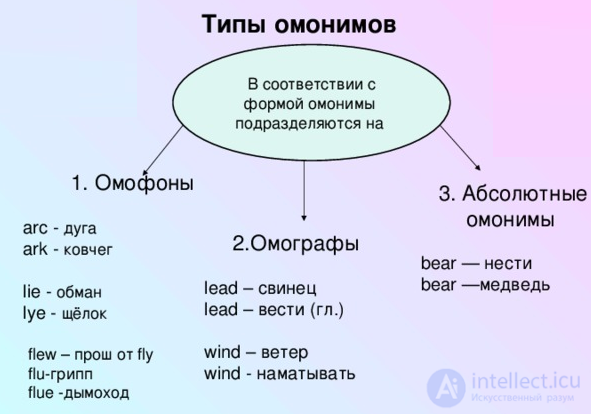
Types of homonyms
The degree of coincidence of the formal side of homonyms allows us to distinguish
full homonyms, coinciding throughout the whole paradigm
rose - a flower;
rose - Past form of « rise »
lighter- a lighting device, an illuminator
lighter- a barge
Another criterial feature, under whose influence the boundaries of homonymy take on different outlines, is the necessary degree of formal coincidence of homonymous words postulated by various authors. As is known, words can be identical in all their forms owing to belonging to one and the same part of speech and the complete identity of their morphological paradigms (e.g., blow1 'to blow' – blow2 'to bloom' (blows, blowing, blew, blown), tent1 'a tent, a marquee, an awning' – tent2 'med. a surgical tampon', sealer1 'one who seals, a sealer' – sealer2 'a seal hunter' etc.). At the same time, the formal identity of homonymous words may be partial and concern only some of their forms (e.g., lie1 'to lie (be in a horizontal position)' (lies, lying, lay, lain) – lie2 'to lie (tell an untruth)' (lies, lying, lied), found1 'to found, to establish' (founds, founding, founded) - find 'to find' (found2, finds, finding), maid 'a servant, a housemaid, domestic help' (maid's, maids, maids) - make 'to make, to do' (makes, making, made) and others). On this basis, a number of scholars treat as homonymy only cases of complete coincidence of word forms, regarding the partial identity of forms of different words as the phenomenon of homoformy. (Cf., for example, the definitions of N.M. Shansky: "Homonyms are words that sound alike but have completely different meanings that cannot at present be derived one from the other, and which coincide with one another both in sound and in writing in all (or in a number of their own) grammatical forms. Homonyms, consequently, are words of one and the same grammatical class ... Homoforms, unlike homonyms, are words of either the same or different grammatical classes that coincide with one another in sound in only individual forms ... Adjoining homonyms and homoforms are homophones, which are words and forms of different meaning that are also pronounced alike but, unlike the former, are written differently" (11,43).)
In such an interpretation the term "homonym" loses its generalising meaning as the designation of the whole many-faced class of words identical in this or that formal feature or set of features, and acquires the character of the name of a particular subset of it, entering into the general class alongside homoforms, homophones and homographs. However, the absence of a general term inevitably entails the use of the term "homonym" in a broader sense as well, which gives rise to vagueness and imprecision in the whole taxonomic construction. There is hardly any point in denying the fruitfulness of the notion of homoformy introduced by V.V. Vinogradov, by means of which, in our view, it is easy to explain why, given such a large stock of homonyms in the English language, no clashes occur between them, since the smaller the number of identical forms of different words, the smaller the possibility of a speech conflict between them. At the same time one cannot fail to acknowledge the greater coherence and consistency of the conception of those authors who, following A.I. Smirnitsky, distinguish within the general system of homonyms full homonyms, i.e. homonymous words coinciding in all their forms, and partial homonyms, characterised by the identity of only part of their word-forms. The result of an attempt at a more precise quantitative reckoning of the degree of coincidence of homonyms was I.S. Tyshler's differentiation of full homonymy, incomplete homonymy, in which a coincidence of half or more of the forms is observed, and partial homonymy, where a smaller part of the forms coincides, although such a differentiation, requiring the definition of quantitative thresholds, gives rise to certain doubts.
Very serious disagreements in defining the boundaries of homonymy are connected with the content plane. In English these take on a particularly fundamental character owing to conversion. Depending on which of the two diametrically opposed interpretations of this phenomenon - as the use of one and the same word in the functions of different parts of speech, or as a word-formation process (see in more detail "Conversion") - is given preference, the whole picture of English homonymy will change substantially. Almost all Soviet linguists, following A.I. Smirnitsky, include words related by conversion within the sphere of homonymy. At the same time, the presence of internal motivation between such words along semantic lines, and the closeness of their lexical meanings, gives a number of scholars grounds for considering it unjustified to class these words as homonyms, since in that case, in their view, the basic condition for homonyms - the absence of any connection between their meanings given identical form - is not observed. It is hard to agree with such a position, for, to be consistent, if one recognises the status of units related by conversion as different words, one must also recognise their homonymy, since the identity of some of their forms is obvious, as is their considerable semantic differentiation.
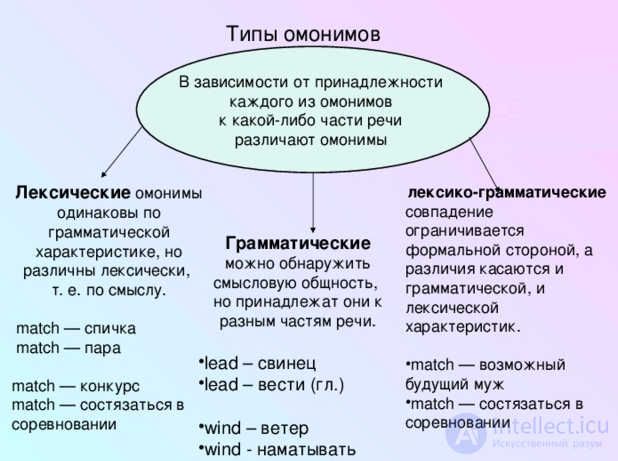
The degree of semantic differentiation and the absence of any connection between meanings, as the main content-based feature of homonymy, at the same time become the most vulnerable and controversial point in its definition. Meaning, in its various aspects, is always the touchstone of linguistic theories. Homonymy is no exception in this respect, all the more so since homonymy is – first and foremost a semantic phenomenon, and the criterion of meaning, whose type determines the type of homonymy, underlies its definition. According to what semantic differences are observed between words identical in form, all homonyms are divided into the following groups:
a) lexical homonyms, belonging to one part of speech and characterised by one lexico-grammatical meaning and different lexical meanings (e.g., miser1 'stingy person, miser, skinflint' – miser2 'boring spoon', mate1 'chess. mate' – mate2 'companion, spouse; male animal', mole1 'birthmark' – mole2 'mole (animal)' - mole3 'pier, breakwater', ring 'to ring' - wring 'to wring'.
b) lexico-grammatical homonyms, or words identical in all or part of their forms and differing both in their lexical and in their part-of-speech meanings (e.g., sea 'sea' - see 'to see', mean1 'to mean' – mean2 'average', red 'red' – read 'read (past tense)', spoon1 'spoon; spinner (fishing lure)' – spoon2 'to spoon; to fish with a spinner', mantle1 'cloak, mantle' – mantle2 to cover, envelop' etc.). This also includes, according to A.I. Smirnitsky, homonyms of the type found1 'found' – found2 'to found', the difference between which runs both along the line of their lexical meanings and along the line of their grammatical meanings, although both words belong to one part of speech.
Among the general run of lexical and lexico-grammatical homonyms, mention should also be made of grammatical homonyms, i.e. homonymous forms within the system of one and the same word, differing in their grammatical meanings (e.g., brothers 'plural' -brother's 'singular possessive' – brothers' 'plural possessive', etc.), since possible divergences in the meanings of coinciding grammatical forms can lead to a given form breaking away from the whole paradigm of the word and to the emergence of lexical homonyms, as happened, for example, with the plural of the nouns colours 'banner, flag', works1 'mechanism', works2 'factory, plant, workshops' and some others, where grammatical homonymy turned into lexical homonymy.
Recently, under the influence of a general increased interest in derived words and derivational processes, alongside the types of homonyms listed above, word-formation homonyms have also been singled out, based on a difference in the word-formation structures of derived words identical in form. In other words, the formal criterion is chosen as the fundamental one, and the actual word-formation homonyms turn out to be derived words with a multiplicity of motivations (of the type English unpacked) or lexical units related by conversion, or else units of the type reader1 'reader (a person)' and reader2 'reader (a book for reading)'.
However, if one proceeds from the premise that the type of homonymy is determined by the type of meaning that differentiates units identical in form, the following conclusion naturally follows: those materially identical units which differ from one another primarily in their word-formation meaning should be classified as genuine word-formation homonyms. Accordingly, by no means all homonyms formed as a result of word-formation processes will fall into the category of word-formation homonyms. Thus, owing to the identity of their word-formation meanings, it is hardly legitimate to assign to word-formation homonyms derivatives of the type bossy1 'bossy, domineering' and bossy2 'knobby, bumpy', whose homonymy is the result of a reflection of the homonymy of their base words and represents a pure case of lexical homonymy. It is also necessary to exclude from the sphere of word-formation homonyms cases of the type controller1 'controller (a person)' – controller2 'controlling device', whose ambiguity apparently arises as a consequence of the repeated involvement of the base word in word-formation processes, and some others. The group of word-formation homonyms will probably include only units of the type girly 'girlish' - girlie 'little girl', as radically differing in their word-formation meanings; units of the type buggy2 'bug-infested' and buggy1 'light two-seater carriage', opposed to one another by the presence/absence of a word-formation meaning; weekend1 'weekend' –weekend2 'to spend the weekend', between whose word-formation meanings fundamental differences are observed; and pairs of words related by conversion, in whose semantics the difference in lexical and grammatical meanings is supplemented by a word-formation meaning.
In speaking of genuine word-formation homonymy, it is necessary to emphasise one circumstance which is, in our view, extremely important, namely that it is, in all likelihood, impossible to isolate a sphere of pure word-formation homonymy in the language. This is determined by the fact that word-formation is by its very nature directed towards producing units that differ from their source units by a new meaning: lexical, grammatical, or both. It therefore becomes impossible to single out units, or a whole special class of words, that would differ from other units formally identical to them solely in their word-formation meaning. Differences in the word-formation meanings of derivatives necessarily correlate with differences in their lexical, grammatical or lexico-grammatical meanings, which leads to the emergence of such types of homonyms as lexico-word-formation, grammatico-word-formation, lexico-grammatico-word-formation homonyms, etc.
The existence within the language system of different types of homonyms, distinguished by the identity or difference of their meanings, accounts for the fact that, in defining the boundaries of homonymy, the criterion of semantic differentiation operates with varying degrees of effectiveness. Naturally, it works the more successfully the wider the range of meanings by which formally identical units differ. In this respect, the differentiation, as separate words, of identical forms characterised by different lexical, lexico-grammatical and word-formation meanings presents no difficulties whatsoever. As regards the classification of such units as homonymy, all researchers hold a unanimous opinion. Disagreements begin where the semantic differences are reduced solely to purely lexical differences (lexical homonyms) or to purely grammatical ones (in the opinion of a number of researchers, words formed by conversion are characterised by an identical lexical meaning, although, in our view, this assertion is contradicted by the presence, in the meanings of many words derived by conversion, of additional semantic components not derivable from the meanings of the base words and accounting for the partial idiomaticity of converted units). The question of the identity or separateness of units even with an identical lexical meaning but different part-of-speech meanings is nonetheless resolved fairly easily, since it is in fact an extrapolation of the fundamental thesis about parts of speech: if different parts of speech represent different classes of words, then the presence of non-identical part-of-speech properties in units identical in form and lexical meaning — is indisputable evidence of their homonymy. A stumbling block for researchers has been, and remains, lexical homonymy, which is traditionally treated as the problem of distinguishing homonymy from polysemy. Neither the distributional criterion, in which the indicator of different meanings is the different contextual environment of the word, nor the word-formation criterion, in which different word-formation possibilities are interpreted as an indicator of the separateness of units with different lexical meanings, nor the differences in semantic connections and the specifics of the synonymic and antonymic series into which units identical in form but with different lexical meanings enter, nor the peculiarity of the sets of grammatical categories for the two lexical meanings - none of the criteria named above, nor even all of them taken together, provide a reliable and objective basis for deciding whether we are dealing with different lexical meanings of a polysemous word, or with different homonymous words. All the differences listed above, as well as certain others (e.g., the presence/absence of common semantic components, the uniqueness of the given combination of meanings, etc.), testify to only one thing - a difference in lexical meanings. Whether these differences are linked to the polysemy of the word or to homonymy, however, cannot be determined by means of these criteria. Appeal to an intuitively felt or unfelt connection between meanings determines the subjectivity of the semantic criterion for distinguishing polysemy from homonymy, and it is from this subjectivity that the discrepancy observed in the linguistic literature and in lexicographic sources in describing particular words as polysemous lexical units or as homonyms stems. Thus, the team of compilers of the Large English-Russian Dictionary under the editorship of I.R. Galperin describes the previously cited colours1 'colours, shades' – colours2, 'banner, flag'', works1 'deeds, works' – works2 'mechanism; construction' – works3 'factory, plant, workshops', as well as mite1 'a small contribution, a mite' –mite2 'mite (a small arachnid)', bone1 'to bone (remove bones from meat)' – bone2 'to arrest; to steal; to beg, to ask for' and many others as homonymous units. The compilers of the Concise Oxford Dictionary, edited by J.B. Sykes, consider the lexical differences of these units to be differences between the lexico-semantic variants of polysemous words and accordingly treat them in a single dictionary entry as polysemantic words. There exists such a huge number of similar discrepancies that the boundaries of homonymy vary within considerable limits.
In the opinion of a number of scholars, a more reliable way of strictly distinguishing polysemy from homonymy consists in formalising the notion of semantic similarity/dissimilarity of meanings - the sole factor directly reflecting the essence of these two phenomena. This formalisation, however, - is a task for future research.
Thus, the boundaries of homonymy display a direct dependence on which features are taken as the basis of its definition. It is also evident from the foregoing account that these features simultaneously become the parameters by which the classification of homonyms is carried out. Described above were the most widespread of the existing typologies of homonyms, each based on some one feature: 1) formal identity (homophones, homographs, full homonyms); 2) degree of identity (full and partial homonyms); 3) type of the differentiating meaning (lexical, lexico-grammatical, grammatical homonyms (see a somewhat different interpretation of these classes of homonyms in Yu.S. Maslov) (6,108).
More complex classifications, built on two or more parameters, are also possible, however. Such, for example, is the classification of A.I.Smirnitsky, which takes into account the degree of identity of forms, the type of differentiating meaning, and whether the units belong to the same or to different parts of speech. Accordingly, the classes of lexical and lexico-grammatical homonyms are subdivided into full and partial. Within partial lexico-grammatical homonymy a differentiation is made between simple (of the type found1 'found' ~ found2 'to found') and complex (of the type bore1 'bore (past of bear)' and bore2 'a boring tool', light1 'light' –light2 'light (not heavy)' and others) cases.
Of interest is the multidimensional classification proposed by I.V.Arnold, in which the distinguishing features of classes of words are lexical and grammatical meaning, paradigm and basic form, and which makes it possible, on the basis of the identities and differences of these features, to reveal not only types of homonyms but also polysemy and synonymy. Adopting the following conventional notations: A -different lexical meanings, A - almost identical lexical meanings, B - different grammatical meanings, B - one and the same grammatical meaning, C - different paradigm, C - identical paradigm, and D - different basic form, D - identical basic form, the author, by calculating combinations of the feat° ures, obtained a matrix in which the following 12 classes proved possible:
ABCD – partial lexico-grammatical homonyms of the type
Light1 'light' –light2 'light (not heavy)'.
ABCD– the same set of features as above, but for one of the words the identical form is not the basic one, of the type might1 'might, strength' – might2 (past tense of may).
ABCD – lexical homonyms differing in their basic forms but coinciding in some other form, for example in the plural form (for nouns) or the past tense form (verbs), of the type axe - axes 'axes (cutting tools)' - axis - axes 'axes (of rotation)'.
ABCD – lexical homonyms having the same grammatical meaning but different paradigms, of the type lie1 'to lie (recline)' (lay, lain) – lie2 'to lie (tell an untruth)' (lied, lied).
ABCD – full lexico-grammatical homonyms, which include invariable function words of the type the preposition for1 and the conjunction for2.
ABCD – full lexical homonyms of the type springy 'a jump, leap' – spring1 'a spring (water source)' – spring2 'spring (the season)'.
ABCD – modelled homonyms (mainly function words linked by their lexical meanings, of the type before adv, before prep, before cj).
ABCD – lexico-semantic variants of a polysemous word.
ABCD — modelled homonyms by conversion, differing in their grammatical meanings and paradigms, of the type eye 'eye' – eye 'to eye, to look at'.
ABCD – homonyms belonging to different parts of speech and coinciding in some of their forms owing to a common root, of the type thought1 'thought (a mental idea)' – thought2 'thought (past tense of think)'.
ABCD — synonyms, hyponyms.
ABCD – cases of the type brother 'brother (sibling)' - brothers: brother 'brother (fellow member)' - brethren.
Close to the classification described above is the typology of homonyms developed by A.V. Malakhovsky, in which the author proceeds from four heterogeneous features: a) identity or difference of sound; b) identity or difference of spelling; c) identity or difference of the invariant of lexical meaning; d) identity or difference of the invariant of grammatical meaning.
An attempt to draw sharper semantic distinctions between classes of homonyms is contained in the typological descriptions of P.A. Soboleva, O.M. Kim. It is unclear, however, to what extent these original, though not in every respect indisputable, semantic classifications of homonyms, carried out on Russian-language material and intended to reflect the specific character of homonymy in that language, are applicable to English material. For this reason we omit a detailed exposition of them. In conclusion, we should like to say that the enormous interest of linguists in the problems of homonymy, and the practical necessity of solving them, connected with the construction of mechanical devices for text perception, the automatic processing of texts, and, in general, attempts to create artificial intelligence, will undoubtedly call new answers and new classifications into being.
REVIEW QUESTIONS

Comments