
Lecture
As has already been noted above (see Introduction), in the process of communication speakers widely make use of the possibility of forming new lexical units on the basis of existing ones, in response to the constantly emerging and expanding needs of conveying new information of the most varied kind. Drawing on the means already available in the lexical system of the language and expressing new meanings through their various combinations is extremely important both for the speaker and the listener, and for the language itself. The synthesis of a new name from ready-made word forms or their meaningful parts allows the speaker to fix some knowledge of the characteristics and features of the object being named, its interrelations with other objects, and to give the object a name that is not arbitrary but conditioned by cognitive experience, however superficial and accidental that experience may be. At the same time, the speaker's message turns out to be more or less economical, since by using such a name the speaker avoids the need for a detailed explanation or interpretation of the name, which would necessarily arise if some absolutely conventional name, unconnected with any other lexical units, were used. For the listener, whose task is to recognize the meaning encoded in the speaker's message, decoding units of this kind is considerably facilitated by the connections which the listener, sharing the same linguistic code as the speaker, readily establishes between the new name and its constituent "old" components of the lexical system. The lexical system itself, thanks to this practice of creating lexical units, turns out to be at once a sufficient and an economical part of the linguistic code, which contributes to its relatively easy acquisition, for more than 70% of its units are units complex, i.e. units that are formally and semantically derived and, consequently, dependent on the corresponding original, base-forming units.
Two theoretical branches of linguistics – word-formation theory, or word-formation, and morphemics – are devoted to describing the synthesis and analysis of names, these two most closely interrelated, interconditioned and interpenetrating aspects of speech activity that alternate with each other, oriented towards the generation of new naming units and the recognition of their meaning respectively. Not always clearly distinguished, and often combined as one of the branches of morphology, word-formation and morphemics have a single object of study but pursue different aims in doing so. The interests of word-formation and morphemics intersect in the word as the basic and central unit of language, since a considerable part of the words of a language, being complex units that have arisen as a result of one or another word-formation process, turn out, quite naturally, to be units divisible into smaller, further indivisible meaningful parts, i.e. morphemes.
It is natural, too, that in many cases the analysis of a word from the point of view of its word-formation structure, i.e. of how the processes and units whose operations led to its formation are reflected in its structure, proves identical in its results to the analysis of the word from the point of view of its morphemic structure. Cf., for example, suffixal words of the type teacher 'one who teaches', writer 'one who writes', baker 'one who bakes', winner 'one who wins', traveller 'one who travels', coolness 'the state of being cool', kindness 'the quality of being kind', sadness 'the quality of being sad' and many, many others, the analysis of whose word-formation and morphemic structure at the surface level yields identical results.
This identity, even at the surface level, is however far from complete. The mismatch between the morphemic composition of a word and its word-formation structure is easily demonstrated by a number of examples. Thus, in English the verbs to table 'to put on the table', to father 'to be the father, author, creator of; to care for paternally', to knife 'to cut with a knife, to stab* and many others, the nouns a cut 'a cut, an incision', a run 'a run, a race' etc. are morphemically indivisible. They are built from only one morpheme. From the word-formation (derivational) point of view these words correlate with the corresponding nouns and verbs, are derived from them and are motivated by them. Thus, despite the simplicity of their morphemic structure, these words are derivatives. (Cf. in Russian the words синь (blueness) and ход (motion, course) and others, morphemically simple, derived from the words синий (blue) and ходить (to go), etc.) A mismatch between the morphemic composition of a word and its derivational structure is also observed in words such as the English verbs to week-end 'to spend the weekend', to blacklist 'to put on a blacklist', to handlist 'to compile an alphabetical list' etc., words that are complex in their morphemic composition but are formed not by combining their constituent morphemes but by another means – conversion (see below).
Numerous discussions concerning the morphological structure of the word, the accumulation of extensive factual material and attempts to systematize it have contributed to the differentiation of morphemics and word-formation as branches directed at two different types of word analysis – morphemic and derivational – each of which has its own aims, operates with its own units and leads to different results. The morphemic structure of a word is established on the basis of the word's occurrence in at least one correlative series with some other linguistic unit, and is the result of isolating the smallest meaningful parts in the word.
The derivational structure of a word, by contrast, is the result of somewhat different processes – the result of the formation of the given word from some other linguistic unit that motivated it. The basic condition for establishing the derivational character of a lexical unit is thus its correlation with another, source unit.
It must be noted that for many specific linguistic units the distinction between morphemic and derivational analysis is fraught with great difficulties. In English these difficulties arise especially often in the analysis of borrowed words, which to a considerable extent reflect the regularities of morphemic structure characteristic of the words of the language from which they were borrowed. For example: cautious 'careful, wary', division 'the act of dividing', fraternal 'brotherly', fraternity 'a brotherhood' and others.
What is fundamentally important, however, is one thing: not to confuse the two different types of analysis, not to identify the morphemic structure with the derivational one, for they correspond to fundamentally different positions of the communicants – the position of the speaker (derivational analysis, or more precisely, synthesis) and the position of the listener (analysis into the smallest meaningful parts). In the process of communication the speaker's position precedes in time that of the listener, and thus derivational synthesis turns out to precede morphemic analysis. This temporal characteristic has determined the sequence of our exposition, in which we first discuss word-formation processes and then the morphemic structure of the word.
Usually, when speaking of the vocabulary of a language, its open character is emphasized, i.e. the possibility of its being replenished with new units, this possibility being linked above all with the active word-formation processes, or word-formation. This is undoubtedly true, since word-formation, by its very essence and nature, best answers the needs of nomination, making use in doing so of the stock of words and names already available in the language. The (social and emotional) need for new names is satisfied not so much through borrowings, which are only a supplementary source, nor even through the emergence of new meanings (so-called semantic word-formation). The language possesses a system of means and rules specially intended for the purposes of nomination, by means of which new words are formed on the basis of units already existing in the language. The study of the structure of new formations provides solid proof of this. According to the data of the new-words supplement to Webster's dictionary, of 6000 new words in present-day English only 7.5% are accounted for by borrowings, while the overwhelming majority of new formations arose as a result of word-formation processes. For example, pedestrianize 'to free a street of traffic for pedestrians', extralinguistic 'non-linguistic', witster 'a person with a sense of humour', to leaflet 'to distribute leaflets', pageturner 'a gripping book' and many others.
How important the system of word-formation is for man's nominative activity can also be inferred from the fact that about 70% of a language's vocabulary is made up of derived words, i.e. words built according to certain rules by means of certain word-formation devices on the basis of source lexical units and motivated by them.
In mastering a language, the speaker also masters the word-formation system inherent in that language. It is significant in this respect, for example, that pupils, as they master their native language and rise to a new stage in their speech development, increasingly choose derived words.
As M. Dokulil observed, word-formation differs substantially from other means of nomination, differing above all in that naming is a creative, one-off act, whereas all other types of nomination are the result of a more or less lengthy development. The specificity of word-formation as compared with other types of nomination also lies in the freedom with which new units are formed. In this respect word-formation is close to the process of sentence-formation. The list of derived words is always an open list.
Thus, one of the principal functions of word-formation is rightly considered to be the replenishment of a language's vocabulary. At the same time, the needs for replenishing the lexical system of a language, especially of such developed languages as English, Russian and others, are not so great, while the word-formation systems of both present-day English and, to an even greater extent, present-day Russian are extremely ramified. The fact is that the roles of word-formation are not exhausted by the formation of new words, whose appearance is conditioned by objective and subjective causes. Word-formation is also at the "service" of grammar, performing a number of communicative functions. The most important of these is the recategorization of words, or the formation of a word with different part-of-speech characteristics (e.g., swim 'to move through water' — swimming 'the act of moving through water', smoke 'to inhale tobacco smoke' - smoking 'the act of smoking', move 'to change position' — movement 'change of position' and others), with the aim of giving them new syntactic roles. Word-formation processes bring about univerbation, i.e. the expression in a single word of complex syntactic constructions and even sentences (cf. as black as coal 'extremely black' — coal-black, as cold as ice 'extremely cold' — ice-cold, to fly aimlessly around the town just like a butterfly 'to flit aimlessly from place to place' — to butterfly), and the compression of information into minimal surface structures.
The communicative role of word-formation phenomena, particularly evident in nominalization, a classic example of which is the formation of a noun on the basis of a verbal word without any change in lexical meaning, or the recategorization of words, has long attracted the attention of linguists, who have noted the existence of certain connections between derived lexical units and sentences. Many words were regarded as transformations of certain syntactic constructions or sentences. In an attempt to explain why different derived units arise on the basis of one and the same sentences or syntactic constructions (see H. Marchand's critique of R. Lees's book "The Grammar of English Nominalizations" (23,59)), linguists came to understand how, depending on the speaker's choice of subject, the "topic" of the message, i.e. depending on the communicative task, one and the same source unit undergoes various transformations. Thus, for example, the sentence Someone pays something to someone on some day may, depending on topicalization, or on the choice of one or another piece of information as the main point of the message, give rise to the following derivatives: payer, payee, payment, paying, pay, payday, etc.
Thus one of the essential communicative roles of the word-formation system is revealed — a role directed at realizing subject-predicate relations between utterances in the process of communication, at the alternation of the thematic and rhematic components of utterances.
No less essential is another communicative role of word-formation — the role that word-formation plays in the univerbation of a complex and lengthy expression and its replacement by a shorter one that includes and conveys, in a condensed, compressed form, all the necessary information by means of a univerb — a derived word. The examples given below provide a vivid illustration of how, in the process of communication, word-formation performs this function of its own. Cf. 'It would take only four words: "Will you marry me?" That's the only anti-loneliness, Doug.' (I.Wallace. The Man) 'It only takes four words: "Will you marry me?" That is the sole remedy for loneliness. Doug'; His mother ... says she thinks her soon-to-be ex-husband is lying. (S.King.It ) 'According to his mother, in her opinion, her soon-to-be ex-husband is lying'; I planned to hire someone to housesit for us while we are gone - these days you can't be too careful (J. Walker. Stormy Weather) 'I planned to hire someone to house-sit for us while we were away — these days you can't be too careful'.
The creation of imagery, expressiveness, and the emotional tone of an utterance — this too is one of the communicative tasks often performed by the word-formation system. Cf. "A great book ... a landmark in American literature ... and it will probably sell a zillion copies". (S.King. It) 'A great book ... A landmark in American literature ... It will, no doubt, sell in enormous quantities'.
These two leading aspects of word-formation — the nominative and the communicative — differ in their purpose and in the tasks they fulfil, while at the same time being characterized by a deep inner unity. They are united, on the one hand, by the identity of the processes through which the realization of one function or another is achieved, and, on the other, by the identity of the end results. New lexical units, as G. Brekle notes, are not planned in advance by speakers for the purpose of extending and replenishing the vocabulary, nor do they arise in the course of any special processes of people's speech-thinking activity. They are created in the process of speech as the realization by the speaker of a particular communicative intention, and only later, given certain social conditions, may they enter the vocabulary fund of the language. Nomination by means of word-formation devices, like nomination in general, thus represents a necessary communicative act, extremely important in its consequences, within the overall process of communication. In the course of recategorization, or transposition, of units from one category to another, carried out by means of word-formation, and of the univerbation of a complex, multi-component name — processes that occur when word-formation performs its communicative functions — a new "vision" of the thing denoted is achieved, which determines a certain nominative significance of the sign and often leads to its inclusion in the vocabulary of the language alongside the old form of designation.
Independent of the nominative or communicative orientation of word-formation processes, i.e. independent of whether the corresponding communicative act is a response to a need for names or to the necessity of a certain reorganization of an utterance, it is modelled, presumably, in the same way. In other words, one and the same derivational processes underlie both nominative and communicative word-formation.
The second general and, in our view, the main unifying feature of the nominative and communicative aspects of word-formation is the unity of the final product of generation, i.e. the obtaining of a special type of word – derived words, or derivatives, which differ in a whole range of fundamental parameters from non-derived, simple words.
What, then, are the basic requirements that a derived word, as the basic unit of the entire word-formation system, must satisfy?
A derivative is a secondary linguistic unit that is formally and semantically dependent on the source unit and, as E.S. Kubryakova points out, given a common nuclear part, stands apart from the source unit by one applied formal operation, or, in different terminology, one derivational step. In terms of meaning, a derivative can always be explained through the source unit; it is motivated by it and represents a certain modification of its semantics. In other words, as G.O. Vinokur wrote, one can speak of a derived stem (or, say, word) only for as long as there exists a corresponding non-derived stem correlated with it. For example, in English the adjectives atomic 'of or relating to an atom', beautiful 'possessing beauty', carpetless 'lacking a carpet' are derived from the corresponding nouns atom 'a basic unit of matter', beauty 'the quality of being beautiful' carpet 'a floor covering' (cf. Russian партизанить (partizanit', to act as a partisan), рыбачить (rybachit', to fish), любопытствовать (lyubopytstvovat', to be curious) and and others.). All the units considered are derived because they exhibit a formal and semantic dependence on the corresponding source, base-forming units. Between derived words and their base-forming units there is not and cannot be complete identity: there is some structural similarity together with difference, as well as certain semantic and/or categorial shifts. This type of relation between vocabulary units is characterized as a relation of word-formation derivedness. The units between which such relations are established correlate as base and derivative, or as motivating and motivated. The base, or motivating, element is a word or a more complex unit, for example a word-combination, on the basis of whose structure and semantics the new name is built. From a formal point of view it may undergo various operations: complete repetition of the sound form, contraction of the source form, or expansion of the structure by means of word-formation devices specially existing in the language, which makes it possible to identify the operative means of word-formation in the system of a given language. As a result of the various formal operations undergone by the base word or word-combination (the clearest case being when the base is a word, and therefore, in characterizing relations of word-formation derivedness, we shall primarily have the word in mind rather than a more complex base unit), the derived word formed on its basis retains various traces indicating its derivedness from one or another unit. In present-day English the reflection of the base word in the derivative is most often the morphological stem of the base word. Let us recall that this is the invariable part of the word to which endings are attached. In derivatives of the type performance 'the act of performing', election 'the act of electing', beginning 'the start', arrangement 'the act of arranging', thoughtfulness 'the quality of being thoughtful' and similar ones, the base words perform, elect, begin, arrange, thoughtful are represented precisely by their morphological stems perform-, elect-, begin-, arrange-, thoughtful-. In a number of cases, for example: wind-driven 'driven by the wind', frost-bitten 'affected by frost', unknown 'not known', the base words appear in the form of individual word-forms of their own – driven, bitten, known. In various types of abbreviation the trace of the base word may be preserved in the form of a letter (e.g., BBC "British Broadcasting Corporation", UNO "United Nations Organization',' GPO "General Post Office"), a syllable (e.g., interpol "International police", doc "doctor", vet "veterenarian", flu "influenza", Sec "second", lab "laboratory", ad "advertisement"), or some sound complex (e.g., brunch (breakfast + lunch)).
This trace of the base word or word-combination, in whatever form it may be preserved in the derived word, is called the base of the derivative. Naturally, the more fully the base is represented in the derived word, even in its purely formal aspect, the more easily the relations of word-formation derivedness between the words are established and the longer they are preserved. It is perhaps for this reason that most often in word-formation, in the structure of a derived word, the base word is represented by its morphological stem, which is also called the derivational stem. It is important, however, to remember that in this case the morphological stem of the word, which in the word itself plays the role of a core uniting all the word-forms into a single whole, acquires a completely different function: it becomes the source unit for some other, new unit, i.e. it performs a word-formation role.
Where, however, base words are represented only by small sound segments that do not in themselves carry a complete meaning but act as substitutes for the whole form of the base word, relations of word-formation derivedness are rather quickly lost, and derived words are perceived by speakers as simple, unmotivated units (cf., for example, radar 'a device for detecting objects by radio waves' (radio detecting and ranging), transistor 'a semiconductor device' (transfer + resistor) and others).
Base words drawn into word-formation processes undergo modifications not only formal but also semantic. They act as motivating elements for derived words and as such are always primary in relation to the latter, although this primacy is not always easy to establish, especially since the word-formation act in which one or another base word took part is removed in time. Thanks to the semantic modifications of base stems that occur in the formation of derivatives, it becomes possible to distinguish word-formation from inflection. The cornerstone principle of their distinction is V.V. Vinogradov's thesis that "the forms of a word are those modifications of one and the same word which, while denoting one and the same concept, one and the same lexical content, either express different relations of one and the same object of thought, or differ by certain additional grammatical shades that do not create a new word" (1, 107). Developing V.V. Vinogradov's concept, E.S. Kubryakova contrasts relations of formal derivedness with relations of word-formation derivedness. "In cases such as стол (table, nom.) – стола (gen.) – столу (dat.), etc. – writes E.S. Kubryakova – we are dealing with a variation of the grammatical characteristics of a unit whose lexical meaning remains unchanged at this time. Of a series of formations of this type it can be said that they are united by the principle of complete predictability of the grammatical differences between them and given the preservation of absolute lexical identity of the source forms" (7, 28). Relations of this kind between units, or more precisely between word-forms of one and the same word, are termed relations of formal derivedness.
Formal-semantic dependence of the derivative on the base distinguishes genuine word-formation from other types of transformation of lexical units and other ways of expressing new meanings, in which either formal correlation is absent (cf. English learn 'to acquire knowledge' and pupil 'a person who is taught', but learn 'to acquire knowledge' - learner 'one who learns', heal 'to cure' - doctor 'a physician', but heal 'to cure' -healer 'one who heals', Russian лечить - врач, лечить - лекарь ['to heal' - 'doctor', 'to heal' - 'healer', with no formal link] etc.), or else no new secondary unit is formed at all (English board1 'a plank', board2 'a table', board3 'food, meals' etc.).
An important role in the formation of derivatives belongs to derivational affixes, or formants, specially existing in the system of a language. Not every affix isolated within the composition of a word is derivational. Hardly, for example, does the suffix -ic function as such in words of the type tragic 'relating to tragedy', comic 'relating to comedy', or -ous in words such as anxious 'feeling anxiety', cautious 'careful, wary', etc., since there exist no base words in present-day English with which these suffixes could interact and perform a word-formation role. In words of the type historic 'of historical importance', economic 'relating to the economy', nervous 'relating to the nerves', melodious 'pleasant-sounding' and others, however, -ic, -ous have the status of word-formation formants; they possess a word-formation function. Since not all affixes within the composition of words are derivational, a cardinal problem in describing the affixal subsystem of any language becomes the determination of the derivational status of affixal morphemes, and the establishment of an inventory of derivational affixes and their semantic load {see the section "Affixation").
The operation itself that leads to the formation of a derived word is also significant in word-formation processes. If it is the operation of attaching an affix to a derivational base (e.g., dependent + in- → independent 'independent', weak + -ness → weakness 'weakness', appear + re- → reappear 'to appear again', etc.), its result is an affixal derivative. Compound words result from the joining of derivational bases (e.g., air + line → airline 'airline', coal + basin → coal-basin 'coal basin', ill + luck → ill-luck 'bad luck'). Derived words formed by conversion (e.g., to hammer 'to strike with a hammer, to hammer in', to nail 'to drive in nails, to nail down', a move 'a movement', a run 'a run, a race') are formed as the result of transposition, of the recategorization of the derivational base. We have given examples of the simplest operations; more complex transformations of derivational bases and more complex interaction of word-formation means will be demonstrated in the description of specific ways of word-formation in modern English.
Specific derivatives, arising as the result of the interaction of a particular type of derivational base and word-formation means, serve as the basis for more complex, classificatory units of word-formation, which reflect the rules for creating derived words and the principles of their organization in the language.
The basic classificatory unit in word-formation is the word-formation pattern, or word-formation type. Despite some discrepancies in definitions and terminology, caused by the authors' desire to emphasize one or another aspect of the word-formation process as especially important, the essence of this classificatory unit is in principle one and the same. It is a scheme, a model, an analogue, a pattern, everything that fixes the rule for building derived words, a rule that takes into account the type of derivational stems and word-formation means and the generalized semantics of words of the same type formed as a result of their interaction.
The various definitions existing in modern linguistics come down to the fact that, following E.S. Kubryakova, the model of a derivative can be called the scheme of its organization, common to a word-formation series, taking into account both the character of the components of the derivative and the order of their arrangement. The model of a derivative — is the most general formula of formations of the same type, it is their structural-semantic analogue. It is a stable structure possessing a generalized lexico-categorial meaning and capable of being filled with various lexical material.
Attempts to refine the properties of the word-formation model, or type, with the aim of a deeper analysis of the general and specific properties of derivatives, have led scholars to single out a number of correlated notions, such as model and pattern in N.A. Yanko-Trinitskaya, or structural word-formation model and structural-semantic word-formation model in S.S. Khidekel, word-formation types and niches in content-oriented word-formation, etc. If a model, by N.A. Yanko-Trinitskaya's definition, is a structural scheme of derived words indicating the affixes and the categorial characteristic of the derivational stem, then in a pattern the semantic properties of the derivational stems are further specified. A pattern — is a structural scheme of derived words indicating the affixes, as well as the semantics of the derivational stem. Similarly, in S.S. Khidekel's constructions the structural-semantic model appears as a semantic variant of the structural model. If the structural scheme reflects the categorial characteristics of derivatives, then the structural-semantic model gives further specification of the lexico-semantic features of the derivational stems and affixes.
+For example, the construction n + -ly →. In the English language there is a structural model reflecting the structure of derived adjectives in -ly: womanly 'womanly', manly 'manly', kingly 'kingly', etc.; the structural-semantic word-formation model of these derivatives must indicate that their derivational bases are names of persons by kinship, profession, social status, etc., combined with the suffix -ly in the meaning of resemblance.
The desire to give a semantic characterization to the analogues of derivatives also led L. Weisgerber to single out, within word-formation types (Ableitungstyp), "lexical niches" — Wortnischen, i.e. series of words possessing both a common structure and a common meaning, and to the further combining of lexical niches of different structure but with a common meaning into lexical blocks - Wortstande.
The concept of the word-formation model, or word-formation type in its various variations, corresponds to only one, extremely important, but not the sole type of connection of derived words, and, as a rule, enters into the general system of concepts as a fundamental one.
Further reflection of the principles of organization of derivatives is carried out by scholars developing a general, global model of the word-formation system, in different ways: with an orientation toward the semantic properties and commonality of derivatives, or else priority is given to the formal characteristics of derivational units.
Word-formation nest, word-formation
paradigm, word-formation category
Interest in the study of systemic connections in word-formation has given rise to heightened interest in the study of large and complex units of this system. The transition from the study of pairs < derivational base – derivative > and word-formation types to the examination of such complex formations in the word-formation system as the word-formation nest, the word-formation paradigm, the word-formation category, marked a new stage in the development of the theory of word-formation. This transition is not accidental, since it is precisely in complex units that the paradigmatic and syntagmatic connections of word-formation units find their fullest reflection, and the regularities governing the combining of seemingly completely different quantities into unified groups become evident. The topicality of this problematics has made it necessary to give these complex units a more detailed description, although their definitions were (partly) given earlier.
The singling out of one or another complex word-formation unit takes place on the basis of various features of derivatives: the unity of their root morpheme, the unity of their derivational base, the unity of their word-formation meanings, etc.
The basis for defining the word-formation nest was the unity, for many derived words, of their root morpheme. The fact that many words may be characterized by the unity of a root morpheme was long ago noticed by linguists and found wide application in the practice of school teaching. However, the conflation, in research practice, of synchrony and diachrony led, over a long period of time, to a failure to distinguish the concepts of the word-formation nest, the word family and the lexical nest.
The basis for uniting words into one family is their etymological kinship, in other words, their diachronic connections, regardless of whether they are felt at the given moment in time or not. The main condition, however, for assigning words to one word-formation nest consists in the existence between them of synchronic and regular relations of word-formation derivedness. According to this condition, the etymologically related but, in modern English, no longer word-formationally connected words hand 'hand' and handsome 'handsome' (historical meaning 'easy to handle, manage'), come 'to come' and comely 'comely, pretty, decorous' cannot be assigned to one word-formation nest. Moreover, the units handsome, comely are perceived as simple, unmotivated. A somewhat more complex question is that of assigning to the word-formation nest headed by knee 'knee' the verb kneel 'to kneel, to be on one's knees', since this verb is semantically and formally connected with the noun knee (cf. also die 'to die' — death 'death', think 'to think' — thought 'thought', high 'high' - height 'height', etc.). But in modern English there is no corresponding word-formation model, no derivational affix -l, no analogous knee — kneel correlations, and as a result many linguists exclude kneel from the composition of the word-formation nest headed by knee, assigning units of this kind to lexical nests, i.e. groupings of words whose structural and whose semantic connection is not supported by analogy. But even where the definition of the word-formation nest is approached from a synchronic standpoint, quite a few theoretical and practical difficulties arise.
Theoretical difficulties are connected above all with establishing the head of the nest. Not all words with the same root, especially words with bound roots (of the type English remit 'to forgive, to remit, to transfer (money)', submit 'to submit, to subject', transmit 'to communicate, to transmit', Russian включать, переключать, отключать - to switch on, to switch over, to switch off etc.), are derivatives. To unite them into a word-formation nest it is necessary to postulate some abstract head of the nest, of which these units would be derivatives. This, however, to a certain extent violates the accepted principle of uniting words into a word-formation nest. It appears that the authors of the section "Word-Formation" in Russian Grammar-80 are right in introducing the requirement of orderliness for the set of words with an identical root in accordance with relations of word-formation motivation. The absence of an initial sign, or head, determined by the existence of root morphemes only in bound form, does not allow the uniting of words of the type indicated above into a word-formation nest.
The identity of the root morpheme also underlies P.A. Soboleva's definition of the word-formation nest. The word-formation nest is defined by her as a finite set of words of differing or identical word-formation structure, characterized by the identity of the operand of the first derivational step – the root morpheme.
This definition contains an attempt to move from units of the morphemic structure of a word to units that actually participate in word-formation processes. The source generating a derivative is a word or even a more complex unit, while the root morpheme is merely a formal trace of this source. It is precisely the first derivational step that, in the theory of the word-formation nest developed by P.A. Soboleva, is meant to reflect the transformation of some abstract root into a derivational word – the head of the nest. As a result of this derivational step, the root is endowed with lexico-grammatical and other word characteristics.
Thus, the definition of the word-formation nest, which would seem not to present any particular difficulties, contains at least two contradictory points: formal cohesion of the members of the word-formation nest by root and semantic dependence on the derivational word.
The definitions of the word-formation nest given above do not restrict the word-formation nest to any particular type of derivative and include words of different word-formation structure — affixal, converted, compound. One cannot say, however, that this is a generally accepted solution. Some researchers prefer to exclude one or another type of derivative, most often compound words, from word-formation nests, arguing this on the grounds of the difficulties of considering them, their simultaneous membership in two nests, etc. The question of whether or not to include adjectivized participles in the nest, or, what is the same thing, adjectives that have developed on the basis of participial forms of the verb, also gives rise to a good deal of discussion. Some authors regard the emergence of adjectives of the type English amusing 'amusing, entertaining', leading 'leading, guiding', Russian вызывающий (defiant), etc. as the result of the operation of conversion, and accordingly assign them a place in the word-formation nest as a deverbal branch. Others, however, guided by the fact that the adjectivization of participles is not a single-act word-formation process but the result of a lengthy change, regard adjectivization as a properly diachronic phenomenon and exclude adjectivized participles from the composition of the nest.
Analogous disagreements and analogous solutions also exist on the question of substantivization (complete or partial) (English native 'native' - a native 'a native, a local inhabitant', rich 'rich' - the rich 'the rich, wealthy people', Russian больной, операционная - the sick person, the operating room).
No little controversy is also connected with the problem of the internal organization of words within a nest. The phenomenon known in the literature as "multiplicity (non-uniqueness) of motivations" (I.S. Ulukhanov), "multiplicity of word-formation structure" (A.N. Tikhonov), "polyformism of the derived word" (E.L. Ginzburg), "equifinality of derivatives" (E.S. Kubryakova), whereby a twofold interpretation of the word-formation connections between words is possible, seriously complicates the task of arranging words within the nest. For example, in Russian the words невежливость, неблагородство (impoliteness, ignobility) can be traced back both to the words невежливый, неблагородный (impolite, ignoble), and to the words вежливость, благородство (politeness, nobility); the derivational bases for the English words indefiniteness 'indefiniteness, vagueness', insensitiveness 'insensitiveness', reenlistment 're-enlistment for extended service', disagreement 'disagreement', disapproval 'disapproval' can be either the nouns definiteness, enlistment, etc., or the corresponding verbs or adjectives. Depending on the decisions adopted, the pattern of the word-formation nest will be different.
Also relevant in connection with the problem of the internal organization of the word-formation nest are questions of the direction of derivedness, word-formation homonymy, etc. The arrangement of words within a nest undoubtedly depends on how we determine the direction of derivedness in pairs related by conversion, of the type English love 'love' — to love 'to love', or in pairs analogous to Russian Приветствие (greeting) — приветствовать (to greet), — from noun to verb or, conversely, from verb to noun.
The problem of the status of units of the type English oozy 'muddy, slimy, moist, exuding moisture', connected by derivational relations both with the noun ooze 'sticky mud, slime' and with the verb ooze 'to flow slowly, to seep', also requires detailed examination. Differences in word-formation structure, which determine the ambiguity of such units, aggravate the already complex problem of polysemy/homonymy of words.
Thus, the study of the word-formation nest - a distinctive and most important type of lexical grouping - is fraught with many unresolved problems, the in-depth study of which is a pressing task of word-formation science.
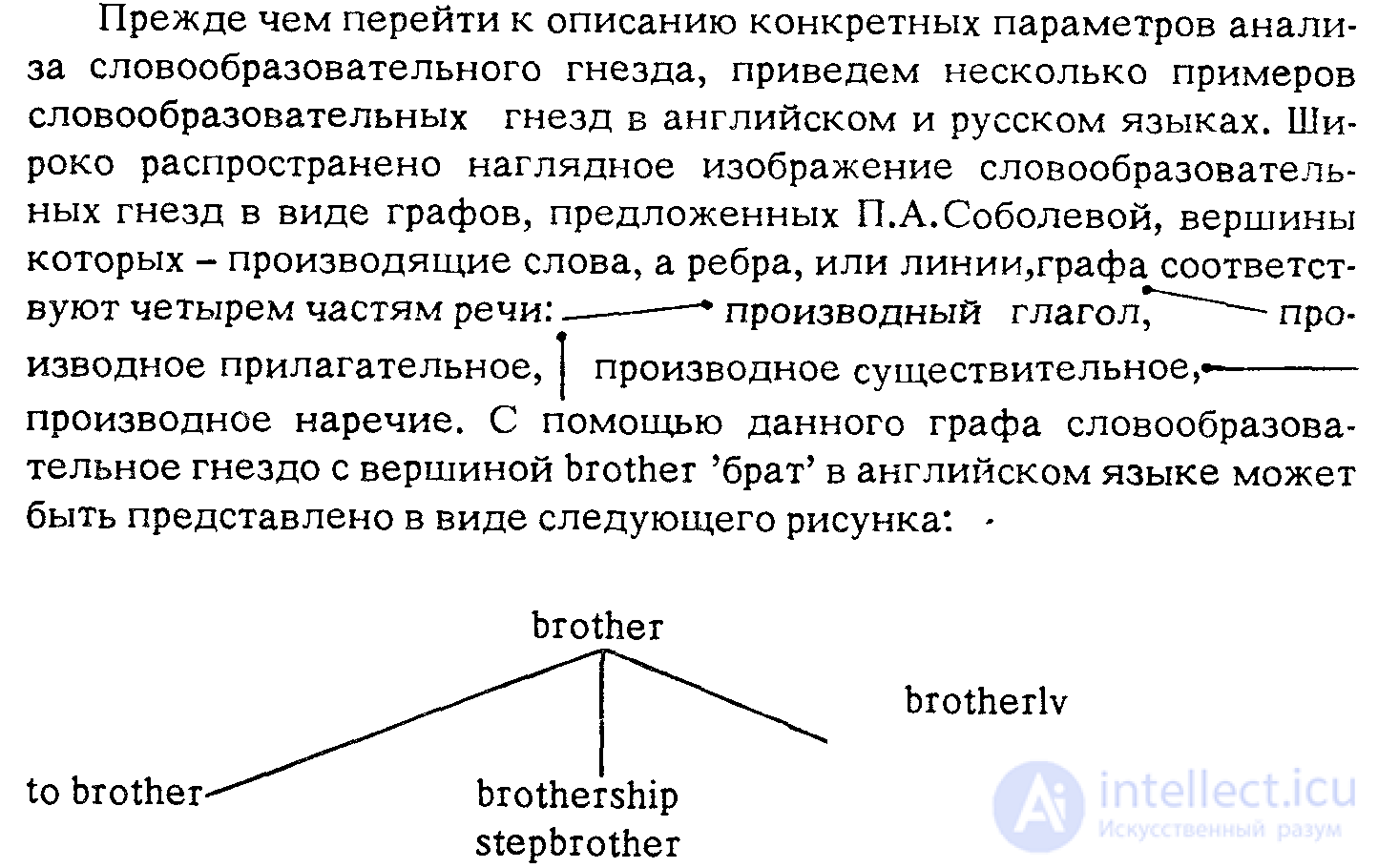
The word-formation nest headed by дочь (daughter) in the Russian language has the following form:

It should be said that in constructing word-formation nests in Russian, the method of graphic representation of the nest proposed by A.N. Tikhonov is often used. The same nest headed by дочь (daughter) can be represented differently:

Each of these methods of unfolding a nest has its own advantages and its own drawbacks. Whereas P.A. Soboleva's graph makes it possible to represent the part-of-speech relations between derivational bases and derivatives more visually, in A.N. Tikhonov's representation the whole composition of the nest and the derived word at a given step of derivation that is drawn into subsequent acts of derivation are more clearly visible. It is precisely for this reason that both methods are used in some works.
Graphic representation of word-formation nests makes it possible to easily classify them on the basis of establishing such characteristics as the size of the nest, its depth, width, regularity/irregularity, etc. The size of a nest is determined by the number of units making up its composition and varies depending on the generative potential of words in the language. Thus, the sizes of the nests given above are measured at 7 and 10 units respectively. The depth of a nest is measured by the number of derivational steps and is established according to the number of derivational acts necessary for generating the most complex derivative. (For the nest headed by brother in English it equals 1, while for the nest headed by дочь (daughter) in Russian – 2.)
The width of a nest is determined by the number of branches issuing from the head of the nest, i.e. by the possibilities of forming derivatives of different parts of speech from the derivational word (in the nests under consideration it equals 3).
A nest is regular if, at every step of derivation, the direction of derivation is preserved and there is a decrease in the generative power of the derivational bases, which corresponds to the law of the decline of the word-formation activity of a word as the degree of its derivedness increases. The nests under consideration are regular.
Our description of the word-formation nest would be incomplete if we did not say, in conclusion, that the intensive study of word-formation nests in the English language has revealed a number of interesting regularities and structural and semantic peculiarities in the makeup and history of word-formation nests in English and, most importantly, has placed on the agenda the task of a more detailed analysis of the semantic relations within a nest.
The multi-stage character and multidimensionality of the relations within a word-formation nest, and the absence of direct connections between many of its members, led to a search for another type of word-formation grouping of lexical units, groupings that are more homogeneous and closely-knit.
Such groupings turned out to be the word-formation chain and the word-formation paradigm, which reflect the relations of derived units either at different, successively arranged steps of derivation (the word-formation chain) or at the first step of derivation (the word-formation paradigm). The study of word-formation chains of the type English occur 'to occur' - reoccur 'to occur again' - reoccurrence 'a repeated occurrence' makes it possible to see the potential possibilities of forming new units on the basis of derived words, to see the semantic and formal transformations that derivational units undergo at different steps of derivation; it makes it possible, finally, to establish the autonomy and interrelation of these transformations and the syntagmatic sequences of particular derivational morphemes. With the help of a word-formation paradigm of the type occur – occurrence 'an occurrence, an event', reoccur 'to occur again', occurrent 'occurring, incidental', it becomes possible to reveal other, but also extremely important, paradigmatic properties of derivational and derived units, namely: the capacity of derivational bases to undergo certain and enumerable modifications, the semantic commonality and differences of derivatives at one and the same step of derivation, etc.
Opinions have been expressed in the linguistic literature that the word-formation nest, with the whole totality of its constituents, is equivalent to a word-formation paradigm, which is in turn isomorphic to the morphological paradigm. However, word-formation nests do not possess the features that are listed as the defining traits of the morphological paradigm: the presence of a constant magnitude typical of the structure of a morphological paradigm, the coordinate arrangement of members, the predictability of the set of formants, the closedness of the series, etc. It is therefore no accident that there are voices raised against treating the word-formation nest as a word-formation paradigm isomorphic to the morphological paradigm.
The desire to establish isomorphism between word-formation and morphological phenomena has led to the fact that the most widely accepted understanding of the word-formation paradigm is as a structurally and semantically closely connected set of derivatives formed as a result of combining a series of word-formation elements with one and the same derivational base. Just as the morphological paradigm designates not only the totality of word-forms making up a given lexical item, but also the totality of the inflectional forms of a given lexical unit, the word-formation paradigm is likewise the totality of word-formation elements attached to one and the same derivational base or class of derivational bases. There exist, however, other definitions of the word-formation paradigm as well.
The condition for the formation of word-formation paradigms of this kind is the capacity of one and the same original unit to undergo, depending on the aims of nomination and the specific character of the formal means of a given language, all manner of modifications. The richness of the word-formation means of a language is thereby increased through their combination with one and the same original units. Cf., for example, English man – manly – mannish – manlike – manless, etc., which can be represented by the following scheme:

A mandatory condition for the formation of a word-formation paradigm, an indicator of its regularity and productivity, is, in contrast to the unity of the semantic properties of the original units, the semantic contrastiveness of the word-formation means that make up the paradigm. This contrastiveness finds expression in the antonymy of word-formation meanings within the paradigm, in the difference and opposition of the "quantors", or qualificative features, of word-formation meanings, and in a number of other features. Thus, paradigms with the suffixes -y, -less or -ed, -less are characterized by an opposition of meanings of presence and absence of that to which the derivational stem points. Cf., for example, ideaed 'rich in ideas' – idealess 'devoid of ideas'; branchy 'branchy' – branchless 'without branches', etc.
Semantic contrastiveness, as a mandatory condition for the formation of word-formation paradigms, brings the study of word-formation paradigms to the forefront as one of the most important ways of penetrating into the content aspect of word-formation phenomena. The analysis of word-formation paradigms also appears relevant and necessary in terms of the typological study of languages and the theory of nomination.
The growing interest in the semantic side of word-formation and the spread of the onomasiological perspective in examining linguistic phenomena have also, to a considerable degree, made apparent the significance of such a unit of description as the word-formation category. The concept of the word-formation category, as indicated earlier, correlates with the concepts of the "lexical block" in L. Weisgerber and the "word-formation field" in O.G. Revzina and A.V. Perevoy, and represents a union of derivatives of different word-formation models or types, having a single, common meaning. Thus, the whole diversity of suffixal word-formation models in the noun system of the English language, on the basis of the commonality of their semantics, falls within only 13 word-formation categories (for example, the word-formation categories of agentivity, quality and state, action nouns, evaluation, collectivity, etc.) (see the table of suffixal word-formation fields of modern English).
Table
SUFFIXAL WORD-FORMATION FIELDS OF MODERN ENGLISH
Noun
Field of agentivity (41 SSM, 22 suffixes: -er, -ist, -ess, -ee1, -ant/-ent, -ite1, -an, -eer, -ling1, -ix, -ster, -ary1, -me, -ie/-y2, -i1, -ard, -ette3, -ory2, -een1, -enne, -erel2).
Field of quality and state (37 SSM, 16 suffixes: -ness, -ity, -ship1, -ancy/-ency, -ance/-ence1, -ation2, -ment2, -ism3, -cy1, -hood1, -age3, -y2, -dom2, -ate, -tude, -ure2).
Field of action nouns (13 SSM, 10 suffixes: -ation1, -ing1, -ment1, -ance/-ence2, -age1
-al, -ure1, -ade1,-y, -ice).
Field of evaluation (12 SSM, 12 suffixes: -let1, -ette1, -ule, -ie/-y1, -et1, -ling2, -kin, -ock, -ee2, -erel1, -le, -en).
Field of collectivity (8 SSM, 8 suffixes: -dom1, -ery3, -age2, -cy2, -hood2, -ship3,
-ing4, -ana).
Field of science, movement, direction (6 SSM, 3 suffixes: -ism1, -y1, -ics).
Field of occupation, activity (5 SSM, 4 suffixes: -ery4, -ing3, -ship2, -y3).
Field of manner of behavior (5 SSM, 2 suffixes: -ism2, -ery2).
Field of locality (6 SSM, 5 suffixes: -ery1, -ary2, -ory1, -age5, -arium).
Field of substance (6 SSM, 5 suffixes: -ing2, -ette2, -ite2, -ade2, -een2).
Field of quantity (3 SSM, 3 suffixes: -ful, -age4, -some).
Field of language and its features (4 SSM, 3 suffixes: -ism4, -i2, -ese).
Field of singularity (5 SSM, 4 suffixes: -let2, -ing5, -et2, -ton).
Adjective
Field of relation (8 SSM, 5 suffixes: -al, -ic, -ical, -ac, -ite).
Field of presence/absence of a quality (20 SSM, 13 suffixes: -y1, -less1, -ous1, -ed2, -ful1, -ish2, -able2, -ate1, -ive2, -ly1, -some1, -ory2, -ant/-ent2).
Field of ability/inability to act (13 SSM, 13 suffixes: -able1, -ive1,
-ory1,-ant/-ent1, -y3, -less2, -some2, -ful4, -like1, -ate2, -ish4, -ous4, -ly4).
Field of resemblance (13 SSM, 13 suffixes: -y2, -ish1, -ly2, -oid, -ed1, -an2, -esque, -ine2, -en2, -ate3, -ar2, -ous4, -ful3).
Field of belonging (9 SSM, 9 suffixes: -an1, -ary, -ar1, -ine1, -ish3, -ese, -ous2, -ile2, -ern).
Field with the meaning "made of" (3 SSM, 3 suffixes: -en1, -y4, -ine).
Field of causation (3 SSM, 3 suffixes: -some3, -y5, -ful4).
Verb
Field of causation (8 SSM, 4 suffixes: -ize1, -ate, -ify, -en).
The study of word-formation categories, as the results of studies conducted on the word-formation categories of resemblance, evaluation, quantity, etc., show, is highly promising, since it is here that the interaction of models within the word-formation system, the range of their functioning, and, what is very important, the role of word-formation nomination among other means of denoting phenomena of objective reality, are most clearly revealed.
+In conclusion, it must be said that the complex units of word-formation - the word-formation cluster, the word-formation paradigm and the word-formation category - together with the traditionally studied word-formation series, or types, create a solid basis for typological research and make it possible to see the specificity and place of the word-formation subsystem among other language subsystems.
The study of the functional aspect of word-formation presupposes the investigation of two interrelated problems. The first – is clarifying which functions the word-formation system is intended to perform, what roles it is called upon to play in the system of language and speech. These have been discussed earlier. The second, no less important, problem is connected with the study of the restrictions experienced by the word-formation system in its functioning, the nature of these restrictions, with the study of its sphere of operation and its specificity as compared with other subsystems of the language, the conditions under which the existing restrictions are valid or invalid, etc.
Scholars have long noticed that by some word-formation models it is possible to form an almost infinite, or at least a considerable, number of derivatives, while others are characterized by an inability to freely produce words. Without going into detail into the history of the formation of the concepts of productivity, activity and frequency, which describe the functioning of the word-formation system from the point of view of the restrictions it experiences, let us say that the most widespread is the interpretation of these concepts proposed by E.S. Kubryakova. "Productivity, – writes E.S. Kubryakova, - is rather a quantitative characteristic of a word-formation series: a model is productive when tens, or even hundreds, of derivatives have been created in the language after its pattern. On the other hand, the activity of a model – is rather its qualitative characteristic, for it means the capacity of a word-formation series to be replenished with new units. Finally, the usage frequency of a model is connected with its realization in text, i.e. with the statistical regularities of its use" (7, 21).
From what has been said above, it follows that productivity – is a static characteristic of the word-formation system, it is an
продолжение следует...
Часть 1 Word-Formation and the Morphemic Structure of the English Word: Derivational Synthesis and Morphemic Analysis
Часть 2 Word-formation meaning. The semantic connection of word-formation with other subsystems

Comments