
Lecture
The vocabulary of Modern English is enormous in its quantitative parameters and includes, as R. Quirk states, about half a million lexical units. In different situations, at different times, in different places and even in different moods, speakers tend to use lexical units that differ considerably from one another. Because it must constantly serve the highly diverse needs of speakers for means of designation that would convey information most adequately and correspond most closely to the moment of communication and to the numerous - spatio-temporal, psychological, social, etc. - properties of the communicants merging in it, the lexical system of a language turns out to be an open system, constantly being replenished with new units and shedding those that no longer meet the needs of communication. This open character is also characteristic of the individual vocabulary of native speakers, the volume of which is shaped by, and depends on, the conditions of its formation and existence and on the individual characteristics of the speakers of the given language. And the more lexical units we come to know in the process of communication, the greater the number of them we are able to use, i.e. the larger the volume of our individual vocabulary, both passive and active, the more precise and profound our connection with the society and the world around us becomes. The quantitative parameters of our vocabulary turn out to be most closely linked with the qualitative characteristics of speech perception and production, with the whole of a person's speech-thought activity. Although the precise limits of the volume of an individual's vocabulary, thanks to which he can successfully take part in the processes of communication, have not so far been determined and are on the whole difficult to calculate, it can be asserted that a native speaker possesses a considerable number of lexical units which together make up his individual lexicon. Within this lexicon one may single out the active vocabulary, i.e. those words and expressions which a speaker of the given language not only understands but also uses himself, alongside which there also exists a passive vocabulary, consisting of units which the speaker understands but does not himself use in speech. Under the influence of the processes of communication, words may pass from the active vocabulary into the passive one and, conversely, words merely perceived by the speaker may come to be actively used by him when the need arises.
What interests us, however, is not so much the division of speakers' vocabulary into active and passive, although this division is quite important and must be taken into account in learning a foreign language. Of the greatest interest, in terms of describing a language's vocabulary in a functional perspective, is the fact that the lexical system of a language, to the extent that it is possessed by a speaker, is a function of memory, from which the speaker draws, as the need arises, the units required for communication. The question arises how a speaker retains in his memory not dozens or even hundreds, but thousands of separate units, none identical to another, each characterized by its own specific sound form and its own meanings. The search for an answer to this question leads us to examine the numerous connections that exist within the lexical system of a language, thanks to which the body of lexical units becomes not a chaotic accumulation of words and set expressions but a fairly clearly, if intricately, organized system. Thanks to these connections, within the vocabulary of a language as a whole, and within the lexicon of an individual speaker, one can single out subsystems of more closely related units - certain communities of words and word-combinations organized according to one principle or another. Reflecting, as refracted through the prism of human consciousness, the connections and relations among the objects, phenomena and properties of reality denoted by lexical units, these connections become the supports by means of which our memory retains such a large number of lexical units, especially in comparison with the phonetic and grammatical subsystems. The interconnection and interdependence of the constituents of the vocabulary, based on numerous and highly diverse relations which form two fundamentally different types of relations – paradigmatic relations and syntagmatic relations, contribute to the formation of a definite network of connections within the lexical system, on which the structure of this system rests and which serves as the key to the lexical wealth contained in the memory of native speakers.
Paradigmatic and syntagmatic relations, whose diversity is dictated by the multi-faceted nature of the lexical units themselves, which represent an integral unity of phonetic, morphological, semantic, syntactic, etc. properties, become the basis on which words are organized into definite lexical structures. Linguists have long tried to describe these structures, the principles of their organization and their role in speech-thought processes. The result of these attempts has been numerous classifications of lexical units, carried out according to different principles, using different criteria, and corresponding to one or another type of relation existing between lexical units within the system of a language. Without denying the validity and usefulness of purely formal classifications of words - built, for example, on the number of sounds, the number of syllables, the letter composition, etc. - of formal-semantic taxonomies reflecting the diversity of the word-formation links of words and described in detail in the section "Word-Formation", or of etymological, functional-stylistic, territorial, etc. differentiation and grouping of lexical units, let us note that the most important type of paradigmatic relations in the vocabulary is the semantic type, and the corresponding groupings of words by meaning occupy the foremost place in systemic descriptions of vocabulary.
Back in the last century, M.M. Pokrovsky, whose semasiological investigations remain interesting and important today, drew attention to the fact that words combine (in our minds) independently of our consciousness into various groups. The basis of their combination is formed by various verbal associations reflecting the connections between objects in the surrounding reality. In modern linguistics, the semantic groupings of vocabulary have received detailed description, and careful analysis in various languages, including English, has been applied not only to closed groups of vocabulary such as kinship terms, but also to broader layers of vocabulary (e.g., names of body parts, names of animals, persons, road objects, the colour spectrum” emotions, processes of speaking, and many, many others). The main achievement of linguistic science, however, was the understanding of the basis of the semantic community of words, the development of a methodology for semantic analysis, the identification of the defining features of semantic groupings, the recognition of their universality combined with their specificity in different languages, the possibility of structuring vocabulary at different levels, and the multiplicity of relations within semantic groupings. These propositions formed the basis of the theory of the semantic field.
The starting point for this theory is the thesis that the vocabulary of a language is not a chaotic accumulation of units. Its systemic character is revealed in the distribution of words by their lexical meanings into groups of words. Different scholars have given these groups of words different names: word field, semantic field, lexico-semantic paradigm, language field, conceptual field, semantic group, lexico-semantic group, thematic group, etc., and correspondingly different definitions. What unites them all, however, is that the grouping of words into a semantic group, field or paradigm takes place on the basis of their close interconnection and interdependence in content, on the basis of one or another connection between the concepts they denote. A semantic field fixes, in a given language, in the form of a more or less autonomous microsystem, a fragment ("piece") of reality singled out by human experience. Words are grouped in the minds of speakers into semantic fields on the basis of their referents' belonging to one area of logical concepts, or on the basis of connections between concepts, which are expressed by words and which express the connections between the objects and phenomena of reality. Every word of a language belongs to a definite semantic field, and most often, owing to its polysemy, to more than one. The individual semantics of a word is revealed through its opposition to other members of the field; in terms of content, each word depends on the entire composition of the field of words close to it in meaning. A single word can be understood only on the basis of the whole set, and this characteristic of the semantic field, called the principle of presence, or combining the principle of completeness and the principle of mutual determination, is one of the defining features of the field. When a word - a member of the field - is used by a speaker or understood by a listener, all the other members of that field are somehow present as well. Moreover, a semantic field is characterized by continuity and wholeness. Language covers reality without gaps or overlaps: the members of a field are interconnected in a continuous manner and form an uninterrupted semantic continuum, which fully reproduces the real world, i.e. the conceptual picture of the given language community. Following Yu.N. Karaulov, one should also stress the historicity of the semantic field, for a field is not only a fact of language structure but also a fact of language history: languages develop within the bounds of their articulation, and this articulation is historical in character.
The above properties of a field - the connection between its elements, their ordering and mutual determination – underlie yet another fundamental property of a field – its independence, autonomy and, consequently, its principled separability. A semantic field is a separate, relatively small lexical subsystem possessing relative independence. Its autonomy is relative, since a given semantic field may have diverse semantic connections with other words. It is precisely this diversity of semantic connections that creates difficulties both in determining its boundaries and in establishing the composition of its components.
Being a universal type of linguistic segmentation of reality, and coinciding in their content-related parameters, semantic fields are at the same time characterized in each particular language by a specific structure, whose distinctiveness is dictated by the historical conditioning of the composition of the fields and of the connections formed within them, and by the national peculiarities of language systems. Since the structure of individual semantic fields is influenced by the culture and the level of development of the consciousness of the linguistic community, the level of development of the material conditions in which the life of society proceeds, and the principles of segmentation of the area of reality covered by the given semantic field, operating alongside purely linguistic factors, the structure of a semantic field acquires an individual character, which allows us to speak of the distinctiveness of the linguistic picture of the world drawn by each language. A clear example of this distinctiveness may be found in the designations of body parts in English and Russian (cf. Russian палец and English finger 'a finger', toe 'a toe'; Russian рука and English arm 'the arm (from the shoulder to the wrist)', hand 'the hand (from the wrist down)'), colour terms (cf. Russian синий, голубой and English blue 'dark blue; light blue, azure; bluish') and many other semantic fields that do not coincide in these languages in their composition and are, for that very reason, characterized by a specific network of relations. For all the distinctiveness of the structure of semantic fields, however, a core can be singled out in every field, represented by the units most widely used to express the given concept, and several zones, some of which may be located in immediate proximity to the core, while others – on the periphery of the field.
Alongside the development of a definition of semantic fields and their criterial characteristics, a search was conducted for objective methods of identifying them, methods that would make it possible to establish, objectively and consistently, the semantic commonality necessary for the formation of a semantic field. The most important milestone in this search was the understanding of lexical meaning as a definite structure consisting of sets of the smallest, further indivisible semantic components, or features, performing an integrating and/or differentiating function. Semantic features may be of varying degrees of abstraction and generality, as a result of which a word possessing one or another semantic feature is included in semantic groupings of different levels, covering different numbers of words. Thus, in the semantics of words one can single out categorial semantic features such as "substantivity", "processuality", "quality" and others, on the basis of whose commonality lexical units are grouped into lexico-grammatical classes, or parts of speech. Subcategorial semantic features are also singled out in the semantics of words, on the basis of which more closely connected semantic sets are formed within parts of speech - for example, verbs of speaking, motion, creation, destruction, etc. within the lexico-grammatical class of verbs; names of persons, names of collectives, names of animals, names of objects, names of artefacts, etc. among nouns; colour terms, and terms for taste, smell, touch, etc. features within the class of adjectives. These subcategorial semantic features receive further refinement and specification thanks to so-called classifying features, on the basis of which, among the names of animals, for example, closer semantic connections and the corresponding semantic groupings are revealed, such as: names of domestic animals, names of wild animals, names of birds, names of reptiles, and so on. The final outcome of semantic analysis, which has come to be known as componential, or seme, analysis, is the establishment of the differentiating semantic features that determine the individual semantics of a word and its distinctness from all the units with which it is interconnected through its various semantic components.
The technique of componential analysis, which works well on closed and quantitatively limited groups of vocabulary, at the same time has its shortcomings and limitations, among which one should first mention the subjectivity of the interpretation of the componential make-up of a word's meaning, the possibility of singling out an unlimited number of semes, the difficulty of determining the hierarchical status of the semes singled out, and a whole series of others. As a result of the application of componential analysis, the segmentation of the semantic continuum of the lexical system, as described in various studies, frequently fails to coincide and depends on the assumptions and aims of the study, while the metalanguage of semantic description itself turns out to be cumbersome. In part, these shortcomings are not a consequence of the inadequacy of the method itself. They stem from the complexity of the object of study itself, from the vagueness and diffuseness of the boundaries between semantic groupings, from the possibility of one and the same ” word entering into different lexico-semantic classes, from the complexity of the multiplicity of semantic relations between words, from the difficulties involved in distinguishing the lexical from the grammatical, from the diversity of types of stratification of lexical systems, and from many other causes. Moreover, the analysis of each specific semantic field is bound up with a number of its own problems. Thus, for example, in the course of analysing the names of body parts, the question arises as to which words have the meaning of a body part not as their primary but as a derived meaning; which names of parts of the human body have come to be used in other meanings and have now entered other semantic fields; which parts of the body have names; what the morphological structure of the names of body parts is; and even the question of what actually constitutes a body part, and whether names such as blood, muscles, bone, hair, etc. belong among the names of body parts, and if not, to which semantic fields they should be assigned. The relative ease of singling out and analysing the core of a semantic field gives way to a mass of difficulties in determining and describing its periphery.
The difficulties of the semantic analysis of fields are also connected with the fact that different fields are characterized by different types of structures and correlations within the field. In the general typology of semantic field structures created by C. Fillmore, the most thoroughly studied and best-known type is the paradigm. A paradigm – is a group of words having one common semantic feature and differing from one another by other features, each of which participates in distinguishing more than one pair of words. Thus, the relation between man 'an adult human male' and woman 'an adult human female' is paradigmatic, since their semantic difference also participates in distinguishing the words boy 'a male child' and girl 'a female child', actor 'a male performer' and actress 'a female performer', and many others. The semantic difference between the words wolf 'a wild canine, Canis lupus' and fox 'a small wild canine of the genus Vulpes', however, is not paradigmatic, since it does not serve to distinguish any other pair of words.
Paradigms consisting of a large number of words, C. Fillmore notes, are not encountered too often, especially in the sphere of common vocabulary. A classic example of a paradigm is the paradigm of words connected with domestic animals, in which such distinctive features as "male/female/neuter", "adult/young/offspring", "the name of the person who tends this type of animal", "the name of the act of giving birth to offspring", etc. are used. This paradigm is incomplete, since English has no word meaning "young sheep" corresponding to such words as heifer 'a young cow that has not yet calved', filly 'a young female horse', gilt 'a young female pig that has not yet farrowed'; nor can this paradigm be considered especially active, since many speakers of English do not even know words such as wether 'a castrated ram', barrow 'a castrated male pig', whelp 'a puppy' or tup 'a male sheep, a ram'.
Two other (not very widespread) types of field structure are, according to C. Fillmore, cycles and chains. Examples of cycles: English spring 'the season after winter' - summer 'the warmest season of the year' - autumn 'the season after summer' - winter 'the coldest season of the year'; Russian утро - день - вечер - ночь (morning - day - evening - night), etc. A chain – is a set of words connected by some rank relation. Examples of a chain structure may be found in military ranks or the names of a mixer's speed settings.
Another type of semantic field structure is the network, which can be illustrated using kinship terms as an example. A network is built on the basis of several simple relations. In the example with kinship terms, the most typical relations will be "to be married to (someone)" and "to be the parent of (someone)", as well as "older than".
An important type of semantic field structure is the partonomy, understood as a structure in which words are connected by a "part - whole" relation. A typical example is provided by the structure of the field of body-part names: English nail - layer of hard substance over the outer tip of a finger, or toe; finger - one of the five members at the end of a hand; hand - part of the human arm beyond the wrist; arm - either of the two upper limbs of the human body; cf. Russian ноготь (nail) - part of the finger; палец - (finger) part of the hand; кисть (hand) - part of the arm; рука - (arm) part of the body.
+The most significant, in Ch. Fillmore's opinion, is the type of structure known as a frame. The concept of a frame is easier to demonstrate through examples than to describe in general terms. Let us take as an example the frame associated with trade. The situation "commercial transaction" consists in the fact that some person exchanges his money for goods or services obtained from another person. There is a multitude of English words describing various parts and aspects of this situation, for example buy 'to obtain in exchange for money', sell 'to give in exchange for money', pay 'to give money owed', spend 'to pay out money', cost 'to require the payment of', charge 'an amount asked in payment', price 'the amount of money asked for something', money 'a means of payment', change 'to exchange money', and dozens of others. Within the set of words belonging to one frame, one can single out subsets forming paradigms, taxonomies and other types of structures; however, their semantic description is possible only on condition of a prior detailing of the conceptual scheme underlying the frame.
Among the most important types of semantic field structures, Ch. Fillmore names contrastive sets and taxonomies, which are also known as antonymic pairs and hypero-hyponymic series. Together with synonymic groups, they reflect fundamental paradigmatic relations in the vocabulary, from which follows the need for a more detailed description of them compared with other types of structures.
The term "hyponymy" is not among the traditional terms of semantics and was coined comparatively recently, by analogy with antonymy and synonymy. However, the type of relation denoted by this term between units of the lexico-semantic system of a language, based on their generic-specific conceptual commonality, has been known for a long time and is recognized as one of the most important constitutive principles of the organization of the vocabulary of all languages. This is a relation of inclusion or dominance, in which one word (called the hyperonym) denotes a class of entities that includes the class of entities denoted by another word – the hyponym, and is thus broader than it in meaning. There are quite a number of sets of words in the lexical system connected with one another by relations of subordination and dominance. They form so-called hypero-hyponymic series, or, according to Ch. Fillmore, taxonomies. A classic example of this kind of structure in the lexico-semantic system is the designation of plants. Within the series of plant names, the most general term plant 'a living organism belonging to the kingdom Plantae' stands out, being generic in relation to all other plant names. The names tree 'a tall woody plant with a single trunk', bush 'a woody plant smaller than a tree, with several stems', grass 'a low plant with narrow green leaves', flower 'a plant grown chiefly for its blossom', etc. stand, in relation to the generic name, or hyperonym, as subordinate terms, connected with the designation of narrower classes of plants, of their individual subtypes. These, in their turn, have a whole series of words subordinate to them - the names of specific kinds of trees (birch 'a tree with thin peeling bark', asp 'a species of poplar', pine 'an evergreen coniferous tree', etc.), of flowers (tulip 'a spring bulb plant with a cup-shaped bloom', daffodil 'a yellow spring bulb plant', rose 'a thorny shrub with fragrant blooms', etc.), of bushes, grasses, etc. - and are related to them as hyperonyms and their subordinate hyponyms. It is evident that hypero-hyponymic relations occur when the semantics of words connected by relations of inclusion reveal shared semantic features, forming part of each of the compared meanings, and additional (at least one) features distinguishing one meaning from the other of the compared meanings. The word tulip 'a spring bulb plant with a cup-shaped bloom' includes in its meaning the semantic features of the word plant 'a living organism belonging to the kingdom Plantae' and the semantic features of the word flower 'a plant grown chiefly for its blossom' that further specify it, as well as containing a number of additional features distinguishing it both from the words named above and from the names of all other kinds of flowers. From this example it is clear that a hyperonym is broader in the scope of its reference, or extension, but narrower in the content of the concept it fixes, in comparison with the hyponym, i.e. narrower in the set of attributes characterizing any entity, or its intension. The meaning of the hyperonym, as a more generalized meaning, becomes specialized in the meanings of all its hyponyms. A single hyperonym has as many hyponyms as there are features of the concept expressed by the hyperonym that are specified and fixed in the lexical meaning or meanings of the word or words.
Alongside relations of subordination and dominance within hypero-hyponymic series, there also exist relations of equality, which are established between the hyponyms of one and the same hyperonym. Such hyponyms are called co-hyponyms, or equonyms, and are distinguished by the differential features singled out in their meanings, while sharing some common semantic part. Within the series of flower names, the words tulip 'a spring bulb plant with a cup-shaped bloom', rose 'a thorny flowering shrub\ violet 'a small plant with purple or blue flowers' and others are equonymous with one another.
The types of relations named above can easily be represented in the form of formulas:
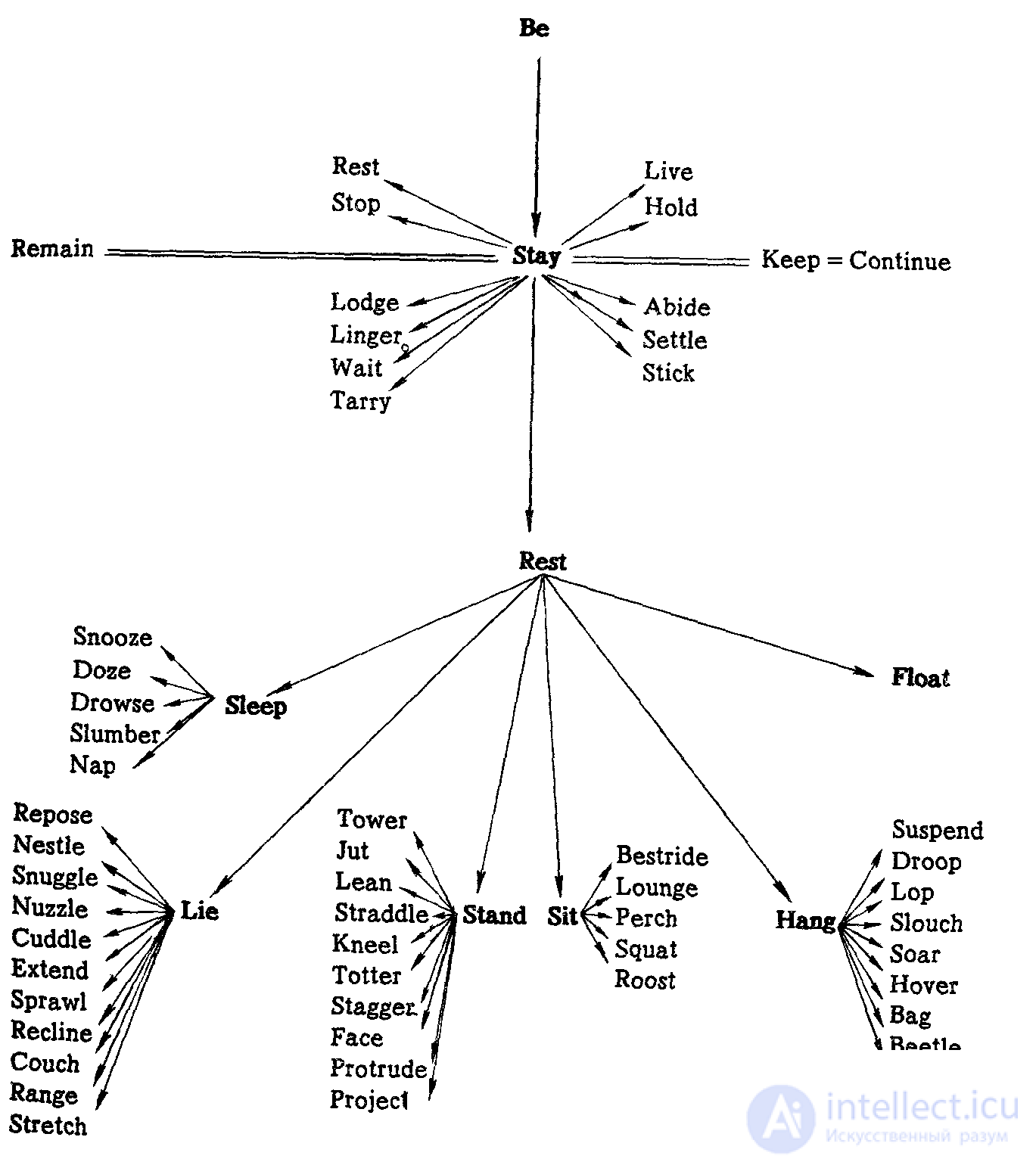
+Xc(X + n) and (X + n) ∩ (X + m), of which the first fixes the relation of hyponymy proper, and the second – the relation of equonymy. The general scheme of these relations forms a hyponymic configuration, which turns out to be distinctive and unique for different semantic fields in different languages. Since a hyperonym can be made more specific not only in its immediate hyponyms, but also at subsequent levels, at which its immediate hyponyms in turn act as hyperonyms, themselves further specified at further levels of the hypero-hyponymic structure, the hyponymic configuration of a semantic field can be multi-level, or multi-tiered, and can take the form of a chain (hyperonym - one hyponym), radial (hyperonym - more than one hyponym) or radial-chain (mixed and most complex) structure. The depth and breadth of the unfolding of the hyponymic structure, and the type of hyponymic configuration associated with them, determine the specificity of a given semantic field of words both within a language and across different languages. Studies of hyponymic structures that have been carried out have revealed the national specificity of their construction. Thus, verbs of rest in Modern English form a four-tiered hyponymic structure (see the figure on p. 89), whereas the corresponding verbs of rest in Russian form a three-tiered hierarchy. Two basic forms of hyponymic relations were also identified: hyponymic relations between lexical units - external hyponymy (which is what was discussed above) - and hyponymic relations within a lexical unit – internal hyponymy, which constitutes a special type of intra-word relation of a polysemantic word (see "Polysemy").
In the structure of semantic fields there is another widespread and well-known type of semantic relations, traditionally described as synonymy. The notion of synonymy has long been the subject of diverse linguistic interpretations. There exist the most contradictory views on what synonyms are, what kinds of synonyms exist, how real this notion is in general, and so on. There are also various definitions of synonyms. Synonyms are defined as words having identical meaning. They are also defined as words having close meaning. There is a definition of synonyms as words denoting one and the same concept, or able to denote one and the same object. All this diversity is explained by the fact that in language there exist various types of semantic convergence, which are reflected in the corresponding definitions of synonyms. As D.N. Shmelev writes, synonymy appears as a phenomenon of nomination that begins with the complete identity of the semantics of words naming one and the same thing, and passes through various degrees of gradation of semantic closeness to the expression of such a degree of difference in lexical meanings that the question arises: are words close in meaning synonyms or not.
The cardinal question of synonymy is the problem of the criteria by means of which the synonymy of lexical units is determined. Among the most widespread and most widely used criteria the following should be named: 1) identity, or closeness, of meanings, the origins of which lie in the identical reference of words, in their denoting one and the same entities or phenomena (e.g., victim 'a victim', prey 'a victim, prey'; pleasure 'pleasure', delight 'pleasure, delight, rapture', joy 'joy', enjoyment 'pleasure, delight, enjoyment', delectation 'pleasure' and so on), 2) interchangeability in context (e.g., I'm grateful (thankful) to you (for help) 'I am grateful to you (for the help)', I'm grateful (thankful) for all you have done for me 'I am grateful to you for all you have done for me'; It's a hard (difficult) problem (book, language) 'This is a difficult problem (book, language)'). Both these criteria, however, are quite defective, since words may be characterized by identity of reference between which no closeness of meaning is found, even though they denote one and the same object (e.g., mother 'mother', wife 'wife', daughter 'daughter', doctor 'doctor', etc. may refer to one and the same person appearing in different aspects). Identity of reference is thus a necessary but not a sufficient condition for synonymy, for two units may possess identical reference yet differ in meaning. As for the criterion of interchangeability, there are very few words in a language that would be interchangeable in all contexts, provided that the sentences resulting from substituting one unit for another possess one and the same meaning. Words admitting such substitution, the so-called genuine synonyms, are very rare and, in the words of S. Ullmann, are a luxury that a language can ill afford.
An interesting attempt to overcome the difficulties described above, connected with the definition of synonymy, is the treatment of synonyms proposed by D.N. Shmelev. "Lexical units opposed by such features as turn out to be inessential under certain conditions can be regarded as synonyms," writes D.N. Shmelev (18, 193). The author further continues: "Thus, synonyms can be defined as words belonging to the same part of speech, whose meanings contain identical elements, while the differing elements are consistently neutralized in certain positions. In other words, words can be recognized as synonyms if they are opposed only by such semantic features as become inessential in certain contexts" (18,196).
The number of common coinciding semantic elements in different words, as well as the number of non-identical elements, and also the number of positions in which semantic differences become inessential, is not the same. Accordingly, on this basis one can speak of a different degree of synonymy for different words. In this respect the classificatory scheme of types of synonymy worked out by J. Lyons is of interest, in which the author, proceeding from the definition of full synonymy as the absolute equivalence of two units and total synonymy as interchangeability in all contexts, distinguishes four kinds of synonymy: 1) full and total synonymy; 2) full but not total synonymy; 3) incomplete but total synonymy;. 4) incomplete and non-total synonymy. At the same time it is incredibly difficult to enumerate the types and degree of synonymy, since words described as synonyms display various kinds of differences. S. Ullmann quotes Professor W.E. Collinson, who presented all the kinds of differences between synonyms as nine possible cases:
1) one word is more general than another: refuse 'to refuse, reject' - reject 'to reject, decline';
2) one word is more intense than another: repudiate 'to repudiate' - refuse 'to refuse, reject';
3) one word is more emotional than another: reject 'to reject, decline' - decline 'to decline, deflect, refuse.
4) one word may contain a moral evaluation or condemnation, while the other is neutral: thrifty 'thrifty, economical' - economical 'economical, thrifty';
5) one word belongs to professional usage, while the other does not: decease formal 'decease, death' - death 'death';
6) one word is more bookish than the other: passing poet. 'death' -death 'death';
7) one word is more common than the other: turn down 'to reject, refuse' – refuse 'to refuse, reject';
8) one word is a dialectism, while the other is not: Scots-flesher Scot. 'butcher' - butcher 'butcher';
9) one of the synonyms belongs to child speech: daddy colloq. 'daddy, dad' - father 'father'.
To this list of differences, from which the origins and causes of synonymy as a phenomenon of nomination become evident, besides those indicated above, one should add, following F.R. Palmer, differences in collocability. Thus, rancid 'rancid, tainted' occurs in combination with bacon 'bacon', butter 'butter', while addled 'rotten, spoiled'” with egg 'egg'. Close or even identical qualities, but belonging to different objects, receive different designations in language, which entails their semantic closeness and at the same time conditions their different collocability. It is therefore no accident that synonymy is widespread precisely in the sphere of attributive words - abstract nouns, adjectives, verbs. At the same time the possibility of gradation of a feature, the singling out of certain points on the general scale of a property, and the closeness of their location also act as a significant factor determining the emergence of synonymy.
Turning once more to the list of differences between synonyms mentioned earlier, one cannot fail to notice that many of the listed types essentially form a single type: synonyms differ in their belonging to different functional styles, or registers, of speech, differ from one another in the emotive component of their meaning, etc. A far more coherent and at the same time exhaustive typology of differences between synonyms is presented by Yu.D. Apresyan in the afterword to the English-Russian Dictionary of Synonyms. In this typology all the observed differences between synonyms are reduced to 4 types: a) purely semantic differences, b) evaluative differences, c) differences in semantic associations, and d) differences in logical emphasis.
Most interesting and at the same time most complex and varied are the purely semantic differences that determine the distinctions between synonyms. Semantically differing synonyms in most cases express notions of actions, events, situations, processes, states, properties (as opposed to purely stylistic synonyms, which most often name objects). Yu.D. Apresyan writes that actions, situations, events, etc. may differ in their participants (subject, object, addressee, instrument, means) and in their own characteristics (cause, result, purpose, motivation, place, final and initial point, time, manner, character, degree, form of manifestation, etc.). It is precisely the types of participants and the generalized characteristics of actions, situations, and states that in very many cases serve as the distinguishing features of synonyms. For example, temporal characteristics underlie the differences between the synonyms associate, pal and comrade 'friend, comrade', companion 'companion', crony 'close, bosom friend'. Associate, pal, comrade presuppose the presence of social and emotional ties between people over a considerable period of time; they cannot denote brief contacts that arise and break off easily (in games, on a train, etc.). Companion is capable of such usage. Crony denotes a situation of old friendship that began in childhood or youth and continued, possibly with interruptions, into mature years. A different degree of a property distinguishes the synonyms expert 'expert, knowledgeable' and skilful 'skilful, adept, expert': expert denotes a higher degree of skill than skilful. Similar differences in degree are found in the series surprise 'to surprise', astonish 'to astonish', amaze 'to amaze'; cool 'cool', cold 'cold', frosty 'frosty', icy 'icy'. Intentionality/unintentionality distinguishes the synonyms of the series gather, collect, assemble 'to cause someone to gather in one place'. Gather does not express intentionality of the action. Collect always presupposes a certain intention on the part of the subject, while assemble – also presupposes the circumstance that the purposes of the subject and the object of the action coincide or are similar and that they are usually of a social or political character.
Evaluative differences between synonyms are conditioned by the fact that the situation described by a word, or its participants, may be evaluated by speakers and listeners from a great variety of standpoints. However, among the distinguishing features of synonyms only two types of evaluation actually figure - a positive or negative reading of the speaker's attitude to the subject of the utterance. Stir, flurry, fuss, ado, for example, denote disorderly or hurried activity, and sometimes also the excited state of a person that gives rise to it (cf. Russian суматоха, суета, переполох - commotion, fuss, turmoil). The latter two synonyms differ from the first two, in particular, in that their definitions contain an evaluation - an indication of the speaker's disapproving attitude toward excessive activity over trifles.
Differences between synonyms may also run along the line of associations connected with a given word. Jump, leap, spring, bound, skip, hop in the meaning 'to jump or move by jumps' display the following features. Jump has the most general meaning. Leap describes an elongated, light, smooth and swift jump, resembling the leap of an antelope. Spring, and to a lesser extent bound, denote a powerful, springy jump with a sharp push-off from the point of support, bound being associated with the leap of a beast of prey. Skip and hop, which denote small jumps, are not associated with the notion of force and are therefore not used, for example, to describe situations of attack. Skip points to the speed, lightness, and gracefulness of jumps, often performed with alternating feet. Hop means to make one or a series of small jumps, perhaps clumsy, on one leg, on both legs at once, or with alternating legs; it is associated with the jumps of a frog, a bird, a grasshopper.
Differences in logical emphasis are observed in the semantics of the synonymous adjectives hard, difficult 'difficult, requiring, because of its complexity or the presence of obstacles, the expenditure of great effort'. In hard the idea of the necessity of expending great effort is emphasized. Difficult focuses attention to a greater extent on the complexities and obstacles lying on the way to solving a task.
From an examination of the types of differences existing between synonymous words, it follows quite obviously that the differences between synonyms do not run along the line of their lexical meanings taken in their entirety, but concern only certain semantic components of the lexical meanings, given the obligatory commonality of the other portions of the structure of the lexical meaning.
Semantic closeness and the synonymic relation of words that follows from it, based on one of their lexical meanings, does not presuppose and does not exclude the possibility of synonymic relations based on other lexical meanings of polysemous words. Accordingly, a polysemous word may belong simultaneously to several different synonymic series or groups. Thus, the word part, owing to its polysemy, turns out to be a member of nine synonymic series: 1) piece, parcel, section, segment, fragment; scrap, crumb; moiety, remnant, portion, section, division, subdivision; 2) member, organ, constituent, element, component, ingredient; 3) share, portion, lot; 4) concern, interest, participation; 5) allotment, lot, dividend, apportionment; 6) business, charge, duty, office, function, work; 7) side, party, interest, concern, faction; 8) character, role, cue, lines; 9) portion, passage, clause; paragraph.
Within synonymic series a synonymic dominant is singled out, that is, the component of the series whose meaning is the most generalizing. As a rule, the words that act as synonymic dominants are of native origin, most frequent, and stylistically neutral. Such is the verb leave in the series leave, abandon, desert, book. or poet. forsake with the general meaning 'to leave, quit, abandon someone; to give up someone; to depart, vanish, go away'. The synonymic dominant of the series hate, loathe, detest, abominate, abhor, with the general meaning 'to hate, not to be able to bear someone or something', is the verb hate.
+In conclusion it should be noted that, in the opinion of many linguists, the English language is particularly rich in synonyms. The cause of this richness is seen in the historical development of the vocabulary of the English language and the intensive borrowing from French, Latin and Greek. Owing to this, in the English language there exist pairs of synonyms of which one word is native and the other borrowed, as is observed in the synonymic groups brotherly, fraternal 'brotherly', buy, purchase 'to buy', world, universe 'world, universe' and others. In the English language synonymic groups of three members are not infrequent, in which one word is of native origin, another is borrowed from French, and the third came directly into English from Latin or Greek. For example: begin, commence, initiate 'to begin, to start', end, finish, conclude 'to end, to finish' and others.
Antonymy is often treated as a phenomenon opposite to synonymy, but the status of these two phenomena in the system of language is completely different. In principle, language does not feel a real need for synonyms and could quite well do without them, although, of course, this would entail a considerable restriction of stylistic variety, an impoverishment of the language system. According to J. Lyons, synonymy is not in itself a structural relation and does not play an essential role in the semantic structure of language, but arises in certain contexts as a consequence of more fundamental structural relations, hyponymy and incompatibility, neutralized under the influence of context (9, 476). Antonymy, or oppositeness of meaning, undoubtedly belongs to the most important semantic relations, which form the simplest type of structure, or a contrastive set. The abundance of units opposite in meaning in natural languages is apparently connected with a universal human tendency to place at the polar points of scales the experience and evaluative judgments accumulated by mankind. Small groups are formed in which, knowing the meaning of one of the members of the group, it is easy to understand the meaning of the other members, for the members of an opposition formed on the basis of contrast are not given to the speaker outside the opposition itself. The simplest examples of contrastive sets may be provided by the most various types of semantic oppositions: tall/short 'tall'/'short', dead/alive 'dead'/'alive', raw/cooked 'raw'/'cooked or fried', etc. Such ease of understanding the meanings of all the members of a group on the basis of knowledge of the semantics of only one of its components is due to the fact that, in semantic terms, antonyms are words highly homogeneous in their meaning structure. Antonymic meanings, opposed to each other in the whole of their content, differ paradigmatically only in a single differential feature.
The cardinal problem of antonymy is the definition of the concept of oppositeness, which may embrace fairly heterogeneous phenomena: associations by contrast, opposedness in nature, mutual exclusion, contrariety of concepts, etc. The existence of many varieties of oppositeness - this logical basis of antonymy - determines the existence in language of various types of antonymy, and the definition of antonymy receives corresponding refinements. As L.A. Novikov points out, words are antonyms if they and their semantic relations with one another satisfy one of the following requirements:
1. Words X and Y correspond to opposite (contrary) concepts, represent the extreme members of an ordered set and express contrary oppositeness: X – not X, not Y – Y (of the type young 'young' - not young/not old 'not young'/'not old' - old 'old').
2. Words X and Y express the oppositeness of oppositely directed actions, features, etc. This oppositeness is called vectorial and can be denoted as X →← Y (e.g., come 'to come' – leave 'to leave').
3. Words X and Y correspond to formally contradictory concepts of the type X – not X, but function in the language as opposites, as an expression of contradictory oppositeness. A characteristic feature of such oppositions – the absence of a middle, intermediate term. E.g., married 'married' ' single 'single', true 'true' – false 'false' and others.
4. Words X and Y, denoting one and the same situation, act as different names for one and the same action, relation, etc., reversed from the point of view of the opposed participants in the situation, and express conversive oppositeness. E.g., buy 'to buy' - sell 'to sell', win 'to win' - lose 'to lose', etc. Thus the class of antonyms turns out to be semantically many-faced and includes contrary, contradictory, conversive and vectorially oppositely-directed antonyms. Each of these types of antonyms has its own characteristics. Thus, contrary antonyms are characterized by the fact that they regularly admit of gradation, which is linked to the operation of comparison, and presuppose the existence of some point of reference or norm relative to which a certain degree of a quality is asserted. Such, for example, are the adjectives big 'big' - small 'small', which receive a different interpretation depending on what is taken as the point of reference. Cf. a small elephant 'a small elephant' and a big mouse 'a big mouse', for which the norm is the size of different classes of objects: elephants and mice, the norm itself proving to be relative, since the smallest elephant in the real world is bigger than the biggest mouse. It is interesting that the negation by a contrary antonym of the presence of some quality does not imply the presence of the opposite quality. When we say that Our house is not big 'Our house is not big', this does not mean that Our house is small 'Our house is small'. It is precisely this property that distinguishes contrary antonyms from contradictory ones, which are linked by a relation of complementarity and in some works are called complementary, i.e. supplementary. Contradictory antonyms are characterized by the fact that the negation of one member of the pair implies the assertion of the other, and the assertion of one member of the pair implies the negation of the other, i.e. these are mutually exclusive words. When we assert that John is single 'John is single', we thereby unambiguously imply that John is not married 'John is not married', and vice versa: asserting that John is married 'John is married', we deny that he is single. One can imagine not entirely ordinary situations in which contradictory antonyms undergo modification (cf. Russian Он скорее женат, чем холост - he is more married than single), but in their normal use this type of antonym is non-gradable. Conversive antonyms of the type husband/wife 'husband'/'wife', parent/child 'parent'/'child', doctor/patient 'doctor'/'patient', lend/borrow 'to lend'/'to borrow', give/receive 'to give'/'to receive' are also joined by words denoting reversive actions of the type tie/untie 'to tie'/'to untie', wind/unwind 'to wind'/'to unwind' and others.
Among vectorially oppositely-directed antonyms various subtypes are also found, connected with the designation of orthogonal oppositions (e.g., North/West/East 'north/west/east'; East/North/South 'east'/'north'/'south'), antipodes (e.g., summer/ winter 'summer'/'winter', North/South 'north'/'south', East/West 'east/west'), causal relations (e.g., learn/know 'to learn'/'to know', know/forget 'to know'/'to forget') and different directions of actions (arrive/depart 'to arrive'/'to depart').
Antonyms also differ in their structural characteristics. A considerable number of antonyms – are words of different roots, of the type clever/stupid 'clever'/'stupid', slow/fast 'slow'/'fast', love/hate 'to love'/'to hate'. Antonymy of different roots (also called lexical antonymy) permeates all parts of speech, especially adjectives, verbs, adverbs, nouns. Numerous groups of antonyms are formed by the addition of affixes opposite in meaning: happy/unhappy 'happy'/'unhappy', merciful/merciless 'merciful'/'merciless, cruel' etc. The result of word-formation processes are single-root (affixal) antonyms.
The concept of enantiosemy is often linked with antonymy, i.e. the phenomenon whereby opposite meanings turn out to exist within the semantic structure of one and the same polysemous word. E.g.: dust 'to wipe off, brush off dust; to sprinkle, dust with'. In other words, enantiosemy differs from antonymy only in that it is an intra-word relation, whereas antonymy presupposes inter-word connections.
Summing up the review of the various types of semantic relations and connections in the lexical system of a language, on the basis of which the distinctiveness of its structure is formed and words are united into structural groups of various types, it is necessary to stress once again the social, historico-genetic and individual conditioning of the vocabulary of a language and its structure. The national specificity of the lexical system is manifested in the distinctiveness of all the previously examined types of relations: synonymic, antonymic, hyponymic, etc., united into a single whole – a semantic field or group, the totality of which constitutes the continuous semantic space of a language.
продолжение следует...
Часть 1 Semantic Relations Between Words in the Lexical System of Modern English: Semantic Classes, Hyperonym-Hyponym Sets,

Comments