
Lecture
Lexical unit - a word, a set word-combination, or another unit of language capable of denoting objects, phenomena, their features, etc.
A lexical unit – a semantic unity, a simple or complex notion expressed by one word or a word-combination, none of the components of which can be omitted without changing the meaning of this unity.
The vocabulary of the subject-heading language, or the word-stock, is the set of lexical units included in a dictionary.
In the subject-heading language, lexical units perform the functions that are characteristic of the vocabulary of a natural language.
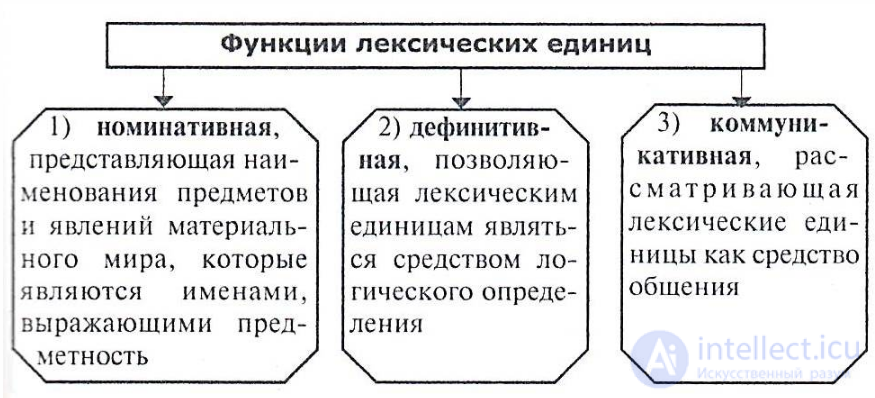
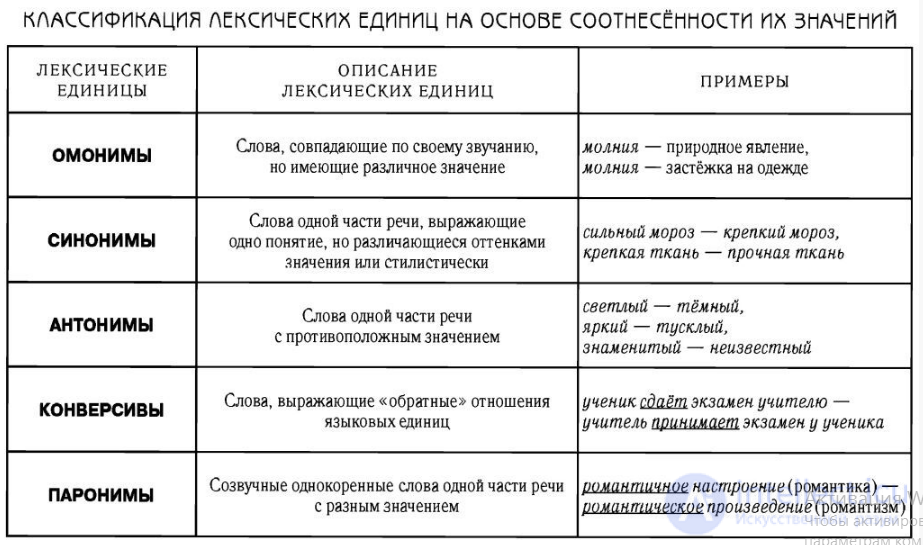
The emergence and functioning of lexical units is determined above all by the needs of communication and is linked with the processes of nomination, i.e. the processes of naming this or that object, phenomenon, property, etc.
For the construction of utterances, in which the speaker conveys a particular thought to their interlocutor or interlocutors, communicating some piece of information, building material is required. Nomination, as a result of which this building material is created, and with it a system of material, sensorily perceptible language signs designed to meet the needs of the language community for designating individual objects and classes of objects, their properties and relations, as well as facts, events and situations, is an extremely complex process. It is characterized by a diversity of forms, means and functions. In the general descriptions of the processes of nomination proposed by Soviet scholars, particular attention is drawn to the distinction of the processes of nomination, firstly, by the type of language forms and objects of nomination. Depending on the language forms used - words, word-combinations or sentences – within the general category of nomination the following are distinguished: a) nomination through a word and a word-combination (lexical nomination), b) nomination through a sentence (propositional nomination), c) nomination through a text (discursive nomination).
Lexical nomination is used, as a rule, to name elements of a person's external and internal experience. The objects of lexical nomination, or nominata, are certain elements of reality: an object, a quality, a process, relations (temporal, spatial, quantitative, etc.), any real or conceivable object. These elements of nomination find expression in any language and form the objective foundation for the emergence of the main classes of words that name them - nouns, verbs, adjectives, adverbs, numerals, and various kinds of function words.
The object of naming in propositional nomination is a microsituation – an event, a fact, uniting a number of elements and representing complex and multidimensional formations.
The object of naming through a text, or discursive nomination, becomes an even more complex chain of situations.
It is evident that as the object of nomination becomes more complex, the complexity of the means of nomination used also increases. By combining words – the initial and simple units of nomination, used in their various forms (the laws of word combinatorics in the processes of word-formation, the formation of word-combinations and sentences will be discussed in the corresponding sections), the speaker builds names that are more complex in structure, and as a result obtains complex units: derived words, word-combinations, sentences and ultimately a text. In the general inventory of language units, the word acts as the basic, main and leading unit of nomination, in relation to which all other units turn out to be derivative or auxiliary.
The relationship described between the object of nomination and the means of its designation is not rigid. A word can name both an event and a fact, while a sentence – any objects (e.g., This is what was lying on the table). At the same time it reflects the most typical correlation of these quantities and the obvious tendency toward increasing complexity of the means of nomination used as the object of nomination becomes more complex.
The second most important direction in the description of the processes of nomination is their examination in the functional-genetic aspect, from the point of view of the use of language elements and units in their basic, primary function, i.e. directly for what these units were specially created, or else for other nominative purposes. The use of language forms for their original purposes, to denote specific objects, is known as primary, or direct, nomination, and the forms themselves – as primary language signs. However, the need for names is enormous and practically infinite, just as the world cognized by man is infinite in the whole diversity of properties and connections already discovered and being discovered anew in the course of human activity. Creating a separate designation, unique to it alone, for each individual object, phenomenon, or separate class of objects, phenomena, properties, relations, etc. would entail the emergence of an extremely cumbersome and correspondingly inconvenient lexical system. Because of this, and also, possibly, owing to the limitations imposed by the capacity of human memory and other features of human psychology, one and the same language element is often used to denote, besides what it already denotes, some other objects, phenomena, properties, and to perform some other functions. This is how secondary nomination takes place and secondary names arise, such as English hand, which in its primary function denotes 1) the hand, and as a result of the processes of secondary nomination acquired the meanings: 2) a forefoot or foreleg, 3) power, authority, 4) skill, dexterity, 5) a worker, a hand, 6) the arm (of a semaphore), and others. Secondary names also include lexical units such as English keyhole 'a hole for a key', formed by combining key 'key' and hole 'an opening', hunter 'one who hunts', kindness 'the quality of being kind', formed by suffixation, black pudding 'a sausage made from blood' and many similar examples both in English and in any other natural language.
The repeated use of language forms for purposes of nomination is of great importance, since: a) it makes it possible, using means already available in the language, to designate something for which there was no special name, and thereby to fill lexical gaps, b) it creates a stylistic effect (for example, when the names of animals are used to denote people possessing some negative qualities, cf. cat 'a bad-tempered woman' and goose 'a fool, a simpleton', bulldog 'a stubborn, tenacious person', etc.), c) it performs a structural, functional role (cf. the use of the verbs be, have, do, etc. as auxiliaries in forming the tense forms of verbs in modern English).
The use of language elements both in their own, primary functions and in secondary, non-inherent functions leads to the formation of a fundamental property of language signs – their asymmetry, or the ambiguous correspondence between a language form (a complex of sounds or letters) and its content, formulated by S. Karcevsky as the principle of "asymmetric dualism".
The ability of a language form to be connected with a whole range of signifieds and accordingly to express several meanings, and, conversely, the connection of one signified with several language forms, become possible owing to a fundamental property of the original, primary language units, namely: their arbitrariness, or unmotivatedness. Despite the direct and inseparable unity of the form and content of lexical units accepted by a given language community, the form itself, chosen to designate this or that object, phenomenon, etc. and to express a certain content, does not depend on the thing designated, i.e. it is conventional, or arbitrary, in relation to the signified, which is proved above all by the existence of different languages. The primary language form, as F. de Saussure points out, has in reality no natural connection whatsoever with the given signified. Owing to the arbitrariness of the language sign, the choice of a sound complex for the designation the speaker needs is not conditioned by any properties of the thing designated. This makes it possible to use various technical devices and means for nomination: onomatopoeia, the use of a sound complex denoting one of the features inherent in the phenomenon designated (the most common way), the formation of one word from another and compounding, the formation of phraseological word-combinations, borrowing and loan translation. The means of nomination listed, as academician B.A. Serebrennikov points out, are common to all languages of the world.
Using, however, a fairly limited system of means for expressing meaning and, in principle, a single technique of nomination, different language communities nevertheless create original systems of names which, in an ordered way, represent the diversity of the surrounding world and are thus its own distinctive linguistic pictures. This originality is based, firstly, on the peculiarities of the conditions – territorial, climatic, economic, social, etc. – of existence of a given language community, which give rise to the presence in languages of so-called non-equivalent vocabulary, denoting realia peculiar only to the life of a particular language community. Examples of non-equivalent vocabulary can be provided by the names of monetary units (such as English penny 'a penny', pound 'a pound', shilling 'a shilling', farthing 'a farthing', guinea 'a guinea'), the system of names connected with the administrative division of a country, the organs of government, institutions, political parties, etc. (for example, English borough 'a small town or urban settlement having, under a royal charter, a municipal council', whip 'a parliamentary party organiser', sheriff 'a sheriff (in England: the chief representative of the government in a county)', etc., the names of games (English cricket 'cricket', golf 'golf', dibs 'knucklebones, "jackstones",' darts 'darts, "the darts"'' and many others.
Secondly, a certain influence on the creation of a specific linguistic picture of the world is exerted by the differing productivity of the use, in various languages, of one or another means of naming. In the English language, borrowing and compounding have found wide application, being less common, for example, in French.
The main reason for the distinctiveness of linguistic pictures of the world is, however, the specific character of man's nominative activity, which is universal in its procedural aspects and dialectically contradictory in the choice of properties and features that may be taken as the basis for a name. This is evidenced by numerous discrepancies even in onomatopoeic vocabulary, in which, one might think, a single technique of nomination (imitation) and a single set of properties (sound manifestations), chosen as the basis for a name, ought to ensure an identical result in different languages. However, no such identity occurs. Cf., for example, English cock-a-doodle-do and Russian кука-реку, English mew-mew and Russian мяу-мяу, English quack-quack and Russian кря-кря, which, alongside a certain similarity of sound forms, display considerable differences in this respect. Even more striking discrepancies are observed where the choice of the properties and features of the object being named, on which speakers rely in the process of nomination, as well as the choice of the manner of naming and the nominative means used, is free and fairly arbitrary. It is precisely this kind of variability that is characteristic of the processes of secondary nomination. The diversity of the properties, relations and connections of the objects denoted, their changeability and development while preserving identity, the individuality of each separate object within a class of homogeneous entities, as well as the specific character of the perception of one and the same object in different situations and by different people, create the possibility of basing the naming of an object either on its essential, most important, most often functionally significant characteristics and connections, on the one hand, or on the use of chance, peripheral parameters, on the other. The greatest number of analogies in different languages is based on the reflection, in secondary names, of really existing and significant connections and functions of objects. Cf., for example, English winnowing-machine 'a machine for winnowing' from winnow 'to winnow', sowing-machine 'a machine for sowing' from sow 'to sow', threshing-machine 'a machine for threshing' from thresh 'to thresh', and their Russian equivalents, in which one and the same feature is recorded, namely: the functional purpose of these objects. There are numerous coincidences in the choice of a feature for naming in the names of persons by profession, place of residence, and other categories of words. At the same time, even in this sphere of secondary nomination, based on the reflection in the name of the most important properties of objects, discrepancies and divergences are possible in different languages. Cf., for example, English bedroom 'a room with a bed/beds' and Russian спальня 'a room in which one sleeps', English sitting-room 'a room for sitting' and Russian гостиная 'a room for guests', English sailor 'one who sails' and Russian моряк 'one who is connected with the sea' and others. The greatest divergences (this, however, does not exclude correspondences as well) are observed where, in the process of creating a name, the choice falls on chance, peripheral features and connections, i.e. in the sphere of metaphoric transfer.
Cf. English eye in its secondary meanings 'the eye of a needle, a loop, a peephole, a spy, an informer', etc., and Russian глазок 'a small round hole in something, a bud cut from a plant for grafting, a pigment spot (in the colouring of insects, birds, jellyfish, etc.)', as well as 'a small circle, a spot in a fabric pattern', and many others.
Linguistics, however, is not concerned with clarifying the reasons for the choice of different features in the processes of nomination. This falls rather within the competence of physiology and psychology. For linguistic science, for lexicological research, a far more important question is that of the relationship between the form and content of lexical units, in connection with which the problem of the motivation of lexical units, of their inner form, through which the manner of expressing a notion shines through, the connection between the sound-shell and the content, acquires fundamental importance. Motivation, or the inner form of language names, not obligatory from the point of view of the functioning of language as a semiotic system, but arising as an obligatory consequence of the secondary use of a name in the processes of nomination, becomes the most important feature dividing the entire vocabulary of a language into units that are motivated and unmotivated, or primary. The close and inseparable connection between sound and content, which is an indispensable condition for the existence of any lexical unit, is of a determined character in motivated units, whereas in unmotivated units it is absolute, conventional and arbitrary. Thus, in modern English the words black in the meaning 'black', salt in the meaning 'salt', ten 'ten' and many others do not reflect in their sound form anything that would "suggest" their meaning to speakers, and are unmotivated primary lexical units. Words such as clap 'to strike the hands together', cluck 'to make the sound of a hen', chairbed 'a chair-bed', poetess 'a woman poet', sable in the meaning 'sable fur', warm 'hot, cordial, warm (of colour)' and many others, on the contrary, are motivated, the ways of their motivation being different. In the onomatopoeic words clap, cluck and the like, the sound-shell, as it were, imitates the sounds characteristic of the object or accompanying this or that action of it. A comparison of onomatopoeic words in different languages (for example, English cackle and Russian хихикать, English hiss and Russian шипеть, English bubble and Russian булькать, пузыриться (of water), English whimper and Russian хныкать and many others) convincingly demonstrates how approximate this imitation is. Phonetic motivation, however, represents only a particular and not the most widespread way of motivation. Morphological and semantic motivation are encountered far more often in languages. In morphological motivation the meaning of a lexical unit is "suggested" by its very composition, by its components, which is evident in the above examples chairbed and poetess. Thus, the sound and meaning of a morphologically motivated word are conditioned by the sound and meanings of the units combined. Semantic motivation, in turn, is based on connections (real and unreal, essential and inessential – see above) which are found between the primary designation of a name and those objects for the naming of which the given name is used secondarily in the language, and, correspondingly, connections between the primary and secondary meanings of lexical units. The word sable in the meaning 'sable fur' appears as motivated by the primary meaning 'sable', while the word warm in the meanings indicated is motivated by the primary meaning 'warm'.
In the process of functioning, the motivation of lexical units may change, disappearing wholly or in part. The causes of the loss of motivation, or demotivation of lexical units, are various: these are phonetic changes (e.g., cupboard 'a cupboard, a cabinet'), the loss of the feature by which the object was named (e.g., blackboard 'a classroom board', which nowadays need not necessarily be black in colour), the loss or change of the meaning of the motivating unit up to its complete falling out of use (e.g., happy 'glad', formed from the obsolete 'chance, a lucky occurrence') etc. The main reason for the demotivation of lexical units, however, lies in the unnecessariness, the non-obligatoriness of the motivatedness of units for their functioning. Motivation facilitates the birth of a word and the memorising and recognition of its meaning; owing to motivation, the connections and associations that speakers have about the objects and phenomena of reality being named become fixed in the language. In other words, the motivation of names serves as a support in the emergence, storage and recognition of lexical units. But since the motivation of a name is not identical with its meaning, reflecting only one or another distinctive feature of the object named rather than the whole set of its most essential properties fixed in the meaning, it becomes redundant once the name acquires the status of a habitual designation of the object, fixed within a given language community. It is no accident that the most frequently used and most important words are simple ones, although etymological - studies show that they too arose as motivated units, which in the course of their functioning underwent demotivation. Thus, in the lexical system there is observed a dialectical struggle between two most important principles: the arbitrariness, the conventionality of language signs, and their motivatedness, one of which may turn out to be dominant at this or that stage in the development of a language. This makes it possible to speak of a varying degree of motivatedness™ of a language, which becomes a typological characteristic. The Old English language, for example, according to S. Ullmann, was a more motivated language than modern English, which is explained above all by the large number of borrowings – French and Greco-Latin – in modern English.
Motivatedness is especially important for the teaching of a foreign language. The quantitative ratio of unmotivated and motivated words and the relative frequency of different kinds of motivatedness in different languages often do not coincide, with the result that unmotivated words of one language correspond to motivated words in another, and vice versa. It is considered, for example, that the degree of motivatedness of words in German is higher than in English, owing to the greater freedom of word-formation and the larger number of onomatopoeic formations. A consequence of the differences in the motivatedness of English and German is the existence of many cases in which English words whose form does not suggest their meaning correspond to words with an inner form in German (cf. English skate 'a skate' – German Schlittschuh, literally: 'a sliding boot', English glove 'a glove' – German Handschuh 'footwear for the hand', English phonetics 'phonetics' –German Lautlehre 'the study of sounds', English hydrogen 'hydrogen' – German Wasserstoff 'a substance from water', etc.).
The acquisition of words with differing inner forms is associated with greater difficulties than the acquisition of words with the same form of motivatedness (cf. English teacher – Russian учитель, English singer – Russian певец, English swimming – Russian плавание and many others, analogous in their inner form and therefore not presenting any particular problem in memorising them).
In concluding the description of language units in the nominative aspect, it should be emphasized that the external form and extent of the units used as names, their primary or derived character, globality, wholeness, arbitrariness as opposed to segmentedness, motivatedness, and the presence/absence of a predicative connection, together make up that basic set of features which become the grounds for various typologies of nominative units. It is important to note here that words, word-combinations and sentences are characterized by unique combinations of the features indicated, which make it possible to distinguish one class of nomination units from another. For example, a simple word is characterized by syntheticity, wholeness, non-segmentedness, and the absence of motivatedness and predicativity. A derived word likewise appears as a synthetic (one-word), but segmented, motivated nominative unit with hidden predicativity. A word-combination, on the other hand, – is an analytic (multi-word), segmented, derived unit with hidden predicativity. In a sentence, unlike in a word-combination, the predicative connection finds its fullest and most explicit expression, as a result of which it becomes a unit of communication rather than of nomination, although it is undoubtedly true that acts of communication are most closely connected with nomination.
Borrowings constitute a special layer of vocabulary both from the point of view of the processes of nomination and in terms of motivatedness. Being one of the possible responses to the needs of nomination that arise as a result of language contacts and the expansion, under the influence of other language communities, of the experience of a given language community, they represent a certain saving of linguistic effort in the production of speech, since ready-made units of a foreign language are used to fill the nominative gaps that arise in a given language. At the same time, the loss of the former associative connections that existed in the language from which they were borrowed also entails the loss of the motivatedness possibly inherent in the borrowed words in the source language, which accordingly causes considerable difficulties in recognizing their meaning in the process of speech perception. Borrowing, as the process of using elements of one language in another, is thus linguistically conditioned by the dialectically contradictory nature of the language sign: its arbitrariness as a force permitting borrowing, and its non-arbitrariness as a factor impeding borrowing. This, apparently, also explains the fact that the process of borrowing in modern English, as, incidentally, also in Russian, according to the available data, is very unproductive and, quantitatively, falls considerably short of such processes of nomination described above as word-formation and semantic derivation. This does not mean, however, that the share of borrowings in modern English is insignificant. Lexical units borrowed from approximately 50 languages of the world make up almost 70% of the vocabulary of the English language and include layers of vocabulary borrowed in various historical epochs and under the influence of various – historical, geographical, social, economic, cultural, etc. – conditions of the development and existence of the English language. Being the result of prolonged historical interaction between languages, borrowing as a process and borrowing as the result of this process are of considerable interest for the history of the language, within the framework of which detailed light is shed on the causes and source languages of borrowings, the paths, forms and types of borrowings, as well as the transformations that a borrowed word undergoes in the language that has borrowed it. For synchronic lexicological studies, borrowings are of interest above all for the influence they exert on the systemic structure of the vocabulary of a given language, as well as for their special status, in cases where a number of genetic characteristics are preserved, within the language that has borrowed them.
This influence is most evident when it is not only individual units but whole groups of words, between which certain relations existed in the source language, that are drawn into the process of borrowing. A clear case where the presence of connections between words in the source language is also relevant for the borrowing language is that of derivational connections. A considerable number of English borrowings (e.g., rural 'relating to the countryside' -L. ruralis, from rus, ruris 'village, field, land', cardiac 'relating to the heart' – Gk. kardiakos, from kardia 'heart', filial 'pertaining to a son or daughter'– L. filialis, from filius 'son, daughter' and many others) turn out to be genetically derived in the source language and are characterized by structural-semantic dependence and derivability. Provided that both members of such word-formation pairs are borrowed, the derivational relations between them are preserved in the borrowing language as well. For example: gloss 'a marginal note or explanation' – glossary 'a list of glosses; a dictionary', dynasty 'a line of rulers' – dynastic 'pertaining to a dynasty' and others. As a result of the group character of borrowings and of the large number of borrowed words interconnected by one type of relation or another, English shows not only the replenishment of the subsystem of simple and derived words (which might seem the most natural result of borrowing). A considerable number of morphologically divisible units also arise, whose complexity is readily perceived by native speakers of English, and this ultimately leads to the formation of new word-formation models. Thus both the very composition of English morphemes and its derivational potential are substantially expanded.
The life of borrowed words in the language that has borrowed them is interesting. Many borrowings, under the influence of the system into which they have entered, undergo considerable phonetic, grammatical and even semantic changes, thereby adapting to the phonetic, grammatical and semantic laws of that system. The process of assimilation can be so profound that the foreign origin of such words is not felt by native speakers of English and is revealed only by means of etymological analysis. This is especially true, for example, of Scandinavian and early Latin borrowings such as get 'to obtain', skill 'ability', sky 'the sky', skirt 'a garment worn round the waist', skin 'the outer covering of the body', they 'the third person plural pronoun'; street 'a road in a town', school 'an institution for teaching', gall 'an abrasion, a sore, chafed spot', mat 'a mat, rug, or matting' and others. Unlike fully assimilated and thoroughly absorbed borrowings, partially assimilated and unassimilated foreign units retain traces of their foreign origin in the form of phonetic peculiarities (e.g., garage [ gæ’ra:Z ], chaise-longue [Seiz ′ lo:n ], chic [Si(:)k ], chronic ['krOnik]), grammatical peculiarities (e.g., singular datum, nucleus, antenna – plural data, nuclei, antennae) and semantic peculiarities (e.g., taiga, tundra, rouble, knout and other borrowings from Russian denoting realia and concepts alien to English speakers). For the purpose of an adequate description of such words, lexicographers of English explanatory dictionaries make wide use of encyclopedic information, giving the places where the objects and phenomena denoted are found, the forms in which they exist, the ways in which they are used, etc. Thus, in defining the words taiga, tundra, alongside an indication of their generic characteristic and differentiating features, which make it possible to see the specificity and difference of these realia in comparison with the realia closest and most familiar to English speakers, indications are given of the climatic zone and geographical area: taiga - swampy coniferous forest of Siberia, beginning where the tundra ends; tundra - treeless plain characteristic of arctic and subarctic regions. The description of names of monetary units borrowed into English, such as rouble, likewise requires an indication both of the fact that it is a monetary unit occupying a certain place in the overall system of monetary units, and of the country in which it is in circulation: rouble – see money table: 100 kopecks, USSR. Knowledge of this information is necessary for a genuine mastery of the semantics of such borrowings.
In conclusion, it should be noted how significant borrowings are in individual strata of vocabulary, above all in general scientific and specialized terminology belonging to various branches of science and technology.
Simple and complex names arising from the nominative activity of speakers, fixed by tradition and reproduced in the processes of speech communication, form a closely knit system peculiar to each language, or the lexical inventory of the language. In this system, lexical units do not exist in isolation but form numerous and varied sets on the basis of different types of connections and relations existing both between individual units and between sets, groups of lexical units. The whole diversity of connections between lexical units can be reduced to two types: paradigmatic and syntagmatic.
Paradigmatic connections arise between homogeneous lexical units possessing one or another common feature. These may be connections of meaning, largely conditioned by the relations between the phenomena of reality denoted by the corresponding lexical units (cf. the groupings of concrete vocabulary "names of animals", "names of parts of the body", "names of plants", "names of means of transport" and many others); they may be derivational connections (cf. brother 'a male sibling' – brotherly 'like a brother' - brotherhood 'the state of being brothers'; motherly 'like a mother', womanly 'having the qualities of a woman' and others, united by a common root or suffix), etc. Paradigmatic connections, which presuppose some common property shared by interrelated units together with their obligatory opposition on some other feature, ensure the selection of the required unit in the process of speech generation.
Syntagmatic connections are relations within the linear combinations of lexical units, relations between elements arranged in a certain sequence one after another in the flow of speech. By their nature these are combinability relations between lexical units juxtaposed in the speech chain. Some syntagmatic relations acquire a stable character in the language: such are the relations between the components of words, relations within set word-combinations and phraseological expressions (e.g., take one's chance 'to seize an opportunity', a bee in one's bonnet 'an odd, persistent idea; an obsession', a dull dog 'a boring, tedious person' and others).
+The whole totality of paradigmatic and syntagmatic relations, in their varied and numerous manifestations (see Chapter V for more detail), determines the interconnectedness of lexical units and thereby the systemic character of a language's vocabulary. However, while sharing the principle of systemicity common to all languages, the vocabulary of a specific language, including English, displays its own peculiar network of relations between lexical units, one that is unique to it alone. This specificity of systemic organization stems from the peculiarities of the composition of the lexical system itself (cf., e.g., given the universality of kinship relations, the existence in English of a single designation for relatives both on the husband's side and on the wife's side - father-in-law, mother-in-law, to which two separate words correspond in Russian: свекор "husband's father", тесть "wife's father", свекровь "husband's mother", теща "wife's mother" and many others), and from the distinctive character of nomination, above all from the mismatch of ways and means of designation (cf. the English compounds taxi-driver, teakettle, panic-monger and others, and their Russian equivalents, the suffixal formations таксист, чайник, паникер). A significant role in the distinctiveness of the systemic organization of vocabulary is played by the specificity of the combinability of lexical units (cf. English take a train, a bus, a ship (literally: 'взять поезд, автобус, пароход', i.e. 'to take a train, a bus, a steamer') and their Russian equivalents сесть в поезд, в автобус, на пароход).
The distinctiveness of a language's lexical system is fostered by its mobility: the constant emergence of new units (and new meanings), the displacement of obsolete units that have lost their relevance, changes in the productivity of nomination methods, and other diachronic processes. The synchronic state of the vocabulary, i.e. its state at some particular stage of its development – in our case the present-day stage – is the result of all preceding stages of its existence and reflects the whole complexity and inconsistency of its centuries-long history.
In the inventory of lexical units, the most significant role belongs to the word. "It is no accident, – notes A.I. Smirnitsky, – that human language is often called a language of words: for it is words, in their totality, as the vocabulary of a language, that constitute the building material without which no language is conceivable; and it is precisely words that change and combine in connected speech according to the laws of the grammatical structure of a given language. Thus the word functions as a necessary unit of language both in the domain of lexis (vocabulary) and in the domain of grammar (grammatical structure), and therefore the word must be recognized as the basic linguistic unit overall: all other units of language (for example, morphemes, phraseological units, various grammatical constructions) are in one way or another conditioned by the existence of words and, consequently, presuppose the existence of a unit such as the word" (5,20 -25).
However, despite the central status of the word among linguistic units and its psychological reality for speakers, owing to which they experience no serious difficulty in isolating and identifying words in the flow of speech, defining the word is incredibly difficult. At present there exist a great many definitions, not a few of them proposed by linguists working on English-language material, but not one that is universally recognized and universal. At the root of all the difficulties of defining the word lies, firstly, the fact that the word is a multifaceted, multidimensional unit. Phonological, morphological, semantic and syntactic properties intersect in it, forming a single whole while not coinciding with one another. Accordingly, attempts to define the word on the basis of any single criterion – phonological, morphological, semantic, or syntactic – inevitably lead to one-sidedness, incompleteness and, ultimately, an inadequate definition. See, for example, the definition proposed by C. Hockett: "A word, then, is any segment of a sentence bounded by successive points at which pausing is possible" (13, 166. - translation ours). Consonant with this definition is the definition of the word proposed by the Soviet linguist P.S. Kuznetsov: "A sound sequence that can be bounded by pauses of any length is a sound sequence that contains at least one independent word" (4, 75). These definitions take into account the phonetic form of the word and the possibility of isolating it on the basis of pauses, but fail to reflect other characteristics of the word that are no less essential to it, for example its content-related characteristics. (Besides this, phonetic definitions may be built on the basis of stress, syllable structure, restrictions on syllable combinability, intonation.) But recourse to content-based criteria does not yield a satisfactory definition either. Many scholars note that there cannot be a purely semantic definition of a linguistic unit, since no linguistically significant unit can be defined on semantic grounds without recourse to other, linguistically more significant criteria. Human language as a whole is capable of expressing complex ideas by means of simple units, and simple ideas often in very long units. Accordingly, definitions of the word that proceed from the word's expressing a concept turn out to be inadequate, especially since far from all words in a language are linked to concepts (cf. the interjections –oh, alas, ouch and others.).
The word can also be defined grammatically – morphologically or syntactically. In the first case, attention is focused on the morphological form of the word, or more precisely on its integral (unitary) formal structure, which, in the opinion of A.I. Smirnitsky, who proposed this criterion, "is revealed in the specific features of the internal structure of the word as compared with the structure of a word-combination, features determined by the lesser completeness and formal integrity of the parts of a word as compared with the parts of a word-combination, i.e. with separate words" (5, 39). The leading feature of the word becomes its morphological paradigm.
In another case, the main attention is given to the positional independence of the word (cf. "A minimal free form is a word" (1, 187), to its ability to function as a separate one-member sentence (cf. "The ultimate, further indivisible sentence" (10,10), to its ability to be moved (cf. "A word is the minimal unit of meaning, realized by a certain sequence of phonemes and capable of being moved within the limits of a sentence" (7, 201).
It might seem that a way out of the difficulties that arise in defining the word, and accordingly a way of overcoming the one-sidedness of definitions, should be sought in devising such a definition of the word as would take into account all the essential properties of the word. The definition of the word proposed by A. Meillet, as an association of a given meaning with a given sound complex capable of a given grammatical use, is, in our view, an attempt to take into account the semantic, phonetic and grammatical characteristics of the word. But – and this is the second, highly significant source of the difficulties in defining the word – not all words in a language possess one property or another to the same degree. For example, alongside notional words, which are characterized by positional independence, there are function words – particles, prepositions, conjunctions – which, as a rule, do not possess positional independence. The variability of characteristics – phonetic, morphological, semantic, syntactic, etc. – of the word does not allow the word to be defined by enumerating its most essential properties. This variability underlies the identification, within the lexical system of a language, of central units possessing the full set of corresponding characteristics and therefore most sharply opposed to one another and clearly distinguished, and of intermediate, peripheral units forming borderline, transitional cases. Such, for example, are auxiliary words in present-day English and other languages, which in their functioning approach form-building morphemes but retain a correlation with notional verbs. A consequence of their intermediate status is the inconsistency of analytical forms, which represent simultaneously forms of a single word and combinations of words (cf., for example, the analytical verb forms in present-day English (I have read; They didn't go), in Russian (Он будет читать – 'he will read') and in other languages, as well as the comparative and superlative degrees of adjectives and adverbs, likewise formed by means of auxiliary words (English more beautiful, most sincerely; Russian самый грамотный) – 'the most literate' and others.). Even such a formal characteristic of the word as its spelling, or orthographic form, turns out to be variable. Cf. the different possible spellings in English of one and the same expression – looking glass 'a mirror', looking-glass and lookingglass – which makes it impossible to use this formal indicator, in particular the solid or separate writing of a word, so important in determining word boundaries in formalized descriptions and widely used in the field of machine translation, with a sufficient degree of reliability.
Besides the variability of characteristics among words of different types within a single language, it also proves impossible to work out a single universal definition of the word because in different languages the phonetic, morphological, syntactic and other properties of the word do not coincide. Words in one language are characterized, in relation to words of another language, by a certain distinctiveness, which means that definitions of the word applicable to one language and based on reflecting the essential properties of the words of that language are not adequate for describing the words of another language. In the Slavic languages, for example, the word is a morphologically formed unit, and owing to inflection in these languages the lexico-grammatical affiliation of the word is evident, which is regarded as one of the basic features of the word, included in the minimal set of features characteristic of the word. In present-day English, with its characteristically poor, underdeveloped morphology, and in languages similar to English, the morphological markers of the word and its lexico-grammatical affiliation belong to secondary features and are unlikely to be included in the definition of the word. Similarly, in the definition of the word in Russian, such a characteristic is introduced as non-bi-stressedness, i.e. the impossibility of a word, if it is not unstressed, having more than one primary stress (cf. even such polysyllabic words in Russian as: экзаменациóнный, империалистứческий, полукилометрóвый, чаевóдческий, планиметрứческий and others, which have only one stress, or words of the type ракèтостроéние, плòдоовощнóй, взаừмопонимáние, which have two stresses – a primary and a secondary one). In English, with its ramified system of words borrowed from various languages, words with two or more primary stresses are fairly widely represented, especially within the subsystem of prefixal words, compound adjectives, affixal and compound nouns, etc.
For example: díshármony, dísestáblish, díspróve, ứnpreméditated, ántemeridian, ánticlérical, ánticyclónic, kínd-héarted, cléar-héaded, snów-whíte, éwe-lámb, sélf-góvernment, ríver-bánk, etc.
On the basis of these numerous difficulties, some researchers come to doubt the very possibility of giving a general definition of the word. Regarding the word as an initial, fundamental concept in the theory of language, one belonging to the class of undefinable, postulated phenomena for which only working definitions are possible – definitions making no claim whatsoever to completeness and finality – does not, however, mean renouncing the use of this concept in specific studies. "The word, despite all the difficulties associated with defining this concept, – wrote F. de Saussure, – is a unit that persistently presents itself to our mind as something central in the mechanism of language" (6, 143), and all other units are invariably considered in relation to words: phonemes – as units that differentiate words, morphemes – as their constituents, word-combinations and sentences – as consisting of words. The word, thus, is the connecting link of the entire language system. This leading role of the word in language is due to its functions. The basic purpose of the word is to name, to denote objects and phenomena of the world around us, elements of man's psychical and emotional activity. At the same time, the word is building material for other words, word-combinations, and for utterances through which communication between people is carried out. Communication, whose needs language is called upon to serve, is bound up with and ensured by the existence and functioning of words – the main constituents of the lexical system of a language, which, thanks to their polyfunctionality and fairly ready transposition now into a morpheme, now into part of a word-combination, now into a sentence, become the most universal and at the same time specifically organized linguistic units.

Comments