
Lecture
Rhyming slang — a form of slang word-formation in the English language. It is especially widespread among Cockneys in England and was first used in the early 19th century in the East End of London; hence its alternative name, Cockney rhyming slang . In the USA, especially in the criminal underworld of the West Coast between 1880 and 1920, rhyming slang is sometimes called Australian slang .
The formation of rhyming slang involves replacing a common word with a phrase of two or more words, the last of which rhymes with the original word; then, in almost all cases, the secondary rhyming word at the end of the phrase is dropped (it is subsequently implied), which makes the origin and meaning of the phrase elusive to listeners who are not in the know.
The pattern of Cockney slang formation is clarified by the following example. The rhyming phrase «apples and pears» is used to mean «stairs». Following the pattern of omission, «and pears» is dropped, so the spoken phrase «I'm going up the apples» means «I'm going up the stairs».
Below are some other common examples of these phrases:
| Slang word | Meaning | Original phrase | |||
|---|---|---|---|---|---|
| Apples | Stairs | Apples and Pears | |||
| Aristotle | Bottle | bottle | |||
| Aris | Ass (backside) | Bottle & Glass - Aris is shorthand to differentiate between an actual bottle and the cockney rhyming slang for Ass, and is where the word Arse originates |
Bottle and Glass - Aris is short for bottle, used to distinguish an actual bottle from the Cockney rhyming slang meaning «ass», and it is where the word «arse» comes from. | ||
| Bottle | Ass (animal) | donkey (animal) | Bottle and Glass |
||
| Brassic (Boracic) | Skint (Penniless) | Boracic Lint | |||
| Bristols | Titty | Bristol City | |||
| Britneys | Beers | Britney Spears | |||
| Butchers | Look | Butcher's hook | |||
| China | Mate | China Plate | |||
| Carpets | Tits (Breasts) | tits ( breasts ) | Carpet bits | ||
| Dog | Telephone | Dog and Bone | |||
| Frog | Road | Frog and Toad | |||
| Gary | (ecstasy) tablet | Gary Ablett | |||
| Hampsteads | Teeth | Hampstead Heath | |||
| Khyber | Arse | Khyber Pass | |||
| Loaf | Head | Loaf of Bread |
|||
| Mincers | Eyes | Mince pies | |||
| Porkies | Lies | Pork pies | |||
| Plates | Feet | Plates of meat | |||
| Raspberry | Fart | Raspberry Tart |
|||
| rubbity | pub | rubbity-dub | |||
| Septic (abbr: seppo) | Yank | Septic Tank | |||
| Syrup | Wig | Syrup of figs | |||
| Tom | Jewellery | Tomfoolery | |||
| Trouble | trouble | Wife | wife | Trouble and strife | trouble and strife |
| Treacle | Sweetheart | Treacle Tart | |||
| Turkish | Laugh | Turkish bath | |||
| Whistle | Suit | Whistle and flute |
In some examples the meaning is obscured even further by adding a second iteration of the rhyme and truncating the original rhyming phrase. For instance, the word «aris» is often used to mean the buttocks. This is the result of a double rhyme, starting from the original coarse synonym «arse», which rhymes with «bottle and glass», leading to «bottle». «Bottle» then rhymes with « Aristotle » and is shortened to «Aris».
Ghil'ad Zuckermann, a linguist and revivalist, proposed distinguishing between rhyming slang based purely on sound and phono-semantic rhyming slang, which involves a semantic connection between the slang expression and its referent (the thing it refers to). An example of rhyming slang based purely on sound is the Cockney «tea leaf» (thief). An example of phono-semantic rhyming slang is the Cockney «sorrowful tale» ((three months in) prison), in which case the person coining the slang term sees a semantic connection, sometimes a jocular one, between the Cockney expression and its referent.
The use of rhyming slang has spread beyond the purely dialectal, and some examples can be found in the mainstream vocabulary of British English, although many users may be unaware of the origin of these words.
Most of the words altered through this process are nouns, but some of them are adjectives, for example «bales of cotton» (rotten), or the adjectival phrase «on one's tod» for «by oneself», named after Tod Sloan, a well-known jockey.
It is believed that rhyming slang arose in the mid-19th century in the East End of London, with several sources suggesting it happened sometime in the 1840s. An anonymous Flash Dictionary, published in 1921 by Smithon ( 48mo ), contains several rhymes. In «A Dictionary of Modern Slang, Cant, and Vulgar Words» by John Camden Hotten, from 1859, it is likewise stated that it arose in the 1840s («about twelve or fifteen years ago»), but among the «chaunters» and «patterers» of the Seven Dials district of London. Hotten's Dictionary included the first known «Glossary of Rhyming Slang», which included later staples such as «frog and toad» (main road) and «apples and pears» (stairs), as well as many other obscure examples, such as «Battle of the Nile» (tile, a vulgar name for a hat), «Duke of York» (to take a walk) and «Pope of Rome» (home).
It remains a matter of speculation exactly how rhyming slang arose, for example as a linguistic game among friends, or as a cryptolect specially devised to confuse non-locals. If intentional, it could also have been used to maintain a sense of community, or to allow traders to talk among themselves in the markets to facilitate collusion, so that customers would not know what they were saying, or by criminals to confuse the police (see below).
Academic, lexicographer and broadcaster Terence Dolan suggested that rhyming slang was invented by Irish immigrants in London, «so that real Englishmen would not understand what they were saying».
Many examples of rhyming slang are based on places in London, such as « Peckham Rye », meaning « tie », , which dates from the late nineteenth century; « Hampstead Heath », meaning «teeth» (usually as «Hampsteads»), first recorded in 1887; and «barnet» ( Barnet Fair ), meaning «hair», , which dates from the 1850s.
In the 20th century rhyming slang came to be based on the names of celebrities — Gregory Peck ( neck ; cheque ), Ruby Murray [as Ruby] ( curry ), Alan Whicker [as" Alan Whickers"] ( knickers ), Puff Daddy (caddy), Max Miller ( pillow [pronounced / ˈ p ɪ l ə / ]), Meryl Streep(cheap), Nat King Cole (« the dole »), Britney Spears (beers, tears ), Henry Halls ( balls ) — and then pop-culture references — Captain Kirk (work), Pop Goes the Weasel ( diesel ), Mona Lisa ( pizza ), Mickey Mouse ( Scouse ), Wallace and Gromit (vomit), Brady Bunch (lunch), Bugs Bunny (money), Scooby-Doo (clue), Winnie the Pooh ( shoe), and Schindler's List ( pissed off ). [24] : 163–164 Some words have numerous definitions, such as dead ( Father Ted , «gone to bed», brown bread ), door ( Roger Moore , Andrea Corr ,George Bernard Shaw , Rory O'More ), cocaine ( Kurt Cobain ; [as «Charlie»] Bob Marley , Boutros Boutros-Ghali , Gianluca Vialli , oats and barley ; [as «line»] Patsy Cline ; [as "powder"] Niki Lauda ), [ flares (" Lionel Blairs ", " Tony Blairs ", " Rupert Bears ", " Dan Dares "), etc.
Many examples have entered common use. Some substitutions have become relatively widespread in England in their contracted form. «Get the butcher's», meaning to look, comes from «butcher's hook», an S-shaped hook used by butchers to hang meat, and dates from the late nineteenth century, but came into independent general use around the world in the 1930s simply as "butchers". Likewise «use your loaf», meaning «use your head», comes from «loaf of bread» and also dates from the late nineteenth century, but came into independent use in the 1930s.
Conversely, usages become outdated or are superseded («Hounslow Heath» for teeth was replaced by «Hampsteads», from the heath of the same name, starting in 1887 ).
In some cases false etymologies exist. For example, the term «barney» has been used to mean a quarrel or fight since the late nineteenth century, although without a clear origin. In the 2001 feature film « Ocean's Eleven » this term is explained as deriving from the name Barney Rubble, the name of a cartoon character from the television programme «The Flintstones », an origin invented many decades after the fact.
Rhyming slang is used mainly in London, England, but is understood to some extent throughout the country. However, some constructions rely on particular regional accents for the rhymes to work. For example, the term « Charing Cross » (a place in London), used to mean «horse» since the mid-nineteenth century, does not work for a speaker without the non-rhotic accent common in London at the time, but not now. A similar example is «joanna», meaning «piano», based on the pronunciation of the word «piano» as «pianna» / p i ˈ æ n ə / . Unique formations also exist in other parts of the United Kingdom, for example in the East Midlands, where the local accent produced «Derby Road», which rhymes with the word «cold».
Outside England, rhyming slang is used in many English-speaking Commonwealth countries with local variations. For example, in Australian slang the term for an Englishman is « pommy », which has been suggested as a rhyme for «pomegranate», pronounced as «Pommy Grant», which rhymes with the word «immigrant»
Rhyming slang is constantly evolving, and new phrases are introduced all the time; new personalities replace old ones - pop culture introduces new words - as in «I haven't got a Scooby» (from Scooby-Doo, the eponymous cartoon dog from the animated series), meaning «I have no idea».
Rhyming slang is often used as a substitute for words considered taboo, often to the point where the association with the taboo word eventually becomes unknown. « Berk » (often used to mean «a stupid person») derives from the most famous of all fox hunts, the « Berkeley Hunt », meaning «cunt»; " cobblers " (often used in the context of "what you said is nonsense") derives from " cobbler's awls ", meaning «balls» (as in testicles); and «hampton» (usually «ampton»), meaning «prick» (as in the word «penis»), derives from « Hampton Wick » (a place in London) - the second part «wick» has also come into common use, as in «he gets on my wick (he is an annoying person).
Less taboo terms include « pony and trap » for «crap» (as in the word «to defecate», but often used to mean nonsense or poor quality); blowing raspberries (a rude sound of mockery) from raspberry tart for «farting»; " D'Oyly Carte " (opera) for "fart"; « Jimmy Riddle » (an American country musician) for «piddle» (as in the word «to urinate»), « J. Arthur Rank » (a film mogul), « Sherman tank », « Jodrell Bank » or « ham shank » for « wank ». , " Bristol Cities (short for «Bristol») for «tits» etc. «Taking the Mick» or «taking the Mickey» is considered a rhyming slang form of «taking the piss», where « Mick » came from «Mickey Bliss». ".
In December 2004, Joe Pasquale, winner of the fourth series of the ITV show « I'm a Celebrity… Get Me Out of Here!» , became well known for his frequent use of the term «Jacobs» for Jacob's Crackers, a rhyming slang term for knackers, that is testicles.
Rhyming slang is widely used in popular culture, including film, television, music, literature, sport, and degree classification.
 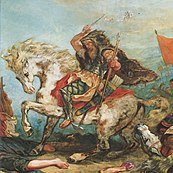   Top: rhyming slang for British university degree classification: Geoff Hurst (top left), Attila the Hun (top right), Desmond Tutu (bottom left), Thora Hird (bottom right)
|
In the British undergraduate classification system, a first-class honours degree is known as « Geoff Hurst » (a First), after the English footballer of the 1966 World Cup. The higher second-class degree (also known as a «2:1») is called « Attila the Hun », and the lower second (a «2:2») — « Desmond Tutu », while the third-class degree is known as «the Hun's Attila». « Thora Hird » or « Douglas Hurd ». ]
Cary Grant's character teaches rhyming slang to his companion in the film «Mr. Lucky» (1943), describing it as «Australian rhyming slang». Rhyming slang is also used and described in a scene from the 1967 film « To Sir, with Love» starring Sidney Poitier in the lead role, in which English students tell their foreign teacher that slang — it's tiresome and something for old people. The closing song of the 1969 crime drama « The Italian Job » («Getta Bloomin' Move On», also known as «Self Preservation Society») contains many slang terms.
Rhyming slang has been used to lend authenticity to East End settings. Examples include «Lock, Stock and Two Smoking Barrels » (1998) (where the slang is translated via subtitles in one scene); The Limey (1999); Sexy Beast (2000); Snatch (2000); Ocean's Eleven (2001); and Austin Powers in «Goldmember» (2002); It's All Gone Pete Tong (2004), named after BBC Radio disc jockey Pete Tong, whose name is used in this context as rhyming slang for «wrong»; Green Street Hooligans (2005). In Margin Call (2011) Will Emerson is played by the London actor Paul Bettany, a friend asks him on the phone, "How's trouble and strife?" ("wife").
«Cockneys vs Zombies» (2012) poked fun at the origin of rhyming slang terms, when a Cockney character calls zombies «trafalgars», which baffles even his fellow Cockneys; he then explains it like this: « Trafalgar Square – fox and hare – hairy Greek – five-day week – weak and weary – pins and needles – needle and thread – Abercrombie and Fitch – Abercrombie: zombie» .
In the song « Trip A Little Light Fantastic » from the Disney film « Mary Poppins Returns », part of the lyrics includes Cockney rhyming slang, and it is spoken mainly by London lamplighters.
In the animated superhero film «Spider-Man: Across the Spider-Verse» (2023), the character Spider-Punk, a native of Camden, can be heard saying: «I ain't got a scooby» («clue»).
The use of rhyming slang was also prominent in « Mind Your Language» (1977–79), Citizen Smith (1977–80), Minder [35] [ page needed ] (1979–94), Only Fools and Horses (1981–91), and EastEnders (1985–). Minder could be entirely uncompromising in its use of obscure forms without any explanation. Thus, a viewer who was not versed in Cockney was forced to infer that, say, «iron» meant «male homosexual» («iron» = «iron hoof» = «poof»). One episode of series 5 of «Steptoe and Son » was titled «Any Old Iron» for the same reason, when Albert thinks Harold is «on the turn».«Birds of a Feather » main characters Sharon and Tracey often left the character Dorien Green, who was unfamiliar with the terms, baffled.
One of the first American shows to regularly use rhyming slang was the Saturday morning children's show «The Bugaloos» (1970–72), in which the character Harmony (Wayne Lary) often included it in his dialogue.
In popular music, Spike Jones and his City Slickers recorded "So 'Elp Me", based on rhyming slang, in 1950. The Kinks' 1967 song "Harry Rag" was based on using the name Harry Rag as rhyming slang for "fag". (that is, a cigarette). This idiom briefly appeared in the reggae music of British DJs of the 1980s in the hit "Cockney Translation" by Smiley Culture of South London; a couple of years later this was followed by «Cockney and Yardie» by Dominic and Peter Metro. London artists such as Audio Bullys and Chas & Dave (and other performers from elsewhere in the UK, such as The Streets, who hail from Birmingham) often use rhyming slang in their songs.
British-born MC MF Doom released a track titled «Rhymin' Slang» after settling in the UK in 2010. The track was released on JJ Doom's 2012 album Keys to the Kuffs.
Another contributor was Lonnie Donegan, who had a song called «My Old Man's a Dustman». In it he says his father has trouble putting his boots on: «He's got such a job to pull them on, that he calls them daisy roots».
In contemporary literature, Cockney rhyming slang is often used in the novels and short stories of Kim Newman, for example in the short story collections «The Man from the Diogenes Club» (2006) and «Secret Files of the Diogenes Club» (2007), where it is explained at the end of each book.
This is also parodied in Terry Pratchett's « Going Postal », which features an elderly junior postman named Tolliver Groat, who speaks «Dimwell arrhythmic rhyming slang», the only rhyming slang on the Disc that doesn't actually rhyme. Thus, a wig — is «prune», from «prune syrup», an obvious parody of the Cockney syrup from syrup of figs — wig. There are many other parodies, although it has been pointed out that the result is even more impenetrable than ordinary rhyming slang, and so may not be as illogical as it seems, given the supposed purpose of rhyming slang as a means of communicating in a manner incomprehensible to all but the initiated.
In Robert Graves's book « Goodbye to All That », beer is «a broken square», since officers of the Welch Fusiliers go into a pub and order broken squares whenever they see men from the Black Watch. The Black Watch had a small blemish on their record of unbroken squares. Fist fights would ensue.
In Dashiell Hammett's « The Dain Curse », the protagonist is familiar with Cockney rhyming slang, referring to gambling with dice using the phrase «rats and mice».
Cockney rhyming slang had a major influence on the dialect spoken in «A Clockwork Orange» (1962). The novel's author Anthony Burgess also believed that the phrase «queer as a clockwork orange» was Cockney slang, having heard it in a London pub in 1945, and subsequently used it in the title of his book.
In Scottish football a number of clubs have nicknames taken from rhyming slang. Partick Thistle are known as «Harry Rags», which derives from rhyming slang for their «official» nickname «Jags». Rangers are known as «Teddy Bears», which derives from rhyming slang for «Gers» (the shortened version of Rangers). Heart of Midlothian are known as «Jambos», which derives from «Jam Tarts», which is rhyming slang for «Hearts», the commonly used abbreviation of the club's name. Hibernian are also called «Cabbage», which derives from Cabbage and Ribs, which is rhyming slang for Hibs.
In rugby league, «meat pie» is used for a try.

Comments