
Lecture
The processes of verbal communication, which constitute the most important form of people's joint activity, in the course of which speakers pursue some goal: conveying information, influencing their interlocutor or interlocutors, controlling their behaviour, etc., are subject to certain rules and are regulated by a whole range of factors. Among these, a special place is occupied by the striving to achieve mutual understanding and cooperation, or, in the terms of H.P. Grice, the cooperative principle. Following this principle and the maxims whose observance is necessary for its fulfilment, the speaker casts his message into language forms that are clear and accessible to the listener's perception, taking into account the communication norms established in society, the social status and relations of the communicants, etc. In other words, the speaker chooses a particular communication strategy depending on the social conditions of communication, as well as the specific context of the given act of verbal communication, the spatio-temporal framework of communication, the range of phenomena being described, and, finally, the textual environment. Among all these components and factors determining the successful course of communication, the most important and indispensable condition is the requirement that every utterance must carry some reasonable sense. This sense appears as a complex whole, made up of the senses of the constituents of the utterance: the senses of the main and subordinate clauses, if the utterance is a complex sentence, the senses of the word-combinations that make up their composition, the senses of the words, parts of word-combinations, the sense of the intonation pattern of the utterance and its parts, etc. Of all these semantic constituents, which in hierarchical sequence form the sense of the whole utterance, the primary and elementary unit of sense is the word. It is precisely for this reason that all theories of meaning, intended to explain the meaning of any utterance addressed by the speaker to the listener in a given situation, and to reveal on this basis the essence and nature of communication and the elements necessary for its realisation, concentrate on the analysis of word meaning as a universal linguistic sign.
In our practical use of language we all understand quite well what word meaning is. Thanks to our knowledge of word meanings we use words correctly in speech, we can explain the meaning of a word by defining it or by means of synonyms, we readily find units equivalent in meaning or establish the degree of correspondence between correlative lexical units in different languages. Difficulties arise when we attempt to give a scientific definition of word meaning, since the word, as a unit of naming, a unit of designation, whose content side, or meaning, is determined by its use in a sign situation, is characterised by the multidimensionality and complexity of its connections.
The word functions as the name of a particular object, phenomenon, process or property, and is thus in close, though specific in character (more on this below), connection with what is denoted, or the denotatum (a term used by C.W. Morris and G. Frege, whose names are associated with the notion of the semiotic, or semantic, triangle reflecting the sign situation). This correlation of the word with the denotatum, or the concrete thing in the broad sense, which determines the meaning of the word, is most evident in utterances of the type The pen is on the table 'The pencil is on the table', The book is interesting 'The book is interesting', and others, in which the nouns used point only to objects known to both speaker and listener.
The word, however, denotes not only a concrete object that actually exists and can easily be identified in a communicative situation by means of a gesture. A word names both a single, individual representative of a class of objects, phenomena or properties, and the entire set, the whole totality of objects, phenomena or properties grouped together according to one parameter or another. The word thus has a generalising function. Since the definition of a class, or set, and its delimitation from another class, or set, rests on singling out the most essential properties common to all members of the class, which make up the concept of the object, the correlation of the word with the class of named objects is nothing other than its correlation with the concept, or notion, people have formed of the given object, or, in the terminology of C.W. Morris, the designatum (Cf. The designatum of a sign is the class of objects to which the sign is applicable, that is, objects possessing certain properties which the interpreter takes into account owing to the presence of a sign-vehicle).
The generalising role of the word and its conceptual correlation are especially evident in contexts of the type The dog is a domestic animal 'The dog is a domestic animal', Language is a means of communication 'Language – a means of communication', in which what is meant is not some particular object, but all the members of a class.
In the semantic triangle these two types of connection are reflected as two lines linking the word with the denotatum (the object, the referent, etc.) and the designatum (the concept, the notion, the significatum, etc.), between which there also exist close relations of a deterministic kind:
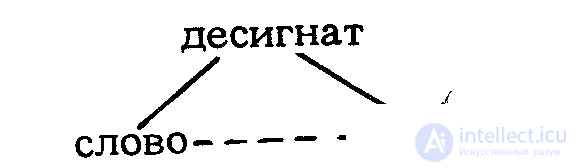
The nature of word meaning would seem to be clear and to be determined by the functions of the word used as a sign in the process of communication. This clarity, however, disappears as soon as we move from stating the word's connections with the denotatum and the designatum, which determine the content side of the word, to establishing whether these connections mean identity of meaning with the denotatum and/or the designatum, what the character of these connections is, etc. Moreover, an unambiguous answer to the question of the denotative/significative essence of word meaning is also impossible because there exist different types of words, and by no means does every word correlate with a denotatum, or a really existing object (e.g., dragon 'dragon', devil 'demon, 'Satan', nymph 'nymph'). In the words of C.W. Morris, "a class may include many members, or only one member, or no members at all", and a general theory of meaning must take into account all these possible uses of the word.
The picture becomes even more complicated when the question of word meaning is examined through the prism of the dichotomies language – speech, social – individual, invariant – variant, i.e. when we are dealing with the meaning of a lexical unit as a social, stable, potential phenomenon, common to the entire language community, as opposed to its concrete speech use by this or that speaker and its perception by this or that listener.
It is also beyond doubt that the object-conceptual correlation of the word does not exhaust its content side, since the participants in the sign situation, i.e. the speaker and the listener, are not indifferent to the objects of their communication, but seek, depending on the circumstances, to express their attitude towards them, to give their own evaluation. This creates the basis for various kinds of additional meanings, or connotations, which accompany the object-conceptual content of the word, while the existence of numerous associations, both general and individual, among speakers of the language in connection with the objects named contributes to the formation of the so-called pragmatic meanings that accompany the object-conceptual content of the lexical unit. Cf., for example, the names of animals in different languages.
In defining the meaning of a word one must also take into account the word's connections with other words in the system of the language and in the speech chain, i.e. its paradigmatic and syntagmatic characteristics, which determine the word's place and significance within the system and its concrete sense in the utterance.
The multiplicity of the word's connections in the sign situation, the non-uniformity of words in their object-conceptual correlation, the complexity of the very relations of the word as a sign to the object, phenomenon or property denoted, the dialectical contradictoriness of the objective and the subjective in linguistic units - all this leads to the absence of a single, universal definition of meaning and lies at the root of the numerous semantic conceptions and theories whose authors attempt, from one standpoint or another, to reveal the essence of word meaning.
Proceeding from the fact that "present-day semantics is a field in which there are far more competing theories than indisputable results and generalisations" (9,121), we shall confine ourselves merely to a brief enumeration of the most important trends that have taken shape up to the present time.
The theory with the longest-standing traditions is the referential theory of meaning, the essence of which amounts to attempts to determine the nature of meaning through the study of the connections between a word and the object to which that word refers. The correlation (reference) of the word with things also suggests a natural way of defining meaning, one characteristic of this conception and very widespread in language-teaching practice. This is the so-called ostensive, or demonstrative, definition, which contains an element of visual demonstration and is carried out by directly pointing to the corresponding object. The ostensive definition, however, has a number of substantial shortcomings. The first is its indefiniteness. For the listener, for example, a mere pointing to an object is clearly not sufficient to explain the meaning of words in utterances of the type It is a book 'This is a book' It's a stone 'This is a stone' and so on. Even if the speaker's intention and the meaning of his gesture consist precisely in defining the meaning of the corresponding unit, the listener must accurately guess the reference of the word, i.e. work out whether the word refers to the object as an integral phenomenon or to some of its numerous inherent properties and constituent parts, and before that correctly identify the object being pointed to from among the whole set of objects lying alongside it. The second critical remark concerning the ostensive definition is that the meanings of many words, for example abstract nouns of the type beauty 'beauty', idea 'idea', verbs, adjectives, numerals of the type think 'think', large 'large', two 'two', conjunctions, etc., cannot be defined by pointing to their denotata. Thus, the ostensive definition is applicable only to a relatively small number of words in the lexical system of the language, the so-called denotative, or identifying, vocabulary, oriented towards the world, the names of natural objects, whose meaning, as N.D. Arutyunova writes, represents, as it were, a ricochet from their reference (1, 186). Unlike object names, which reproduce, with one or another degree of precision, the picture of the natural division of the world, predicate names, or characterising names, which point to the properties and manifestations of objects of reality and to their relations with one another, cannot be defined ostensively.
Furthermore, the ostensive definition of word meaning does not "work" also because, in pointing to one and the same object, we can give it different names (for example, pointing to a tulip, one can say This is a tulip 'This is a tulip', This is a flower 'This is a flower', This is a plant 'This is a plant', This is an object 'This is an object', etc.). The words tulip, flower, plant, object differ in their meanings, but a theory of word meaning in which meaning is treated as the object replaced by the word does not explain these differences.
A serious difficulty in the ostensive definition of a word is also raised by the question of how the identification of the meaning of a word correlated with many objects of one and the same class takes place. Given that the meaning of a word becomes known through correlating the word with a concrete object which is merely a single representative of a class of objects united by certain common properties and called by one and the same name, ostensive definition of meaning is impossible for a word taken in the context of a generalising utterance of the type The cow is a domestic animal 'The cow – a domestic animal', or for a word taken out of context.
Thus, the referential theory of meaning, while correctly emphasising the correlation of the word with the object, phenomenon or thing in the broadest sense, but absolutising only a particular case of this correlation, fails to reveal the full complexity of the nature of meaning (for a critique of this conception see: 3,79 -128).
The conception of meaning intended, to some extent, to avoid the limitations imposed by ostensive definitions of word meanings is one whose key point is the interpretation of word meaning as the concept, or notion, denoted by the word. The conceptual theory of meaning, known since the time of Aristotle and developed by many well-known philosophers, psychologists and linguists, for example J. Locke, G. Stern, H. Kronasser, and, among Soviet scholars, most consistently by A.I. Smirnitsky, defines meaning "as a certain reflection of an object, phenomenon or relation in the mind (or a mental formation similar in character, constituted from the reflections of individual elements of reality -mermaid, goblin, witch and the like), which enters into the structure of the word as its so-called inner side, in relation to which the sound-form of the word acts as the material shell necessary not only for expressing the meaning and communicating it to other people, but also for its very origin, formation, existence and development" (10,152).
The subjectivity of speakers' reflection of elements of reality, its personal character despite the undoubted presence of a general idea of the objects, phenomena and properties of the world around us, and the existence of numerous associations, both socially significant and individual, which arise and exist against the background of the basic knowledge of the named classes of objects, phenomena and properties, also make the psychological interpretation of word meaning fairly vulnerable. Moreover, one must acknowledge the obvious impossibility of all speakers knowing all the general and specific features of the objects and phenomena of reality and the connections between them, on the basis of which concepts are formed. In many kinds of communication, people exchanging information are guided not by the scientific data and knowledge that mankind has accumulated in the course of its development and which constitute the essence of this or that field of science, but orient themselves towards some minimum of distinctive features common to all members of the language community. This circumstance underlies the distinction between two types of word meaning – the proximate and the further meaning, proposed by A.A. Potebnya. "What is the 'meaning of a word' ? – wrote A.A. Potebnya. – Evidently, linguistics, without deviating from the achievement of its goals, examines the meaning of words only up to a certain limit. Since all manner of things are spoken of, without the aforementioned limitation linguistics would contain within itself, besides its own indisputable content, on which no other science passes judgement, also the content of all other sciences. For example, in speaking of the meaning of the word tree, we should have to move into the sphere of botany, and with regard to the word cause or a causal conjunction, to treat of causality in the world. But the point is that by the meaning of a word in general two different things are understood, one of which, falling within the province of linguistics, we shall call the proximate, the other, constituting the subject of other sciences, - the further meaning of the word. Only the proximate meaning of a word alone constitutes the actual content of thought at the moment the word is uttered" (8, 19). "The proximate, or formal, meaning of words together with the idea makes it possible for the speaker and the listener to understand one another" (8, 20).
The opposition between the proximate and the further meanings proposed by A.A. Potebnya, however, runs into practically insoluble difficulties today in differentiating meaning as an objective psychological phenomenon and meaning as a subjective phenomenon, and into the concrete task, confronting the researcher, of defining and establishing that minimum of features which constitutes the meaning of the word.
Moreover, many linguists object to the fact that, in the theories mentioned above and in the relativist interpretation of meaning close to them, meaning turns out not to be identified with the object and/or the concept, but is understood as a relation: a relation to the object (the denotatum, the referent), a relation to the concept or idea, a relation to social culture, etc., lying outside language – in the sphere of reality or in the sphere of the psychical. The connection of the word with these entities – the object and the concept formed on the basis of the reflection of its properties – is undoubted, and the determination of word meanings by the realities of the world around us and by the ideas and concepts existing about them is obvious, but neither this closest connection nor this obvious dependence provides a complete explanation of the essence of word meaning.
An attempt to give a purely linguistic definition of word meaning, without taking it beyond the bounds of language, is made by the so-called functional conception. Its founder, L. Wittgenstein, wrote: "For a large class of cases of the use of the word meaning -though not for all - this word can be interpreted thus: the meaning of a word is its use in the language " (3,97).
The basis for such an interpretation of word meaning is the fact that words are used by speakers, as L. Wittgenstein points out, in countless, varied ways, related to one another in different ways, and the meaning of a word can often be determined only on the basis of the context, or the environment of the word. This is especially true of words which are repeatedly used for purposes of secondary nomination and are accordingly linked with the expression of several meanings. Thus, in the contexts deep river 'deep river', deep lake 'deep lake', deep ocean 'deep ocean', the word deep indicates the distance from the surface to the bottom or to some point in a downward direction, the magnitude of this distance varying depending on whose depth – that of a river, a lake or an ocean – is meant, and being determined, moreover, by our idea of the average depth of rivers, lakes, oceans, etc. In other words, in order to say that a river, a lake, an ocean, etc. is deep, we must relate the object being characterised, with respect to this property, to other objects of the same class and find a point of reference which is accepted in the language community as the norm. In the contexts deep wound 'deep wound', deep sleep 'deep sleep', deep feelings 'deep feelings' and others, however, the word deep already carries a different sense. These examples unambiguously demonstrate the variability of a word's meanings under the influence of context, and thus the dependence of word meaning on context. This dependence, however, should not be perceived as an identity between meaning and use, for words have meanings even outside context, as is evidenced by the possibility of indicating the meaning of a word by means of a definition even before the word is used. The different environments in which words find themselves do indeed serve as an indicator of their differences in meaning and help listeners correctly recognise the sense of an utterance, but without correlating the word with what it denotes we cannot know its meaning, however many examples of the use of the given word we are given, since it is not always unambiguously clear from the situation what is being talked about.
The situational conditioning of word meaning brings us to the examination of yet another – the behaviourist, or behavioural - interpretation of meaning, which was most clearly formulated by L. Bloomfield. "The meaning of a linguistic form, -writes L. Bloomfield, – is the situation in which the speaker utters it and the response which it calls forth in the hearer" (2,142).
Prompted by the striving for objectivity in linguistic science, for rigour in its methods and for the empirical grounding of its tenets, this theory places language within the general sphere of human behaviour, in whose structure linguistic and non-linguistic stimuli and responses are closely interwoven, linguistic stimuli, i.e. words, acting as substitutes for the non-linguistic stimuli that arise in one situation or another. Wholly legitimate and, in our view, fruitful for studying the mechanisms of speech activity, the motives conditioning the choice of particular linguistic expressions, and the effect they produce on listeners, this approach, however, does not allow us to give a more or less satisfactory definition of meaning. The physiological conception of meaning is vulnerable because, as K. Allan rightly points out, in one and the same situation a speaker may utter linguistic units differing in their meaning (in the situation described by L. Bloomfield, hungry Jill, seeing an apple on an apple tree, could tell her companion that she was hungry, that she would like to eat an apple, that she liked apples, ask him to get her the apple, etc.). Equally unpredictable may be the listener's response to the linguistic stimulus. In response to a request, for example, to give him a pencil, the listener may throw it on the floor, break the pencil, put it in his briefcase, hand it to another person, etc. Nor is the situation saved, K. Allan stresses, by the requirement that the definition of meaning should not be based on a single use of the unit alone, but should take into account all the situations in which the unit is used, for it is impossible to enumerate all the possible situations of use of any given word or expression (12,82 – 85).
Thus, the diversity of linguistic forms arising on the basis of one and the same situation and acting as verbal stimuli directed by the speaker at the listener, together with the diversity of response reactions, make L.Bloomfield's conception of meaning very vulnerable indeed.
At the present time another line of semantic research is being actively developed, known as prototype theory. Created and developed in the works of B.Berlin and P.Kay, W.Labov, G.Lakoff, E.Rosch,. C.Fillmore and other scholars of our time, this theory reflects a cognitive approach to language. Language is among the most characteristic types of human cognitive activity, and by their very nature linguistic categories – are conceptual categories forming part of our cognitive apparatus.
The linguistic sign, arbitrary with respect to the object, or denotatum, it denotes, from the point of view of its sound composition, is not arbitrary in this respect from the point of view of meaning. In defining the content of a particular lexical unit, we usually have in mind the characteristic features common to the class of objects - physical or psychical - denoted by this unit, or, in other words, the characteristic features of the prototypical object. Knowledge of these properties constitutes our basic knowledge of the world.
+In the course of observations of children's speech and numerous experiments, scholars are trying to identify the mechanism by which a person correlates a particular linguistic unit with a particular object, and thereby to establish the principles of linguistic categorisation. In this respect, the experiments of W.Labov are widely known, in which subjects were asked to give names to vessels depicted in pictures, used for water, tea, coffee, beer, soup, etc. The choice of the appropriate name from among the vessel names available in English (cup 'cup', mug 'mug', glass 'glass', bowl 'bowl, cup', goblet 'goblet', vase 'vase') testifies to speakers' knowledge of the conditions under which a given object belongs to the class of objects called by a particular name. For example, in order to draw a boundary between birds and all other living creatures that are not birds, one must know that birds have wings, that they lay eggs, that they have beaks, a pair of legs, etc. In other words, one must know certain cognitive characteristics, called prototypical, which together form the prototype of the object, in this case, the prototype of a bird, and in the examples given earlier the prototypes of a cup, a mug, a goblet, etc. The fullest correspondence of an object to the prototype, resulting from the object possessing all the prototypical characteristics, indicates that the object belongs to the central members of the category. If, however, the properties of the prototype are inherent in the object only partially, then it belongs to the periphery of the category. Thus, robins and sparrows, as revealed in the experiments of E.Rosch, are rated as better examples of birds than eagles, pelicans, hens, etc. As G.Lakoff points out, the central members .of a category are recognised faster, are memorised earlier, are used more often, and act as representatives of the whole category. Without going in more detail into the typology of prototypes and the sources of prototypical characteristics, which can be extremely varied, as G.Lakoff convincingly demonstrated using the example of the concept "mother" (6, 36 - 43), let us say that the interpretation of word meaning as the prototype of the object denoted by the word proceeds from human perception of the world and attempts to reflect the limitations of human experience and the peculiarity of the way people make sense of the surrounding world. This theory thus differs from those semantic theories which interpret word meaning proceeding only from the realities of the natural world named by words, without taking into account the human factor, both in the cognition of reality and in language.
The nature of meaning, its model and the sources that generate it are the same for all languages of the world and, moreover, for all linguistic units – lexical and grammatical alike. Differences may be observed in the sets of prototypical features that make up the meaning of a linguistic unit in a given language. However, as studies of colour terms in various languages have shown, the core features of prototypes are universal, and this commonality is predetermined by the identity of the perceptually apprehended properties of denotata, which arises as a consequence of the identity of the neurophysiological processes of human perception. It also underlies the semantic equivalence of units belonging to different languages, which brings about the possibility of translation from one language into another and thus the possibility of communication between different language communities.
This unity also manifests itself in the commonality of the types of meaning distinguished according to various parameters, both linguistic and non-linguistic. Among classifications of meaning based on non-linguistic principles, the most widespread is the classification of meaning based on sign relations, since a word undoubtedly possesses the properties of a sign in the course of its functioning. Drawing on the connections of the sign with the components of the sign situation, the following aspects, or types of meaning, are distinguished in the content of a word:
the referential, or denotational, aspect of word meaning, determined by the word's relatedness to an object (denotatum, referent), also called referential meaning;
the conceptual, or significative, aspect of meaning, determined by the relation between the word and mental content (concept, image, idea) and containing the general essential features that serve as the basis for grouping individual objects into classes;
the pragmatic, or connotational, aspect, determined by the speaker's attitude to the object denoted by the sign and including subjective-evaluative, modal, etc. components;
the systemic, or differential, aspect, formed on the basis of the word's relation to other words, both within the corresponding group of words to which the given word is semantically related (this aspect is also called value – fr. valeur), and in the speech chain.
In its most general form, this classification corresponds to the three branches of the science of meaning – semantics, which studies signs in their relation to objects and concepts, pragmatics, which is concerned with the attitude of speakers toward signs, and syntactics, which investigates the relations between signs themselves.
The above classification of meaning is to some extent echoed by a classification that has emerged more recently as a result of the cognitive approach to language. In this classification, meanings are divided according to which structures of consciousness underlie them: cognitive ones, reflecting a person's objective knowledge of the world around them, enriched by the millennia-long collective experience of the whole of humanity, or pragmatic ones, carrying information about a person's subjective evaluation of the phenomena around them, their personal experiences, interests and attitude toward what is observed.
Since, as M.V. Nikitin notes, "every particular meaning... inevitably receives a qualification as an element of these two structures of consciousness" (7, 20), meaning becomes stratified into components - cognitive and pragmatic (here, as before, different terms are also used in linguistic theories to denote these components: denotational, referential, sigmatic, sometimes semantic, intellectual and connotational, emotive and others).
Developing this classification of meaning further, M.V. Nikitin distinguishes intensional and extensional components within the cognitive meaning of words. The intension, or the content of the concept, is the set, or more precisely the structure, of features reflected in the given concept (meaning, name). The extension, or the scope of the concept, is the set of things (denotata) to which the concept (meaning, name) corresponds. For the word cup 'a drinking vessel' in its direct meaning, the intension is made up of such features as "a vessel, small, open, usually with a handle, intended for drinking", while the extension is all the objects united into a single set by the commonality of these features.
Both the intension and the extension of a name vary under the influence of context, i.e. they turn out to be unstable. Compare, for example, the following contexts of use of the word cup: I have broken her favourite cup 'referring to one particular cup' and How much does a cup cost? 'referring to cups in general'. In the first case, the intension of the word cup includes the feature favourite, and the extension is a particular cup; in the second, the extension may be any cup out of the whole set of cups, and the intension – our idea of a certain average, prototypical cup.
However, despite all the variability of the content (intension) that arises in different situations of communication and depending on the subjective knowledge of speakers, a stable core, a stable part called the intension of meaning, is singled out within the content. Thanks to this stability of the intension, communication between people becomes possible, and mutual understanding is achieved in the process of communication. Changes in the intension constitute qualitative semantic transformations and lead to the emergence of new meanings (cf. such meanings of cup as: 'a bowl, goblet; a portion, one's lot; the cup (calyx) of a flower' and others).
It should, however, be emphasized once again that the stability of the intension does not exclude variation in contensional meaning, which, depending on the context in which the word is used, appears in two of its varieties: denotative and significative meaning. "A name, – M.V. Nikitin points out, – has denotative meaning if it represents a single denotatum or a group of single denotata, in all other cases it carries significative meaning" (7, 30).
If significative meaning includes the general features of the class of objects denoted (cf. In freshness, youth and beauty she was like the flowers of spring 'flowers as a class in general', I am fond of flowers 'flowers as a class in general' etc.), then denotative meaning encompasses, in addition to the features of the class, other features belonging to the individual object denoted by the name and distinguishing it from other objects of the same class.(cf. "Flowers, Miss Covak". Fran opened the door. "Flowers?". That's right. Just delivered downstairs". With the flowers was a small envelope with a note in it. P.Highsmith. The Network. '"Flowers, Miss Covak?" Fran opened the door. "Flowers?" – "Yes, just delivered downstairs." Enclosed with the flowers was a small envelope containing a note.').
The denotative meaning of a name is variable, since it is based on concrete entities given in a particular situation and is not the same either in different contexts or for the speaker and the listener. Significative meaning, on the contrary, tends toward constancy, 'stability, coincidence between speakers and listeners, and identity across different contexts.
On the whole, the classification of meaning proposed by M.V. Nikitin has the following form:
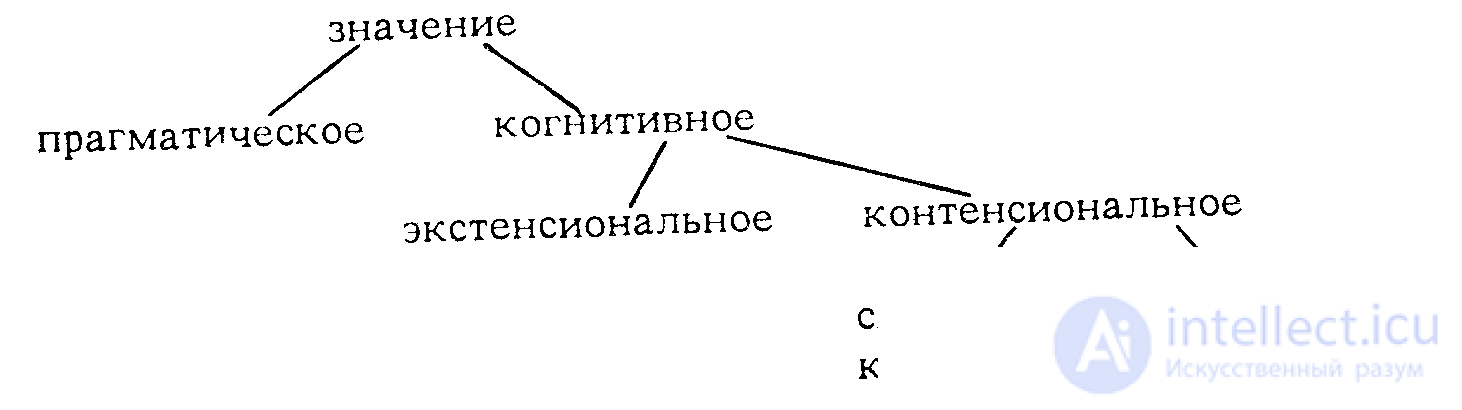
It is also significant in this classification that pragmatic and cognitive meanings appear as components of the meaning of a name that are realized simultaneously; extensional and intensional meanings are likewise components of meaning. The same, however, cannot be said of denotative and significative meanings. In the author's view, they are varieties of contensional meaning and cannot combine in a single act of using a name. In a given speech situation, a word carries either denotative or significative meaning.
Coherent and logically consistent, this classification, in our view, largely resolves the numerous disagreements that existed in the literature on the question of denotative and significative types of meaning and their correlation within the meaning of a word, and creates a solid basis for distinguishing between object-vocabulary, or denotational vocabulary, which can be used in both denotative and significative meaning, and feature-vocabulary, or significative vocabulary, which has only significative meaning and does not carry denotative meaning (verbs, adjectives, etc.).
It seems, however, that denying feature-words denotative meaning on the grounds that they denote non-object entities disregards the fact that the concepts underlying the semantics of feature-words are formed on the basis of the objectively existing properties and features of the external world as reflected in our consciousness. The objectivity of properties follows from the objectivity of the existence of things, for if the objective existence of a thing is acknowledged, it inevitably follows that the objective existence of its properties must also be acknowledged. Thought merely discovers these properties, and a person, by means of various linguistic devices, gives them corresponding names. Owing to the objectivity of the existence of properties, feature-words naming certain properties in a given situation are just as concretely referential as object-vocabulary (cf., e.g., Give me that blue pencil! 'referring to one particular pencil' or His seriousness attracted them to him. 'referring to one particular person's trait' etc., in which reference" is made to concrete properties of concrete objects, rather than to classes of properties forming a single set).
Taking this into account, an extended definition of the denotatum may make sense, according to which the denotatum is "whatever we have in mind" (11,183).
The classifications of meaning given above do not exhaust all the possibilities for classifying meaning. There are also other classifications of meaning based on linguistic parameters and oriented not so much toward the content-related differences in meaning as toward the forms of their expression.
The specificity of a language system is largely determined by the distinctiveness of the linguistic forms in which one or another meaning becomes fixed, i.e. by the ways of expressing meanings, which differ both within one and the same language and, even more so, across different languages of the world. On this basis a general linguistic classification of meaning is carried out, in which the sharpest opposition is formed by lexical and grammatical meanings, which form a close and integral unity in the basic lexical unit – the word. "A word, – wrote A.A. Potebnya, – contains within itself an indication of a certain content peculiar to it alone, and at the same time an indication of one or several general classes, called grammatical categories, under which the content of this word is subsumed on an equal footing with the content of many others" (8, 35). The content peculiar to a given word alone and distinguishing it from other words of the language is called the lexical meaning of the word. It is one and the same in all forms of the word and does not change when the word changes its form. Such, for example, are the lexical meanings of the English words write 'to set down in writing', ask 'to put a question', student 'a person who studies' and many others, into whose system of forms, i.e. paradigm, there enter not only the word-forms named above but also the forms wrote, has written, have written, am writing, have been writing; asked, has asked, have been asking; students, student's and others.
At the same time, the word-forms of the examples given above, writes, asks, students, belong to groups of the same word-forms of other words and form unified series: writes, asks, smiles, sits, lies, sings, runs, makes, sharing the meaning of the third person singular, and students, tables, pictures, vases, balconies, flowers - sharing the meaning of the plural number. These shared meanings are what is customarily called grammatical. Thus, lexical meaning turns out to be purely individual, bound to a particular word in all its word-forms, while grammatical meaning – is general, uniting many words in identical forms, and for a single word in all its forms - is variable, supplementing the lexical meaning and complicating it.
At times the concreteness of lexical meaning and the generalized character of grammatical meaning are proposed as the basis for distinguishing lexical and grammatical meanings. This basis, in our view, needs refinement, since in such a formulation the concreteness of a word's lexical meaning contradicts the generalizing nature of the word. Every word, by naming a class of things, phenomena, properties, relations, necessarily contains in its semantics an abstraction, a detachment from the individual differences of the concrete objects, phenomena, etc. that make up the given class, as a result of which the lexical meaning of a word also represents a generalization. However, this is a generalization at the level of a class, whereas grammatical meaning, which covers not just one class of objects or phenomena denoted by words, turns out to be a generalization at the level of a class of classes, i.e. a generalization of a higher order. These differences, apparently, allowed A.I. Smirnitsky to assert that "in the domain of vocabulary there is a certain generalization of particular cases, but the concreteness of the word does not fully disappear here even so" (10,22), and to liken a word, from the lexical point of view, to an arithmetical quantity, and from the grammatical point of view – to an algebraic one.
The opposition between lexical and grammatical meaning, not so much in their nature as in their manner of expression, leads to the fact that in different languages one fairly often observes cases where meanings expressed grammatically in one language find lexical correspondences in another, and vice versa. An example may be the grammatical marking of gender in verbs, in the singular forms of the past tense or the subjunctive mood, by means of the endings -a (fem.), -o (neuter), and a zero ending (masc.) – cf. расцвела, расцвело, расцвел in Russian, and the use of pronouns to express analogous meanings in English (He has written a letter 'masculine, expressed lexically by the pronoun he', She has written a letter 'feminine, expressed lexically by the pronoun she'). The duration of an action is expressed in English in the system of aspect-tense forms as Continuous forms (is writing, was writing, has been writing, will be writing, etc.), i.e. grammatically: to convey this meaning, Russian uses lexical units (Я пишу каждый день; Я пишу два часа; Я пишу в настоящий момент) or else a context is needed from which it would be clear when the action takes place and how long it lasts. The system of case forms of Russian words and the meanings they express correspond to the system of function words of the English language. Other examples of such discrepancies in the ways of expressing meaning could be given, as well as examples of the complex and peculiar interweaving, in different languages, of grammatical and lexical meanings, which, on the basis of semantic proximity, form a single semantic zone and a content-based foundation for functional-semantic fields, in which grammatical (morphological and syntactic), lexical, lexico-grammatical, and word-formational elements of the language system closely interact.
The foregoing does not rule out a number of serious differences that exist between the lexical and grammatical types of meaning. These are the accompanying character, regularity, high frequency and obligatoriness of grammatical meanings, and certain other properties of theirs that distinguish grammatical meanings from lexical ones. It is important, however, to emphasize that within a word the lexical and the grammatical form a close and indissoluble unity that determines the functioning of the word.
Lexical and grammatical meanings, the distinction between which is directly linked to the manner of their linguistic expression, form, as was said earlier, the sharpest opposition in the linguistic classification of meaning based on the type of linguistic unit used to convey a given sense, a classification that includes, alongside grammatical and lexical meanings, other types of meaning as well (for example, word-formational and syntactic meanings as varieties of grammatical meanings, and phraseological, collocational, etc. meanings as varieties of nominative meanings).
Other linguistic classifications of meaning are also possible. Further stratifications of lexical and grammatical meanings, for example, are widely known. The classification of lexical meanings that is significant for lexical semantics is connected with their differentiation under various conditions of functioning and coexistence within the unified semantic structure of a word. Since the origins of this classification lie in the ambiguity (polysemy) of the word, it will be examined a little later.
At this point it seems necessary to note the close connection between the content-based types of meaning and linguistic meanings. This connection is particularly evident in the study of lexical meaning, which turns out to be a complexly structured formation consisting of interdependent parts, or components, differing in content. Within the structure of lexical meaning the following components are distinguished: denotative, significative and connotational, in accordance with the classification of meaning based on the properties of the sign. Within the cognitive approach to word meaning, which, as shown earlier, proposes a somewhat different content-based classification of meaning, the structure of lexical meaning takes on the following form.
Lexical meaning may combine both types of content – cognitive and pragmatic, or be limited to one of them. A considerable number of words are pragmatically neutral, and their meanings contain only the cognitive component of content, with a certain internal structure (cf. English water 'a clear liquid', salt 'a crystalline seasoning', take 'to get hold of', run 'to move fast on foot', green 'the colour of grass', strong 'possessing great force', and many others). The words named are not in themselves connected with the expression of emotional-evaluative attitudes, although in certain contexts they may acquire a certain pragmatic colouring. The latter, however, is not part of their own meaning; it is the result of using the word in a particular speech situation.
Many words combine both cognitive and pragmatic components within their lexical meanings, and one of these may turn out to be dominant. For example, in words such as upstart 'a pretentious newcomer', cad 'an ill-mannered man', monster 'a hideous creature', etc., the pragmatic component dominates; words such as anarchist 'an advocate of anarchism', coward 'a person lacking courage', "informer 'one who informs against others' contain a cognitive component, but the type of people and their activity that these words denote evokes a definite emotion and evaluation.
The internal structure of the cognitive component of the lexical meaning of many words is likewise multi-componential and represents a specifically organized set of semantic features, i.e. features reflected in the meaning of a linguistic unit. The semantic features that make up the core of lexical meaning form the intension of lexical meaning, while the peripheral semantic features, whose presence is determined, with a greater or lesser degree of probability, by the intensional features, i.e. by the principal features of the denotatum, form the implicational component of lexical meaning.
The implication of features may be strong, obligatory, highly probable, in which case the set of implied features is regarded as the strong implicational component of meaning. On the other hand, the implication of certain features may be impossible or unlikely. The set of such features forms the negative implicational component of meaning, or negative implicationum. Finally, there are features whose presence or absence is equally probable. This set of features forms the free, or weak, implicational component (7,58 - 66).
Let us illustrate this with the example of the English word winter. The intension of the cognitive component of the direct lexical meaning of this word is the set of the following semantic features: season between autumn and spring (November or December to February or March in the northern hemisphere) 'the season of cold weather'. The strong implicational component of the lexical meaning of this word includes such features as: 'cold weather', 'snow falls', 'rivers freeze', 'the sun is low on the horizon', 'people wear warm clothing', etc.
The negative implicational component of this word includes features incompatible with the concept of winter, such as, for example, the properties round, wall-mounted, clayey. Winter cannot buy, sell, dance, smirk, etc. It is obvious that the negative implicational component tells the speaker how to use the word correctly, while at the same time creating broad possibilities for metaphorical transfers such as "Winter is skipping, winter is dancing, winter sings its little songs".
Features such as long, endless, short, severe, frosty, warm, damp, etc., which may be, or may v not be, features of winter, make up the free implicational component of this word.
The content components (in any interpretation of them) and the very construction of lexical meaning are universal and are determined by the nature and purpose of linguistic units. The distinctiveness of the structure of lexical meaning, dictated by the type of words to which these meanings belong, is also fairly universal. There are words whose lexical meaning is exhausted by a single feature. The structure of the lexical meaning of such words is simple, monosemous, elementary, which creates difficulties for lexicographic description. Such are many adjectives that, as a rule, denote a single feature, for example keen 'sharp', pure 'clean, unmixed', shallow 'not deep', clever 'intelligent', grand 'main, important', red 'of the colour of blood', and the verbs sit 'to rest on the buttocks', smile 'to curve the lips in pleasure', move 'to change position', sleep 'to rest with eyes closed', as well as abstract nouns. All these are feature-words, also called predicate words, belonging to significative vocabulary.
The structure of the lexical meaning of denotational vocabulary, i.e. of object, denotational, identifying words, is not exhausted by a single feature but represents a set of interconnected and interdependent features. These words are characterized by a close connection with the denotatum, multiplicity of features, heterogeneity of semantic components, and a number of other characteristics.
The universality of the structure of lexical meaning, as well as the universality of the specific character of lexical meaning in certain classes of words, does not mean, however, that the lexical meanings of correlative words in different languages are absolutely identical. This is evident from the divergence in the collocability possibilities of correlative words.
So, in modern English, the word combinations red hair 'lit. red hair', red fox 'lit. red fox', red beard 'lit. red beard', etc. are possible and are in common use, whereas in modern Russian the corresponding phrases do not use the ordinary word for red but the word рыжий instead: рыжие волосы, рыжая лиса, рыжая борода. Similarly, maple leaves in autumn are associated in the linguistic consciousness of Russian speakers with a yellow or golden colour rather than with red, as is the case in modern English. Thus, the language-specific segmentation of the colour spectrum is evident, and, correspondingly, so is the divergence of the intensions of the lexical meanings of correlative colour terms. The sphere of denotation, or the range of reference, to which the English word red is applicable, turns out to be broader than the sphere of denotation of the Russian adjective красный (krasny, 'red').
Another example of the divergence of the intensions of the lexical meaning of correlative words in different languages may be found in the nouns English dinner and Russian обед (obed, the midday meal), English morning and Russian утро (utro, the period from dawn to noon). Differences in the systems of naming meals (English breakfast, lunch, dinner, supper; Russian завтрак, обед, ужин, i.e. breakfast, midday meal, evening meal) and differences in the temporal division of the day (cf. Russian три часа ночи, literally 'three o'clock at night' – English three o'clock in the morning) account for the incompleteness of the correspondence between correlative units in different languages, which must necessarily be taken into account in the process of mastering the vocabulary of the language being studied. It is important, nevertheless, to emphasize here that the divergence of the intensions of lexical meanings is only partial, and it is owing to this that translation from one language into another is fundamentally possible.
Even more frequent are divergences in the implicational components of the lexical meanings of correlative words in different languages, connected with the national-cultural specificity of the practical activity of speech communities, the particularities of national behavioural patterns, traditions, etc. Compare, for example, the meanings of denominal derived adjectives in English and Russian: piggish 'resembling a pig, or characteristic of a pig: dirty, untidy; greedy and stubborn' and свинский 'resembling a pig, or characteristic of a pig: coarse, primitive: dirty, untidy; ignorant, uncultured'; doggish' characteristic of a dog; resembling a dog: rude, irritable; sullen', собачий 'characteristic of a dog: hard, bad, unbearable; very intense in its manifestation' etc.
Correlative words in different languages may also differ from one another in the pragmatic components of their lexical meanings. Compare English physiognomy 'face, countenance, appearance' and Russian физиономия, which has a colloquial character. The different stylistic colouring of the English and Russian words underlies their different collocability. In English, combinations such as the political physiognomy of the new parliament 'the political face of the new parliament' are possible, while in Russian the combinations неприятная, отвратная, лукавая физиономия (an unpleasant, disgusting, sly mug) are used, and it is unlikely that these correlates could correctly be used in translating them.
Thus, despite the general regularities in the structuring of lexical meanings, complete identity of the semantic components whose totality makes up lexical meaning is not observed across different languages, and this considerably complicates the search for equivalent forms of conveying content from one language into another and forces the translator to resort to descriptive constructions in order to achieve the greatest possible accuracy and adequacy of translation.
продолжение следует...
Часть 1 The Meaning of Lexical Units: Word Meaning, Its Aspects and Types

Comments