
Lecture
Typology — the branch of linguistics concerned with establishing the most general regularities across different languages, not necessarily related by common origin or mutual influence. Typology seeks to identify the most probable phenomena found across various languages. If a given phenomenon is found in a representative group of languages, it can be considered a typological regularity applicable to language as such.
Typological analysis can be carried out at the level of sound (phonetic and phonological typology), at the level of the word (morphological typology), the sentence (syntactic typology), and supra-syntactic structures (the typology of text or discourse).
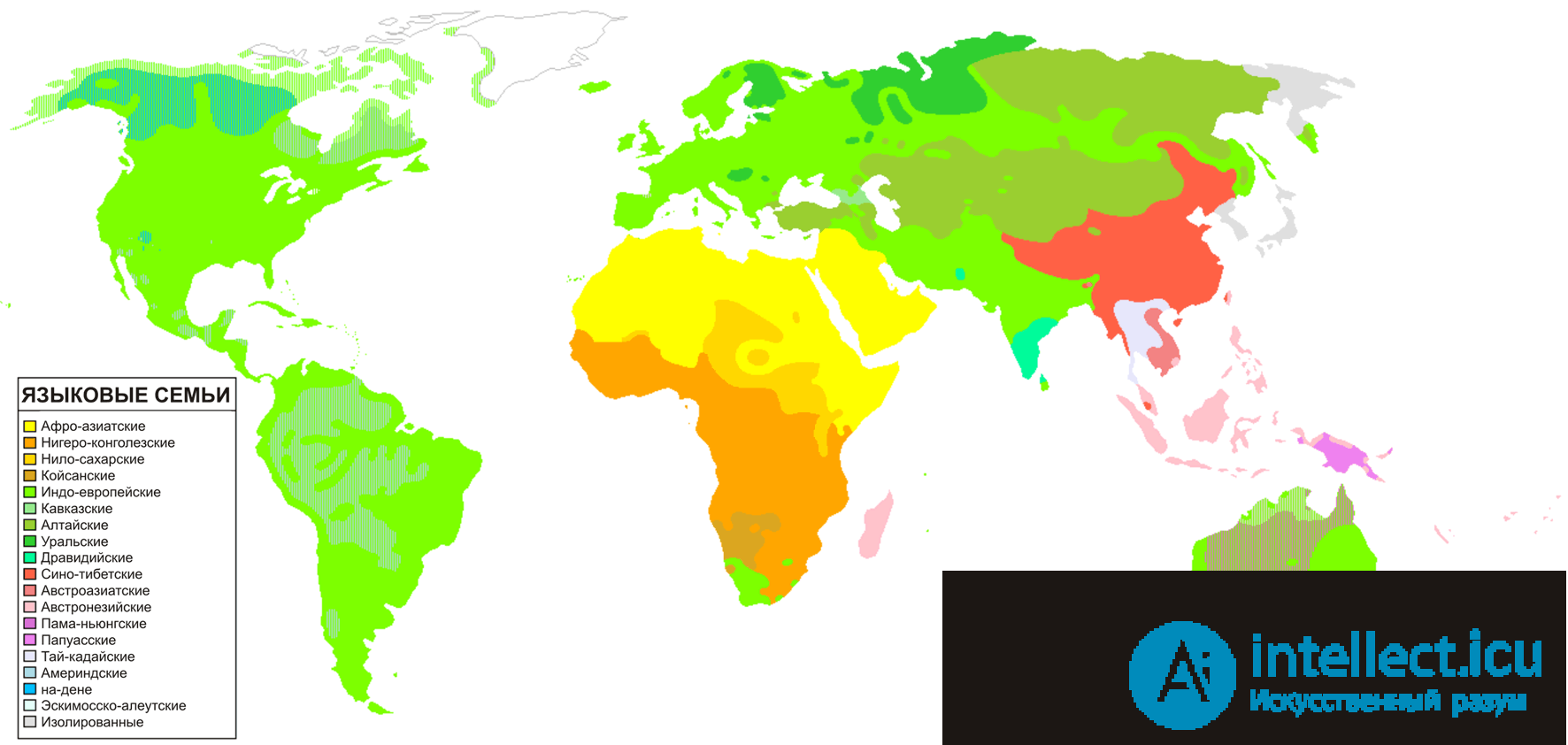
In the early stages of its development, typology tried to answer the question of which languages, and on what grounds, could be classified as «more primitive» and which as «more advanced». It soon became clear that the initial premise was wrong: a language's typological characteristics cannot be used to judge how «advanced» or «primitive» it is. Completely different languages can belong to the same type (for example, Chinese — a superbly developed language with an extremely rich literature — and the unwritten language of the Qiang people in northern China are equally classified as isolating languages), while related languages at roughly the same stage of development can belong to different types (the synthetic Slavic languages Russian or Serbian versus analytic Bulgarian, isolating English versus fusional German). Finally, one and the same language can change type more than once over the course of its development: for instance, the history of French can be divided into an isolating early Indo-European stage, fusional late Indo-European and Latin stages, an analytic Middle French stage, and the practically isolating spoken French of today.
As a result of these findings, linguists became disillusioned with typology until roughly the middle of the 20th century, when typology underwent a rebirth. Today's typology deals not with individual elements of languages but with systems of languages — the phonological system (the system of sounds) and the grammatical system.
Phonological typology is of particularly great practical importance for comparative linguistics. Phonological typology proceeds from the obvious premise that, for all the enormous diversity of the world's languages, all humans have practically the same structure of the speech apparatus. There are a good many regularities tied precisely to this fact. For example, palatalization occurs in a great many of the world's languages. Its essence is that a dorsal (velar) consonant (in Russian — к, г, х [k, g, kh]) followed by a front vowel (in Russian — и, е [i, e]) changes its character. Its pronunciation shifts forward, becoming «softened». This phenomenon is easily explained on linguo-technical grounds: it is hard to rapidly reconfigure the speech apparatus from dorsal to front articulation. Interestingly, palatalization usually causes dorsal consonants (к, г [k, g]) to shift into affricates (double sounds of the ч, ц, дз [ch, ts, dz] type). Languages in which palatalization occurs may have nothing else in common with one another, but noting the similarity of the alternation in Russian пеку-печёт ('I bake' — '(he/she) bakes'), Italian amico-amici «friend — friends», and Iraqi Arabic чиф «how» against literary Arabic киф, one must understand that this is a matter of a universal typological regularity.
In phonological typology the notion of binary opposition is extremely important. A binary opposition is a pair of sounds alike in every respect except for the one feature by which they are contrasted. For example, the Russian д and т, and the English d and t, are contrasted by the feature of voicing: Т is voiceless, Д is voiced. In an opposition, one member is unmarked and the other is marked. The unmarked member of the opposition is the primary one: its statistical weight in the given language is always greater, and it is linguo-technically easier to pronounce. In this opposition, the unmarked member is — Т. Д is the marked member of the opposition: it is less convenient to pronounce and occurs less often in the language. In certain positions the opposition can be neutralized. For example, at the end of a word in Russian д is pronounced as т (код=кот — 'code' = 'cat', both pronounced /kot/), i.e. the marked member loses its marker.
In other languages the contrast may run along different lines. For example, German or Chinese d and t are marked not by the voiceless-voiced feature but by the lax-tense (weak-strong) feature. d is the lax (unmarked) member of the opposition, while t is the tense (marked) member. This is exactly why a German accent in Russian literature is rendered as «исопрашается таким споссопом именно ис-са тофо» ('is requested in precisely this fashion, precisely because of that', with the normally voiced consonants devoiced throughout, mimicking a German accent), since Russian voiced (marked) consonants sound to a German like their own unmarked ones.
The typological criterion is one of the most important when testing hypotheses connected with language reconstruction. Nowadays, no reconstructed phonetic system of a language can be accepted without being checked for typological consistency. It cannot be said that all typological invariants have already been discovered, described, and explained. «At the same time, even today the rich experience accumulated by the science of language already allows us to establish certain constants that are hardly ever likely to be reduced to „semi-constants“. There are languages that lack syllables beginning with a vowel, and/or syllables ending in a consonant, but there are no languages that lack syllables beginning with a consonant, or syllables ending in a vowel. There are languages without fricative sounds, but there are no languages without plosives. There are no languages that have a contrast between plain plosives and affricates (for example, /t/ — /ts/) but lack fricatives (for example, /s/). There are no languages in which labialized front vowels occur but labialized back vowels are absent».
To date, morphological typology of languages is the most highly developed. It is based on the way morphemes are combined (morphemics) that is typical of a given language. There are two traditional typological parameters.
Traditionally, analytic and synthetic types are distinguished.
As a result, with analytic expression of grammatical meanings words typically consist of a small number of morphemes (in the limiting case — of just one), while with synthetic expression they consist of several.
The highest degree of synthetism is called polysynthetism — this phenomenon characterizes languages whose words have a number of morphemes considerably exceeding the typological average.
Of course, the distinction between synthetism and polysynthetism is a matter of degree, and there is no sharp boundary. Determining what counts as a separate phonetic word is likewise a problem. For example, in French personal pronouns are traditionally considered separate words, and the orthographic norm supports this interpretation. In fact, however, they are clitics or even affixes attached to the verb, and are hard to distinguish from pronominal affixes in polysynthetic languages.
The type of expression of grammatical meanings should not be confused with the type of morphological structure. The two parameters correlate to some extent, but are logically independent. Three types of morphological structure are traditionally distinguished:
Later, incorporating languages were also described — their difference from fusional languages is that the fusion of morphemes takes place not at the level of the word, but at the level of the sentence.
Strictly speaking, this parameter should be considered separately for form and for meaning. Thus, formal agglutination is the absence of phonetic interpenetration between morphemes (sandhi), while semantic agglutination is the expression of each semantic element by a separate morpheme. Similarly, fusion can be formal, as in the Russian word детский [d’etsk’iy] ('children's'), or semantic (=cumulation), as in the Russian ending (inflection) «у» in the word столу ('to the table'), where the grammatical meanings ‘dative case’, ‘singular number’, and, indirectly, ‘masculine gender’ are all encoded at once.
Isolating languages in fact coincide with analytic ones, since expressing grammatical meanings by means of function words is in reality the same thing as the maximal separateness of morphemes from one another. However, parameters (A) and (B) should not be conflated or merged, since the opposite ends of these scales are independent: synthetic languages can be either agglutinative or fusional.
Thus, the following types of languages are usually distinguished:
The difference between fusion and agglutination as ways of linking morphemes can be demonstrated using the example of the Kyrgyz agglutinative word ата-лар-ыбыз-да 'father + plural + 1st person plural possessor + locative case', i.e. 'of our fathers', where each grammatical category is represented by a separate suffix, and the Russian fusional adjective word form красив-ая ('beautiful'), where the ending -ая simultaneously conveys the meaning of three grammatical categories at once: gender (feminine), number (singular), and case (nominative). Many languages occupy an intermediate position on the scale of morphological classification; for example, the languages of Oceania can be characterized as amorphous-agglutinative.
The foundations of this classification were laid by F. Schlegel, who distinguished flectional (inflecting) and non-flectional (in effect, agglutinative) languages, and, in keeping with the spirit of the age, regarded the latter as less perfect than the former. His brother, A. W. Schlegel, added a class of amorphous languages to the first two, and also introduced, for inflecting languages, the opposition between the synthetic type (in which grammatical meanings are expressed within the word through various changes to its form) and the analytic type (in which grammatical meanings are expressed outside the word — by function words, word order, and intonation). The notion of the word was assumed to be intuitively self-evident, and no one raised the question of where the boundaries of a word lie (it became clear only by the middle of the twentieth century that answering this is far from simple).
W. von Humboldt identified the types listed above under their modern names; he treated incorporating languages as a subclass of agglutinative ones. A number of further morphological classifications were subsequently proposed, the best known being the typologies of A. Schleicher, H. Steinthal, F. Misteli, N. Finck, and F. F. Fortunatov.
The most recent, well-grounded, and most detailed morphological classification was proposed in 1921 by E. Sapir. Interest in constructing morphological classifications of this kind subsequently waned somewhat.
Fairly wide recognition was gained by J. Greenberg's attempt to construct a quantitative morphological typology . In general grammatical descriptions of individual languages, the Humboldtian typology, supplemented with the notions of analyticity and syntheticity, continues to be used everywhere, while the focus of attention in linguistic typology as a branch of linguistics has shifted to other parameters of the structural diversity of languages. Working from material compiled by comparing 30 languages from different language families, Greenberg analyzed and concluded that there is a correlation between a language's word order (the so-called SVO, SOV, etc. languages) and the ordering of the «noun-adjective» type, word stress, and so on — 45 regularities in all (so-called «universals»).
The main parameters of syntactic typology are:
From the standpoint of the relationship between the verb and the noun, languages fall into:
There are also several less widespread types.
In practice, every language deviates to some extent from this strict classification. In particular, in a number of Indo-European and Semitic languages (for example, in English) the morphological distinction between the nominative and the accusative has been lost (except in pronouns, whose system is fairly conservative), so these cases are distinguished only conventionally, on the basis of their syntactic role.
The classification of languages by syntactic type rests on the most important features of the semantic and formal structure of the main clause constituents.
In languages of the nominative-accusative type, the sentence is based on the opposition between the subject (the agent of the action) and the object (the undergoer of the action). Nominative-accusative languages distinguish transitive and intransitive verbs, the nominative and accusative cases of the noun, and direct and indirect objects. Verb conjugation uses subject-object series of personal affixes. This type includes the Indo-European, Semitic, Dravidian, Finnic, Turkic, Mongolic, and Tai languages, as well as Japanese, Korean, and Chinese.
In languages of the ergative type, the sentence is built not on the opposition of subject and object, but on that of the so-called agentive (the performer of the action) and the factitive (the bearer of the action). Languages of this type distinguish an ergative construction and an absolutive construction. In a sentence with a direct object, the subject stands in the ergative case and the object — in the absolutive. In a sentence without an object, the subject stands in the absolutive case. The subject of an intransitive action coincides in form (absolutive case) with the object of a transitive action. A noun in the ergative case denotes, besides the subject of a transitive action, also an indirect object (often the instrument of the action).
The notion of the type (locus) of marking as a characteristic of a language was first formulated by Johanna Nichols in a 1986 article .
Along this parameter, head marking is opposed to dependent marking — head marking is a way of encoding syntactic relations in which the grammatical markers reflecting those relations are attached to the head of the syntactic group, while dependent marking is one in which the grammatical markers indicating the presence of a syntactic link are attached to the dependent. Other logical possibilities attested in various languages also include double marking (markers are present on both the head and the dependent) and zero marking (no overt markers at all). Variable marking may be singled out as a separate strategy, in which none of the types listed above predominates in the language.
The opposition between different types of marking manifests itself in various syntactic constructions. The type of marking in the possessive noun phrase and in predication (the clause) are considered the most significant for characterizing a language as a whole.
| Construction | Head | Dependents | Description (WALS) |
|---|---|---|---|
| Possessive | Noun (possessum) | Possessor | Marking in the possessive noun phrase |
| Attributive | Noun | Adjective | |
| Prepositional/postpositional | Preposition/postposition | Complement | |
| Predication | Verb | Arguments of the verb | Marking in the clause |
Lexical typology, or lexico-semantic typology, studies the diversity of the semantics of lexical units across the languages of the world.
The main goal of typology is to investigate the relationships that exist between linguistic phenomena (G. Altmann and W. Lehfeldt)
The structural diversity of the world's languages is striking. There are languages in which neither nouns nor verbs inflect, while in others, by contrast, there are around 40 cases. There are languages (Slavic languages, for example) in which nouns are divided into three grammatical classes (genders); in the Nasioi language (New Guinea) there are more than 40 noun classes, while many languages have no noun classes at all. Some Turkic languages have 12 moods, yet there are languages not only without moods but also without grammatical number and without verbal tense.
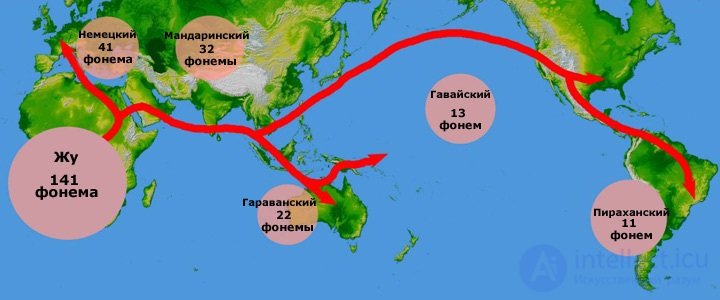
There are languages with only 10 phonemes, while others have more than 80. A language with just a single vowel is possible (three such languages are known), while some Caucasian languages have 24 vowels. There are languages with very rare, and therefore strange-sounding, sounds — resembling clicks, the sound of «blowing out a candle», or «clearing one's throat». But the sounds [t], [p], [u], or [s] will strike no one as strange — they occur in every language. Languages without nasal consonants ([p] or [t]) are almost unheard of, whereas nasal vowels are a great rarity... [The latter cases are classed as language universals.]
Resources on typological linguisticsSections of the page on linguistic typology:
Also see the single-page compendium of typologies for about 6000 languages from the "Tower of Babel" project (Starling.rinet.ru), a global etymological database created under the direction and with the active participation of the great comparativist Sergei Starostin, together with his students and collaborators.
Types of non-genetic language classifications (from simple to complex):
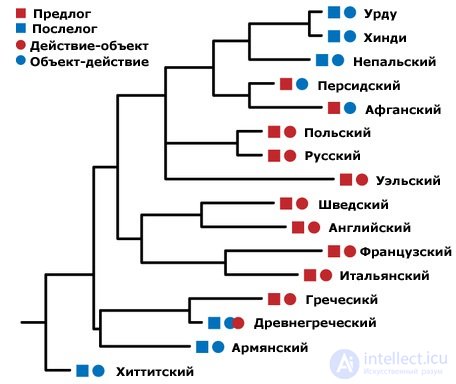
The relationship between language structures
The strong, unchanging vowel of the Altaic root is fundamentally different from the vowel of the Indo-European root, which is subject to ablaut, or from the Semitic vowel, in which not only quality and quantity but even position within the root are subject to change.
In Semitic and Indo-European, all consonants, regardless of their position in the root, are equal in status and possess the same phonological features. In languages of the "Turanian" structure, that is, in the Uralic and Altaic languages, the consonants in the anlaut (initial position) have fewer phonological features than the consonants in the middle or at the end of the root, whereas in vocalism, by contrast, the vowel phonemes of the first syllable of a word are usually phonologically richer than the vowels of the remaining syllables. As is well known, vowels play no special role for the Semitic root; for East Caucasian (Nakh-Daghestanian) roots, not only the vowels but also the sonorants are of little importance; East Caucasian verb roots usually consist of a single obstruent consonant [!]. ( N. S. Trubetzkoy )

Comments