
Lecture
Theorem:
If a string of length n has a border of length k, then it also has a period of length n−k.
Proof:
Let a string αα be given.
Let us formally write the definition of a border of length kk of the string αα:

Let us make the substitution x=n−k:

We have obtained the definition of a period of length x. But x=n−k, so the string αα has a period of length n−k.
Theorem (on multiple periods):
If a string has a period of length k, then it also has a period of length kx, where x∈N.
Proof:
Let the length of the string be nn, and the string itself — α.
We carry out the proof by induction on the number x.
For x=1 the statement is obvious.
Suppose it is true for x⩽m. Let us prove the same for x=m+1.
From the definition of a period we have



So the string has a period of length k(m+1).
The statement is proved.
Before proving the next theorem, let us check a couple of intuitively clear statements.
Lemma (1):
Let a string ss have periods p and q, where q
Proof:
Let us show the truth of the statement for the prefix; the proof for the suffix is analogous.
We need to show: 
Since ss has period p, we have 
Also s has period q, and from the constraints on ii it holds that  , hence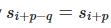
Lemma (2):
Let a string ww have period qq, and let there exist a substring vv of ww such that |v|⩾q|v|⩾q and vv has period rr, where qq ⋮⋮ rr. Then ww has period rr.
Proof:
Let 
We need to show:  .
.
Let us fix ii and jj. Note that since |v|⩾q|v|⩾q, the segment [h,k][h,k] contains at least qq integers, so there will be found
 j.
j.
Given that qq ⋮⋮ rr, we can write i≡i′(modr), j≡j′(modr)i≡i′(modr), j≡j′(modr).
Moreover, i≡j(modr), and in that case i′≡j′(modr) also holds.
Now let us use the following fact: if a string ss has period rr, then i≡j(modr) ⇒ si=sj (indeed, without loss of generality we may assume that i⩽, and from this build the chain of equalities si=si+r, si+r=si+2r, …, sj−r=s).
Since ww has period qq, the equalities si=si′ si=si′ and sj=sj′ sj=sj′ hold. Moreover vv has period rr, so si′=sj′si′=sj′ holds. Hence si=sjsi=sj as well.
Theorem (Fine and Wilf):
If a string ww has periods p and q, where  is also a period of this string.
Proof:
Let us denote r=gcd(p,q). We carry out the proof by induction on n=(p+q)/r.
In the case p=q we see that n=2, which corresponds to the base case, whereas for p≠q we have max(p,q)>gcd(p,q), so n>2.
The truth of the statement follows from p=q=r.
Since p≠q, without loss of generality let us assume q
Let w=uv, where |u|=q.
By Lemma 1 vv has period p−qp−q, and vv also has period qq as a substring of ww. Now let us consider the length of vv:

Note also that for the periods p−q, q the value of n will be smaller than for p, q, since  . Then by the induction hypothesis we conclude: v has period
  Taking into account
  , we can say that vv has period r.
As already mentioned,  , hence
  , and consequently, by Lemma 2, ww has period rr.

Comments