
Lecture
Analytic languages — languages in which grammatical relations tend to be conveyed mainly through syntax, that is, through separate function words (prepositions, modal verbs, etc.), fixed word order, context, and/or intonational variation , rather than through inflection by means of dependent morphemes (endings, suffixes, prefixes, etc.). In other words, the synthetic way of expressing relations between words is confined within the bounds of a single morpheme that is part of one word, whereas in analytic languages these relations are carried outside the word forms , that is, there occurs a specialization and division of labor between grammatically significant function words (prepositions, auxiliary verbs) and lexically significant units, which remain unchanged in form or change only slightly. If a language is isolating (only one morpheme per word), then by definition it will be «maximally analytic» (but not all analytic languages are isolating: inflections are preserved, for example, in modern English). Languages with a well-expressed tendency toward analyticity traditionally include Afrikaans, English, Dutch, New Persian, and Bulgarian. At the same time, the ancestors of all these languages had a well-documented inflectional character. A pronounced tendency toward analyticity is manifest in all the Romance languages, including French, which represents it most fully, showing the greatest contrast compared to inflectional Latin. Although some analytic constructions have appeared in Russian and German , these languages nevertheless remain predominantly inflectional in structure.
The term «analytic» is usually used in a relative rather than an absolute sense. For example, English has fewer inflections (internal inflection) than most Indo-European languages (verbs in English can have up to 5 forms, nouns — up to 3), and is therefore often called analytic, although «traditional» analytic (fully isolating) languages usually have no inflections at all. Thus, the division of languages into analytic and synthetic is usually made on the basis of one or another predominant tendency in the development of a given language. In other words, unlike isolating languages, which appear in this form from their very earliest written records, analytic languages have undergone, or are undergoing, a rapid course of inflection breakdown over a fairly short period of time, sometimes literally within a few generations. The causes of inflection breakdown often lie both in intralinguistic processes (for example, the drive to simplify the cumbersome inflectional forms of Classical Latin in Vulgar Latin) and in foreign-language influence, when in a multilingual environment bilinguals show a tendency to simplify the grammar of one or more languages in order to ease communication. Confirmation of the latter theory is the extreme morphological poverty of virtually all the creole languages of the world.
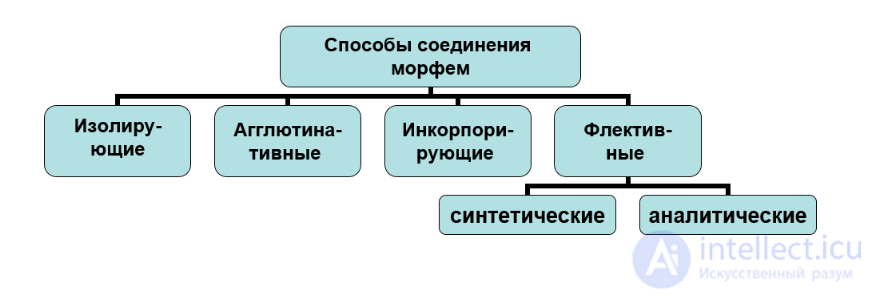
Figure 1 Ways of Joining Morphemes
It is also worth noting that in the course of the evolution of originally synthetic languages, analytic tendencies can affect different parts of speech differently: for example, in the Romance languages the classes of nouns and adjectives are generally more susceptible to analyticity, while in the Germanic languages it is the verbs .
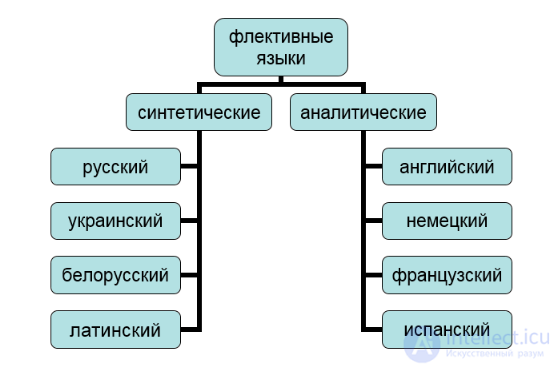
Figure 2 Inflectional / Fusional Languages
It should also be noted that many non-Indo-European languages are currently moving from an analytic structure toward a synthetic one, that is, analyticization is not some universal final process inherent to all languages, but proceeds with varying degrees of intensity. V. V. Ivanov notes, for example, that Old Chinese was a synthetic language, whereas modern Chinese, despite its analyticity, is gradually beginning to restore elements of synthetism . Further progress in syntheticity, in the form of an increase in the number of cases, is also observed in the already fairly synthetic Finno-Ugric languages . B. Comrie speaks of growing synthetism in Basque . In the Indo-European language Lithuanian, under the influence of a Finno-Ugric substrate, the illative, allative, and adessive cases developed in historical times[10]. The cyclicity of processes in language structure is most interestingly manifested in the Indian languages, in which, over a chronologically short span of a little more than two millennia, a cyclical process took place of transition from a synthetic structure to an analytic one and back again[11].
The American linguist J. Greenberg introduced a synthesis index, calculated by the formula M/W, where M is the number of morphs in a stretch of text, and W (from the English word — «word») is the number of speech words in the same text. Languages with an index value below 2 are classified as predominantly analytic .
Owing to the decline of inflections, analytic languages tend toward a reduction in the number of syllables per word: whereas in Russian the average word consists of 2.3 syllables, in the somewhat more analytic German it drops to 1.6 syllables, in the still more analytic French it is already only 1.5 syllables, and in English only 1.34 syllables on average. As a result, a distinctive stratum of children's literature has even taken shape in English-speaking countries, using almost exclusively monosyllabic words. In Chinese, where there are no inflections at all, each word usually consists of one syllable and two or three primary phonemes.
Analytic tendencies in word formation manifest themselves in two main ways. The functions of cases in the Germanic languages are taken over by the compounding of noun roots, in which the first root plays the role of an adjective. In this process, modern compounding acquires complex, multi-component forms (German Schneeballschlacht — a snowball fight), and this compounding also actively draws in other parts of speech (English walk-in closet — a walk-in wardrobe). In addition, a special possessive suffix -s/'s is also widespread. In the Romance languages, compounding is little used, and noun roots form new semantic lexemes with the help of the linking Latin prepositions de and a (Spanish reloj de pulsera — wristwatch). In Chinese, both compounding and a special possessive particle de (的) are widespread, whose usage is almost identical to the English -'s. Most words in modern Mandarin (官话) are compound, two-morpheme words, but three- and even four-morpheme words, reflecting new realities of life, are becoming increasingly widespread.
However, the reduction in word length in languages with a tendency toward analyticity also means growth in the number of words needed to express the same thoughts: thus, to convey identical meaning, an English translation requires approximately 10% more words than its more synthetic Armenian equivalent. This is explained by the fact that in English texts function words make up more than a third of all units, while in Armenian texts they account for only a quarter (Sarkisyan, 2002, p. 5). L. Weisgerber, in his book «On the Worldview of the German Language», gives a similar example for another pair of languages whose areas border one another: when German poetry is translated into French, the translation contains on average 11% more words than its German original. This happens because French, where the case inflections of nouns and articles have completely died out, employs a greater number of function words. The functions of the genitive and dative have long been taken over by the prepositions de(s) and a(ux); and numerous German compound words are replaced by phrases held together by the same prepositions de and a(ux): Eisenbahn > chemin de fer.
Word order in a sentence, as well as in phrases, is usually fairly strictly regulated in analytic languages. The subject is usually followed by the predicate, and the predicate by the object. Modifiers follow either strictly after the word they modify (as in the Romance languages) or strictly before it (as in the Germanic languages or in Chinese). The Romance languages have a whole set of rules governing the order of clitics and other function words and particles interspersed among them.
Chinese, owing to the complete absence of person, number, case, and other inflectional categories, as a rule has strictly direct word order, in which modifiers (and various particles) follow strictly after the word they modify, except in cases of noun-root compounding.
| 我 | 所有 | 的 | 朋友 | 都 | 要 | 吃 | 鸡 | 蛋 |
| wǒ | suǒyǒu | de | péngyou | dōu | yào | chī | jī | dàn |
| I | all | possessive particle | friend(s) | all | want | eat | chicken | egg(s) |
All my friends want to eat chicken eggs.
Direct word order is observed in English fiction in approximately 80% of cases; in Russian this figure drops to 59%, and in Ukrainian only 53% of sentences are built on the direct model. In addition, omission of the pronominal subject, so widespread in Latin and still preserved in most modern Romance languages, is no longer possible in French, where the erosion of verb inflections has already gone too far. The same applies to English. At the same time, in Chinese and in the Romance languages, emphatic resumption of objects fronted to the first position in the sentence is often observed, something that does not occur in the Germanic languages. Example: El libro no lo he leido (I haven't read the book). By comparison, in English only I have not read the book" (I did not read the book).
In many analytic languages a decline of the category of number for nouns, adjectives, and verbs is observed. The most illustrative example is Chinese, where number is conveyed lexically. Examples: 一天 yī tiān «one day», 三天 sān tiān «three days» (literally «three day»); 一個男孩 yī ge nánhái «one boy» (literally «one [classifier] male-child»), 四個男孩 sì ge nánhái «four boys» (literally «4 [classifier] male-child»); 多课 (duō kè) many classes (literally much class).
In French, the category of number for most nouns and adjectives has been lost in spoken speech (but not in writing): un jour > les jours. In both spheres, number is conveyed by means of articles, and also lexically (plusieurs/deux/trois jours). In Megleno-Romanian, a language related to French, nouns ending in -p, -b, -f, -v, -ț, -z, -č, -š, -j, -ľ, -i̯, -ń, -r, and a stressed vowel, likewise do not distinguish number forms (number is disambiguated with the help of articles that have a plural form, or by lexical units with a quantitative meaning)[12]. Analyticity develops along a similar model in many dialects of Spanish (Caribbean, Rioplatense), where debuccalization of the final plural marker -s has led to its disappearance in spoken speech: the number of nouns and adjectives is now conveyed either by articles or by lexical units (numerals or quantitative adverbs).
The lowest inflection index Greenberg obtained was for Vietnamese: 1.06 (106 morphs per 100 words). The level of analyticity for English came out at 1.68. The analytic languages include Chinese, Bulgarian, Persian, Italian, Spanish, Portuguese, French, Danish, and others.
In terms of the development of verbal analyticity among the Indo-European languages, the Germanic languages are the leaders. This indicator is achieved mainly owing to the record-low level of verb syntheticity in Afrikaans (0.2) and English (0.5) . Grammatically, Afrikaans is one of the most analytic of the Indo-European languages, since in the course of its development its morphology underwent the most radical simplification within just two centuries[13], although its phonetics remains quite complex. A similar path of increasing analyticity was followed by Dutch and English, languages related to Afrikaans, as well as by some German dialects (linguistic conservatism prevented the complete breakdown of inflections in literary German). At the same time, Icelandic retains a high level of syntheticity.
In the Slavic languages, tendencies toward analyticity are on the whole fairly weakly expressed. The South Slavic languages are an exception, which is explained by the influence of foreign-language systems and active interlanguage contacts within the Balkan language union.
The analyticity index of Russian fluctuates between 1 and 3[14], but on average is between 2.33 and 2.45[15].
Bulgarian is considered the only analytic Slavic language, which makes it possible to study the process of the development of comparative analyticity using it as an example. At first its cases began to be reduced and to lose their phonetic distinctiveness, which eventually erased the distinction between inflections in living speech. This process was most spontaneous in the 12th—16th centuries. A considerable role in this process was also played by the decline of Bulgarian writing over more than four centuries of Ottoman rule, during which spoken language was not burdened by the conservative written traditions of Old Church Slavonic. At the first stage, certain prepositions began to be associated with cases in Middle Bulgarian. Over time, the need for the case itself disappeared altogether. The decline of case paradigms, paralleled by the growing significance of prepositions and articles, are the main markers of analyticity[16]. Compare: Russian капли росы with Bulgarian капки от роса (literally капли от роса). In the end, the prepositions themselves came to distinguish meanings quite clearly on their own, taking over the function of the cases.
At the beginning of the 20th century, accusative-case masculine forms such as чакам г-на Симеонова or подарявам книгата на Ивана Петрова were actively being replaced by the caseless forms чакам г-н Симеонов and подарявам книгата на Иван Петров, because this makes it easier to distinguish gender and sex: e.g., уважавам Валентина Георгиева and уважавам Валентин Георгиев.
Nouns are the most easily subject to inflection breakdown. As in the Romance languages, this process lags somewhat behind in pronouns, which always retain inflectional forms longer than nouns. At the same time, again, in modern spoken Bulgarian the growth of analyticity is evident in this category of words as well, even though from the standpoint of the modern literary language the following examples are classified as errors. Example: «На кой се обаждаш?» (instead of the literary case construction «На кого се обаждаш?»), "«Аз ми се струва» (instead of «На мен ми се струва»), «Той го няма» (instead of «Него го няма»).
The future tense is also fully analytic and is formed with the help of the invariable auxiliary particle ще.
The Romance languages are characterized by a fairly early onset of the development of analytic tendencies, both in terms of the breakdown of noun inflections and in terms of the development of a rich array of analytic tenses and various periphrastic verb constructions. The inherently analytic future-tense construction on the AMARE+HABEO model already appeared in the Vulgar Latin of the late Empire, although analytic tendencies were not yet so pronounced at that time. Unlike the cryptogendered Germanic languages, the category of gender retains its stability, being based (as in the Slavic languages) on the sounds at the end of the word, although it too has undergone simplification (in most languages the Latin neuter gender was redistributed between the feminine and masculine). In Spanish, radical simplification affected not only noun morphology but also the phonetics of the language as a whole. At the same time, a wealth of personal inflections is preserved in the verb conjugation system, to which has been added a whole range of new analytic constructions with the auxiliary verbs HABER, TENER QUE, and the periphrases IR A, ACABAR DE, PONER A.
These analytic tendencies are most fully represented in modern French. However, a distinctive feature of French is the persistence of a substantial gap between the spoken language (where analyticity has reached its apogee) and the written norm (where conservative traditions preserve various inflectional markers such as the «silent» endings -s and -x marking the plural, a marking that has lost its inflectional form in the spoken language). An important role in conveying relations between words is now played not by endings but by word order in the sentence and by the prepositions a, de, pour, as well as by auxiliary words (je sais pas) and articles (le loup > les loups). The personal inflections of the verb are heavily reduced in spoken speech (but not in writing). The large number of homophones ([sɛ̃]: saint, sain, sein, ceint, seing) in French makes context especially important in spoken French, and traditional spelling especially important in written French . In spoken French, a word torn out of context has not only virtually no grammatical properties but is also often devoid of semantics as well. However, unlike English and Afrikaans, whose analyticity gravitates toward the classical isolating type, the analytic tendencies in French and the other Romance languages are of an entirely different character — they are developing toward analytic polysynthetism[17], in which the entire sentence forms a single phonetic-syntactic stream: il y est allé («He went there») /i.ljɛ.ta.le/[18], Spanish Dímelo tú «you tell it to me». Polysynthetic constructions can run counter to the general tendency toward fragmentary analyticity, as most clearly demonstrated by the French and Italian adverbial pronouns (en/ne and y/ci)[19], although the etymologically related ende, which survives in Spanish, is little used.
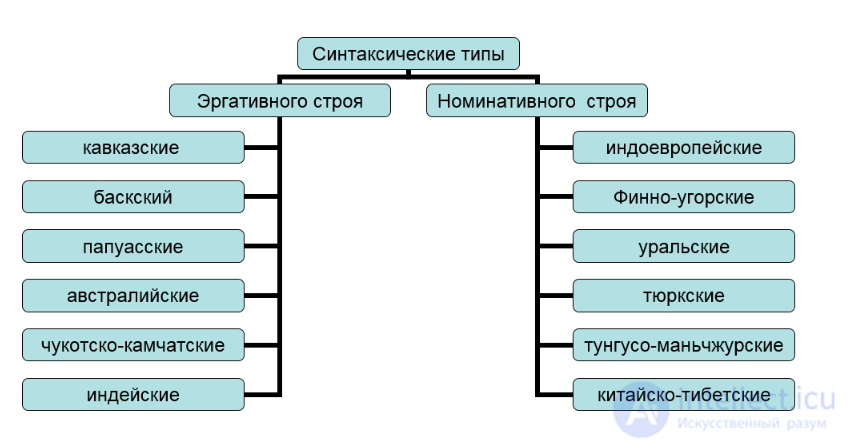
Figure 3 Syntactic Types of Languages


Comments