
Lecture 2 min.
Matrix grammar is a formal grammar in which the production rules are grouped into finite sequences. The production rules cannot be applied individually, only as a sequence. When such a sequence is applied, the replacement is carried out according to each rule in the sequence, from the first to the last. The sequences are called matrices. A matrix grammar is an extension of a context-free grammar.
A matrix grammar is an ordered quadruple

where
 is a finite set of nonterminal symbols
 is a finite set of terminal symbols
 is the start symbol
 is a finite set of nonempty sequences of ordered pairs
The pairs are called production rules and are written as  . The sequences are called matrices and are written as

Let  be the set of all production rules in the matrices
  of the matrix grammar
  . Then the grammar is a grammar of type
  , non-contracting, linear,
  -free, context-free or context-sensitive if and only if the grammar
  has this property.
For a matrix grammar a binary relation  is defined, also denoted
  . For any
 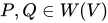 ,
,  holds if and only if there exists an integer
  such that there exist words

over the set V and
 and
and 

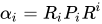 and
and 
If these conditions are satisfied, it is also said that holds with the specification  .
.
Let  be the reflexive transitive closure of the relation . Then the language generated by the matrix grammar is defined as follows:

Consider the matrix grammar

where is the collection of the following matrices:

These matrices, which contain only context-free rules, generate a context-sensitive language


Comments