
Lecture
Semantic differential (English: semantic differential) — a method for constructing individual or group semantic spaces (English: semantic space). The coordinates of an object in a semantic space are its ratings on a number of bipolar graded (three-, five-, seven-point) rating scales (English: rate scale), whose opposite poles are defined by means of verbal antonyms. These scales are selected from a pool of trial scales using methods of factor analysis.
The semantic differential makes it possible to obtain a description of an image and to reveal the «language» by which target consumers perceive the surrounding world and make decisions.
The semantic differential method:
The semantic differential method was introduced into psychological research by Charles Osgood (English: Charles E. Osgood) in 1952 . Ch. Osgood argued for the use of three basic seven-point rating scales:
| «evaluation»: | good | 3 | 2 | 1 | 0 | −1 | −2 | −3 | bad | |
| «potency»: | strong | 3 | 2 | 1 | 0 | −1 | −2 | −3 | weak | |
| «activity»: | active | 3 | 2 | 1 | 0 | −1 | −2 | −3 | passive |
The semantic differential (in the narrow sense) is also the name given to the bipolar graded rating scale used in the semantic differential method.
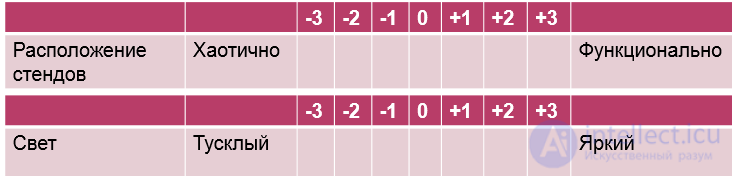
The main advantage of the method:
The essence of the method: the object is rated on a number of characteristics using a seven-point scale, with the poles of the characteristics defined verbally by means of antonyms.
To construct a subjective semantic space, a group of subjects is asked to rate some set of objects (concepts) on a set of bipolar graded scales. In the view of Ch. Osgood and later researchers, the phenomenon of synesthesia plays a significant role in constructing such ratings.
Synesthesia — is the basis of metaphorical transfers and evaluations, which makes it possible, for example, to rate a voice as soft or harsh (that is, on the bipolar scale «soft-harsh»). The phenomenon of synesthesia consists in the emergence of a sensation of one modality under the influence of a stimulus of another modality.
Ratings of concepts on the original scales as a rule correlate with one another. Factor analysis makes it possible to isolate the main, basic scales. Ratings on the remaining scales are functions of the basic ratings, up to a comparatively small random error.
The size of the groups of subjects can vary enormously: from a single person (an individual semantic space) to representative samples representing large social groups or entire nations. The number of objects and trial scales can range from a few dozen to several hundred.
Not only adjectives can be used as poles for defining bipolar scales. For example, in a study by V. F. Petrenko , abstract graphic images were used. Earlier, Leon James used graphic images to denote the poles of scales. Examples of such polar images: a black circle — a white circle; an arrow pointing up — an arrow pointing down, and so on.
In addition, studies often use unipolar scales, by means of which objects are rated according to the degree of expression of a single property; the use of factor analysis to find basic properties does not require bipolarity. Unipolar scales using adjectives are often called Stapel scales or Likert scales in the English-language literature, after the researchers who first described the use of this type of scale. In the Russian-language psychological literature, the name «semantic differential» has generally become attached to all rating scales with more than three scale points.
The methods of processing the data can also vary: from classical factor analysis and the principal component method to neural networks and numerous other nonlinear generalizations.
Ch. Osgood's basic scales are by no means always the main factors, and the dimensionality of semantic spaces is also not always equal to 3. Thus, the following sets are found among the main coordinates in an individual semantic space, such as
pleasant — unpleasant, dangerous — safe (dimension 2);
6-7 dimensional individual semantic spaces also appear .
V. F. Petrenko identified the following factors: «evaluation», «potency», «activity» (the Osgoodian basis) and, in addition, «orderliness», «complexity», and one further, special factor named «comfort».
Independently of Ch. Osgood, a similar technique was developed within the framework of psychotherapeutic practice by George A. Kelly and his followers.
As an example, the object chosen for the marketing study was the shampoo «Magiya trav» ('Herbal Magic'), produced by the Nikolaev Pharmaceutical Factory and the joint venture LLC «Magiya trav». The basis for comparison chosen was the shampoo «Elseve», produced by the French company «L’oréal».
The products indicated were studied across 10 consumer characteristics, which were rated on a 10-point scale (table). Respondents rated each item of the questionnaire with the corresponding score for the «Magiya trav» shampoo, the «Elseve» shampoo, and an ideal shampoo they would like to purchase.
Table. Semantic differential of the consumer characteristics of the shampoos «Magiya trav», «Elseve», and the ideal shampoo
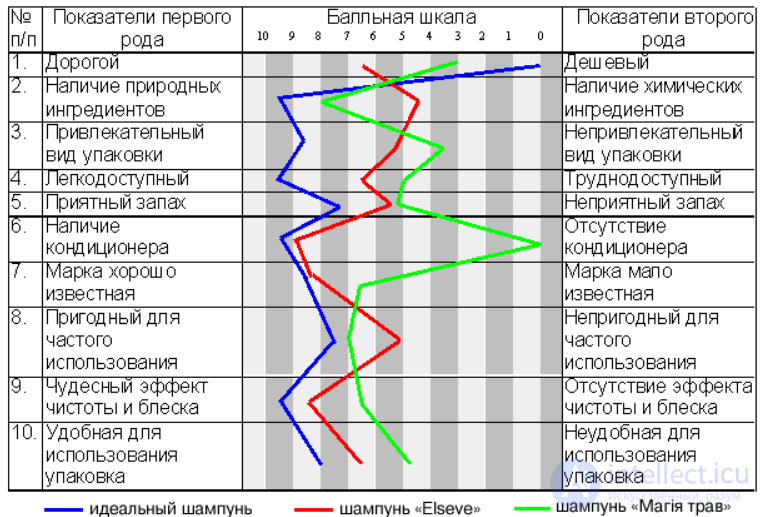
Based on the data obtained, average profiles of the three curves were constructed, reflecting the averaged subjective perception of the consumer characteristics of the products studied and the vision of the ideal shampoo.
Analyzing the curves (table), it should be noted that the «Magiya trav» shampoo studied satisfies target consumers on the following characteristics: pleasant scent; the effect of cleanliness and silky shine; a relatively well-known brand and the presence of natural ingredients; price (lower than that of the «Elseve» shampoo).
At the same time, consumers are not entirely satisfied with the packaging of the «Magiya trav» shampoo, in particular its design and convenience, as well as the absence of a conditioner in it. The manufacturer can therefore be recommended to pay more attention to improving the packaging and to combining the shampoo with other components (conditioner, keratides, etc.). Attention should also be paid to ensuring the shampoo is available in sufficient quantity in the retail network, as a factor in its accessibility for purchase.
Thus, the use of the semantic differential in marketing research provides a thorough and clear differentiation of the characteristics of the products being compared. In addition, it helps identify the needs of different categories of consumers before positioning a product in the market, since any consumer perceives a product as a set of specific characteristics and, depending on the optimal combination of these, gives preference to one product over another.
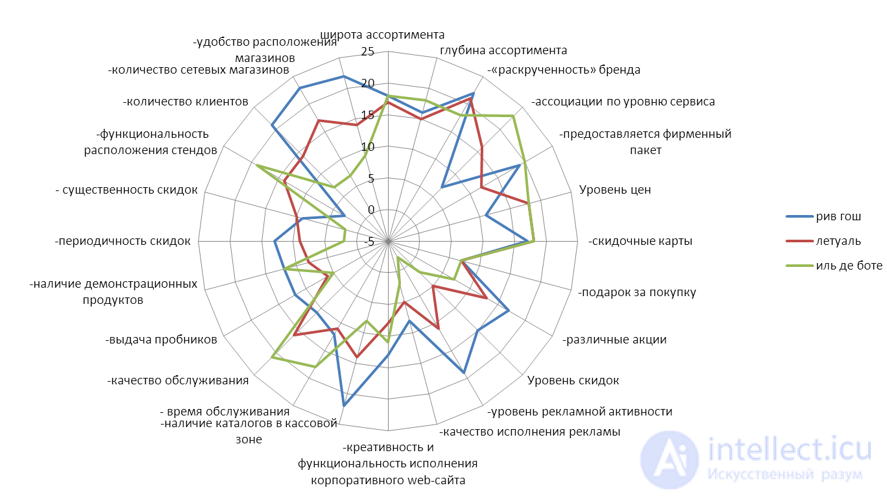
Fig. 3. Example of a company profile of enterprises in terms of the marketing mix
The semantic differential method makes it possible to pose and solve the following typical questions:
Constructing semantic spaces and analyzing the position of objects within semantic spaces — is an important tool in many practical applications:
and in many other fields.
A semantic field — is the largest meaning-based paradigm, uniting words of various parts of speech whose meanings share one common semantic feature.
For example: the semantic field «light» — свет, вспышка, молния, сиять, сверкать, светлый, ярко (svet 'light', vspyshka 'flash', molniya 'lightning', siyat' 'to shine', sverkat' 'to sparkle', svetlyy 'bright', yarko 'brightly'), etc.
To organize a field, a dominant is identified within it.
The dominant — is a word that can serve as the name of the field as a whole. The dominant is included in the field.
Fields can be synonymic or hyponymic. In a synonymic field, the dominant is included in the field on an equal footing with the other members of that field. If, however, the dominant rises above the other elements of the field, such a field is called hyponymic.
The differential semantic feature is the seme.

Comments