Semantic Core
The semantic core of a text — is an ordered set of words, their morphological forms, and phrases that most accurately characterize the type of activity and the meaning described in the text. The semantic core has a central keyword, usually a high-frequency one, and all the other keywords in it are ranked in decreasing order of how often they co-occur with the central query across the overall document collection. Thus, the semantic core is represented as a semantic graph, in which the length of an edge is inversely proportional to the frequency of co-occurrence.The semantic core — is a set of words and phrases that reflect the subject matter and structure of a site. Such words and phrases are also called keywords and key phrases.
The keywords (search queries) of the semantic core are selected by analyzing the company's services or products, query statistics, site statistics, the content of competing sites, and the seasonality of search query use. The composition of the semantic core should correspond as closely as possible to target visitors' ideas about what information, in their view, should be present on the site.
A site's semantic core consists of the keywords that the search engine found when crawling the site; however, it may differ significantly from the reference core built on the semantic graph that characterizes the given subject area. This is due to particular features of the resource's business model.
The semantic core is the foundation of your text. Whether or not your site ranks in the TOP of the search engines depends directly on it, as does how the text will be perceived by a human reader.
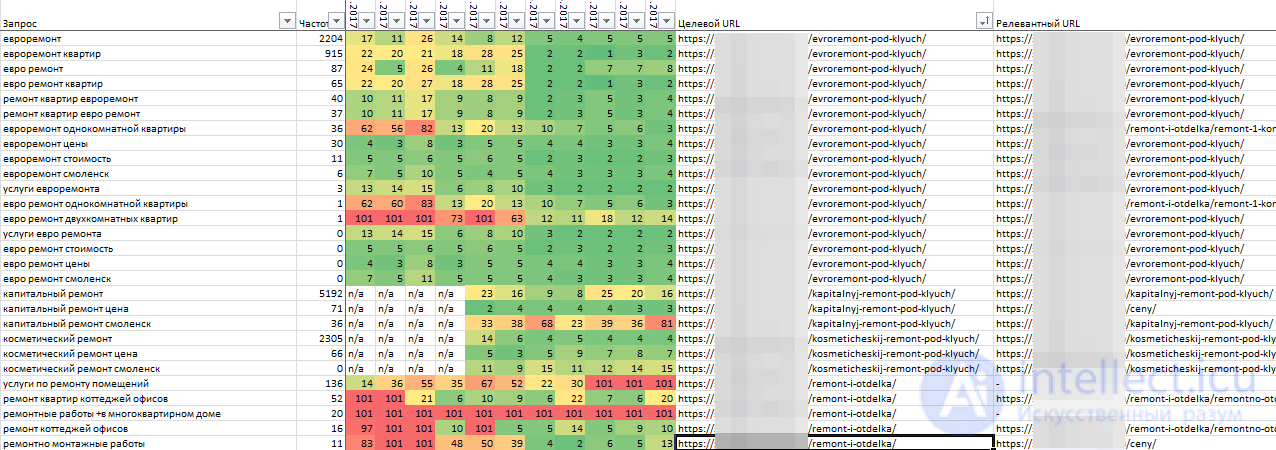
Example of determining the semantic core for different pages of a site
Goals of Creating a Text's Semantic Core
- The semantic core forms the subject matter of the text, which is evaluated by search engines.
- A correctly formed semantic core is the basis for an optimal text structure.
- A semantic core that correctly reflects the business model helps search engines rank the site more accurately in search results and, thereby, better satisfy users' needs.
The Procedure for Compiling a Semantic Core
Before creating a semantic core, you should thoroughly study the enterprise's business model. There are services that generate a semantic core automatically, extracting the most valuable key phrases from an existing pool of data. There are 3 types of semantic cores: commercial, non-commercial, and combined, which includes both commercial and non-commercial search queries. The division of the core into commercial and non-commercial parts is used, among other things, in techniques for building satellite sites.
- Services such as «Google Analytics», «Yandex.Wordstat», and similar tools, which provide information on how frequently keywords are used in search queries;
- analysis of usage statistics for the main keywords by which visitors arrive from search results at the site for which the semantic core is being compiled (this information is available in «Google Analytics», «Yandex.Metrica», and similar tools);
- monitoring the visibility of competing sites in search results for presumably relevant queries.
When selecting keywords, their regional affiliation and seasonality should be taken into account.
Clustering the Semantic Core
Clustering — is the manual grouping of search queries based on search results. If the search engine returns the same documents for a set of search queries, and the number of such matches meets the required degree of grouping, — such queries are combined into groups. For each group, a target page is created to mention all the search queries in that group on a single page.
Grouping degree — is the number of identical documents on the search results page by which the grouping is performed.
Types of Clustering
Today there are at least 3 algorithms for clustering based on search engine results — Soft, Hard, and Moderate. The Soft and Hard algorithms were introduced and described by Alexey Chekushin. The Moderate method was introduced and described by the team behind the «Topvizor» service.
- Soft — based on query statistics, the most popular search query is selected, and all other queries are compared against it by the number of documents they share on the search engine's results page. If the number of matches meets the required grouping degree, the queries are combined into a group. In the resulting group, all queries will be linked to the popular query, but may not be linked to one another.
- Moderate — based on query statistics, the most popular search query is selected, and all other queries are compared against it by the number of documents they share on the search engine's results page, additionally comparing all the search queries with each other. If the number of matches meets the established grouping degree, the queries are combined into a group. In the resulting group, all queries will be pairwise linked to one another, but in different pairs the URLs of the compared queries may differ.
- Hards — based on query statistics, the most popular search query is selected, and all other queries are compared against it by the number of documents they share on the search engine's results page, additionally comparing all queries with each other and all URLs in the resulting pairs. If the number of matches meets the established grouping degree, the queries are combined into a group. In the resulting group, all queries will be linked to one another by shared URLs. In simple terms: «every member of the group is friends with every other member». For queries to fall into the same group, all of them must share one and the same common set of URLs. This condition almost completely rules out possible incompatibility among the queries in a group. This method looks good on paper, but in practice it is often excessively strict, and splits clearly similar queries into different groups. For this reason, this method is recommended only in cases requiring absolute compatibility of queries, for example, in Text Analysis or when promoting service sites for high-frequency queries.
Factors Affecting the Semantic Core
The semantic core usually takes into account factors such as:
- the frequency with which the search query is used;
- the frequency of use excluding phrases that include the given query;
- the frequency of use excluding morphological forms;
- the competitiveness of the given query;
- the projected and actual number of visits to the site from search results;
- the seasonality of the query;
- geotargeting;
- the query's share in the semantic graph.
Using the Semantic Core
The semantic core is used by site creators for the successful promotion of sites and their texts in search engines. The semantic core is often compiled before any site promotion, whereas it should really be compiled long before the site is created. The process of building a semantic core before a site exists is called semantic design.
Compiling the list of keywords plays a foundational role in building the semantic core. The sequence for building the semantic core looks like this: taking the site's subject matter and its goal into account, you need to compile a list of keywords that most fully describe the site's content; the collected keywords then need to be clustered by site sections; afterward, the collected semantics are used for page-by-page optimization of the site's pages for the collected keywords.
Errors in Selecting Keywords for the Semantic Core
Among the main errors made when collecting key phrases, the following should be noted:
- only the most obvious queries are collected;
- synonyms, word forms, and professional jargon are not taken into account;
- geo-queries are not taken into account;
- a large number of varied queries are assigned to a single page;
- queries with the same meaning are mapped to different pages.
If you take too few queries into account, then when working on meta tags and content you are highly likely to simply miss some of the key phrases that could have brought traffic to your site, and the promotion results will be lower.
If you compiled the «Query-Page» mapping in a suboptimal way, then:
- you will run into problems with search engines correctly ranking your pages, which can lead to a sudden drop in positions;
- in the case of an unjustified expansion of the site's structure, this may be treated as spam, and the site's positions will be lowered;
- in the case of an underdeveloped site structure, it will be harder for you to promote the site for all queries.
See Also
- Semantic periphery
- [[b8576]]
- [[b3990]]
- Linguistics
- sampling (statistics)
- Philology
- Marketing
- communications
- SEO
- Search engine
- Keyword
- Rewriting
See also


Comments