
Lecture
A formal grammar, or simply a grammar, in the theory of formal languages — is a way of describing a formal language, that is, of singling out a certain subset from the set of all words over some finite alphabet. A distinction is made between generative and recognizing (or analytical) grammars — the former specify rules that can be used to construct any word of the language, while the latter allow one, given a word, to determine whether or not it belongs to the language.
The theory of languages examines the principles and features of constructing various languages. Before the beginning of the 20th century only natural (spoken) languages existed. At that time, a language was understood as a means of communication between people. With the development of linguistics it was established that means of communication are not unique to humans. Nowadays a language is understood to be any means of communication.
A language includes the following constituent parts:
The signs of a language can be:
Note that in information technology all information is represented in the form of strings. Thus, any transformation of data in a computer consists of transforming some strings into others.
In any language one can distinguish correct (admissible) and incorrect constructions. The rules for building correct texts make up the syntax of the language. The description of the correspondence between meanings and texts makes up the semantics of the language.
The semantics of a language depends on the origin and nature of the language, i.e. on the nature of the objects the language describes. The syntax of a language depends less on the nature of the language. Therefore, when studying syntax, a formal approach can be used.
The essence of the formal approach is that a language is regarded as a set of formal objects built according to definite rules. Sequences of symbols serve as the formal objects. When such sequences are constructed, their meaning is not taken into account. The emergence and development of the formal approach is connected with the need to solve problems of the following type:
Depending on their origin and degree of universality, languages can be divided into the types shown in fig. 12.1
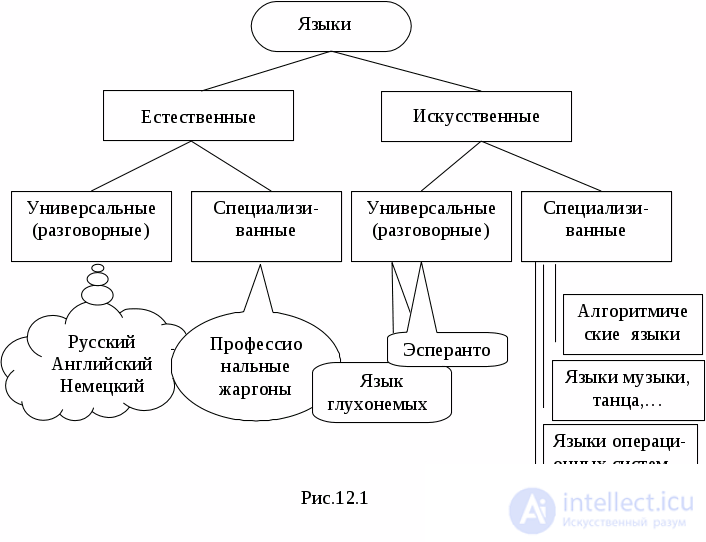
Natural languages arise and develop gradually, together with the development of society, over a long period of time.
Artificial languages are developed specifically for a particular field of application over a relatively short period of time.
Universal languages are used for communication among people in everyday life.
Specialized languages serve as a means of communication for a fairly narrow circle of people when exchanging information in some special field of knowledge. Examples of specialized languages can include various professional jargons (the language of computer users), the language of algebra, the language of the algebra of logic, and so on.
The features of natural languages stem from their origin. The main features that make a formal approach to studying natural languages difficult are listed below.
* Dependence of syntax on semantics (meaning). For example, word endings can depend on whether the objects the words refer to are animate or inanimate. As an example, consider two similar phrases:
"Я увидел пень" ('I saw a stump') (What?).
"Я увидел оленя" ('I saw a deer') (Whom?).
* Semantic and syntactic ambiguity. Semantic ambiguity arises because some words can have different meanings. For example, the phrase "Косой шел с косой" ('The cross-eyed man/the hare walked with a scythe') can have different meanings depending on context. Syntactic ambiguity arises from the insufficient rigor of syntactic rules. For example, the phrase "Бытие определяет сознание" ('Being determines consciousness') can be interpreted in different ways. If we assume that the basic element is being, the original phrase can be replaced by the phrase "Бытие является главным, и оно определяет сознание" ('Being is primary, and it determines consciousness'). But the original phrase can also be interpreted this way: "Бытие определяется сознанием" ('Being is determined by consciousness').
* The possibility of paradoxical sentences arising. Paradoxical sentences are constructed so that they can be classified as neither true nor false. An example of a paradoxical sentence is the phrase: "Данное предложение является ложным" ('This sentence is false').
12.3. Formal languages and their features.
Most artificial languages use formal rules, i.e. rules not dependent on meaning, when constructing sentences. Such languages are called formal. The syntax of formal languages must ensure the possibility of a formal approach to constructing sentences. Formal languages therefore have the following features
Formal languages, like natural ones, can change over time. But unlike natural languages, these changes appear not gradually but through the emergence of new versions of the language. In this case, different versions of the same language can be regarded as different languages.
The smallest syntactic unit of a formal language is the symbol. A symbol (letter) - is a simple, indivisible sign. The set of symbols of a language make up the alphabet.
The words of the language defined by a grammar are all the sequences of terminals derivable (generated) from the start nonterminal by the derivation rules.
To define a grammar, one must specify the alphabets of terminals and nonterminals, the set of derivation rules, and also designate a start symbol among the nonterminals.
Thus, a grammar is defined by the following characteristics:
 — the set (alphabet) of terminal symbols
 «right-hand side», where:
A derivation is a sequence of strings composed of terminals and nonterminals, where the first is the string consisting of a single start nonterminal, and each subsequent string is obtained from the previous one by replacing some substring according to one (any) of the rules. The final string is a string consisting entirely of terminals, and therefore constitutes a word of the language.
The existence of a derivation for a given word is the criterion for its belonging to the language defined by that grammar.
According to the Chomsky hierarchy, grammars are divided into 4 types, each subsequent one being a more restricted subset of the previous one (but also more tractable to analyze):
In addition, the following are distinguished:
 , where
  . The length of the right-hand side of the rule is not less than the length of the left .
 , or
, or  , that is, the right-hand side of the rule may contain at most one occurrence of a nonterminal .
Let us consider a simple language defining a limited subset of arithmetic formulas consisting of natural numbers, parentheses, and arithmetic operation signs. It is worth noting that here, in every rule, only one nonterminal symbol stands to the left of the arrow  . Such grammars are called context-free.
Terminal alphabet:
Nonterminal alphabet:
{ FORMULA, SIGN, NUMBER, DIGIT }
Rules:
1. FORMULAFORMULA SIGN FORMULA (a formula is two formulas joined by a sign) 2. FORMULA
Start nonterminal:
FORMULA
Derivation:
Let us derive the formula (12+5) using the listed derivation rules. For clarity, the sides of each replacement are shown in pairs, with the part being replaced underlined in each pair.
FORMULA  (FORMULA)
(FORMULA)  (FORMULA SIGN FORMULA)
(FORMULA SIGN FORMULA)  (FORMULA + FORMULA)
(FORMULA + FORMULA)  (FORMULA + NUMBER)
(FORMULA + NUMBER)  (FORMULA + DIGIT)
(FORMULA + DIGIT)  (FORMULA + 5)
(FORMULA + 5) (NUMBER + 5)
(NUMBER + 5)  (NUMBER DIGIT + 5)
(NUMBER DIGIT + 5) (DIGIT DIGIT + 5)
(DIGIT DIGIT + 5) (1 DIGIT + 5)
(1 DIGIT + 5) (1 2 + 5)
Generative grammars are not the only type of grammar, but they are the most widespread in programming applications. Unlike generative grammars, an analytical (recognizing) grammar defines an algorithm that determines whether a given word belongs to the language. For example, any regular language can be recognized by a grammar defined by a finite automaton, while any context-free grammar can be recognized by a pushdown automaton. If the word belongs to the language, such an automaton builds its derivation explicitly, which makes it possible to analyze the semantics of that word.
A formal language in mathematical logic, computer science, and linguistics is a set of finite words (strings, chains) over a finite alphabet. The concept of a language is most often used in automata theory, computability theory, and the theory of algorithms. The scientific theory dealing with this object is called formal language theory.
In model theory, a language is built from sets of symbols, functions, and relations together with their arity, as well as a set of variables. Each of these sets may be infinite. Logical statements are formed from the language together with universal logical symbols.
A formal language can be defined in various ways, for example:
For example, if the alphabet is given as  , and the language
  includes all words over it, then the word
  belongs to . The empty word (that is, a string of zero length) is allowed and is often denoted as
  ,
,  or
or  .
.
Some other examples of formal languages:
 , where
  is a nonnegative number, and
  means that
  is repeated times;
Some operations can be used to generate new languages from given ones. Suppose that  and
and  are languages defined over some common alphabet.
 contains all words satisfying the form
  , where
  is a word from , and
  is a word from .
 contains all words contained both in and in .
 contains all words contained in or in . contains all words of the alphabet that are not contained in .
 contains all words for which there exists a word in such that was contained in .
 contains all words that can be written in the form
  , where
  is contained in and
  . Note that this also includes the empty word , since
  is allowed by definition.
 contains the reversed words from . and contains all words that can be written in the form
  , where
  and
and  are such words that the pair
  is in , and
  are such words that
  is in .
Formal semantics — a discipline that studies the semantics (interpretations) of formal and natural languages through their formal description in mathematical terms.
A formal language can be defined without any interpretation. This is achieved by specifying a set of symbols (also called an alphabet) and a set of inference rules (also called a formal grammar) that determine which strings of symbols are well-formed formulas. When transformation rules are added and certain sentences are taken as axioms (which together is called a deductive system), a logical system is formed. Interpretation is the assignment of meaning to its symbols and truth values to its sentences.
The truth conditions of the various sentences that may appear in arguments depend on their meaning, so conscientious scholars cannot entirely dispense with some description of the meaning of these sentences. The semantics of logic describes various approaches to understanding and defining those parts of meaning that are of interest. As a rule, what is of interest from a logical point of view is not the sentence itself, but its propositional, idealized form suitable for logical transformations.
Before the emergence of modern logic, in Aristotle's «Organon», namely in the treatise «On Interpretation», the foundations for understanding and the meaning of logic were laid. The introduction of quantifiers was meant to solve the problem of the generality of sets, which could not be solved within the framework of Aristotle's subject-predicate analysis, although in term logic a new interest appears, namely attempts to build a calculus in the spirit of Aristotle's syllogistic, but using the generality properties of quantifiers from modern logic.
The main modern approaches to semantics for formal languages are:
Linguists rarely applied formal semantics until Richard Montague showed how English (or any other natural language) could be treated as a formal language. His contribution to linguistic semantics, known as Montague grammar, provides the basis for what linguists call formal semantics.
Model theory
|
Formal languages and formal grammars
|
|
|---|---|
| General concepts |
|
| Type 0 |
|
| Type 1 |
|
| Type 2 |
|
| Type 3 |
|
| Parsing |
|

Comments