
Lecture
Case grammar, «role grammar» ( Case grammar)— a method of describing sentence semantics (excluding modal and performative elements) as a system of semantic valencies, in which the meaning of the head verb dictates the roles («cases») performed by the nominal constituents. It is sometimes regarded as one of the varieties of generative semantics :114 (alongside the direction represented by J. McCawley, G. Lakoff, and other scholars).
Many languages have been described from the semantic standpoint within the framework of case grammar. The results of such research are used in work on problems of artificial intelligence (in the area of frame semantics) and in psycholinguistics .
Case grammar («role grammar») — a method of describing sentence semantics as a system of semantic valencies, through the connections of the «main verb» with the roles dictated by the meaning of that verb and performed by the nominal constituents.
Each verb corresponds to a specific set of cases (a case frame), with each case corresponding to a specific participant
in the situation, or participant.
Case grammar arose within the framework of transformational generative grammar in the late 1960s in the work of C. Fillmore. As a method of grammatical description, it developed under the influence of the tagmemics of K. L. Pike .
The approaches of linguists (W. Chafe, J. Anderson, J. Grubor, W. Cook, S. Starosta, and others) to case grammar differ in the type of logical sentence structure, the set of roles and their permissible combinations, called «case frames», or frames, as well as in how semantic connections are reflected in sentence structure by formal means. Another difference, which separates S. Starosta's «lexicase» non-transformational grammar from the others, lies in the particulars of its use of the concept of deep case .
With the emergence and development of cognitive linguistics, the growing attention of linguists in the second half of the 20th century and the beginning of the 21st century has been drawn to problems associated with the study of the semantic-syntactic side of language, as well as cross-level functional connections in language. In linguistics, dissatisfaction began to emerge with the long-standing orientation of research toward descriptive and generative approaches, oriented toward the formal description of language and ignoring meaning. Moreover, the view arose that linguistic semantics cannot be reduced solely to semasiology (lexical semantics), and that its primary object should be the contextual meaning of units in the sentence and discourse. Structuralists' interest in the systemic connections between lexical units (and lexical meanings) took shape in the form of independently developed theories of lexical (semantic, lexico-semantic) fields and the method of componential analysis of the meanings of a group of interrelated words, which traces back to the oppositional analysis used in phonology (and later in morphology). Following this, syntactic semantics (or semantic syntax) arose, quickly taking a leading position in linguistic semantics. At the end of the 1960s, within the framework of transformational generative grammar, the so-called «case grammar» arose, founded by the American linguist C. Fillmore, who worked on syntax, lexical semantics, and linguistic pragmatics. Three major research programs are directly associated with his name: case grammar, frame semantics, and construction grammar. The first of these was initiated by Fillmore's major article «The Case for Case» (1968, Russian translation 1980). Case grammar («role grammar») — a method of describing sentence semantics as a system of semantic valencies, through the connections of the «main verb» with the roles dictated by the meaning of that 175 verb and performed by the nominal constituents, e.g., the verb «to move» requires the roles («cases») of the moving object, the addressee and direction of movement, and the agent initiating this movement.
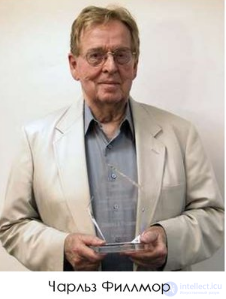
Charles Fillmore
Thus, at the end of the 1960s, «case grammar»
had 3 programs:
According to Fillmore, a sentence consists of a modus, which includes mood, tense, and modality, and a proposition — the core meaning. The proposition contains a predicate, usually expressed in the surface structure of the sentence by a verb, sometimes by a function word (for example, the predicate of accompaniment in Russian can be conveyed by the conjunction с (with)), and deep cases, or semantic roles, necessarily presupposed by the given predicate: thus, the predicate underlying the verb to give, presupposes the deep cases of «agent» (the one who gives), «object», and «addressee».
Deep cases often do not correspond to surface cases (or their equivalents in analytic languages), therefore, within the framework of case grammar, a system of rules is proposed for transforming deep structure into surface structure. In particular, there are rules for introducing complements, while the rules for introducing the subject are organized as follows:
The rules for the formal expression of cases describe the correspondence between deep cases and elements of the surface structure of sentences in a given language: thus, in English, a case in the surface structure is usually matched by the preposition with, however, if the word with the case «instrument» is used in the function of the subject, the preposition with is eliminated. A special rule specifies that with the verb play the preposition with can either be eliminated (He can play piano ‘He knows how to play the piano’), or replaced by the preposition on (He is playing a sonata on the piano ‘He is playing a sonata on the piano’) :115—116.
Shortcomings of the theory include the lack of clear definitions and criteria for identifying semantic roles, the uncertain status of roles in sentence formation, the degree of completeness of the set of roles, and the boundary between role-performing elements and other elements of the sentence .
C. Fillmore presented the content plan of the sentence as a proposition - a timeless set of semantic-syntactic functions («roles») for nominal components, whose composition and relationships are determined by the lexical meaning of the predicate sign, usually a verb. Semantic roles are nothing other than «concepts in terms of which a person judges the events occurring around him». Each verb corresponds to a specific set of cases (a case frame), with each case corresponding to a specific participant in the situation, or participant. For example, the situation corresponding to the verb «to move» presupposes the presence of at least three participants, expressed by nouns in different cases (in the Russian version, the nominative, dative, and accusative): «WHO moves WHAT and WHERE». A possible expansion of the number of participants may occur through «WHEN, HOW, and BY WHAT MEANS»

In situations denoted by different verbs, language seeks out participants with similar roles and denotes (encodes) them with the same cases. For example, in Russian, with the verbs «to kill, to boil, to saw, to teach, to wash, etc.», the participant that carries out the action is encoded by the nominative case, while the one at which the action is directed and whose state changes as a result of this action is encoded by the accusative case. The set of features common to identically encoded participants is called a semantic role. The case of a noun expresses the semantic role of the participant denoted by that noun. Modern linguistics proceeds from the assumption that behind the external diversity of case systems in different languages of the world lies a universal set of semantic roles. Let us emphasize that one and the same specific situation can be conceptualized differently within the same language, so that the same participants are assigned different semantic roles.
The most important semantic roles, identified by almost all researchers, are:
1) agent (from the Latin word agens «acting») is the participant who exercises control over the situation; the one on whose initiative the action unfolds;
2) patient (from Lat. patiens «undergoing») is the participant toward whom an impact is directed and whose physical state, including position in space, changes as a result of the situation;
3) experiencer (from Lat. experiens «experiencing») - the participant whose internal state the situation affects;
4) stimulus - the participant who is the source of the impact exerted on the internal state of another participant in the situation;
5) instrument - the participant used by one of the participants to change the physical state of another participant;
6) recipient (from Lat. recipiens «receiving») the participant who acquires something in the course of the situation.
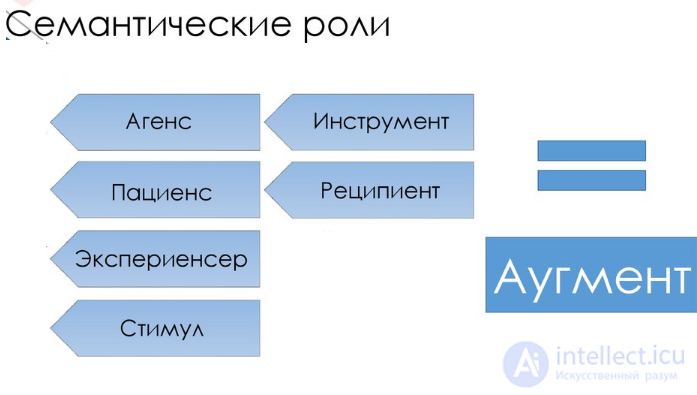
All participants are united under the term augment (Lat. augmentum - increment, increase, unfolding)
Semantic roles are also called semantic cases or deep cases (as already mentioned, this concept
was introduced in the 1960s by the American linguist C. Fillmore).
Initially C. Fillmore identified 5 cases - ergative, agentive, dative, comitative, instrumental, later in
the work The case for case he changed the set somewhat:
Some semantic roles exclude one another or, conversely, presuppose one another. Thus, within a single situation Stimulus
presupposes the presence of an Experiencer, Instrument - the presence of an Agent and a Patient, while an Experiencer and a Patient in the same situation,
by contrast, generally do not combine. This is because the set of semantic roles postulated by linguists is
in fact based not on a classification of the participants themselves, but on a classification of possible combinations of participants, i.e., role frames.
Fillmore's semantic roles make it possible to take into account the deep structure of a sentence when analyzing text, thanks
to a corresponding preliminary description of the model of the world in terms of «roles». The semantic structure of a sentence, or
proposition, is defined as a timeless set of relations between verbs and nouns. The relation between the verb -
predicate and the noun is called a deep or semantic case, whose meaning is revealed on the basis of transformations —
conversions. Cases are semantically elementary and are not subject to further analysis. Each case enters into the
structure of an utterance only once. Cases (semantic relations between a verb and a noun) can be obligatory
or optional. The definition of the semantic relations of a noun to a verb (action) reflects the basic cognitive
universals that reflect the objective relations between the participants (actants) of real situations.
The second stage of case grammar describes the processes (or rules) of transition from deep structures to their surface realizations:
A natural question may arise: but how then do caseless languages exist - such as English,
French, Chinese? A distinction should be made between «deep cases» and «formal cases», expressed formally.

Obviously, caseless languages do not exist: information that in Russian is encoded by formal markers (inflection), in
these languages is conveyed by other means. In English, the distinction between the subject and the direct object (and the related distinction between Agent and Patient - nominative and accusative) relies on word order: the subject is placed before the verb in the finite form, while the direct object comes after. Thus, English and many other languages solve the problem of the absence of nominative and accusative case forms. Formal analogues of other cases are combinations with prepositions (prepositional constructions). The Recipient, which in case languages is encoded by the dative case, in English
is encoded by the preposition to, while the analogues of the instrumental case are the prepositions with and by.
In combination with a preposition, a noun in inflected languages must stand in the form of a specific case: each preposition governs a specific
case, and the prepositional construction reflects a specific deep case.
Thus, for caseless languages, the situation in which the subject and direct object are distinguished only by their position relative to the verb is apparently more typical. This is precisely why such languages are characterized by a much stricter word order - changing the word order leads to the same consequences as changing case marking in Russian, i.e., either to a grammatical error or to a redistribution of the roles of the participants in the situation, whereas changing the word order in Russian, although it requires special intonational marking, never leads to a change in the roles of the participants and only in very rare cases produces sentences that are clearly unacceptable.
Thus, for example, the English sentence
The hunter kills the wolf with a knife
when the word order is changed produces either a grammatically incorrect sentence
(With a knife kills the wolf the hunter),
or a sentence with a different meaning
(The wolf kills the hunter with a knife).
Many of the deep case meanings, even in inflected languages, are expressed by analytical prepositional constructions: compare the use of prepositions for marking various spatial meanings in Russian. Semantic syntax (the case grammar of C. Fillmore) is a further development of generative syntax, supplemented with a semantic component.
Partially drawing on transformational grammar while at the same time taking into account the ideas of the European linguists L.
Tesnière, E. Kuryłowicz, and R. Jakobson, C. Fillmore's case grammar rehabilitated the traditional notion of case, practically discarded in early generativism, while, on the other hand, it introduced a new conception of deep, or semantic cases (or semantic roles) and of the processes of transition from them to surface syntactic constructions or morphologically expressed cases.
Positive aspects of case grammar. C. Fillmore and his followers:
From the positions indicated, the sentence acts as a two-sided unit of language, the plane of content of which is made up
not only of logical-communicative but also semantic-functional (propositional) components, that are, in a complex way,
connected to and interacting with one another.
Shortcomings of case grammar:
The ideas of case grammar had a great influence on the development of syntactic typology; another field of research in which they were in demand became artificial intelligence, where a whole series of case-type metalanguages was created.
Generative semantics – is one of the directions of foreign theories of transformational generative grammars (mainly in the USA in the late 1960s — mid 1970s), which set itself the goal of constructing a model of language according to the scheme «from meaning to text» and «from text to meaning».
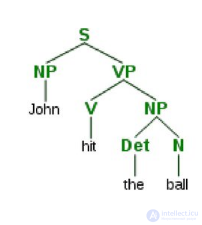
The ideas of case grammar had a great influence on the development of syntactic typology;
another field of research in which they were in demand became artificial intelligence, where a whole series of case-type metalanguages was created.
Grammar
Thematic role (Semantic role)
Theta role
Karaka , a concept in Pāṇini's grammar
Generative semantics
caseless language
case-type metalanguage
artificial intelligence
syntactic typology
[[b9994]]

Comments