
Lecture
Automated text processing has lost none of its relevance. The need for it arises both in solving the simplest applied problems and in actively developing fields of science, such as genetics. DNA chain analysis, compiler development, implementation of full-text search in DBMSs, dictionary-based data compression methods, and, finally, small programs for the mundane editing of product descriptions in a database – all of these are areas where string algorithms are applied. First of all, the basic terms used in this section should be defined. A symbol here is a rather broad concept – it is an information unit of a certain type, to which, as a rule, some printed form is assigned.
Alphabet –.Alphabet (Eng. alphabet) — a finite non-empty set of symbols. Let us agree to denote the alphabet by a capital Greek letter 
The following alphabets are most commonly used:
Symbol (Eng. symbol) — an object having its own content and a unique readable form.
String (word) – a sequence of symbols of some alphabet.
String length – the number of symbols in a string. Chain length (Eng. string length) — the number of symbols in a chain. The length of a chain w is usually denoted |w|.
A string is denoted by symbols of the alphabet, for example 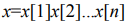 – a string of length n, where x[i] is the i-th symbol. The length of a string x is usually denoted |x|.
Σk — the set of chains of length k over the alphabet Σ .
 — the set of all chains over the alphabet Σ .
Concatenation – joining, the operation of «gluing» strings together. The concatenation of strings x and y is denoted xy.
Let  . Then α⋅β or αβ denotes their concatenation (Eng. concatenation), that is, the chain in which the chains α and β are written one after another.
Empty string – a string containing no symbols. Empty chain (Eng. empty string) — a chain containing no symbols. This chain, denoted ε , can be regarded as a chain in any alphabet. For any string  the following holds:
 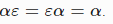 .
.
The set of strings with the operation of concatenation and the neutral element the empty string forms a free monoid.
Substring – a certain non-empty sequence of consecutive symbols of a string. A string x is called a substring of string y if there exist
strings z1 and z2 such that  .
.
Prefix – a certain beginning of a string. A prefix p of string t – a string such that pv=t for some (possibly empty) string v. A prefix is called
proper if  .
.
Suffix – a certain ending of a string. A suffix s of string t – a string such that vs=t for some (possibly empty) string v. A suffix is called
proper if 
Definition: Prefix (Eng. prefix) of string β — a string α:β=αγ
Let 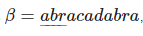 , then α=abr — a prefix of β .
Definition: Suffix (Eng. suffix) of string ββ — a string α:β=γα .
Let β= 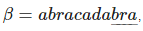 , then α=bra — a suffix of β.
Definition: Border (Eng. circumfix) of string β — a string 
Let 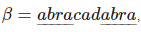 , then α=abra — a border of β.
Definition: α[i] — the symbol of string α located at the i-th position.
Let  , then
 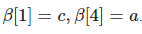 .
.
Definition: Period (Eng. period) of string αα — a number  .
.
Let 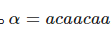 , then p=3 — the period of string α=acaacaa .
Claim:
Suppose the string ττ — the period αα and |α||α| are known, then the entire string αα can be reconstructed.
From the definition of the period of a string it follows that 
Thus 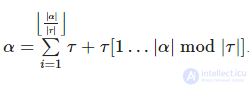 .
.
Definition: A string α≠ε with period p≠|α| , is called strongly periodic if |α|modp=0 .
The string α=acaacaaca is strongly periodic with period p=3
Definition: Substring (Eng. substring) — a certain non-empty subsequence of consecutive symbols of a string.
Let 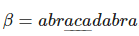 then α=aca — a substring of string β.
Definition: A non-empty string of the form αα is called a tandem repeat (Eng. repetition).
Definition: A palindrome (Eng. Palindrome) is a string of the form 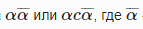 — the reversed string α, c — any symbol.
Definition: A string α is lexicographically less than a string β (α<β ), if
1. α — is a prefix of β
or

String α=aca<β=acaaba , since it is a prefix of β.
String α=acaa<β=acab , since a
Definition: A language (Eng. language) over an alphabet Σ — a certain subset of Σ∗ . Such languages are sometimes called formal (Eng. formal) to emphasize the difference from language in the everyday sense.
Note that a language over Σ need not contain chains that include all symbols of Σ. Therefore, if it is known that L is a language over Σ, then it can be asserted that L — is a language over any alphabet that is a superset of Σ.
Let L and M — be languages. Then the following operations can be defined on them.
 — complement.
 ; concatenation with the reverse word:
  .
.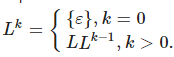 .
. .
.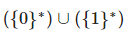 — the language consists of sequences of zeros, sequences of ones, and the empty string.
 — similar to the previous one, but does not contain the empty string.
 — contains all binary vectors and the empty string.
 will contain the decimal representations of prime numbers that do not begin with a three.
 .
.Definition: Let two alphabets Σ1,Σ2 be given. A homomorphism is a mapping  such that:
 , that is, it preserves concatenation
Definition:
Image of a language L⊂Σ∗1 under the homomorphism φ:Σ∗1→Σ∗2 (sometimes called a direct homomorphism) is the name given to the language
 .
.
Note that φφ will be a homomorphism of the monoids ⟨L,⋅,ε⟩ and ⟨M,⋅,ε⟩
Definition: Preimage of a language M⊂Σ∗2M⊂Σ2∗ under the homomorphism φ:Σ∗1→Σ∗2 (sometimes called an inverse homomorphism) is the name given to the language 
Note that φφ will be a homomorphism of the monoids ⟨L,⋅,ε⟩ and ⟨M,⋅,ε⟩
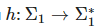 a chain homomorphism is a function φ:Σ∗1→Σ∗2 , acting on each symbol of a string from the language as follows
  . Regular languages are closed under chain homomorphism

Comments