
Lecture
For the sake of social-psychological adaptation, humankind has worked out certain social rules and norms that regulate the processes of communication and interaction. People absorb these stereotyped patterns of behaviour from childhood and follow them trustingly throughout their lives. People's stereotypes and attitudes are “mechanisms of compliance”, which can be exploited by various professionals of influence to achieve their own gain. According to Robert Cialdini, a well-known specialist in the psychology of influence, modern people prefer to be guided by stereotypes when making decisions. “The headlong rush of modern life forces us, when necessary, to rely on tried-and-tested stereotypes, empirically established rules and principles…Although we all prefer well-considered decisions, the variety of forms and the rapid pace of modern life often do not allow us to carefully weigh all the relevant “pros” and “cons”. More and more often we are forced to use a different approach to decision-making – an approach based on stereotyped patterns of behaviour, whereby the decision to comply (or agree, or believe, or buy) is made on the basis of a single, usually trustworthy, piece of information” [Cialdini, 2004, p.252]. For example, advertisements for soft drinks do not give full information about their composition and taste; instead they simply say: “The new generation chooses Pepsi!”.
R. Cialdini includes among such “trigger mechanisms” of compliance:
This principle holds that a person tries, in one way or another, to repay what another person has given them.
From childhood, people are “trained” to follow this rule. Anyone who ignores it feels society's disapproval. Such people get labelled: “freeloader”, “beggar”, “ungrateful person”.
The effectiveness of the reciprocity principle is due to the following reasons:
1) the principle is universal (it operates in every sphere of life: politics, trade, interpersonal communication, and others);
2) it comes into force even when it has not been asked for;
3) it can push a person toward an unequal exchange.
The universality of the reciprocity principle is confirmed by how widespread it is across various spheres.
For example, in politics there are known cases of legislators being provided with gifts and services in exchange for a favourable resolution of certain matters.
In medicine, some scholars write articles promoting new medications in exchange for financial support from pharmaceutical companies.
In retail and services, promotional campaigns are often held in which customers are given free samples of products, in the hope of increasing sales volume.
One American supermarket owner once sold 1,000 pounds of cheese in a few hours by letting customers cut off pieces for themselves as a sample.
The Amway company, which manufactures household appliances and personal-care items, raised its sales volume to 1.5 billion dollars within a few years, outpacing its competitors. This success came through the use of door-to-door selling tactics. A company representative visits potential customers at home and offers them free samples to try.
In some restaurants, waiters attach a “gift” to the customer's bill ‑ a piece of candy or a stick of chewing gum ‑ hoping for a more generous tip.
Sometimes the reciprocity principle unexpectedly helps resolve difficult situations in interpersonal communication. In his book, R. Cialdini tells the story of a German soldier. During the First World War, this soldier used to go on reconnaissance missions behind enemy lines and capture “tongues” ‑ enemy soldiers for interrogation. One day he caught an enemy soldier by surprise in a trench; the man was eating and so was unarmed. The frightened soldier, holding nothing but a piece of bread, did the one thing that saved his life. He held the bread out to his enemy. The German was so moved by this gift that he could not carry out his mission.
Following the reciprocity principle can lead a person to make an unequal exchange.
EXAMPLE. Once, on a crowded street, a young female driver's car stalled. She was in despair. Seeing this, a young man working at a nearby petrol station came over and helped start the car. Overcome with gratitude, the girl gave him her phone number and offered to return the favour if he ever needed help. A month later the young man called and asked to borrow the car for two hours to run some errands. As a result, he got into an accident and wrecked the car.
By accepting a favour, a person involuntarily takes on a moral obligation. Realizing that you owe someone something causes discomfort and a feeling of awkwardness. A person does not want to remain in debt. These reasons often make him give back far more than he received.
Most often people exchange gifts and favours. But there are other known ways of exercising influence in keeping with the rule of exchange. This is the exchange of mutual concessions – situations in which a person can make a concession that will push the opponent toward a concession in return.
The technique known as “refusal, then retreat”, or as “how to open a door that has been slammed in your face”, is well known. It consists of pressuring someone into an exchange of mutual concessions. R. Cialdini describes the results of an experiment he conducted. Supposedly, representatives of a youth counselling programme approached college students with a request to accompany a group of juvenile offenders on a trip to the zoo. 83% of those asked refused. Then the request was changed. The students were asked to counsel juvenile offenders once a week for two years. Naturally, everyone refused. Then those surveyed were asked for a minor favour: to accompany the offenders on a walk through the zoo. Most agreed.
This technique is effective because: 1) the rule of exchange operates (“they made a concession to me – I must make one in return”); 2) the principle of contrast perception operates (“if I want to borrow 5 dollars from you, I will first ask for 10, so that the amount will seem insignificant to you”). This is precisely why shop salespeople try to show a more expensive model first and then a cheaper one, thereby heightening the customer's contrast in price perception and creating a desire to buy.
The effectiveness of the exchange principle is due to psychological reasons:
1) the victim's sense of responsibility is heightened, because it seems to the person that they themselves dictated the terms, which motivates them to fulfil them;
2) the victim's satisfaction with the agreement reached, because the sense of responsibility for the outcome of the deal increases satisfaction with the result.
A method of self-defence is to reappraise the situation. One needs to view favours not as gifts but as ploys; then there will be no sense of obligation to respond to them with a favour of one's own.
The principle holds that people strive to be consistent in their words, thoughts, and deeds.
A person tries to remain consistent (in their own eyes and in the eyes of others) with what they have already done. Once they have made a choice or taken a particular position, they will strive to act in keeping with the commitments they have taken on and to justify the decision made earlier.
The well-known theorists L. Festinger, F. Heider, and T. Newcomb considered the drive for consistency to be the main motivator of human behaviour.
The reasons a person strives to be consistent:
1) consistency in behaviour is highly valued by society; a consistent person is perceived by others as mature, reliable, and self-confident;
2) consistency helps solve a wide range of everyday problems;
3) an orientation toward consistency creates opportunities for forming valuable stereotypes under the complex conditions of modern existence.
The consistency principle has both positive and negative consequences for a person.
The positive consequences of the consistency principle:
‑ the shortest path to solving a problem;
‑ saving mental energy;
‑ a fast response in emergency situations.
The negative consequences of the consistency principle:
‑ a desperate desire to solve their problems makes people believe in fairy tales, tall stories, and miracles, contrary to reason;
‑ following old harmful principles and habits because it is safe ‑ this is how a person justifies their own laziness and lack of willpower;
‑ people's desire to be consistent can be exploited by someone else for gain.
EXAMPLE. Large companies that make children's toys experience a sharp drop in demand during the month following the New Year rush. One company developed an original method for combating this phenomenon. A month before the New Year, television advertising heavily promoted a new, fashionable toy. In response to their children's requests to buy the toy, parents would promise to give it to them for the upcoming holiday. However, on the eve of the New Year holiday, stores deliberately created a shortage of the heavily advertised toys. Salespeople would politely reply: “You will definitely be able to buy it, but later.” Disappointed parents were forced to buy other toys so as not to leave their children without presents. After the New Year holidays, the stores would fill up with the coveted toys. Naturally, the children would remind their parents of their promise. And the parents were then forced to go to the shops. The company's toy sales after the holidays not only did not decline but in fact grew significantly.
The key factor behind consistency is the commitment a person has taken on.
This principle is used in compliance tactics developed by professionals of influence. A person is pressured into taking some action or making a statement that will later make them comply, out of a desire to appear consistent.
For example, telephone fundraisers first ask superficial questions: “How are you?” or “How are you feeling?” This is a special technique. People who have just claimed that things are going great and that they feel wonderful, even if it was only polite small talk, will be afraid to appear stingy.
There is a tactic known as “foot in the door” ‑ this involves placing small commitments on a person in order to induce them, later on, to provide more substantial favours. For example, getting someone to make a large purchase after they have already bought something minor.
American social psychologists conducted an experiment. They asked homeowners to place huge signs reading “Drive Carefully” on their front lawns. 83% of those asked refused.
Other homeowners were first asked to put up small notices reading “Be a Disciplined Driver”. Everyone agreed. Then came the request to put up the large signs. 76% of those asked agreed.
R. Cialdini and his colleagues demonstrated a variant of the “foot in the door” phenomenon using the example of the “low-ball” tactic ‑ a tactic that, as is well known, some car salesmen use. After a buyer decides to purchase a new car because of its attractive price and begins filling out the purchase paperwork, the salesman suddenly cancels the discount and demands additional payment for something the buyer believed was included in the total price, or turns to his boss for advice, who then blocks the deal, declaring that “this isn't profitable for us”.
Airlines and hotel administrations also use this tactic, attracting the attention of potential customers with the availability of seats and rooms at low prices, hoping that afterward, in order to improve their conditions, the customers will agree to pay more. R. Cialdini and his colleagues concluded that this tactic really does work. When they invited psychology students who had just entered university to take part in an experiment and come at 7 a.m., only 24% of those invited showed up. But when the students first agreed to take part in the experiment without knowing anything about its timing, and only afterward were invited to come at 7 a.m., 53% showed up.
1. Written commitment.
Reasons for its effectiveness:
a) it is material evidence;
b) it can be shown to other people, made public.
Examples:
- people's trust in written sources (books, newspapers);
- signing written contracts when hiring;
- written receipts, promises;
- making a written commitment to oneself ‑ setting a goal;
- large companies announcing written contests for customers for the
best essay titled “I like this product because…”;
c) they require greater effort (the greater the effort expended in taking on
the commitment, the more strongly that commitment is carried out).
2. A commitment made as a result of great effort.
Examples:
- probationary periods, competitions when hiring ‑ strengthening the drive
to work well;
- competitive university admissions ‑ meant to instil a desire to study well;
- the high price of tickets to star concerts ‑ a guarantee of success with the audience.
People who have gone through great difficulties or suffering in order to achieve something tend to value their achievements more than people who have achieved the same thing with less effort.
3. Public commitments.
4. Allowing freedom of choice in behaviour (commitments must be
internally motivated)
The method of self-defence ‑ conscious, responsible, deliberate acceptance of commitments and consistent behaviour.
It consists in the fact that people, in order to decide what to believe and how to act in a given situation, look to what other people believe and do in a similar situation.
This kind of behaviour is based on the mechanism of social imitation, described by the behaviourists G. Tarde and A. Bandura. They believed that a drive to imitate underlies all human relationships. Observing other people's behaviour and imitating it are the primary sources of human learning. Imitation is characteristic of both children and adults.
People can imitate both socially approved and antisocial patterns of behaviour.
The findings of American psychologists R. Liebert and R. Baron (1972) show an increase in children's aggression as a result of imitation. Children (aged 5-6 and 8-9) responded with aggression after watching violent films and television programmes.
A. Bandura conducted experiments using observation sessions for people suffering from phobias. His goal was to develop ways of changing undesirable behaviour patterns. He obtained the following results. A child who was afraid of dogs watched, for 20 minutes a day, another child playing happily with a dog. After 4 days the fear disappeared. Through video-observation sessions, A. Bandura managed to rid 67% of the children who took part in the experiment of a similar fear.
The social proof principle works more strongly when the proof is provided by the actions of many other people.
In 1969, American psychologists S. Milgram, L. Berkowitz, and L. Bickman conducted an amusing experiment. During rush hour, on one of the central streets, three New York psychologists stood and, tilting their heads back, stared up at the sky. Within 60 seconds a crowd had gathered around them. 80% of passers-by followed their example [Cialdini, 2004].
The social proof principle is most effective when two factors are present:
1. Uncertainty;
2. Similarity.
When people are in doubt, when a situation seems uncertain to them, they are more inclined to pay attention to what others are doing and to consider those actions correct.
In 1956, American scholars L. Festinger, H. Riecken, and S. Schachter published, in their fascinating book “When Prophecy Fails”, the results of participant observation of a small Chicago religious sect whose members had gathered in one small town to wait together for the December day when a worldwide flood would engulf the earth while they themselves would be saved. The researchers noted the behaviour of the sect's members:
- their level of belief was very high;
- complete inactivity of the sect's members while waiting for the flood (they did not actively try to convert people to their faith) ‑ they maintained secrecy.
When the prediction failed to come true, the secretive conspirators turned into zealous missionaries. The failed prediction created a situation of uncertainty. In keeping with the social proof principle, the way out of the impasse was to strengthen their faith by growing the sect and recruiting new members. The more people who come to believe in their idea, the more true it will be considered.
When people find themselves in an uncertain, ambiguous situation, they are unable to assess it quickly and correctly. This phenomenon is known as “pluralistic ignorance.”
EXAMPLE. In 1964, Americans were shocked by an article in a local newspaper. It told of the murder of a young woman in a residential district of New York. The woman was killed at night in the yard outside her home in full view of her neighbours. 38 people watched from their windows as events unfolded, and no one called the police. The case sparked a storm of debate and speculation. An objective assessment of what happened was given by the New York psychology professors B. Latane and J. Darley. In their view, the causes of what happened were: 1) diffusion of responsibility (everyone thought that perhaps someone else had already called the police ‑ as a result, no one helped); 2) the phenomenon of pluralistic ignorance (a failure to understand that the situation was an emergency).
Very often, people who witness an unusual situation are unable to assess it correctly and respond appropriately ‑ that is, to come to someone's aid. People cannot tell whether a man lying in the road is having a heart attack or is simply a hopeless drunk; whether sounds from the street are gunshots or traffic noise; whether shouting from behind a neighbour's door is a fight or a loud marital quarrel. In such situations people tend to look to others for a clue. We try to gauge from other witnesses' reactions whether the situation is critical. If no one seems concerned, then everything must be fine.
From the reasoning of B. Latane and J. Darley, an interesting conclusion can be drawn: a victim in an extreme situation who hopes to be safer in a crowd may find that hope unfounded. They devised an interesting experiment. A young man who staged an epileptic seizure received help in 85% of cases when only one passer-by was present, but in only 35% of cases when a group of people had gathered.
For this reason, the chances of receiving help are lower in a big city than in the countryside. The reasons for this are: 1) the chaotic nature of a big city (it is harder for a city dweller to assess a situation quickly and correctly); 2) overcrowding, the sheer number of people (this causes diffusion of responsibility among witnesses); 3) the fact that people in a city do not know one another.
To obtain people's help in a critical situation, a person needs to observe the following conditions:
1. Be specific when stating your need for help (instead of moaning, put your need into words, for example, “Help!”).
2. Ask for help from a specific person in the group of onlookers (for example, “You, sir, in the grey jacket, I need your help. Call an ambulance.”) It is necessary to put the person in the position of a “rescuer”.
The social proof principle operates most strongly when people observe the actions of people similar to themselves. For example, an anti-smoking programme run in schools is more effective when peers act as the campaigners. Or another example: a child learns to swim more easily when they see other children their own age swimming.
Evidence for the powerful effect that the actions of “similar others” have on people's behaviour is found in the suicide statistics collected by the sociologist D. Phillips. This phenomenon is known as the Werther effect ‑ named after the main character of J. W. Goethe's work “The Sorrows of Young Werther”. After its publication, the book triggered a wave of suicides among young people in Europe. The statistics collected by D. Phillips show that after suicides receive wide media coverage, a fairly large number of anxious people, who are in some way similar to the person who took their own life, decide to end their lives too. In the two months following each published account of a suicide, an average of 58 more suicides occur than usual.
Statistical data from American sources also indicate an increase in accidents after suicides receive media coverage. In the view of researchers, these accidents are disguised copycat suicides. A person going through a crisis becomes even more nervous, tense, and distracted under the influence of such grim statistics, as a result of which various mishaps befall them.
Cases of copycat crimes are known to occur as a result of media reports about plane hijackings, food poisonings, and the like. Under the influence of such information, as reported by journalists, mass cases of plane hijackings occurred in 1970, and in the United States in the 1980s there were numerous cases of product tampering. In recent years there have been cases of serial killings at schools. Students carry out bloody massacres of their classmates. This is a copycat way for teenagers to rid themselves of depression and psychological discomfort.
People need to maintain their emotional equilibrium and be guided by common sense when making decisions, rather than taking their cue from the actions of “similar others”. One should not blindly trust the rule: “If a lot of people are doing the same thing, they must know something we don't”. An instructive example can be given here. Native American tribes have a particular way of hunting bison. They drive a frightened herd toward a steep cliff. As the bison run in a panic, their heads are lowered, and the animals cannot see anything beyond the herd. In order not to become like these panicked bison, one should not, even when feeling uncertain, uncritically trust the collective knowledge of the crowd. Quite often the crowd is wrong, because its members act not on reliable information but on the principle of social imitation.
The principle holds that people fall under the influence of those whom they find more attractive. This phenomenon is also known as the “halo effect” or the “halo phenomenon” ‑ the tendency to transfer a favourable (or negative) impression of one quality of a person onto the assessment of their personality as a whole.
Several reasons account for the emergence of liking:
When we meet someone who surpasses us in some important quality, we generally rate them more positively than we would if they were our equal. For example, if a person who is sickly and weak but wants to be strong and healthy meets someone like that, it is quite possible that he will overrate that person on every other quality as well.
We automatically attribute positive qualities such as talent, kindness, honesty, intelligence, and so on to people with an attractive appearance.
The American psychologist A. Miller, using the method of expert ratings, selected photographs of attractive, average-looking, and unattractive people. He then showed them to participants ‑ men and women aged 18 to 24 ‑ and asked them to comment on the inner world of the people pictured. The attractive people were rated as more confident, happier, more sincere, more even-tempered, more energetic, kinder, more refined, and spiritually richer. Male participants rated attractive women as more caring and attentive.
The findings of American psychological research show:
The paradox is that physically attractive people often have low self-esteem. This is because they believe that other people's positive assessment of them is due not to their own merits but to the halo effect.
People feel liking toward those who are similar to them. Similarity matters along various dimensions: opinions, personal qualities, appearance and clothing, background, lifestyle, and so on.
This is precisely why sales agents and salespeople are specifically trained to mirror the customer's posture, mood, manner of speech, and so on.
People who love us or think well of us seem to us significantly better than those who feel negatively toward us. Learning that someone likes us can be an effective means of evoking reciprocal liking and a willingness to comply.
EXAMPLE. The name of Joe Girard, a Chevrolet salesman, entered the Guinness Book of Records as the name of the greatest car salesman. He earns more than 200 thousand dollars a year. For 12 years in a row he held the title of “Salesman No. 1”. Every day he managed to sell more than 5 cars. His advice to business owners: “Find a salesman that customers will like, and set a reasonable price”. One of Joe Girard's techniques for building liking was sending his clients greeting cards for the holidays.
We like what is familiar. Advertising's effectiveness is based on this principle.
A familiar person is perceived as more attractive.
Positive emotions influence our assessments of the people around us, reducing criticism and intolerance. There are known cases of reduced racial prejudice through the integration of people, but only under favourable conditions of interaction, free of disappointment, conflict, and competition. In schools, hostility and ethnic prejudice among children are intensified by the negative emotions the pupils experience: anxiety, competition, and opposition. Children therefore need to be taught to cooperate. An effective method is the “jigsaw classroom” technique. Each child is given part of the information needed to complete some learning task. As a result, everyone needs the others in order to manage the situation.
In retail, many salespeople display a sense of unity with customers in order to secure their agreement.
There is a tendency to dislike a person who gives us unpleasant news, even if they had nothing to do with it.
Innocent associations with something bad or good affect the feelings other people have toward us.
A mother forbids her child to be friends with badly behaved children. Her concern stems from the fact that other people's negative attitude toward those children might extend to her own child as well.
Advertisers try to link their products with things that customers like. This is precisely why various goods are advertised by beautiful young women ‑ fashion models. When an advertisement for a car with an alluring young woman standing next to it is shown to male customers, they tend to rate the car's specifications more highly.
Business owners try to link their products with some fashionable trend or cultural or scientific achievement.
Advertising often makes use of a connection between celebrities' names and a particular product.
Many companies use the “luncheon technique.” The good mood people are in while eating is put to use during presentations, the signing of contracts, and meetings with inspectors.
Fans associate themselves with their favourite team. A win or a loss by their favourite team is perceived by them as a personal success or failure. That is why fans' conversations feature phrases like “We won” or “Our guys lost”.
People tend to display their connections with successful members of society and to try to hide their acquaintance with people who have failed, in order to enhance their own standing.
Method of self-defence. To reduce the undesirable influence of the liking principle on compliance reactions, one must follow this strategy. Having realised that the person making the request is very likeable, one should mentally separate that person from his proposal and make a decision based on the merits of the proposal itself.
The principle of obedience to authority is people’s strongly pronounced readiness to follow the instructions of an authority.
Authorities exert very strong pressure and control people’s behaviour.
The experiments of the American psychologist S. Milgram (1965, 1974), aimed at determining what would happen if an authority’s orders diverged from the promptings of conscience, became perhaps the most famous and most debated in social psychology. Two people were invited to the psychology laboratory at Yale University to take part in the experiment. A stern experimenter in a grey lab coat explains that the study is testing innovative research into the effect of punishment on learning. The experiment requires that one of the participants teach the other a list of word pairs and punish mistakes by administering electric shocks of increasing intensity. To assign the roles, the participants draw lots. One of the participants, a 47-year-old accountant with manners betraying a mild disposition, is a “confederate.” He pretends that the draw has made him the “learner” and goes into the next room. The “teacher” (a volunteer who answered a newspaper advertisement) is given a mild sample shock, and then watches the experimenter strap the “learner” into a chair and attach an electrode to his wrist.
After this the “teacher” and the experimenter return to the main room, where the “teacher” takes his place in front of a “shock generator” with switches ranging from 15 to 450 volts in steps of 15 volts. The switches are labelled: “slight shock,” “very strong shock,” “danger: severe shock,” and so on. At the 435- and 450-volt marks stands “XXX.” The experimenter orders the “teacher” to “move the generator one step higher” every time the “learner” gives a wrong answer. With each switch, a light flashes, a relay clicks and a buzzer sounds.
If the participant yields to the experimenter’s demands, he hears the “learner” groan at 75, 90 and 105 volts. At 120 volts the “learner” shouts that it hurts. And at 150 volts he cries out: “Experimenter, get me out of here! I don’t want to go on with the experiment! I refuse to go on!”. At 270 volts his protests turn into an agonised scream, and he keeps insisting that he be let out. At 300 and 315 volts he shouts that he refuses to answer. After 330 he falls silent. In response to the “teacher’s” requests or suggestions to stop the procedure, the experimenter notes that the absence of an answer must be treated as a wrong answer. To make the participant continue, he uses four phrases:
- “Please continue”.
- “The experiment requires that you continue”.
- “It is absolutely essential that you continue”.
- “You have no other choice; you must continue”.
In fact the “learner” in these experiments received no electric shocks (he got up from the chair and switched on a tape recording of protests). But the “teacher” participants did not know this.
How far would you have gone? S. Milgram described the experiment to 110 different people: psychiatrists, students, representatives of the middle class. In all three groups the respondents assumed that they themselves would obey up to about 135 volts; not one intended to go past 300 volts. Bearing in mind that self-assessment bias could skew the estimate, S. Milgram also asked how far, in their opinion, other people might go. Almost no one expected that anyone at all would reach the “XXX” shock mark (the psychiatrists estimated about one in a thousand).
But when S. Milgram ran the experiment with 40 men – of various professions, aged 20 to 50 – 25 of them (63%) went all the way to the full 450 volts. What actually happened was that everyone who reached 450 volts obeyed the command to “continue” until the experimenter himself stopped them.
Having obtained these disturbing results, S. Milgram subsequently made the “learner”’s protests still more convincing. When the “learner” was strapped into the chair, the “teacher” could hear him complain of a heart condition, to which the experimenter replied: “Although the shock may be painful, it will cause no permanent tissue damage”. The “learner”’s anguished protests did little good; of the 40 new participants in this experiment, 26 (65%) fully complied with the experimenter’s demands.
S. Milgram not only revealed the extent to which people obey authority; he also investigated the conditions that produce obedience. The decisive factors turned out to be the following.
Emotional distance from the victim. Milgram’s participants acted with less sympathy toward the “learners” when they could not see them (and were not seen by them).
Proximity and legitimacy of the authority. When an authority figure is nearby, the rate of compliance rises. When the experimenter gave his orders by telephone, only 21% of participants obeyed him. The authority must also be perceived as legitimate.
Institutional authority. The influence of an authority is strengthened when it is backed by the status of official institutions. The legitimacy of the orders in S. Milgram’s experiments was underpinned by the prestige of Yale University.
The liberating effect of a group that refuses to obey authority. S. Milgram recorded refusals to obey authority in experiments where the “teacher” was to be assisted by two “confederates.” As the experiment proceeded, both confederates refused to obey the experimenter, whereupon he ordered the real participant to continue the experiment alone. 90% of participants freed themselves from further participation in the experiment, imitating the disobedient group of “confederates.”
The principle of deference to authority performs positive and negative functions.
The positive functionlies in the fact that the existence of a system of authority hierarchies gives society certain advantages: the development of structures that regulate material production, trade, defence and social control. It prevents the emergence of anarchy and chaos.
The negative function shows itself in mechanical obedience to authorities. In obeying, people react but do not think. As soon as an authority gives an order, subordinates stop thinking and begin to act automatically. This mechanism is the cause of professional errors. Medical errors are especially dangerous, caused by junior medical staff thoughtlessly carrying out doctors’ mistaken orders.
1. People’s tendency toward obedience and loyalty to authorities has great social value.
2. Religious upbringing implants in people’s minds the idea that obedience to authorities is necessary.
3. Transferring personal responsibility for the outcome of a situation onto the authority figure.
4. Saving mental effort in decision-making (information received from an authority can suggest how to act in a specific situation).
5. The opinions of authorities are considered correct and are easy to obey. Authority figures, as a rule, have far greater access to information and power than ordinary citizens and therefore, in the eyes of others, know more.
6. People are not able to critically evaluate authorities, distrusting their own experience and their own knowledge.
There are symbols of authority to which people tend to react automatically. These include:
People sometimes react not to the authority itself but to symbols, whose role is, as a rule, underestimated.
Titles. People often use titles they hold, or assume titles, in order to influence other people.
In one witty experiment the psychologist P. Wilson showed students in different college classes the same man, whom he called “Mr England.” In one class he was introduced as a student, in the second as a laboratory assistant, in the third as a lecturer, in the fourth as a senior lecturer, and in the last as a professor. After the guest left, the students were asked to estimate his height and the experimenter’s own height as accurately as possible. It turned out that P. Wilson’s estimated height did not change, while “Mr England”’s estimated height grew by 15 cm as his social status rose [Kunitsyna et al., 2002, pp. 309-310].
Sometimes people are forced to conceal their title so as not to put pressure on people in everyday communication. One professor tried never to use his title while relaxing, travelling or meeting people, because he had had a negative experience. People who had been direct and interesting conversation partners, as soon as they learned of his status, would immediately become deferential, dull, and agree with his every word.
Since size and status are interrelated, some individuals substitute the former for the latter to their own advantage. In animal communities the status of an individual is determined by its size, so the tactic animals use when meeting a rival is a show of increased size (they arch their backs; their fur stands on end; fish puff up and spread their fins; birds fan out their wings and tail). In human society, too, height can affect status. Taller men enjoy greater success with women. People invented heels in order to increase height and thereby strengthen their influence on others.
Clothing. Another type of symbol that can make people obey automatically. A strong influence is exerted by uniforms. A series of studies by the social psychologist L. Bickman (1974) shows how hard it can be for people to refuse requests coming from people in uniform. An experiment conducted on the street of a crowded city showed that 92% of passers-by complied with the demands of the psychologist’s assistants, dressed as police officers, who made people carry out various absurd requests (“pick up a paper bag someone had thrown away”; “stand on the other side of a bus-stop sign,” and so on). The effect of the uniform persisted even after the person wearing it had left. The “police officer” would give an order and walk away – and the request would still be carried out.
Evidence of authority is also found in expensive clothing. An experiment by R. Cialdini, conducted in Texas, shows that a person in expensive, fashionable clothes commands the respect of others and a desire to imitate him. A 31-year-old man violated traffic rules by crossing the street against a red light. In half the cases he was dressed in an expensive suit, and in the rest in work trousers and overalls. In the first case, 3.5 times more people followed the violator’s example.

Make of car, jewellery and other attributes. Studies by R. Cialdini, conducted on the streets of San Francisco, showed that drivers, before they started honking at a car stopped at a green light, usually waited longer if that car had a luxurious look rather than being an old, cheap model. A prestigious car had such an intimidating aura that 50% of drivers patiently waited for it to move off, without honking at it.
Self-defence against the negative effect of the principle of deference to authority. We usually underestimate the influence of authority on our own actions and stop being careful. In order not to become the object of someone else’s influence, one must observe the following rules.
1) Recognise the power of the authority.
2) Ask yourself: “Is this authority really an expert in this particular field?”. For example, if a physicist, a Nobel laureate, undertakes to give advice on raising children, will that advice really be competent?
3) If the recognised authority is competent, ask yourself: “How truthful has this authority been in this particular case?”.
The value of something positive in people’s eyes increases substantially once it becomes unavailable.
One manifestation of the scarcity principle is the precious-flaw phenomenon. Among collectors, if an item is a rarity, it is especially valuable, so damaged items are sometimes considered the most valuable precisely because of their rarity and uniqueness. For example, American collectors hunt for a defective coin that has the president’s portrait struck on both sides.
The scarcity principle explains the fact that the thought of a possible loss has a greater effect on people than the thought of a gain. For example, fear of how much money one could lose by not insuring one’s property makes a person yield to the influence of an insurance agent.
Many sales tactics are based on the scarcity principle. There is the well-known tactic of announcing a limited quantity. For advertising purposes it is announced that a particular product is scarce and may not be enough to go around. Salespeople can strengthen a hesitant buyer’s desire to purchase an item with the words: “Unfortunately, we have just sold the last one”. Seeing how disappointed the buyer is, the salesperson adds: “All right, let me go and check whether there is one more in the stockroom”.
For advertising purposes the tactic of setting a deadline is also used. A specific time interval is officially set during which a person can take advantage of the opportunity offered to them. “If you don’t buy the item now, tomorrow its price will be quite different”.
1) Things that are hard to obtain tend to be more valuable, so people often judge the quality of an item by its availability. To explain to ourselves our desire to obtain an item that is unavailable, we begin to attribute positive qualities to it.
2) When things become less available, a person loses part of their freedom. According to J. Brehm’s theory of psychological reactance, people respond to a restriction of freedom by intensifying their desire to have that freedom in full.
The psychology of reactance shapes the emergence of certain information throughout one’s whole life. However, this resistance is especially pronounced during the crisis periods of age three and of adolescence. At these times a heightened sense of individuality emerges, so sensitivity to restrictions grows. Two- to three-year-old children do everything the opposite way.
An example of the harmful effect of parental pressure on adolescents is the Romeo and Juliet phenomenon. Passion was brought to its highest pitch by the very existence of barriers.
The scarcity principle affects not only the evaluation of objects and experiences but also the evaluation of information. Restricting access to information makes people especially eager to obtain that access in full, and also makes them view that information more favourably. Restricted information becomes more persuasive. For example, banning books or films arouses heightened interest in them. R. Cialdini’s book gives an example of an experiment. Students were shown several advertisements about the merits of a particular novel. A line was inserted into the text: “This book is intended only for persons over the age of 21”. Students who learned of the age restriction felt a stronger desire to read the book and were confident that they would like it.
When information is scarce, its value rises. Greater trust is placed in a message about an impending shortage and in the idea that this information comes from a reliable, classified source that few people know about.
In some cases the scarcity principle manifests itself most strongly.
1) Scarce items rise in price when it becomes clear that they have only just become scarce. We value more highly the things that have recently become unavailable than those that have always been unavailable. For example, inconsistent parents, who sometimes grant privileges and sometimes haphazardly impose strict rules, provoke a child into disobedience.
2) Limited resources are most attractive when they force us to compete with other people for them. For example, a lover indifferent to his partner often begins to feel genuine passion the moment a rival appears. There is a well-known “pushed out by the fence” tactic, in which a threat of losing the object is deliberately created through possible competition. This tactic is used at auctions. One enterprising seller used this tactic to inflate the price. He placed an advertisement in the newspaper for the sale of a car. To everyone who responded to it, he arranged a viewing at the very same time.
Self-defence against the undesirable influence of the scarcity principle.
1) Emotional arousal in situations of scarcity is a signal that one should calm down and act with caution.
2) One should ask oneself: “Why do I need this scarce item? To possess it (what price am I willing to pay for it) or to use it?”
3) One should remember that, by becoming rare in people’s eyes, things do not thereby become better in quality (tastier, better-functioning, and so on).
One of the questions studied in the psychology of influence is the study of a person’s potential for influence. Researchers try to establish which qualities allow a person to become an inspiration to others.
In contemporary psychology there are various opinions on this question. Having analysed the existing literature, A. Nahavandi identifies the following characteristics:
The American psychologist D. Goleman considers the main factor in personal influence to be a person’s possession of emotional intelligence, which he defines as a high degree of intellectual and emotional insight. Within the structure of emotional intelligence he identifies a complex of abilities for recognising one’s own emotions, for emotional self-control and management of emotions, and also for recognising the emotions of other people and building effective relationships with them. A high level of development of emotional intelligence is characterised by the following features:
The Russian psychologist S. I. Makshanov names the components of the charisma of influence:
Psychosexual attractiveness is the component that is biologically determined, connected with the evolutionary need to continue the species. What attracts is anyone whose appearance and other characteristics somehow promise effective continuation of the species, and the laws governing such attraction are inscribed in the depths of our collective unconscious, genetic memory, and the like. Marginality, or inner contradictoriness, attracts as a mystery does. It awakens exploratory behaviour. Among intrapersonal contradictions one can include, for example, the coexistence within a person of such opposite personal qualities as cruelty and tenderness, creativity and pedantry, frivolity and calculation, mischievousness and primness, modesty and grandeur, and so on.
E. V. Sidorenko, in her programmes for teaching influence, places particular emphasis on the effectiveness of speech. She sets the following tasks for developing the ability to influence:
1) developing eloquence (constructing one’s speech and the manner of delivering it);
2) focusing one’s speech on the interests of the listeners;
3) developing skills of suggestion, emotional contagion, imitation;
4) expressing one’s own personal individuality in any situation instead of following the expectations others are assumed to have;
turning any performance of one’s own into a joint “happening” with the listeners (perhaps even a “show”).
The foundation of the ability to influence is a complex of personal and communicative traits that helps it to manifest and develop over the course of one’s life. V. M. Pogolsha, in her candidate’s dissertation, described the communicative-personal potential for influence. It includes the following traits: ease and skill in communication, adaptability, confidence, an active stance in interaction, the achievement motive, affiliation, understanding of the interlocutor, and social intelligence as a whole.
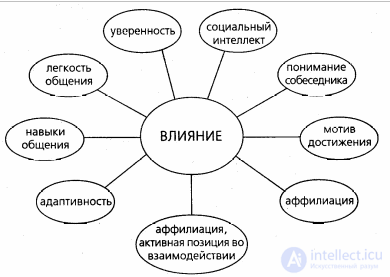
Fig. 4. The communicative-personal potential for influence [Pogolsha, 1998]
V. M. Pogolsha developed a typology of personal influence. In her view, the capacity for personal influence depends on the type of personality, on the leading traits of the individual’s communicative-personal-motivational structure, and also on the needs the individual is satisfying. Depending on this, it can manifest itself at different levels. As a basis for distinguishing types of influence and personality types, such traits were taken as aggressiveness – friendliness, emotional instability – self-regulation, sociability – reservedness, the risk motive – the failure-avoidance motive, authoritarianism – partnership, as well as frustration, conflict-proneness, impulsiveness, reflexivity, adaptability, empathy, exhaustibility, activity, and such factors of self-awareness as self-respect and self-control. The criterion of developed self-awareness proved decisive in distinguishing the highest level of personal influence, to which the type “Personal Magnetism” belongs. The criterion of dissatisfaction with relationships and with life in general proved fundamental in defining the lower end of the continuum of levels of personal influence. According to this criterion, the lowest position is occupied by the type “Manipulative Adaptability”.
In total V. M. Pogolsha identifies 7 types of influence, of which four are basic and three are compensatory. The basic types of personal influence are: 1) social intelligence, 2) personal magnetism, 3) frustration-based influence, 4) partnership and trust based on empathy. The types of compensatory, or indirect, influence include: manipulative adaptability, responsibility and competence, and “militant virtue.”
The first type of influence – social intelligence – unites people who are easy to get on with, who adapt well to any situation, who are self-confident, with high, adequate self-esteem. Their communication is based on the need for approval and the motivation to help, and at the same time they are characterised by satisfaction with communication and with life as a whole. These are people with good self-regulation, able to build up willpower in themselves. They have high social intelligence, good persuasive qualities, high working capacity. Such people are able to make decisions, are active in their work, are usually open, friendly and attentive, and prefer a partnership style of communication. They have a positive effect on others by their very presence. Those around them, in turn, perceive them as warm-hearted, understanding and reliable people. It is also said of them that they react with the heart rather than the mind. It is notable that this type of influence is the most widespread; one person in four possesses it.
Personal magnetism is a type of influence close to the first, only with an even more pronounced social intelligence, a sense of self-worth and a high degree of self-acceptance, as well as higher indicators of influence, communication skills, adaptability and self-confidence. Representatives of this type of influence are sensitive to the emotional states of others, understand people well, are friendly, and are receptive to criticism. Their distinguishing trait is complete self-possession and a sense of tact. They are highly responsible, reflective, and at the same time have a high energy potential. They are not prone to aggressiveness, shyness or a feeling of loneliness. But their main distinction from other people is high self-respect, emotional stability and excellent self-regulation. These people are also characterised by a striving for self-improvement. “Personal magnetism” is characteristic of a mature personality and belongs to the highest level of manifestation of the capacity for personal influence. But it is characteristic of only one person in ten.
The frustration-based type of personal influence is characteristic of sociable and charming people. Such people readily make contact, are endowed with a sense of humour, are self-assured, impulsive, able to take risks, and are result-oriented. But at the same time they are not distinguished by high self-respect and self-possession, stability, reflexivity and satisfaction with communication. In the communication of such people an authoritarian style often shows itself, along with a tendency to draw a partner into their own problems and emotions. Their state is characterised by tension and discomfort, since it is dominated by frustration, aggression, conflict-proneness and neuroticism. Both they themselves and the people around them suffer from these qualities, which is confirmed by their low satisfaction with life.
Frustration plays an important role in the life of these people. For them, failure and difficulties are a challenge, a spur to action.
They are not skilful manipulators, owing to their conflict-proneness, authoritarianism, and lack of self-possession. This type of influence is fairly widespread. One person in six possesses it.
Individuals with a trust-and-partnership type of influence are modest, attentive, understanding interlocutors who inspire confidence. They have a strongly pronounced need for approval and a need for self-disclosure, for confiding communication. At the same time they are altruistic and inclined to maintain equal, partnership relations. These individuals are distinguished by high empathy, reflectiveness, sensitivity and, perhaps because of this, a high degree of exhaustibility. This type of influence manifests itself in an atmosphere of intimate, confiding communication, when partners feel safe. The circle of influence of these people is narrower than that of the first two types, but their satisfaction with communication and with life as a whole is high. This type of influence is fairly common, and is more widespread among representatives of “person-to-person” professions.
The next three types of influence are compensatory, or indirect, since their representatives belong to the category of people with low influence, who are overly cautious and not very self-confident.
Influence that manifests itself as manipulative activity presupposes good communication skills, adaptability and manipulative abilities: flexibility, diplomacy and, at the same time, persistence and tenacity in contacts. These individuals are also characterised by stability, sensitivity, caution in decision-making and motivation to avoid failure. They are not impulsive, do not like to take risks, are not distinguished by high confidence or responsibility, and their moral attitudes and motivation to help are not high. These people are distrustful and often suffer from a feeling of loneliness. They provoke reciprocal distrust in others, since they are perceived as cunning and dishonest. People of this type have low satisfaction with life and low self-respect. As a stable type, “manipulative influence” in its pure form is not common, but as a tactic it is found everywhere.
An orientation toward responsibility and competence is characteristic of people with very high responsibility, well brought up, with fairly high moral attitudes and self-respect. These are shy people; they have a low capacity for influence, are not impulsive, do not like to take risks, are very prudent and cautious, and are painstaking and thorough in their work. A striving for stability, compliance, competence, high working capacity and endurance are their main traits. Such people gain authority through their intelligence, their thorough knowledge of the subject, their reliability and responsibility. Others listen to their opinion. They are very valuable workers, but they are not the “life of the party.” This type is distinguished by high satisfaction with life and very low spontaneous aggression. They are most often found among representatives of “person-to-machine” professions.
The seventh type of influence is “militant virtue.”It is represented by fairly authoritarian individuals with high moral attitudes but low responsibility. Their attitudes include an insistence on correct behaviour, observing all moral norms, on the part of others, but not always on their own part. They influence other people by transforming their own “I want” into “You must.” But, like any authoritarian personality, such an individual will only dominate the weak, while at the same time submitting to the strong, which is confirmed by their high compliance and lowered self-respect. “Militant virtue” tends to appear in human communication more often as a tactic than as a stable type of influence.
Thus the nature of personal influence is not straightforward and manifests itself depending on temperament and personality type. The most creative, developmental types of influence are social intelligence and personal magnetism, since they provide maximum satisfaction with communication both for the person exerting the influence and for the one being influenced.

Comments