
Lecture
Psychological influence is an inseparable attribute of human life. It permeates every act of human communication and social interaction. The legitimacy of people's use of psychological influence can be examined on two planes: the moral-ethical and the psychological. Most often the initiator of influence sincerely believes that his goal is to serve the interests of the cause or of other people. Yet, as the well-known saying goes, “no one is good enough to teach others.” Every person's sense of being right is relative, and people may disagree about what is actually useful for the cause, for themselves, or for other people. From this point of view, any influence is illegitimate. On the other hand, any influenceis legitimate.Every person can and will try to influence us in one way or another, because this is one of the ways in which they express their own needs, and everyone is given an equal right to express their needs and stand up for them. It is only important to recognise that mutual influence is a mutual expression of needs, and in this contest everyone is equally right. Modern psychology does not raise the question of the right to influence (everyone has that right); it examines what forms mutual influence takes and how useful and constructive they are for the people involved.
In modern psychological literature, psychological influenceis defined as“the process and result of one subject changing the behaviour and psyche of another subject”[Konyukhov, 1996, p. 17] or as“an impact on the state, thoughts, feelings and actions of another person by exclusively psychological means, allowing that person the right and the time to respond to this impact[Sidorenko, 2001, p. 11].
According to researchers, psychological influence is a complex phenomenon that is simultaneously:
a process of one individual influencing another;
a result of influence, which is not always obvious;
a personal ability.
When considering the right to influence, the term individual influence is used.Individual influence is influence directed at satisfying one of the needs of one's own personality: the need for safety, love, power, or self-esteem. It is precisely the right to individual influence that every person is granted in equal measure. However, when it comes to influence that produces its effect not in a second, five minutes, or a few hours, but over months, years, and decades, this is no longer a matter of the right to influence but of its power. V.N. Kunitsyna and her co-authors call this kind of deep and lasting influence on a personpersonal influence.Personal influence is “the ability to affect another person in a way that motivates, restrains, calms, or otherwise develops them, changing not only their behaviour but also their views, motives, consciousness, and even character” [Kunitsyna V.N. et al., 2001, p. 156].
We cannot know in advance whether another person will affect only our reaction today, or whether they will also help change our views, values, and attitudes in the long run. Everyone needs to realise that any act of influence is ultimately an attempt to change other people and the world as a whole. Influence can contribute to the progressive development of humanity and the universe, or it can hinder that process.
In real life, to achieve psychological goals, people use psychological and non-psychological means of influence.Psychological means of influence are non-material, internal means: signs, symbols, signals ‑ that act on individual consciousness or behaviour and produce a psychological effect of change. Exclusivelypsychological means of influence includeverbal, paralinguistic andnon-verbal.
Verbal signals are words – above all their meaning, but also the nature of the words used, the choice of expressions, the correctness of speech, or various kinds of its incorrectness.
Paralinguistic signals are features of how speech, individual words, and sounds are pronounced.
Non-verbal signalsare the mutual positioning of interlocutors in space, postures, gestures, facial expressions, eye contact, appearance, touch, and smells.
To achieve psychological goals, non-psychological means are often used. However, in this case it is not correct to speak of psychological influence. What is meant here is physical or social influence.Non-psychological means of influence are external material (including monetary), social, physical, organisational, and other means that produce a psychological effect of behavioural change. Non-psychological means of influence are inadequate to the nature of psychological interaction. For example, fearing defeat in a fair game of chess or a fencing bout, a participant may resort to physical means of neutralising an opponent (bribery, assault) that have nothing to do with chess or fencing. Non-psychological means of influence achieve a faster effect, but one that is more superficial and short-lived compared with the effectiveness of psychological means. The study of these means has given rise to special disciplines such as “Organisational Behaviour” or “Human Resource Management.” In these disciplines, psychological phenomena, including psychological means of influence themselves, are examined alongside material and organisational ones. The director of a modern company, seeking to influence the efficiency of subordinates' work, more often resorts not to persuasion but to tried-and-tested and reliablenon-psychologicalmeans of motivating staff: pay increases, a convenient work schedule, reassignment to other positions, dismissal of negligent employees, and so on. Psychological means of influence can be transformed into non-psychological ones. For example, a threat of dismissal or physical punishment is a psychological means of influence only as long as the threat has not been carried out.
Means of influence are used in various methods of psychological impact. The following methods of psychological impact exist:
Informational-psychological impact (informational-propagandistic, ideological) is impact by means of words and information. It is used to form certain ideological (social) ideas, views, and beliefs.
Psychogenic impact results from:
physical impact, which disrupts normal neuro-psychic activity (the impact of physical factors such as sound, lighting, temperature, etc., which alter the state of the psyche through certain physiological reactions);
shock impactof the surrounding conditions or of certain events (for example, scenes of mass destruction or numerous casualties) on a person's consciousness, as a result of which he is unable to act rationally, loses his orientation in space, experiences an affective state or depression, falls into panic, stupor, etc.). An example of psychogenic impact is the influence of colour on a person's physiological and emotional state. Red, orange, and yellow have a stimulating effect; green, light blue, blue, and violet have a calming effect.
Psychoanalytic (psycho-corrective) impact is an impact on a person's subconscious by therapeutic means, especially in a state of hypnosis or deep sleep. It is carried out in order to uncover hidden motivation; to obtain information about neurotic states of the psyche; and to correct states through command-words, image-pictures, and scent-motivators of a particular kind of behaviour. For example, sound control of the psyche: verbal suggestions in coded form are recorded onto any medium of audio information (audio cassettes, radio and television broadcasts, sound effects). A person listens to music or the sound of surf, follows the dialogue of characters in a film, and does not suspect that it contains commands that are not consciously perceived but are always registered by the subconscious, later compelling him to do what has been prescribed.
Neurolinguistic impact (programming) (NLP)is a method of psychological impact that changes people's motivation by introducing special linguistic programmes into their consciousness. Here the main object of impact is the neurophysiological activity of the brain and the emotional-volitional states arising from it. The main means of impact are specially selected verbal and non-verbal programmes, the assimilation of whose content makes it possible to change, in a given direction, the beliefs, views, and representations of an individual person or of a group of people.
Psychoanalytic impact and NLP are useful when they are used for humane purposes, but they can also serve as means of psychological violence.
Psychotronic (parapsychological, extrasensory) impact is an impact on other people carried out by transmitting information through unconscious perception. An example of the use of technical means of impact on consciousness is the phenomenon of the 25th frame. There is a known effect produced by colour spots embedded in a computer virus designated by the apocalyptic “number of the beast” ‑ 666 (V666). This virus is capable of negatively affecting the psychophysiological state of the operator. As the 25th frame, V666 displays on the monitor screen a specially selected colour combination that plunges a person into a hypnotic trance. After a certain time the picture changes. Subconscious perception of the new image causes changes in cardiac activity and fluctuations in blood pressure. According to a special study, over the past few years 46 cases of the death of operators working in computer networks have been recorded as a result of this kind of virus. Another example of psychotronic impact is the mass “TV epidemic” in Japan on 1 December 1977. After the broadcast of another episode of the popular cartoon “Pokemon” (pocket monsters), more than 700 children were taken to hospital with symptoms of epilepsy. According to psychiatrists, the mass affliction was caused by episodes accompanied by dazzling multicoloured flashes. Doctors proved that the flickering of red light at a frequency of 10 to 30 flashes per second first caused irritation of the optic nerves and partial spasm of the brain's blood vessels, and then loss of breath, convulsions, and even suffocation.
Psychotropic impact is an impact on people's psyche by means of medical preparations, chemical, or biological substances.
Strong-smelling substances have a powerful effect on the psyche. The American psychiatrist A. Hirsch established that smell affects a person's physical well-being, and through it, his actions. Smells can be used to raise or lower blood pressure, slow down or speed up the heartbeat, excite or induce sleep. Smells relieve symptoms of depression in patients. Clinical experiments have shown that the scent of lavender, chamomile, lemon, and sandalwood reduces brain activity faster than medication, while jasmine, rose, mint, and clove are stimulating.
Psychological influence is exercised to achieve three goals:
To satisfy one's own needswith the help of other people or through their agency;
To confirm one's own significance;
To satisfy the need for influence.
In essence, the first of these goals also encompasses the other two. However, they are treated separately because the differences between them are quite substantial.
Psychological influence is used to achieve the satisfaction of one's own needs. These needs may be either conscious or unconscious. Most people tend to regard the goals of their influence as noble, that is, dictated by the interests of the cause, of the development of society, of creativity, and so on. Goals connected with other needs are often not recognised or are carefully concealed. Thus a person may attempt to exert influence in order to discharge aggressive impulses, protect himself, attract attention to himself, or win prestige, power, respect, love, and so on.
EXAMPLE
|
Action of the initiator of influence |
Conscious or declared goals |
Real goals |
|
1.A managerinsists on his own decision |
Ostensibly in the interests of the cause |
In reality – to provoke reactions of indignation and insubordination from unwanted employees and thereby obtain a pretext for dismissing them |
|
2.A business partnerdelays the conclusion of a contract |
Under the guise of fighting for precision and transparency of terms |
In reality – so as not to lose the chance to conclude a more favourable contract with another partner |
|
3. Parents demand independence from their children |
For the sake of instilling valuable qualities in them |
In reality – to relieve themselves of the guilt of spending too little time with their children |
Given a certain habit of self-analysis, every person can admit that on many occasions he tried to convince other people of something or to persuade them toward a particular line of behaviour simply because it served only his own interests. One must admit to oneself that these interests might be purely selfish, or that achieving them involves coercive methods that infringe on the rights and freedom of others, and that a reasonable person ought therefore to refrain from pursuing them.
According to A. Adler, the creator of individual psychology, the primary motive behind any person's behaviour is the desire to assert oneself in life and to become convinced of one's own significance to others. A sense of one's own inadequacy before one's parents and the world as a whole, caused by weakness and helplessness, is experienced by the child in childhood and persists into adulthood. A person's entire subsequent life is an overcoming of this painful sense of inadequacy. The ability to exert influence is proof of one's worth. By persuading, suggesting, and inspiring others to imitate us, we help ourselves become convinced that we exist, and that this existence matters.
EXAMPLE
|
Action of the initiator of influence |
Conscious or declared goals |
Real goals |
|
1. A manager insists on his own decision |
Ostensibly in the interests of the cause |
In reality – to satisfy the need to feel his own power |
|
2. A business partnerdelays the conclusion of a contract |
Under the guise of fighting for precision and transparency of terms |
In reality – to satisfy his need for attention or for revenge for past failures |
|
3. Parentsdemand independence, self-control, and so on from their children |
For the sake of instilling valuable qualities in them |
In reality – to satisfy their own need for rest and peace |
Exercising constructive influence requires awareness of one's true goals. Having become aware of one's goals, one can decide how worthy they are of being pursued, and then find civilised ways of obtaining the help and support of other people to achieve them.
Influence is itself a vital need and acts as an attribute of a living person striving to extend beyond their own limits. Influence can manifest itself quite spontaneously, without any effort. A person radiates influence the way certain physical objects radiate heat or emit light. Some people, for example, are characteristically able to influence those around them by the mere fact of their presence. Whatever they say carries weight; their gaze can subdue or inspire; their laughter and enthusiasm are contagious; one involuntarily wants to imitate their behaviour and to call their goals one's own. Such is the effect of a charismatic or charming personality. The “mechanism” behind this ability to attract people remains unknown and awaits its researchers.
A person's effect can also be different. Their word may seem too heavy, and their mere presence may oppress others, drain their strength, and plunge them into the viscous infinity of boredom or the shifting quagmire of anxiety.
The ability to exert influence is linked to how successfully one can withstand the influence of others. People experience the inability to resist another's influence far more acutely and painfully than their own inability to exert influence. The fear of dissolving in someone else's radiance, of losing the sense of one's own significance, separateness, and uniqueness of existence, of losing one's own self – this is the central drama of human interaction. People with a stronger personal radiance are simply better protected from this drama and are not always even aware of it, since this drama belongs more to other people – those who are close to them and feel their radiance.
Thus there is a contradiction between the need to influence and the need to resist the influence of others, since assimilating to another's influence threatens one's own identity. People could help one another fulfil the need for influence, but instead they hinder one another, because they do not believe that the influence of others will not be destructive for them. Perhaps people will agree to serve as conduits for another's influence once they come to believe that influence can be developmental rather than destructive of their personal integrity.
Contemporary research in social psychology and the psychology of management describes a variety of types of influence, which are classified on various grounds. Summarising the results of contemporary research, the following types of influence can be distinguished.
By result (causing harm or benefit), influence is divided intoconstructive,destructive, and controversial. Constructive influenceis influence based on the principles of voluntariness, mutual interest, openness, and trust, and which fosters self-development and the development of other people. One person conveys to another, in a non-coercive form, something of their own (knowledge, experience), and the other sincerely wishes to adopt it. The constructive types of influence areargumentation andself-promotion.Destructive influenceis influence that presupposes interaction on a footing of inequality between the partners, treating other people as objects of impact that can be influenced by force or cunning for the sake of achieving one's own benefit alone. Restricting personal freedom and infringing on dignity leads to the destruction of relationships and impairs the development of the personality. The destructive types of influence includeattack, coercion, and manipulation. Controversial influence is influence that is useful in some cases and harmful in others. The controversial types of influence includesuggestion, emotional contagion, inducement to imitation, cultivating goodwill, requesting, and ignoring.
By degree of awareness, influence is divided intoconsciousandunconscious. Conscious influenceis influence controlled by consciousness, in which the higher cognitive processes are engaged: thinking, imagination, speech, as well as volitional mechanisms. Examples: persuasion, open suggestion, argumentation.Unconscious influence is influence not controlled by consciousness, in whose realisation the simplest cognitive processes are involved: sensation and perception, as well as emotional processes. Examples: the formation of automatic behavioural reactions and associations as a result of repeated exposure to stimuli (obedience to an authority figure); unconscious reactions to non-verbal signals coming from others; subliminal messages (anxious music in a film heightens the perception of frightening scenes); covert suggestion in advertising; emotional contagion.
By the presence of a goal, influence may bedeliberate or unintentional. Deliberate influence is purposeful influence undertaken with the intention of achieving change. The influencing person deliberately selects the necessary words and looks for suitable arguments in order to achieve a specific goal.Unintentional influence is undirected influence, without specific goals. An example of unintentional influence is natural charm.
By the number of influencing subjects, influence is divided intoindividual andgroup. Individual influenceis influence produced by a single person.Group influence – is influence, exerted by a social group. An example of group influence is group pressure.
By vector of direction, influence may beexternal andinternal. External influenceis influence produced by external objects(the people around one, social conditions, the situation), as well as the subject's return influence directed at the external world.Internal influence is influence directed at oneself, whose means are self-persuasion, self-suggestion, self-command, self-control, self-encouragement, and self-stimulation.
By the degree of the initiator's personal participation and activity, a distinction is made betweendirect andindirect influence. Direct influence is the immediate influence on another person, produced by the initiator of influence with the aim of changing that person's behaviour. It is carried out by means of persuasion, exhortation, requests, orders, advice, the personal example of the influencing subject, encouragement, and punishment.Indirect influence is influence exerted through the creation of special conditions or situations that prompt a person to change their attitude and behaviour, and to display activity.
To better understand the phenomenon of psychological influence, it is necessary to determine its similarities to and differences from such closely related concepts as “power” and “leadership.”
In contemporary social psychology, poweris defined as “the ability of an acting person to impose their will despite the resistance of other people; as a potential for influence” [Kunitsyna et al., 2001, p. 159]. In some conceptions of power, power and influence, power and authority, are treated as identical.
Nevertheless, many authors point to substantial differences between these concepts.
Influence is easily detected in any act of interpersonal interaction, but power cannot be spoken of in every case. Power is associated with relations of imposing one's will by means of the resources one possesses. The means of impactin the exercise of power can bephysical, material, social(the ones least related to psychological influence, for example coercion, reward, legitimacy), orpsychological, in which case they are called tactics of influence, among which persuasion occupies a central place.
Power can rest on institutional andpersonal sources. Institutional sourcesare specific factors of power that distinguish it from psychological influence. These include legal right, role-based authority, social position or status, possession of resources or information.Personal sources, i.e. individual personality characteristics, are the psychological factors of power that bring it closer to influence. These include: intelligence, physical strength, health, beauty, and charm.
The main distinguishing feature of power is the asymmetry of the relationship between the interacting people. One of the participants in the interaction necessarily occupies a commanding position, the other a subordinate one. The criterion of asymmetry of relations brings the concept of power close to a particular kind of influence – manipulation.
The phenomenon of leadershipintersects with the problem of psychological influence. According to contemporary researchers, leadership is persuasion, not domination. People who can demand that others carry out their orders merely because they hold power are not leaders.A leader is“the person who can persuade other people to set aside their own interests for a time and work toward a common goal that matters for the freedom and well-being of the group”[Kunitsyna et al., 2001, p. 161]. In accordance with this definition, the phenomenon of leadership is closest to the phenomenon of personal influence. Many authors define leadership as the ability to influence other people. The main means of impact in both cases can be: persuasion, appeal, inspiration, charm, and humour. At the same time, since personal influence can be exercised not only by leaders but also by ordinary people, the means of impact here can be simple participation, any display of empathy, or merely the presence of a “significant” person. According to the results of contemporary foreign and domestic research, leadership and personal influence reveal that a person possesses practically the same qualities – confidence, assertiveness, sociability, orientation toward success, self-regulation, capacity for work, and social intelligence.
Psychological influence produces changes in various spheres of the psyche: the need-motivational, the intellectual-cognitive, the emotional-volitional, and the communicative-behavioural.
The need-motivational spherecomprises the needs and motives that are the sources and drivers of a person's activity. There are various kinds of needs and motives. These include:drives, wishes, beliefs, value orientations, and others. The results of influence are reflected above all in the direction and strength of people's urges (drives, wishes).
The intellectual-cognitive spherebrings together the cognitive mental processes:sensation, perception, attention, memory, thinking, imagination. Psychological influence is aimed at changing the images of cognition in the desired direction. A change in the nature of perception or thinking leads to a change in one's picture of the world and of the personality as a whole.
The emotional-volitional sphere comprisesemotions, feelingsandvolitional processes. The results of influence may be reflected in inner experiences. Emotional-volitional processes determine a person's assessment of the significance of events taking place and regulate the direction and degree of their activity.
The communicative-behavioural sphere determines the character and features of people'scommunicationandinteraction,relationshipsandinterpersonal perception. The results of influence can manifest themselves in creating conditions of socio-psychological comfort or, conversely, discomfort in communication, in people's tendency to cooperate or to conflict with those around them.
This division of the mental spheres of influence is conventional. Any act of psychological influence produces changes in the psyche as a whole.
One of the recognised classics of the psychology of social influence, F. Zimbardo, proposes a more detailed approach to this problem.
From Zimbardo's point of view, there are five types of human reaction to socially significant stimuli:
behaviour itself (specific actions performed as a result of normative and/or informational influence);
behavioural intentions (intentions or plans of action that are far from always realised in practice);
cognitions themselves (beliefs that accompany both the behaviour itself and the behavioural intentions);
affective reactions (emotions or “deep feelings” that reflect a person's attitude both toward the agent of influence and toward the content of the impact);
attitudes themselves (complex reactions that include all of the above components).
Accordingly, changes in personality resulting from group influence can be seen, in Zimbardo's figurative expression, as changes in the “three whales of influence” — cognitions, attitudes, and behaviour.
The restructuring of the psyche as a result of influence exerted can vary:
in breadth, there may be partial (particular) changes in some single mental quality (for example, a person's opinion about a specific phenomenon) and generalchanges in the psyche (for example, a change in a range of a person's psychological qualities).
in duration, psychic changes can be short-term or long-lasting.
The effectiveness of psychological influence depends on the characteristics of the mechanisms of transformation (change) of beliefs, stereotypes, and attitudes.
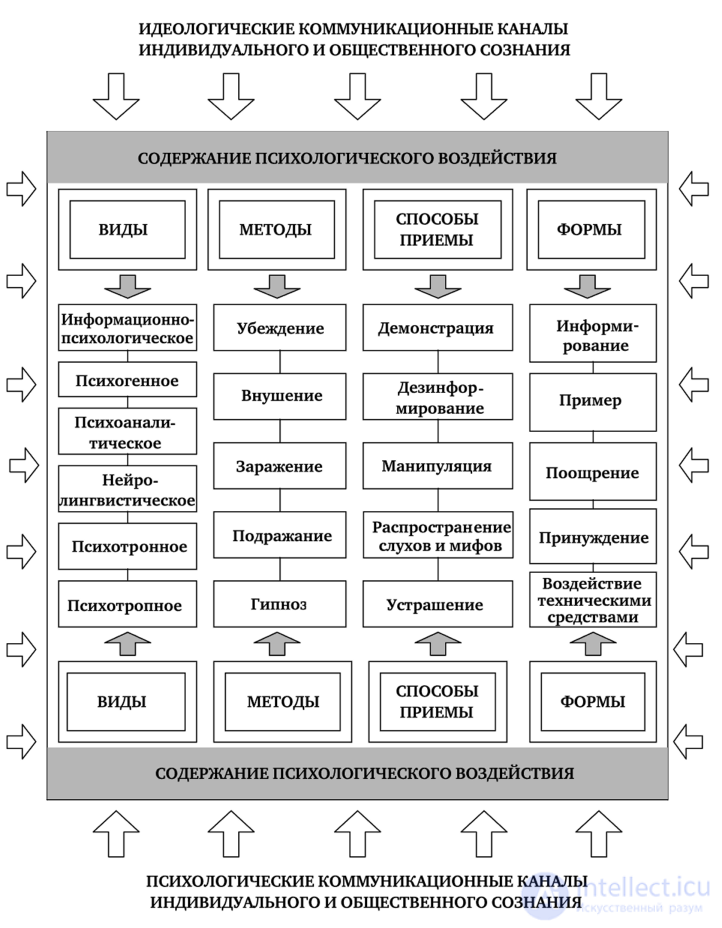
Psychological impact is the socio-psychological activity of some people, carried out in various forms and by various means, directed at other people and their groups in order to change the psychological characteristics of the personality (their views, opinions, attitudes, value orientations, moods, motives, attitudes, and behavioural stereotypes), group norms, public opinion, or people's experiences that mediate their activity and behaviour.
There are many types of psychological impact.
Informational-psychological impact (often called informational-propagandistic, or ideological) is impact by means of words and information.
Psychological impact of this kind has as its main goal the formation of certain ideological (social) ideas, views, conceptions, and beliefs in people, while simultaneously provoking positive or negative emotions, feelings, and even violent mass reactions in them.
Psychogenic impact results from:
a) physical impact on the individual's brain, resulting in disruption of normal neuro-psychic activity (for example, a person suffers a brain injury as a result of which he loses the ability to think rationally and his memory fails, and so on; or he is subjected to factors such as sound, lighting, or temperature, which alter the state of his psyche through certain physiological reactions;
b) shock impact of the surrounding conditions or of certain events (for example, scenes of mass destruction, numerous casualties, etc.) on a person's consciousness, as a result of which he is unable to act rationally, experiences an affective state or depression, falls into panic, and so on.
The less prepared a person is for the psycho-traumatic impacts of the surrounding reality and its physical influences, the more sharply expressed are his psychic traumas, known as psychogenic losses.
Psychoanalytic (psycho-corrective) impact is an impact on a person's subconscious by therapeutic means, especially in a state of hypnosis or deep sleep.
Neurolinguistic impact (neuro-linguistic programming) is a type of psychological impact that changes people's motivations by introducing special linguistic programmes into their consciousness that affect people's behaviour.
Psychotronic (parapsychological, extrasensory) impact is an influence on other people carried out by transmitting information through extrasensory (unconscious) perception.
Psychotropic impact is an impact on people's psyche by means of medical preparations, chemical, or biological substances.

Comments