
Lecture
Resistance to influence– is a return influence, i.e. a form of influence in its own right. Constructive resistance to influence 1) complies with the rules of etiquette, and 2) complies with the ethical norms accepted by the resisting party itself.
Resistance begins with minimal means.
Resistance stops:
a) either when the initiator of forceful or manipulative influence switches to dialogical interaction;
b) or when the target of influence who is resisting decides to end the communication.
3. A move to more powerful means of resistance is made only in the
event that the initiator of influence does not respond to less powerful means.
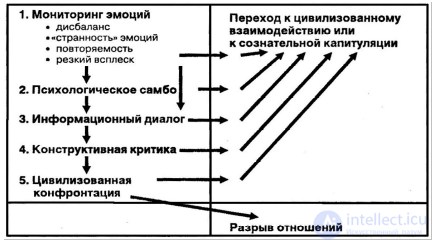
In accordance with these rules, one can use the algorithm of constructive resistance to influence.
Fig. 5. The algorithm of constructive resistance to influence, according to E. V. Sidorenko
Resistance to influence begins with the application of minimal and least powerful means (monitoring one's emotions, psychological self-defence, informational dialogue), and ends with maximal or most powerful means (constructive criticism, confrontation).
The stage of psychological self-defence may be skipped. It is necessary only in cases where the target is overwhelmed by feelings and unable to move straight to informational dialogue.
Monitoring– is the continuous observation of a phenomenon in its dynamics; tracking it over time.
This technique is widely used in behavioural therapy.
Self-monitoring of emotions performs two important functions:
It allows one to judge a partner's manipulative intentions from one's own emotional reactions;
The very fact of self-observation substantially reduces the intensity of the observed emotional reaction.
Analysing one's emotions is necessary in order to recognise the signs of incipient, unwanted manipulative influence.
These signs include:
imbalance– inconsistency, ambivalence of emotions, for example a combination of pride and resentment, joy and distrust, tenderness and anxiety, etc.;
the “strangeness” of emotions– emotions that are inadequate to the given situation, for example a flash of rage during a business conversation about trivial details, or unaccountable fear during a peaceful discussion, and so on;
recurrence of emotions– the systematic recurrence of the same emotions on meeting a particular person: feelings of guilt, professional incompetence, humiliation, protest, and so on.
a sharp surge of emotion – an unexpectedly intense emotional reaction whose strength is out of proportion to the objective significance of the situation.
A. Ellis put forward the idea that “exaggerated” emotions are a sign that an irrational idea has been activated (see Topic 5). If our (often unconscious) beliefs about what we ourselves should be like, what the people around us should be like, and what the world as a whole should be like are touched, unpleasant feelings arise whose intensity greatly exceeds the significance of the event that occurred, of the phrase uttered by the other person, and so on. Instead of mild concern we experience panic for some reason, instead of fleeting annoyance – anguish, instead of regret – despair, instead of barely perceptible irritation – rage, and so on.
Our own emotions serve as important signals informing us that manipulative actions by another person are beginning. It is necessary to maintain self-control (not becoming too emotionally involved in the situation, and distancing oneself from it). “You're right, of course, Timofei, they are lying to us about the goods not moving, but let's wait another week before we make an issue of it.”
Psychological self-defence – is a way of protecting the individual from the destructive consequences of attack and manipulation. It allows one to gain the time needed to master one's emotions and restore the capacity for rational interaction.
Conditions for effective psychological self-defence:
the use of clear verbal formulations;
a correctly chosen intonation – for example, calm, cold, thoughtful, cheerful, or sad;
thoroughness in the response, which is achieved by:
holding a pause before responding;
an unhurried response;
directing the response toward a space deeper and broader than the immediate zone of confrontation.
A pause is perceived as a sign of strength. A pause should be accompanied by an attentive, direct look into the other person's eyes. A response that is too hasty means that the target cannot cope with their agitation and is hurrying to “throw off” the shell lobbed at them, the way one tries to toss away a hot potato. But tossing the hot potato back and forth means giving in to manipulation, or answering attack with attack. Contrary to the attacker's expectations, the target holds on to the potato for a while, examines it, looks it over, weighs it up – and only then returns it to the intervener in an unrecognisable form.
A calm tone of response leaves room for reflection, and thus helps to shift the interpersonal intervention into an informational discussion.
Using other intonations, for example an assertive or a caustic one, will amount to a counter-attack. Sometimes it is acceptable to respond with humour and use a cheerful tone.
Psychological self-defence is not only a method of socio-psychological interaction, but also a method of reflection.
Table 7. Techniques of Psychological Self-Defence
|
Name of technique |
Definition and examples of techniques |
|
The technique of endless clarification
The technique of outward agreement, or “fogging”
The broken-record technique
The English professor technique |
A detailed and precise clarification of what the attacker or manipulator is targeting M. You always tie your tie crooked! When will you finally learn? A. What would you suggest changing?
Expressing agreement with some part of the partner's statement, or with the idea that what they pointed out is indeed important, is of interest, gives one pause for thought, contains a valuable rational kernel, enriches our view of the problem, or even … corresponds to the truth M.You look terrible in jeans! A.Maybe you're right.
The repeated recitation of one and the same capacious phrase, containing an important message for the attacker or manipulator, each time with the same intonation. M. I thought you could understand me… A.I'm ready to hear you out again. M.What's the point of talking if you don't understand basic things. A.I'm ready to hear you out again. M. Maybe you just don't want to understand me? A.I'm ready to hear you out again.
A correct expression of doubt as to whether complying with someone's demands would in fact violate the target's personal rights. M.Could you speak a little more slowly and in shorter sentences, so that I can interpret more accurately? A.I'm afraid not… You see, speaking quickly and in long sentences is part of my personality
|
This technique was described by N. V. Tsen and Yu. V. Pakhomov as one of the exercises for developing the ability to listen to another person: “If your partner in communication emotionally demands something or accuses you of something, you should find out, as fully and precisely as possible, everything that is happening with them, without getting into arguments, explanations or excuses. Your partner may increase the pressure, provoking you into resistance. But you must steadfastly hold to the position of someone who wants to find out the other person's opinion”[Tsen, Pakhomov, 1985, p. 141].
Using this technique helps one consistently stay at the rational level of discussing the problem. The ability to ask a question that requires a substantive, detailed answer activates both one's own intellectual efforts and the thinking of the partner in communication. Energy is shifted from emotional reacting to rational thinking. In addition, we gain the time that the partner spends thinking over the answer. Thus, having found in ourselves the strength for the first clarifying question, we then gain the time and energy needed to keep our emotions from overpowering us. The ability to draw an important clarifying question out of a situation must be so well practised that it does not let us down in a critical, emotionally charged situation.
- What about my proposal seems most vulnerable to criticism to you?
- What needs to be changed?
- What would you advise?
Another variant of the technique of endless clarification is a detailed explanation of one's own position to the partner. It can conventionally be called “self-clarification.”
- You see, I really am easy to offend, and for three reasons. First, I strive for perfection. Second, any slip-ups and failures plunge me into a state of extraordinary anguish. Third, I am an extremely sensitive and perceptive person.
This technique is especially effective against unfair criticism or outright rudeness. It was described in foreign works devoted to assertiveness training.
It matters to everyone that people agree with them and acknowledge their right to their own opinion. Meanwhile, in our speech “no” is very often heard instead of “yes,” for example:
A. Would you like some coffee?
B. No, of course, a cup of coffee wouldn't hurt!
If we are expressing agreement, it is better not to create a negative psychological field with our “no.” The technique of outward agreement is important because it addresses the most fundamental human need – to be in agreement. When a partner agrees with us, we find ourselves immersed in an atmosphere of warmth, acceptance, even happiness. This disarms us. A person who is agreed with wants people to keep agreeing with them.
This technique demonstrates not only outward agreement. We also show a readiness to agree and to move forward together in resolving a problem.
The partner will appreciate that we are, at the very least, willing to consider their point of view. By agreeing at first only “outwardly,” in words, we give ourselves the chance to gradually find points of “inner” agreement.
-What an unexpected thought! I'll have to think it over…
- You know, I'm forced to agree with you, although it's hard for me to do so right away.
- I often think about this myself, but I haven't yet come to a definite decision.
In response to an attack, the target formulates a capacious phrase containing an important message for the attacker or manipulator. This phrase should be such that it can be repeated several times without disrupting the coherence of the conversation. It should contain what the interlocutors would arrive at on the third round of the conversation. They could have arrived at it earlier, had the attacker not been so worked up.
A woman decides something for herself definitively, for example: “I don't want to discuss this issue today, because I need to attend to my own affairs.” She then simply states this and keeps repeating her phrase until the message gets through to the addressee. One must beware of being drawn into side topics, for example: “I understand that it's convenient for you to discuss this today, but I really do need to attend to my own affairs.”
Intonation is important in this technique. As with a record that has “got stuck,” the phrase should be said each time with the same intonation. The broken-record technique also makes use of the well-known rule of three S's – say it three times, so that you are understood.
In this technique the partner correctly expresses doubt as to whether complying with someone's demands would in fact violate their personal rights. This technique was formulated by E. V. Sidorenko and got its name from an incident in her own life. She was once invited to interpret at the therapy sessions of a professor from Great Britain. He spoke indistinctly and at great length. It was very hard to understand him and interpret. During a break, the following dialogue took place:
E. Sidorenko.George, could you speak a little more slowly and in shorter sentences, so that I can interpret more accurately?
George.I'm afraid not… You see, speaking quickly and in long sentences is… it's part of my personality.
The author's initial reaction was annoyance and irritation. Later she came to appreciate the professor's wisdom, when she made use of his phrase on hearing a remark directed at her.
This technique stopped and softened the attack, although it may have been emotionally unpleasant for the attacker.
- If I did that, I wouldn't be myself anymore…
- That doesn't fit with my idea of myself.
- I value some of my quirks and prejudices, because they help me find unconventional solutions.
Informational dialogue– is the clarification of the partner's position and one's own position through an exchange of questions and answers, messages and proposals.
The purpose of using informational dialogue is to seek information. It is a conversation on the merits of the matter. In each of the partner's remarks, one looks for the essence that is relevant to the matter under discussion, setting aside everything else.
If the partner engages in discussing the matter on its merits, gradually abandoning manipulation, the resistance can be considered successfully completed: the manipulation has been transformed into an informational discussion.
Questions aimed at clarifying the substance of the matter:
“What do you mean when you say…”;
“What should be done to change the situation?”;
“What exactly do you consider unconstructive?”.
Questions aimed at clarifying the manipulator's goals:
“Why are you asking me about this right now?”;
“Why are you telling me this?”;
“What are you trying to say?”.
Answers and messages:
“Yes, this work was not finished on time”;
“That was my decision”;
“Yes, I voted against it too”.
Proposals on the substance of the matter:
“I suggest we discuss the facts;
“I suggest we discuss our disagreements in light of the new data”;
“Could you restate your question?”.
Proposals to limit the scope of discussion:
“I suggest we return to the substance of the matter;
“I suggest we avoid personal comments in our discussion”;
“I suggest we discuss the issues one at a time”.
There are limits to the use of the informational-dialogue technique. If the intervener or manipulator has addressed the target with a statement (for example, “You're being careless again”), the target has the right to immediately ask a clarifying question in response. However, if the manipulator has asked a question (for example, “Don't you think you're being careless again?”), the rules of etiquette require the target to answer with a question of their own. Before asking one's own question, one should first answer the other person's question.
Depending on whether the other person addressed you with a statement or a question, different techniques of informational dialogue are used.
EXAMPLE 1. Reaction to a statement
M a n i p u l a t o r. You're being careless again.
The target has entrusted a responsible task to a young new employee.
|
Option |
Reaction |
Technique |
|
Option 1
Option 2
Option 3
Option 4
Option 5
|
What do you mean?
Why did you bring this up right now?
Decided to take a risk
I suggest we discuss how we can support the newcomer at first.
I suggest we discuss the content of the assignment |
A question on the substance of the matter
A question to clarify the manipulator's goals
A statement
A proposal on the substance of the matter
A proposal on choosing the topic of discussion |
EXAMPLE 2. Reaction to a question
M a n i p u l a t o r. Don't you think you're being careless again?
The target has entrusted a responsible task to a young new employee.
|
Option |
Reaction |
Technique |
|
Option 1
Option 2
Option 3
Option 4
Option 5
|
It hasn't seemed that way so far. And what are your thoughts?
Perhaps that was a risky decision… Why did you bring this up right now?
Yes, I took a risk this time.
I suggest we discuss how we can support the newcomer at first.
I suggest we discuss the content of the assignment |
Answer + A question on the substance of the matter
Answer + A question to clarify the manipulator's goals
Answer
A proposal on the substance of the matter
A proposal on choosing the topic of discussion |
There are some typical mistakes made when using the techniques of psychological self-defence and informational dialogue.
Self-justification. Any form of self-justification is a sign that irrational ideas have taken hold, and consequently that the target has been drawn into the manipulation.
Counter-attack – is destructive influence (“Look at yourself. It's not me, it's you who doesn't understand anything,” and so on).
A question about the opinion of other people, “third parties” (“Yes, and what do they say about this?” and so on).
A question about the source of information(“Where did you find that out?” “Who said that?” and so on). This is a counter-manipulation. If the attacker does not cite sources themselves, then they have reasons to conceal them. By asking about sources, we deliberately trigger the activation of their possible irrational ideas absorbed since childhood (for example, “Don't tell on anyone!”), thereby throwing them into confusion.
A question about the “instigators” (“Who started this first?” and so on). This is a counter-manipulation.
Lying and insincere statements, because that is manipulation.
Rude wording of questions and answers (“What's it to you?”). A rude form is violence, barbarity.
Statements about psychological rights and obligations (“I have the right not to tell you that! I don't owe you an explanation!” and so on). Talking about rights inevitably leads the conversation away from discussing the substance of the matter and the manipulator's goals, and slides into a discussion of the relationship.
A question about the relationship (of the attacker to the target, to others, to themselves, or of others to the target) (“Don't you trust me?”, “They're judging me,” and so on). Such questions may be a counter-manipulation (for example, a display of weakness), self-justification, or a counter-attack. If the manipulator themselves provokes a discussion of the target's relationships with someone, it is often important to them to later be able to refer to the very fact that the conversation took place.
Constructive criticism – is a fact-based discussion of the goals, means, or actions of the initiator of the influence, together with a justification of their inconsistency with the target's goals, conditions, and requirements.
General characteristics:
Factuality: possibilities, facts, events, and their consequences are assessed, not personalities.
Correctness:only tactful expressions are permitted.
Dispassion: analysis and assessment are carried out “without emotion,” dispassionately, without any personal involvement or raising of the voice, and so on.
Expressing doubt about the advisability
- Perhaps we can come back to this question in a year.
- I believe that using your idea would require unjustified expenditure.
Citing a past case
A reference to similar events, situations, and decisions, describing the unfavourable consequences to which they led.
- We had a similar case a month ago. Unfortunately, it turned out that orders of this kind require bringing in additional staff.
Citing three reasons
A message stating that the proposal cannot be accepted …for three reasons.
Three reasons carry weight. Moreover, there are always three of them to be found. A partner can use the method of separating arguments against them. When a person says “for three reasons,” they are structuring their own attitude to the proposal. This is a very valuable exercise for the mind and a genuine test of the proposal's effectiveness.
- I don't agree to give Ivanov this position. He hasn't completed his probationary period yet. That's one. He has made several mistakes. That's two. And he is the husband of one of the female employees, and I'm against nepotism. That's three.
Constructive criticism is, in essence, counter-argumentation, which can be carried out through the technique of reframing, separating the partner's arguments, or unfolding one's own arguments. Expressing doubt about the advisability of something and citing a past case are methods of unfolding one's own arguments.
Confrontation – is pitting one's own strength against the partner's strength in order to make them reckon with us and stop ignoring us.
This is the most powerful means of resisting influence. This method is justified in cases where the initiator of the influence uses such non-constructive methods of impact as manipulation, destructive criticism, ignoring, or coercion.
According to the cognitive psychotherapist A. Beck, confrontation can serve a useful function. By entering into confrontation, we give the other person and ourselves the opportunity to change and improve our relationship, while at the same time respecting our own need to express discomfort.
A. Beck believes that there is a risk in confrontation and a risk in avoiding confrontation.
The risk of confrontation:
the relationship deteriorates;
anguish;
cooperation will be destroyed.
The risk of avoiding confrontation:
an even stronger conflict may arise;
harmful consequences both for the organisation and for the psychological well-being of those involved in the interaction [Beck A., 1988. P. 14 – 15; cited in Sidorenko, 2002, p. 123]
According to A. Beck, in order to decide whether to enter into confrontation, one must first answer several questions for oneself.
Honestly assess the situation you are in.
Determine whether your actions or inaction are having the desired effect.
Examine what you want from the person or the situation, and what is preventing you from achieving it
Next, consider the possible results of your actions. What are the best and worst possible consequences?
The answers to these questions may lead you to confront the other person, to accept their behaviour, or to end the relationship [A. Beck, 1988].
If the decision is made to enter into confrontation, one must be consistent and prepared to see it through to the end. Confrontation can be effective only if each of its necessary phases is carried out.
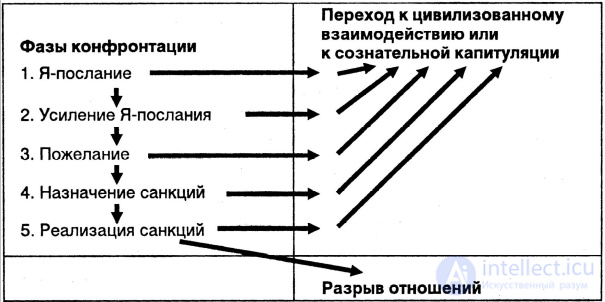
Fig. 6. The algorithm of confrontation, according to E. V. Sidorenko
The first phase of confrontation. An I-message about the feelings that this behaviour of the initiator of the influence evokes.
For example, a manipulator (a man) deliberately violated the psychological distance between himself and the target of his influence (a young woman), so that she would feel uncomfortable and more readily agree to fulfil his request. He moves his chair right up against hers and, putting his arm around her shoulders, says: “Please give me this manual, I really need it today.” The young woman, the target, replies with an I-message: “When someone sits down this close to me, I feel anxious and uncomfortable.” If the manipulator accepts the I-message, apologises, and moves away, the goal has been achieved and the confrontation is over. Only if he does not do so, or, having done so, then repeats his attempts to limit the target's psychological space, is it necessary to move on to the second phase.
The second phase of confrontation. Strengthening the I-message.
In this example, the young woman, the target, did it like this: “When I say that I'm feeling anxious and uncomfortable, and there's no reaction to it, I start to feel anguish, upset. Resentment, even. I feel bad, do you understand?” If the initiator of the influence accepts this I-message and stops the behaviour, the confrontation can be considered successfully completed. Only if he does not do so does the target need to move on to the next phase.
The third phase of confrontation. Expressing a wish or a request
For example, “I'm asking you to sit at roughly this distance from me, no closer. And also I'm asking you not to pat me on the arm and not to touch me at all.” If the request is not fulfilled, one must move on to the fourth phase.
The fourth phase of confrontation. Imposing sanctions
Example: “If you pat me on the arm again, or sit closer than is comfortable for me, first, I will leave immediately, and second, I will move away every time you come near me. I will stop talking to you.” A sanction is a threat, and a threat is an attribute of coercion. If the confrontation has reached this phase, one must admit to oneself that we are forcing the manipulator to make a choice: either submit to our demands, or give up the possibility of interacting with us. The manipulator may resist the coercion in the form of a counter-confrontation. We can enter into negotiations and discuss their demands. Only if they continue their actions, or if we fail to reach an agreement, is it necessary to move on to the fifth phase.
The fifth phase of confrontation. Carrying out the sanctions
The target of the influence must refuse all interaction with the initiator. Break off the relationship with them, if there is no other way out.
Confrontation is a method that requires the resolve to see things through to the end in asserting one's psychological freedom, one's right to resist another's influence.
Other forms of resistance can also be used against attack, manipulation, and contentious kinds of influence. They are called additional because they are not self-sufficient; they are more a backdrop to resistance than a method in themselves, a generalised preparation rather than a specific sequence of actions. These techniques are listed in Table 8.
Table 8
Additional Kinds of Resistance to Influence
|
Kind of resistance to influence |
Definition |
|
Internal mobilisation |
The deliberate activation of factors that produce, restore, and increase one's inner strength; in particular, emotional regulation |
|
Creativity |
Creating something new, contrary to the pattern of behaviour or action being imposed |
|
Avoidance |
Avoiding any form of communication with the initiator of unwanted influence and/or reducing and regulating the time, conditions, and procedure of the interaction |
|
Refusal |
The target's expression of disagreement to comply with the initiator of influence's request |
Internal mobilisation involves the activation of one's own resources in situations where someone else's will is being imposed. Such resources include vitality, positive emotions, positive self-perception, and self-confidence. Internal mobilisation contributes to effective resistance against attack, suggestion, emotional contagion, and attempts to win one's favour.
Internal mobilisation can be achieved through the targeted use of psychological and physiological stimuli: a hot shower or a sauna, a particular regimen of diet and sleep, reading one's favourite books, watching certain films, meeting certain people, and so on.
Internal mobilisation can also be achieved through emotional regulation. Resisting unwanted influence by means of emotional regulation consists of: 1) the ability to stay calm in emotionally charged situations; 2) transforming negative emotions into positive ones (fear and anger into humour, anxiety into surprise); 3) transforming asthenic emotions into sthenic ones (fear and depression can be transformed into anger). Some psychologists recommend following this rule: if you don't know how to react to a situation in which unwanted influence is being exerted on you, react with the emotion of anger. Try to get angry at that person, or at yourself.
Creativity involves performing unpredictable, original acts and actions. Creativity is especially effective for resisting attempts to induce a tendency toward imitation. To do this, one must develop within oneself a need for self-expression.
Imitation, whether voluntary or involuntary, pervades our whole life. From childhood, the habit of following others' models becomes deeply rooted in us. The existing system of education and upbringing contributes to this. A negative consequence of such behaviour is the mindless following of imposed models, their uncritical adoption, an inability to show independence, laziness, and a lack of originality and individuality in life.
If the inner need for creativity does not become active in us of its own accord when someone else calls on us to imitate them, there remains one way out – to think up something else, something different, not what we are being offered or even imposed on us. Let this be creativity by contradiction, or “imitation in reverse,” but it alone can save us from sinking into the quagmire of imitation (sometimes an intoxicating one, since it is natural for a person to revel in the experience of unity with others, the experience of their own resemblance to others, their own not-being-alone).
In modern psychotherapeutic practice, one of the existing techniques for maintaining psychological well-being is controlling stress factors. Together with the therapist, the client identifies the conditions under which stress arises for them. They are then offered methods for reducing and controlling the occurrence of stress in their life: managing one's time; solving problems before they become problems; avoiding certain places, meetings with certain people, and, in general, situations that provoke unwanted feelings and reactions in them [D. Greenberg, 2002]. Such techniques belong to strategic avoidance.
If a stressful situation is unavoidable or is already occurring, it is possible to apply tactical avoidance– time-outs and shortening the time spent interacting with the unwanted person.
Avoidance techniques:
Time-out:
diverting attention to a mundane detail (Oh, my chair just broke; something got in my eye; it's time for me to take my medication, and so on);
physically leaving the space of the interaction under a plausible pretext (Excuse me, I need to go get these papers from the office manager right away; I need to check this data, let me take a three-minute break; excuse me, I have to leave you for one minute, and so on);
a philosophical way out of the situation – rhetorical questions or generalised statements such as “What is truth?” or “We are all subjective…”;
attempts to laugh it off or use a joke to shift attention to something else (“Oh, they're already scolding! Soon there'll be a beating!” – see “The Days of the Turbins” by M. Bulgakov).
Shortening the intervals of interaction:
postponing the conversation to another time (Sorry, I can't talk right now, let's say tomorrow at two; let's get back to this in half an hour, all right? and so on);
establishing a “schedule” of interaction (I can devote only 1 hour a day/three hours a week/15 minutes every evening to this project, and so on).
Preventing personal interaction:
ruling out the possibility of meetings with the attacker or manipulator, if this is allowed by the conditions of work;
converting a personal meeting into correspondence (Please send me the address with the exact details, I will deal with it after lunch and answer the clients myself, and so on).
Avoidance in business communication is a temporary postponement of real action, and therefore it must sooner or later be replaced by more effective means that do, after all, involve interaction, rather than avoiding it.
Refusal
Refusal is one of the rights of an assertive person on K. Kelley's list. In K. Kelley's view, a person has the right to respond to a request with a refusal without feeling guilty or selfish. [Kelley C., 1979. P. 58-59; cited in E. V. Sidorenko, 2002].
Techniques of Refusal
1. Refusal through apprehension:
-I'm afraid that's not possible.
-There's a real danger that I won't be able to accept this proposal.
- The thought of having to refuse you frightens me.
2. Refusal through regret:
- I'm very sorry, but I won't be able to do that.
- I'm sorry, but I won't be able to agree to this.
- I really don't want to upset you, but my answer will be no.
3. Refusal through necessity:
- I am forced to decline this offer.
- Alas! My other obligations require me to decline.
- I will still have to give you a refusal…
Refusal cannot be a systematically used technique, since it may disrupt business interaction. Refusal is also dangerous in that, regardless of the will of the person refusing, it leaves a residue of guilt, and this is a weak string that a manipulator can play on.

Comments