
Lecture
All the well-known theoretical approaches within which socio-psychological research is conducted – the psychoanalytic approach, neo-behaviourism, cognitive psychology, interactionism – have contributed to the development of the problem of the psychology of influence.
As is known, each of these approaches singles out a key determinant that shapes social behaviour and interaction. For behaviourism and neo-behaviourism this is external stimuli; for cognitive theories, internal psychological motivations; for the psychoanalytic approach – unconscious drives repressed into the subconscious; for interactionism – the structure of role prescriptions.
Table 1 presents the main ideas and concepts developed within these approaches, which have done much to shape the theoretical understanding of the psychological laws of influence.
Table 1 Foreign psychological theories explaining the nature of influence
|
Name of the theory |
Authors of the theory |
Key idea of the theory |
|
I.The psychoanalytic approach
1. Psychoanalytic theory |
S. Freud |
The psychological patterns of influence in people's communication are shaped by the experiences of early childhood, transformed into unconscious drives |
|
2. Neo-Freudian theories |
A. Freud, K. Horney, H. Sullivan, E. Fromm |
Influence is the process of realising a person's unconscious basic motivation – for example, the need for security, for power, for love – regulated by the mechanisms of identification and psychological defence |
|
3. Transactional analysis |
E. Berne |
Psychological influence is an exchange of transactions, i.e. stimulus-actions and responses that correspond in content to the three-part structure of personality, comprising the positions of the emotional “Child”, the normatively stereotyped “Parent” and the rational “Adult” |
|
II.Neo-behaviourism 1. Theory of social imitation |
G. Tarde |
All human relationships are grounded in an irresistible drive to imitate |
|
2. Social learning theory |
A. Bandura |
People influence one another by serving as a source of learning. By observing the behaviour of others, a person learns |
|
3. Theory of interaction outcomes |
J. Thibaut, H. Kelley |
People interact with one another on the basis of experience, weighing possible costs and benefits. Every interaction leads to an outcome: a reward or a loss. The interaction is repeated if the sum of rewards exceeds the sum of losses |
|
4. Social exchange theory |
G. Homans |
Influence is an exchange of resources of a certain kind (love, status, services, goods, information, money, etc.). Different types of resources presuppose different rules of exchange |
|
III.Interactionism 1. Theory of symbolic interactionism |
G. Mead, H. Blumer, M. Kuhn |
Influence is psychological interaction through symbols (gestures, facial expressions, style of dress, etc.), in which their individual and social meaning, as well as social roles, are manifested |
|
2. Impression management theory |
E. Goffman |
A person is able to see himself through the eyes of others and adjust his behaviour to match the expectations of those around him, in order to create a more favourable impression of himself |
|
3. Small group theory |
C. Cooley |
The main initiator of influence and social control is the small group, in which people communicate closely (family, neighbours, study group, work collective) |
|
4. Reference group theory |
H. Hyman |
A person is influenced not by just any social group, but by a reference group (i.e. one that is significant, whose norms and values serve as a standard) |
|
IV.Cognitivism 1. Field theory |
K. Lewin |
The process of influence is the interaction between the person and his psychological environment (objects capable of attracting and repelling), forming a field of forces
|
|
2. Structural balance theory |
F. Heider |
Influence is an exchange of information involving cognitive processes and structures (attitudes, ideas, beliefs). Every person strives for a balanced state of their cognitive structures
|
|
3. Cognitive dissonance theory |
L. Festinger |
Cognitive dissonance is one of the main factors governing human behaviour and interpersonal interaction. Cognitive dissonance is a contradiction in a person's knowledge that produces an unpleasant experience and drives them to actions aimed at eliminating that contradiction
|
Various psychoanalytic theories contain ideas explaining the nature of influence. These include S. Freud's theory, the neo-Freudian theories of K. Horney, H. Sullivan, E. Fromm, A. Freud, and E. Berne's transactional analysis.
Psychoanalysis – is a scientific psychological approach whose subject of research is the deep unconscious psyche. Its main task is to study the content of the unconscious, which plays a decisive role in clarifying the value of the personality. Psychoanalysis emerged in the early 1890s out of the medical practice of treating patients with functional mental disorders. The founder of psychoanalysis was the Austrian psychiatrist and psychologistS. Freud.
Although psychoanalysis has not become widespread in social psychology, its basic ideas can be applied to explaining the social behaviour of the individual. According to Freud, the psychological patterns of influence in people's communication are shaped by the experiences of early childhood, transformed into subconscious drives. From earliest childhood we establish templates or patterns of behaviour to which we tend to fit all our future relationships. If a child maintained a warm relationship with their parents, they may well tend to show respect and sympathy toward authority figures. If, on the contrary, the parents were very strict with the child, that child may come to view authority figures as threatening and respond with aggression, protest, or, conversely, with fawning and flattery in an effort to protect themselves. At the root of any act of influence lies the need to replay situations and relationships that were especially difficult or problematic in childhood.
According to Freud, one form of influence – identification – is one of the fundamental mechanisms of personality development.Identification – is the adoption of certain traits of another person and their incorporation into one's own personality. Each age has its own identification figures: animals, imaginary characters, objects, groups, ideas. Children identify with their parents. Rejected children show strong identification in the hope of winning back their parents' love. Identification can also arise from fear – a child identifies with the parents' prohibitions, constantly experiencing feelings of guilt and shame.
The term “neo-psychoanalysis,”or “neo-Freudianism,”refers to the body of doctrines created by the followers of Freud –K. Horney, H. Sullivan, E. Fromm, E. Erikson, A. Freud. Neo-psychoanalysis originated in the 1930s. A distinctive feature of these doctrines is the development of the basic tenets of classical psychoanalysis to meet the new challenges facing the theory and practice of psychological assistance, while also bringing various social factors into the scope of research.
Well-known representatives of neo-Freudianism – E. Fromm, H. Sullivan, K. Horney, E. Berne – made various social-psychological phenomena the special subject of their research, studying them using the core ideas of classical psychoanalysis.
Representatives of modern psychoanalysis study the mutual influence of the individual and society. K. Horney's socio-cultural theory of personality examines the influence of cultural factors on the formation of a person's character and neuroses. H. Sullivan – a practising psychiatrist and the author of the concept of interpersonal psychiatry – studied the influence of interpersonal relationships on the formation of personality and the process of its development. He defined personality as “a relatively enduring pattern of recurrent interpersonal situations that characterise a human life” [cited in Florenskaya T.A., 1974, p.163]. The key problem in the concept of social psychoanalysis developed by E. Fromm, the most prominent representative of neo-Freudianism, is “a particular kind of relatedness of the individual to the outside world.” “…Society performs not only a repressive function but also a formative one with respect to personality. Human nature – a person's passions and anxieties – is a product of culture” [9, p.20-21]. Fromm analyses every sphere of society – its economic, social and political structure – in terms of their influence on a person's inner spiritual changes.
From the standpoint of neo-psychoanalysis, the nature of interpersonal influence is rooted in the process of realising a person's unconscious basic motivation – for example, the need for security, for power, for love, for freedom, and so on. The content of an adult's dominant motives depends on childhood experience and relationships with parents and the surrounding environment. Neo-Freudianism describes various strategies and types of influence. For example, K. Horney identifies the need for security as the basic need of personality that determines its capacity to exert influence. To satisfy this need, a person may use one of three strategies of exerting influence:
moving toward people (dependency, compliance, helplessness; the underlying belief: “If I give in, they won't hurt me”),
moving away from people(avoidance, withdrawal; the guiding principle: “If I withdraw, I'll be fine”),
moving against people(dominance, power, manipulation; the underlying principle: “If I have power, no one will touch me”).
None of these behavioural strategies is productive, since all of them lead to the self-destruction of the personality and its alienation from other people.
The theme of the loneliness of modern man is central to Fromm's teaching. The result of this loneliness and alienation is a pull toward destruction and aggression, and unhealthy strivings and drives. The root cause of the problems of modern people lies in the fundamental contradiction of human existence – the contradiction between the striving for freedom and independence from the surrounding world and the striving for security and belonging within society. To overcome the sense of alienation and loneliness, a person resorts to such strategies of influence and interaction as authoritarianism, destructivenessandconformity.
Authoritarianism – is the tendency to fuse oneself with someone or something external in order to regain the strength lost by the individual “I.”
Destructiveness – is the tendency to destroy, annihilate, and conquer someone or something.
Conformity– is the tendency to submit as fully as possible to the social norms that regulate behaviour.
Only a person possessing positive freedom is capable of exerting a developmental influence.Positive freedom is a kind of freedom in which a person feels part of the world while at the same time remaining independent of it. A person possessing positive freedom belongs to theproductive typeof personality.A productive personalityis marked by independence, honesty, calm, love for other people and for all living things, and a striving toward creativity and socially useful action. Fromm studied not only the problems of a person's influence upon himself, upon other people, and upon social development, but also questions of society's influence upon the personality. Society shapes the social type of character. All social formations, past and present, have produced unproductive types of personality:
receptive– passive, trusting, sentimental;
exploitative‑ self-assured, aggressive;
hoarding – stingy, stubborn, cautious;
marketing – presenting himself as a commodity and treating others as commodities too.
The productive type of personality could become dominant in a future, perfected society of humanistic communal socialism.
Among psychoanalytic concepts, transactional analysis is of the greatest importance for the development of the theory of influence.Transactional analysis– is an approach in psychology developed in the 1950s by the American psychologist and psychiatrist Eric Berne. Its subject of study is thetransaction – the interaction of the ego states of two individuals entering into communication. Transactional analysis comprises: 1) the theory of ego states; 2) the theory of transactions (interactions); 3) the analysis of psychological “games”; 4) the analysis of a person's life script.
Transactional analysis has made a substantial contribution to the study of the nature of interpersonal influence. According to Berne, influence is characterised by the positions taken by the participants in an interaction, given the situation and the style of interaction. He identified three types of positions in every person's behaviour, and the correspondingego states:the “Parent,” the “Adult,” the “Child”. Each position is a psychological strategy for exerting influence. The position of the Parentcan be defined as the position of“I must!,”the position of the Child‑ as the position of“I want!”, and the positionof the Adult – a fusion of“I want”and“I must.”
While occupying the Parentposition, a person seeks to control other people. As a rule, they are guided by the norms and rules instilled in them by their parents, school teachers, and so on. The inner Parent is conventionally divided intothe Nurturing Parent, who seeks to offer help and support, andthe Critical Parent, who criticises and blames those around them. The means of influence used bythe Parentinclude: looking down on others; a condescending or contemptuous facial expression; categorical, accusatory, or patronising intonations. Everything is clear to them, they know the truth. They favour expressions such as: “I won't put up with this,” “This must be done immediately,” “Is it really so hard to understand,” “What idiot came up with that,” “You misunderstood me,” “How many times do I have to tell you,” “Aren't you ashamed of yourself,” “Absolutely not,” and so on.
The Adult controls the actions of the Parent and the Child, adapting them to reality. The state ofthe Adult is a state in which a person seeks to examine a situation from every angle, work out a plan of action, and carry it out. In communication,the Adult behaves confidently and calmly. The relationship with the other person is built on equal terms. Means of influence: a direct gaze, calm even intonations, confident behaviour. Typical expressions: “Sorry, I didn't understand you, could you explain that again, please,” “That's my opinion,” “What if we did it this way,” “How do you plan to get this work done?” and so on.
The state of the Child (naturalorspontaneous,adaptive,rebellious) is a state that follows one's own desires and the advice of adults and parents, displaying creativity and originality, and revealing one's weakness when unable to solve problems independently. In the state ofthe Childa person most often depends on the assessments of other people, awaiting approval or disapproval. In communication, the posture and facial expression ofthe Childmatch their inner emotional state: joy, grief, fear, anxiety, delight. They show laughter, tears, trembling lips, shrugging shoulders, a downcast or darting gaze, ingratiating or guilty intonations, and so on. They often exclaim: “Excellent!”, “Wonderful!”, “I want to!”, “I don't want to!”, “I'm sick of this,” “I won't agree to that for anything,” “Why do I need this?”, “When will all this be over?”.
The act of influence in the process of human communication is called a transaction. Berne held that the purpose of a simpletransactional analysisis to determine which ego state is responsible for thetransactional stimulusand which state of the person produced thetransactional response, thereby determining the character of the influence and of the relationship between people. According to Berne, the first rule of communication states that as long asthe transactions are complementary, that is, the stimulus elicits an appropriate, expected, and natural response, the process of communication will proceed smoothly and can continue indefinitely.
EXAMPLE
A . Students don't want to study at all.
B . Yes, people used to take their studies more seriously.
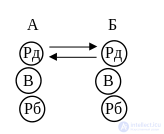
A . That shirt doesn't suit you.
B . Well, what should I wear then?
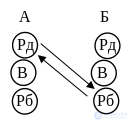
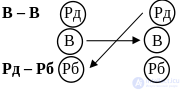
The opposite rule states that the process of communication is interrupted when what may be called a crossed transaction occurs, that is, the stimulus provokes an inappropriate response. In crossed transactions, the partner's response is directed at a different ego state than the one the person is actually in. The source of such behaviour is usually a hurt Child. This kind of state is typical of people who, in childhood, experienced undeserved criticism or a strict, critical attitude from their parents or teachers. They have retained within their personality a hurt, rebellious Child.
To overcome the hurt (which in reality may not even have had any real cause), the hurt Child becomes a critical Parent and influences the partner through accusations, insults, and destructive criticism.
EXAMPLE
Instructor: You didn't write the paper as required, so I can't give you a pass.
Student: Nobody needs your subject anyway
Besides open transactions, there are also hidden transactions. Their meaning is not directly tied to the observable behaviour and the literal text of the utterance (for example, an outwardly harmless remark may conceal a very hurtful subtext).
EXAMPLE
Student: Can intelligence even be measured? (Are you the one who's going to measure it?)
Instructor:It can, if you have any! (Yours clearly isn't up to much.)
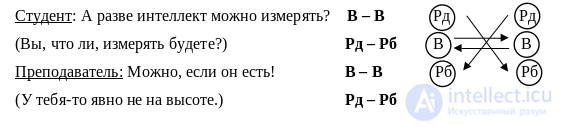
Communication by means of hidden and crossed transactions is called a psychological game.A psychological game – is a series of moves with a clearly defined and predictable outcome.A game‑ is the most complex type of mutual influence, since in games each side unconsciously tries to gain the upper hand over the other and obtain a payoff. The main distinguishing feature of games is the hidden motivation of their participants. Games can be played within the family, at work, or over a lifetime. The most common game scripts played out are:“Poor me”; “I'm only trying to help you”; “What would you do without me”; “It's all because of you”; “Why don't you… – Yes…, but…”; “See how hard I'm trying”; “If it weren't for you…”.
EXAMPLE
The psychological game “Yes…, but…”
Patient: Doctor, I'm feeling unwell again.C -P
Doctor: Why don't you get treatment in hospital?P- C
Patient:Yes, that would be nice,but who wouldP- C
look after my children and husband?
Doctor: You could get treatment at home.P - C
Patient:Yes, I agree,but who wouldP - C
go to work for me? and so on.
This game is unproductive for both participants in the interaction, since the patient receives no help and the doctor gets no satisfaction from fulfilling their professional role. In the same situation, the game “Yes…, but…” may, after a while, turn into the game “It's all because of you,” in which accusations are levelled at helpless medicine, incompetent doctors, and so on.
The doctor could break the script imposed by the patient and exert a constructive influence by letting her describe how she would like to be treated and what helps her, or by using the question: “What matters more to you – proving that doctors can't treat patients, or your own health?”
According to Berne, games make up a significant part of human communication. For people who lack attention, support, self-confidence, and trust in the world, games are the only way of communicating. Because of their inner problems, such people are unable to form relationships of closeness and attachment. Most often, people choose their friends, partners, and loved ones from among those who play the same games as they do. For some people, games are essential for maintaining their mental well-being. In such people, psychological equilibrium is so unstable, and their outlook on life so precarious, that if they were deprived of the chance to play, they would fall into hopeless despair.
To prevent an influence that leads to conflict in communication, it is necessary to analyse what state the partner is in and which of your own ego states their influence is directed at. Parallel transactions should be built using the techniques of amortisation andsuper-amortisation[Litvak M.E., 1995].
EXAMPLE husband wife
Husband: Darling, where's my shirt? A – A
Wife: You're not a little boy anymore, it's time you learned P-C
for yourself where your things are!
Husband: Yes, I'm not a little boy, it's long past time I knewC- P
where my things are, but you're so
good at running the household, you always tell me.
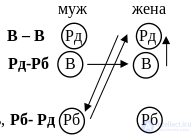
With such a response, no conflict will arise, provided there is no hidden transaction in which the partner conveys the insincerity of their words through nonverbal means (irony, mockery, irritation in facial expression, gaze, and intonation).
Besides amortisation, there is also the technique of super-amortisation, which consists in the following: if you are subjected to a negative influence in the form of destructive criticism or a rude remark, offer a counter-influence, that is, exaggerate in yourself the very quality that your communication partner attributed to you.
EXAMPLE
A. Barging around like a bear, you've trodden on everyone's feet!
B. Of course, a bear, even worse – a hippopotamus, there's no forgiving me, and so on.
In his theory, Berne describes the most perfect form of interpersonal influence – intimacy. Mutualintimacy can be defined as communication free of games, involving a warm, genuinely interested attitude between people and excluding any extraction of benefit. Intimacy brings incomparable pleasure and ensures personal growth and well-being.
Behaviourism – is one of the leading approaches in psychology, whose subject of study is behaviour, understood as a set of “stimulus – response” relationships. The founder of behaviourism is the American psychologistJ. Watson. Behaviourism is called “surface psychology” or “psychology without a psyche” because of its inattention to the role of the psyche and consciousness in human behaviour.
Neo-behaviourism– is an approach in psychology that replaced behaviourism in the 1930s. It is characterised by its recognition of the active role of mental states in governing behaviour. It is represented in the teachings of the American psychologistsE. Tolman, C. Hull, B. Skinner, A. Bandura, and others. Neo-behaviourists regardlearningas the main mechanism of behaviour formation. Learning takes place through one's own experience, by forming associations (stimulus-response) and by trial and error, as well as through adopting the experience of others by observation and imitation. A special role in the learning of behaviour belongs toreinforcement.
Neo-behaviourists have made a significant contribution to the study of the psychology of influence. For understanding the psychological mechanisms and laws of influence, particularly important are such concepts as Tarde's theory of social imitation; Bandura's theory of social learning; Thibaut andKelley's theory of interaction outcomes; Homans's theory of social exchange.
The theory arose at the end of the 19th century at the intersection of two sciences – sociology and social psychology. According to Gabriel Tarde, the theory's founder, all human relationships are grounded in an irresistible psychological drive to imitate. Relationships between people are always built on the “teacher – pupil” model. Later sociological works identify three types of imitation: 1) imitation of one person by another; 2) imitation of customs and models; 3) imitation of an ideal. All social processes can be explained through the phenomenon of imitation. The capacity for imitation is a source of progressive change in society. People endowed with creative initiative and originality display new models of behaviour (inventions), arousing in others the desire to imitate them. The phenomenon of imitation is also a cause of social conflicts. Conflicts in society arise because people follow different models of imitation, competing inventions, which sets them in opposition to one another.
The theory was developed within social behaviourism, which emerged at a later stage in the development of the psychology of behaviour – in the 1960s. Its author is the American psychologist A. Bandura. Bandura studied the mechanisms of social learning. He believed that new behaviour could be acquired by a person not only through personal experience, but also by observing the behaviour of others.
People influence one another by serving as a source of learning. By observing the behaviour of other people and analysing its consequences, a person learns. The effectiveness of imitating a model depends on thepropertiesof the object of imitation,the personal qualities of the observer,andthe consequences of the observed behaviour.
We are more inclined to imitate people who are:
high in status;
competent;
strong.
People are more susceptible to the influence of others when they are:
low in status;
incompetent;
helpless, weak;
children imitate more often than adults;
novices more often than experienced professionals.
We more often choose as models for imitation people:
with whom we communicate often;
who are attractive;
who are useful.
Learning through observation is governed by four interrelated processes: attention, retention, reproduction of behaviour, and motivation[cited from Hjelle and Ziegler, 1997].
Attention ensures the selection of the necessary information and understanding of the behaviour model being observed.
Retention processes ensure the memorisation of the model's behaviour and its storage in long-term memory. Two main systems aid retention:imagery and verbal (word-based) coding.
Motor reproduction processes ensure the translation of information stored in memory into behaviour.
Motivational processes ensure positive reinforcement (external, vicarious or self-reinforcement) of the modelled behaviour.
Vicarious reinforcement occurs whenever an observer sees the model's action and the outcome of that action.Vicarious positivereinforcement makes the observer more likely to repeat the model's behaviour, whilevicarious negativereinforcement reduces the tendency to behave in that way.
Self-reinforcement occurs whenever people set a personal standard of achievement for themselves and reward (or punish) themselves for reaching, exceeding, or failing to reach it. Whether a person rewards or punishes their own behaviour depends on the personal standards against which it is judged.
Reinforcement facilitates the modelling of behaviour, but is not necessary for it. For instance, children who observe certain behaviour on television later behave in a similar way regardless of whether they knew in advance that such imitation would be rewarded. Bandura carried out numerous studies confirming the importance of learning through observation in the acquisition and modification of aggressive behaviour. According to Bandura, aggressiveness is a product of social learning. It develops, is maintained, or diminishes simply as a result of observing scenes of aggression and taking into account their visible consequences for the aggressive person. Bandura's laboratory studies demonstrate the influence of televised violence on social behaviour. Prolonged exposure to violence on television can lead to: 1) an increase in aggressive behaviour; 2) a reduction in the factors that inhibit aggression; 3) desensitisation to aggression; 4) the formation of an image of social reality as threatening and full of fears and dangers.
Bandura offered recommendations to adults on teaching children non-aggressive behaviour. He suggested that, on a personal level, parents should model non-aggressive forms of behaviour for their children and encourage non-aggressive behaviour. He insists that parents try to shield their children from violence on television by assessing the content of such programmes in advance. Bandura recommends that parents watch television programmes together with their children and comment on them, so that the children become sensitive rather than indifferent to the evil and suffering caused by acts of violence. Non-aggressive behaviour can be modelled by showing prosocial programmes on television.
The outcome of social learning should be the acquisition of self-efficacy – the conscious ability to cope with difficult life situations. Self-efficacy can be acquired through any of four routes: the ability toconstruct one's own behaviour, vicarious experience, verbal persuasion, and states of emotional arousal.
The ability to construct one's own behaviour implies drawing on past experience to achieve desired outcomes.
Vicarious experience– is observing other people who successfully construct their own behaviour.
Verbal persuasion – is a person talking themselves, in words, into believing – or being persuaded by someone else – that they possess the abilities needed to achieve their goal.
Emotional arousalcan hinder the achievement of a goal, so people are more likely to succeed if they are relaxed and emotionally calm.
Bandura's theory of social learning is currently very popular and is widely used in the United States in various areas of social practice, especially in planning and running prevention programmes aimed at changing and shaping health-related behaviour, promoting a healthy lifestyle, and treating illness.
The approach of Thibaut and Kelley is a theory of the dyadic interaction between people, in which the quality of their relationship depends on the sum of the “rewards” received by each participant. The authors focus mainly on the mutual exchange of rewards and costs within the context of the interaction. A distinctive feature of this theory is its use of a measurement-based approach to studying the process and outcomes of influence.
The main tenets of the theory:
any interpersonal relationship is an interaction;
any interaction leads to an “outcome”: a reward or a loss;
the interaction is repeated if the sum of rewards exceeds the sum of losses;
the interacting parties depend on one another in achieving positive outcomes.
The factorsinfluencing the quality of the interaction are:
a) independent variables– mutual control, mediated by the ability to influence the other person's outcomes (reward payoffs, reinforcement payoffs, utilities);
b) dependent variables – the products of human relationships (norms, roles, power).
Positive payoffs can bematerial orpsychological(for example, a gain in status, power, and so on).
The authors identify two types of control:
fate control – one participant fully determines the outcome for the other, regardless of what that other person does;
behavioural – neither party can fully determine the other's outcome, but each has means, in the form of their own strategies, to influence those outcomes.
The rewards or losses received by participants are determined by internal or external factors relative to this interaction. The external determinantsinclude:
the individual needs and abilities of the participants;
similarities and differences in their attitudes and values;
the specifics of the situation of interpersonal interaction;
distance (relationships at a distance offer fewer opportunities for positive outcomes, since they require more effort to maintain and therefore involve higher costs);
additional conditionsthat make it possible to reward one another at a low cost to oneself.
Internal determinants– arise in the course of the interaction and also as its product. They determine whether positive outcomes are actually achieved. These include, for example, behavioural strategies such asrivalry and conflict, which increase mutual costs (in the form of irritation, embarrassment, anxiety).
The authors of the theory predict any social interaction with arithmetical precision, using the apparatus of mathematical game theory. For this purpose they construct an outcome matrix, by means of which they calculate:
all possible rewards and costs in this interaction;
all possible lines of behaviour of the participants.
A shortcoming of this theory can be considered the authors' universalisation of an important (though not the only) regulator of interpersonal relations – the principle
“rewards – costs”. Moreover, it is quite difficult to measure and evaluate quantitatively the usefulness (and harmfulness) of people's interaction within a dyad, and it is even harder to assess the possible types of influence strategies depending on a partner's psychological reactions.
J. Homans's theory of social exchange represents yet another approach to studying interpersonal interaction (mutual influence) from the standpoint of behaviourism.
In J. Homans's view, people interact with one another on the basis of experience, weighing possible costs and benefits.
Interpersonal influence represents a mutual exchange of resources of a particular kind (love, respect, recognition, status, information, services, goods, money, and so on). People differ from one another in the resources they prefer. Resources that are desirable to a person are perceived by them as rewards. Not all rewards have equal value. The greater the resource a person has already accumulated, the less valuable it becomes to them. Rewards act as positive reinforcements and increase the probability of behaviour associated with that reinforcement. The loss of a desired resource, or failure to obtain it, is defined ascosts.
The essence of human behaviour within a dyad, in J. Homans's view, comes down to interaction, in the course of which people exchange activities and “sentiments” (sentiment). Sentiments are actions that express a person's feelings and attitude toward their interlocutor (a kiss, a handshake, a pat on the shoulder, and so on). They reinforce – negatively or positively – the interlocutor's behaviour. In this connection, the main point of interaction, in J. Homans's thinking, comes down to the proportionality between the gain received and the costs incurred. If the gain is disproportionate to the contribution, this leads to a feeling of guilt in the participant.
There are different personality types in situations of interpersonal interaction. Some strive for an advantageous exchange with maximum benefit and minimum cost to themselves, disregarding the interests of others. Others strive for a fair exchange, taking into account the interests of both sides.
Interactionism (from the English interaction) – a school of thought in contemporary Western social psychology whose subject of study is interaction (mutual influence) as the primary determinant of behaviour and personality development. Social interaction is understood as direct interpersonal communication (an “exchange of symbols”), the most important feature of which is recognised as a person's ability to “take the role of the other,” to imagine how they are perceived by their communication partner or group, and to interpret the situation and construct their own actions accordingly. The scientific orientation is grounded in thetheory of symbolic interactionismof the American sociologist and psychologistG. H. Mead. In contemporary social psychology, interactionism includes not only the development of G. H. Mead's ideas but also a number of other theories:role theory (T. Sarbin), small-group theory (C. Cooley), reference-group theory (H. Hyman), and E. Goffman's social dramaturgy (impression-management theory).
Interactionism has studied the structure of personality, the processes of socialisation, role behaviour, the functions of the reference group, and more.
Interactionism specifically investigates various aspects and the nature of interpersonal influence.
The founder of this theory, George Herbert Mead, was an American philosopher, sociologist, and social psychologist. His main ideas are set out in his work “Mind, Self, and Society,” published in 1934. G. Mead's views were further developed by other American psychologists – H. Blumer, M. Kuhn, T. Shibutani, and others. These scholars paid special attention to problems of “symbolic communication” – communication and interaction carried out by means of symbols (gestures, facial expressions, style of dress, and so on).
According to the theory of symbolic interactionism, society should be understood as an ongoing interaction among acting individuals who meet within the framework of various situations. How people treat one another and respond to others depends on how they interpret the social situation. When people gather together for a festive dinner, they must work out an agreement as to how it will proceed. The end result is that everyone present understands the meaning of what is happening. If the event has taken place and mutual understanding has been reached, this means that the social meanings in the participants' minds have coincided, thereby forming a basis for further joint activity.
Personality is a product of social interaction. Interaction between people is a continuous dialogue, in the course of which they observe, make sense of one another's intentions, and respond to them. People convey a significant part of the information about their feelings, intentions, and attitudes to those around them symbolically: through movements, gestures, facial expressions, gaze, style of dress, and so on. The meaning of symbols is determined by other people's reactions to them. Some symbols are so deeply internalised that responses to them often follow automatically, without passing through consciousness. For example, a gesture understood as a threat instantly triggers the corresponding reaction.
Symbols are transmitted in accordance with the social positions or roles that people occupy in relation to one another. Each such position is associated with the expectations of those around a person for certain behaviour, for the performance of certain functions. The complex of expectations associated with a given position is called a role. A role presupposes the ability to see oneself through the eyes of others. Having taken on a particular role, a person keeps within the bounds of the behaviour expected of them in accordance with the role they are performing. It is precisely these expectations that programme their actions. For example, we would hardly let in a doctor called out to our home if, instead of a person in a white coat, we saw a citizen dressed in a padded jacket and rubber boots. Anticipating such a reaction, the doctor will not dress the way they usually do at their dacha during farm work when going to see a patient.
Symbolic transmission leads to “role-taking,” the copying of a partner's actions. Through it, a person comes to know the meanings and values held by other people. The accumulation of interactional experience leads to the formation, in a person, of an image of the “generalized other.” An integration of attitudes occurs with respect to those people who see them from the outside.
A person's behaviour is regulated mainly by three determinants: the structure of the personality, the role, and the reference group. The structure of the personality consists of three components: I– the impulsive, creative component; individual variations within role behaviour;Me (Me)– the normative “self,” internal social control;Self (the self)– the totality of the impulsive and normative “self,” their interaction.
The formation of personality passes through three stages: 1) imitation – a child's copying of adult behaviour without understanding it; 2) the play stage – understanding adult behaviour through the performance of roles; 3) the stage of collective games – children learn to become aware of the expectations not only of individual people but of an entire group embodying public opinion, which must be reckoned with.
Whereas G. Mead considered a person's capacity for role play within their imagination, the representative of the dramaturgical approach, the American sociologist and social psychologist Erving Goffman, proposes to consider not imagined role play but the real behaviour of people as a form of acting.
In his work “The Presentation of Self in Everyday Life,” published in 1959, E. Goffman set out his concept of social dramaturgy. In his view, situations of interpersonal interaction should be regarded as dramatic performances: in communicating, people behave like actors on a stage, using “scenery” and “setting” to create a particular impression of themselves in others. That is why, in describing the process of interpersonal interaction, E. Goffman uses theatrical terminology: “role,” “front” (appearance and manner of behaviour), “front stage” (the place where the interaction takes place), “backstage” (the place where activity related to the performance of the role takes place but which is not accessible to the audience's eyes), and so on.
What interested him was what he called “situations, or encounters,” taking place in time and space. Since social contacts and social encounters are always open to observation, visible to the participants, the study of social space, in E. Goffman's view, is the study of bodily behaviour. In order to produce the desired impression, a person must take care of their own appearance – costume, make-up, and “mask,” manner of behaviour, “scenery” (arranging the meeting place), that is, engage in the “construction” of their own body. For example, if you want to make an impression of a strict person who knows exactly what they want and values their time, this can be helped by the deliberate arrangement of the meeting place (the office): the placement of the desk and chairs, the chosen style of speech, hairstyle, and so on. Interpersonal interaction, according to this approach, can be regarded as negotiation over space: by structuring their behaviour as a kind of stage performance, individuals agree on who occupies which territory, who may move where and how often, and so on.
People stage performances and play particular roles because they are interested in regulating the behaviour of others, especially their response. This regulation is carried out through their influence on how others understand the situation. People act so as to produce on those around them the impression they need.
A person's success in interpersonal interaction depends on the quality with which they perform their prescribed role. Effective role performance depends on the following conditions:
knowledge of the role;
the ability to perform the role;
internalisation of the role being performed.
The repertoire of roles that a person must master over the course of a lifetime is diverse. It includes interpersonal roles (friend, conversation partner, helper, and so on); everyday roles (husband, wife, neighbour, fellow traveller, and so on); organisational and professional roles (boss, subordinate, colleague, and so on); social-occupational roles (doctor, engineer, scientist, and so on); and intragroup roles (leader, anti-leader, the favoured one, the disregarded one, the critic, the idea generator, and so on). If a person is unable to fulfil the demands placed on them by a role, role conflicts arise. There are types of conflicts:
inter-role conflicts– situations in which an individual is forced to perform several roles but is unable to meet their demands (for example, a woman strives to combine the roles of a successful company manager and a wonderful homemaker and mother);
intra-role conflicts– situations in which the demands placed on the holders of a single role come into contradiction in different social groups (for example, a teenager strives to be respected in a class that scorns “nerdy” straight-A students, while at the same time wanting to be a good son and not upset his parents, who expect excellent academic results from him).
The intensity of a role conflict and the success of overcoming it depend both on external factors(the degree of strictness of the demands placed by the role; the extent of the divergence between the demands placed on the role by different social groups) and onintrapersonal factors(the performer's attitude toward the role, their system of values, expected sanctions, level of anxiety, and so on).
The performance of roles is accompanied by certain recurring actions and behaviour. The exchange of phrases and gestures accepted in society and appropriate to a given situation; stereotyped patterns of behaviour that perform the functions of stabilising relationships, social control, and the transmission of experience, are called rituals. Rituals were a special subject of study for E. Goffman. Rituals are of great importance in the process of managing other people's impressions. They performsupportive andprotective functions. An example of supporting a good impression of a person is the phenomenon ofdeferential behaviour.E. Goffman distinguished two rituals of deferential behaviour:avoidance ritualsandpresentational rituals. Avoidance rituals– are prescribed restrictions on behaviour, intended to ensure that people do not infringe on one another's freedom and individuality. For instance, a manifestation of goodwill toward your acquaintances is the traditional question about how things are going, about their well-being. However, it would sound sacrilegious if you happen to know about some tragic circumstances in your interlocutor's life. Avoidance rituals require keeping silent about embarrassing or discrediting episodes, and also keeping silent about the fact that one is keeping silent.
Presentational rituals – prescribe ways of drawing a partner into interaction by expressing signs of respect. Such signs are greetings, invitations, compliments, small favours.
Rituals can act as a form of protective behaviour, a way of managing conflict interaction, a way of regulating communication in the event of a mismatch in how the situation is defined or in the expectations between partners. Among the protective rituals, E. Goffman includesthe process of avoidance,the process of clarification,andaggressiveness.
The process of avoidance involves withdrawing from contact with people whose company holds a hidden or immediate danger for us. This also includes those reactions to events that indicate a person's “unserious” attitude, when that person is threatened with “losing face,” toward the circumstances that have arisen. These reactions include, for example, attempts to get away with a joke or to pretend that the affront was not noticed or not understood.
If it is impossible to avoid an unpleasant situation, the participant in the interaction resorts to corrective measures to revise the ritual that has taken shape in that situation, or to the process of clarification.Examples include exaggerated politeness toward the “offender,” maintaining an outward goodwill in communicating with them, and an exchange of visits and gifts.
If the presumed course of events is disrupted deliberately, and the threat to the persons involved in the interaction is intentional and conscious, aggressive rituals are used. This happens in cases where the offender, having become convinced that those present are willing to give them a chance to make amends and to accept their apology, begins to feel unpunished and to act exclusively in their own interest, displaying “cynical licence”: jibes and mockery, arrogance and disdain.
Of interest is another condition of ritual behaviour to which E. Goffman drew attention. This is demeanour – the use of a particular set of means by which people present themselves to one another in an appropriately outward way.
This side of ritual behaviour finds expression through posture, clothing, and the way one deals with people, and testifies to the presence of desirable or undesirable qualities. In the American society of his time, E. Goffman singled out such features of a person's outward ceremonial bearing as circumspection, modesty in one's own claims, athleticism, fluent command of speech and one's own body, control over one's emotions, appetites, and desires, and the ability to maintain composure even under external pressure, and so on.
The main initiator of influence and social control is the small group, within which people communicate closely (family, neighbours, a study group, a work collective). A person is dependent on the group, since through it they assimilate 1) norms, values, ways of acting; 2) an idea of themselves, of their own self, as a mirror reflection of the group members' opinions of them.
A person strives to structure their behaviour in accordance with the expectations of the group to which they belong, since the group's evaluation affects self-esteem and is a necessary condition for preserving self-respect.
In the author's view, not every social group is capable of influencing a person – only the one whose values they share, whose opinion they are guided by. Such a group is called a reference group. The norms and values of the reference group are assimilated by the person and become their own norms and values. They determine the motives of behaviour. The reference group also performs a comparative function. Its norms, values, and social attitudes become the standard against which a person compares (refers) their own actions and the behaviour of others. As relationships with those around them grow more complex and the range of activities expands, a person acquires a considerable number of reference groups. This is why situations often arise in which different reference groups demand opposite actions from a person. Such contradictions become a source of intrapersonal conflicts.
A reference group can also be one that does not really exist (a conditional group) – for example, the heroes of books or films, or musical groups. In this case, a person builds their behaviour and self-evaluation using, as a standard, their idea of the expectations and evaluations of such a conditional group, as if it were observing their thoughts and actions.
Cognitive psychology – a branch of contemporary psychology that studies the laws governing how a person obtains information, processes it, and is
продолжение следует...
Часть 1 Psychological Theories Explaining the Nature of Psychological Influence
Часть 2 K. Lewin's field theory - Psychological Theories Explaining the Nature

Comments