
Lecture
Pedagogical influence – is a variety of influence that arises in a teacher's professional communication with students. Pedagogical influence – one of the leading functions of professional pedagogical communication.
One of the main goals of pedagogical influence is to provide optimal conditions for the successful learning and development of every student. The teacher seeks to influence the student in such a way as to help them unlock their potential and develop independence, critical thinking, creative abilities and social skills.
In order to define pedagogical influence, we must first give a definition of pedagogical communication. According to A.N. Leontiev, “pedagogical communication – is the professional communication of a teacher with students in the classroom and beyond it (in the course of instruction and character education), which has definite pedagogical functions and is directed (when it is complete and optimal) at creating a favourable psychological climate, as well as at other kinds of psychological optimisation of learning activity and of the relationships between the teacher and students within the student group” . The main function of pedagogical communication – is the management (influence) of the learning process and of the process of students' personal development. Accordingly, pedagogical influence isa system of pedagogical impacts by the teacher on the group of students and on individual students, aimed at achieving set learning outcomes. At the same time, as L.D. Stolyarenko notes, to manage (influence) – does not mean to suppress or to impose on the process of learning and development a course that contradicts its nature, but, on the contrary, to take its logic and patterns into account as fully as possible. Effective management (influence) presupposes defining the place of every participant in the learning process, their functions, rights and duties, and creating favourable conditions for the best possible performance of learning tasks. Accordingly, pedagogical influence is a two-way process of mutual influence involving two subjects: the teacher and the student.
Pedagogical influence performs two main, specific functions:the instructional function, which encompasses the upbringing function, andthe facilitative function (a term coined by C. Rogers).
The instructional function is the leading one and consists in the teacher's transmission of social knowledge and in coordinating actions jointly with students in the course of learning. As A.B. Dobrovich notes, “whatever subject a teacher may teach, above all he conveys to the student a conviction in the power of human reason, a powerful drive toward knowledge, a love of truth and a commitment to selfless, socially useful work… And when a teacher is also able to display to students a refined and polished culture of interpersonal relations, fairness combined with impeccable tact, enthusiasm combined with noble modesty – then, unconsciously imitating such a teacher, the younger generation grows up spiritually harmonious, capable of humanely resolving the interpersonal conflicts that are so common in life…” .
Equally significant is the function of facilitation of communication identified by C. Rogers. This function is so important that C. Rogers calls the teacher, above all, a facilitator of learning and communication. This means that the teacher helpsthe student to express themselves, to reveal what is positive in them. Interest in the student's success and a benevolent atmosphere help,ease learning, and foster self-actualisation and the student's further development.
In the process of pedagogical influence, deliberate,purposeful, conscious actions are combined, in a distinctive way, with spontaneous,unintentional,impacts that the teacher is not even aware of exerting on students. The teacher does not always control his or her words, actions, gestures, facial expressions, emotional reactions and so on. Yet any impact made by an adult leaves a trace in a child's soul. A.S. Makarenko, who was known for his fine pedagogical intuition, once wrote that we raise children at every moment of our lives, even when we are not present. That is why it is especially important for teachers to be aware of, and to regulate, the impacts they have on students.
Pedagogical influence in its naturecan vary: it may take the form ofcooperation, rivalry, conflict and evenconfrontation. The teacher's choice of one strategy of influence or another is determined by professional motivation, the teacher's personality traits, the state of his or her emotional sphere, communicative abilities and creative individuality, as well as by past communication experience, the established character of the relationship between the teacher and the students, the specifics of the interaction situation, the characteristics of the student group, and the impacts coming from the students themselves.
Pedagogical influence involves the use of a variety of methods. The principal ones are methods of monitoring, reward and punishment, persuasion, personal example, the creation of educational situations, joint activity between the student and the teacher, and psychotherapeutic methods (conversation, socio-psychological training).
I.A. Zimnyaya cites the results of a survey of teachers in Moscow, which show that the methods of influence most often used in pedagogical communication are proof and explanation. Asked in the questionnaire, “What is easier for you to do in class?”, more than 50% of teachers answer: “explain,” “tell,” “persuade.” At the same time, asked “what do you most often have to do in class,” about 50% of teachers answer “prove,” which they did not describe as an easy task. It has been shown that 66.7% of the teachers surveyed “persuade” more successfully when they are contradicted than when people agree with them. 80% of teachers prefer communicating with the whole class rather than with a single student, i.e. for them socially oriented influence is preferable to personally oriented influence.
Effective pedagogical influence is carried out on the basis of learning cooperation and presupposes the following abilities on the part of the teacher:
1) close attention to the student's (students') thought process: the slightest movement of thought requires immediate support, approval, or sometimes simply a sign that the thought has been noticed;
2) empathy – the ability to put oneself in the student's place, to understand the goals and motives of his or her behaviour and, hence, the student themselves, which makes it possible to anticipate the student's actions and manage them in advance;
3) benevolence, and genuine interest in the student's success;
4) reflection – the continuous analysis of one's own behaviour and actions that guide the students' activity, together with the introduction of corrections into the learning process as quickly as possible.
There is a wide variety of theories, and of the models of pedagogical influence based on them. One radical point of view holds that the teacher should not intervene at all (C. Rogers's humanistic approach). The other extreme position – complete management and strict control over students' behaviour through a system of rewards and punishments (the behaviourist model). An intermediate position is occupied by theoretical models that attempt to balance freedom and constraints (the democratic approach). Table 9 gives a brief description of the models named above.
Table 9 Models of pedagogical influence
|
Model of pedagogical influence |
Philosophy of teaching |
Theory |
Strategies and methods of pedagogical influence |
Authors |
|
Humanistic |
Student-centred, giving students freedom |
Humanistic |
Minimal teacher intervention; the teacher creates a supportive environment and encourages students' independent development. Methods used include discussion, group projects and student self-assessment |
C. Rogers
|
|
Democratic |
Mainly student-centred (students take an active part in the lesson while the teacher guides it) |
Democratic |
The teacher sets reasonable limits, uses explanation techniques, points out to students the logical consequences of their behaviour, and uses class meetings to establish rules |
J. Kounin, R. Dreikurs |
|
Directive |
Teacher-centred; direct management |
Behaviourist |
Behaviour-modification methods, such as reinforcement, modelling, punishment |
B.F. Skinner |
Humanistic models take into account the uniqueness and dignity of every student. Teaching is oriented toward the students rather than toward the teachers. Teachers are advised to intervene as little as possible in the life of the classroom, while students act actively during lessons. The teacher creates an atmosphere that supports the students and pays attention to their self-development. The most important of these is C. Rogers's model.
C. Rogers believed that all students have a desire to grow, to develop, to become. Ideally, parents and teachers should create a supportive environment that facilitates the growth and development of the child's personality. In such an atmosphere the child is accepted unconditionally, children are valued for who they are, and these conditions foster their development. In this model the teacher does not direct but helps, and the students – are the active, central participants in the learning process.
C. Rogers maintains that the goal of humanistic teachers – is to develop inner discipline in students. In the broadest sense, inner discipline – is self-knowledge and knowledge of the actions one needs to take in order to grow and develop as a person. This does not mean that C. Rogers advocates complete permissiveness. He believes that students need to be helped to become disciplined and to learn self-control. The teacher's task ‑ is to help rather than to direct, so that students develop the motivation for self-control and need only minimal guidance.
C. Rogers does not insist on any specific methods of influence that teachers should or should not use in the classroom; however, in his account of the general approach, which emphasises a helping, non-directive kind of influence, pedagogical recommendations can be found. In particular, non-directive teachers:
reflect back.They take into account the most significant aspects of students' behaviour and speech and encourage them to think about their own thoughts (for example, the teacher says: “It seems to me you mean that…”);
support the students.They treat them with unconditional attention and respect;
encourage students' self-assessment.(for example, the teacher might ask: “How well do you think you did on the assignment today?”);
develop a sense of responsibility in students.(for example: “What do you think you should do?”);
encourage self-actualisation.They provide opportunities for learning and growth. They encourage the development of special talents.
In C. Rogers's view, pedagogical influence in the learning process should foster significant learningin students. Bysignificant learning is meant“not merely the accumulation of facts, but a change in a person's behaviour in the present and the future, in his attitudes and in his personality” . Significant learning ‑ is self-directed and independent learning.
Conditions for ensuring learning that is significant for the student:
1. Confronting problems. The teacher allows the student, at whatever level, to come into contact with the important problems of his or her life, so that the student is faced with controversial questions that he or she wants to resolve.
2. The teacher's congruence.The teacher must be as he or she really is. He must be aware of his attitude toward other people. He accepts his genuine feelings. In this way he becomes open and honest in his relationships with students. He can be enthusiastic about what he likes and bored by conversations on topics that do not interest him. He can be angry and cold or, conversely, sensitive and sympathetic. Because he accepts his feelings as his own, he has no need to attribute them to his students or to insist that they feel the same way.
3. Acceptance and understanding of the student. The teacher accepts the student as he or she is and is able to understand his or her feelings. The teacher regards the student with unconditional positive regard and empathically understands the feelings of fear, anxiety and discouragement that accompany the perception of new material.
4. Providing resources. The teacher provides students with a variety of learning resources: books, a place to work, lectures based on his own research, pictures, maps, his own emotional reactions ‑ but without insisting that they be used. He will make sure that students know he can provide various resources for advancing their knowledge. He will help students find these resources themselves. But the right to judge their usefulness and to use them in one's own experience remains with the students.
Observational data from contemporary foreign researchers who support C. Rogers's theory show that a teacher's humanistic influence produces a higher level of personal adjustment, creativity, independent knowledge acquisition and responsibility in students than traditional pedagogical guidance does.
Like humanistic methods of influence, democratic models are based on a respectful attitude toward students' individuality and rights. Students are given the opportunity to take part in important decisions, and their opinions are taken into account. At the same time, such models involve a more directive role for the teacher than humanistic ones do. Teachers are expected to place reasonable limits on students' behaviour, to use logical arguments in setting rules and behavioural goals, and to specify what awaits anyone who breaks these rules.
The models of pedagogical influence developed by J. Kounin and R. Dreikurs are based on preventive strategies of influence. A preventive strategy– is a strategy of pre-emptive influence designed to head off possible discipline problems among students before they arise.
The authors take the view that it is far more effective to prevent students' misbehaviour than to use pressure tactics to stop pranks and rule-breaking once students have already begun misbehaving.
Among the techniques of preventive influence J. Kounin includes the following:
The “insider” teacher– the teacher's awareness of everything happening in the classroom, and the deliberate, timely stopping of students' mischief.
The “ripple” effect‑ the side effect of restraining measures on all students, not just those who are punished or warned (for example, telling one student “Stop talking” has a disciplining effect on everyone else too).
Synchronisation– managing everything that happens in the classroom while keeping the lesson intact as a whole.
Pacing and rhythm – ensuring students move calmly from one activity to another while the lesson keeps its pace.
Maintaining attention– ways of ensuring that students follow the lesson and take an active part in it (for example, the teacher asks students to answer his questions in chorus, or to write down the main ideas and come up with questions while listening to a classmate's presentation).
To prevent students' misbehaviour, R. Dreikurs proposes using a tactic of influence that he calls the logical consequence. The logical consequence – is a tactic of pedagogical influence that involves making students aware of the consequences of their actions as a result of the teacher's modification of their behaviour. The logical consequence is planned, explained, discussed and acknowledged by the students. To arrive at logical consequences, the teacher must be able to analyse and correctly understand the motives behind children's pranks and misdeeds.
R. Dreikurs's algorithm of pedagogical influence for preventing undesirable student behaviour
Clearly state the information to the student so that he understands exactly what is required of him (for example, trying to stop a student with the call “Stop it!” is not as clearly formulated as “Edward, stop writing on the window.”)
Offer an alternative, say what needs to be done now, rather than simply demanding that the irrelevant behaviour stop (for example, the teacher continues: “Please go back to your seat, Edward.”)
Praise the student for exemplary behaviour, and ignore behaviour that is unrelated to the lesson (for example, turning to Edward again, say: “Edward, could you write these words in your notebook as neatly as you did yesterday? You have such a nice notebook.”)
Describe the desired behaviour or the relevant classroom rules (“Listen, Edward, the cleaner gets very upset when someone writes on the window, because she has to wash it off.”)
Stop the student in time, before he resumes or intensifies his misbehaviour.
Take targeted measures to contain undesirable behaviour, aimed at the main instigator of the mischief.
Respect for students' rights – is one of the main advantages of democratic models of pedagogical influence. Teachers show respect for students when they discuss rules of conduct and the consequences of misbehaviour together with them. The systems of pedagogical influence developed by J. Kounin and R. Dreikurs offer teachers specific and useful recommendations. These recommendations help avoid problems in managing students and make the learning process normal and predictable.
These models are based on strict management of students' behaviour by the teacher. This influence involves the direct modification of students' undesirable behaviour. The most common methods of behaviour modification are reinforcement and punishment. The workings of these methods of pedagogical influence rest on mechanisms described in behaviourist theories of learning.
According to behaviourists, a programme of pedagogical influence consists of several sequential steps.
D. Presland's programme for changing a student's behaviour
Defining the problem. This is usually a list of behaviours that occur either too often or too rarely.
Determining the seriousness of the problem. The teacher tries to determine how serious particular misbehaviours are (whether they occur often or rarely).
Identifying antecedent events and consequences.What provokes and reinforces the behaviour.
The teacher decides how to change the events that usually precede mischief and misbehaviour, and the consequences of that behaviour. For example, one consequence of undesirable behaviour – is increased attention from the teacher. In that case, the teacher's inattention will have the opposite effect. And increased teacher attention to more desirable behaviour increases its frequency.
Planning and carrying out interventions. Once it has become clear which behaviour needs to change, certain antecedent factors (stimuli) and their associated consequences (potential reinforcement) are identified, making it possible to design a programme whose goal ‑ is to change that behaviour.
Refinement.After the programme has been carried out, the teacher (and the student) evaluate its effectiveness and determine whether additional or different interventions are desirable.
Reinforcement – is the rewarding of desirable behaviour with the aim of having it repeated and consolidated in experience.
Teachers have at their disposal – a large number of reinforcements, which can be divided into external andinternal ones.
External reinforcement– is reinforcement that comes from outside. It is directly controlled by the teacher. External reinforcements include praise, high marks, smiles, approval, respect, attention from adults and peers, the granting of autonomy, money, material goods, and so on.

Internal reinforcement– is reinforcement that comes from the person themselves. Internal reinforcements includeenjoyment of the process of the work itself,satisfaction of the need for new knowledge,satisfaction and a sense of achievement and success,consistency of one's behaviour with one's inner system of values, and an awareness of personal growth.Although internal reinforcements are not directly controlled by the teacher, he can influence them indirectly. The teacher's task – is to organise learning so that the student more often experiences internal satisfaction.
Within the behaviourist model of pedagogical influence, principles for the application of reinforcement have been formulated.
The effectiveness of both reinforcement and punishment of behaviour depends on the individual characteristics of the student. For example, peer attention generally serves as a strong reinforcer, but very withdrawn, shy students may perceive peer attention as a punishment.
A sufficient amount of reinforcement must be used in order to influence behaviour. At the initial stage of learning any given behaviour, reinforcement should be used as often as possible. To this end, the task is broken down into small steps, each of which can be reinforced separately (B. Skinner's principle of programmed instruction).
Once the behaviour has been learned, reinforcement should occur from time to time. The absence of external reinforcement can lead to the disappearance of a useful habit in the child.
Reinforcement or punishment must be directly linked to the desired (or undesired) behaviour. Teachers should pursue a limited number of clearly recognised goals so as to reinforce behaviour consistent with those goals, and students should understand what they are being rewarded (or punished) for.
Reinforcement must be consistent. The student must know exactly which of his behaviours will definitely be rewarded and which will be punished.
Reinforcement should follow directly after the act. A delayed reward or punishment is far less effective than an immediate one. For example, a teacher should inform students of the results of a test as quickly as possible.
Punishment – is the application of an unpleasant stimulus or the removal of a pleasant stimulus following some undesirable behaviour. The main function of punishment – is to suppress undesirable behaviour.
Behaviourist researchers classify punishments. There are three typesof punishment:the reprimand, the time-out, and response cost.
Reprimands – are the usual mild form of punishment, taking the form of an expression of disapproval. Reprimands can be verbal (“you shouldn't have done that”) or non-verbal (shaking one's head).
Researchers suggest that the effectiveness of a teacher's reprimands depends on the following characteristics:
Effective reprimands specify the undesirable behaviour and give a specific reason why the child is receiving them. For example, it is more effective to say: “Robert, please don't stick out your tongue, because you're distracting the other children and disrupting me while I'm trying to explain something,” than simply to say: “Robert, don't do that!”
Reprimands must be consistent.
Reprimands should be delivered at close range.At close range the teacher reinforces the reproof with eye contact and non-verbal gestures that increase the effectiveness of the reprimand.
Reprimands are delivered in a mild manner.When a reprimand is delivered in a harsh or demeaning manner, the student reacts not to the content but to the form of the demand being made. The student's usual reactions – are self-defence, resistance, or ignoring the reprimand.
Reproofs are expressed through simple, unobtrusive remarks such as “shh,” “wait,” “no,” or even through a look or a gesture of disapproval. Such remarks hardly disrupt the flow of the lesson.
Time-outs – are a tactic of pedagogical influence in which students are removed from a situation in which they normally receive reinforcement. For example, if a student enjoys taking part in classroom activities, then removing him from the classroom – giving him a time-out, turns out to be a form of punishment.
Contemporary behaviourist researchers identify three types of time-out that teachers can use in the classroom: seclusion, exclusion, and contingent observation.
Seclusion – is a form of punishment in which the child is removed from the reinforcing setting (usually the classroom, the playground, the cafeteria, or the library) and placed somewhere else.
Exclusion – is a form of punishment in which the child is not removed but has his activity interrupted at a given moment (for example, the child is moved to the back row or made to stand in the corner).
Contingent observation – is a form of punishment in which the child is removed from whatever he is doing and made to watch the other children carrying on with the activity (for example, the child is removed from a game and observes what is happening from the sidelines).
Response cost – is a form of punishment in which tangible reinforcers that had been given to the child for good behaviour are taken away from him for misbehaviour.
In E. Stones's work, the results of experimental studies are presented showing that the effectiveness of punishment in eliminating undesirable behaviour is almost unpredictable, and that its use leads to problems that teachers are not always aware of.
One of the problems associated with the use of punishment ‑ is that the person being punished often becomes accustomed to it, which means that the intensity of the punishment must keep increasing. As soon as a badly-behaved child becomes used to a punishment, it is increased, which again leads to a new habituation and creates a vicious cycle in which ever-increasing punishment constantly coexists with the problems of bad behaviour.
Punishment draws attention to the student and can in fact act as reinforcement. Students sometimes deliberately commit acts that lead to punishment in order to attract the teacher's attention, or more often the attention of their classmates. Even disapproving looks or remarks can act as reinforcement if the child is looking for a way to attract the attention of the teacher or classmates. Any form of attention to undesirable behaviour almost always acts as reinforcement, and instead of stopping, the behaviour intensifies.
The nature of the teacher's interaction with individual students affects the atmosphere of the whole classroom.Negative emotions tend to spread; a “ripple effect” comes into play. An atmosphere of conflict is harmful to learning. Fear associated with the threat of punishment inhibits cognitive activity. The child's psychic energy is directed not at learning and self-development but at self-defence against possible punishment.
The teacher is not always aware of the forms of punishment being used. An overlooked effect – is the increased intensity of a reproach made in the presence of other people.If not all students have completed the work successfully, then praise for the correct results of some students may be perceived by others as a reproach for their incorrect actions. An unforeseen effect arises whereby one student's success influences another's failure.
Information about a poor performance, when accompanied by critical remarks, doubles the punishment.
Punishment influences social learning. Actions carried out at school become a model for the student's social learning.The legitimisation of punishment helps students regard it as an accepted form of social relations. Students internalise an aggressive model of behaviour. Relationships based on power are reinforced.
Behaviour that has been followed by punishment will recur wherever the person who administered the punishment is absent. This is how a double standard of behaviour develops in the student.
In classroom teaching, there are more reliable and effective methods than punishment for reducing students' undesirable behaviour. The most effective way to change the situation – is to ignore the undesirable behaviour. At the initial stage of applying ignoring, undesirable behaviour almost always increases. This is probably explained by students' attempt to attract the teacher's attention by intensifying their bad behaviour. A teacher who imagines that the technique of ignoring will produce the desired effect immediately will be disappointed in his expectations and may decide that the method does not work, even though the student's behaviour is in fact confirming the effectiveness of the method. This so-calledextinction burstwill eventually stop, and the undesirable behaviour will gradually begin to fade, but this stage requires special patience from the teacher. If the teacher pays attention to the student's extinction burst, he will thereby reinforce the intensification of the behaviour, and the undesirable behaviour will become entrenched.
Sometimes the source of reinforcement is the student's classmates, in which case the teacher's ignoring of the undesirable behaviour will not produce the desired effect. In such a case, the best thing to do ‑ is to get the classmates of the misbehaving student to ignore his behaviour as well. One possible means of diverting attention in this way – is to arrange a short break in the lesson. The teacher can also take actions that neutralise the class's attention toward the student. He can draw the children's attention to an activity that interests them and encourage them to engage in it. The same method can be used with regard to the student whose behaviour needs to change. It is important not to miss the moment when the student begins to perform the required actions, and to reward him for it right away. In this way, two mechanisms work simultaneously: the undesirable behaviour is ignored and the desirable behaviour is reinforced.
In certain circumstances it is impossible to ignore students' undesirable behaviour. Actions that disrupt the work of others or threaten their safety must be stopped as quickly as possible. In such cases punishment may be used, but it should be used with caution. Many problems associated with this decision must be taken into account. It is necessary not only to remove the student from the classroom or exclude him from some activity, but also, as with reinforcement, to be consistent in administering this punishment and to explain to the student why he is being punished, how long the punishment will last, and under what conditions forgiveness is possible.
Thus, the main advantage of the directive model of pedagogical influence proposed by the behaviourists is that it develops specific programmes and recommendations for pedagogical management.
However, many education theorists believe that the behaviourist model places too much emphasis on controlling students' behaviour. This model fails to take into account the student's sense of self-worth and self-importance. The main methods of influence are external control and direction, which does not foster the development of autonomy and inner discipline in students. Furthermore, the use of such control methods as punishment leads to negative consequences: an increase in students' aggressiveness, anxiety, and lack of self-confidence, and the spread of feelings of fear and danger at school.
To solve pedagogical tasks, various combinations of methods, techniques and means of influence can be chosen.
In his work, the teacher uses a system of methods of influence appropriate to the goals set. And since methods of influence are “instruments for touching a personality”(A.S. Makarenko), their choice must take into account all the subtleties and characteristics of the student's personality.
Contemporary literature describes a variety of methods of pedagogical influence:
1. Methods of the teacher's direct influence on the student: persuasion, moralising, demand, order, threat, punishment, reward, personal example, request, advice.
2. Creating special conditions and situations that compel the student to change his own attitude and behaviour, to show his character, and to express his own position.
3. The influence of the mass media, of the opinion of the reference group, and of a person who is an authority figure for the child.
4. Creating joint activity between the teacher and the student, communication, play.
5. Teaching and self-education, the transmission of information.
6. Immersion in the world of folk traditions, reading imaginative literature.
7. Methods of psychotherapeutic influence on the personality (conversation, socio-psychological training). These methods are aimed at helping the pupil overcome conflict and stressful situations and resolve academic and personal problems. It should be noted that these methods are becoming increasingly important in work with children, since every year more disturbances are observed in children's emotional state, especially at school, manifesting as anxiety, fears, and aggressiveness.
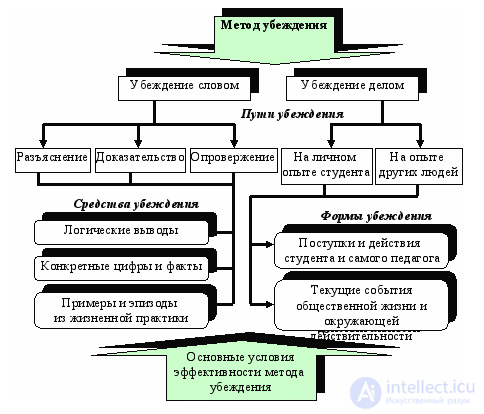
Fig. General characteristics of persuasion as a method of influence
Based on the above, the following differences can be identified among methods of upbringing:
1) cognitive methods of influence are aimed at transforming the pupil's system of knowledge;
2) emotional educational influences promote the emergence in the pupil of a particular affective state (interest, joy, calm);
3) behavioural educational influences are directed straight at a person's actions.
However, since a person's knowledge, emotions and actions are interconnected, any one of these influences affects the personality as a whole.
The child's personality development, self-esteem, and success in various areas of activity depend on the adult's proper interaction with the child. When choosing methods of influence, it is necessary to take into account the age-related characteristics of children. Thus, a child under 6 does not need everything proved to him or even shown visually. This stage can be called the stage of categorical demand. In primary school age, when visual thinking and visual memory play a large role, the example of the people around the child and literary images become very important. This is the stage of the visual image. In adolescence and senior school age, as abstract thinking develops, much needs to be proved. But things often turn out the other way round. We often spend a long time persuading a small child where we should simply require something, while categorically forbidding a teenager something where the prohibition needs to be justified so that he accepts it internally.
When choosing methods of educational influence on a child, it is also important to take into account the pupils' individual characteristics. The pupil's mental state largely determines how he perceives the teacher's influence. For example, a pupil reacts differently to reproach depending on whether he is agitated or calm. There is a rule according to which punishment should be meted out only once the child has “cooled down” from the misdeed he has committed. Otherwise, the agitation caused by the punishment simply “attaches itself” to the residual agitation left over from the misdeed, reinforcing it to some extent.
When exercising influence, a teacher must take into account the pupils'needs and motives. Depending on which motive drives the child, a particular specific type of influence may be used to affect him.
Pupils most often identify five resources of teacher influence:
1) expertise– “he knows a lot”, “he can do a lot”;
2) ability to coerce, strength– “he's strong”, “everyone is afraid of him”, “he is respected”;
3) expression of social emotions – “he's kind”, “everyone loves him”;
4) cooperation – “likes to do the same things I do”;
5) other – “pleasant appearance”, “often helps me”, etc.
There are individual differences in pupils'dominant motivesand, accordingly, in theirpreferred types of influence.
Desire to receive a reward. The child allows himself to be influenced in order to get what he wants. This type of influence is called“the power of reward”.For example, a newcomer to the class needs recognition and approval from the teacher and other pupils; to get it, he will agree with their opinion even if it does not match his own. And the greater the need for recognition, the greater the willingness to give in he will display.
Desire to avoid punishment. The child accepts an attempt at influence in order to avoid punishment. This is–“coercive power”. The child agrees with the teacher out of fear of being rejected or ignored.
The child develops negative feelings toward whoever exercises coercive power, and as soon as the threat of punishment recedes, he stops obeying. Under coercive power, just as under the power of reward, the pupil changes only his outward behaviour, while his beliefs and norms remain unchanged. This is the reason a discrepancy arises between a person's external and internal norms, i.e. double morality, an inner conflict.
Desire to be a person who is liked and admired. If a pupil regards a teacher or parent as a role model, he will accept their influence and submit to it. This type of power is called “referent power”.
Referent power is linked to the phenomena of imitation, copying, and identification. This type of power affects both a person's outward behaviour and his inner norms, attitudes, and rules; he adopts new standards and experiences negative feelings if he fails to live up to the model.
Desire to belong to a group. This striving to be a member of a group determines a person's readiness to change and to be influenced by the group's members in a direction consistent with the norms the group upholds. This is “inclusionary power”.
Desire to follow one's own values and ideals. If a pupil shares the same ideals as his parents or teachers, he will readily submit to their influence, since achieving self-identity will be a far greater incentive for him than a reward.
Sharing the same values gives rise to “legitimate power”, whereby a person acknowledges another's right to exert influence on him.
Desire to have an accurate picture of the surrounding world, of reality. If a pupil considers his parents or teachers to possess special knowledge and to be competent, then his wish to acquire that knowledge grants them “expert power”.
It should be kept in mind that once a pupil has granted someone expert power, that person's competence is extended to cover many other matters. Adults behave in exactly the same way, which is why journalists ask film stars for advice on economic questions and ask deputy prime ministers for their opinions on art.
A pupil may accept adults' influence simply because he likes what they ask of him, and carrying it out gives him pleasure. This is called“internalisation power”. In this case, the influence of parents and teachers affects both the child's outward behaviour and his norms, and it continues even after the direct influence has ended.
Sometimes a teacher's actions and demands take on a meaning for the pupil that makes them unacceptable. A persistent lack of mutual understanding arises between teacher and pupil, which has come to be known as a “meaning barrier”.
The discrepancy in meaning concerns the content of the demand: the pupil and the teacher invest different meanings in one and the same demand. For example, a child views fighting differently from an adult, seeing it as a display of courage, and therefore does not respond to demands not to fight. To overcome this barrier, one needs to know the child's attitude toward a given phenomenon and to reshape that attitude, which is not always easy.
The discrepancy in meaning does not concern the content itself, but the particular way the demand is presented: a) the demand is presented in an ironic or rude form, so that the content loses its meaning for the pupil, and only the form now carries meaning; b) the demand is presented too often and loses its motivating force; c) the demand is beyond the pupil's ability to meet. In these cases the ways in which demands are presented need to be restructured.
The third type of barrier – this is a barrier directed at a particular person. Based on the negative impression the child has formed of the teacher's attitude toward him, he perceives all of that adult's actions not on their own terms but as an expression of that attitude. The content of the demands ceases to register. Yet the pupil responds readily to similar demands from other people. The emergence of this type of barrier depends not only on external influences (negative assessment of the pupil, peremptory demands that are humiliating in form) but also on the interaction between the adult's educational influence and the child's individual characteristics. For example, when a child is credited with the motive of “not trying”, the barrier arises only when the child in fact tried very hard, and felt and was aware of this.
Consequently, pupils' reactions to various methods of influence are determined not only by the objective fairness or unfairness of the teacher's actions, but also by the pupil's own inner psychological makeup.
The problem of pedagogical assessment as applied to schooling was first worked out most fully, from a psychological standpoint, in the 1930s by B. G. Ananyev. He stressed the necessity of pedagogical assessment in school, since people's need for social evaluation cannot be ignored. B. G. Ananyev noted that pedagogical assessment is “a fact of the direct guidance of the pupil”, and that pupils' awareness of their own abilities and learning outcomes is an essential condition for their further psychological development.
According to B. G. Ananyev, pedagogical assessment performs two functions:an orienting one and a stimulating one. In its first function, the assessment serves as a specific indicator of the pupil's results and level of achievement in schoolwork. The stimulating function of pedagogical assessment is connected with motivating effects on the pupil's affective-volitional sphere. Changes in the child's affective-volitional sphere bring about significant shifts in self-esteem, level of aspiration, motivation, behaviour, and relationships with teachers and classmates.
Pedagogical assessment manifests itself in different forms and variations. Assessment can be classified by level of generality, by mode of presentation, and by evaluative effect.
By level of generality, pedagogical assessment is divided into: 1)partial, 2)fixed and 3)integral.
Partial assessment relates to a specific piece of knowledge, a skill, or a single act of behaviour, and is expressed verbally, for example: “Well done, Sasha, you gave a good account of that!”.
Fixed assessment reflects a pupil's progress during a lesson, is more generalised in character, and is usually expressed in marks. A fixed assessment expressed in marks is often called a grade.
Partial and fixed assessments serve as the basis for a pedagogical profile that characterises the pupil's personality and behaviour as a whole, and together make up an integral assessment.
By mode of presentation, B. G. Ananyev divided pedagogical assessment into: 1) direct and 2)indirect assessment.
Direct assessment is addressed straight to the pupil being assessed. In the indirect form, one pupil is assessed through the assessment of another pupil, or through an assessment given by one of his classmates. An example of the first variant: a pupil called to the board receives no assessment at all for his answer, but calling up another pupil and then giving that pupil's answer a direct positive assessment becomes, for the first pupil, evidence of his own defeat: “There, Dima, that's more like it, well done, sit down. You sit down too, Ivanov.” Systematic use of this form of assessment has a depressing effect on the pupil and leads to a change in the relationships between the partners in questioning. An example of the second variant of indirect assessment – the teacher gives the pupil no assessment but also does not object to the assessment given by his classmates (the classmates laugh at the girl who made the mistake, while the teacher stays silent and looks at the girl ironically). As in the first case, the teacher's withdrawal from assessing is essentially itself a form of negative assessment, and it leads to the child becoming neurotic and to a deterioration in her relationships with her classmates.
By mode of evaluative stimulation, B. G. Ananyev distinguished the following types of partial assessment:absence of assessment, indeterminate assessment, direct positive and negative assessments. Absence of assessment, as well asindeterminate assessments, are considered by many researchers to be the worst in terms of their psychological consequences. Such a mode of influence gives a person no bearings on the results of his activity, disorganises his behaviour, and produces a state of insecurity.
The variety of evaluative influences a teacher uses creates a rich emotional, motivational, and psychological context for the whole learning situation, not just for questioning. It is therefore important that the teacher's evaluative activity be carried out in the interests of the child's psychological development, and for that, above all, pedagogical assessment must be adequate, fair, and objective. Under an authoritarian system of teaching, assessment is often replaced by a mere grade.
Sh. A. Amonashvili drew attention specifically to the teacher's content-evaluative activity during the lesson. This activity trains the child to assess his own schoolwork by various criteria. This changes the very learning situation in the lesson: the pupil knows both what is required of him and how to achieve the desired result. Moreover, a school grade a child receives for his work is perceived and evaluated by both the teacher and the pupil himself merely as a snapshot for that particular day, rather than as a definition of all the child's academic abilities, still less as a characterisation of his personality as a whole.
The proper formation of an adequate self-assessment in the pupil depends on correct pedagogical assessment. If a teacher consistently underrates a pupil's work, the child may develop a persistent lack of self-confidence, while overrating his marks may lead the pupil to develop an inadequacy affect. Inadequacy affect – this is a stable negative emotional state that arises in connection with a failure that has occurred in some activity. In this case, the very fact of failure is ignored, or the subject does not acknowledge his responsibility for it. This psychological phenomenon arises in conditions where the pupil wishes to preserve an inflated self-assessment and an inflated level of aspiration at the cost of violating an adequate relationship to reality.
Like the entire process of learning, pedagogical assessment should be based on an optimistic strategy, evoking a sense of joy in learning and confidence in tomorrow's successes, large and small.
It is important that the system of monitoring and assessment meet the following requirements,noted by various authors in the pedagogical and psychological literature.
It is important to apply various types of monitoring, paying special attention to systematic and comprehensive monitoring;
All of the most important actions of every pupil in the learning process are monitored;
The teacher's monitoring should gradually be replaced by peer monitoring and self-monitoring, for which the method of monitoring each action should be indicated when it is being studied;
The assessment of monitoring results should be carried out combining personal and normative approaches;
It is desirable that the results of assessment be recorded openly;
Pedagogical assessment should be based on an optimistic strategy and should promote the pupil's personal development.
In their professional work, teachers often have to deal with cases of difficult pupil behaviour. When a teacher's expectations about how pupils will behave are not borne out, he experiences negative emotional states. One way of protecting himself is to use various destructive influences toward problem pupils: threats, shouting, biting remarks, criticism. Such influences undermine learning activity, worsen relationships, and have a negative effect on the personality of both the teacher himself and his pupils. The main way, therefore, for a teacher to keep his influence on pupils under control is to become aware of the emotions and feelings that arise in the course of interaction, and of their causes.
According to A. Adler – a well-known psychologist and the founder of individual psychology, behind every act of a pupil lies a need to achieve a particular goal. To understand pupils' behaviour, it is important for a teacher to know what these goals are, how the pupils interpret them, and what behaviour, in their view, will surely lead to achieving what they want.
At the root of a pupil's behaviour lie goals of four basic types: the need to attract attention, gain power, take revenge, or appear helpless.
As A. Adler explains, these goals are hierarchical. That is, pupils first do something to attract attention; if that fails, they may try to seize power, even to assert themselves and behave disobediently. If that goal is not achieved, the child will display a strong desire for revenge. Finally, if nothing else works, the child will act out helplessness and inadequacy.
The psychologist R. Dreikurs, building on A. Adler's theoretical propositions, describes models of pupils' misbehaviour and ways for teachers to exercise effective control over their influence.
Pupils, whose goal – attention, are convinced that they become part of this world only when they are noticed. They deliberately behave in such a way as to force the adult to remain constantly nearby: they talk loudly and quickly, break discipline, are lazy, ask for help, cry, and fight. All this can provoke irritation in the teacher. If such an affective reaction arises, the teacher should treat it as an informational signal that the pupil's goal is–attention.
R. Dreikurs advises ignoring a pupil's misbehaviour, when he is trying to attract attention. Teachers who openly display irritation and impatience, or who react in some way to pupils' attempts to attract attention, are simply reinforcing that behaviour. A pupil like this should therefore not be punished, scolded, soothed, advised, or warned. However, R. Dreikurs believes, the teacher does need to pay attention to this child when he is behaving normally. It is especially important for the teacher to notice pupils when they are working well or listening to the teacher. In this way the teacher rewards them for the behaviour that is desired.
Pupils, whose goal – the attainment of power, usually behave as though they feel a sense of belonging only when they refuse to do what others ask of them. Such pupils test the limits a teacher has set on what may and may not be done, behave aggressively, become stubborn, love to argue, and are disobedient. In response to these displays by children who are “hungry for power” and eager to prove their superiority over him, a teacher usually feels anger. If a teacher experiences such an affective reaction, he should treat it as an informational signal that the child's goal is –power.
Once a teacher has determined that a pupil is displaying a desire to dominate, the most important thing, R. Dreikurs advises, is neither to fight nor to give in. Confronting pupils' defiant attacks, and trying to answer a show of force with even greater force, only intensifies the sense of hostility. Instead, the teacher needs to:
acknowledge that the pupil has a right to power;
grant the pupil power when that is acceptable;
avoid power struggles;
ask pupils for help when possible;
respect pupils;
reach agreement.
Pupils, whose goal – revenge, are convinced that some person or some circumstance has done them serious harm in life. It seems to them that the only way to feel significant – is to get back at others. Vengeful pupils may try to inflict physical or emotional harm on the teacher or on other children. They may throw something at other children, damage or break objects, or make an unpleasant personal remark to the teacher. When this happens, the teacher may feel deeply hurt. He may even feela desire to pay the pupil back in kind.These feelings – an informational signal that the child's goal is–revenge.
When a teacher is responding to pupils' desire for revenge, he should observe a simple but very important rule, R. Dreikurs believes: never show that he feels hurt. Since the goal of revenge – is to hurt someone, when a teacher acknowledges or displays a feeling of being hurt, he thereby reinforces behaviour aimed at settling scores. R. Dreikurs advises teachers to act unexpectedly. Pupils bent on revenge, he explains, always know how to react to a teacher's expected responses. An unexpected reaction, however, can defuse the situation before serious problems arise. A teacher can also turn for help to one or more pupils in the class in order to win over a hostile pupil. The goal in this case – is to convince the pupil that others like him or her.
Pupils, whose goal – inadequacy (withdrawal), feel completely insignificant. They are not able to answer for themselves. Such pupils do not want to carry out difficult tasks, become discouraged quickly, ask to be left alone, and do not take part in classroom activities. They may simply stand or sit in one place with no inclination to do anything at all.
Pupils who display a sense of inadequacy are often, as R. Dreikurs notes, overly ambitious, and find it hard to keep up the level they would like to reach.
Some children who have completely lost faith in their own abilities show no desire whatsoever to do anything or to interact with the teacher in any way.
Working with such children, a teacher is likely to feel helpless, lost, and discouraged.
As R. Dreikurs says, the most important rule when dealing with inadequacy – is to encourage pupils' efforts even when they lead to a mistake. The main thing – is to make pupils feel their own worth and let them know that the teacher has not given up on them. As R. Dreikurs notes, it is especially important for the teacher to support the pupil and behave constructively.
A condition for exercising developmental pedagogical influence in the course of teaching is the teacher's emotional and personal wellbeing. The foundation of a teacher's psychological wellbeing is a positive self-concept. A teacher who perceives himself positively has greater self-confidence, greater satisfaction with his profession, and greater overall effectiveness. Such a teacher strives for self-actualisation. The behaviour of a person who fully realises his potential and enjoys psychological health is marked by spontaneity, autonomy, a creative approach, and democratic attitudes.
Summarising the personal qualities of a teacher with a positive self-concept, R. Burns identifies the following:
A teacher's positive perception of himself determines a positive perception of the people around him. For such a teacher, the inner, psychological side of things matters more than the outer; he first tries to understand another person's point of view and only then acts on the basis of that understanding; people and their reactions matter more to him than things and formal situations; he trusts people and believes them capable of solving their own life problems, and expects them to show friendliness rather than hostility; a person always represents, for him, an individual possessing dignity.
A teacher who enjoys such wellbeing shows creative individuality in exercising influence on pupils. He uses various dialogic techniques aimed at maintaining a favourable emotional atmosphere for learning, especially in situations where pupils are experiencing difficulty and tension.
L. V. Tarabakina describes the following techniques of developmental pedagogical influence:
1. Acknowledging and reinforcing the good aspects of a pupil's academic work.The teacher approvingly highlights the content in which positive changes have occurred, stressing the need to consolidate them. Typical remarks: “I liked how you managed to:
2. Acknowledging the difficulty of a learning task. The teacher reminds the pupil that others also run into the difficulties he has encountered. Typical phrases: “That's not always easy to achieve”, “Many people have trouble with:
3. Minimising the consequences of a mistake made.The teacher can provide emotional support through remarks such as: “Right now what matters is not that you made a mistake. Now you know its cause. So think about how not to repeat it in future. Try to make sure a mistake like this is the last one in your work”, and so on.
4. Encouraging an elevated form of interpersonal relations.The teacher demonstrates a positive model of interpersonal relations. Typical phrases begin with the words: “Thank you for your…curiosity, enthusiasm, wit, fairness, love of truth, punctuality, tact, openness, ability to listen, calmness, understanding”, etc.
5. Focusing on valuable qualities in cognitive activity.The teacher constantly reminds pupils of the positive aspects of cognitive activity. It is necessary to:
6. Drawing pupils' attentionto their personal experience and to systematically
recording their achievements. The pupil learns to assess and monitor the following aspects of change in personal experience:
It is especially important that a teacher's positive self-concept also promotes the development of a positive self-concept in pupils. Studies by American psychologists have shown that there is a close link between a teacher's self-concept and pupils' immediate self-perception. It has been established that pupils of teachers with a positive self-perception have more positive self-concepts than pupils of teachers with the opposite tendency. When interacting with someone who is confident in their abilities, pupils begin to display their abilities to the full and gain a sense of their own worth.
It is important to note that pedagogical influence must be ethical and constructive in nature. A teacher must respect the individuality of every pupil, take responsibility for his own actions, and use his professional skills and knowledge for the benefit of his pupils.
Thus, pedagogical influence is a key aspect of pedagogical activity, and its purpose is not only to convey knowledge but also to shape the pupil's personality, promote his development, and help him successfully integrate into society.
1. What are the distinctive features of pedagogical influence?
2. Name the main foreign theories and models of pedagogical influence.
3. What do you see as the advantages and disadvantages of directive models of pedagogical influence?
4. What are the basic principles of humanistic and democratic pedagogical influence?
5. Give examples of methods of direct and indirect pedagogical influence. Which of them, in your opinion, are the most effective? Why?
6. What are the main criteria a teacher uses to choose a method of influence in a specific situation of interaction with a pupil?
7. What are the main functions performed by pedagogical assessment?
8. Formulate the criteria for effective evaluative influences by a teacher.
9. In what way does a teacher's personality affect the character of the influence he exerts on his pupils?
10. What are the main ways of self-monitoring pedagogical influence?

Comments