
Lecture
Syntactics — is a branch of linguistics and semiotics that studies the relations between signs (see Sign) within a sign system. The main subject of syntactics is the compatibility of signs, the rules for constructing sign expressions. Syntactics is generally considered within the interdisciplinary field of the study of signs and sign systems, semiotics (see Semiotics), together with its two other branches: semantics (see Semantics) and pragmatics (see Pragmatics). The first of these studies the relations of signs among themselves (syntax), while the second studies the relations between signs and the subjects that produce and interpret them. Syntactics is the most developed discipline in the field of the study of signs and sign systems, since the systematic study of syntax began considerably earlier than that of the other directions.
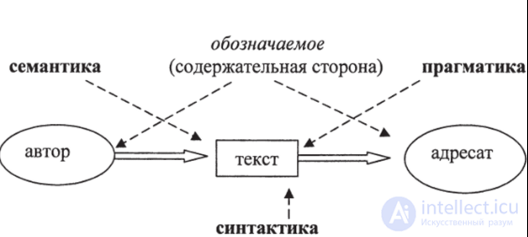
The most important subject of study for syntactics is language, which is why it forms a constituent part of linguistics (as the syntactics of natural language), logic, and mathematics (as the syntactics of formal languages).
The syntax of natural language includes a set of grammatical rules governing the construction of more complex language units from simpler ones. Originally, this task was reduced to studying the construction of sentences and phrases from words. It is precisely this construction that is traditionally called syntax. Subsequently, the subject matter of the syntactics of natural language came to be understood ever more broadly. On the one hand, it came to include the rules for combining units of language smaller than words. Thus, the study of the structure not only of sentences but also of words and morphemes — that is, the area traditionally called morphology — fell within the purview of syntactics. This fact is connected with the emergence of the generalizing term «morphosyntax». On the other hand, syntactics is also considered to have the task of constructing units of language larger than the sentence, such as text or discourse. Thus, the syntactics of natural language studies syntax in its broadest sense, as the rules — fixed within the language system — for generating various linguistic phenomena (utterances, speeches, texts, or discourses).
The syntax of formal languages includes the initial alphabet of the language, the rules for constructing sentences (or formulas) from the symbols of the alphabet, and the rules of inference. Within logical syntactics, criteria for the correctness of language expressions are developed. In particular, one of the tasks of syntactic research is to determine the criteria of correctness for sequences of formulas, such as derivations or proofs. In this sense, the syntactics of a formal language is a set of metastatements about the syntactic properties of sentences of the object language. Examples of such metastatements are: «formula F is provable in this language» or «formula F is derivable from formula G».
Within the theory of cognition and the philosophy of language, syntactics is most often developed not independently, but in connection with the tasks of semantics or pragmatics. At the same time, the very view of the syntax of language or sign systems may vary depending on the researcher's basic approach. Various schools and research directions in semiotics and in the philosophy of language place emphasis on different aspects of the existence of sign systems. One can (with a certain degree of convention) distinguish the syntactic-semantic and pragmatic approaches.
For the syntactic-semantic direction, syntax determines the ability of the sentences of a language to express facts of reality. Thus, for logical positivism (with which substantial progress in the study of the syntax of formal languages is associated), the internal structure of language must ensure two basic functions: 1) the correct writing of meaningful sentences of the language, and 2) transformations that do not change the meaning (that is, the set of semantic properties) of the sentence. The strict distinction between syntax and semantics in logical positivism correlates with the distinction between analytic and synthetic sentences. On the other hand, it is precisely the syntax of language that determines its relation to reality. This circumstance is especially clearly presented by L. Wittgenstein in the «Tractatus Logico-Philosophicus». According to his conception, a meaningful sentence of language does not merely express but depicts a real situation, since the internal (syntactic) structure of the sentence coincides with the structure of the situation. In other words, language, thanks to its syntax, is a kind of mirror of reality.
Syntax is viewed quite differently within the pragmatic direction. The first attempt at such a pragmatic interpretation of syntax was made by C. Morris, who sought a connection between the internal structure of language (as well as other sign systems) and human behavior. He regarded sign messages as stimuli that must evoke a certain reaction from the listener. The connection between signs within a message correlates, according to Morris, with the connection between reactions. «The syntactic structure of language is the interconnectedness of signs, conditioned by the interconnectedness of reactions, the result or part of which the sign means are» (Morris C. W. Foundations of the Theory of Signs. — Semiotics. — Moscow, 1983. P. 51). In Wittgenstein's later works, an approach to the syntax of language that is in many ways close to this one is developed. The rules for constructing linguistic expressions are considered there as a special case of the rules for the use of language, which, in turn, are intersubjectively established rules of behavior. In other words, syntax is determined by the nature of the language games adopted by a community. Such an approach substantially broadens the scope of syntactic rules compared both with the formal rules of logical syntax and with the syntactic norm of natural languages as described in linguistics. Real language games may permit linguistic constructions quite far removed from both the first and the second.
Another variant of the pragmatic approach to the question of the place of syntax is considered in speech act theory. Within this theory, the problematics associated with the syntactic dimension of language are discussed from the point of view of the internal structure of the speech act. The rules for constructing a speech act have a definite pragmatic function: they serve to express (and recognize) the illocutionary force of an utterance. J. Searle, developing the thesis of the intentionality of speech acts, insists, moreover, on the dependence of the internal structure of the speech act on the intentional structures of consciousness.
A special place among the various approaches to syntax is occupied by N. Chomsky's theory. This is, apparently, the only conception of language that considers syntax independently of other aspects of linguistic activity — moreover, as its foundation. According to the ideas of Chomsky and his followers, the use of language is due predominantly to the presence, in speakers of the language, of innate structures that allow them to produce correct sentences. All semantic and pragmatic aspects of language appear as derivatives of this primary linguistic capacity.
Within the study of natural languages, the following trends in the development of syntactics have emerged in recent decades:
This section examines the syntactic mechanisms that shape the artistic and aesthetic specificity of a literary text; V. Shklovsky’s concept of «defamiliarization» is analyzed and refined from the standpoint of semiotics and linguistic conceptology.
Keywords: defamiliarization, syntactics, literariness, valency, concept.
Pre-translation analysis, by definition, is not limited to an analysis of the lexical and syntactic components of the text to be translated,
but also involves determining the principle on the basis of which the text becomes a text, that is, a structure. This principle is, above all, the object of
reconstruction in translation. Pre-translation analysis of a literary text, in turn, must include procedures for identifying the generative principle that makes the text specifically literary rather than journalistic, scholarly, commercial, and so on.
By now, both literary studies and linguistics have accumulated substantial material on the phenomenon of literariness (see,
for example, [6], [9]). Most researchers working on this issue consider literariness to be an immanent feature of the semantics of a literary text. At the same time, there are authoritative theories whose proponents hold that a text possesses no internal, inherent
characteristics that would allow us to classify a text as literary or, conversely, non-literary [11]. Theories of this kind
emphasize the pragmatic aspect of the formation of literary semantics. At the same time, the phenomenon of literariness, when viewed
from a semiotic standpoint, appears, above all, to be the result of the work of the text’s syntactic mechanisms, which form special mechanisms for constructing the sign chain. It is likely that the phenomenon of literariness can be fully identified and understood only by taking into account three levels
of literary semiosis. Let us dwell on the last of these, the syntactic level.
Although V. Shklovsky’s programmatic article on device in art [10] appeared nearly a hundred years ago, and the term «defamiliarization» he introduced is now perceived as something of a terminological archaism,
the heuristic potential of this classic work of OPOYAZ has still not been fully unlocked.
This can be done by applying to the analysis of the mechanism of defamiliarization
the tools of semiotics, that «organon» of the sciences [4: 38], capable of «sanitizing» and clarifying the analytical procedures accepted within them. Undoubted assistance both in refining the propositions of Shklovsky’s article and in more precisely defining the phenomenon of literariness can also be provided by contemporary linguistic conceptology. Let us recall: according to Shklovsky, the basic «…device of art is the device of „defamiliarizing“ things and the device of the difficult form, which increases the difficulty and duration of perception, since the process of perception in art is an end in itself and must be prolonged» [10:
13]. This device of bringing «a thing out of the automatism of perception» can, in the researcher’s view, be realized in various ways. In the article under analysis,
Shklovsky shows how this device works in the writing of L. Tolstoy.
«Tolstoy’s device of defamiliarization,» the researcher writes, «consists in the fact that he does not call a thing by its name, but describes it as though seen for the first time, and
describes an event as though occurring for the first time, using in the description of a thing not the names of its parts that are conventionally accepted, but naming them as the corresponding parts are named in other things» [10: 14] (italics mine – V.M.).
Without using either the conceptual apparatus of semiotics or its terminology, Shklovsky in essence uncovers the syntactic mechanisms behind the formation of the literary. By naming the parts of a thing differently than is conventional, the writer imposes on the description of the thing a syntactics foreign to that description, recombines the order and sequence in which the sign chain unfolds, and introduces into it a logic and sequence acceptable in other chains.
Technically, this is a superimposition of syntactic structures (a syntactic
metaphor) and, on this basis, their resemanticization; in Shklovsky’s work this is examined, though not commented on semiotically, using material from Tolstoy. In
the novella «Kholstomer,» where the horse’s perception of the world serves as the defamiliarizing principle, the title character perceives the syntactic chain «my horse» (a phrase he constantly hears applied to himself: Kholstomer, like all horses, is the property of a human being) as a variant of the syntactic chains «my land,» «my air,» «my water,» and this superimposition exposes for him, and for the reader of «Kholstomer,» the absurdity of
the relations of ownership established in human society («The words ‘my horse,’ applied to me, a living horse, seemed to me just as strange
as the words ‘my land, my air, my water’» [8: 382]).
This superimposition produces the «effect of deceived expectation» (R. Jakobson), creating that very «impeded perception» which, as the main
instrument for forming literariness, Shklovsky writes of. If
we proceed from the premise that the syntactic mechanisms determining the logic of the unfolding of the sign chain include, among other things, valency – those very
«hooks» of L. Tesnière [7: 250] that ensure the normal combinability of the elements of an utterance – then, by recombining their order and sequence, the creator of a literary text breaks the possible (the «implied» – C. W. Morris [4: 42]) valency links between them. From this we can draw a first assumption: the effect of literariness is predetermined,
above all, by the weakening or destruction of valency links between the elements of the sign chain. As a tendency, the literary text is a text whose elements are «charged» with respect to other elements with zero or
even negative valency, a text that tends toward the breaking of valency links, which is essentially a tendency toward self-destruction. But the breaking of links at
the level of specific combinations of textual elements does not destroy it as a whole, above all because the wholeness of a written, that is,
formally completed text cannot be destroyed – it already exists as a sign construction realized by the author (the presumption of textuality). On the basis of
this wholeness, a recombination of the valency structure occurs at another, higher level. But this recombination will pertain no longer to the «defamiliarizing» (literary) component, but to the «synthesizing» (aesthetic) component of the literary-artistic work.
As an illustration of how these syntactic
transformations proceed, here is a small example from the early lyric poetry of B. Pasternak. Verse text is convenient for the analysis of syntactic processes because in
it, owing to the «cramped quarters of the poetic line,» the laws governing the formation of literary semantics are more evident; Pasternak’s text is convenient because the great Russian
poet, especially in his youth, made very active use of a variety of defamiliarizing devices:
Whether it's buds or sticky, melted candle-ends
That cling to the branches! April
Is kindled. The park breathes of coming manhood,
And the forest's replies have grown firm.
The forest is bound at the throat by a noose of feathered
Throats, like a buffalo by a lasso,
And it moans in nets, as in sonatas moans
The steel gladiator of the organ.
O poetry! Be a Greek sponge
With suckers, and amid the sticky greenery
I would lay you down upon the wet plank
Of a green garden bench.
Grow yourself luxuriant frills and farthingales,
Absorb the clouds and ravines,
And at night, O poetry, I shall wring you out
For the health of greedy paper [5: 31].
Pasternak's poem is a work with a dominant meta-component; it fits into the broadest tradition which, in school-level aesthetics, is customarily called «poems about the poet and poetry»: within this tradition the poet, apparently having no other interests, writes exclusively about himself and his own occupations. Pasternak the «metaphorist», in full accordance with the impeccably functioning scheme of psychological (natural)
parallelism, correlates the process of the «swelling» of the poetic principle with the «swelling» and «maturing» of the springtime principle. At the same time, the «springtime» theme is realized in the poem not only at its lexico-semantic level (swelling sticky buds, the warmth of April, the ever louder and more insistent cries of
corvids drifting from the forest), but also at the phonological level. Phonosemantically, the theme of spring is introduced by a rhythmicized repetition of consonant clusters with a final [l], imitating the sound of dripping water:
«…sticky, melted… clinging... kindled April… replies… grown firm…»,
in combination with the narrow vowel [e]. And here, against the backdrop of this soft and sticky «kindling», at the end of the first line, in its strong position, we find something that is by no means soft and sticky, but hard and dry – «candle-ends» – an element which, both at the lexico-semantic and at the phonosemantic level (candle-ends), demonstrates
a rupture with the preceding part of the syntagm (it is important that syntactically,
but not syntactically [sic], «candle-ends» form a single whole with «buds»). It is precisely here, at the junction of «sticky, melted» and «candle-ends» in the syntactic chain, that,
on the one hand, the mechanism of negative valency is realized, while, on the other, the principle of the presumption of textuality begins to work, which re-
semanticizes the «a-valent» elements of the text and once again endows them with valency – but now at a different, aesthetic level of the work.
It is interesting that in the best of the existing English translations
of this poem by B. Pasternak (the author – A. Kline, a translator of Ovid,
Goethe, and others) the syntactic «fracture» we have noted is smoothed over both by the explicating translation and syntactically («candle-ends», which in Pasternak are not un-
ambiguously «the ends of a candle», acquire, in the translation, the status of homogeneous members in relation to «buds», and are moreover separated from them by a comma –
and the comma removes the conflict of valencies of the elements of the syntactic chain):
How many sticky buds, candle ends sprout from the branches! [12]
And, since the translator softened the effect of negative valency,
the mechanism of «defamiliarization» was realized not as fully as in the original text, and, consequently, the artistic potential of the original text was not fully disclosed.
The presumption of textuality (the initial assumption, based on a tacit agreement between reader and writer, of the wholeness and completeness of the text, within the framework of which structural connections and relations are necessarily realized) ensures the formation of new syntactic connections, which will
correlate elements of a different level, subordinate to different vectors of organization – not directly horizontal, but, so to speak, associatively-
vertical.
In B. Pasternak's poem, the «candle-ends», characterized by negative valency with respect to the «sticky, melted» buds, establish new relations (including by means of a phonosemantic connection: candle-ends – throat… throats… gladiator… organ…)
with the «Greek sponge with suckers», i.e. with poetry, which is quite logical: the association of poetry with the flame of a candle, with flame in general – is one of the commonplaces accompanying the figure of the poet and the phenomenon of poetry.
True, Pasternak's candle burned down and went out long ago, but this nuance is material rather for the history of literature
than for semiotics and the theory of language. Here, at this new syntactic level, it is no longer the artistic but the aesthetic principle of the text that is formed –
a certain semantic configuration within which the semantics of the mutual interpenetration of everything dominates, the idea of the natural essence of poetry and the poetic essence of nature, the image of the universe (and even of the «absolute») – and still
many, many other things, about which one can read in specific studies of poetic creativity, and, moreover, not only the creativity of B. L. Pasternak.
For us, however, what matters is not the semantics of this configuration, but its underlying logic, the essence
of which, apparently, comes down to the fact that the artistic principle, based
on mechanisms of negative valency, breaks the direct syntactic connections of the elements of the sign chain and establishes new connections,
forming the aesthetic configuration of the work, its «architectonics» [1: 36-43]. The artistic thus turns out to be an operator of the aesthetic, and the aesthetic – a function of the artistic.
Let us note a second important point in the work of V. Shklovsky, relating
no longer to the mechanisms of the generation of the artistic, but to the results of their work. «The purpose of art, – the researcher writes, – is to give the sensation of the thing as vision, and not as recognition» [10: 13]. The «vision» of a thing that V. Shklovsky speaks of is not necessarily connected with the visualization of the object described. As much as one would like to relate etymologically the words «artistry» and
«artist» (it is precisely the latter who visualizes the image) – everything is far more complex.
But what the researcher says about the importance of the visual, concretely-
sensory component of the «thing» generated in the text by the device of defamiliarization,
is obvious. «First of all, attention is drawn to the concretely-sensory,
individually-objective form of the reflection of objective reality in
the A.i. (artistic image – V.M.)» [2: 149], – this notion of the artistic image has long since made its way into dictionaries and encyclopedias.
The term «image» – is not the most popular one in traditional linguistics with
its predominant attention to the «bodies» of signs and texts. But this term
correlates quite well with the conceptual-terminological apparatus of more modern branches of linguistics, addressing the problems of the consciousness of the linguistic
personality. The image as a cognitive phenomenon, on the one hand, realized
(«objectified») in the «body of the text» and, on the other hand, re-created («de-objectified») in the process of the latter's reception, correlates most closely with
the main object of linguo-conceptology, the concept.
If one proceeds from the notion, established in scholarship, of the three-level structure of the concept (image-based, notional and value-based), then in the artistic concept it is above all the first level that is realized. And this is
quite explicable if one proceeds from V. Shklovsky's theory of «defamiliarization» and
the modern theory of the concept. Thus, V. I. Karasik, describing the dynamic
three-level structure of the concept, holds: «The image-based component of a cultural concept correlates with the perceptual and cognitive sides of the con-
of the concept as a psycholinguistic phenomenon, while the conceptual component
represents an exit into the linguistic embodiment of the phenomenon under consideration» [3: 136]. From this a conclusion inevitably follows: if the «linguistic embodi-
ment» of a concept is subjected to the destructive effect of «estranging»
speech strategies aimed at its conceptual, logical-discursive
component, then the compensatory strategies leading to the preservation, in full, of the artistic information are realized precisely at the level of special mental representations – images, pictures, schemas, etc. [3: 133].
It is precisely through these representations that the writer leads us to the image of the «thing» – the thing as «vision», rather than as «recognition» (10: 13).
For the translator these considerations are important for the simple reason that
the object of translation (especially literary translation) is not words and syntactic structures, but rather the principle on the basis of which words and syntac-
tic structures are «arranged» into a text in this particular way and not another. Uncovering
the very principle of the existence of a literary text necessarily leads us to the need to analyze the mechanisms of its «self-destruction», i.e. –
the mechanisms of artistic syntactics.
In connection with the problems of syntactics, as they are represented in musicology, a paradoxical situation has likewise developed. Syntactic relations were constantly located within the sphere of the semiotic approach to musical art, but all efforts were directed toward the search for a significant unit (sign), that is, toward semantics, and the problems of syntactics proper were resolved depending on, and on the basis of, the results that the search for this notorious unit did (or did not) yield. "The greatest difficulties are caused by the very definition of the sign and its isolation. In this connection, one of the main questions is the segmentation of the musical text and, accordingly, the problem of musical context," states A. Milka /Milka 1987, 196-197/. 1 It was precisely semantics that turned out to be at the center of attention even in cases when attempts were made to solve other semiotic problems. As U. Eco wrote, "semantics is a field marked by the fact that its existence has been alternately denied, and, on the contrary, there has been an evident tendency to reduce all semiotic research to it" /Eco 1972, 379/. Therefore, there is nothing strange in the fact that the negative results of the search for a "linguistic" unit paralyzed efforts in other directions as well – in particular, in syntactics.
Where the productivity of these efforts turned out to be indisputable, the results were achieved, in essence, along the paths of traditional musicology, only "spiced up" with new terminology. Hence arose categorical judgments denying the possibilities of semiotics: "There cannot be a semiotics of music, because musical structures are not capable of fixing musical semantics," believes A. Clark /Clark, 199/; "...semiotics, exact methods, structuralism ... have not yet had a noticeable influence on musicology," echoes V. Devutsky /Devutsky, 90/. 2
The situation is paradoxical because, first, the role of syntactics is in fact quite significant as a powerful factor, without which it would be difficult to imagine a full-fledged perception of the semantics of the sub-sign layer of musical speech; 3 second, syntactics as one of the dimensions of semiotics also has its own object of research, independent of the semantics of the sub-sign layer; and, finally, third, as an independent factor of musical speech, syntactics is connected with a specific meaning peculiar to it alone, which contributes its own share to the meaning of the work as a whole. 4 As with semantics, here too there is a case of analytical practice outpacing its theoretical comprehension, and this circumstance will provide substantial help in the further discussion.
Once again it is necessary to return for a while to the general aesthetic perspective of these problems, for musical speech possesses parameters shared with other kinds of artistic speech, which is precisely what makes possible a unified semiotic approach to all its varieties.
Above all, one must clarify: what can be expected from syntactics, what questions connected with the literary text should it answer? Insofar as syntactics is that level of semiotics devoted to the study of relations of signs (sub-signs) among themselves, "independent of their relation to objects or interpreters" /Morris, 48/, the sequence of studies in this area of semiotics can be represented as follows:
establishing invariants in the internal structure of signs (sub-signs);
identifying the elements of this internal structure and the invariant relations between them;
identifying invariant structures of a higher order and the invariant connections between them, etc. 5
Such is the most general approach, encompassing the most diverse semiotic objects. These principles are preserved also in application to artistic speech: "By discovering invariants in many works of a given art form, one may regard them as signs (or as elements from which signs are built) of the language of that art form. Descriptions of such invariants are an indispensable prerequisite for its in-depth study. Following this arises the task of discovering and describing the invariant connections and dependencies between them, invariant complex structures,... invariant connections and dependencies of these complex structures," writes S. Rappoport /Rappoport 1973, 18/. 6 All of this (with the exception of the references to the "language of an art form") raises no doubts and fully corresponds to the general semiotic conception of syntactics /T. 5.2.3.1.-5.2.3.5./.
Wherein, then, lies the stumbling block on the path to the correct application of this method in music (and in artistic speech in general)? The whole point is that one of the fundamental principles of syntactics, formulated as far back as C. Morris, was violated – the independence of syntactic relations from the relations of signs to the objects (representations) standing behind them and to their interpreters, that is, the independence of the syntactics of semiotic objects from their semantics and pragmatics. This independence acquires special significance when signs are studied from the point of view of their internal structure (i.e., when the connection between the signified/signifier within the element of a sign – a sub-sign – is to a considerable extent optional). Explicitly or implicitly, in defining the "characters" of syntactic relations, researchers were guided by the following definition of the tasks of structural analysis: "the search for the overall meaning of a work through the identification of discrete significant elements, the discovery of connections between them, and the determination of the nature of these connections – that is, through the discovery of particular (intermediate) meanings" /Maksimov 1980a, 82/.
Meanwhile, the "characters" of syntactics can (and must) be by no means the same objects that are studied by semantics and pragmatics, especially when what is being studied is not a collection (system) of signs, but the internal structure of a single integral sign. 7 This axiom has found brilliant confirmation both at the microlevel (in phonology and grammar) 8, and at the level of structural research into integral artistic signs.
The pioneer in this field turned out to be the outstanding Russian scholar – philologist and folklorist – V.Ya. Propp. He carried out the first structural description of a group of texts of the same type – complete literary texts (Russian fairy tales) – anticipating by many decades the flourishing of structuralism and serving as a kind of benchmark for subsequent research. 9 The scholar abandoned the traditional description of fairy tales by plot type (the signified), but instead singled out invariants – "constructive (stable) elements of the tale, leaving aside the non-constructive (variable) elements" /Propp 1983, 577/. Among the former he included the functions and roles of the characters, while among the latter fell the plot and many other factors, including verbal form. 10
Thus, the object of analysis became a layer of whole, typologically homogeneous literary texts/signs. The object of analysis was not words (sub-signs) but invariant factors and the connections between them. This method was widely used later as well, but, as Propp himself believed, it "has its limits of applicability." It is most appropriate in cases where "there is repeatability on a large scale. This we find in language, we find in folklore" /ibid., 583/; and as R. Jakobson likewise said, "such strict laws are, however, inapplicable to tales belonging to the pen of individual authors – such as the tales of Andersen or Hoffmann" /Jakobson 1985, 391/. 11 Nevertheless, attempts at structuralist analysis of individual, authored works of verbal creativity were made; however, they brought nothing but disappointment with the method. 12
The application of this method to music encountered particular difficulties. Attempts to study music on a structuralist basis, without a critical analysis of the method itself or a search for adequate objects of study, met with active resistance from the musical material itself and naturally led to the following conclusion: "In folk music-making, the meaning of musical signs is self-evident and stable, since it rests, on the one hand, on the everyday life, rites, and rituals in which the music participates, and, on the other, on an awareness within which lives the principle of the universal correlation of heterogeneous realities (including both sonic and non-sonic ones). In the individualized compositional language of recent times, the meaning of musical signs is unique... In professional traditionalism, on the other hand, a constantly maintained orientation toward a model introduces into the musical fabric, even a highly individualized one, a layer of signs whose "reading" has already been established by tradition" /Cherednichenko 1988, 137/.
Of course, one can and should take issue with this conclusion: there is the incorrect use of the term sign, and an exaggerated notion of the uniqueness of contemporary music (complete uniqueness would entail semantic "muteness"), and, on the other hand, an underestimation of the uniqueness of professional traditional music (music is unthinkable not only without KhD but also without overcoming it). Moreover, as an analysis of the degree of "primacy" of folklore genres has shown, not all of them are equally close to extra-musical origins. But the tendency toward different levels of typification – maximal in folklore and tending toward its minimization in professional creative work – is correctly identified. Hence the difficulties that the structuralist method encounters.
Musicology (and not only musicology) faces the questions: "Why ... do attempts to adapt the techniques of semiotic analysis to the study of specific works fail to yield substantial results? Why does the semiotic analysis of the artistic unity of a work often prove helpless precisely where traditional methods of musicological research have achieved great success?" /Berezovchuk, 13/. The author, it seems, does not expect answers that would change the situation and is rather inclined, on the grounds of the absence in music of "the basic ... principle of semiotics – the correspondence of signifier to signified" /ibid., 14/, so to speak, to "deny" this science "a home in music."
But as regards semantics, an answer has already been given: it is enough to remove the problem of the sign and of language in music, that is, to recognize the sole aesthetic reality – musical speech as mediated by sub-signs/events, and the question of musical semantics is resolved naturally, without violence to the musical material, and moreover demonstrating principles common to all forms of artistic speech. The problems of musical syntactics are resolved just as naturally, given an adequate approach. Its essence consists in the following.
Proceeding from the tasks facing syntactics, and relying on the fact that every musical work is a single, integral sign, it is necessary to identify such groups of musical works in which one could discover: invariant elements, invariant connections between them, invariant combinations of these elements and invariant connections of these combinations, and finally, the invariant structure of entire groups of musical texts/signs. And if one approaches the solution of this problem without bias, that is, discarding the accumulated layers associated with the structuralist analysis of verbal texts, it becomes clear that structural-semiotic analysis of musical works and the analysis of musical structures, one of the traditional disciplines of musicology, are one and the same thing. 13 Nevertheless, musicology, like Molière’s Monsieur Jourdain, did not realize that it had long been speaking the language of structural semiotic analysis.
From the very first steps of the analysis of musical structures, when it was still to some degree an analogue of, or a counterpart to, musical rhetoric, and subsequently – over the course of more than two centuries 14 – musicologists were engaged in pure structuralism and spoke semiotic "prose." 15 For it was precisely within the framework of this discipline that invariant (typical) elements were discovered – motifs, phrases, sentences, types of connections between them (conjunction, juxtaposition), invariant constructions and their connections, structures – complex and simple, their internal and external typical connections and so on. Moreover, literary studies can only dream of such a developed science as has taken shape in this sense in musicology 16: "Such a science could exist not as a science of contents..., but only as a science of the conditions of the existence of content, in other words, as a science of forms; what will interest it are the semantic variations that a work generates and ... is capable of generating...; in a word, its object will be not the fullness of meanings but, on the contrary, that full meaning which serves as their support" /Barthes 1987b, 374/.
As is evident, the science that R. Barthes dreams of has long been established in music as one of its most important and actively developing scholarly disciplines. E. Ansermet once observed that European music is short-sighted and passed through its history without self-reflection, without realizing what, in fact, it had accomplished /Zoltai, 127/. Apparently, these words can also be applied to musicology, which, having now realized "what it has accomplished," is, following T. Todorov’s thought, in a position to teach a great deal to both the semiotics of literature and the semiotics of painting or architecture.
In substantiating the need for a "rigorous, scientifically grounded theory" of musical art, E. A. Ruchyevskaya holds that music needs one owing to the non-verbal, non-conceptual nature of "the basic level of the elements of the structure of musical content" (i.e., the sub-sign layer of musical speech). It is precisely for this reason, in her view, that "neither literature nor painting needed a theoretical basis to the degree that professional music did. In no other field has such a quantity of mathematical theories arisen. This reflects the law of compensation, the law of complementarity, which ultimately equalizes holistic, spontaneous, sensory cognition with analytical, dissecting, intellectual cognition" /Ruchyevskaya 1987, 87-88/. One cannot but agree that between the existence of a considerably more developed theory of musical art (compared to the theory of painting and literature) and the specific nature of the semantics of the sub-sign layer of musical speech there is, without doubt, a connection. However, E.A. Ruchyevskaya's judgment about the nature of this connection appears far from indisputable.
First, it is unclear how theoretical cognition could compensate for (supplement) spontaneous perception: after all, these two spheres lie on different planes of mental activity. Theoretical cognition is the province of a comparatively small circle of professionals, whereas spontaneous perception encompasses everyone who enters into psychological contact with a musical work, everyone who is in principle capable of joining the continual thought carried by music.
But that is not the main point. The specificity of the sub-sign layer, the particular difficulty of perceiving its semantics, is the result not only of a special type of mediation of its connections with the extra-musical world, but also of the fluidity of musical events, their constant succession, the impossibility of "stopping" this or that musical "instant." This is the fundamental circumstance that has given rise to the special structure of musical speech, its special syntactics. And the latter, owing to its striking organization, its near-mathematical precision in the proportions and relations of structural elements, brings into being an equally rigorous theory, close to the mathematical, capable of describing and comprehending these structures and their organization.
Thus semantic "inarticulateness" is compensated for not by theoretical intellectualism, but by the indisputable manifestations of intellectual activity within the musical fabric itself, in its syntactics, and with a clarity and distinctness for which no analogue is found either in verbal artistic speech or in the visual arts, but which are comparable to the principles of organization of artistic fabric only in ornament and, in particular, in architecture.
Meanwhile, the fundamental regularity underlying musical syntactics is, in essence, common to all varieties of artistic speech. It was formulated by R. Jakobson as the law of the projection of the principle of equivalence from the axis of selection to the axis of combination. The point is that in the process of forming an artistic text, it is far from all elements that turn out to be equivalent (i.e., possessing potentially equal rights to enter that text), elements that, on the basis of their pre-textual meaning, could be selected for entry into a given sentence, a given drawing, a poetic or musical line, but only those among them that correspond to the norms of combinability born within that text (drawing, line). For example, a word that falls at the end of a line of verse cannot simply be chosen from a series of synonyms suited by the meaning contained in the word itself, but must correspond to the poetic rhythm, must rhyme with a corresponding other word, must enter into a particular sound series, and so on. "Equivalence becomes the constitutive factor of the sequence," writes R. Jakobson /Jakobson 1975, 304/. 17
In the form of verbal creation closest to music - in poetry - this principle is realized on the basis of a diverse and ramified system of contact and distant repetitions (parallelisms), variations, and echoes. 18 Repetition, formed by the broadest spectrum of devices, constitutes the basis of rhythm /Volkova E., 79/ and is present in art everywhere in one form or another, but it has yet another function: to single out, to intensify this or that semantic element; "repetition... a means of increasing importance" /Torsuyeva, 38/. Both as a source of meter-rhythm and from the point of view of its role for semantics, repetition determines the very essence of syntactic processes in music. It is precisely repetition that ensures the possibility of "fixing in memory" the events of musical speech - the "artistic matter" of music, marked by "subtlety and ephemerality" /Sokolov 1974a, 57/; repeatability underlies "the creation of any musical construction" /Ordzhonikidze 1960, 290/; and it is repeatability, too, that ensures "comprehensibility as a property of structure" in any music - from the ancient to the newest /Kholopova-Kholopov, 140-141/. The role of repetition in music is all the more significant in that, contrary to the assertions of literary scholars, there is in fact no "tautologically musical parallelism" /Shklovsky, 37/ 19: "even if the performer introduces no new nuances, the perception of a repeated fragment will differ qualitatively from the initial one, will bear the character of a confirmation of suggestion rather than of a first impulse, that is, will have a different artistic meaning" /Sokolov 1974b, 156/. 20 V.V. Medushevsky describes the role of repetition in music even more fully, touching on almost every aspect connected with this factor: assistance in orientation, anticipation and memorization, the suggestion of the composer's artistic ideas thanks to the semantics carried by the repeated sections /Medushevsky 1976a, 135/. This last factor is described in detail by J. Wierszyłowski, according to whose words repetitions even contribute to the acquisition of meaning: "A new musical theme that seems unmelodic and loose on first hearing begins to acquire the features of a melody when one listens to it many times. As a result the theme is perceived as a melody, although no changes whatsoever have occurred in its structure. And yet the listener discovers in it features of variety and coherence and hears it as a melody" /Wierszylowski 1966, 21-22/. Thus, thanks to repetitions, there arises the effect of an awakening of the continual and, correspondingly, of joining artistic thought /Ch. 4.7.5.0.2.-4.7.5.0.3./.
Repetitions and the structure of a musical work regulated by them constitute a kind of stage direction that presents the semantics of the sub-sign layer from the most advantageous and convenient angle for perception. It was in just this way, as "a school of directorial command of the listener's attention," that Asafyev described the scores of Haydn's symphonies and quartets, emphasizing that "a sensitive skill" in meeting the listener halfway "was possessed by almost all the classics, which is precisely why they became classics, knowing how to help themselves be heard" /Asafyev 2, 69/. 21 Along this path more or less stable manifestations of communicative syntax arise /Medushevsky 1976a, 115/, and if "from a historical point of view there is no construction not justified by content, then from an aesthetic point of view there is no form not tested by mass auditory experience, for otherwise why would it exist at all?!" /Asafyev 2, 65/. 22
Among the principal properties of a musical work that dictate the choice of one structure or another, its scale stands out above all. 23 Speaking of the meaning-clarifying logic of musical form, V.A. Zuckerman emphasizes that this role of it is most important for works of "large scale," which require "considerable strain for their perception" /Zuckerman 1971b, 8/. However, as has been shown earlier /Ch. 5.2.5.1.3.-5.2.5.1.4./, scale is merely an external criterion of the "energetic saturation" /Mukha, 187/ of musical material, which is most palpably manifested in the density of the musical fabric: there exist works of modest scale marked nonetheless by an exceptional concentration of events (for example, the music of Mozart, Bach, Webern). And it is no accident that it is precisely for such works that "repetition is one of the key concepts" /Kholopova-Kholopov, 141/.
However, repetition is only one of the "directorial" devices to which syntactics resorts. The syntactic properties of the material that leave so firm an imprint on its "physiognomy" that they become perceptible to the ear even outside of context acquire considerable importance: these are the type of the material (background, relief), the manner of its existence (exposition, development), its functions in form-building (i.e. its capacity to be foundational, preparatory, or concluding). 24 In the process of sounding, a "disembodiment of the material" takes place /Vygotsky 1968, 9/, not only of the semantics of its sub-sign layer, but also of the syntactic potentials "imprinted" into it. 25
The interrelations of properties of a single level within the framework of a unified, integral work are determined by their conjugation and juxtaposition, on the basis of which, within the framework of large forms, the form-building principles of identity, contrast and dynamic conjugation operate /Ruchyevskaya 1981, 123-124/. Most researchers, following Asafiev, prefer to use the opposition "identity-contrast", 26 although it does not reveal all the possible interrelations of material. After all, identity is, in essence, similarity, presupposing material that is uniform in its basic parameters. Therefore, for characterizing the interrelations of different material, only contrast remains – a particular case of juxtaposition. But in reality, even dissimilar material can enter into relations marked by both juxtaposition and conjugation. And therefore only an analysis of the interaction of conjugation and its antipode – juxtaposition – is capable of characterizing the whole enormous range of relations of material existing in music, which ensures the organization of broad-breathed structures. 27
Conjugation (preservation of connection) – in all its numerous varieties, is unconditionally the leading principle, for it is precisely this that provides artistic speech with unity, wholeness, cohesion – those properties without which the very concept of artistry cannot exist. Conjugation is most closely connected with continuity and is the bearer of the creative principle. 28 Juxtaposition (fixed difference) – is the most important factor of renewal, of refreshing attention, but requires caution, for repeated juxtapositions are capable of producing the opposite effect as well: "Contrast is a moment of variety, but it scatters the attention," wrote Stravinsky /Stravinsky 1988, 28/. This property of juxtaposition (it was precisely this that Stravinsky was writing about) compels composers, as a rule, to compensate juxtaposition with a more or less prolonged conjugation. 29
Syntactics, understood as the organization of the musical fabric, is not only a necessary condition for the perception of the semantics of the sub-sign layer, but also the bearer of a meaning peculiar to it alone, 30 one so specific that its detection and description require particular effort (although its direct perception is ensured by all means of expression). It is true that V.V. Medushevsky considers that these meanings, "taken by themselves ... possess negligible informativeness" /Medushevsky 1979b, 205/, while I. Belenkova, referring to A. Sokhor, believes altogether that the "cause-and-effect relations existing in the object" (i.e. in the sub-sign) are, in this case, replaced by an "artificial dependency" created according to the rules of musical logic /Belenkova, 79/.
However, syntactics is also connected with the extra-musical world, though not the real world of objects ("things") and energies, but with the ideal world of human thought, that is, with the process of thinking as the interaction of logic and the free flow of thought. The principal stratum of instrumental music of the European tradition gravitates toward the first of these poles, achieving in the work of Bach, Haydn, Mozart, Beethoven and a number of other great masters examples of the highest logical level of the development of thought – from the initial impulse all the way to the integral composition, where rigid determinacy even of the smallest details is combined with the ease and naturalness of the flow of the process of music-making. This combination largely accounts for the profound meaning embedded in typical structures (musical forms), which, while constantly being renewed, nonetheless retain their potential to this day. 31
The long life of these structures gave rise to the notion of structural rigor as an inherent property of the art of music; manifestations of this property often testify to the influence of music (sometimes quite unconsciously) on other kinds of artistic creation, extending even to the discovery of traits of the same typical structures (ternary, rondo, sonata, variations) in poetic and prose literary texts or in paintings. 32 The manifestation of a greater number of structural regularities made it possible to hold that "poetic thought is more akin ... than prosaic thought to the musicality of sound form" /Potebnya, 364/.
However, as has already been said, according to this criterion architecture stands closest to music: structural clarity, the hierarchical nature of the relations among elements, the palpable influence of repetition and symmetry on the appearance of the whole – qualities just as inherent to this art form as they are to music. The comparison of music and architecture already has its own history, which goes back to the beginning of the 19th century and is associated with the names of Schelling, Schlegel, Hegel, Goethe and other major German thinkers /Mikhailov Al. 1981, 44-47, 400 et al./. 33
The comparison of these two kinds of creative activity also concerned another property common to them: semantic mediation, the absence of direct and immediate links in them with the real world. It is characteristic that the strengthening of structural rigor in adjacent art forms, proceeding from music, even in those art forms where this connection is more evident, as a rule intensifies the "blurring" of the semantics of the sub-sign layer: "The musical intonation of verse conveys music's non-concreteness to the word, "de-objectifies" it, creating around it a "cloud of meaning"" /Ilyin, 140/; "The more rigidly the order of the text's segments is set, the freer the semantic reference of the elements of the musical text to extra-musical representations... ...the more rigidly one of the ... systems is organized, the freer, within the given structure, is the construction of the other" /Lotman 1970, 63/. In this, too, one can discern the operation of the law of the transfer of the principle of equivalence from the axis of selection to the axis of combination: where combination dominates to a degree close to the limiting one, the possibilities of selection likewise turn out to be extremely limited, and therefore it is often carried out at the expense of a weakening of the semantic clarity of the elements making up the artistic fabric. 34
Equally characteristic is the reverse process – the influence that "object-related" art forms exert on music: by strengthening the concreteness of the semantics of the sub-sign layer, this influence leads to a weakening of structural rigor, and sometimes even to the abandonment of typical structures. This is most palpable in vocal genres and, in particular, in the most large-scale of them – opera. "Opera cannot be integral, as drama or instrumental music can," believed E. Hanslick /Hanslick 1982b, 323/. It is perhaps this circumstance that explains the difficult road to the winning of recognition in music of mixed genres (beginning with Beethoven's Ninth
продолжение следует...
Часть 1 The Concept of Syntactics. The Syntactics of the Literary Text and the Problems of Syntactics
Часть 2 5.3.0. - The Concept of Syntactics. The Syntactics of the

Comments